
See your price
Application

Painting a fence? Choose the right scaffold.

Painting a fence with opaque paint is not high work, but it is long work. Two or three coats over both faces means covering the same metres several times, always with a tin and a roller occupied. Height barely comes into it: the lowest build of the MiTower already arrives at 4.2 metres, which puts you well above an ordinary garden boundary. What you actually need is a floor that stands firm and travels with you, and that alone is the reason people hire a mobile scaffold for a job barely off the ground.

  • Order before 3 pm, delivered tomorrow
  • Professional Altrex scaffolds
  • Up to 14.2 metres working height
  • Easy to assemble yourself
4,2 tot 14,2 mWorking heights available
12Provinces served
7Days a week
200 kg/m²Load class 3
In short
  • For painting a fence we recommend the 1-person scaffold.
  • For painting a fence the lowest build of the hired MiTower is enough, since that setting already reaches 4.2 metres.
  • Opaque paint wants several coats across two faces, so the same long run of metres gets covered again and again.
  • A ladder is ruled out because it loads the posts sideways, whereas a hired tower stands entirely clear of the boards.
  • First 24 hours from €100 incl. VAT and delivery; every day after that 95% off.
Key facts for this job
FeatureValue
Recommended scaffold1-person scaffold (Altrex Mi Tower)
Working height for this job4.2 to 4.2 metres
Available working heights4.2 to 14.2 metres
StandardEN 1004, load class 3 (200 kg per m²)
DeliveryOrdered before 3 pm, delivered next working day
Each extra day95% off, from €5 a day
Why a mobile scaffold for painting a fence?

Safe, stable and professional work at height

A boundary is not about reach, it is about purchase. A ladder wants something to rest against, and here that something is a row of boards on posts designed to take load in one direction only. Lean on it and the top gets pushed away, leaving the whole line out of true. Working from the ground is fine to shoulder level, after which you stretch and it shows in the finish. A tower on castors solves both problems: it stands on its own feet, touches nothing, and gives you somewhere for the tin, the roller and the brush. One shove takes you along to the next bay, and the entire run then gets treated from one and the same height rather than in awkward stages.

  • Fence posts must never be given a sideways load
  • Two faces, several coats and a great many metres
  • The tin and the roller need somewhere to stand
  • Working at one steady height keeps the film even
Read more about working safely →

Which scaffold to hire for painting a fence in coats

The Altrex MiTower is the obvious model here: 75 cm wide, built around one user and light in the hand. You push it along the boundary entirely by yourself, it passes through a garden gate without trouble, and no second person has to be rounded up to help you move it. That fits paintwork, where you stand alone with a roller for most of a day anyway. Specifications sit on the page for the MiTower in our hire range, including its transport weight.

A 135 cm rolling tower would only get in the way out here. The stabilisers reach into the border, turning between two hedges is impossible, and shifting it at every bay eats more time than the coat itself. Deck area is not what this job needs, since painting a fence calls for a tin, a roller and a brush for the edges. More deck area simply means more components to raise at the start and more weight to drag through the garden at every bay.
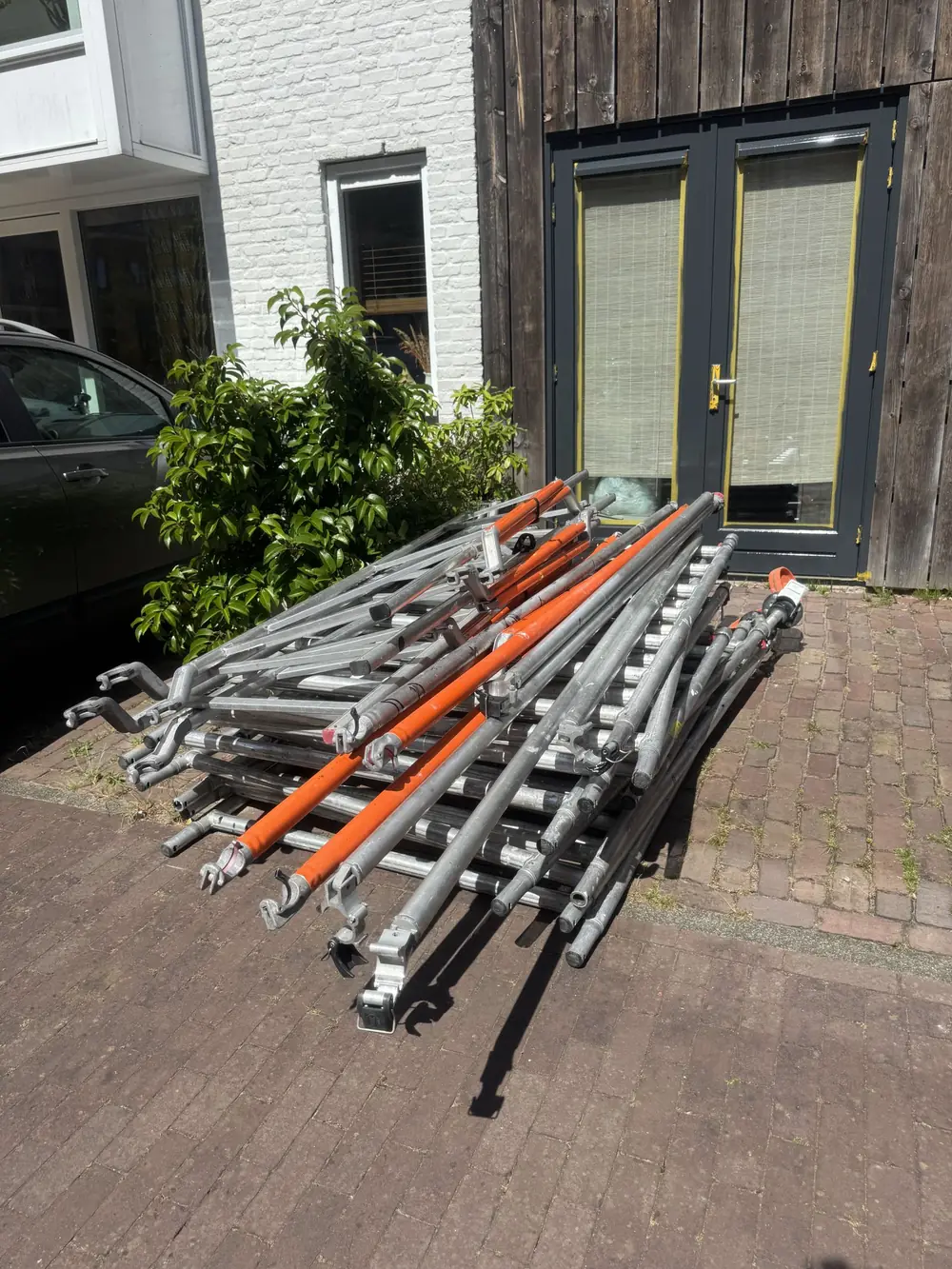
Loose tubes, braces and platforms of a hire set stacked outside a house, ready to be carried through and built up

Do check the MiTower will actually reach your back garden. A gate leaf of eighty centimetres, a narrow passage down the side of the house or a flight of steps up to a raised terrace are where it comes unstuck. Faced with one of those, carry the components round loose and build at the back instead. It is worth pacing that route out before the hire dates are chosen, because painting a fence begins with getting the tower to it at all.
Why hiring the lowest build of 4.2 metres suffices

A standard boundary comes to two metres, and with trellis on top perhaps two and a half. None of that calls for an impressive structure or a tall one. The smallest setting of this model reaches 4.2 metres, which is more than adequate, even where the run meets a shed wall you intend to include. Those two metres in the sum are the arm's length that still lets you reach a top edge in comfort, and adding them to your platform height gives the working height.

In practice you paint from the lowest deck position, somewhere around knee or hip level, and the structure serves chiefly as a steady plateau. That is precisely why a boundary demands so little height: what matters is the angle of your body to the board, not the distance to the ground. The page covering a build of four metres shows what such a setting looks like once assembled, and it is the setting most people hire for garden timber.

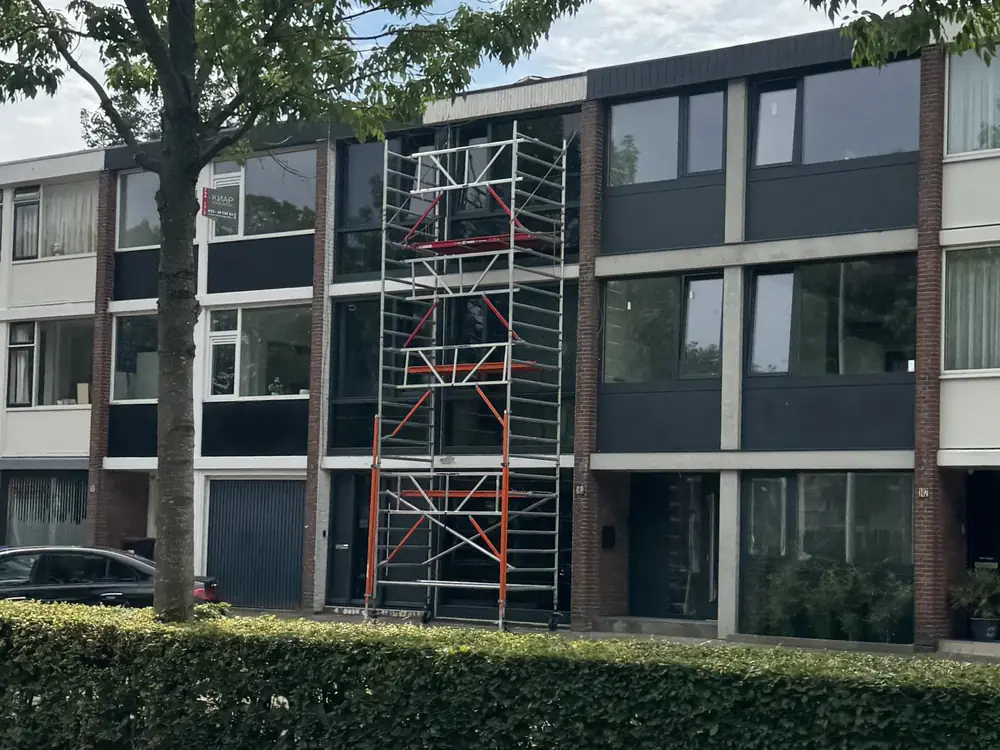
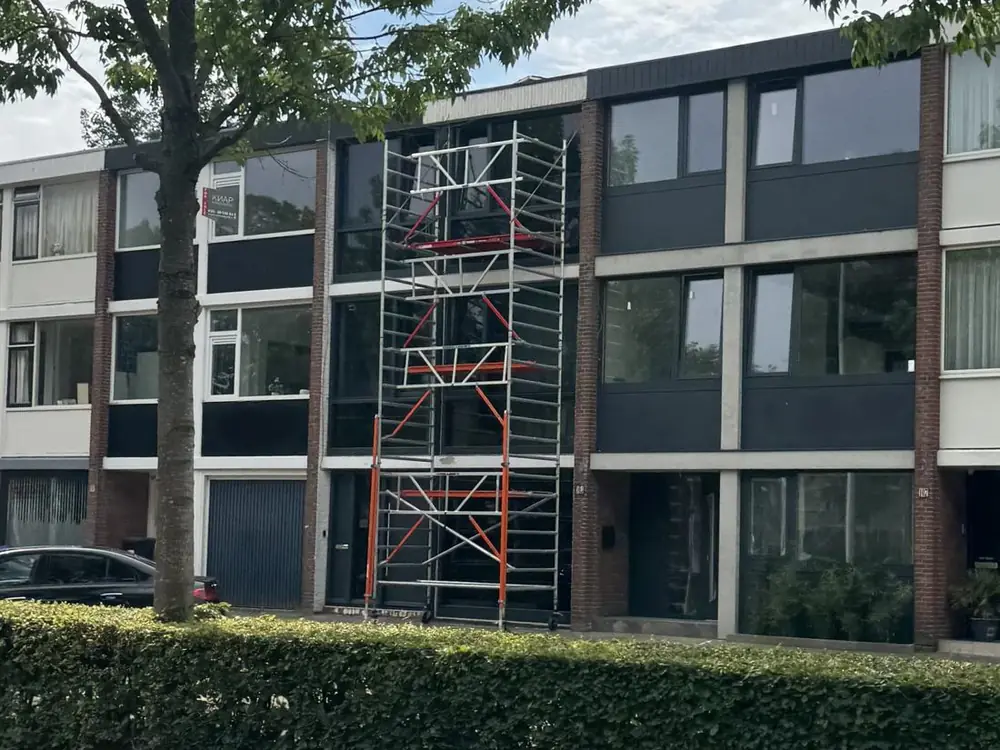
Mobile tower standing at the front of a dwelling, reaching far higher than the low build hired for a garden boundary

Measure anyway. If the boundary sits on a low wall, if the neighbouring plot lies lower, or if the garden falls away towards a ditch, your starting point moves and one side needs more reach than the other. This model will go up to 6.2 metres if pressed, so height is never the constraint. Building higher than you need only adds time at the assembly stage and gives nothing back while painting a fence, so take the measurement and then stop worrying about height altogether.

Hiring a tower: where it stands beside the fence

In a garden the ground is where things go wrong. Grass yields the moment it is wet, topsoil even faster, and shell or gravel lets the castors sink straight in. Lay a few sound boards or paving slabs under the wheels, or else simply keep to the terrace and the hard path. At the same time the stabilisers have to swing out freely on both sides, which between a boundary and a planted border is less obvious than it sounds. Check for level again after every move.

Look at what lines your route as well. A water butt, an outside tap, a low branch, a raised bed or a footing that just clears the soil are all things the tower will catch on. Clear away what can be cleared and work out in advance where lifting has to replace rolling. Measure the gate opening as well, because every component has to pass through it before anything can be raised. On a sloping lawn, the approach to uneven ground gives you the right method for getting level.

Stabilisers reaching out under the base of a mobile tower, the clearance a garden boundary rarely leaves free

Work out in advance how you will get at the far face. Where the boundary adjoins a neighbour's plot you need their cooperation to paint that side, and sometimes the tower has to travel through their garden as well. Arrange all of that before the hire is booked, because painting a fence on one face only is a job you will find yourself repeating within a couple of seasons, and hiring twice costs more than asking once.

How many days to hire when painting a fence properly

Opaque paint means arithmetic. Two coats across both faces of a twenty metre boundary comes to eighty metres of painting, and that ignores the preparation entirely. Sanding, degreasing, priming the bare patches and dealing with the posts as a separate exercise swallows a whole day on its own. For the whole undertaking count on three days with the tower in your garden, and four along a really long run. Count your bays first and you will know exactly what you are taking on.

Between coats sits waiting time you cannot shorten. Paint has to cure before the next coat goes over it, and how long that takes is decided by the product and the weather rather than by your diary. Outdoor painting also fails in rain, in dew and in full afternoon sun. In practice you work in blocks of a few hours spread across several days, so what you are really hiring is the time in which the paint can do its own work undisturbed.

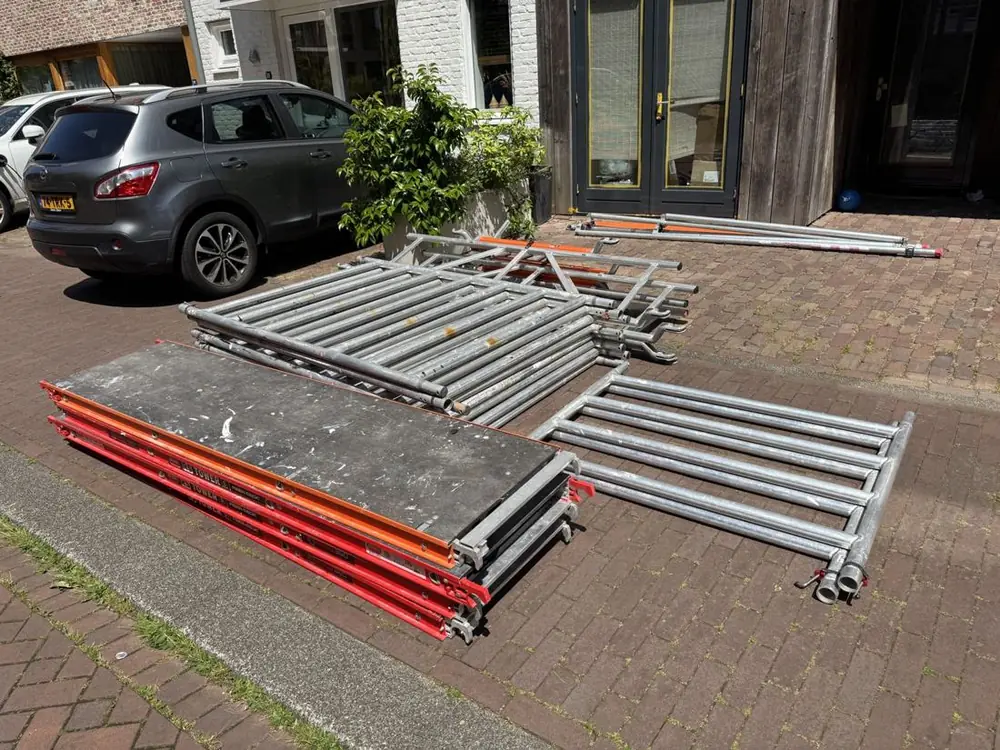
Loose frames, tubes and orange braces on a brick drive, the fence job's hire set for three garden days.

That is why a roomy reservation pays. The whole of that first twenty four hours goes at the standard rate, after which ninety five per cent comes off every following day, so an added day scarcely shows in the rental price. If the weather turns kind you simply report an earlier collection date. That date is yours to give when reserving, and it is where all of the flexibility in the arrangement actually comes from.

Which mobile scaffold suits painting a fence?

Kamersteiger RS44
  • Working height up to 4 metres
  • Compact and narrow
  • Great for indoor and small jobs
View and calculate →
Smalle rolsteiger RS51
  • Working height up to 14.2 metres
  • Narrow (75 cm)
  • Ideal for narrow passages
View and calculate →
Brede rolsteiger RS52
  • Working height up to 14.2 metres
  • Wide platform (135 cm)
  • Extra stability and workspace
View and calculate →
Most chosen
1-persoons steiger MiTower
  • Working height up to 6.2 metres
  • Very compact
  • Quick and easy to assemble
View and calculate →

Building up coats of opaque paint from the deck

Opaque paint lays a closed film on the timber, which asks for a different approach from stain. You build it up: a primer on bare patches, then two thin coats rather than one heavy one. Thin coats key better, they do not sag, and they dry evenly on the end grain where a heavy coat never does. Work one bay between two posts and finish it completely before pushing the tower onward, or the place where you stopped will show through the film afterwards and no amount of rubbing will disguise it.

Fix the order and keep to it: posts first, then the top rail, then the boards working downwards. That way any runs get picked up by a band you still have to cover anyway. A roller does most of the work, while the joints between the boards and the cut ends have to be chased in with a brush. Those edges drink the most of the paint and dry the fastest of all. If you move on to stain on other garden timber, keep the products strictly apart.

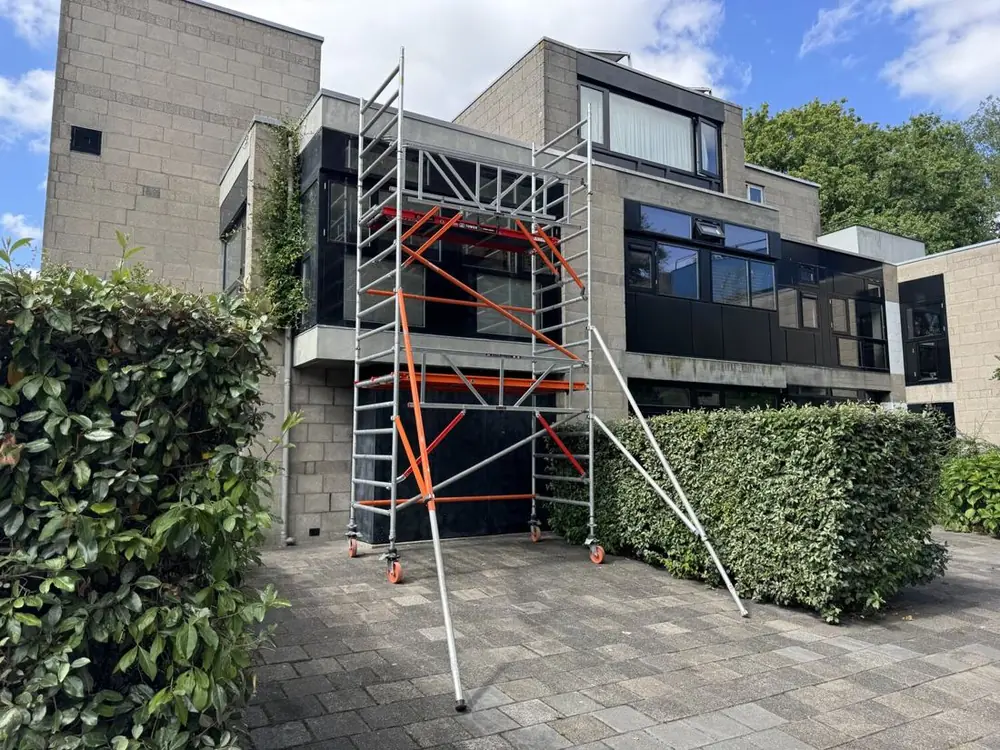
Assembled mobile tower with a boarded platform beside a house, the steady working floor hired for coating timber

Protect whatever is underneath you. Paint travels further than expected, especially off a roller, and on slabs or block paving it dries fast to the surface. Lay sheeting or card across the full width of the bay in hand and drag it along with the tower as you go. Painting a fence over a patio without first covering the slabs is a decision people regret for a very long time indeed, and no hire day is short enough to make it worth the risk.

Delivery, self build and collection when you hire

The components arrive as a complete set, counted for completeness before loading. Agree in advance where they may lie and choose somewhere dry: the drive, the terrace or at a pinch the garage, but never the middle of a soaking wet lawn. Send the booking in on a weekday and beat the 15:00 mark, and everything you ordered is waiting on the ground one working day afterwards. Cover the stack if showers are forecast, since wet boards are slippery to build with.

Assembly belongs to the hire and it belongs to you; we do not come and erect anything, and nothing leaves us standing. With this light model it goes quickly, guided by the supplied manual and the film. Do it the day before your first coat, so that on painting day nothing has to be spannered together first. The order of each lift appears in this step by step account of the assembly. Give it a quiet hour rather than squeezing it in.

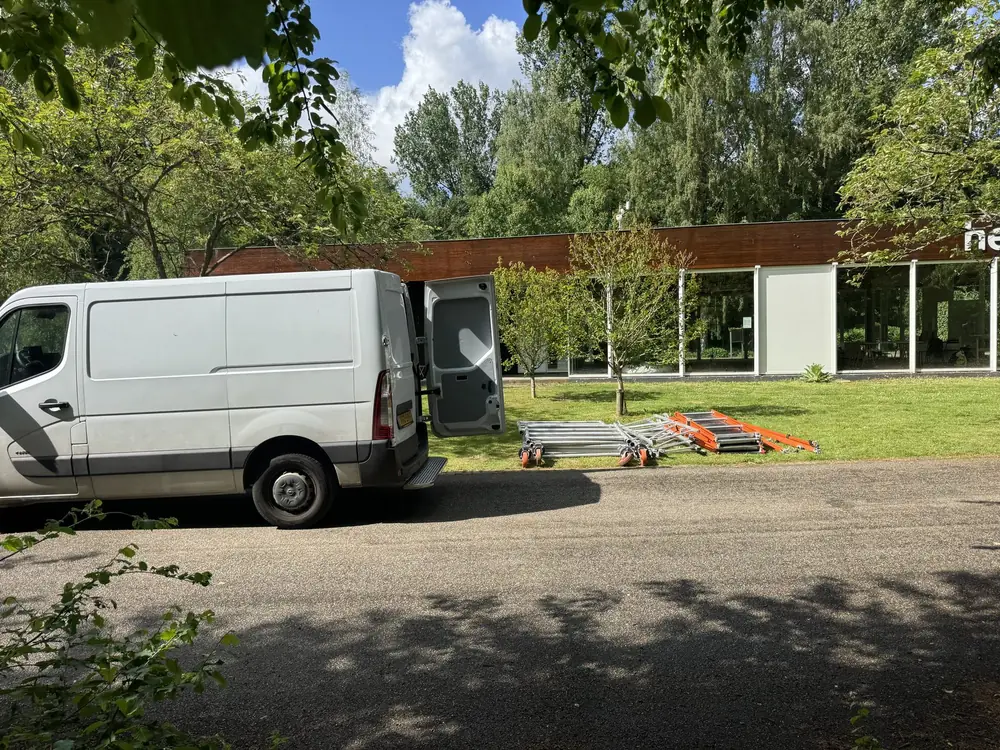
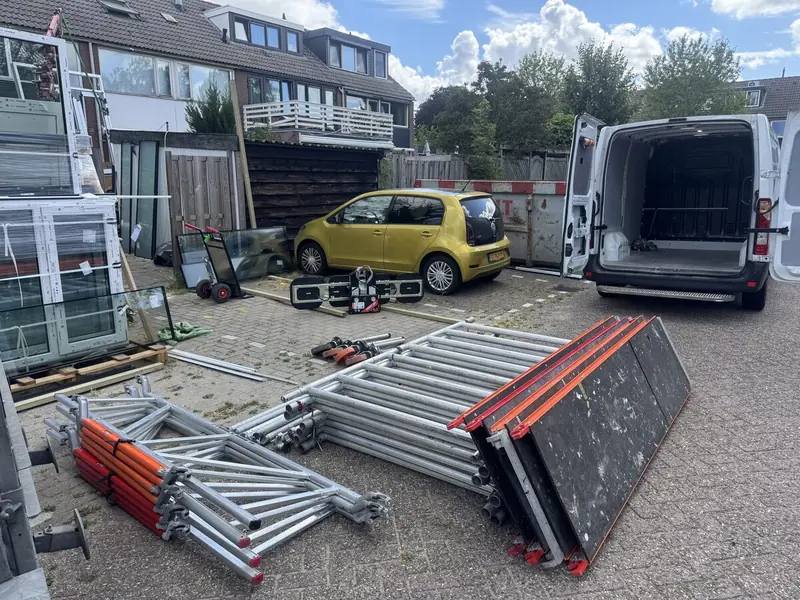
Van being unloaded with scaffold tubes and platform sections, the delivery that opens a hire period at a home address

Arrival and departure are dates you enter yourself when reserving. Once the final coat has dried you take the tower down and stack the parts in the agreed spot, and we call by to load them. Anyone whose garden lies close to the city may pick them up in person instead, by appointment and for nothing, at Zeeburgerpad 89 in Amsterdam, provided the vehicle takes the whole lot in one go rather than in two separate journeys across town.

Why hiring a scaffold beats leaning a ladder on posts

A fence post stands in the ground or in a shoe and is designed for wind and for the weight of the boards. Putting a ladder against it adds a force that pushes sideways, exactly where the post has least to give. You do not see the result at once, but after a season the line stands out of true and boards begin pulling loose. On a newly built boundary with fresh concrete footings that happens faster still, because the concrete has yet to reach anything like full strength.

A free standing tower never touches the boundary at all. It carries its own weight, sits on four braked castors and has stabilisers of its own, so the load goes into the ground rather than into your boards. On top of that you keep both hands free, which on a ladder is simply not possible once a tin and a roller are involved. The two options are weighed up in this piece on choosing between a ladder and a tower.

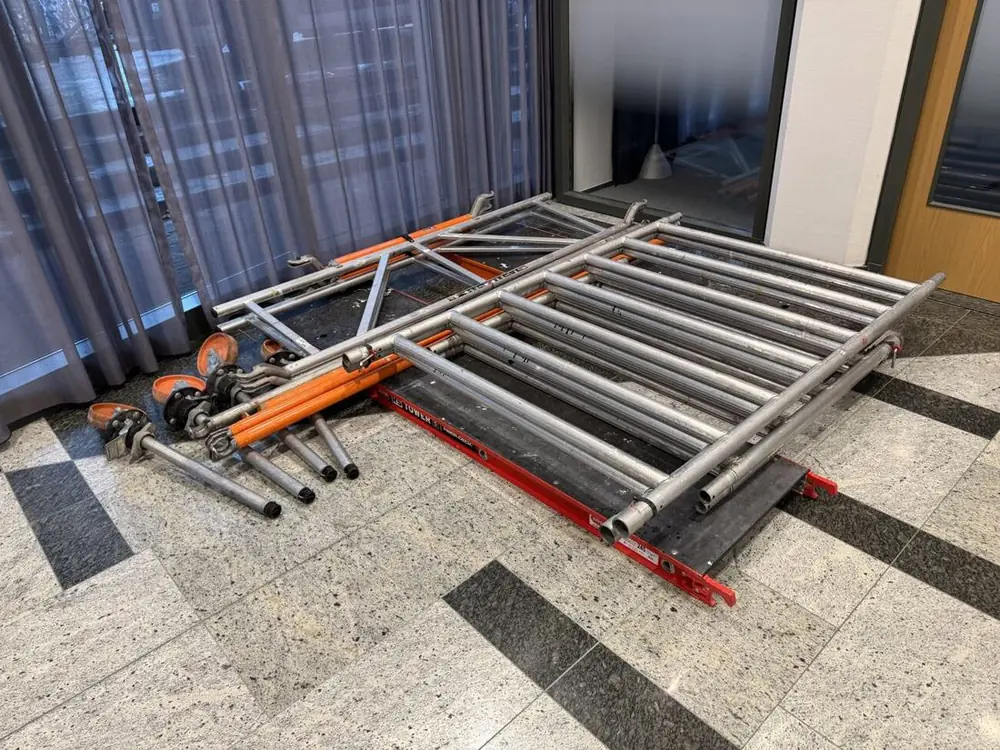
Inspected scaffold set standing complete and counted in the yard, the free standing structure hired instead of leaning anything on timber

The familiar agreements apply otherwise. The towers go out in accordance with EN 1004 under load class 3, which is two hundred kilos of bearing capacity for each square metre, and with paint and tools you never approach that. Lock the brakes before stepping aboard, roll the tower along only when the deck is empty, and stop working once the wind gets up. Spilled paint underfoot makes a platform slippery, so wipe it while painting a fence rather than afterwards.

In 5 steps

How hiring a mobile scaffold works

1
Choose working height

Pick the height that suits your job.

2
Book online

Sorted in 60 seconds, price shown instantly.

3
We deliver

At the agreed spot the next working day.

4
Assemble safely

Assembled by you, with a manual.

5
We collect

One call and we collect the scaffold.

Good to know

Practical tips for painting a fence

1

Coat the posts before you start on the boards themselves. Paint dripping off a post onto a freshly done board shows up later as a streak, while the reverse leaves an edge you can easily work away.

2

Use two thin coats rather than one thick one. A heavy coat sags between the boards, dries unevenly on the cut ends, and lasts a shorter time outdoors than two light applications ever do.

3

Unroll card across the slabs at the bay you are working on and move it along with the tower each time. Roller spatter dries onto paving quickly and afterwards is almost impossible to remove.

4

Position the tower so that your bay falls exactly between two posts. You then always stop at a post and never halfway along a board, which prevents every visible overlap appearing in the film.

5

Think about the neighbours' side of it. Ask well before the hire period whether their garden can be used for half a day, otherwise you paint only one face and end up hiring all over again.

6

Reserve a day of slack at the very end. Outdoor coating almost always runs a day beyond the plan, and with the hired tower still in the garden those last metres get finished calmly.

Frequently asked questions

Frequently asked questions about painting a fence

Which tower do people hire for painting a fence in a garden?+

The MiTower is the most practical: a width of 75 cm, intended for one user and light enough to reposition without help. That way you get past a gate, a border and a narrow side path where a wide rolling tower would simply jam. Paintwork uses very little deck anyway, since you carry a tin, a roller and a brush and nothing more. Measure your gate before you hire anything, because that opening is very often the obstacle nobody thought about.

How does hiring a tower for garden paintwork proceed?+

At booking you fix the model and the build, then name the arrival day and the departure day for the set, at amounts settled in advance including VAT. We put the counted components down at your address, then you assemble the tower and paint your way along bay by bay. As soon as the film is dry you take it apart and leave the parts ready for our driver. Permission from the neighbours is yours to arrange if their face of the boundary is being included in the work.

How many hire days does two coats of opaque paint take?+

For a boundary of twenty metres, count on three to four days of hire from start to finish. Preparation, two coats of opaque paint and two entirely separate faces will fill that without difficulty, and the curing gaps between coats are not something you can influence. The rest of the plan is dictated by the weather. Book a day of slack and you never stop halfway along a bay, while the hired tower simply stands there until the final coat is on.

What do you pay when hiring, and why is the second day cheap?+

The figure is set by the model you choose and by the build height you settle on, with a charge for bringing and fetching fixed per province alongside it. The complete list of amounts, VAT included, sits on the page with all our rates, so the rental price is clear before you commit. For coating work that suits you: only the opening period weighs heavily and each day after it counts for very little. Booking roomy dates therefore costs very little extra, which is welcome when drying times are involved.

What working height is hired for a boundary only two metres tall?+

The lowest build covers it easily. That setting arrives at 4.2 metres, which puts you comfortably above an ordinary boundary, trellis included. You will normally be painting a fence from the bottom deck position, using the hired tower mainly as a steady plateau. The page about working heights shows what each setting yields. Where the run stands on a low wall or on a slope, measure once more in case a taller build is wanted.

Can the hired tower be delivered round into the back garden?+

We unload the set wherever the van can actually get to, so usually the drive or the ground by the front door. The stretch round to the back is walked by you, and that is worth knowing before you hire. Reckon on two people for the heavier parts of the set. Bringing and fetching costs a fixed sum per province, and the date for it is yours to choose. Collection in person is allowed by appointment as well, provided your transport takes every single part in one run.

Is the tower delivered assembled, or is that part of what you hire?+

Raising the tower falls to the customer. We supply the full set and take it back again afterwards, while raising it, pushing it along and dismantling it all belong to your own work. This model is light and uncomplicated, so with the booklet beside you it stands up in short order. Plan the assembly for the day before your first coat goes on. Ready built structures, cherry pickers and every kind of facade or system scaffold fall outside what we keep, which is why this model suits a garden.

What if the paintwork overruns and I have to hire on?+

Give us warning the moment it looks likely and the collection date shifts, unless the set has already been committed to another customer. Outdoor coating nearly always overruns, whether through rain or a film staying wet longer than hoped. To avoid the worry entirely, reserve an extra day straight away and let us know if it went faster than planned. You then pay only for the days on which the tower genuinely stood in your garden.

How much space along the boundary does the hired tower need?+

Count the footprint of the tower, add whatever the stabilisers project on either flank, and then add the room needed to roll the whole thing along. In a narrow garden that often means pots, a water butt or garden furniture must move a few metres before you begin. Do it before the delivery arrives, since manoeuvring an assembled tower between planting wastes a lot of time. Keep a corner of the garden free for the components themselves as well.

Can I go on hiring when it is too damp to paint outside?+

Certainly, and with opaque paint that is genuinely necessary. Paint laid on clammy timber will not key and flakes off within a single season, so a wet day is simply skipped. The tower can stay standing meanwhile while you wait for better weather. Such a day is still useful for sanding, for degreasing or for masking off the bay that comes next. An extra day of hire is cheaper than a boundary redone next year.

What happens to the deposit after the hired scaffold goes back?+

You pay a deposit up front when the hire is booked. Whatever you left comes back inside a single working day, provided the tally of returned parts adds up correctly. On paintwork look out for spatter on the platform and for mud under the castors; a quick clean before you dismantle avoids all trouble. Every last brace and coupling goes back with the hire, since an incomplete tower holds up the settlement. The full sequence appears in this article on deposits.

When is hiring a tower better than standing on a pair of steps?+

As soon as you are busy for more than an hour, need both hands free, or find yourself standing on soft grass. Steps sink into soft ground and force you to climb down and move them constantly. A rolling tower goes on with one shove, keeps the tools at deck level and loads the posts nowhere. For touching up a single board, hiring is plainly overkill; for a whole boundary the tower repays itself in time saved.

Hire a mobile scaffold for painting a fence today?

Calculate your rental price now or ask for free advice.

Rolsteiger van SteigerTaxi geleverd op locatie
Book it online

Your scaffold sorted in 2 minutes.

Choose your scaffold and working height, see the price instantly and book online.