
See your price
Application

Staining a fence? Choose the right scaffold.

Staining a fence is board by board work. You start at a post, finish the panel between that post and the next in one go, then shuffle along. Penetrating stain forgives no lap marks, so breaking off in the middle of a panel always leaves a stripe. That calls for a steady stance, the tin kept within reach and an easy way of moving on to the next panel. The MiTower, a single person tower 75 cm wide, fits a garden best of all, and you hire it in the 4 to 6 metre range.

  • Order before 3 pm, delivered tomorrow
  • Professional Altrex scaffolds
  • Up to 14.2 metres working height
  • Easy to assemble yourself
4,2 tot 14,2 mWorking heights available
12Provinces served
7Days a week
200 kg/m²Load class 3
In short
  • For staining a fence we recommend the 1-person scaffold.
  • Along a boundary you hire a 75 cm MiTower, rated for one user, in the build that spans 4 to 6 metres of reach.
  • Finish every panel between two posts in a single pass, because penetrating stain never forgives a join halfway along.
  • Cover the paving under your working panel with card or with sheeting, since drops of stain settle into slabs permanently.
  • First 24 hours from €100 incl. VAT and delivery; every day after that 95% off.
Key facts for this job
FeatureValue
Recommended scaffold1-person scaffold (Altrex Mi Tower)
Working height for this job4 to 6 metres
Available working heights4.2 to 14.2 metres
StandardEN 1004, load class 3 (200 kg per m²)
DeliveryOrdered before 3 pm, delivered next working day
Each extra day95% off, from €5 a day
Why a mobile scaffold for staining a fence?

Safe, stable and professional work at height

The question is not how tall the boundary is but how you travel along it. Penetrating stain has to be kept moving, so stopping in the middle of a panel shows later as a stripe. Standing on the ground works up to a point, though from there a brush never reaches the top edge or the end grain neatly. A tower on castors gives you a fixed deck, room for the tin and the option of moving on one panel at a time without dragging anything about. You are also working with an open tin that has to sit somewhere, and a ladder gives it nowhere to sit. That is why people hire a mobile scaffold for garden maintenance rather than borrowing steps.

  • Ground level leaves the top edge out of reach
  • Staining a fence one panel at a time hides joins
  • The open tin and brush must sit within easy reach
  • Rolling onwards suits a long boundary line best
Read more about working safely →

Which tower to hire for staining a fence panel by panel

For this job you hire the Altrex MiTower, a tower rated for one user and measuring 75 cm across. In a garden that width decides everything: it has to pass a border, get through a gate and travel a path that is rarely more than a metre wide. You also push it onward single handed, which over a long boundary happens dozens of times in one afternoon. The model is described in full on the page about hiring the MiTower, including what fits in a car.

A broad 135 cm rolling tower buys you nothing out here. In a back garden it cannot be turned properly, the stabilisers flatten your planting, and at every panel you spend longer manoeuvring than staining a fence. The extra deck area goes unused anyway, because this job needs a tin, a brush and a rag and no more than that. The difference between them is unpicked in this comparison of the narrow and the wide design, which settles the question quickly.
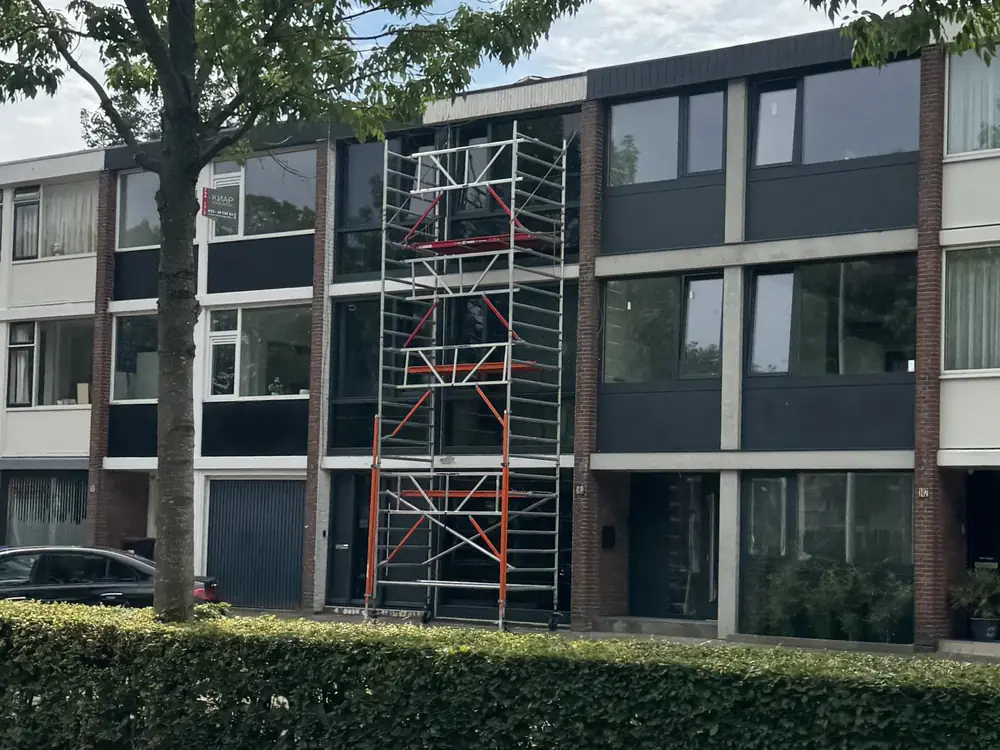
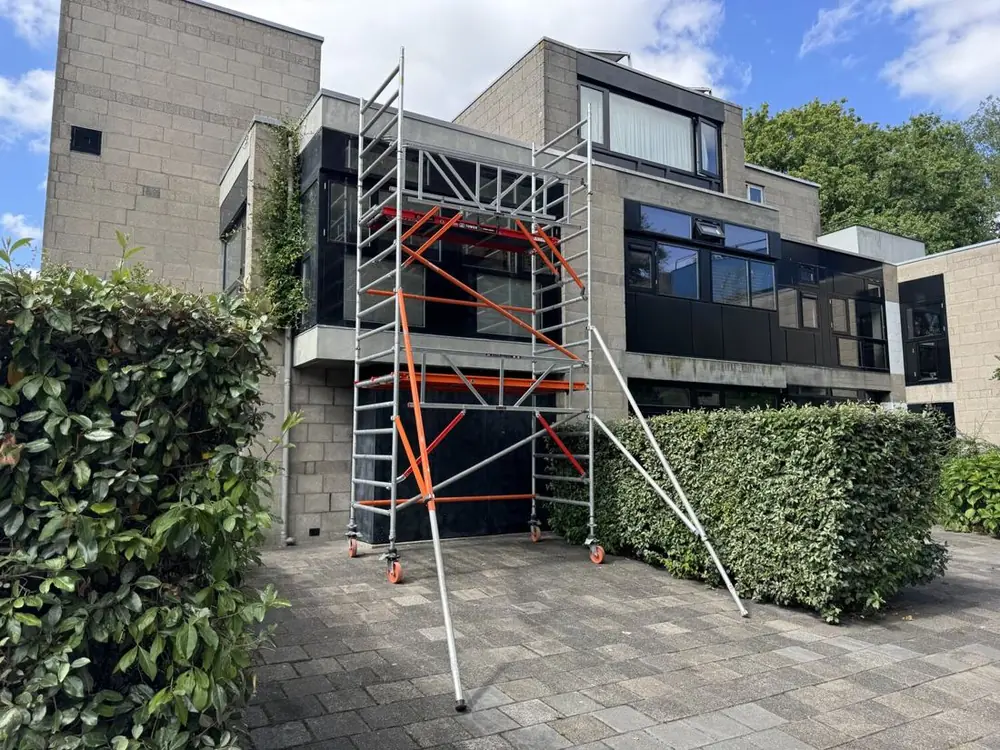
Mobile tower with platform and guard rails standing on paving, the kind of hire set used for work in a garden

Do bear in mind that a single person tower really is meant for one person. If two of you want to work at once, you either hire a second one or split the job so that the second pair of hands sands and fills at ground level. In practice it saves less time than people expect, because one of you ends up waiting on the other anyway, and only a single tin stands open at any moment while staining a fence from a narrow deck.
Working height to hire for a tall boundary fence

An ordinary boundary reaches two metres, and it seldom stops there. Trellis goes on top of it, the run meets a carport, or the whole thing carries on until it reaches a shed wall. Measure to the highest edge that still takes stain rather than to the top of the boards. The smallest build of this tower already starts at 4.2 metres, which is ample for the work, so hiring inside the 4 to 6 metre range covers even an unusually tall run with plenty to spare.

Working height means the height of the deck plus about two metres of reach, which explains why the top setting is almost never needed. Staining a fence usually leaves you standing half a metre to a metre and a half up, using the tower mainly as a stable rolling floor. Stand higher than that and it is normally because a shed roof or a pergola joins the boundary and you have to work over it. What each build offers appears at the four metre setting.

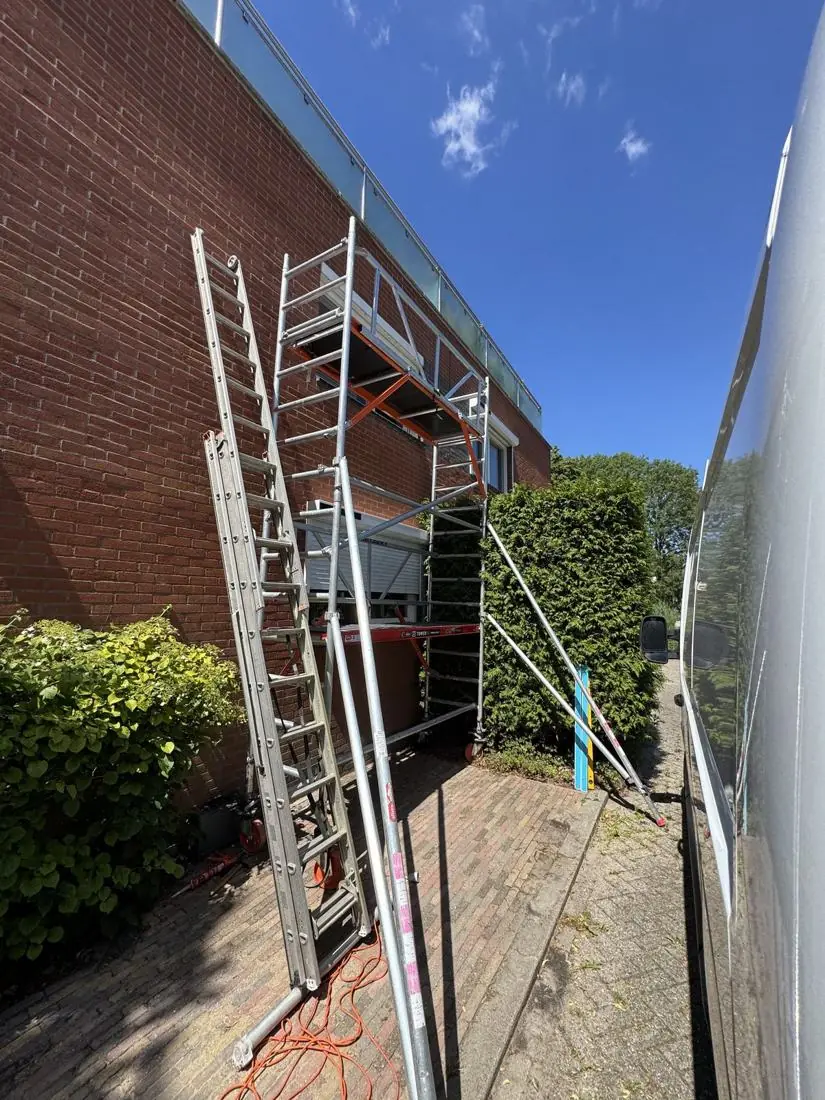
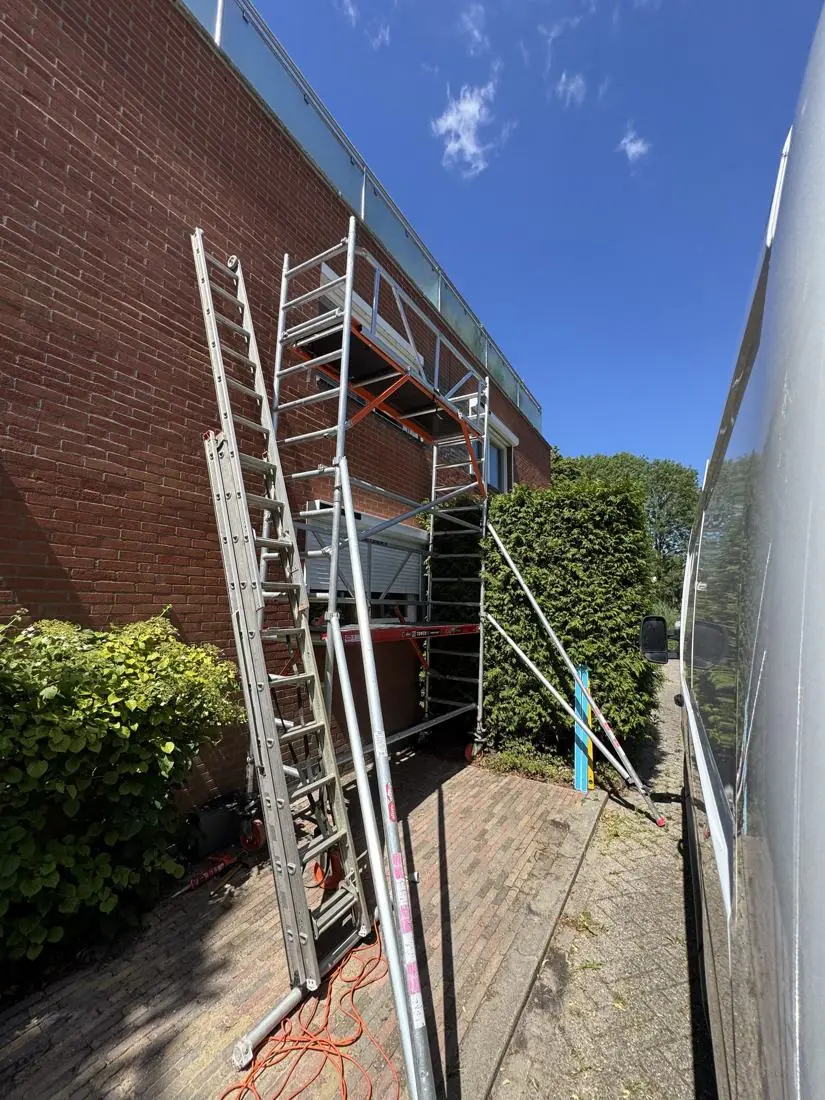
Mobile tower assembled alongside a side wall of a house, taller than the build hired for a tall garden boundary

Measure from the garden and not from the pavement out front. If your terrace sits higher than the back path, or the boundary stands on three courses of brick, everything shifts upward with it. The same is true where the run climbs a bank: reaching is easy on one side and half a metre short on the other. Take the measurement at the lowest patch of ground the castors will actually stand on before you settle on a build, and write that figure down before the booking page is open.

Hiring a MiTower and standing it on garden ground

Ground conditions in a garden are the real difference from work against a house. Grass gives way under castors as soon as it has rained, and a planting bed offers no support at all. Put paving slabs or sound boards under the base, or keep to the terrace and the back path. The stabilisers need to swing clear on both sides, and in a narrow plot that conflicts with the planting sooner than anyone expects. Check the base is level again after every single move along the run.

Walk the route you intend to follow before the delivery arrives. A water butt, a compost heap, a low branch from next door and a projecting post footing all sit exactly where they are least welcome. Clear what can be cleared and note where the tower will have to be lifted rather than rolled. Measure the gate opening while you are at it, since the whole thing has to pass through it. On sloping ground, the method for an uneven surface gets you level.

Stabilisers projecting outwards under the base of a mobile tower, in a garden the point where planting gets in the way

Do not forget the far side. If both faces are being treated, the tower has to reach the neighbours or the back alley too, and that takes agreement and sometimes a different order of work. Settle all that before the hire dates are fixed, because a boundary treated on one face only looks worse than one left alone entirely. A shared gate key is worth asking about at the same time, along with a spot where the components may rest.

How many hire days staining a fence really needs

Fifteen metres of boundary will not be finished in an afternoon. Each panel between two posts takes a quarter of an hour once preparation, the coat itself and the end grain are counted, and multiplying that by the number of panels and then by two faces adds up quickly. On top of that, penetrating stain often wants two coats, and the first has to sink in before the second follows. Reckon on the tower standing with you for two to three days.

The weather settles the rest. Working in full sun leaves streaks because the product disappears too fast, and in rain or heavy dew you cannot start at all. In practice you work in the morning and again late in the afternoon, which means whole days pass when the hired tower simply stands there doing nothing. That is no problem at all provided those days sit inside your booking, so plan around the forecast rather than around your own days off.

Frames leaning by the front steps of a brick house, the hire set that stays with you two or three days.

The tariff makes that affordable. The full charge covers the opening day only, and each day after it comes with ninety five per cent knocked off, so two spare days barely register in the rental price. Book too tightly and the last four panels cost you a whole second build. Since the collection date is yours to name, extending afterwards is rarely necessary once you have allowed for weather at the start, and staining a fence is a job the weather rules completely.

Which mobile scaffold suits staining a fence?

Kamersteiger RS44
  • Working height up to 4 metres
  • Compact and narrow
  • Great for indoor and small jobs
View and calculate →
Smalle rolsteiger RS51
  • Working height up to 14.2 metres
  • Narrow (75 cm)
  • Ideal for narrow passages
View and calculate →
Brede rolsteiger RS52
  • Working height up to 14.2 metres
  • Wide platform (135 cm)
  • Extra stability and workspace
View and calculate →
Most chosen
1-persoons steiger MiTower
  • Working height up to 6.2 metres
  • Very compact
  • Quick and easy to assemble
View and calculate →

Staining a fence board by board from the platform

Penetrating stain behaves nothing like paint: it soaks into the timber and forms no film you can touch in later. Visible joins appear precisely where you stopped and then started again on a board that had half dried. So work each board over its whole length, from one post to the next, and only then drop to the board below. A panel between two posts is usually about two metres, which matches a single tower position neatly and puts every join on a post rather than out in the open.

Newly delivered timber needs care. Freshly treated boards are still full of the preservative they were given and will barely accept stain, so the product sits on the surface and turns tacky instead of soaking in. Leave such timber outside for a while and test on an inconspicuous board to see whether it takes anything yet. If you later move to an opaque coating on the same boundary, an entirely different set of rules applies to the preparation and to the number of hire days.

Tower with guard rails and an internal climbing route, the working floor hired for treating timber panel by panel

Think about what falls beneath you. Stain is thin, drips readily off a brush and soaks into slabs and block paving just as willingly as into timber. Sheet the ground under your working panel with card or plastic and slide it along as you move. A drop wiped away at once is nothing; a drop found the following morning is a permanent mark on somebody's patio, which is why the sheeting travels with the tower rather than staying where you first put it down.

Delivery and collection of the tower you hire

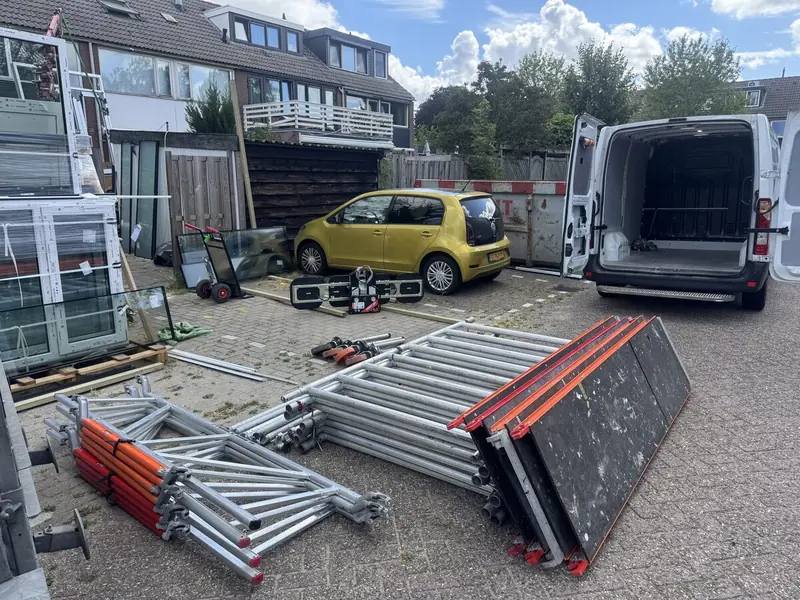
What pulls up is a set of loose components, counted before it left our yard. Choose a drop point where the stack stays dry and out of the way, because in a garden loose parts sink into wet grass within the hour. A drive or a stretch of terrace beats the lawn itself. Any weekday order placed while the clock still shows less than 15:00 puts the components on your path the following working day. Throw a sheet over the stack if rain is coming, because wet boards are needlessly slippery to build with.

The build is left to you: we do not put towers up and we hand nothing over standing. With this model that is no hardship, since it is light and straightforward, and with the manual and the video beside you an hour or two sees it done. Do it the day before you intend to start work, so that the next morning begins with dry boards and a tower already standing there and waiting for you. The order of the lifts is in this explanation of the build sequence.

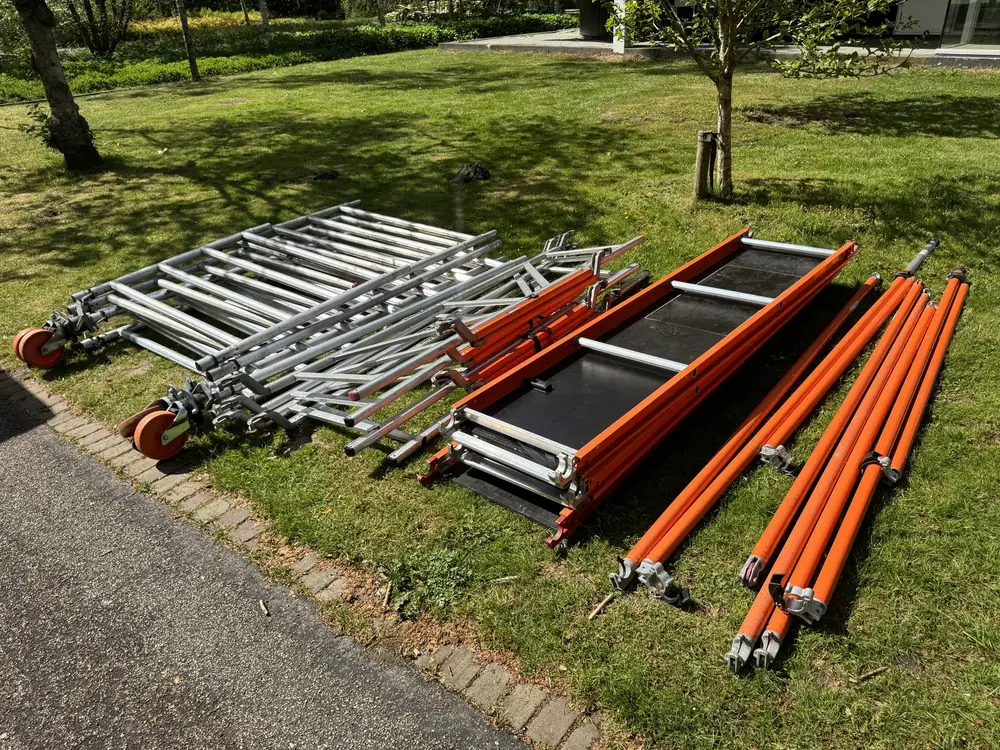
Scaffold components lying on grass in a garden, the delivered hire set before it is carried to the working line

Arrival and departure are two separate dates that you fill in yourself, and out in a garden the forecast deserves a say in both. When the last coat is on, take the tower apart and pile the components up again; we come and fetch them. Living near enough to Amsterdam, you may fetch them yourself instead at no cost, by appointment, from Zeeburgerpad 89, provided your vehicle swallows the whole lot in one journey rather than two.

Safety on a single person scaffold beside the fence

Load class 3 under EN 1004 covers our whole fleet, and that permits two hundred kilos for every square metre of decking. Staining a fence never approaches such a figure, because the only cargo up there is a tin and a brush. What matters far more is that a tower rated for one user is genuinely used by one person alone: nobody else climbs up to hand anything over. The standard is unpicked in this note on the standard behind them.

The usual agreements hold in a garden too. Brakes go on before you step aboard, you roll along only with an empty deck, and you stop the moment a strong wind gets up. Wind is doubly awkward here: it carries your product onto the neighbours' planting and it dries the stain off before you have spread it out. A still morning gives the best finish, so look hard at the forecast before any tin is opened and before the hire days are chosen.

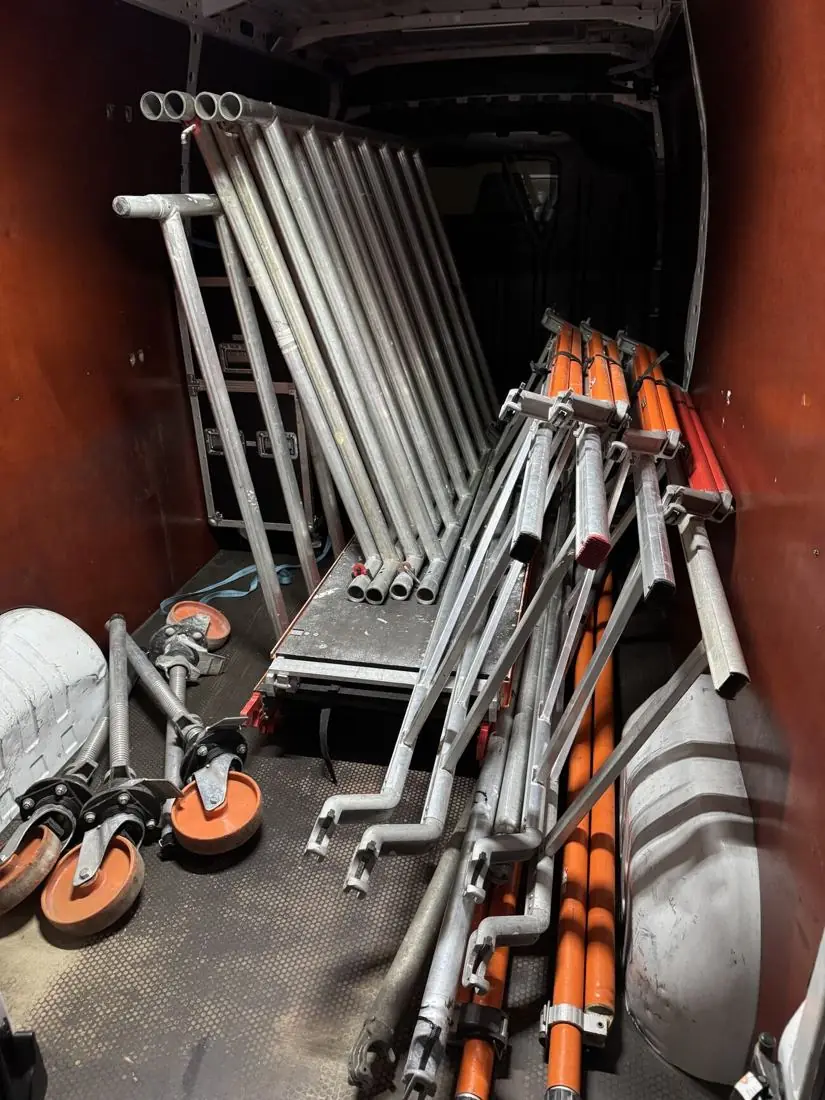
Tower components bundled ready for transport, the complete counted set collected again when a garden hire ends

The risk that genuinely stands out is the floor under your boots. Spilled stain turns a platform treacherous and you generally only find out about it when a foot slides. Wipe a splash away at once and lay a sheet of card down underfoot if need be. Look at what sits beneath you as well, because a garden table or a child's bike under a tower is exactly what you roll into when moving along the line, and staining a fence involves a great many of those small moves.

In 5 steps

How hiring a mobile scaffold works

1
Choose working height

Pick the height that suits your job.

2
Book online

Sorted in 60 seconds, price shown instantly.

3
We deliver

At the agreed spot the next working day.

4
Assemble safely

Assembled by you, with a manual.

5
We collect

One call and we collect the scaffold.

Good to know

Practical tips for staining a fence

1

Mark the end of your panel on the top edge with a strip of tape. From the deck you then see at a glance exactly how far to keep working before the hired tower gets pushed along.

2

Take a tin with a hook on it rather than a bucket set down on the deck. A tin hanging from the guard rail cannot be tipped over by your boot when you shuffle the tower forward.

3

Do the end grain of the boards first of all. That is where the timber drinks most, and leaving it until the end means dragging a wet brush along a panel which has already dried out.

4

Treat the bottom two boards from ground level rather than from the tower itself. That way you avoid climbing down again and again, and you keep one comfortable fixed working height on the deck.

5

Roll out a run of card along the panel you are working on and drag it forward as you go. Drops of stain that dry on slabs cannot be lifted out again by any product on the shelf.

6

Book the collection for well after your last day of work. Rain at the wrong moment wrecks a plan, and with two days of slack in hand you never have to abandon a panel halfway through.

Frequently asked questions

Frequently asked questions about staining a fence

Which tower is hired for staining a fence in a garden?+

The MiTower suits it best: 75 cm across, rated for a single user and light enough for one person to shift alone. That gets you through a gate, past a border and along a narrow back path without lifting at every panel. A wide 135 cm rolling tower is simply too cumbersome for a garden and damages the planting on its way past. Measure the tightest opening into your back garden before you hire, because that gap is where the trouble usually starts.

How does hiring a tower for fence work run in practice?+

When you reserve, you set the model, the build and the days on which the set arrives and departs, at rates that are fixed and include VAT. We unload the counted components at the address, then you raise the tower yourself and work along the run panel by panel. Once finished you dismantle it and leave the parts ready, then we collect. Nothing else needs organising, apart from permission if the neighbours' side is being treated too, which is worth asking early.

For how many days should the scaffold be hired for staining?+

For a boundary of fifteen to twenty metres in length, allow yourself two to three hire days from the outset. Each face wants its own pass, penetrating stain frequently needs two coats, and the first has to sink in before the second. Add to that the days when strong sun or rain stops you working altogether, which in a wet spring is most of them. Book a day of slack at the outset and bad weather never forces a rewrite of the plan halfway through the run.

What does hiring cost, and what does the second day add?+

The amount varies with the model and with the build height you choose, and a bringing and fetching charge fixed per province sits on top of it. Everything is shown including VAT on the page listing our rates. For garden work that structure is kind: the opening day counts fully and the ones after it barely at all. Booking the tower generously therefore costs less than two short separate periods, and it removes the pressure to rush a panel.

What working height do I hire for a tall garden boundary?+

A build of 4 to 6 metres is enough for this, and most of the time you will be standing on the lowest deck setting anyway. Measure up to the highest edge that still gets treated, so including trellis or an adjoining shed wall. The overview of working heights shows what each build of the tower delivers. Where the run sits on a low wall or on a bank, add that difference in before you hire anything.

Where does the hire set get dropped off for a garden job?+

We set the counted components down somewhere the van can reach at the address, typically the drive or the ground in front of the door. The last stretch round to the back is yours, so keep that in mind when hiring a scaffold for garden work. Delivery costs a fixed sum per province and you pick the day. Collecting in person is possible by appointment, as long as your transport takes every part in a single run round.

Do I build the tower myself when hiring it for this work?+

Yes, that falls to you entirely. We hire out the counted set and collect it again later, but raising it, rolling it along the run and taking it apart are all your own tasks. With a single user model that is hardly a burden: it is light, uncomplicated, and with the instructions to hand it goes up inside an hour or two. Do it the day before, and you begin with a dry garden and a tower already standing.

What if the work overruns and the hire needs extending?+

A message is enough on its own. We move the collection date along unless the set has meanwhile been promised to somebody else. On outdoor garden work overruns are common, usually a shower pushing the second coat back a day. To sidestep that, hire an extra day from the beginning and tell us if it went faster. The date is yours to set, and the tower waits quietly where it stands in the meantime, doing no harm to the lawn.

How much room is needed along the boundary for a hire set?+

Start from the tower's own width, add the reach of the stabilisers left and right, then a further strip for rolling it forward through the hire. In a narrow back garden that usually means a few pots, a water butt or a garden chair have to shift. Move them before the delivery van arrives, since manoeuvring a built tower between plants is unpleasant work. Think about where the components themselves may lie during the hire.

Can I keep hiring when the weather is too poor to work?+

The tower can stand quietly while you wait for better conditions, several days running if that is what it takes. Stain applied in rain or onto damp timber will not sink in and leaves blotches, so postponing is the only sensible choice. Spend such a day sanding, clearing green growth or masking off the next panel instead. One extra day of hire weighs nothing at all against a whole boundary covered in streaks.

When is the deposit returned after the hire finishes?+

You settle the deposit at the moment of booking, before anything is loaded. Once the returned components have been counted through, it follows within a single working day, provided the tower came back complete. On this work watch for splashes on the platforms and mud off the lawn; a quick wipe before you dismantle saves bother. Hand in every loose part, right down to the last brace and coupling. The process is described in this article about deposits.

How often does the hired tower get moved along the boundary?+

Once per panel, so on a twenty metre run that is ten or so moves a day. Each one means climbing down, releasing the brakes, rolling on a couple of metres, levelling and setting the brakes again. That is exactly why a single person tower gets hired for this rather than a wide build: you shift it alone, in under a minute, without anyone holding the other end. Count your panels beforehand and you know how the day will run.

Hire a mobile scaffold for staining a fence today?

Calculate your rental price now or ask for free advice.

Rolsteiger van SteigerTaxi geleverd op locatie
Book it online

Your scaffold sorted in 2 minutes.

Choose your scaffold and working height, see the price instantly and book online.