
See your price
Application

Interior painting? Choose the right scaffold.

Interior painting rarely comes unstuck over the paint and nearly always over the height. A ceiling, the top band of a tall wall or the strip above a door frame stays just out of reach from a step stool, and you stretch in a room full of furniture. For this work you hire the Altrex RS44 room scaffold, which reaches a working height of 3 to 4 metres and stays narrow enough for an interior door. Read on for setting it up indoors, how many hire days to book and what goes under the wheels.

  • Order before 3 pm, delivered tomorrow
  • Professional Altrex scaffolds
  • Up to 14.2 metres working height
  • Easy to assemble yourself
4,2 tot 14,2 mWorking heights available
12Provinces served
7Days a week
200 kg/m²Load class 3
In short
  • For interior painting we recommend the Room scaffold.
  • For interior painting up to the ceiling you hire the RS44 room scaffold: working height 3 to 4 metres, slim enough for a door.
  • Under the wheels of the tower you hire, lay hardboard or a tarpaulin, because laminate, parquet and vinyl pick up pressure marks.
  • Push the furniture towards the middle of the room and keep a clear metre all round for the tower and for yourself.
  • First 24 hours from €50 incl. VAT and delivery; every day after that 95% off.
Key facts for this job
FeatureValue
Recommended scaffoldRoom scaffold (Altrex RS44)
Working height for this job3 to 4 metres
Available working heights4.2 to 14.2 metres
StandardEN 1004, load class 3 (200 kg per m²)
DeliveryOrdered before 3 pm, delivered next working day
Each extra day95% off, from €2.50 a day
Why a mobile scaffold for interior painting?

Safe, stable and professional work at height

Indoors the height is modest and the room is cramped, and it is that combination which makes it awkward. A ceiling gets painted in bands that have to meet while still wet, so you want to keep going instead of stepping off a stool every two minutes. At the same time a sofa is in the way, the floor must not be scratched and everything you use has to pass a doorway of perhaps 78 centimetres. Hiring a scaffold for interior painting is therefore not about height alone, but about passage, floor protection and a steady deck where you can handle a roller on a pole.

  • Fits through an interior door from about 70 cm
  • Ceilings in bands, so no stepping off midway
  • Floor protection under wheels and stabilisers
  • Working height 3 to 4 metres indoors
Read more about working safely →

Hiring a room scaffold for interior painting: which model fits

For paintwork inside the house the Altrex RS44 room scaffold is the model you go and hire. It comes to a working height of 3 to 4 metres and covers just about any ceiling in a home with that. For a void you look further, but for ordinary rooms this is the size. More telling still is the build: it is made so you can take it through an interior door from roughly 70 cm. What there is to choose in this format is shown with the room scaffolds available to hire.

Measure your doors before booking, and not only the door of the room itself. The route runs from the front door along the hall, sometimes past a stair rail and then into a room, and the narrowest point on that route governs everything. A handle sticking out, a threshold or a door that only opens halfway will each swallow ten centimetres. Note straight away whether the hall has a turn the longest tube will not go round. Whether that works is covered in the piece on a tower through the doorway.
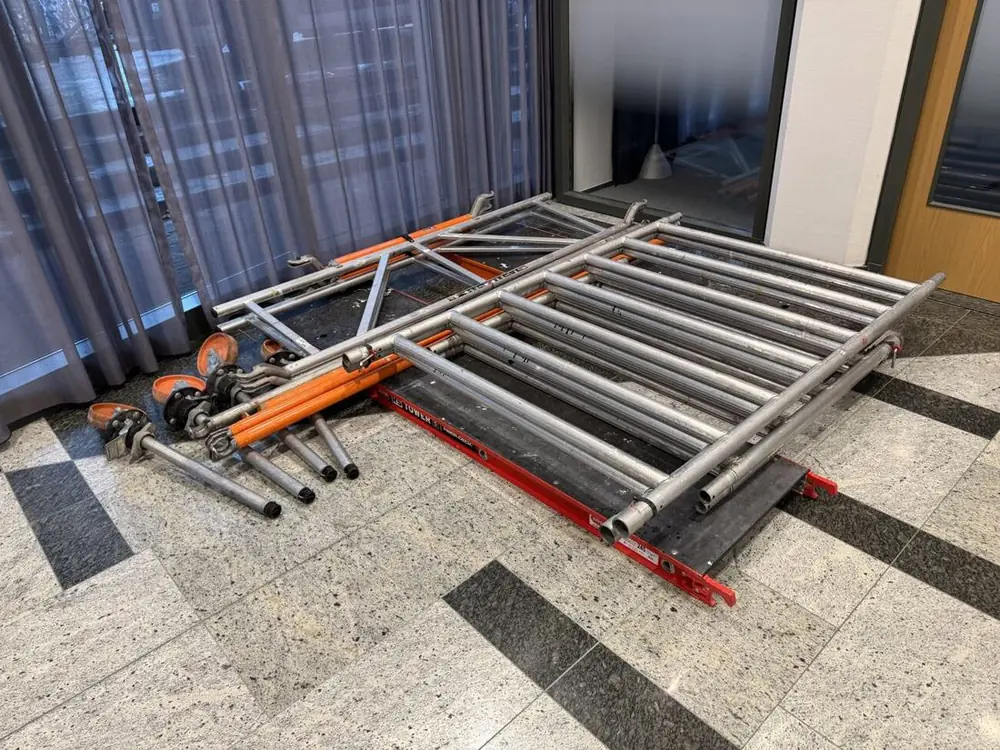
Counted set of scaffold parts checked over, the kit that goes indoors when ceilings need painting

An outdoor model such as the RS51 or RS52 is a poor swap for this job. Those start at 4.2 metres of working height, weigh more to carry inside and have a footprint you cannot place anywhere in a living room. If you are carrying on outside with the facade, hire a mobile scaffold for that separately and leave the room scaffold standing indoors. Keep the two bookings apart, because each model has its own build sequence and its own place to stand.
What working height to hire for ceilings and high walls

The highest point on this job is the ceiling itself, or the top edge of a wall just below it. In many homes that sits at 2.6 metres and in an older front room at 3.5 metres. That brings you to a working height of 3 to 4 metres, with your platform between 1 and 2 metres. The rest of the height you supply yourself: from the deck you stand on, an adult with a roller still reaches a good two metres higher. You enter that figure when you book your hire period.

Indoors, always measure from the floor the wheels will rest on up to the ceiling. That sounds obvious, but in a house with a raised floor, a thick underlay or a step up into the conservatory the figure differs from room to room. So walk your rooms one by one, write down the largest measurement and hire on that, and you will not have to improvise indoors. Which build belongs to such a size is shown at a working height of 4 metres.

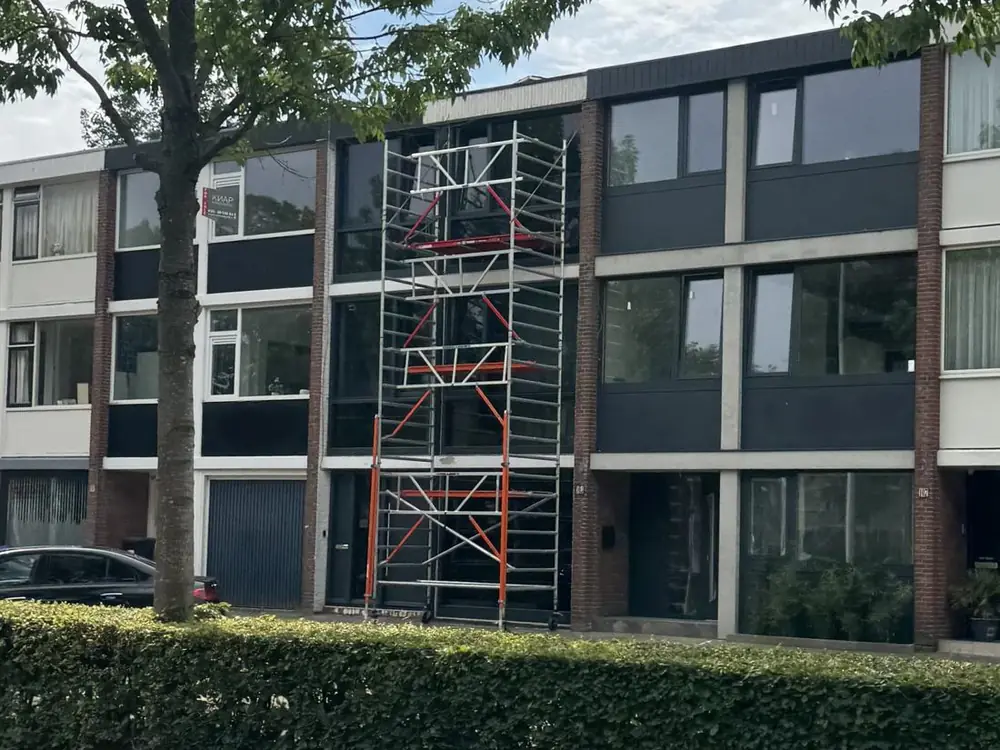
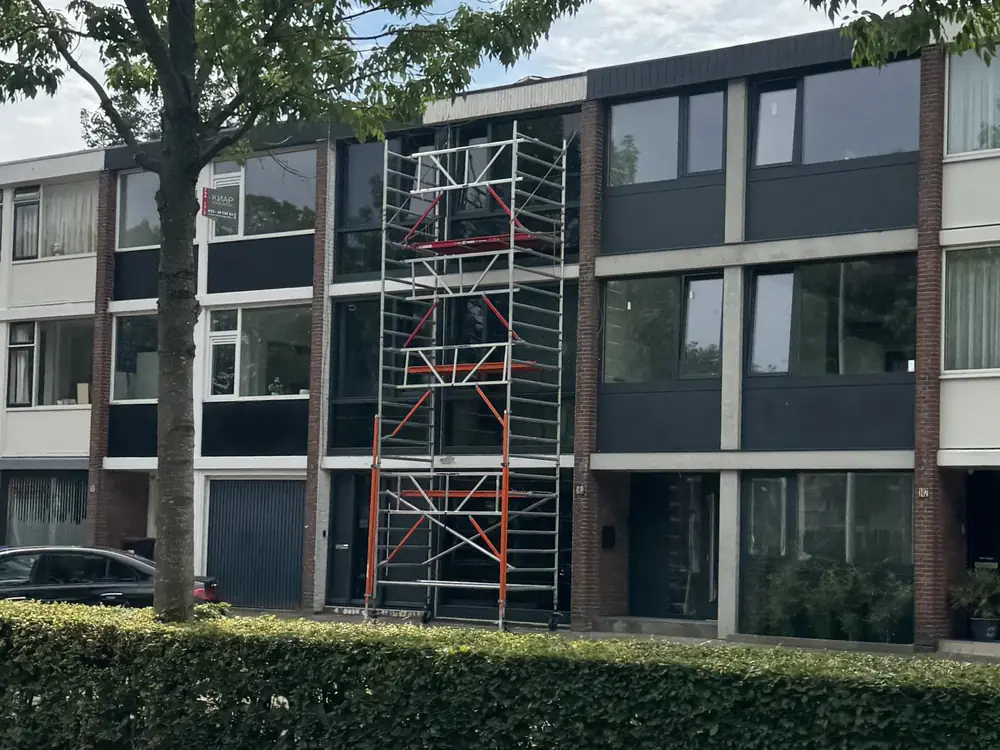
Tall slim tower built up over three storeys of a modern block, the sort of build height you state when booking

Choosing too tight is something your shoulders notice at once. Half a metre short and you push the roller against the ceiling with straight arms, lose sight of the wet edge and see the bands come back as stripes once they dry. On top of that you end up working with a pole too long for the room. Take the build above instead and you paint under a ceiling standing upright. It also removes the temptation to climb onto the top rail.

Where the room scaffold stands: floor protection and furniture

Indoors you do not choose your surface, you inherit it. Laminate, parquet, vinyl or tiles: everything in a living room is flat but vulnerable, and the weight of a tower comes down on four small wheels. So lay hardboard sheets, thin plywood or a stout tarpaulin under the foot, and rather than sliding over it, lift the sheet along when you move. Grit under a wheel makes a two metre score in one pass, so sweep the floor and check the wheels are clean before they enter.

The furniture is the second half of the puzzle. Push what you can towards the middle, cover it and keep a clear metre all round, because you have not only the tower but yourself and a paint tray to fit in. Anything too heavy stays put and gets sheeting over it. A room that is half empty works faster than one where you are constantly squeezing past. Think of the pendant light or the downlighters too: those come off before the tower rolls underneath.

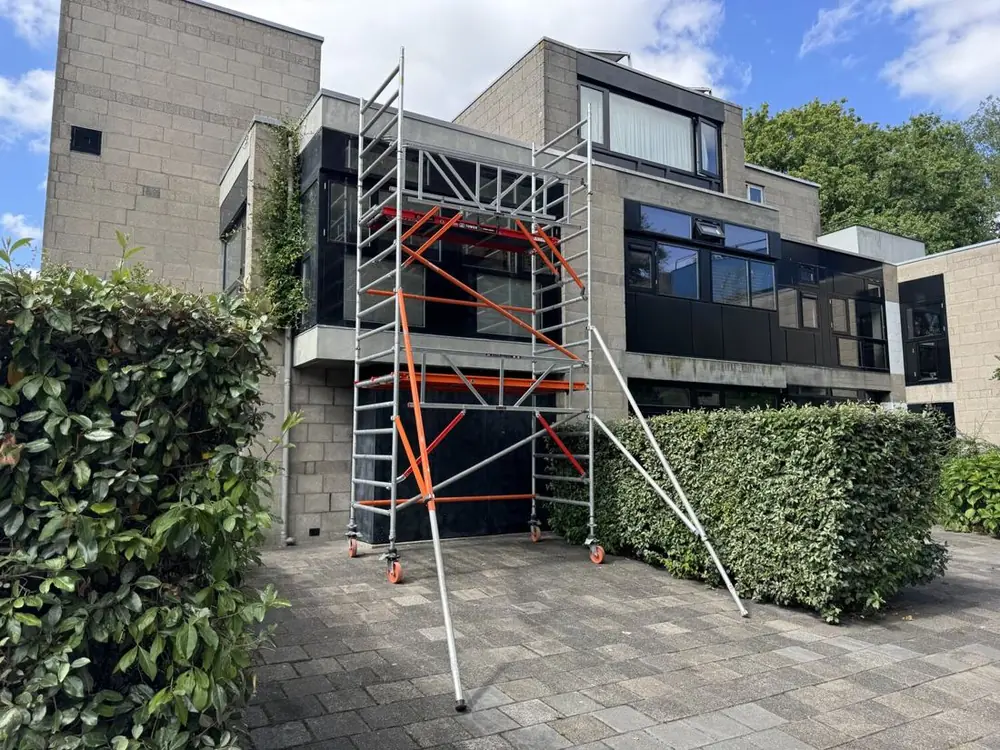
Foot of a mobile scaffold with wheels and stabilisers, the part that indoors has to rest on a protected floor

Then watch the things that only crop up inside. A threshold between hall and room is not one to take with an assembled tower, a radiator under the window costs you half a metre, and a rug left down will ruck up under the wheels. Look at where the light falls as well, since you want to see the wet edge of your band; stand a lamp in the corner if need be. Setting a tower up inside is covered in the guidance on indoor use.

How many days do you hire a tower for interior painting

Work in rooms, not in square metres. An average living room means the ceiling in two coats, the walls with it and the cutting in along skirtings and frames. With preparing, shifting furniture and masking, that is a day and a half before you have hit a single snag. Add the hall and a bedroom straight away and you are on two to three hire days, and you genuinely need the tower on each of them because you build and position it afresh in every room.

The waiting on this job sits between the coats. Emulsion on a ceiling has to lay off and dry before the second coat can go on, and in a closed room with little ventilation that takes longer than the tin promises. Open the windows, keep the room warm and put the second coat calmly on the following morning. Rushing a day gets you a ceiling you redo later anyway. Count this work in mornings rather than in loose hours.

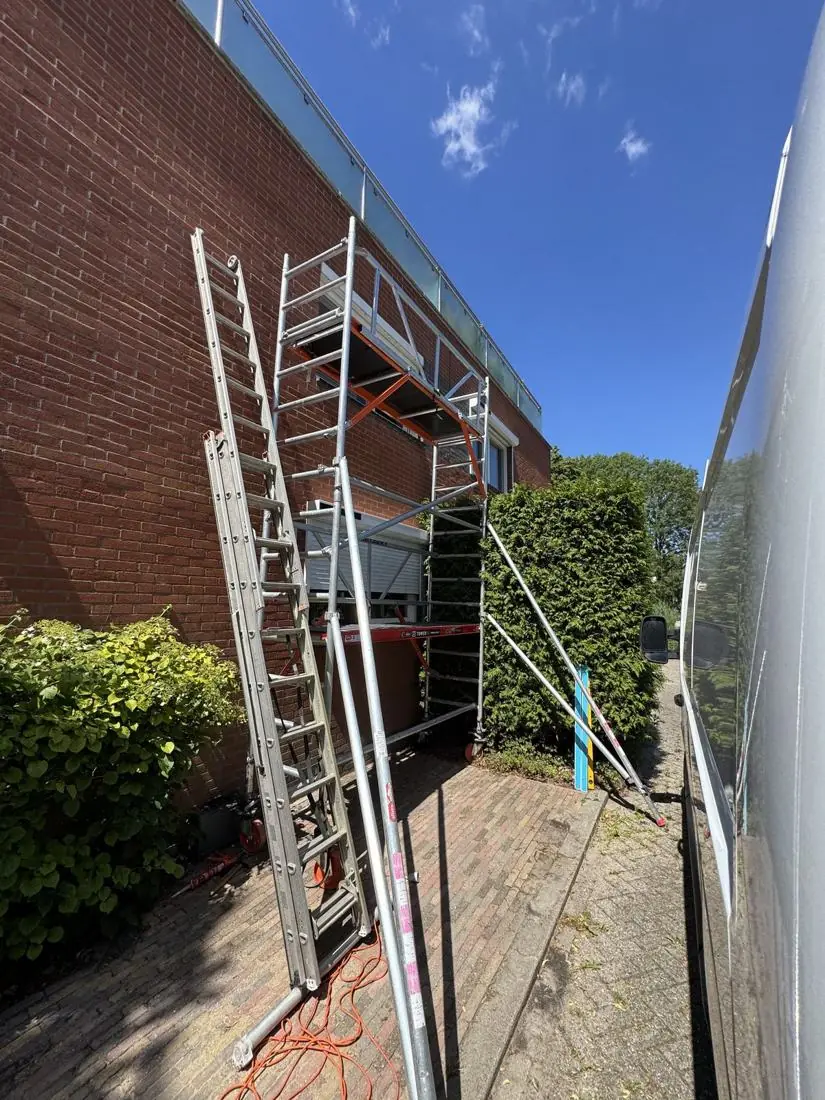
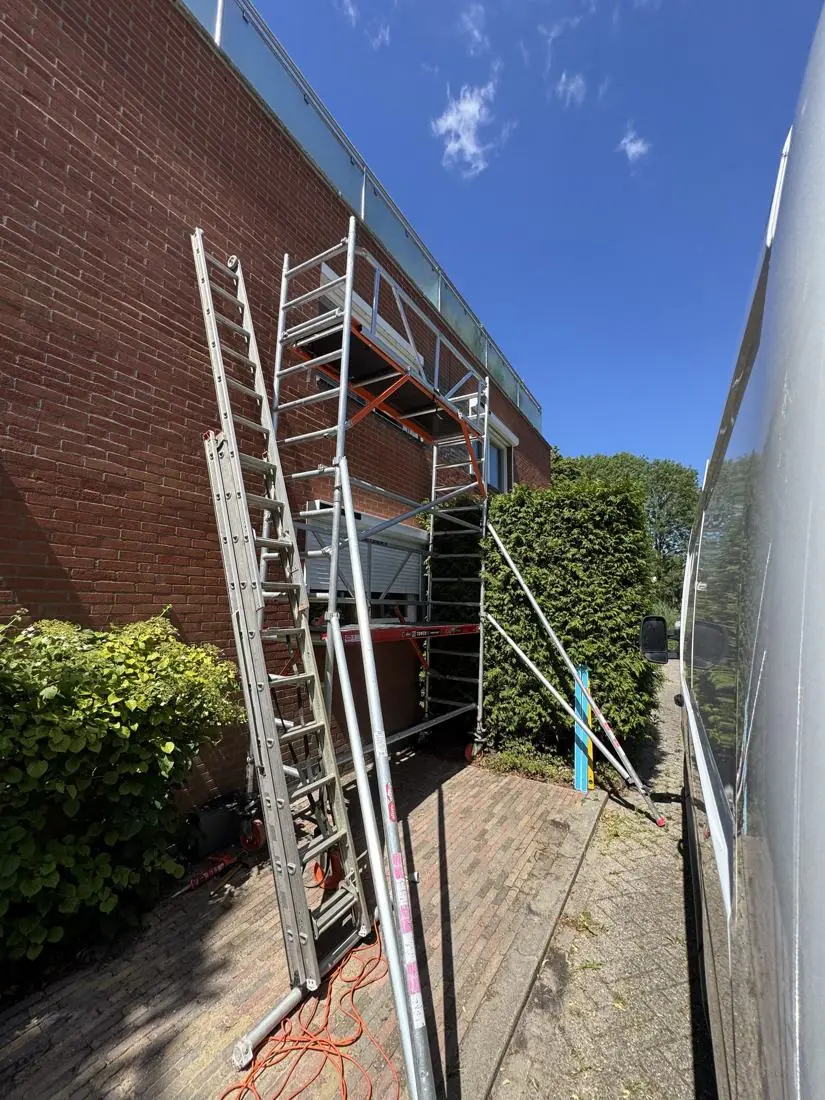
Tower assembled in a narrow passage against brick, with a loose extension ladder propped beside it through the hire days

It helps your planning that the rental price sits heavily at the front. Over the first twenty four hours you settle the whole rate, and after that each day counts for only a twentieth, since 95 per cent is taken off. An extra day to finish at leisure therefore costs little, whereas a booking cut too fine means leaving a ceiling half done. Build a day of margin into your reservation. Otherwise have a look at what a realistic hire period is.

Which mobile scaffold suits interior painting?

Most chosen
Kamersteiger RS44
  • Working height up to 4 metres
  • Compact and narrow
  • Great for indoor and small jobs
View and calculate →
Smalle rolsteiger RS51
  • Working height up to 14.2 metres
  • Narrow (75 cm)
  • Ideal for narrow passages
View and calculate →
Brede rolsteiger RS52
  • Working height up to 14.2 metres
  • Wide platform (135 cm)
  • Extra stability and workspace
View and calculate →
1-persoons steiger MiTower
  • Working height up to 6.2 metres
  • Very compact
  • Quick and easy to assemble
View and calculate →

Painting a ceiling from a platform of 245 cm

Your platform is 245 cm long, and that is what you divide the ceiling with. A room of four by four metres takes two or three positions, and from each one you finish a strip across the full width. Work in bands that overlap while the edge is still wet, because a dried join stays visible in raking light. So put the division between two positions at a beam, a line or the edge of the ceiling. Split the room up on paper before you start rolling.

Take up in one go what you need. That is more than you think: the tray, the roller with its pole, a brush for the corners, a cloth and tape. Do not stand the tray loose on the deck but clamp it or hang it from the rail, because a tipped tray above a wooden floor is a bigger problem than one out on the pavement. Anything that will not fit stays below. Run through that list before you climb, since every descent costs you the wet edge.

Scaffold carrying a platform of 245 cm, the very length in which you split a ceiling into strips indoors

Repositioning goes differently inside than out. First you take your materials off, then the protective sheet from under the wheels, roll the tower along and put the sheet back before setting the brakes. That is two minutes each time, and precisely why you finish as much as you can from each position. In an average living room you move three or four times. If you go on to paint high walls afterwards, extra positions come with it.

Hiring a scaffold with delivery through the front door

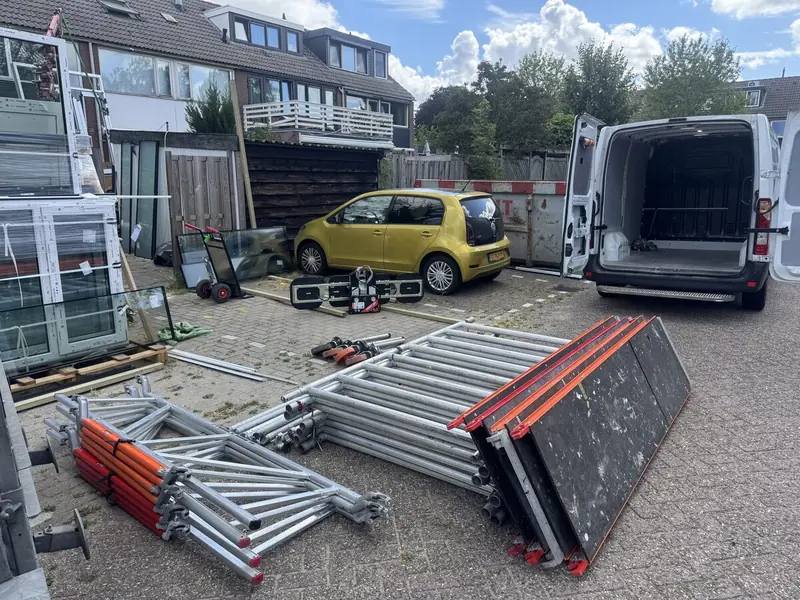
The room scaffold is delivered as a full, counted set of separate parts. For work inside that is an advantage, because you carry the pieces one by one along the hall and only assemble them in the room. Point the driver to a spot where the set can go, usually the pavement, the drive or just inside the front door. Book on a working day before the clock passes 15:00 and your set travels to your address the very next working day, so prop the porch or the gate open in good time.

Which day the parts turn up, and which day they go, is yours to set. Feel free to have them brought a day before your first painting day: building is your own task, with the manual and the video beside you, and indoors it takes a little extra time because everything is hauled to the right room first. Lay a strip of cardboard down the hall so the tubes miss your floor and your skirtings while you carry. That way you begin the next morning with a tower already standing.

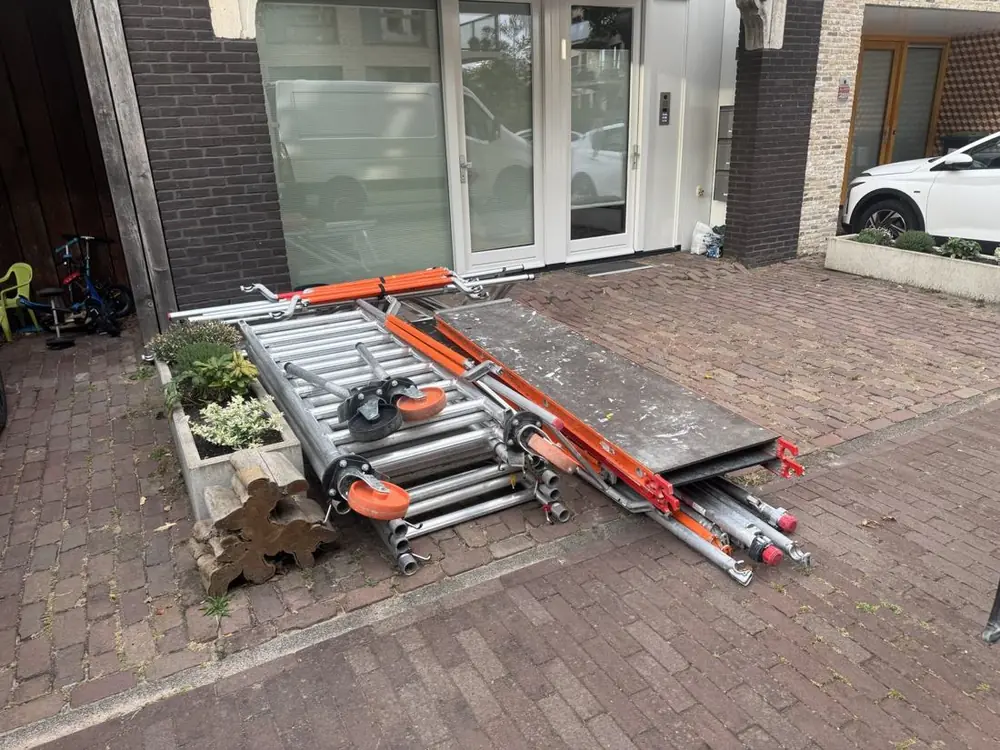
Scaffold parts beside a front door, the loose pieces you carry to the room for paintwork inside the house

When you have finished we come and collect the parts. You strike the tower, carry the pieces back out through the hall and stack them complete on the pavement, so the driver can reach them without a detour. Count them as you dismantle and you will spot a forgotten brace before the van pulls up. Set the parts down dry, since they go straight back into the load. What collection and delivery come to in your province is listed with the transport rates.

Safe interior painting on a scaffold from the rental fleet

The deck you stand your roller on is tested to EN 1004 and belongs to load class 3, meaning 200 kg is allowed per square metre. On paintwork indoors you seldom get near it, but do add up when a second person comes along and a full tub of emulsion is standing there. What matters more is not concentrating the weight at one end, for instance by putting all your material in one corner of the deck. A tub by the rail and the rest in the middle keeps the load even.

Inside the house the same basics apply as outside. Lock the wheels before you climb, and bear in mind that a brake on a poured floor or on laminate grips less than it does on block paving. Move the tower with a bare deck, no tools and nobody aboard. Strong wind is no worry indoors, but a draughty door slamming shut startles you just as badly, so wedge it. Check the brakes again once you have put the protective sheet back.

Tower with guard rails all round its deck, the same fall protection you stand behind at ceiling level indoors

The hazards that truly belong to this work sit in the things around you. Emulsion spatter makes a deck slippery, a dropped roller hits a wooden floor or a cabinet, and above your head there may still be a light or a smoke alarm. Keep the area under the deck clear and send children and pets out of the room while you work. Park tools you are not using in the middle of the deck. The full set of rules is at safe work at height.

In 5 steps

How hiring a mobile scaffold works

1
Choose working height

Pick the height that suits your job.

2
Book online

Sorted in 60 seconds, price shown instantly.

3
We deliver

At the agreed spot the next working day.

4
Assemble safely

Assembled by you, with a manual.

5
We collect

One call and we collect the scaffold.

Good to know

Practical tips for interior painting

1

Measure the narrowest interior door on your route and note the height under the head of the frame as well. A protruding handle and a threshold together can easily cost ten centimetres of usable opening.

2

Lay hardboard under the wheels where there is laminate or parquet, and carry that sheet with you when you reposition. Dragging across a wooden floor gives you exactly the scratch you meant to avoid.

3

Take the light fitting out of the ceiling before the tower comes into the room. A chandelier halfway across your deck costs you an extra position and usually the fitting itself at the end.

4

Finish the ceiling of each room completely before you start on the walls. Then you only have to assemble and reposition the tower once in that room instead of coming back to it.

5

Hang your paint tray on the guard rail and leave the deck free for your feet. Above a wooden floor that tray is the last thing you want to kick over while rolling a band.

6

Book an extra day after your final coat so you can dry, dismantle and carry the parts out unhurried. That saves a great deal of lugging on the morning the van pulls up.

Frequently asked questions

Frequently asked questions about interior painting

Which scaffold should I hire for interior painting?+

Interior painting is done from the RS44 room scaffold. That model reaches a working height of 3 to 4 metres, stays slim enough to pass an interior door of roughly 70 cm and has a foot you can still place in a furnished living room. An outdoor model only starts higher and weighs too much for indoors. If you doubt whether it will come along your hall, measure the narrowest point on the route and hold that figure against the specification.

How does hiring a room scaffold for interior painting work?+

Online you settle on a model and a working height, then mark a delivery day and a collection day. What you pay is settled beforehand, VAT included. We put down a complete, counted set, you carry the pieces in and assemble them, paint your ceilings and put the tower out dismantled on the final day. After that we take it away with us. The only thing you plan yourself is the order of your rooms.

How many hire days should I allow for interior painting?+

For a single room you often manage in a day, provided the second coat can go on that same afternoon. Do the living room with the hall as well and you should count on two to three hire days. The time goes mostly into masking, moving furniture, assembling per room and the drying between coats. Take in the stairwell too and it is better to hire the tower a little longer, since that gets its own build and costs half a day.

What does hiring a room scaffold cost and how does the discount work afterwards?+

The rental price follows from the room scaffold you pick and the height you state, and alongside that a fixed amount applies for bringing and collecting the set in your province. Both figures stand on the price page with VAT included. Because only the first twenty four hours count in full and every following day is charged with a hefty discount, booking a generous period is seldom an expensive choice. For work indoors that suits, since a ceiling dries at its own pace.

What working height do you hire for a ceiling or a high wall?+

Count on 3 to 4 metres of working height, with the platform of your tower at 1 to 2 metres. Measure from the floor the wheels will stand on up to the ceiling, and do it room by room, because an old front room can sit half a metre higher than a bedroom at the back. The overview page of working heights shows which build suits which size. Caught between two, hire the taller variant.

Do you deliver the tower to my door, or is collecting it from the hire depot an option?+

Either route is open to you. With delivery we set the parts down on your chosen day at the front door, on the pavement or on the drive, for a fixed amount in your province. Carrying them inside is down to you, and that goes smoothly because the set consists of loose pieces. Driving yourself is allowed too: by appointment the tower stands ready free of charge on Zeeburgerpad in Amsterdam. Do reckon on the pieces needing a fair load space.

Do I have to build the room scaffold myself when I hire it?+

Yes, assembly belongs to your side of the arrangement. We supply the complete set and fetch it again later, but carrying in, building, repositioning and striking are your tasks, with the manual and the instruction film to hand. For a room scaffold at this height that is a matter of half an hour. We do not come and build, and cherry pickers or system scaffolds are not in the range. For a living room ceiling none of that is needed anyway.

Can I hire for longer if the interior painting overruns?+

That is possible, provided you tell us in good time. We then push the collection day back, unless the tower is already reserved for the next customer. Indoors, work often runs on because a ceiling stays wet longer than expected or because another room gets added. You choose the collection date yourself, so booking one extra day straight away is the simplest insurance. Returning it early is fine too, and costs you nothing at the far end.

How much space does hiring a tower cost me in an ordinary room?+

Keep roughly a metre free all round the tower, so you can walk past it and the stabilisers have somewhere to go. In a living room that means the sofa and the table towards the middle and the small stuff out. Reckon on shifting the tower a few times as well, so leave that lane clear. If a room is genuinely full, empty it before the parts are delivered, or you will be dragging cabinets about on build day.

Will a scaffold damage my floor or my skirting boards?+

Not if you protect it. Lay hardboard, thin sheeting or a sturdy tarpaulin under the wheels and the stabilisers, and sweep the floor clean before the tower goes on it, because a grain of sand under a wheel does the most harm. Carry the loose pieces upright along the hall so you miss the skirtings and the door posts. Done that way, having a scaffold indoors leaves no damage to your floor or your finish.

When do I get the deposit back after the room scaffold goes?+

You settle a deposit when reserving your tower and get it returned one working day after the set has been counted and approved. With paintwork that means keeping an eye on residue: get spatters off the tubes and the deck before they harden, and hand in every part you were given. A cloth over the platform while you roll saves a lot of cleaning afterwards, and you notice it in how quickly everything is wrapped up.

Can the tower go from one room to the next fully built?+

Usually not in one piece. Indoors, doorways and halls are too narrow to wheel an assembled tower through, so you build it again in each room. That is less work than it sounds, especially if you lay the pieces out in order. Plan your job room by room and finish each ceiling entirely before you dismantle. That can easily save you a day on the hire as well, because you are not returning to the same room twice.

Hire a mobile scaffold for interior painting today?

Calculate your rental price now or ask for free advice.

Rolsteiger van SteigerTaxi geleverd op locatie
Book it online

Your scaffold sorted in 2 minutes.

Choose your scaffold and working height, see the price instantly and book online.