
See your price
Application

Painting high walls? Choose the right scaffold.

A living room with a raised ceiling, or a void above the hall, is indoor work where steps let you down. The top metre and a half of emulsion has to meet the rest wet in wet, and that only comes off if you stand firmly and can slide sideways as you go. For painting high walls you hire the Altrex RS44 room scaffold, good for 3 to 4 metres of working height and slim enough for an interior door. Below: how to pitch it indoors and how many rental days a void asks for.

  • Order before 3 pm, delivered tomorrow
  • Professional Altrex scaffolds
  • Up to 14.2 metres working height
  • Easy to assemble yourself
4,2 tot 14,2 mWorking heights available
12Provinces served
7Days a week
200 kg/m²Load class 3
In short
  • For painting high walls we recommend the Room scaffold.
  • Painting high walls is done from the RS44 room scaffold, which reaches 3 to 4 metres indoors and passes an interior door.
  • Emulsion wants a wet edge, so you have to carry a band through without stepping off the scaffold in between.
  • Measure the doorway into the room before you hire, because the frame has to come through it in separate parts.
  • First 24 hours from €50 incl. VAT and delivery; every day after that 95% off.
Key facts for this job
FeatureValue
Recommended scaffoldRoom scaffold (Altrex RS44)
Working height for this job3 to 4 metres
Available working heights4.2 to 14.2 metres
StandardEN 1004, load class 3 (200 kg per m²)
DeliveryOrdered before 3 pm, delivered next working day
Each extra day95% off, from €2.50 a day
Why a mobile scaffold for painting high walls?

Safe, stable and professional work at height

Indoors the height looks like the hard part, but with emulsion it is the joining. Emulsion pulls through as it dries, and an edge you left standing for a moment shows up for good under raking light. Every band therefore has to run top to bottom in one pass and butt against the previous one while that is still wet. Which means you stay up on the deck, with the bucket within reach, and slide a couple of metres sideways without climbing down. A pair of steps forces the exact opposite on you. Hiring a scaffold for painting high walls is therefore about working time per band, about a firm floor under your bucket, and about a frame that will come into your room.

  • Holding a wet edge without climbing down between bands
  • A frame that passes an interior door of 70 cm
  • Reach to four metres alongside an open void
  • Bucket of emulsion within reach on the deck
Read more about working safely →

Which room scaffold to hire for painting high walls

Indoors your limit is not the height but the door frame. For emulsion work you therefore hire the Altrex RS44, a room scaffold that goes through an interior door from roughly 70 cm in parts and reaches 3 to 4 metres inside the house. That is exactly the band a raised ceiling, a stairwell or a void falls into. An outdoor frame on four swivel castors will simply not enter that room. More about this type is on the page about room scaffold hire.

The deck itself matters more here than on most indoor jobs. On the platform there is a bucket of emulsion, a spare roller lying down and a wet brush hanging for the angles, and you still have to move around all of it without kicking anything over. A deck length of 245 cm gives you that room, and it is also the width of wall you can finish per set up without losing your wet edge. Broader than that the deck need not be.
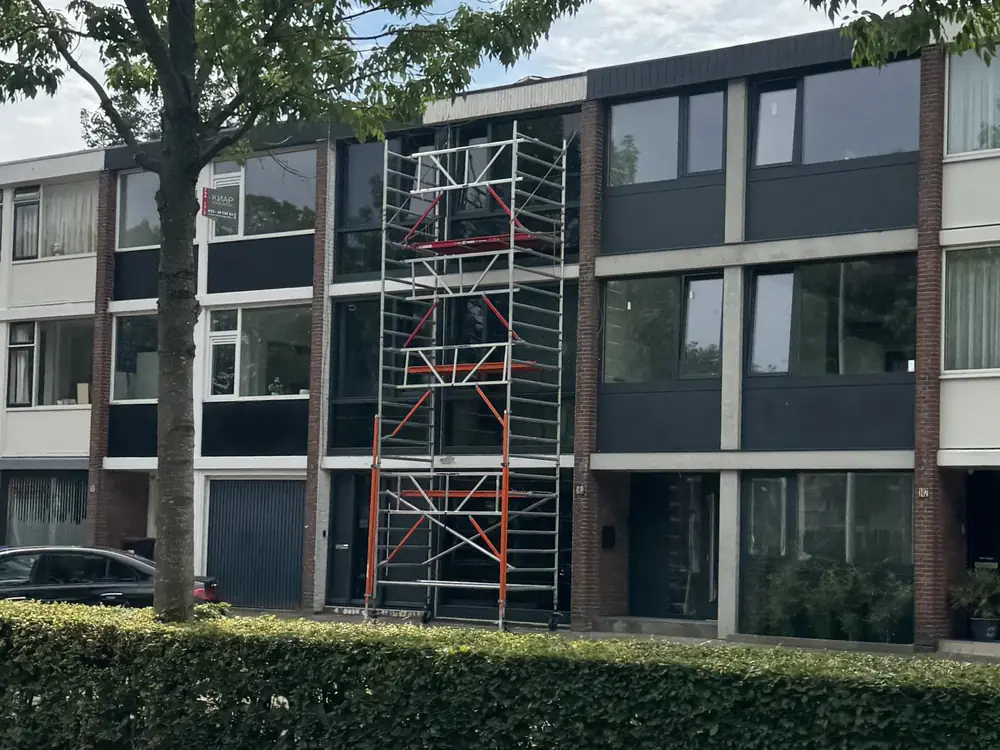
Scaffold with a low built platform and guard rails, comparable to the pitch you paint a high wall from

A larger mobile scaffold makes little sense inside. It will not pass down the hall, it will not turn the corner at the stairs, and the extra working height goes unused because your ceiling is fixed. Only where a void runs deeper than four metres does this model fall short and you have to look further. Stay under four metres and this room scaffold is the obvious pick. What is and is not possible indoors is set out in the guidance on towers inside the house.
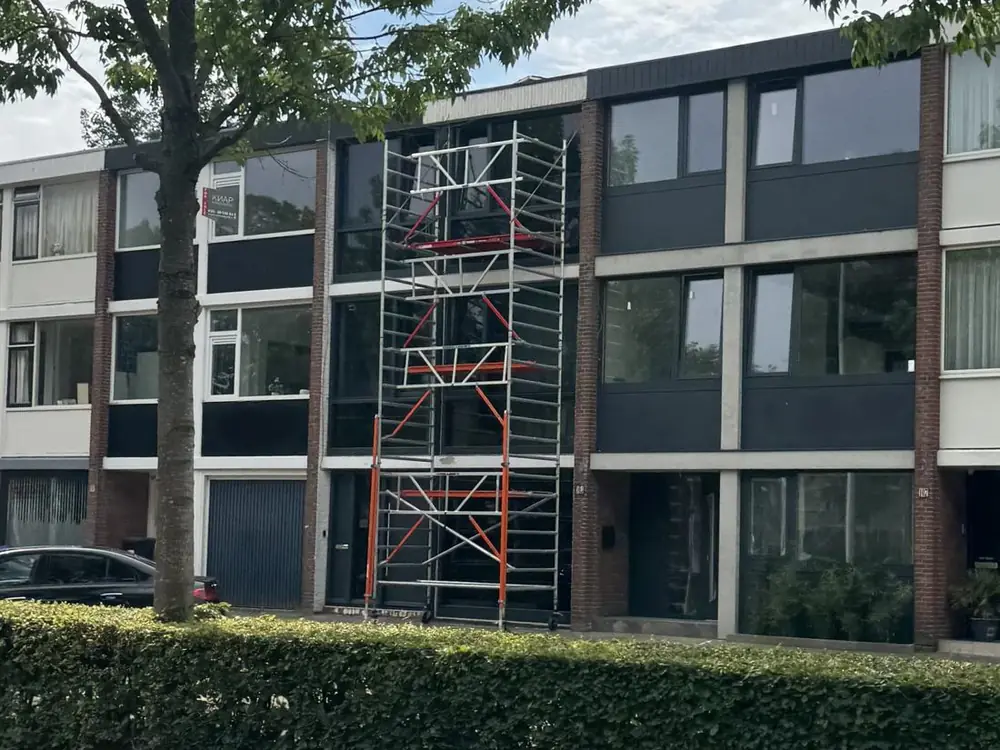
Working height to hire for emulsion on a four metre wall

On emulsion work you measure to the seam where the wall meets the ceiling, because that corner has to be cut in with a brush. In a raised living room that sits around three metres; alongside a void it climbs to four. When you book working height with a hire firm, we mean your platform height plus the good two metres you still bridge with a lifted arm. What a low build gives you is shown at four metres of working height.

Measure from the finished floor the scaffold will stand on, and mind the stairs. Beside a void part of the frame sometimes sits on a half landing or right next to an open stairwell, so your starting level is higher or lower than in the rest of the room. Look too for a beam, a downlight or a duct sticking out, because your build will meet an obstacle like that sooner than it meets the ceiling. Measure that point separately.

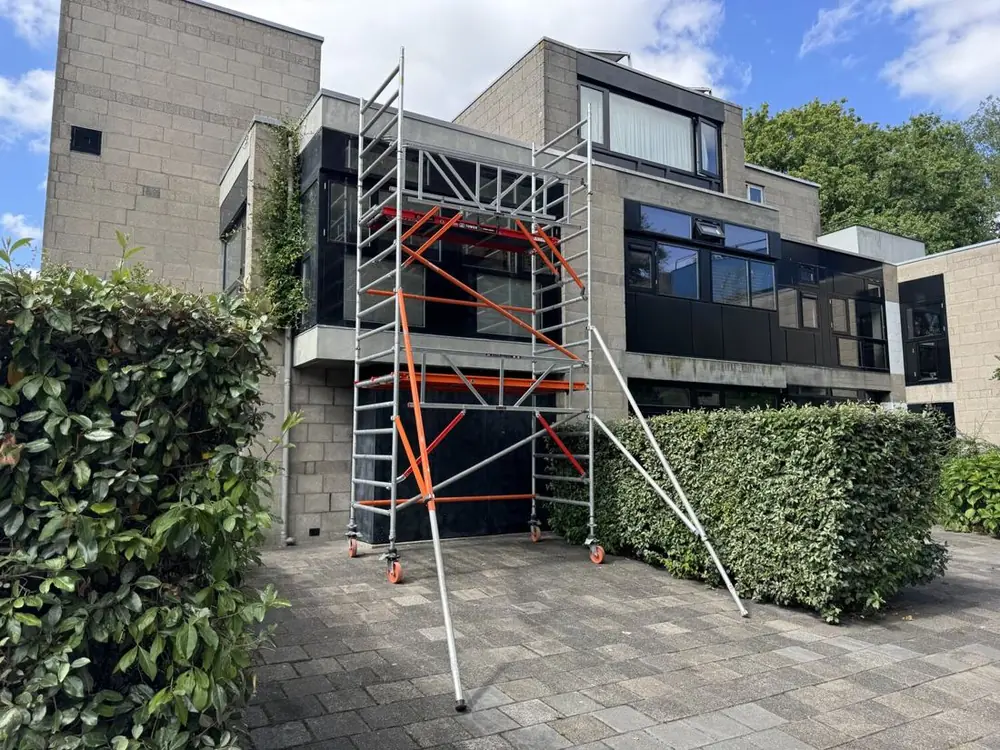
Built up scaffold with deck boards and guard rails at modest height, the reach a tall indoor wall calls for

Choose too low and you paint the top strip with your arm fully stretched. The coat goes thin and uneven, and on a big wall you see that transition come back as a band once it dries. You also lose your wet edge while climbing off the steps to fetch something. Hiring roomier costs you only a little extra build time indoors. For a wall carrying on over more than one storey, look instead at a wall up to first floor level.

Hiring a room scaffold and pitching it along the high wall

A high wall is seldom entirely clear. There is a radiator beneath it, a stair rail running past, or the void begins half a metre beyond the edge of the floor. So establish first where the four feet come down and whether they all rest on the same solid surface. A leg half on a stair tread or on the lip of a landing is not a pitch you want to climb with a full bucket, however short the job.

Inside, the castors and stabilisers are your biggest risk of damage. Parquet, poured floors and vinyl do not care for point loads, and emulsion splashes soak into the joint between two boards. So lay hardboard or a stout sheet down first over the entire strip you will travel that day, and only then set the scaffold on it. That way you need not drag the dust sheet out from under the wheels each time you shunt a band along, and your floor survives.

Castors and extended stabilisers beneath a scaffold, the parts that rest indoors on a protected floor

Clear the room out beyond the last band you intend to do that day. A sofa that still has to be moved halfway through costs you time at precisely the wrong moment, namely while a wet edge is waiting on you. Think about what is on the wall itself as well: switches, a thermostat, picture hooks and the fixings of a curtain track are better off removed before the hired scaffold stands in front of them.

How many days to rent a room scaffold for emulsion work

On this job count in coats rather than in walls. A high wall takes two coats of emulsion as a rule, and between those two the first has to be through before you can go over it again. Which means leaving the scaffold standing overnight where it stands. Add the preparation to that, because masking skirtings, filling holes and cutting in the top edge all happen from the pitch as well. Two to three rental days is a realistic period for a void.

What stretches the planning indoors is the climate in the house. A cold, damp room lets emulsion cure more slowly than the tin promises, and painting on over a coat that still tacks always makes more work than waiting does. Open a window in the morning and ventilate, but do not put a heater straight onto the wall. And bear in mind that the room will be out of use for the household throughout those days.

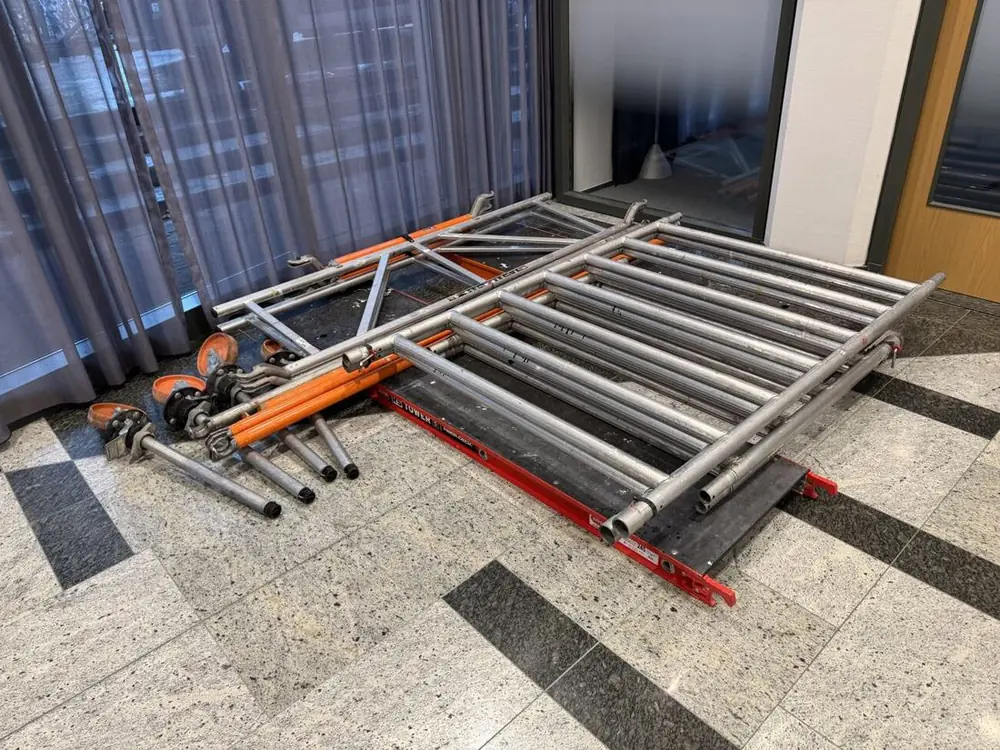
Counted and checked set of scaffold parts, the way you receive it for a number of rental days indoors

Holding on longer is not an expensive choice with this hire. The first twenty four hours form the weight of the bill and on everything after that 95 per cent comes off the day rate. Book too tightly and you are waiting beside a half painted wall for the van to arrive, which is exactly the moment that last coat was still due. How the rental price is put together can be checked on the page with our tariffs before you lock in your dates.

Which mobile scaffold suits painting high walls?

Most chosen
Kamersteiger RS44
  • Working height up to 4 metres
  • Compact and narrow
  • Great for indoor and small jobs
View and calculate →
Smalle rolsteiger RS51
  • Working height up to 14.2 metres
  • Narrow (75 cm)
  • Ideal for narrow passages
View and calculate →
Brede rolsteiger RS52
  • Working height up to 14.2 metres
  • Wide platform (135 cm)
  • Extra stability and workspace
View and calculate →
1-persoons steiger MiTower
  • Working height up to 6.2 metres
  • Very compact
  • Quick and easy to assemble
View and calculate →

Painting high walls from the platform with a wet edge

Divide the wall before you start into bands that match the 245 cm your deck is long. From one pitch you do the upper strip over that full length, cutting in along the ceiling and into the corner as you go. Work away from where the light falls, so you can see for yourself how far you have got. The lower half of those same bands you then roll in from floor level, with the same roller and out of the same bucket.

Shunting along belongs to the rhythm of your wet edge. Do not roll the last band of a pitch right out to its edge, but leave a hand's width still wet for when you move the scaffold. Set the bucket on the floor before you release the castors, move, put the brakes back on, and only then pick that edge up again. The transition between two pitches then stays invisible, even when you look along it later under raking light.

Scaffold carrying a platform 245 cm long, the same measure you divide a tall indoor wall into bands by

What you need up top you carry up in one trip: the bucket, a roller on a short handle, a brush for the junctions and a clean cloth for splashes. A long pole works against you inside, because you catch the lamp or the ceiling with it. People underestimate how often they end up descending: on a wall of eight metres wide that already comes to three separate pitches per coat, so six of them across two coats.

Room scaffold hire with delivery for an indoor job in emulsion

The set arrives at your door in loose, counted parts and not as a whole. For indoor work that is a blessing, because it lets you carry it piece by piece down the hall to the room being painted. Do not put the parts down in that room itself, but in the hall or in an adjoining space. Anyone reserving before 15:00 on a working day has the complete set indoors one working day later.

The date on which delivery happens and the day we take it back again are yours to mark. For emulsion work you would rather have it brought a day ahead of your first coat, so you can build and mask in peace. Assembly is something you do by hand, guided by the manual supplied and the instruction footage. In a cleared room two of you are busy with that for about an hour, ladder and guard rails included.

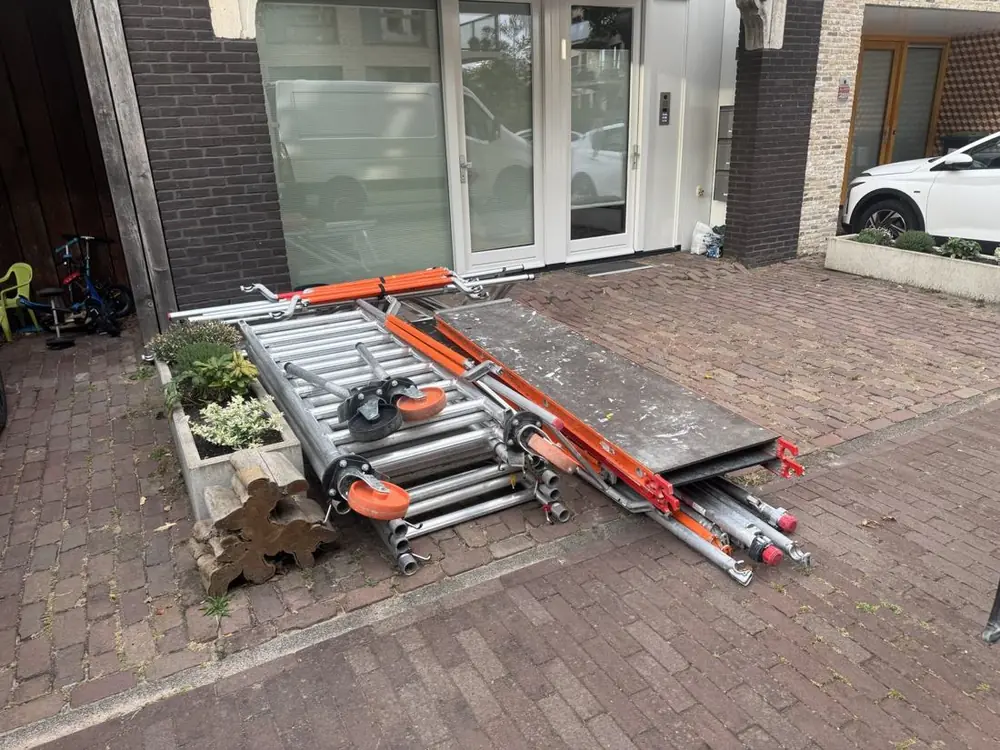
Scaffold components standing ready at a front door, the parts carried inside one at a time for an emulsion job

Once the painting is finished and dry you strike the room scaffold, carry the parts back to the hall, and we load it into the van on the agreed day. Wait until the emulsion is hard before you start stripping down, or you will drag fresh paint past the door frames into the passage. Count the parts as you dismantle so nothing stays behind in the room. What the return trip comes to differs from one province to the next, and you can read that figure back under the charge for delivery and collection.

Painting safely at height on a hired room scaffold

Carrying capacity: 200 kg on every square metre of deck, called load class 3 in the standard EN 1004. On emulsion work that sounds like far too much, until you add up what is really up there: you, a second person cutting in the corners, a full bucket, a spare tray and a box of tools you would rather not keep carrying down. What such a class allows in practice is set out in the piece on loading and weight.

The ordinary conditions apply indoors as well. Brake the castors before you go up the ladder, never move it with a person or a bucket on the platform, and always climb up through the inside rather than round the outside. That last one is a genuine temptation inside, because the distance down to the floor looks so small from up there. After each move check that all four stabilisers stand firmly again on the protected floor before you climb.

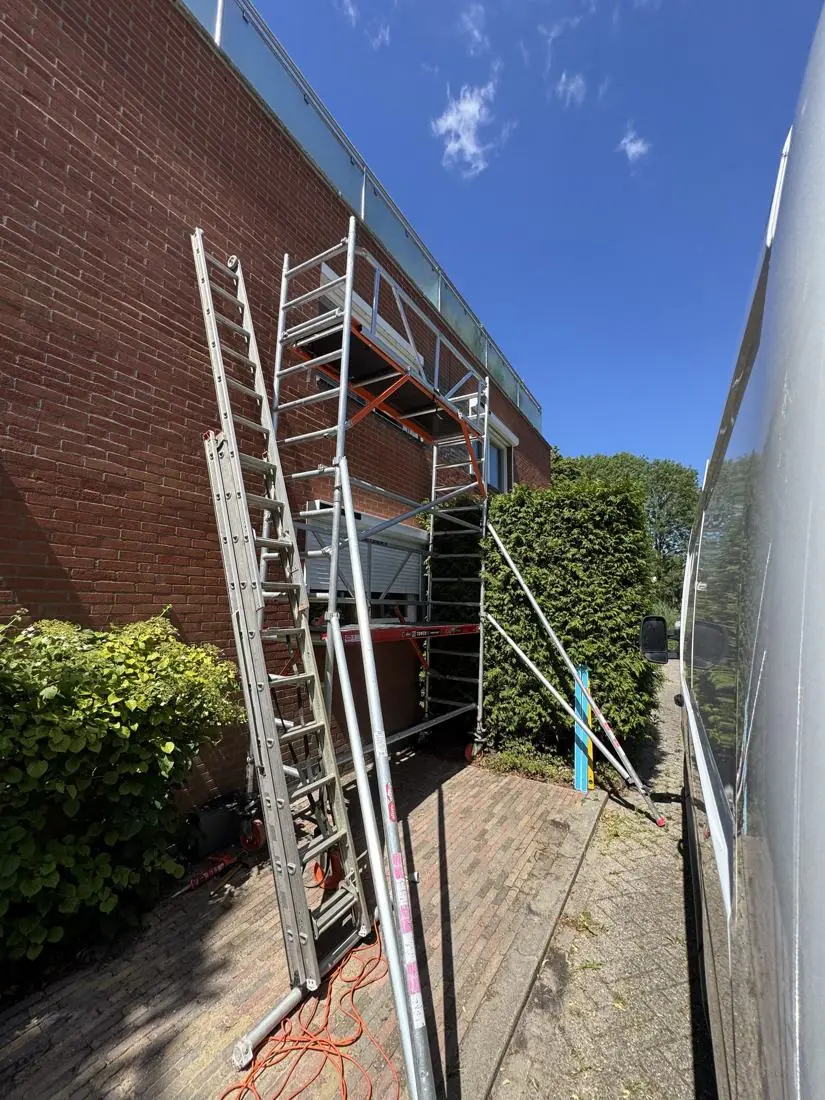
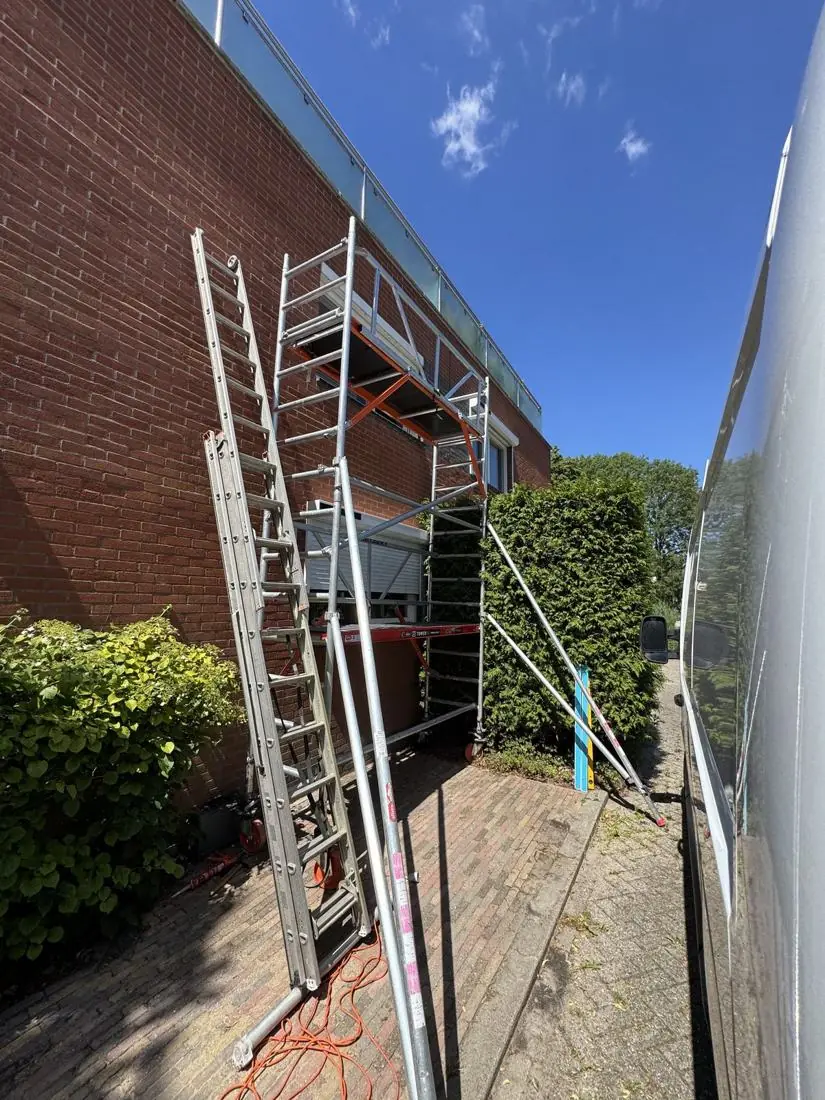
Mobile scaffold up against brickwork beside a separate sliding ladder, a deck taking two hundred kilos on every square metre

The hazard that goes with this work is slipperiness. Emulsion dripping off the roller onto the deck boards makes a patch where your shoe finds no grip, and you notice it only as you step backwards. Put a piece of card under the bucket and wipe splashes away at once. Keep the space directly below you free of household and pets too, especially with a bucket standing near the edge. The full list of requirements sits under the rules for work at height.

In 5 steps

How hiring a mobile scaffold works

1
Choose working height

Pick the height that suits your job.

2
Book online

Sorted in 60 seconds, price shown instantly.

3
We deliver

At the agreed spot the next working day.

4
Assemble safely

Assembled by you, with a manual.

5
We collect

One call and we collect the scaffold.

Good to know

Practical tips for painting high walls

1

Cut the angle between wall and ceiling in with a brush the moment you reach a new pitch. Leave it until the roller is already running and your wet edge has gone before you get anywhere near it.

2

Fill a smaller bucket than you are used to and carry it up twice instead. A full tub on the deck of a room scaffold is heavy, slippery and awkward to shift when you shunt along.

3

Mask the skirting and the floor edge over the whole length you are painting that day, and not per pitch. With the hired scaffold standing in front of it you simply cannot reach it later.

4

Shift the furniture into the centre of the floor rather than against the opposite wall. You need room on both sides of the room scaffold to walk past it and to set the bucket down.

5

Stand a clamp lamp on the floor throwing light at a slant across the wall. From the platform you are looking from close up, and without raking light a thin patch or a missed edge simply will not show.

6

Ask for delivery a day before your first painting day. Then you can build, mask and dust off without cramming all of it into the morning on which the first coat is meant to go on.

Frequently asked questions

Frequently asked questions about painting high walls

Which scaffold should you hire for painting a high wall?+

Indoors take the RS44 room scaffold: it reaches 3 to 4 metres and goes in parts through an interior door from around 70 cm. That covers a raised ceiling or a void without having to bring a large frame down the hall. To hire a mobile scaffold of the outdoor sort has little point in here, because it will not come into the room and you would never use the extra reach anyway. Do measure your narrowest opening beforehand.

How does hiring a room scaffold for indoor emulsion work go?+

You choose the model and the build online, put a date against the drop off and against the return trip, and see at once what you pay, VAT included. We set the counted scaffold parts by the front door, you carry them in, build, and paint the wall band by band. On the final day you put everything ready dismantled and we take it away again. What you have to arrange yourself is the drying time between the two coats.

How many days do you want to rent a room scaffold for a four metre void?+

Reckon on two to three rental days. On the first you build, mask and cut in; then the first coat of emulsion follows, and the second can only go on once the first is properly dry. That night the scaffold simply stays where you stopped. If you are working alone, or it is a void with several walls meeting at a corner, add a day to the hire without hesitating over it.

What does hiring a scaffold for emulsion work cost and how does the discount sit?+

The amount hangs together with the chosen build and the model, topped up with bringing and fetching to your address. Everything is on the site including VAT, so you know exactly where you stand before reserving the scaffold. On painting work the make up of the rental price falls kindly: the first twenty four hours press on the bill, the days after it barely at all. Fixing one generous period is wiser than two separate blocks.

Which working height should you hire for a wall four metres high?+

Then pick a build that makes 4 metres of working height, so you come comfortably to the join along the ceiling with a brush. Measure from the finished floor where the scaffold will stand up to that seam, and not to the top of a window frame. If part of the pitch beside a void sits on a landing, measure that point separately. That is the height you pass on when you hire.

Is the room scaffold delivered to the house or do you collect it yourself?+

Either is workable. Choose delivery and we put the parts by the door on the day you picked and take them away afterwards; a fixed price per province applies to that. Prefer to drive, and you can take the complete set free of charge by appointment from Zeeburgerpad in Amsterdam. For an indoor job that is quite doable, because a room scaffold consists of relatively short parts that fit in an ordinary car.

Do you have to put the room scaffold together yourself after hiring it?+

Yes, assembly stays work for the hirer. We deliver the scaffold in parts and remove it later, but building, shunting and dismantling you do by your own hand, helped by the manual supplied and the footage. In a room that has been cleared out first, that costs two people roughly an hour of steady work. Count that time into your planning, because no emulsion usually reaches the wall on the day you build.

Can you rent for longer if the painting takes more bands than you thought?+

You can; report it in time and we will move the collection day, unless the room scaffold is already booked in with a following customer. On painting work that happens regularly, usually because a wall wants more covering than expected or the first coat dries slowly. To avoid that tension, take an extra day into your reservation straight away. Handing back early is always allowed, so you never pay for a day you did not use.

How much room do you have to clear in the room for the scaffold?+

Keep a strip along the wall wider than the scaffold itself, so you can walk past and put the bucket down somewhere. Push furniture into the middle rather than up against the other wall, or you will jam yourself every time you shunt along. Clear that strip over the full width you are painting that day; moving a cupboard halfway through while the tower stands there costs you precisely your wet edge.

Can you keep it on hire if the emulsion dries more slowly than planned?+

Yes, and indoors in autumn that is a real scenario. The room scaffold stays where it is, castors braked, and you pick the second coat up a day later. Since the day of the return trip is one you fix yourself, a delay of that sort costs you nothing but the single extra rental day. Ventilate steadily in the meantime and do not stand a heater right against the wall, or the top skin dries shut too fast and splits open.

What about the deposit if emulsion gets onto the scaffold?+

A deposit travels with the reservation. Once the return trip has been made and every part counted off, that sum is booked back inside one working day. Spatters on the deck boards belong to painting, but dried emulsion is another story: wipe drips away while they are still wet. Lay a piece of card under the bucket and go over the boards before you take the scaffold apart and stack it in the hall for collection.

Can you hire the same room scaffold to do the ceiling afterwards?+

That is an obvious move, since the pitch is standing there anyway. Reserve an extra day at once in that case, because a ceiling costs more time per square metre than a wall and you shift the scaffold more often. Bear in mind that working above your head tires you out faster than a wall does, and that it means climbing down to refill rather more often. More on that kind of job is at painting a ceiling.

Hire a mobile scaffold for painting high walls today?

Calculate your rental price now or ask for free advice.

Rolsteiger van SteigerTaxi geleverd op locatie
Book it online

Your scaffold sorted in 2 minutes.

Choose your scaffold and working height, see the price instantly and book online.