
See your price
Application

Painting a ceiling? Choose the right scaffold.

Painting a ceiling means brush and roller, and at least two passes across the same room. Every pass wants the same standing positions, so indoors you need to shuffle along briskly with your head close under the surface. That is why the RS44 room scaffold is the model to hire, the one Altrex builds for interior work and whose parts pass an ordinary internal door. Below is which build suits your ceiling height, what two coats cost in hire days, and how the scaffold reaches the room without marking your floor.

  • Order before 3 pm, delivered tomorrow
  • Professional Altrex scaffolds
  • Up to 14.2 metres working height
  • Easy to assemble yourself
4,2 tot 14,2 mWorking heights available
12Provinces served
7Days a week
200 kg/m²Load class 3
In short
  • For painting a ceiling we recommend the Room scaffold.
  • Painting a ceiling indoors runs off the RS44 room scaffold, which reaches four metres and comes apart to pass an internal door.
  • You roll towards a wet edge every time, so the tower has to move on before the previous band starts closing.
  • Count your passes through the room first, because after cutting in and a primer there is still a covering coat.
  • First 24 hours from €50 incl. VAT and delivery; every day after that 95% off.
Key facts for this job
FeatureValue
Recommended scaffoldRoom scaffold (Altrex RS44)
Working height for this job3 to 4 metres
Available working heights4.2 to 14.2 metres
StandardEN 1004, load class 3 (200 kg per m²)
DeliveryOrdered before 3 pm, delivered next working day
Each extra day95% off, from €2.50 a day
Why a mobile scaffold for painting a ceiling?

Safe, stable and professional work at height

Painting a ceiling has you looking up for hours while you push a roller on a pole across a surface hanging above your head. That only comes off if you stand directly beneath it and your feet stay put, because every stretch shows up later as a band that has not covered evenly. A pair of kitchen steps denies you that stance and makes you climb down and drag them along every few square metres. Anyone weighing up scaffold hire for ceiling work is mainly buying a flat 245 cm deck to take into the room, roomy enough for you, your paint kettle and your cutting-in brush. What is left to settle is the build you order and the number of days.

  • A roller on a pole just overhead
  • Painting a ceiling in two or three passes
  • Moving on before the wet edge closes
  • Loose parts carried in through the doorway
Read more about working safely →

Painting a ceiling: which room scaffold to hire indoors

For ceiling work in a living room, a bedroom or a hall the Altrex RS44 is the model that fits. It is a room scaffold, made to be used inside, and its frames go through a doorway of roughly 70 cm in sections you carry by hand. That sounds like a detail until you have to take a build along a passage, squeeze past a stair rail and turn one more corner on a landing. The broader models among the wheeled scaffolds we hire out stop at the first door frame.

On a deck of 245 cm you are seldom up there with just the roller. There is a kettle or a bucket, a spare sleeve, a cutting-in brush, a screwdriver for the light fitting and a rag for the spatter that ceiling work always throws down. You want that lot beside your feet rather than hooked over a guard rail, because your face is turned upwards and you would rather not grope about blindly below you. A fixed place for the kettle saves you half a minute on every band.
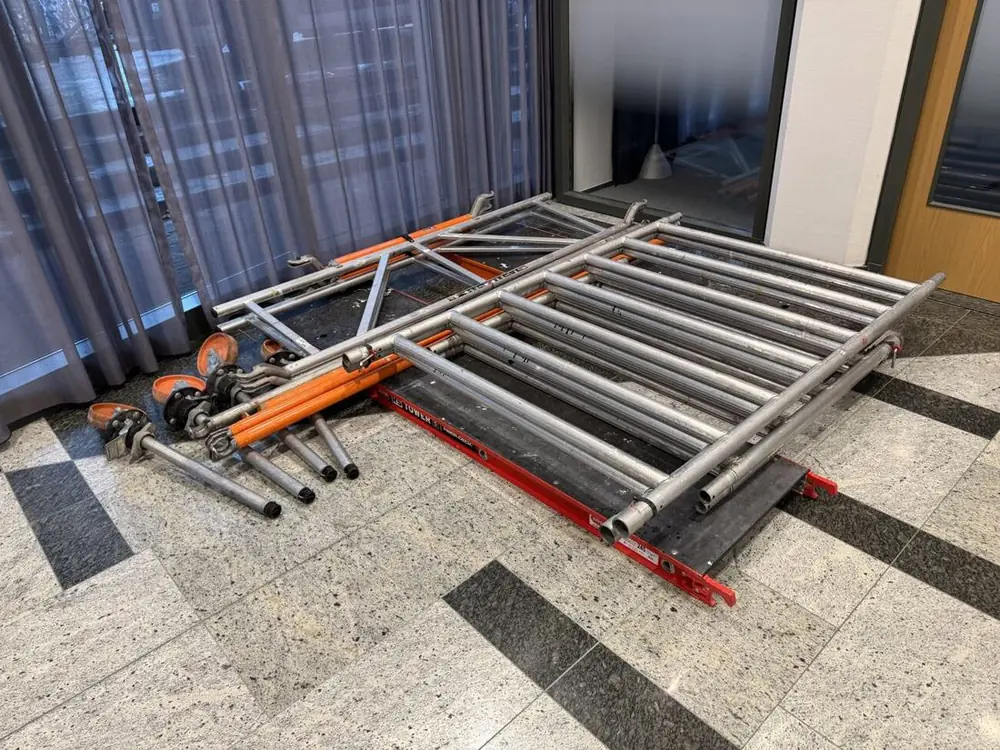
Complete counted set of room scaffold parts checked over, the components that go through an internal door one by one

With two of you it runs better still: one cuts the edges in, the other rolls the open surface, and you take turns on the deck. This build copes with that perfectly well, as long as you do not both plant yourselves beside a full ten litre bucket at the same moment. If you are unsure whether this model suits your room or whether an ordinary wheeled one would serve you better, this comparison of the two types sets the differences out.
Hiring the right deck height under a living room ceiling

The highest point of this job is the ceiling itself, which makes measuring up pleasantly unambiguous. In a post-war house it hangs at around 2.60 metres, in a nineteen thirties property nearer 3 metres, and above a void or in a converted upper flat a good deal more. Measure from the bare surface the castors will end up resting on. If there is still carpet down that comes out before you paint, take the state the room will be in while the job runs.

The rule that working height equals platform height plus roughly 2 metres of reach lands differently on a ceiling than on a facade. You do not want the roller shoved up on straight arms but held just above the crown of your head, so you are after a deck height that leaves your head about half a metre below the surface you are coating. For the usual room heights that puts you in the 3 to 4 metre build, precisely the span this model was made for.

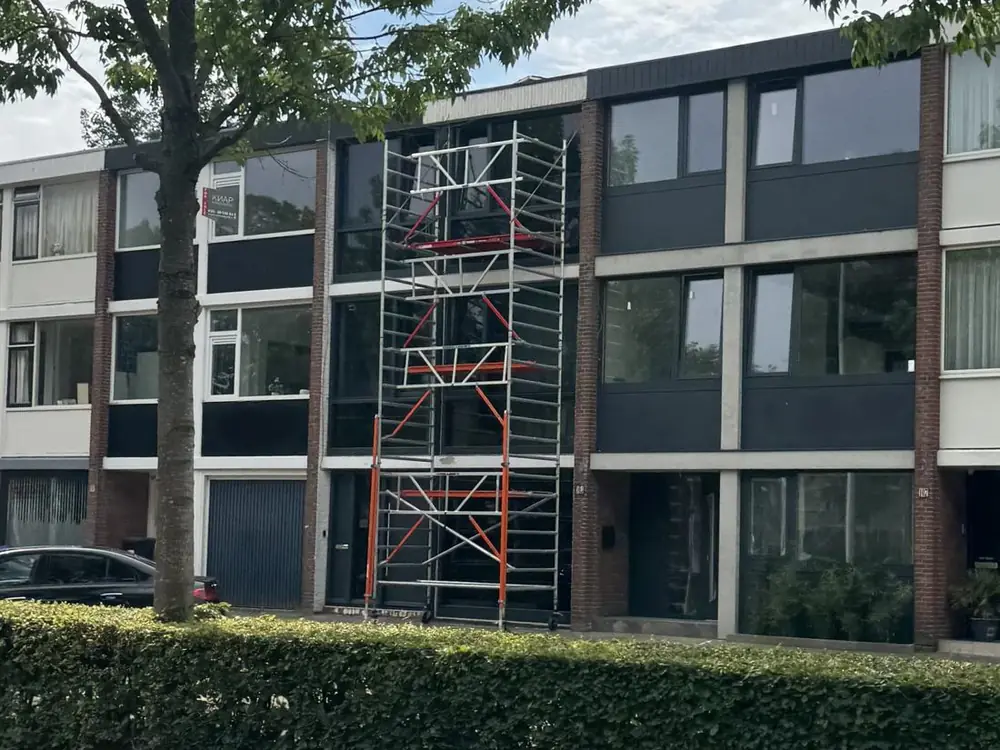
Mobile scaffold erected against a front elevation, the platform stands you choose between when hiring for a ceiling

Sit too low and you stand there stretching, lose sight of your wet edge and lay a coat that covers unevenly, which you get to put right on the next pass anyway. Choose too generously and you roll with a bent neck and feel it in your lower back within the hour. Caught between two stands, take the higher one and leave the bottom section out of use; that costs you nothing in build time. Which platform stand goes with which reach is set out on the page about four metres of working height.

Where the hired tower travels while you roll a ceiling

Painting a ceiling happens in an empty room. Everything that can leave moves to another room, the rest shifts into the middle under a sheet, and the middle is exactly the ground you need for wheeling about. So clear a free strip from wall to wall first, because that is where the build has to travel. A cupboard that stays where it is quietly decides where you start and where you finish, so walk that route once before you cover a single thing.

Then look at the floor everything will rest on. On laminate, parquet or a poured floor you want no castor marks and no brace rubbing along a skirting, so put hardboard or thick card down wherever you come to a standstill. A threshold between two rooms is not something you simply ride across with an assembled tower. Spare a thought too for the pendant light or the smoke alarm hanging right above your route, which is better taken down before you start.

Scaffold parts set down in the street beside a house, the load that still has to reach your cleared room

Space has to be left at the base for the stabilisers, and between four walls that is tighter than it looks. A radiator, a deep window board or a door that swings inwards sits in the swing of such a leg soon enough. Keep the doorway itself clear as well, since you walk through it all day with kettles and sleeves. If the walls are next on your list, that approach is covered under emulsioning walls that run up high.

Two coats, three passes: how many hire days

Painting a ceiling in an average room rolls out in a couple of hours, but that is not where it ends. Beforehand the edges have to be cut in, holes filled, dust wiped off and the whole space covered. After that comes the wait until the coat is hard enough to go over a second time. If there is an old mark in it, or you are moving from a dark colour to white, a blocking coat joins the queue and you make three passes instead of two.

Add those passes together and you are at two or three days with the scaffold simply left standing in the room. That is the practical reason to take a longer period than the arithmetic suggests: striking the build and putting it back up a day later costs more effort than leaving it where it stands between coats. How best to pin down the length of your period is described in the piece on taking a scaffold by the day or by the week.

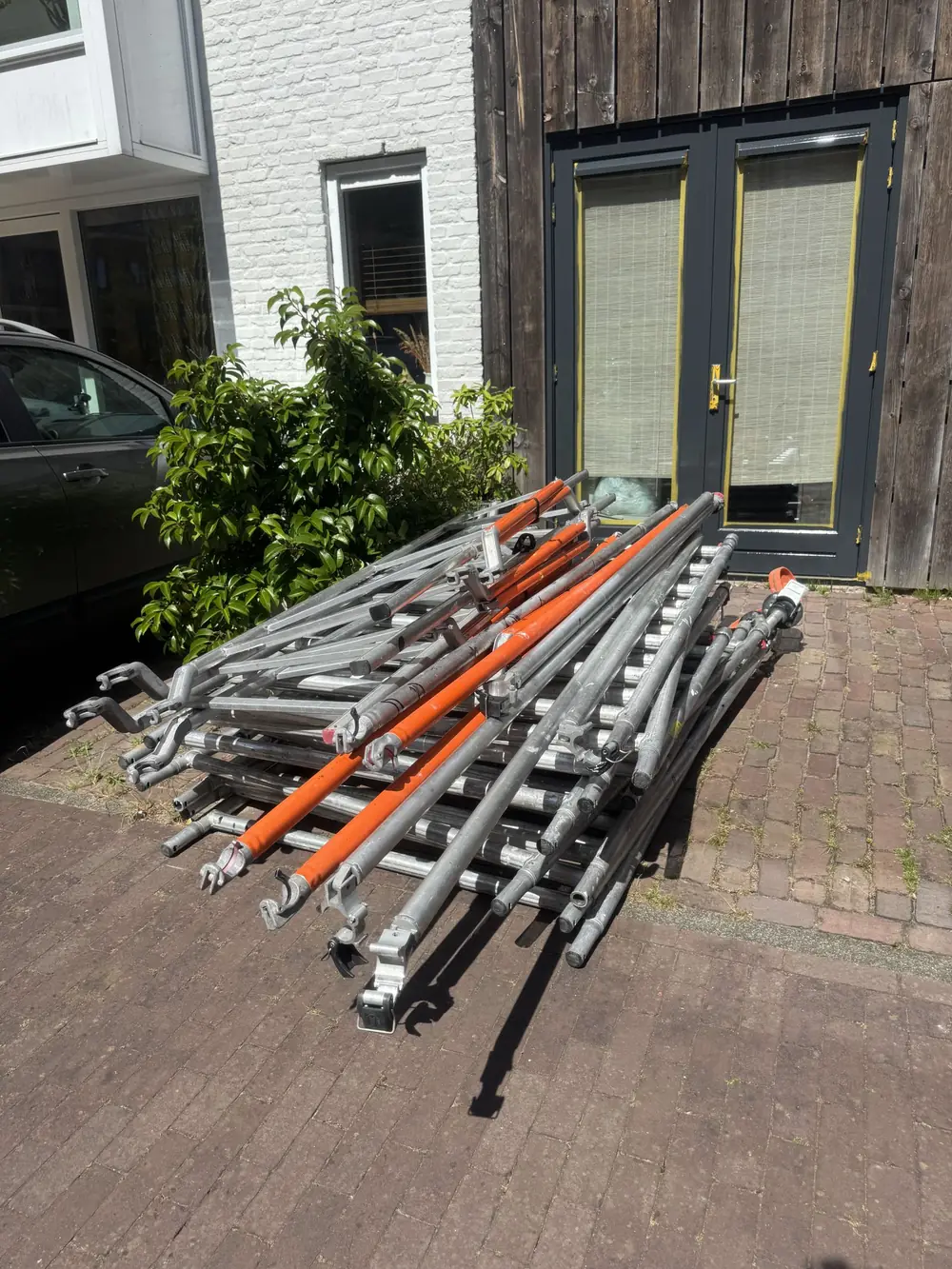
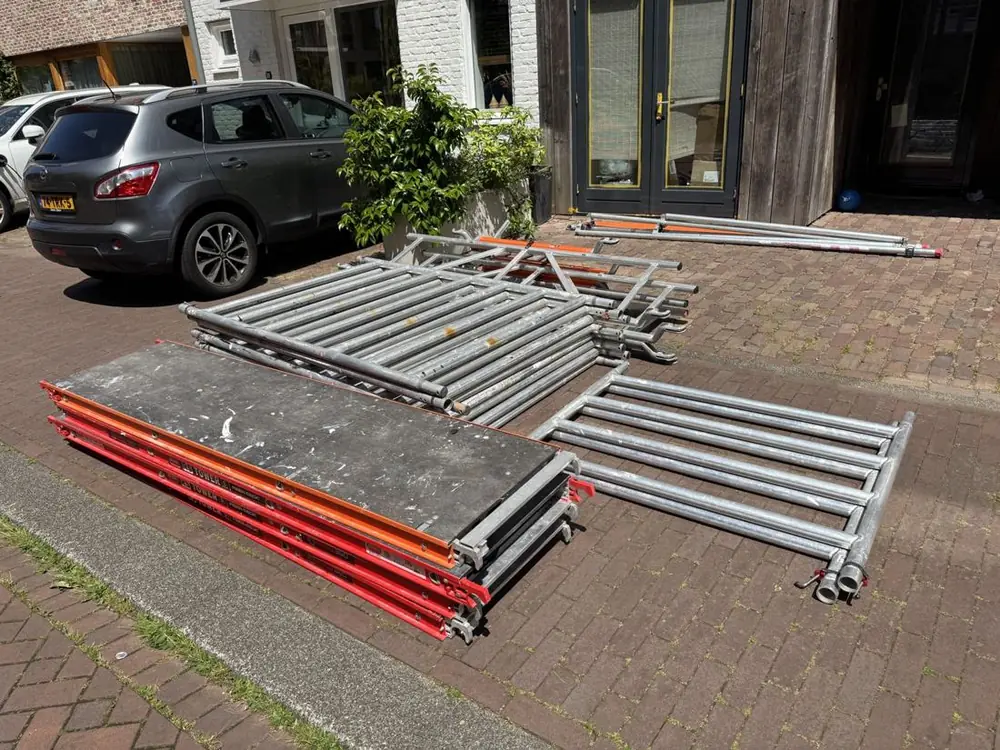
Frames, tubes and orange braces on a brick drive, the hire set that stays with you for two or three days.

For what you pay, that works in your favour. Only that first twenty-four hour block goes at the full rate; from the second hire day onwards 95 per cent comes off, so a day given over to hardening barely touches what you pay. Hire tightly and you find yourself looking at a half-finished ceiling with a van already outside. Put your end date past the day the last coat goes on rather than on it, and keep the following morning free for clearing up.

Which mobile scaffold suits painting a ceiling?

Most chosen
Kamersteiger RS44
  • Working height up to 4 metres
  • Compact and narrow
  • Great for indoor and small jobs
View and calculate →
Smalle rolsteiger RS51
  • Working height up to 14.2 metres
  • Narrow (75 cm)
  • Ideal for narrow passages
View and calculate →
Brede rolsteiger RS52
  • Working height up to 14.2 metres
  • Wide platform (135 cm)
  • Extra stability and workspace
View and calculate →
1-persoons steiger MiTower
  • Working height up to 6.2 metres
  • Very compact
  • Quick and easy to assemble
View and calculate →

Painting a ceiling from the 245 cm scaffold platform

A deck of 245 cm gives you a ceiling strip of a good two metres from each standing position. Divide the room into strips like that in advance and work them in a fixed order, usually from the window into the room, so the raking light travels with you and you can see where you had got to. Cut the entire perimeter in with the brush first, or halfway along you will be shuffling about with two tools in your hands at once.

You roll towards the wet edge. As long as that edge is still open the next band runs into it invisibly, which means the build has to move on before the paint pulls away. Work in a short rhythm, then: roll the strip out, step down, brakes off, push on one platform length, brakes back on, climb up again. On your own, reckon the move itself takes a minute, and set the length of your bands so that minute never falls in the middle of an open edge.

Erected tower alongside a house showing its 245 cm deck, the strip width you cover from one position

What travels up with you stays modest: the roller and pole, a filled kettle, the cutting-in brush and a rag. You top up on the floor, not with a bucket over your arm on the rungs. Do not underestimate how often you move on, because you multiply that number by the number of passes. A room of four by five metres runs to some eight positions per coat, and three passes over that makes twenty-four moves. If a gun appeals more than a roller, look at spraying ceilings instead.

Room scaffold hire with delivery before your first coat

The scaffold reaches your address as separate parts, counted and complete in a single drop. Point out beforehand where that stack may land, since the room you are about to work in has just been cleared and sheeted, and tubes dragged over your covers help nobody. A hallway, a utility room or a garage answers better. An order confirmed on a working day before the 15:00 cut-off goes out the following working day, so pick the date that suits your preparation.

Assembly is not part of the delivery. You put it together yourself, working from the printed manual and the instruction video, and with two of you it is done inside the hour. We do not turn up to build, and nothing leaves the depot in an assembled state. Both the arrival date and the collection date are yours to set when you book. If you would rather drive and the car will take it, collection from our Amsterdam address on Zeeburgerpad costs nothing once an appointment has been made.

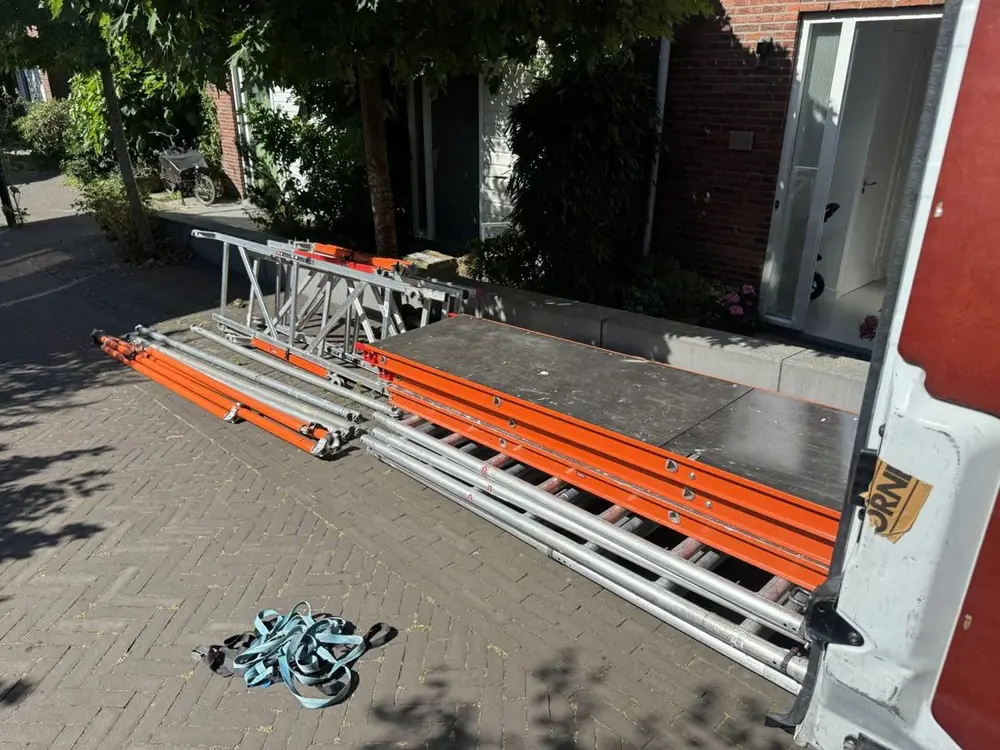
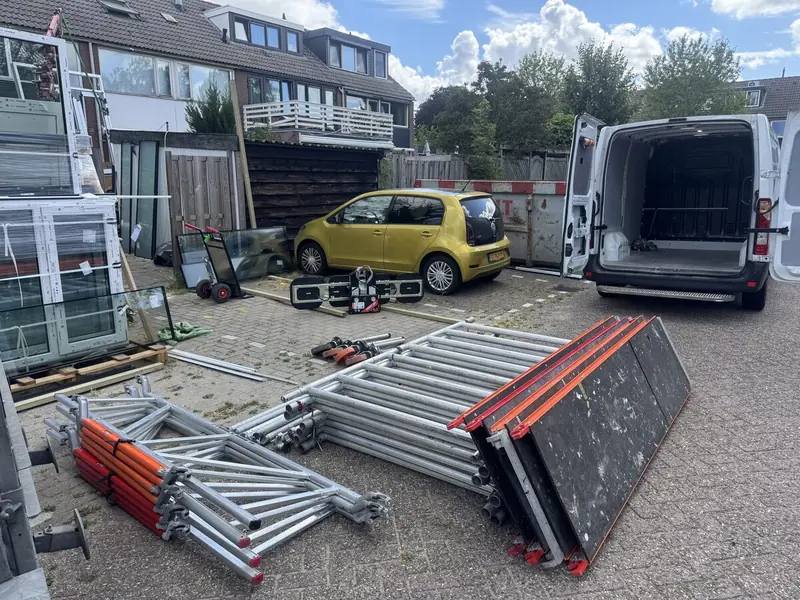
Loose scaffold parts laid out on the street before assembly, the counted drop you carry indoors yourself

Once the last coat is on we come back for the parts; all you do is take them apart and lay them out complete. Wait until the ceiling feels dry before you do, because otherwise you are carrying tubes past a fresh surface and you will see that later in the light. Count everything through while you are dismantling. What the run out and back costs in your part of the country is listed under delivery charges by province.

Safely painting a ceiling on a hired mobile scaffold

Every square metre of this deck is rated for 200 kg, the figure EN 1004 attaches to load class 3. When painting a ceiling you do not come near that limit in a hurry, unless there are two of you up top with a full ten litre bucket standing between you and a tool case carried up as well. In that case run the sum once. What such a limit means in practice is explained under weight and loading on a scaffold.

Lock the castors before your foot touches the first rung, and keep them locked while anyone remains on the deck. An indoor floor is slicker than a pavement, so an unbraked tower slides away with less provocation. The urge to have somebody nudge you along a metre while you are still rolling runs high on this job, because you want to stay ahead of that wet edge, but a tower carrying a person or a load is never wheeled anywhere. Step down, push on, brake, climb again.

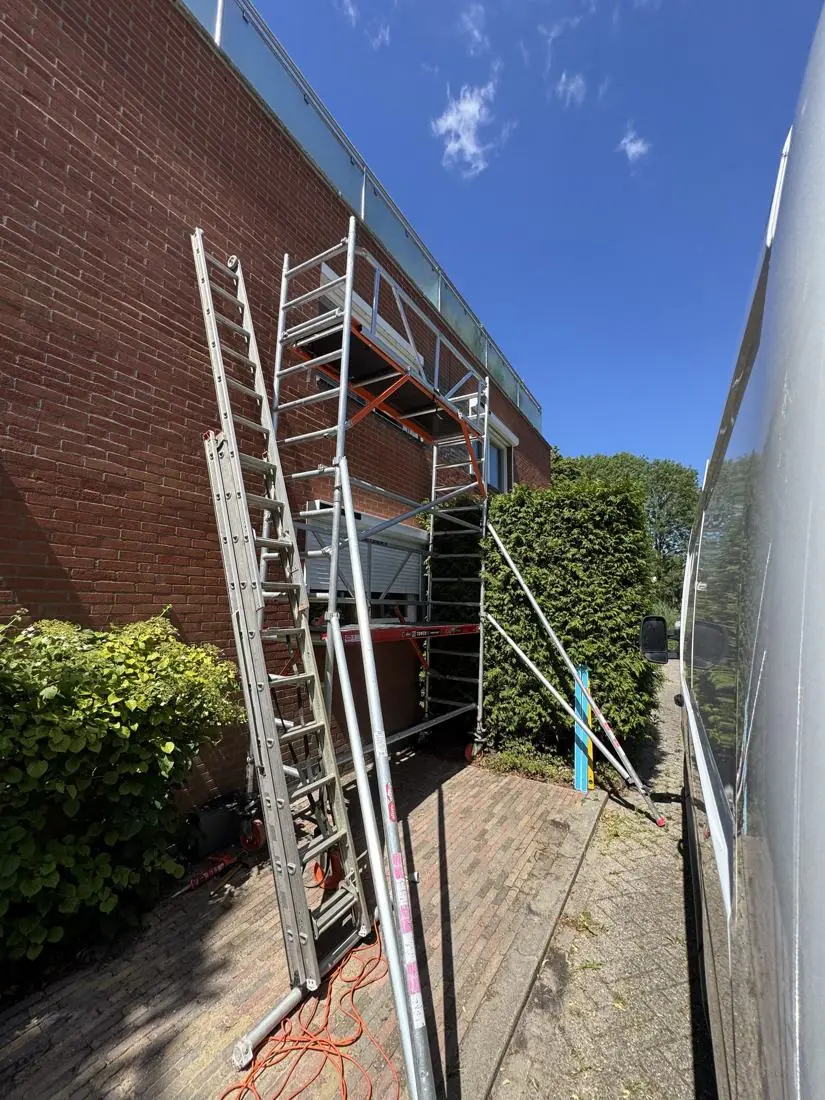
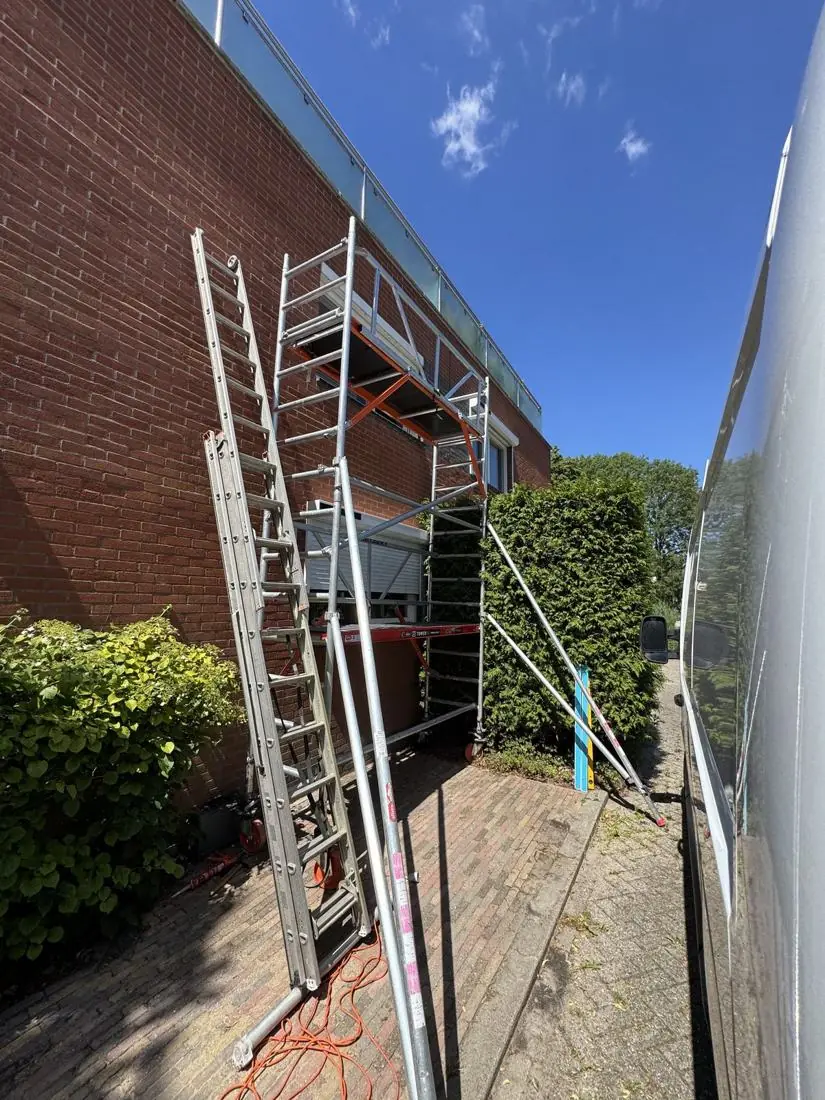
Built tower in a side passage with guardrails at deck level and a loose ladder leaning on the brickwork next to it.

The risks that belong specifically to a ceiling are of another kind. You look upwards for hours on end, which makes your balance less reliable than you realise, and spatter arrives straight in your face. Wear goggles, take a short break every hour and keep the space under the deck free of kettles and cables. If a light fitting is loose, kill the power first. There is more on that under using a scaffold inside the house.

In 5 steps

How hiring a mobile scaffold works

1
Choose working height

Pick the height that suits your job.

2
Book online

Sorted in 60 seconds, price shown instantly.

3
We deliver

At the agreed spot the next working day.

4
Assemble safely

Assembled by you, with a manual.

5
We collect

One call and we collect the scaffold.

Good to know

Practical tips for painting a ceiling

1

Cut in the full perimeter of the ceiling before you pick up the first sleeve. You then need no brush in your back pocket up top and you keep one steady rhythm at every position.

2

Mark small tape lines on the floor where the castors belong for each strip. After a break or a drying night you wheel the build straight back to exactly the same spot.

3

Take the light fitting out of the middle of the ceiling before the parts arrive. A lamp that still has to come down halfway costs you half a band and a wet edge that closes meanwhile.

4

Include the drying night between coats in the period you book. Striking the build and reassembling it the next day takes longer than simply leaving it standing in the cleared room.

5

Slide hardboard under the castors if you are working on parquet or a poured floor. That prevents scratches when you push on and avoids an argument about damage when the furniture goes back.

6

Set the collection date a day past your final coat. That leaves you time to dismantle the build, clear away the sheeting and put the room back together without anybody waiting outside.

Frequently asked questions

Frequently asked questions about painting a ceiling

Which model do you hire when painting a ceiling indoors?+

Indoors you want the RS44 room scaffold for this. That model is meant for work inside a house, reaches 3 to 4 metres of working height and goes through a door opening from roughly 70 cm in loose parts. That gets it into a passage, a bedroom or a hall. You can hire a mobile scaffold of the outdoor sort for the job, but a build like that already jams at the first door frame. On the deck you are also left with room for your kettle and brush.

How does hiring a scaffold for ceiling work run from start to finish?+

Online you choose the model and the height, name the day we come and the day we fetch, and pay a fixed sum with VAT already included. The parts reach you counted and complete, you assemble the scaffold in the cleared room and paint your ceiling in as many passes as the colour asks for. On your last hire day you lay everything out dismantled and we take it away. There are no further steps to it.

How many days should you hire a room scaffold for painting a ceiling?+

For a single room you usually land on two or three hire days. The rolling itself only takes a few hours per coat, while cutting in, covering up and above all the hardening between coats swallow the rest. If you do several rooms one after another, allow at least a day more for each. Since the tower stands there anyway while a coat dries, a generous period is nearly always the calmest choice on this work.

What does it cost to hire for painting a ceiling and how does the discount work?+

What you pay follows from the scaffold you choose and the height you build to, with the run out and back charged per province on top. Those amounts include VAT and sit together on the page with our rates. On ceiling work the rental price mainly rewards ordering your drying time along with the rest: the first full day weighs heavily and the days behind it hardly count. Booking a week in one go therefore lands better than two short periods.

Which working height should you hire for a ceiling, and how is it measured?+

Measure from the surface the castors will stand on up to your ceiling, and hire a scaffold whose deck leaves your head about half a metre below that plane. For most living rooms that means 3 to 4 metres of working height. If you are working above a void or in a loft, check the page about working heights for the stand that suits. Always measure the room as it will look while you paint, so without carpet that is coming out.

When you hire, is the set brought to you or do you fetch it?+

Either works. With delivery the scaffold arrives on the date you pick and we take it back after your last coat, for a fixed amount that differs by province. Driving yourself is fine too, free of charge and by appointment, as long as your car or van will swallow the longest parts. People working indoors mostly choose to have it brought, because the build day is already taken up with clearing out the room and laying sheets.

Do you assemble the scaffold when it is hired for painting a ceiling?+

That side of it stays with you. We deliver the components complete and counted through and collect them again later, but assembling, wheeling on and taking apart are your own work. With the manual and the video next to you, two of you are through it inside an hour. Handing over a ready-built tower is not something we offer, and cherry pickers or facade scaffolds are not in our fleet at all. For a ceiling indoors this room scaffold is the obvious tool anyway.

Can you hire for longer if the ceiling turns out to need a third coat?+

Yes. Tell us in time and the collection date shifts along, as long as that scaffold has not already been promised to the next customer. On ceiling work that happens more often than average, because an old water ring or a yellow nicotine stain only really declares itself after the first coat. If you would rather hire a spare day from the outset, you are covered either way. If it goes smoothly you simply hand back sooner.

Does the room have to be completely empty for the hire?+

Reckon on the footprint of the build itself, plus the swing of the stabilisers around it, and on top of that a clear running strip from wall to wall. In practice that comes down to a room that is largely empty, with the remainder stacked under a sheet in one corner. Radiators, deep window boards and a door that opens inwards belong in the same calculation. Sort that out before the scaffold arrives, not on the morning itself.

Does the hire period cover the night a coat needs to harden?+

Yes, and that is exactly why this job is counted in hire days rather than working hours. The scaffold stays in the room while the paint cures, castors braked and stabilisers out. The next morning you carry on from the same spot without measuring up again. Do set a window ajar in the meantime and take loose kettles off the deck, so nothing dries out or tips over while you are not there. That standing time counts inside the period you booked, not on top of it.

What happens to the deposit after an indoor hire like this?+

A deposit rides along with the hire and comes back to you inside one working day after collection, as soon as the scaffold has been looked over. On ceiling work watch two things. Hand back every component you received, and leave no dried spatter on tubes or deck boards. A cloth thrown over them while you roll saves you scrubbing, and a wipe down the same evening finishes the job. There is more in the piece on getting your deposit back.

Can the same hired scaffold do the walls afterwards?+

It can, and that is a sound reason to take a slightly wider period from the start. The ceiling goes first, since whatever you spill from above lands on the walls regardless. After that you wheel the same tower along the walls and finish the top edges. At an ordinary wall height this working height serves you well; only above a stairwell or a void would you check separately whether this stand still reaches. Book the wall days along with the ceiling days and nothing has to be rearranged later.

Hire a mobile scaffold for painting a ceiling today?

Calculate your rental price now or ask for free advice.

Rolsteiger van SteigerTaxi geleverd op locatie
Book it online

Your scaffold sorted in 2 minutes.

Choose your scaffold and working height, see the price instantly and book online.