
See your price
Application

Spray-painting a ceiling? Choose the right scaffold.

Spray-painting a ceiling costs little time; wrapping everything that must not catch the mist costs a great deal more. Once the walls, floor, frames and radiator sit under film you are back down within the hour. So you work indoors in a closed, parcelled up room where mist lingers until you have aired it out. The model you hire for that is the Altrex RS44 room scaffold, reaching 3 to 4 metres. Below is which build to order, what it costs in hire days, and where the tower stands among the sheeting.

  • Order before 3 pm, delivered tomorrow
  • Professional Altrex scaffolds
  • Up to 14.2 metres working height
  • Easy to assemble yourself
4,2 tot 14,2 mWorking heights available
12Provinces served
7Days a week
200 kg/m²Load class 3
In short
  • For spray-painting a ceiling we recommend the Room scaffold.
  • Spray-painting a ceiling means hiring the RS44 room scaffold, an indoor model good for 3 to 4 metres of reach.
  • Masking fills your day; the spraying itself is over inside an hour, after which the room has to be aired out.
  • Get the tower standing before the film goes down, because after that no tubes should be dragged across your covering.
  • First 24 hours from €50 incl. VAT and delivery; every day after that 95% off.
Key facts for this job
FeatureValue
Recommended scaffoldRoom scaffold (Altrex RS44)
Working height for this job3 to 4 metres
Available working heights4.2 to 14.2 metres
StandardEN 1004, load class 3 (200 kg per m²)
DeliveryOrdered before 3 pm, delivered next working day
Each extra day95% off, from €2.50 a day
Why a mobile scaffold for spray-painting a ceiling?

Safe, stable and professional work at height

Mist travels everywhere. Outdoors it blows off, but in a closed room it settles on whatever you failed to wrap and then hangs in the air a while longer. This job is therefore mostly preparation: taping, stretching film, sealing gaps and thinking out a route for the air. Anyone weighing up scaffold hire for ceiling spraying is really looking at the days either side rather than at the gun work itself. You also want a build you can mask the top edges from, because that tape line runs at exactly the height you will be coating later. A pair of steps has you climbing down for that far too often.

  • Spray-painting a ceiling fills a room with mist
  • Top edges masked from the same height
  • Tower standing before the film goes down
  • An airing route before, during and after
Read more about working safely →

Which scaffold to hire for spray-painting a ceiling

For spray-painting a ceiling inside a house the Altrex RS44 comes first, the room scaffold cut out for interior jobs. Its parts pass through a door frame of roughly 70 cm, which counts for more here than on other work: you carry them in before the room is parcelled up, and out again afterwards across a floor that by then lies under film. The less humping about that takes, the fewer tears appear in your covering. That alone argues for hiring the narrow indoor model rather than something broader.

The footprint of the base matters for a second reason. A compact build leaves more bare floor for the film you unroll in strips, and in a wrapped room you have little appetite for edging past a leg that sticks out. Anyone who would hire a mobile scaffold of the wide sort because more material has to go aloft is misreading this job: almost nothing goes up with you. What else stands ready and where the differences lie is set out under room scaffolds for interior work.
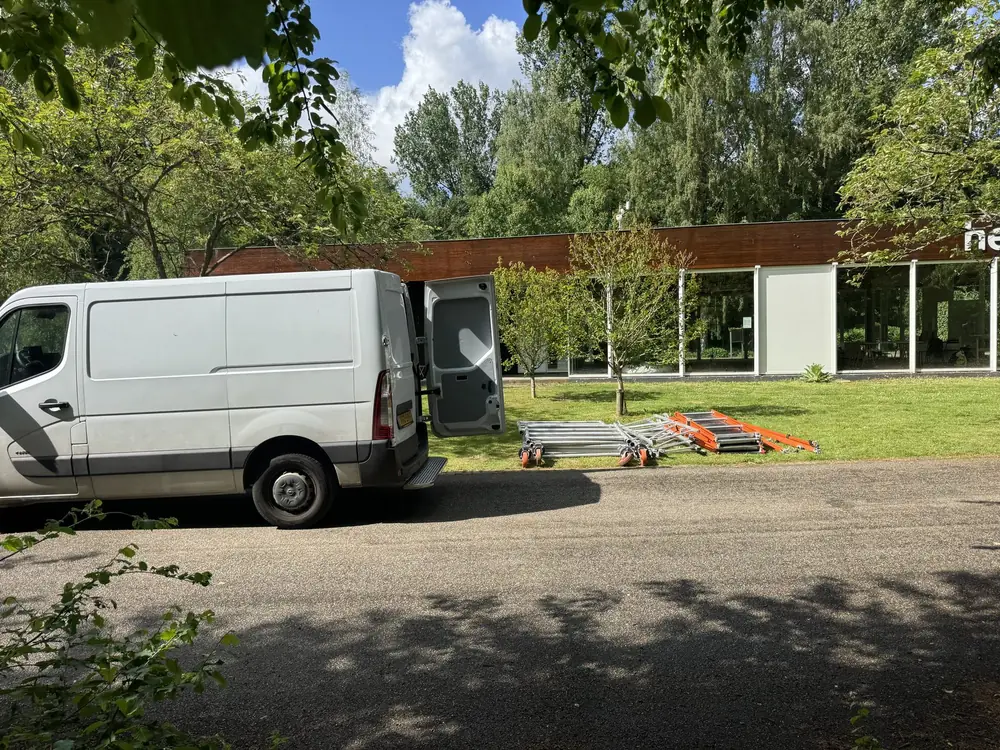
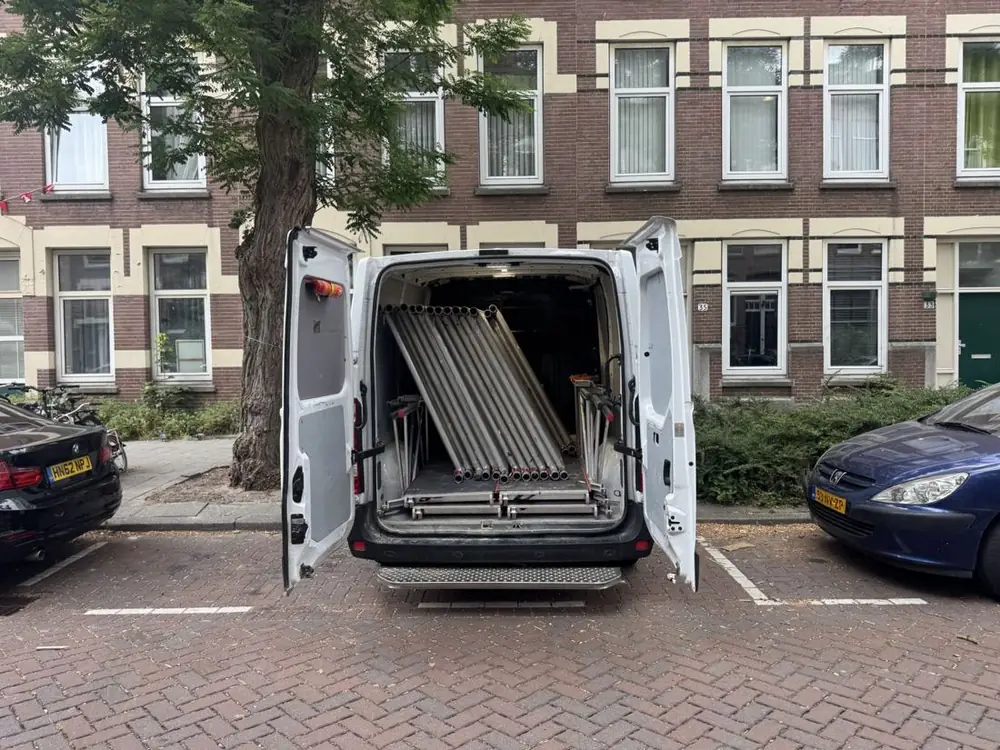
Van at the kerb loaded with scaffold material, the counted indoor set whose parts must pass a door frame

On the 245 cm deck you carry remarkably little: the gun, a spare tin or a filled pot, and nothing further that can collect mist. Whatever you leave up there ends up wearing a fine layer, your tool case included. That bare deck is precisely what you want, since you shuffle sideways along it with your eyes turned upward. Where a ceiling sits higher than a room scaffold reaches, above a stairwell or in a tall hall, the one-person MiTower on hire covers 4.2 to 6.2 metres.
Standing lower than a roller: the build you hire

Your working height on this job is the deck you stand on with about two metres of reach added, and here those two metres deserve to be taken seriously. You do not hold the gun flat against the surface but half to three quarters of a metre off it, or you lay down a thick running band instead of an even film. So you stand lower than somebody working with a roller, sometimes a full platform stand lower, and when you book that is the one difference that genuinely matters.

Measure from the bare floor up to the ceiling and allow for whatever is still leaving the room. At the usual heights of 2.60 to 3 metres, this model with its 3 to 4 metres is exactly sufficient. Only above a stairwell, in a void or under a sloping roof do you check separately whether this build still serves, because there the surface often runs on to five metres. The guide to working on the ground floor sets out the heights you meet there.

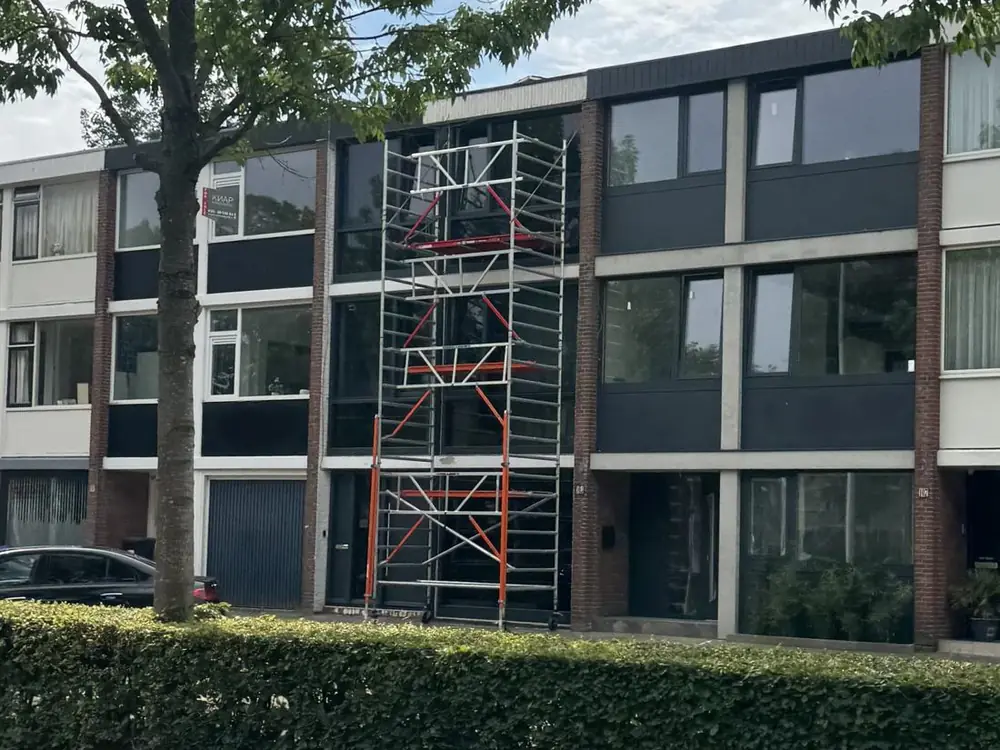
Mobile scaffold erected against a front elevation, showing the platform stands you set one lower for indoor spray work

Build too high and the gun comes too close to the surface, with the drips telling you inside a minute that something is wrong. Build too low and you spray at a slant, the mist meets the plane at an angle and you lose material into the air. On a job that lasts an hour you read that difference straight off the finished surface, so adjust the stand calmly before your first pass rather than during it. Resetting a platform stand takes ten minutes, which is nothing against a whole extra pass.

Standing the hired room scaffold in a masked room

On this job the order of things counts for more than the place. Empty the room, stand the scaffold, and only then finish the covering, because film you walk over with tubes and legs tears exactly where you cannot see it. Leave a patch of floor bare around each castor, or double the film there, so the material is not dragged along the moment you wheel on. Turn that order round and you are patching tape at your very first position.

Beyond that you want a clear run that reaches into the corners of the room. Spray-painting a ceiling takes you everywhere, including above the spot where a sofa normally stands. A heating pipe, a deep window board or a door that opens inwards helps decide where the stabilisers can still swing out. Check that while the room is bare, not once everything lies under plastic and you can no longer reach anything. A wrong guess costs half a masking day.

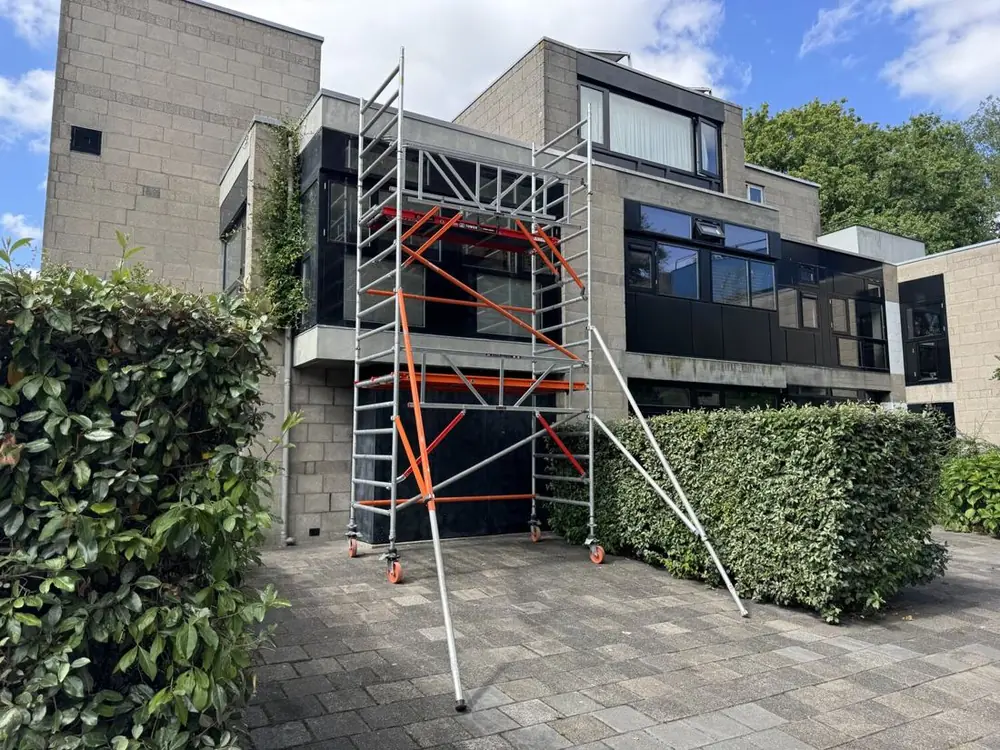
Extended stabiliser arms bracing a mobile scaffold at floor level, marking the space that must stay clear of plastic sheeting

Finally, think about the air route. You need a window or a door the mist can leave through, and you have to reach it without walking across wet work. So stand the scaffold in such a way that your last position lies on the exit side and you step outside with the gun still in your hand. Mark that final position on your plan before the scaffold even goes up. If the walls come next in the same week, that method is described under painting walls.

Masking day and gun day: how many hire days

The arithmetic of spray-painting a ceiling runs against the feeling. For an average room a good part of a day disappears into emptying it, stretching film, taping frames and setting the edges along the wall neatly. The spraying that follows often takes under an hour, even where the ceiling is a large one. After that the mist has to settle and the space has to be aired through before you can begin pulling any of that plastic off again. That imbalance is what your hire period has to cover.

In practice that puts you at two hire days: a masking day with the assembly included, and a day on which you spray, let it dry and clear up. Want a second coat and half a day of waiting joins in, so you book a third. Several rooms in a row simply roll the same rhythm forward while the tower stays standing between two masking rounds. What other jobs ask for is set out in the explanation of hire periods. Book both days in one stretch rather than as two separate blocks.

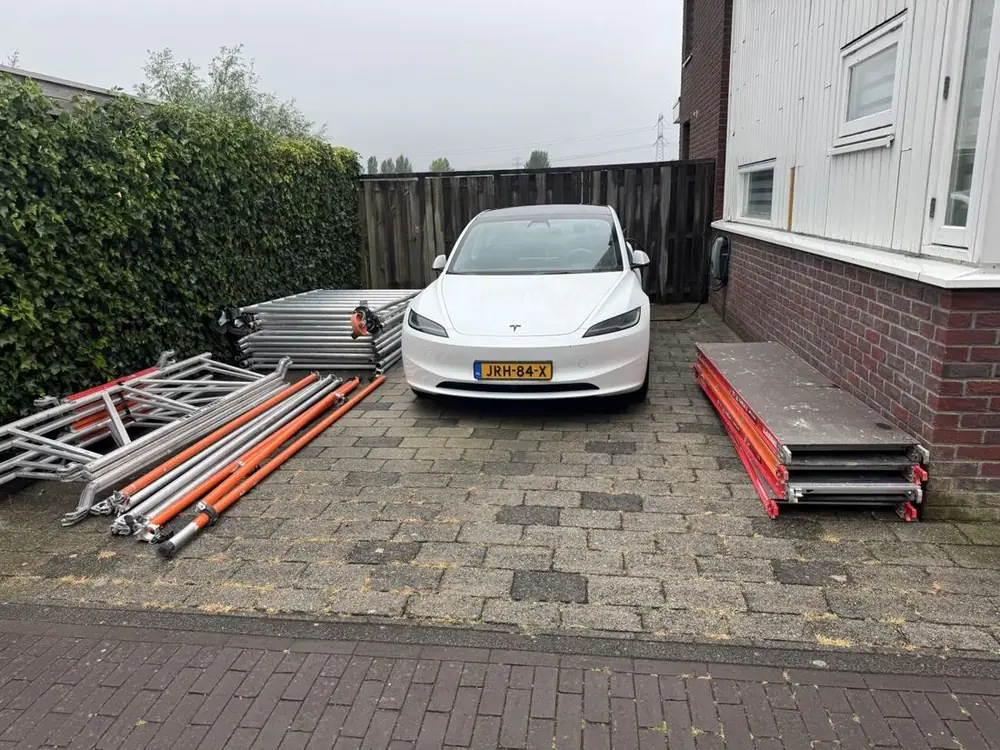
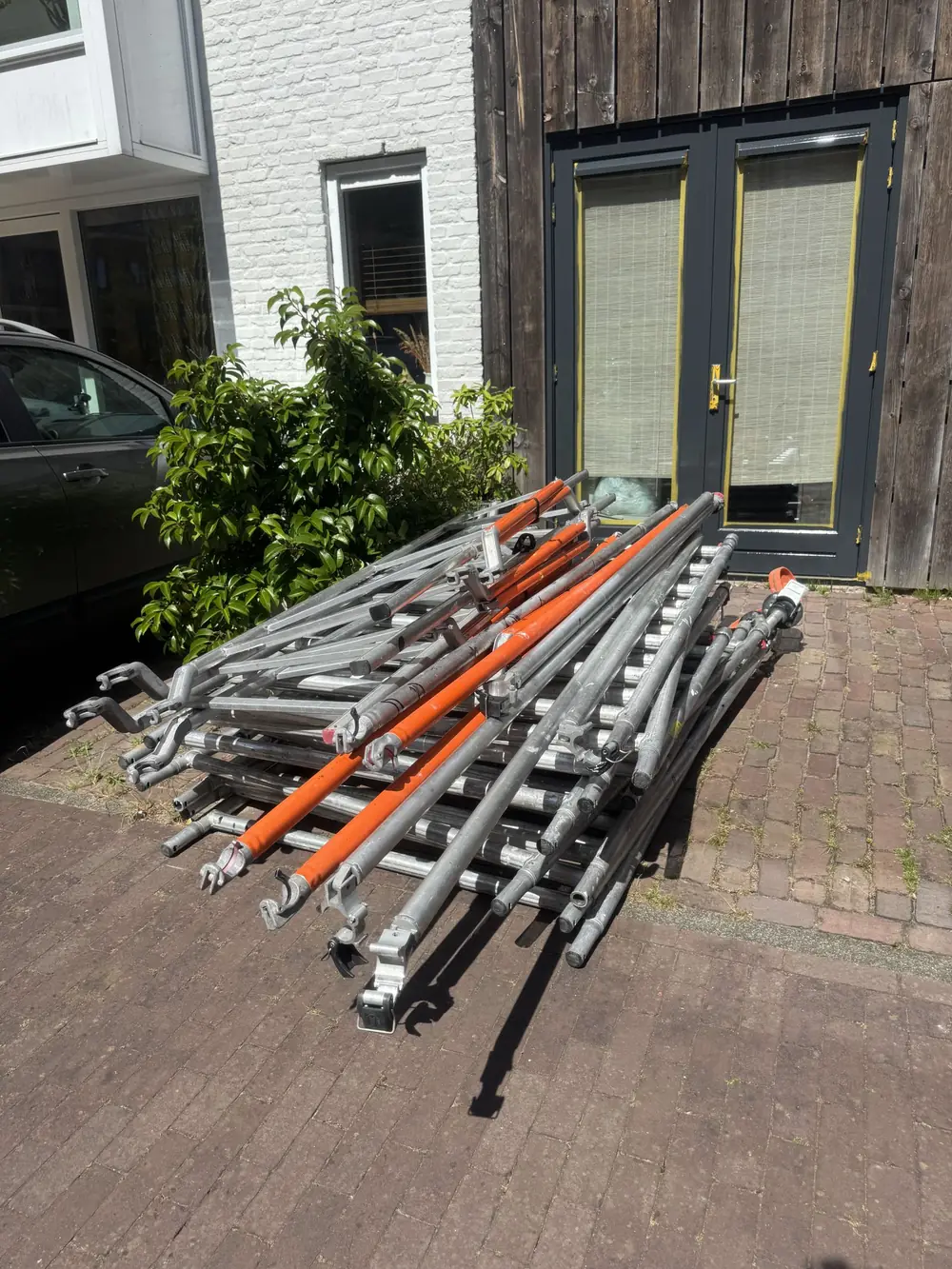
Complete scaffold set delivered on location, the counted components that stay with you across masking day and spraying day

Being finished quickly is no argument for a short booking. Every day after the first is billed with ninety-five per cent removed, so an extra day for airing or for lifting the film calmly hardly shifts the rental price at all. And if you overrun because the masking bit back, the last thing you want is the van already heading your way. Set your collection a full day after your spraying day and use that final morning for clearing up.

Which mobile scaffold suits spray-painting a ceiling?

Most chosen
Kamersteiger RS44
  • Working height up to 4 metres
  • Compact and narrow
  • Great for indoor and small jobs
View and calculate →
Smalle rolsteiger RS51
  • Working height up to 14.2 metres
  • Narrow (75 cm)
  • Ideal for narrow passages
View and calculate →
Brede rolsteiger RS52
  • Working height up to 14.2 metres
  • Wide platform (135 cm)
  • Extra stability and workspace
View and calculate →
1-persoons steiger MiTower
  • Working height up to 6.2 metres
  • Very compact
  • Quick and easy to assemble
View and calculate →

Spray-painting a ceiling from a 245 cm deck

A working deck of 245 cm hands you a strip of a good two metres per position, and for spray-painting a ceiling that is a comfortable size: you run the length of the platform out in one calm, even movement without turning your wrist. Divide the ceiling into strips that overlap each other by a hand's width. Begin on the side furthest from the door, so you neither box yourself in nor have to walk back across fresh work. Set those strips out on paper before the scaffold goes up.

Wheeling on goes faster than with brushwork, and that is precisely why people forget the brakes. Lay the gun down, step off, release the castors, roll one platform length, lock them again and only then climb. At every move look at where the hose or the lead is sitting: across smooth plastic a hose slides cheerfully along with you and drags your masking away from the skirting. You notice that only once mist has crept in under the tape. Lift the hose clear over the guard rail each time you wheel on.

Mobile scaffold standing hard against a house wall, the 245 cm deck length you work out in one even pass

Beyond that, take as little as you can up with you. Everything that stays on the deck collects mist, and you carry that through the rest of the house later on. For a room of four by five metres you come out at some eight positions per coat, and you take them one after another in a single continuous run without a pause. Nothing else earns a place on that deck while you are up there. If brush and roller suit you better, that method sits under painting a ceiling by hand.

Hiring a room scaffold delivered before your masking day

A counted set of separate components arrives at the house. Agree where that stack is to end up, because it cannot lie in the room itself: that one stands empty, waiting for film. A hallway, a shed or a utility room answers better. Booking runs until 15:00 on a weekday, and anything logged before then travels out on the following working day. Aim the drop at the morning you empty and mask, so nothing waits about. A short carry from stack to doorway saves more time than it sounds like.

Assembly remains on your side of the line. A manual travels with the set, and the video runs through the order in which the components meet; two of you will be standing on the deck within the hour. We hand nothing over erected, indoors any more than out. Both dates are yours to choose, which suits this work, since you want the parts indoors a day ahead of masking. Fetching them yourself is fine too, at no charge, on an agreed slot at our Zeeburgerpad depot in Amsterdam.

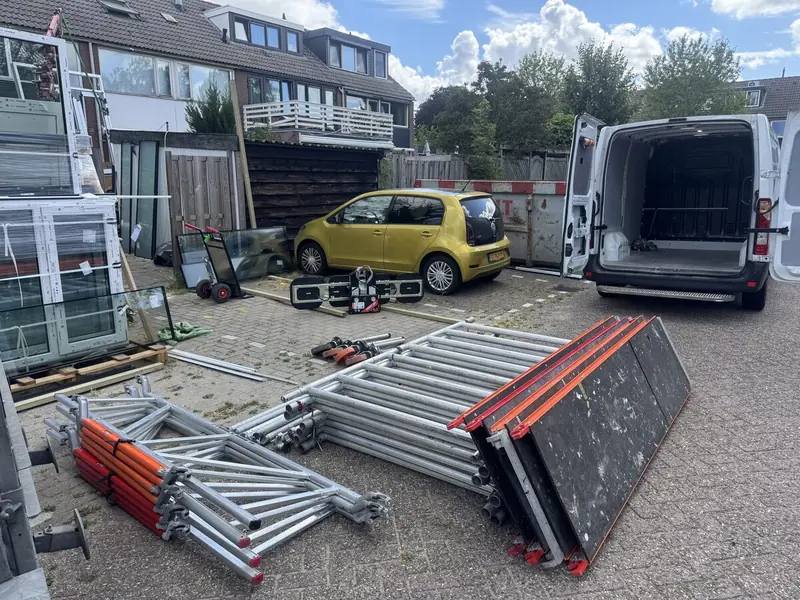
Scaffold parts loaded into the back of a van, the counted set that arrives at your address on masking day

Afterwards we drive round for the parts; you take the build apart and lay everything out complete. Only do that once the space has been aired through and the surface feels dry, or you will be shifting tubes with wet mist still on your hands. Lift the film away first and the scaffold second, so you never walk over plastic carrying components. Count the parts through as you stack them, then nothing has to be hunted for. What delivery to your own province costs is listed under delivery and collection charges.

Spray-painting a ceiling safely on a hired scaffold

Load class 3 goes with these scaffolds: 200 kg is allowed on each square metre, a boundary that EN 1004 fixes. On spray work you stay far below it, because you go up with an appliance and a tin and nothing more. The risk on this job sits somewhere else entirely. Keep both hands free and let nothing lie loose on the platform you move across while your head is tipped back. You are the only real load on that deck, and the appliance you carry weighs a fraction of what is allowed.

Do not forget to lock the castors before you climb, and never shift the build while a person or a load is on it. On an indoor floor lined with plastic a tower slides away sooner than on a paved path, and the material on the deck turns glassy the moment mist begins settling on it. Replace that sheet once it begins to gleam, or work off a bare deck and clean the tubes down afterwards. The second option also pays off at the final check when the set goes back.

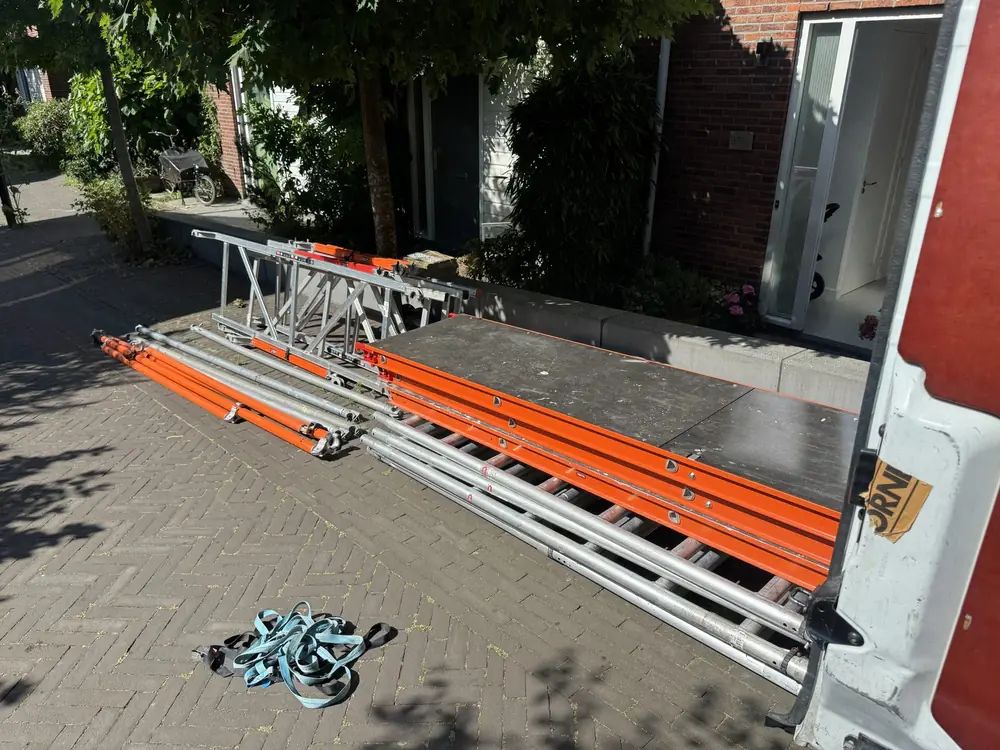
Delivery van with scaffold material outside a house, the set you build indoors and strike again once the room has aired

The real issue with indoor work is the air. Wear a mask matched to the material you are using, open a window and keep the door to the rest of the house closed, so the mist does not draw into the hall and up the stairs. Do not work on your own with solvent based material, and take your breaks outside. Have somebody stand in the doorway to keep an eye on you while the room is thick with mist. The rules that always apply are gathered under working safely at height.

In 5 steps

How hiring a mobile scaffold works

1
Choose working height

Pick the height that suits your job.

2
Book online

Sorted in 60 seconds, price shown instantly.

3
We deliver

At the agreed spot the next working day.

4
Assemble safely

Assembled by you, with a manual.

5
We collect

One call and we collect the scaffold.

Good to know

Practical tips for spray-painting a ceiling

1

Put the scaffold up before you begin stretching film. Tubes and legs dragged later across a covered floor pull your masking loose along the skirtings without you noticing until mist has already got under it.

2

Mask the top ten centimetres of every wall from the deck rather than from a pair of steps. You are already standing at the height the tape has to reach, and both hands stay free for the run.

3

Lay a double thickness of film under the castors, or keep a bare strip of floor instead. Otherwise the plastic winds itself round the wheels as you wheel on and rips your covering wide open.

4

Settle your air route before the first pass. A window open, the room door closed and a gap somewhere further off saves you hours of waiting before the film may come away and the furniture returns.

5

Have the set delivered on the day you empty and mask the room. It is then already indoors when the taping begins, and no half day goes on standing about waiting for a van.

6

Never park the gun on the deck during a break. Anything left up there collects mist, and you walk that straight into your hallway and up your stairs when you come to strike the build.

Frequently asked questions

Frequently asked questions about spray-painting a ceiling

Which tower do you hire for spray-painting a ceiling?+

The RS44 room scaffold is the model meant for it. It is made for interior work, comes to 3 to 4 metres of working height, and its components go in through a door opening from about 70 cm. That last point weighs extra on spray work, because you carry them in before the room is wrapped and back out afterwards without tearing your film. Taking a wide outdoor tower on hire makes little sense between four walls.

How does room scaffold hire work for an indoor spray job?+

For the booking you give the model online, plus the height, a date for the drop and a date for the pick-up, and you settle a fixed price with VAT counted in. We run the counted set out to you, you build it in the emptied room, mask up, spray your ceiling and let the space air. On the final hire day everything lies dismantled and we collect it. Nothing else has to be arranged around the rental.

How many hire days does spray-painting a ceiling take?+

Two days is a realistic plan for one room: a day for emptying, assembly and masking, and a day for spraying, airing and clearing up. If you want two coats, reckon on three hire days. The gun work is short, so your period is really decided by the taping beforehand and the waiting afterwards. Several rooms one behind another shift along in that same rhythm, with the scaffold left standing throughout. The tower is up for all of it, so one continuous hire period is by far the simplest.

What sets the rental price here, and how does day two count?+

It follows from the scaffold you pick, the height you build it to, and the province we drive to for bringing and fetching. You will find every figure, VAT already counted in, on the overview of our prices. What matters on this job is that the opening day carries the weight and the days behind it add almost nothing to the bill. Hiring briefly wins you very little, while it puts you under pressure during the taping.

What platform height do you hire for spray-painting a ceiling?+

You measure from floor to ceiling and add roughly two metres of reach to your platform height. Because you deliberately keep the gun back from the surface, you hire the scaffold a stand lower than somebody rolling paint on. For room heights up to about 3 metres this reach is ample. The page with working heights shows per build how far you get and where your deck ends up. Give the platform height you want when you book, not only the ceiling height.

Is the tower brought to the door, or do you collect the hire yourself?+

You decide that when you book. Choose delivery and we set the scaffold down on the date you picked and take it away again after your spraying day, for an amount fixed per province. Anyone who would rather come with their own transport collects the set free of charge after an appointment, provided the longest parts will fit. On masking day your hands are full, though, so having it brought is the calmer route. Say where the stack may be left, because the room itself will be standing empty.

Do you erect the scaffold, or is that part of my hire?+

Building it up is your side of the arrangement. The parts reach you complete and counted through and go back in the van afterwards, but assembly, wheeling on and dismantling belong to your own job. The manual and the video point out the order, and two people are done inside an hour. Delivering in an erected state is not part of the rental, indoors or out, and we keep no cherry pickers or facade scaffolds at all.

Can you extend the hire if the masking takes longer than planned?+

Yes, and on this job that is far and away the commonest reason to slide the dates. Tell us and we shift the pick-up date, provided the same scaffold has not already been promised elsewhere. Taping nearly always eats more time than people allow, certainly in a room with many frames, a boxed radiator and a kitchen run against one wall. So take the spare day when you first book. A day added in advance causes far less trouble than a rushed handover.

How much clear floor does the scaffold you hire need?+

Enough to wheel the build with its stabilisers out into every corner, since on a ceiling you go everywhere. In practice that means a bare room, with at most a single piece of furniture standing under plastic in the middle. Allow for the film on the floor as well: it must not end up trapped under the castors. Check all of that before you hire, while the space is still empty and uncovered. A room only half cleared leaves the tower unable to reach two of the corners.

Can the tower stay on hire while the room is airing?+

That is exactly what it is doing. The scaffold stands there with locked castors while the surface dries and the last mist settles, because clearing up only begins once the air is clean again. That waiting time is why this work is counted in hire days rather than hours worked. Do take every loose item off the deck in the meantime and set a window open, since anything left up there collects mist. None of that waiting falls outside the hire period you have already booked.

What does overspray on the hired scaffold mean for the deposit?+

You pay a deposit when you book, and it is credited back one working day after collection, once the scaffold has been found complete and clean. On spray work that is a real point of attention: fine mist settles on tubes and couplers and holds on there. So cover the build while you spray, or clean it down the same day. There is more on that in the piece about what happens to your deposit.

Can the scaffold you hire be used for the masking as well?+

Do exactly that, because the build earns its keep there at least as much. The top edge of the walls, the heads of the frames and the line around the ceiling all sit at precisely the height you will later be spraying from. With both hands free you pull a clean tape line, which saves you touching in with a small brush afterwards. So count those taping hours in when you decide how many days to hire.

Hire a mobile scaffold for spray-painting a ceiling today?

Calculate your rental price now or ask for free advice.

Rolsteiger van SteigerTaxi geleverd op locatie
Book it online

Your scaffold sorted in 2 minutes.

Choose your scaffold and working height, see the price instantly and book online.