
See your price
Application

Painting walls? Choose the right scaffold.

Painting a tall wall is decided at the edges. The field in the middle rolls out easily enough, but the line against the ceiling, the two corners and the join down to the skirting have to be cut in close up with a steady hand. That is exactly where a step stool leaves you stranded. For painting walls indoors you hire the RS44 room scaffold, built for 3 to 4 metres of working height, with a base that passes an interior door from about 70 cm. Below: how to spread your hire days.

  • Order before 3 pm, delivered tomorrow
  • Professional Altrex scaffolds
  • Up to 14.2 metres working height
  • Easy to assemble yourself
4,2 tot 14,2 mWorking heights available
12Provinces served
7Days a week
200 kg/m²Load class 3
In short
  • For painting walls we recommend the Room scaffold.
  • For painting walls indoors you hire the RS44 room scaffold, giving 3 to 4 metres of working height on a narrow base.
  • When painting walls, work one face at a time: cut the corners, the ceiling line and the skirting edge, then roll the field.
  • Two hire days usually cover painting walls in a room that gets two coats, provided you plan the drying time between them.
  • First 24 hours from €50 incl. VAT and delivery; every day after that 95% off.
Key facts for this job
FeatureValue
Recommended scaffoldRoom scaffold (Altrex RS44)
Working height for this job3 to 4 metres
Available working heights4.2 to 14.2 metres
StandardEN 1004, load class 3 (200 kg per m²)
DeliveryOrdered before 3 pm, delivered next working day
Each extra day95% off, from €2.50 a day
Why a mobile scaffold for painting walls?

Safe, stable and professional work at height

A wall is not a surface but a frame of four edges. Along the top runs the line against the ceiling, left and right sit the corners into the adjoining walls, and below comes the join with the skirting. Those four lines decide how your work looks, and they ask you to stand square to them instead of reaching across at an angle. On top of that a wall face has to be finished in one go, because a roller returning to half dry paint leaves a band you will see later. Hiring a scaffold for painting walls therefore means standing comfortably at every edge and working corner to corner without a break.

  • Cut lines at ceiling, corners and skirting board
  • Painting walls means finishing each face in one go
  • A base that passes the interior doors
  • Paint dries faster than you expect it to
Read more about working safely →

Which room scaffold to hire when walls run high

Indoors you work with the Altrex RS44 room scaffold, a build whose working height stops at 3 to 4 metres and which exists for interior jobs and nothing else. The base passes an interior door of around 70 cm, so you wheel it from the hall into the sitting room in one piece without unbolting anything first. That saves half an hour a room. What else stands ready for inside jobs is listed among the room scaffolds available to hire.

For painting walls what matters most is being able to stand with your hip against the guard rail while you cut in. One hand is then free for the brush and one holds the kettle, and you sidestep along the ceiling line without shifting your weight or climbing down. On a ladder that is impossible: you stand with your upper body twisted, and within a metre your cut line has already wandered away from the ceiling join. Over four walls that adds up to an edge nobody wants to look at.
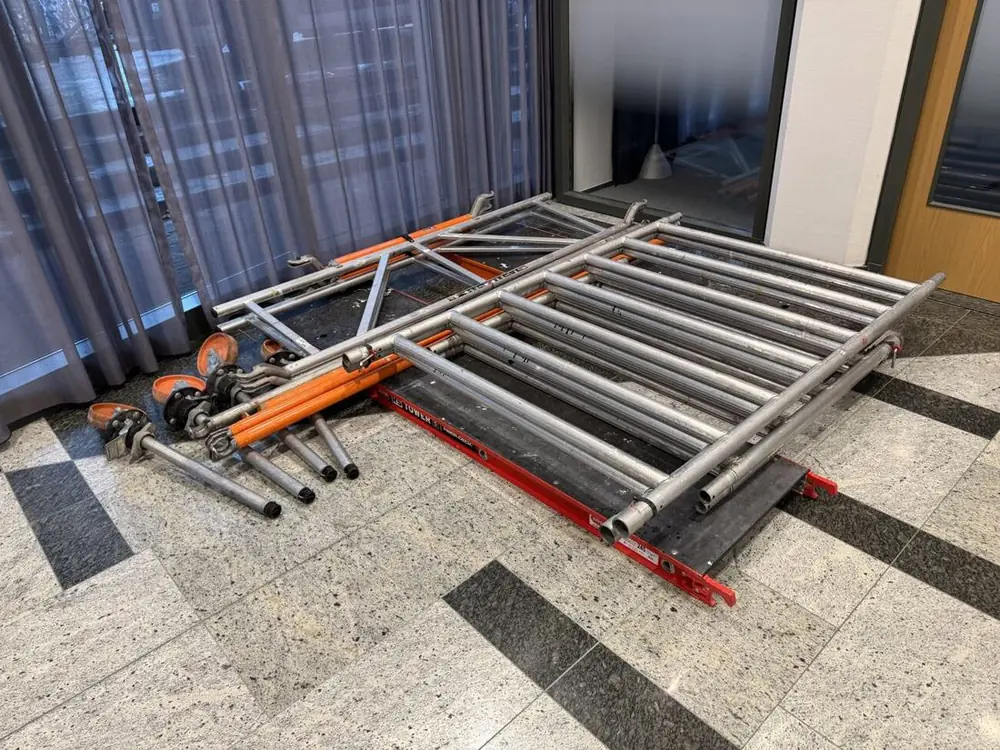
Counted and inspected scaffold components, the material you assemble indoors into a build for painting tall walls

An outdoor model like the RS51 is a poor choice here, even though it reaches far higher. The parts are longer, it does not go through an ordinary doorway, and the deck stands higher than a room with a three metre ceiling can take. If you need genuine reach in a void or a stairwell, look at a slim one person tower instead. And when the elevation outside comes up later in the year, you hire a mobile scaffold for that job separately, because indoor and outdoor builds are not interchangeable.
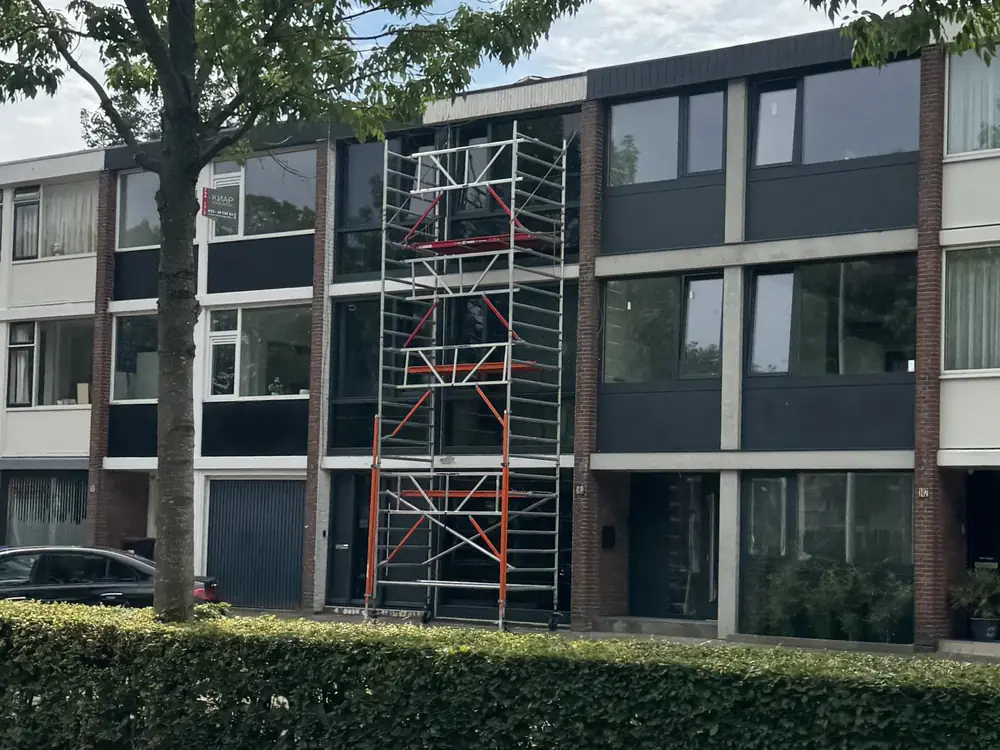
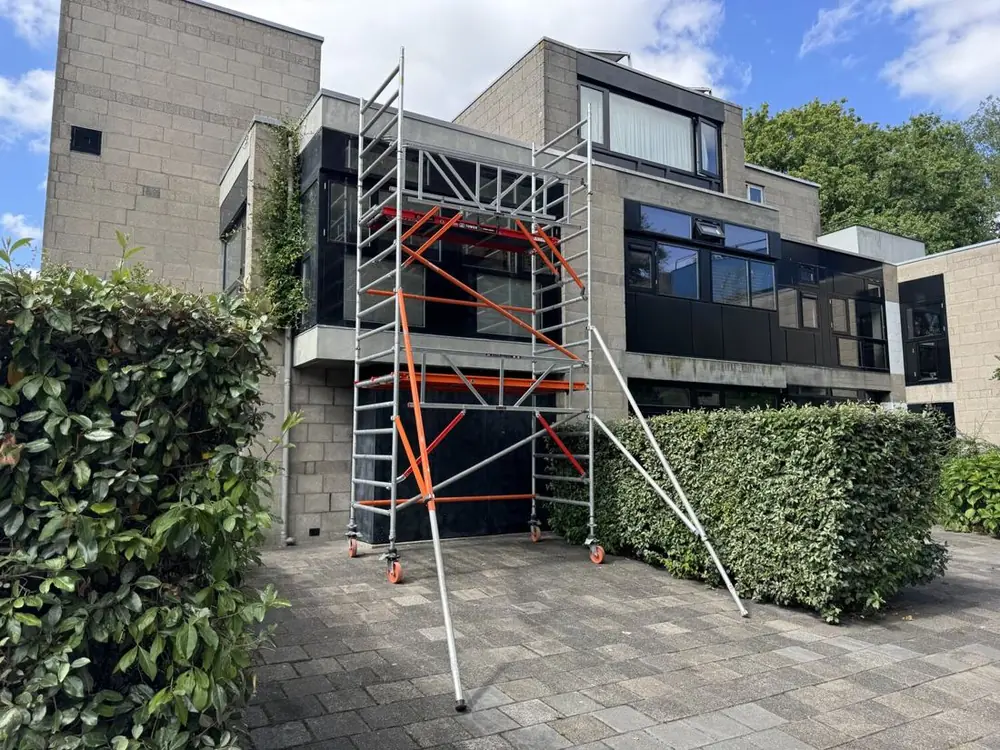
Hiring the working height for painting walls up to the ceiling

On interior work the highest point is nearly always the seam between wall and ceiling. In an average sitting room that seam hangs somewhere between two and three metres, while a house with a raised ceiling or a void puts you comfortably past four. A working height of 3 to 4 metres covers that: the deck sits at one and a half to two metres and you reach roughly two metres above it, which is where the figure comes from. Which parts belong to it is set out at the four metre build.

Measure indoors from the bare floor, so not from a thick underlay or from the raised hearth. Ten centimetres sounds like nothing, but inside you work to small margins: you want the ceiling line at eye level and not just above your crown. Cut in with your head tipped back and you simply cannot see the line, and your brush drifts off the seam without you noticing. You find out when the room is furnished again and the light comes in from the side.

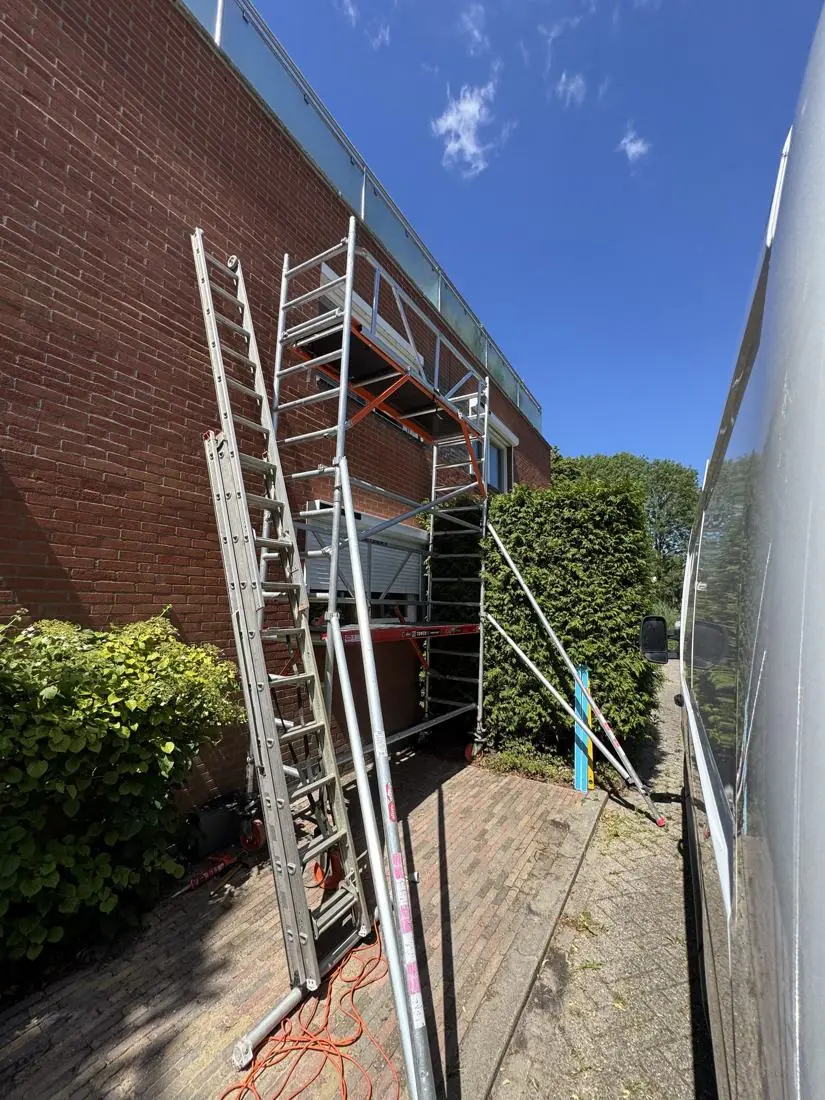
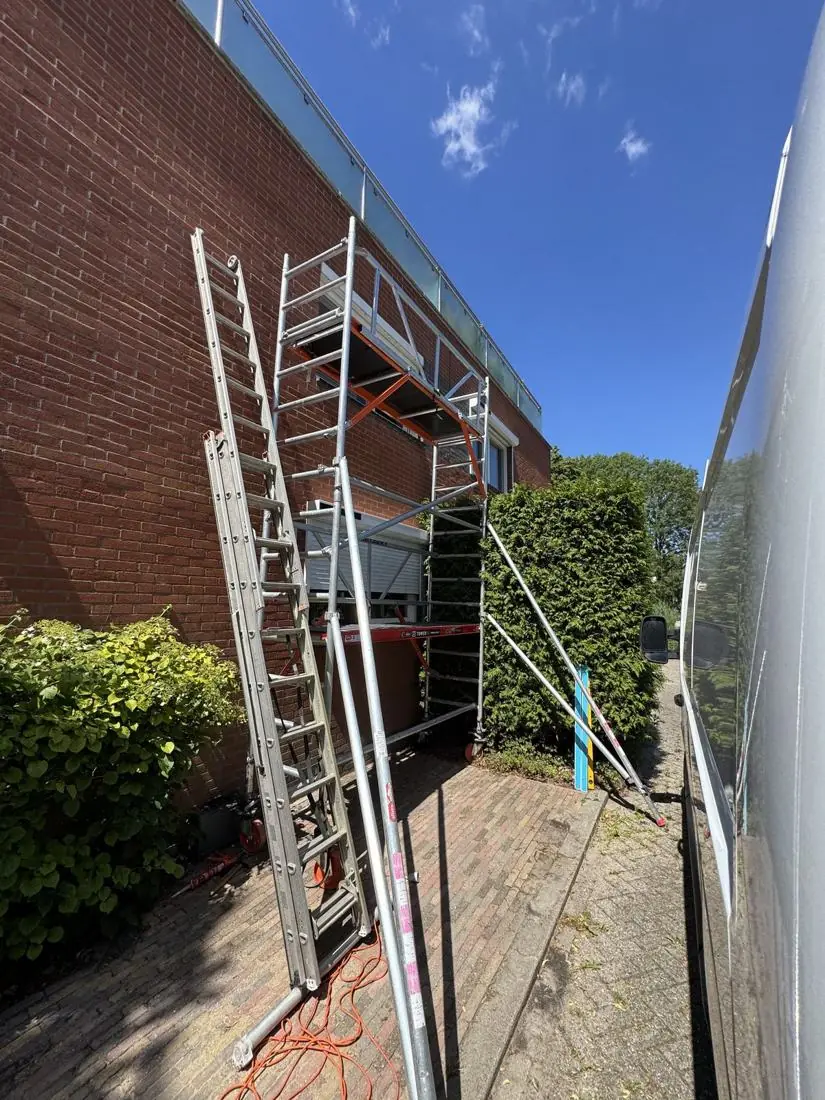
Erected tower with a full deck and guard rails, the sort of build you stand on to cut a ceiling line

Look as well at what else hangs from the ceiling. A light, a smoke alarm, a curtain track or a beam can decide how tall your build may actually be. A position that stops just under such an obstacle and lets you stand solidly beats a taller one you have to steer around with a full kettle in your hand. For a room in an older house with high plastered ceilings on the first floor, this is the usual choice, and it is worth measuring before you book rather than after the parts arrive.

Setting the hired tower in the corner of the room

Do not push the build tight into the corner but leave a hand's width. With the castors against the plaster you can no longer cut the corner line square on, and you work with a twisted wrist at exactly the spot where a wobble shows most. A few centimetres of clearance gives you sight of both walls at once and lets you draw the vertical line in one flowing pass from the ceiling seam down to the skirting, without lifting the brush.

Under the build lies the problem of the skirting. The four feet and the stabilisers stand precisely on the strip where your bottom edge has to be cut, and that edge you do from floor level anyway. So finish the lowest fifty centimetres of a wall face completely before you roll the tower in front of it. Then you never have to touch that strip again and the build can stay put until the whole face is done, second coat included.

Wheels and splayed stabilisers under a scaffold, the footprint that has to fit the strip along a skirting board

Protect the floor that is already down. Put hardboard or heavy sheeting under the castors, certainly on parquet or a poured floor, and lift those boards with you when you move rather than dragging them through underneath. Take everything off the walls, including the plugs you will not miss, and push the furniture into the middle of the room. Around the build you need walking room for your kettle, your bucket and a roller on a long extension pole, and none of that fits if the sofa is still standing where it was.

How many hire days for painting walls in one room

The painting itself moves along; the waiting fills your days. An average room with four wall faces takes a day for the first coat, but the second may only go on once the first is dry right through, and with interior emulsion that swallows a good part of a day. In practice you land on two hire days for a room getting two coats, and on three to four once several rooms are meant to follow one another. Book them as one run.

Count the preparation in as well. Filling holes, stopping, sanding and then getting the dust off runs to half a day easily, and most of it happens from the same build you later paint from. Anyone who only books the room scaffold for the painting days ends up doing that preparation from a step stool after all, with precisely the back ache and the ragged edges they meant to avoid. Leave the build standing from the sanding through to the last coat.

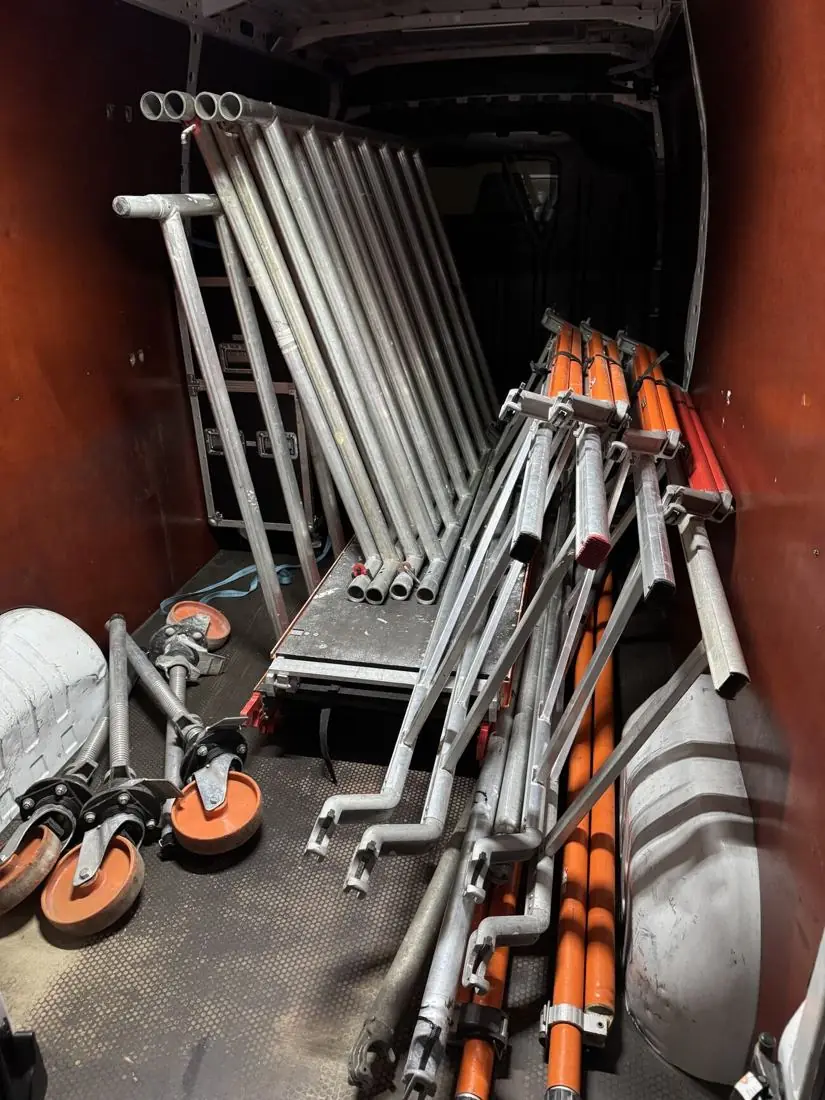
Scaffold parts stacked and ready for transport, the counted set that goes out for your indoor hire days

The way the rates are put together works in your favour here. Day one is the only one billed at the full rate; from the second onwards a 95 per cent reduction lands on each hire day, so that extra drying day hardly features in the budget. The page showing the rental price per model sets out how it lands for the room scaffold. Booking two separate spells for two rooms almost always costs more than one continuous week, if only for the double transport.

Which mobile scaffold suits painting walls?

Most chosen
Kamersteiger RS44
  • Working height up to 4 metres
  • Compact and narrow
  • Great for indoor and small jobs
View and calculate →
Smalle rolsteiger RS51
  • Working height up to 14.2 metres
  • Narrow (75 cm)
  • Ideal for narrow passages
View and calculate →
Brede rolsteiger RS52
  • Working height up to 14.2 metres
  • Wide platform (135 cm)
  • Extra stability and workspace
View and calculate →
1-persoons steiger MiTower
  • Working height up to 6.2 metres
  • Very compact
  • Quick and easy to assemble
View and calculate →

Painting walls from the 245 cm deck you hire

A deck length of 245 cm gives you a good two metres of wall per position. That is exactly the measure you think in: cut the ceiling line over that full length, cut the corner if you are standing at one, and roll the field beneath it straight away. Always finish your edges up there before you pick up the roller, because a drip from the brush onto a freshly rolled band cannot be removed without redoing the whole band.

Keep the sequence per wall face and not per operation. So not all the ceiling lines in the room first and then all the rolling, but face by face from corner to corner. That way the paint stays equally wet as you close the band and no joins show up later in raking light. If a wall runs further than your position reaches, move only once a band is complete, never halfway through a strip that is still wet. Plan where those breaks fall before you open the first tin.

Scaffold with a 245 cm deck and guard rails all round, the length by which you divide up a wall face

Carry up what you genuinely need and nothing else: a kettle, a brush, a roller on a short handle and a cloth. A ten litre tub of emulsion belongs on the floor below, not on your deck. Send a second person up with anything heavy rather than carrying it one handed on the ladder. If the ceiling in the same room is also getting done, plan that before the walls, and check the order in painting the ceiling, so the room scaffold only has to go up once.

Room scaffold hire with delivery for painting indoors

Everything turns up in pieces, counted through and complete, and it still has to come inside. Reckon on several trips between the pavement and the room, and clear the hall and the stairs beforehand so you can get a long tube round the turn without taking a chunk out of the wallpaper. If your order is in on a normal working day and beats 15:00, it is dropped off the working day after. Both the arrival day and the collection day are yours to name.

Have the parts come the day before you start. That gives you time to carry everything in, put the build together, mask the floor and clear the room, and you begin fresh with sanding the next morning. Assembly is your job: the enclosed manual and the film show the order, and with two people the room scaffold stands within a couple of hours, without a single tool being needed. Doing that on the morning you meant to start painting simply eats the day.

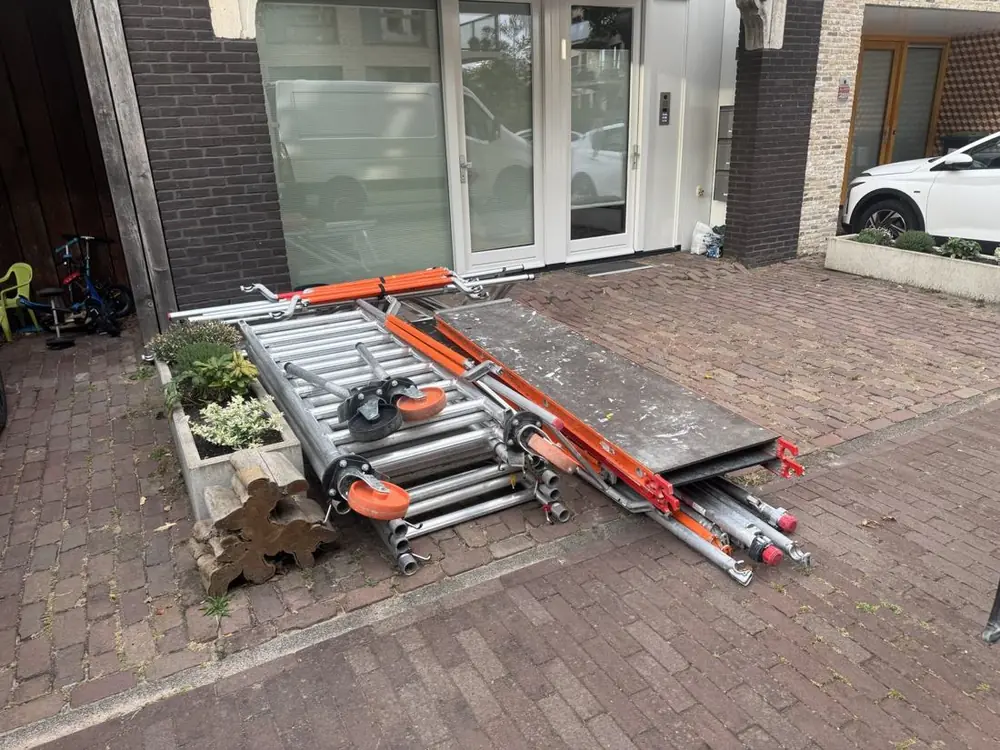
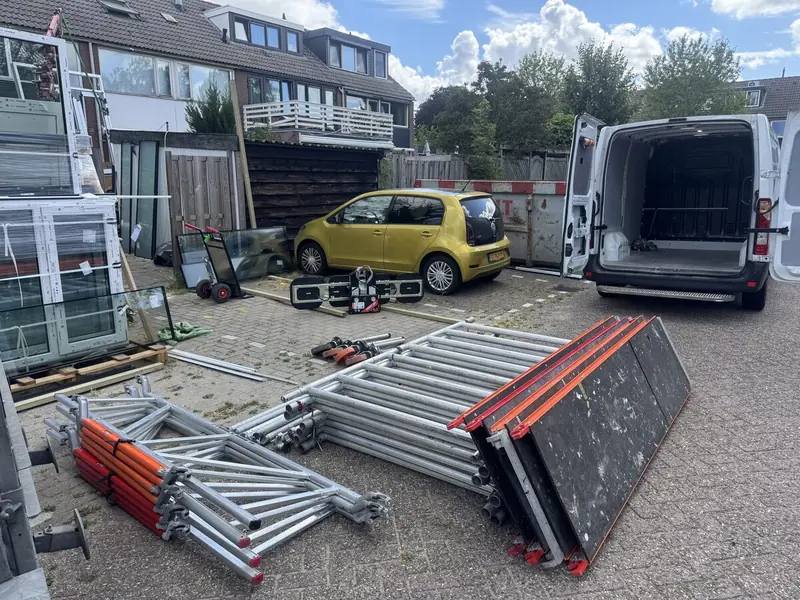
Scaffold parts on the pavement by a front door, the components you carry into the room yourself for indoor work

When the final coat has dried you break the build down and carry the parts back outside, after which we take them away again. Wipe the deck boards and get the spatters off the tubes before stacking them, because emulsion that has dried on is awkward to shift later. What bringing and collecting within your province comes to is set out on the page about delivery, VAT included and settled per journey rather than per day.

Working safely on a hired room scaffold when painting walls

Indoors the same requirements apply as outside: EN 1004, load class 3, meaning 200 kg to a square metre of deck. On painting work you come nowhere near that, but the temptation to use the deck as a table for tins, rollers, your phone and a radio is strong. Keep it clear instead. Anything lying loose up there is something to trip over at the moment your head is at the ceiling line and your eyes are nowhere near your feet.

Brake the castors as soon as the build is in position, and never shove it along while somebody is still up there, not even the half metre to the left that looks so harmless. Fold the stabilisers out indoors just as consistently as you would outside; a smooth room floor with a crease in the sheeting under it lets a build slide away. You will find what that standard demands of a build in the standard these towers are built to.

Assembled tower with rails on every side and a ladder built into it, the climbing route on a hired build

The risk with painting indoors lies in the details of the room. A door swinging open against an upright, a child wandering in, a spot of paint on smooth sheeting: small things that become large at two metres up. Wedge the door on a hook, hang a cloth over the guard rail for your brush and mop up spilled paint the moment it lands rather than at the end of the day. The rest of the rules you will find in the article about working on a tower indoors.

In 5 steps

How hiring a mobile scaffold works

1
Choose working height

Pick the height that suits your job.

2
Book online

Sorted in 60 seconds, price shown instantly.

3
We deliver

At the agreed spot the next working day.

4
Assemble safely

Assembled by you, with a manual.

5
We collect

One call and we collect the scaffold.

Good to know

Practical tips for painting walls

1

Cut the ceiling line with a brush slightly narrower than you are used to. From the floor a thick line hides itself, but at deck level every overrun along the ceiling shows straight away.

2

Finish the bottom strip along the skirting before the build stands in the room. Otherwise you end the day cutting in between four scaffold legs, exactly when your back has had enough of it.

3

Set the build a hand's width out of the corner rather than against it. You can then draw the vertical corner line in one smooth pass from top to bottom without turning your wrist.

4

Take two kettles up the tower with you: one with paint and an empty one for your wet brush. You then never have to climb down for anything, and nothing drips onto your sheeting.

5

Clear the room out properly instead of shoving everything under one dust sheet. You move the room scaffold several times per wall, and every chair in the way costs you time at each move.

6

Let the last coat dry a whole night before you start dismantling. Freshly rolled paint sticks to a tube sliding past it, and that smear is one you will never get out again.

Frequently asked questions

Frequently asked questions about painting walls

Which scaffold should you hire to paint tall walls?+

Indoors that is the RS44 room scaffold. It exists for interior work, the base clears an interior door of roughly 70 cm, and the working height sits between 3 and 4 metres. That lets you go from one room to the next without taking anything apart. Hiring an outdoor model for this leaves you with long parts that will not come through your doorway and a build you cannot place in a sitting room. Inside, this version is simply the logical one.

How does hiring a room scaffold for indoor painting work?+

Model and height are chosen online, you mark the day the parts may come and the day they may go, and the fixed price including VAT is settled up front. We set the parts down at your door; after that you carry them in and put the room scaffold together. Beyond that we stay out of your way. Then you paint your walls in whatever order suits you, and when you are done the parts go back outside for us to collect on the day you named.

How many hire days do you need for painting walls in a room?+

For a room getting two coats you come out at two days, preparation and the drying time between coats included. Doing several rooms or a void pushes it to three or four. Rolling takes less time than people estimate; cutting the edges and waiting on dry paint are what actually fill the day. Better to book a day extra than to break the hired scaffold down with wet walls behind it and no way back up to them.

What does hiring a room scaffold for walls cost, and how does the daily discount work?+

That follows from the model and the height, alongside transport to and from your province. All the amounts are shown online including VAT. For interior work the structure helps: the full price is charged once, at the start, and every hire day behind it arrives at a small fraction of that. A drying day between two coats therefore costs you next to nothing, whereas hiring the room scaffold twice in two short spells means paying carriage twice as well.

What working height do you hire for a three or four metre wall?+

Then you are on the 3 to 4 metres the room scaffold offers, with the deck at one and a half to two metres. Measure from the bare floor to the seam between wall and ceiling, and allow for a light or a beam hanging below it. You want that seam at roughly eye level, because only then do you see what your brush is doing against the plaster. The page with all available heights shows the matching build.

Do you deliver the hired room scaffold, or shall I collect it myself?+

You choose that when you reserve. With delivery the parts stand at your door on the day you nominated, and afterwards we take them back again, at a fixed rate for your province. If you would rather fetch the set, you can load it at Zeeburgerpad 89 in Amsterdam at no charge, by prior arrangement. A room scaffold has shorter parts than an outdoor model, so an ordinary van or a trailer will get you a long way.

Do I put the room scaffold together myself when I hire it?+

Yes, the assembly is yours, and on this model it goes easily: two people are busy for a couple of hours and no tools are involved. The video runs through the steps in order, and no experience is needed to follow it. We handle the rental, the delivery and the collection, but putting anything up is not part of what we do. Indoors as well, no ready built tower is dropped off at your door, however compact a room scaffold happens to be.

Can you hire for longer when the decorating overruns indoors?+

As a rule that is no trouble. Say the word the moment more time is clearly needed and your collection day moves back, unless the room scaffold is booked in elsewhere immediately afterwards. Interior work often overruns because a wall turns out to want far more filling than anyone allowed for at the start. So reserve with a day of slack built in; ending your hire period early is always allowed and costs you nothing at all.

How much room does hiring a scaffold like this take up?+

Reckon on the 245 cm deck plus the stabilisers folded out, and keep enough walking room around it to pass with a kettle. In practice you clear a band three to four metres wide along the wall and push the furniture into the middle of the room out of the way. Whatever stays put has to be shifted again at every move of the hired scaffold, and that costs more time per move than you would think.

Can the hire keep running while the first coat dries?+

That is exactly what the extra day is for. The room scaffold stands there quietly while your first coat dries, castors braked and stabilisers folded out, and next morning you carry on with the same face from precisely the same position. Set a window ajar meanwhile, so the paint cures faster and the room does not keep its smell. Dismantling the build and putting it back up later costs you far more time than that single day of hire ever saves.

What about the deposit if paint gets on the hired scaffold?+

The deposit you put down at the booking is returned within 1 working day once the room scaffold is back with us, provided it is complete and clean. The odd spot on a deck board comes with decorating, but dried layers of emulsion on the tubes do not belong there. So wipe spatters away while they are still wet; that takes seconds each time and saves you scraping at deck boards on the morning you hand the whole set back.

Which order works best for painting walls from a hired tower?+

Start with the wall catching the most light and work towards the door, so you never have to walk past fresh paint. Finish each face from corner to corner before starting the next, and move the hired scaffold only at the moment a band is complete. That keeps your edges wet, keeps the joins out of sight in raking light and means no face has to be gone over twice. It saves you the best part of half a hire day as well.

Hire a mobile scaffold for painting walls today?

Calculate your rental price now or ask for free advice.

Rolsteiger van SteigerTaxi geleverd op locatie
Book it online

Your scaffold sorted in 2 minutes.

Choose your scaffold and working height, see the price instantly and book online.