
See your price
Application

Painting a dormer? Choose the right scaffold.

Painting a dormer is careful work over a small area: the two cheeks, the fascia board along the top edge and the frames of the windows. You need little material for it, but you do need patience, because sanding, priming and two topcoats follow one another with drying time in between. For that the slim RS51 at 75 cm is more than enough, built to 6 or 8 metres of working height. Further down: which build suits your dormer, how many days you keep it and where it fits in the garden.

  • Order before 3 pm, delivered tomorrow
  • Professional Altrex scaffolds
  • Up to 14.2 metres working height
  • Easy to assemble yourself
4,2 tot 14,2 mWorking heights available
12Provinces served
7Days a week
200 kg/m²Load class 3
In short
  • For painting a dormer we recommend the Narrow mobile scaffold.
  • For painting a dormer a slim 75 cm tower is wide enough, with a reach of 6 to 8 metres.
  • You carry little up: a tin of paint, a brush, sandpaper and a cloth all fit together on a narrow deck.
  • Count on three to four rental days, since a drying period sits between the primer and the second topcoat.
  • First 24 hours from €150 incl. VAT and delivery; every day after that 95% off.
Key facts for this job
FeatureValue
Recommended scaffoldNarrow mobile scaffold (Altrex RS TOWER 51)
Working height for this job6 to 8 metres
Available working heights4.2 to 14.2 metres
StandardEN 1004, load class 3 (200 kg per m²)
DeliveryOrdered before 3 pm, delivered next working day
Each extra day95% off, from €7.50 a day
Why a mobile scaffold for painting a dormer?

Safe, stable and professional work at height

Paintwork on a dormer is exactly the kind of job where people stay on a ladder too long. You think it will be quick because it is only a few square metres, and then you spend half a day with a brush in one hand and a tin in the other, edging sideways a bit at a time. On a tower you stand still, you set your paint down beside you and you finish a whole cheek in one go without a join. On top of that this work takes several rounds, and rounds only get heavier off a ladder. A few rental days buy you a tidier result.

  • Slim 75 cm build along the dormer
  • Working height of 6 to 8 metres
  • A fixed place for tin, brush and paper
  • Several coats without shifting position each time
Read more about working safely →

Which mobile scaffold to hire for painting a dormer

For paintwork on a dormer the Altrex RS51 will do, the model that measures 75 cm across. You carry almost nothing up on this job: a tin of paint, a brush, a small roller, some abrasive paper and a cloth. Those sit easily beside your feet on a narrow floor. The gain of this model lies somewhere else, namely in the route to the spot where the dormer sits. A gate, a garden door or a path along the boundary usually passes a 75 cm set and not a broader one.

If two painters are up there at once, or you are doing serious repairs first with filler and new timber, the wide RS52 at 135 cm is worth weighing up. That gives you a floor where material can stand without being underfoot. For a single dormer it is generally a luxury. Ask yourself whether you are painting or carpentering first, because the answer decides which width you hire. What separates the models in width, height and weight is laid out in the comparison of tower sizes.
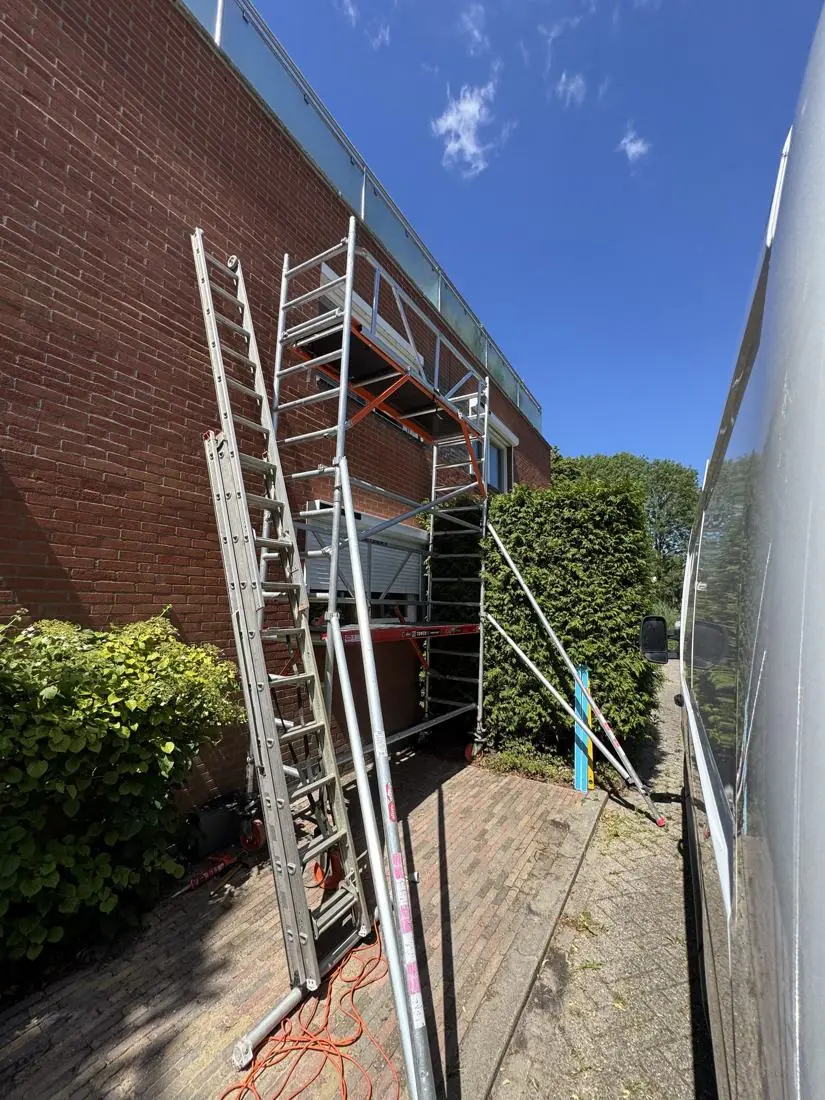
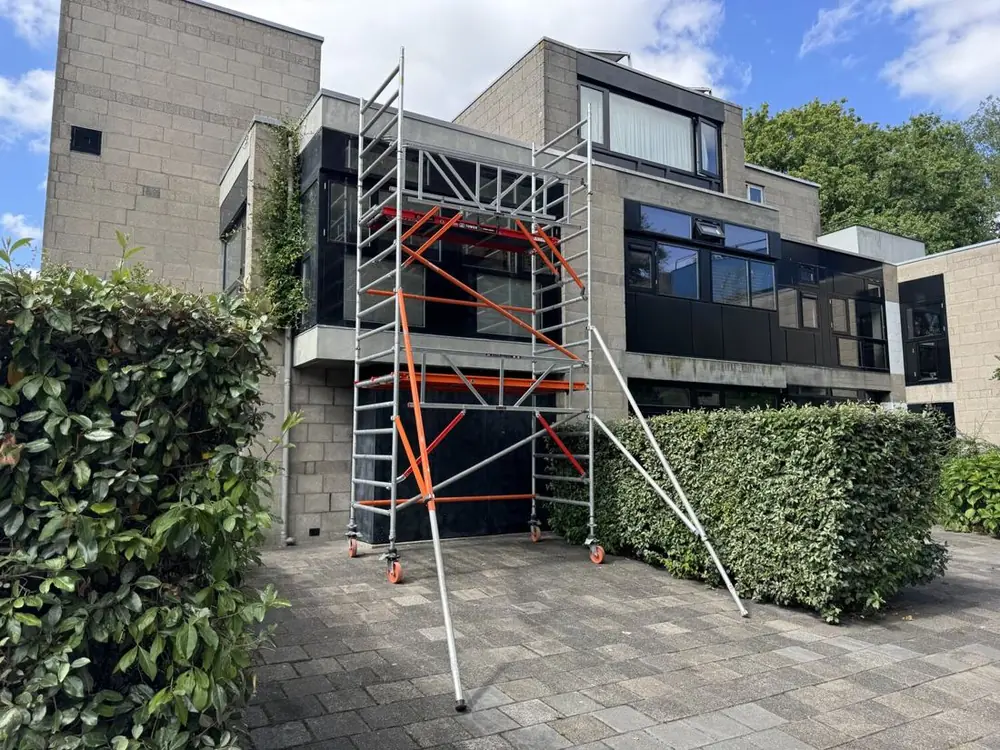
Slim mobile scaffold pitched along a house wall, the 75 cm model that suits paintwork on a dormer

More important than width on this job is that you can move the build. A dormer has a face and two cheeks, and you approach those three planes from different positions. A slim tower you roll a few metres sideways on your own; a wide one is far harder to shift across a garden path, certainly where slabs are missing or a tree root has lifted. Look through the models when you hire a mobile scaffold for outdoor work, and see which size suits your own garden.
Working height of 6 to 8 metres on a dormer

The highest thing you touch on this job is the upper edge of the fascia board, which sits lower than most people assume. On a house with one storey and a roof, that edge often sits around 5 to 7 metres above the garden, and then 6 to 8 metres of working height is exactly enough. Where the dormer is in the roof of a taller building, the figure moves up with it and you pick a larger build. So measure before you hire, with a long tape or from an upstairs window.

What you enter when you book is the height your brush reaches, not the floor you stand on yourself. There is about 2 metres of reach between those two, so anyone hiring at eight metres of working height is standing at roughly six. On paintwork you want that floor just below the surface you are finishing, so you can pull the brush downwards and keep the coat even. How many frames belong with that is shown at eight metres of working height.

Mobile scaffold built against a home up to just below the roof, the height held for painting a dormer

Stand too low and you finish the top strip of the fascia with your arms above your head. That gives runs, drips down your neck and an uneven film precisely where the rainwater travels. Standing too high is awkward on paintwork as well, because then you spend the day stooping over your work. When in doubt take the roomier build and hang the top floor a notch lower if that turns out to sit better once you start.

Renting a slim tower and pitching it under the dormer

Under a dormer there is rarely a neat, level terrace. More often it is a border, a garden path running away from you or a strip of gravel along the wall. So look for the place where the wheels stand on something hard and flat: slabs, a drive or a well trodden path. On soft ground you put stout boards under the feet, or the build settles unevenly the moment you are working on it. Check that again after a day of rain, because ground that was dry on Monday need not still be so.

Then allow for the room the stabilisers take, which you set out on four sides. On paintwork a small zone comes on top of that for your tins, your masking tape and the bucket of water your brushes stand in. Do not put that gear on the floor above where you cannot get at it, but on a small table beside the build. If the pitch is an awkward one, read how to make it solid in the article on anchoring.

Stabilisers folded out beside the foot of a tower, the room kept free in a garden under a dormer

Finally look at what hangs or grows in front of you. A projecting bay, a pergola, an espalier tree or a shed roof holds the tower away from the wall, and every half metre of distance means reaching further with your brush. Prune that branch a week earlier rather than starting your first painting day with a saw. A garden cleared in advance can easily save you half a day once you have the scaffold on hire.

How many days to hire a tower for two coats

The painting itself goes quickly; the waiting takes the time. An average dormer is primed in a couple of hours, and a topcoat takes about as long again. But in between the timber has to be clean, dry and sanded, and between two coats sits a period in which you can do nothing. Add the repairs to the cheeks and the touching in of bare patches, and you arrive at three to four days with the build standing there.

The weather has the last word on this work. You do not paint in full sun on a south wall, not in the rain and not on morning dew. In practice that means starting once the dormer has dried off and stopping well before the evening chill comes in. It makes the workable hours per day shorter than you would like, so the number of days you keep the tower rises without your putting in more hours.

Tower along the side wall of a house, left in place through the days between primer and topcoat

Happily, only that first day weighs heavily. You pay the full amount for the first 24 hours, and every rental day after it carries 95 per cent off, which makes a painting job full of drying time work out surprisingly well. So book a whole week at once instead of piecing three separate days together and hoping the weather plays along. How that spreads over a longer period is explained in the comparison of hiring by the day or by the week.

Which mobile scaffold suits painting a dormer?

Kamersteiger RS44
  • Working height up to 4 metres
  • Compact and narrow
  • Great for indoor and small jobs
View and calculate →
Most chosen
Smalle rolsteiger RS51
  • Working height up to 14.2 metres
  • Narrow (75 cm)
  • Ideal for narrow passages
View and calculate →
Brede rolsteiger RS52
  • Working height up to 14.2 metres
  • Wide platform (135 cm)
  • Extra stability and workspace
View and calculate →
1-persoons steiger MiTower
  • Working height up to 6.2 metres
  • Very compact
  • Quick and easy to assemble
View and calculate →

Painting the cheeks and the fascia from the platform

With a floor 245 cm long you stand in front of the full width of most dormers. That is what you want, because a fascia board brushed out in one pass gives a cleaner line than one done in two halves with a join in the middle. Start at the top with the fascia, work the cheeks next and finish at the frames, so you never have to lean over fresh work. Only move the build when a whole plane is done.

Take up what you actually need per round and no more. A tin standing open on a narrow floor is a tin that will go over at some point, so decant into a small kettle and leave the rest at the bottom. Hang your brush from the rail on a hook rather than laying it on the edge of the floor. Everything that falls on this job lands in your own garden or on the path you walk along yourself.

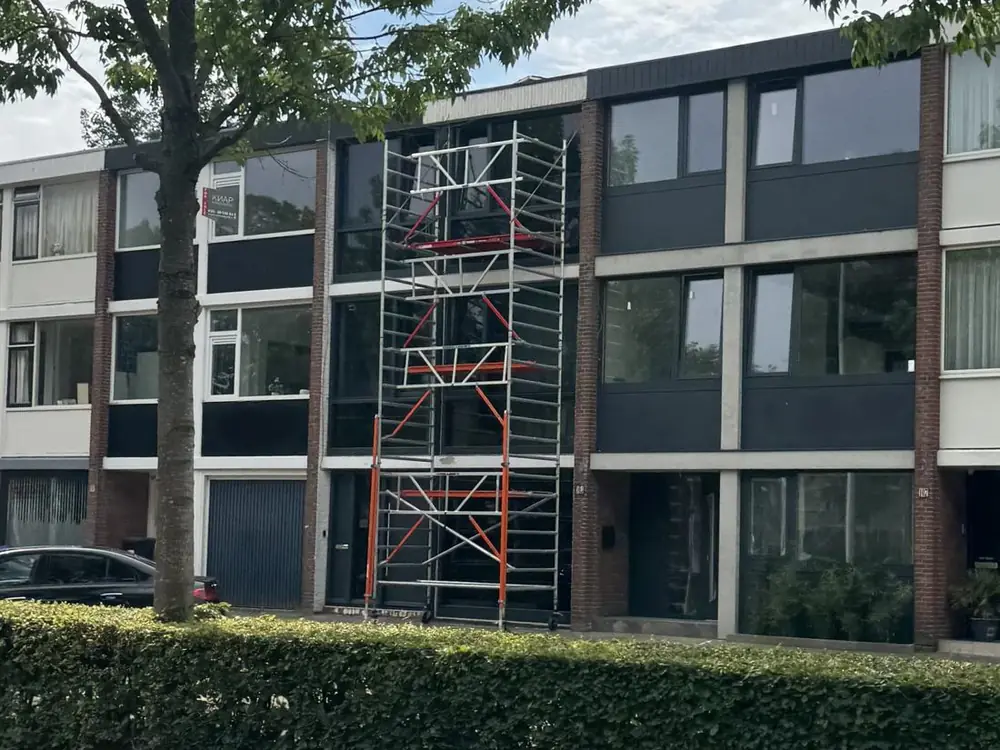
Erected tower at a front elevation with its deck up high, the pitch a dormer is painted from

Do not underestimate how often you go up and down. Sanding, dusting off, priming, checking, filling, sanding again and only then the topcoat: that is seven rounds along exactly the same surface, and each one begins with a climb. It is precisely why a build with a fixed way up works better than a ladder you keep repositioning. If you take the gutter with the brush on in the same week, keep the tower a few days longer.

Scaffold hire and delivery among your tins and brushes

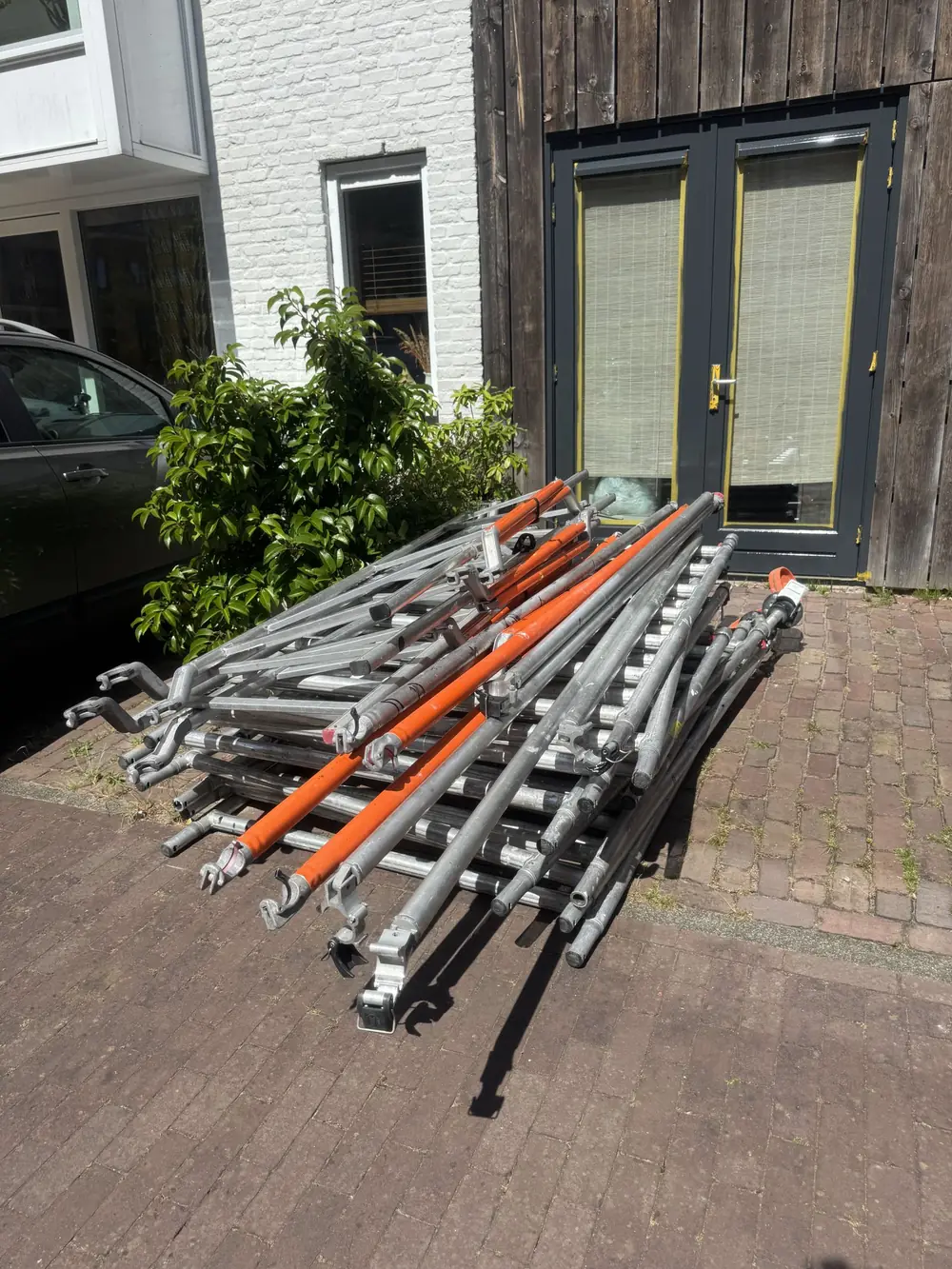
You are sent a complete set of separate components, counted and checked over: uprights, floors, braces, guard rails and stabilisers. Bookings completed before 15:00 on a working day go out on the next working day. Work out beforehand where that stack may lie, because during a painting job your shed or garage is usually already full of tins, brushes and dust sheets. A corner of the drive or a piece of grass beside the path is fine, as long as it does not stay wet there for days.

When the set comes and when it is collected you settle at the booking. On paintwork you tune those dates to the forecast: have it brought at the start of a run of dry days and not on the Saturday showers are promised for. If there is a day in that run when you cannot paint anyway, then that is the day you use for building the tower or for sanding. That way you lose no rental days waiting for better weather.

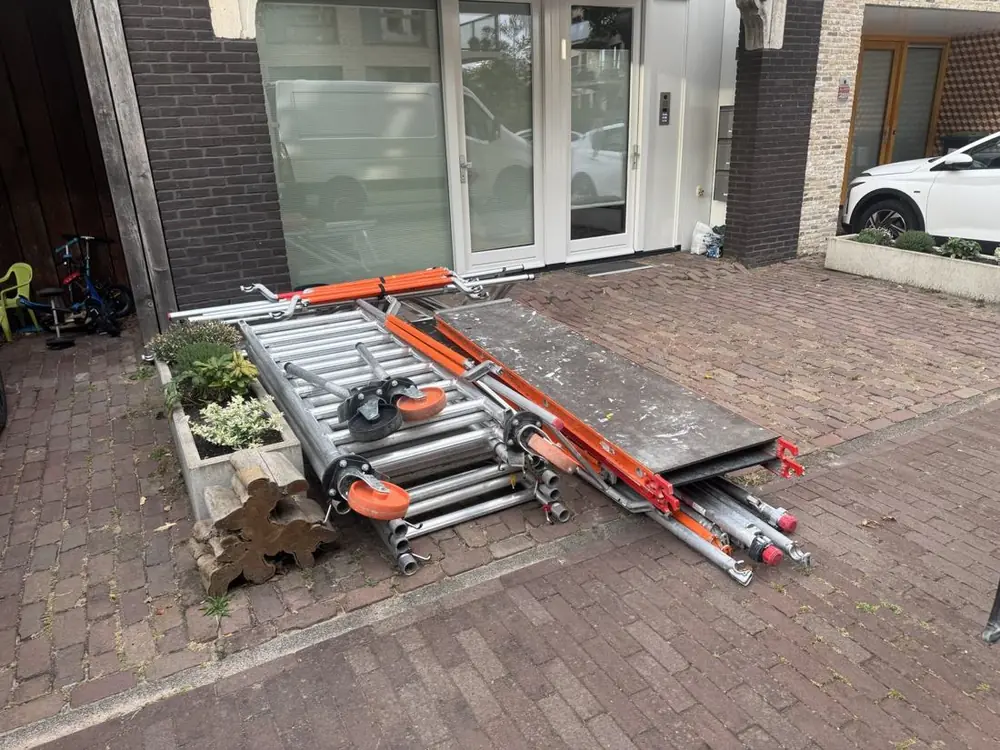
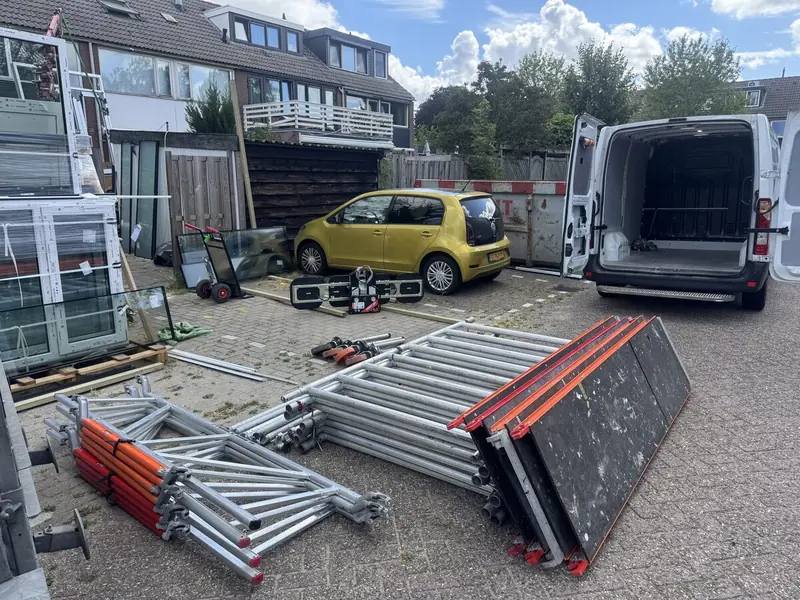
Scaffold parts lying ready beside the front door of a house, delivered before the painting starts

After the last coat we come and fetch the gear again. You take the build apart, gather the parts into one pile and leave them somewhere the driver can reach without trouble. Only do that once the paint has gone genuinely hard, because sliding a tower against a freshly finished cheek is exactly the mistake you have spent the whole week avoiding. What bringing and fetching costs is on the page with the rates per province.

Painting safely on a hired mobile scaffold at a dormer

On paintwork you never come near the 200 kilos per square metre the floor carries under load class 3 of EN 1004. Weight is not the problem here; your own behaviour is. People lean over the rail on this job to catch that last corner of the cheek, instead of climbing down and shifting the build a metre. Keep your waist inside the rail and move once more rather than stretching for it, however tempting the shortcut looks at the end of a coat.

The standing agreements hold: wheels braked before you step on, nobody aboard while it rolls, and no working on in a strong wind. Wind is your enemy on paintwork anyway, since dust, seed and leaves stick straight into a wet film and never come out again. Go round the four stabilisers again each time you reposition, even after a shuffle of only a metre; it is exactly on those short shuffles that one of them gets left up.

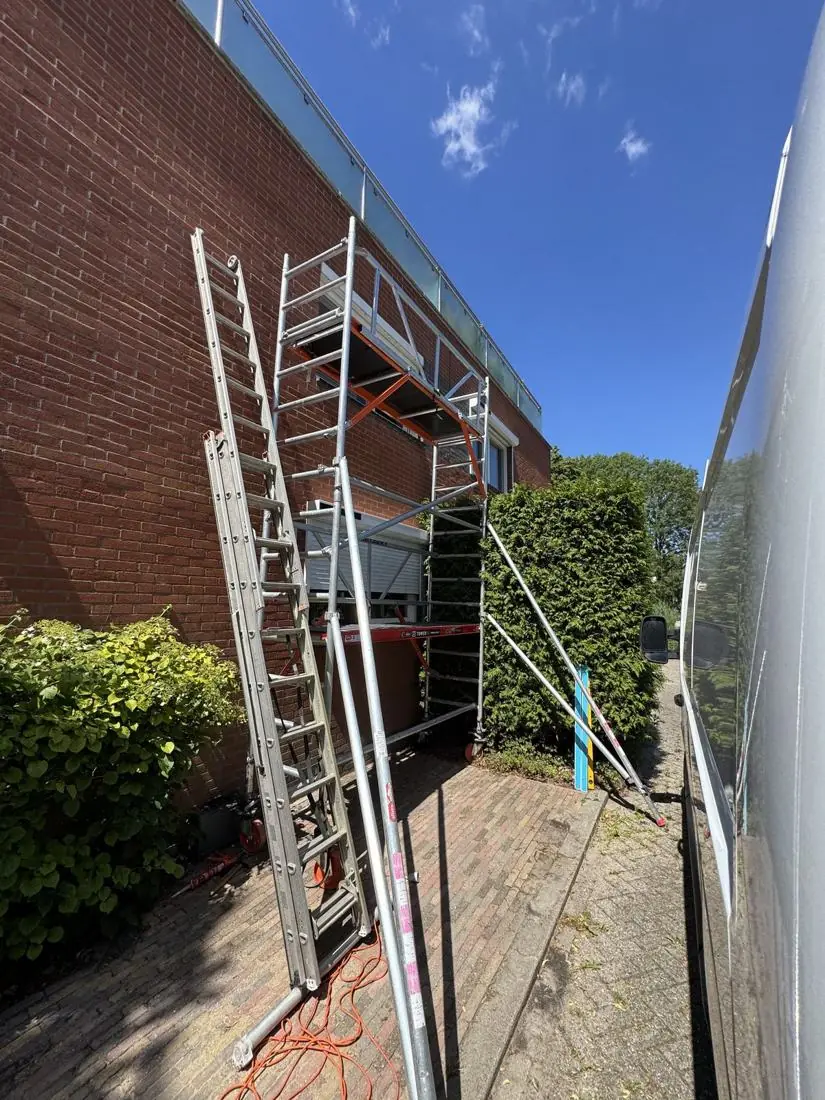
Hired tower assembled against a brick gable, guard rails at every level and a separate ladder leaning on the wall

The risk that belongs to this job is a slippery floor. Paint, water from your brush bucket and sanding dust make a deck treacherous, certainly in smooth soles. Lay cardboard over it and replace that when it soaks through. Never set a tin on the edge of the floor and keep the ground below clear, because the garden chair you forgot to move is exactly what such a tin lands on. The remaining agreements are in the guidance on working safely at height.

In 5 steps

How hiring a mobile scaffold works

1
Choose working height

Pick the height that suits your job.

2
Book online

Sorted in 60 seconds, price shown instantly.

3
We deliver

At the agreed spot the next working day.

4
Assemble safely

Assembled by you, with a manual.

5
We collect

One call and we collect the scaffold.

Good to know

Practical tips for painting a dormer

1

Do the sanding on the day the build is finished. You then see the rotten patches at once and know whether more timber or filler is needed before the dry days begin.

2

Finish the side the sun reaches first and follow the sun round after that. On a wall in full sun the paint pulls away too fast and every brush stroke shows up later.

3

Put a lidded bucket on the floor instead of an open tin. If it goes over while you roll the build a metre, you are left with a mark on the bucket and not on your paving.

4

Mask the glass and the lead before you go up, not while you are standing there with a brush in your hand. Taping at height takes twice as long as preparing on the ground.

5

Check the forecast before you fix your collection date and set it a day wide. Two wet days in the middle of your period are no trouble, but two wet days at the end are.

6

Walk the dormer once more with a lamp at dusk before you strike the build. In daylight you often miss patches under the fascia, and rebuilding for a handspan of paint is a waste.

Frequently asked questions

Frequently asked questions about painting a dormer

Which mobile scaffold is best to hire for a dormer in need of paint?+

The slim 75 cm version is plenty for this job. You take little up with you and what you mostly want is to shift easily between the face and the two cheeks. A narrow tower also passes through a gate or along a garden path where a wide one sticks. Only for heavy repair work, or with two painters up at once, do you pick the 135 cm build, and then chiefly for somewhere to put your things.

How does hiring a scaffold work when you paint in coats?+

You book one unbroken period and simply leave the build standing between the coats. That is the great advantage over a ladder you put away every evening: next morning you climb up in the same spot and carry on where you stopped, with your masking still in place. When you hire you set the start and end dates yourself, so the drying time of your paint fits inside that period without any separate arrangement.

How many days do you rent for sanding, priming and two coats?+

Three to four days is realistic for an average dormer. Day one goes on building, cleaning and sanding, day two on priming and repairs, and the topcoats follow with drying time between them. On a wide dormer with plenty of timber, add a day. That extra day hardly shows in the total, so you may as well fix the margin when you hire instead of ringing about it halfway through.

What does it cost to hire a slim tower for a painting job?+

That depends on the build height you choose and on delivery and collection in your province. You see the amounts including VAT before you confirm, on the page with rates. For paintwork it helps that the rental price of a mobile scaffold sits mostly in the first day: a period of five days costs little more than one of two, while you get all the calm you need to let your coats dry properly.

What working height do you need for the cheeks and the fascia?+

On most dormers 6 to 8 metres is enough. The deciding point is the top edge of the fascia board, so measure from the garden to that point and add that your arms reach a good way past the floor you stand on. If the dormer is on a higher roof, you simply hire a build with more frames in it. The page on working heights shows which tower belongs with each height.

Can you have the scaffold delivered, or do you collect it yourself?+

Either works. Delivery goes at a fixed price per province and happens on the day you choose, after which we fetch the tower once your last coat is on. If you would rather drive, the set stands ready by appointment and free of charge at the Zeeburgerpad in Amsterdam. Bear in mind that a set for 8 metres consists of long uprights; an ordinary car with the seats down is usually too small for it, even though the part count is modest.

Does erecting come with hiring a scaffold for paintwork?+

No, the building is a job for you. The components are delivered and you assemble them, with the supplied manual and an instruction video to hold on to. For a build up to 8 metres two people are busy a couple of hours, and that is a good task for the day it is too wet to paint anyway. We do not erect, and we supply no facade scaffolds or cherry pickers; what you hire is a tower you pitch yourself.

What if the paint is not dry and you want to hire for longer?+

Then we extend the period, as long as the tower is not needed straight away by somebody else. On autumn paintwork that happens often: the dew lies until late in the morning and a coat then wants an extra day. Tell us a day ahead if you can, and we adjust the collection run. You may also return the build early when things go well, because the end date is not set in stone.

How much room do you need to put the tower under the dormer?+

For a slim build reckon on roughly two by three metres of level ground, including the stabilisers set out and a spot for your painting gear. That fits in most front gardens and on virtually any terrace. Allow for the room to move as well, since you shuffle the scaffold sideways a few times to the next cheek. Clear garden furniture, planters and bikes out of the way before the parts are dropped off, and the first day is all building.

Do you have to hire longer in the rain to get the dormer finished?+

Usually by a day or two, and that is precisely why you book generously. The tower can stand in the wet quite happily, but painting on damp timber is pointless: it will not key and you see the streaks afterwards. Use such a day for masking, sanding or sorting your kit. Once the timber feels dry again you pick the next coat up from the same position, without measuring anything out afresh.

How do paint marks and the deposit work when you hire?+

You have the deposit back within one working day after the set is collected and found complete. So watch where you lay your brush and cover the floor with cardboard, because dried paint on a deck and on the rails shows up at the check. A tower handed back clean and complete never causes any discussion at the count afterwards. There is more on that in the article about the deposit.

Can you hire the same tower to paint the window frames below?+

Yes, and that is sensible planning. While the build is there anyway, you can lower it or roll it a few metres to take in the upstairs windows. Bear in mind that you then need a few days more and state that at the booking. Hiring a second time for the same house means another delivery, another build and another wait for dry weather, and that costs you more than the days you are adding now.

Hire a mobile scaffold for painting a dormer today?

Calculate your rental price now or ask for free advice.

Rolsteiger van SteigerTaxi geleverd op locatie
Book it online

Your scaffold sorted in 2 minutes.

Choose your scaffold and working height, see the price instantly and book online.