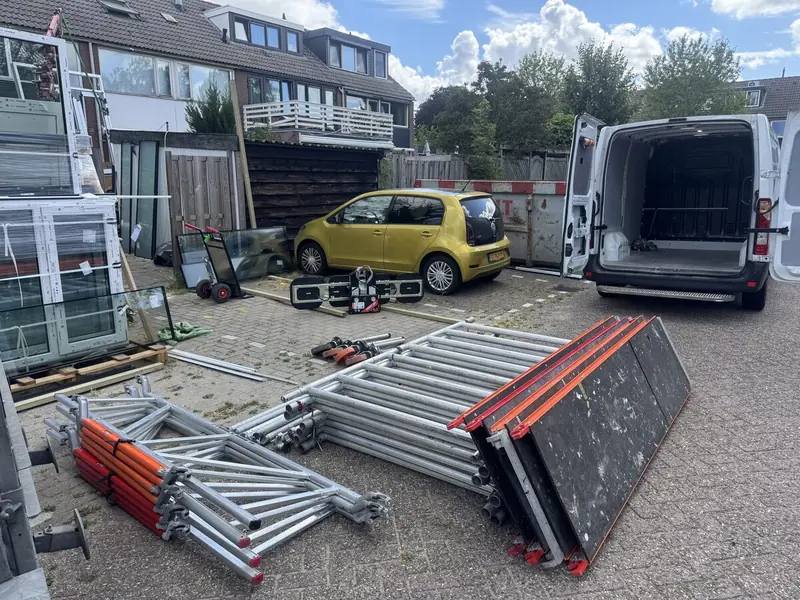

Mobile scaffold for the 1st floor
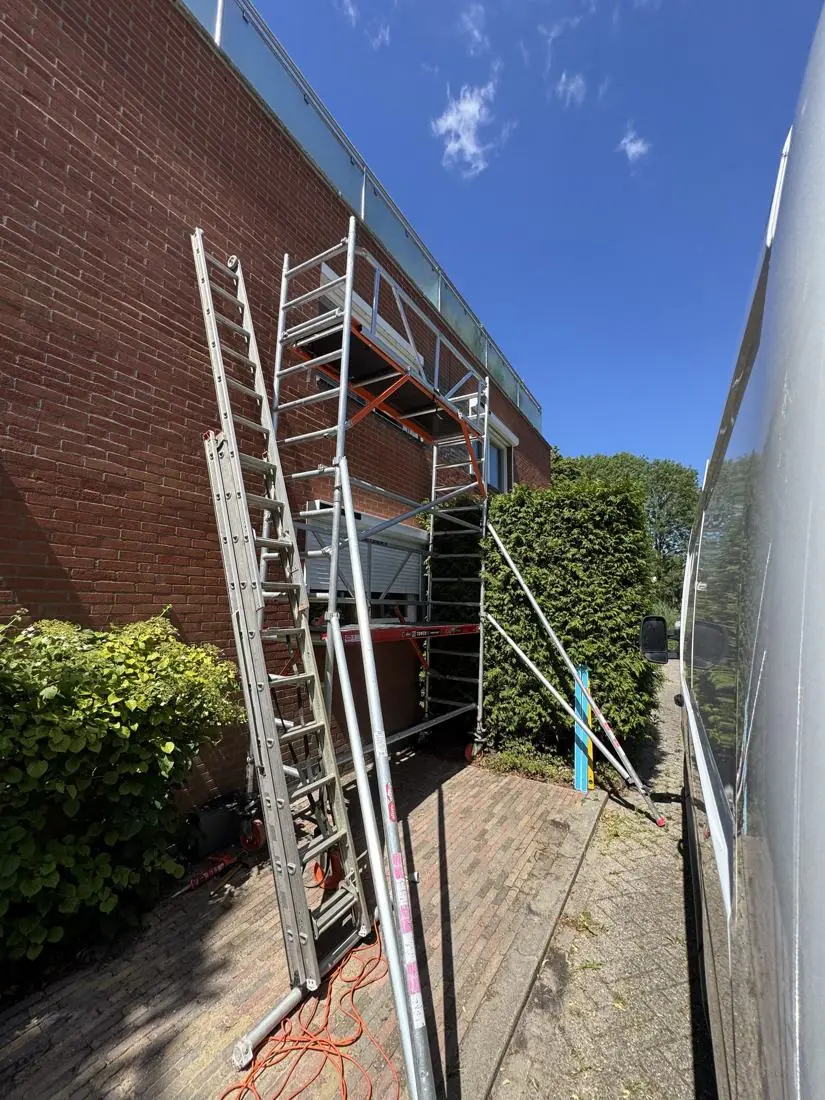
On most homes the first floor sits at around 6 metres of working height. At that level you work on the bedroom windows and their frames, on a canopy above the front door and on the brickwork in between. What makes it tricky is usually not the height itself but what stands underneath the tower: an extension, a raised patio or a garden that slopes away.
- For the 1st floor you can count on a working height of approximately 6 metres.
- Hire from €175 per day incl. VAT (1-person scaffold (MiTower)).
- Ordered before 15:00 means delivery the next working day, anywhere in the Netherlands.
- Assemble it yourself without tools, using the manual and video.
Which working height do you need?
The average floor height of a Dutch home is about 2.5 to 3 metres. For work at first-floor height, such as painting window frames or facade maintenance, a working height of around 6 metres is usually just right.
Working height is not the same as platform height: the working height is the platform height plus approximately 2 metres reach height of an average adult. If you are between two heights, most customers prefer the taller one, so that you do not have to stretch or stand on your toes while working.
Which scaffold fits the 1st floor?
| Model | Working height | Platform height | First 24 hours | Each extra day (95% off) | Deposit |
|---|---|---|---|---|---|
| Narrow mobile scaffold (RS51) | 6.2 m | 4.2 m | €180 | €9 | €500 |
| Wide mobile scaffold (RS52) | 6.2 m | 4.2 m | €205 | €10.25 | €500 |
| 1-person scaffold (MiTower) | 6.2 m | 4.2 m | €175 | €8.75 | €500 |
What there is to do on the first floor
At six metres of working height you reach the top of the first floor window frames. Typical jobs are dealing with rot in the lower sill, painting the opening parts, renewing the sealant around the glass and adjusting insect screens or roller shutters. The canopy above the front door, the awning and the joint between the extension and the wall also fall in this range, as does cleaning windows that do not tilt inwards.
Storey heights vary a great deal. In a nineteen thirties house the first floor windowsill often sits higher than in a post war terrace, with new builds somewhere in between. So always measure to the highest point you need to reach yourself and subtract roughly 2 metres of reach; what remains is the platform height you need. That keeps you from standing on tiptoe or from building unnecessarily high.
An extension, a canopy or a sloping garden under the tower
Behind many houses an extension or conservatory sits exactly under the first floor windows. You do not work over such an addition by standing the tower on its roof, but by placing the tower alongside it and working from the side. If you cannot get around it, choose the narrow RS51 at 75 cm so the base still fits next to the extension while you still reach the frame.
A garden that slopes towards the fence, or a raised patio with a step, leaves the base uneven. Take up that difference with the adjustable legs and firm boards under the feet, never with stacks of slabs or loose blocks of wood. Check with a spirit level that the bottom frame really is flat before you build any higher, because a small lean at the bottom becomes a big one at six metres. Never stand the tower half on a border edge.
Lifts, getting material up and wind at six metres
Six metres of working height means about 4 metres of platform height and therefore several lifts. The tower is delivered as a complete set of parts and you build it yourself using the manual and the instruction video; we do not assemble on site. Work from the bottom up, fit the braces and guardrails as you go, and get someone to help on a taller build, if only to pass parts up to you.
At this height you notice the wind clearly, certainly on a detached wall or in an open back garden. Sheet material catches a lot of wind, so do not leave loose boards lying on the platform when you stop. Load class 3 at 200 kg per m2 leaves room for you plus paint, sealant and tools, but lift heavy items up in small batches rather than all at once. The RS52 at 135 cm gives you more room to move.
Suitable for
- Painting first-floor window frames
- Facade maintenance up to the first floor
- Gutter on a home with a flat extension
Frequently asked questions
What tower height do I need for the first floor windows?
Usually that comes down to around 6 metres of working height, or about 4 metres of platform height. Because storey heights differ from house to house, it is best to measure to the head of the frame yourself. The RS51 and RS52 are available from 4.2 to 14.2 metres of working height, so you can pick a size that ends just above your highest work point.
My back garden slopes, can the tower stand there?
It can, as long as you take up the height difference with the adjustable legs and set the feet on firm boards. Do not work with stacks of slabs or bits of wood under a leg. Check the bottom frame with a spirit level before you build any higher and see that every leg really carries; at six metres a leaning base shows badly.
How do I work over an extension or a canopy?
Do not put the tower on the extension, but next to it on solid ground. With the narrow RS51 at 75 cm the base often still fits between the addition and the fence. If the extension is too deep, work in two set ups: first the part you can reach, then move the tower along. Always move it empty.
Is the tower delivered ready assembled?
No. Steigertaxi delivers the tower as a complete set of parts and does not assemble on site. You put it together yourself with the supplied manual and an instruction video, which at this height is very manageable with two people. Afterwards we collect the complete set again; you only need to dismantle it and put the parts together.
Do you assemble the scaffold, or do I do that myself?
Our scaffolds are designed to be assembled quickly and safely by yourself, without special tools. Follow the manual and video supplied. If you get stuck, we will help you straight away via WhatsApp or by phone.
Can I choose a lower working height for the 1st floor to save money?
You can, but we advise against cutting it too fine: too little working height means you still have to stretch or stand on your toes, which is less safe. Choose a slightly taller working height rather than one right on the limit.