
See your price
Application

Repairing brickwork? Choose the right scaffold.

A cracked or loose brick gets dealt with one at a time. You cut the joints around it away, tap the brick free, brush the cavity clean and bed a matching replacement. The mortar then has to go hard before you can point around it, and that wait sets the length of your booking. For a two storey house you hire a mobile scaffold in the 75 cm RS51 version, put up for 6 to 8 metres of reach. Below: which build fits for repairing brickwork, where it stands, how many days you book.

  • Order before 3 pm, delivered tomorrow
  • Professional Altrex scaffolds
  • Up to 14.2 metres working height
  • Easy to assemble yourself
4,2 tot 14,2 mWorking heights available
12Provinces served
7Days a week
200 kg/m²Load class 3
In short
  • For repairing brickwork we recommend the Narrow mobile scaffold.
  • For repairing brickwork you take the 75 cm wide RS51, with enough parts on board for 6 to 8 metres of working height.
  • Repairing brickwork asks for a position per brick, because the chiselling and the bedding happen over a very small patch.
  • The bed behind a new brick has to set before you point it, so count on three to five consecutive hire days.
  • First 24 hours from €150 incl. VAT and delivery; every day after that 95% off.
Key facts for this job
FeatureValue
Recommended scaffoldNarrow mobile scaffold (Altrex RS TOWER 51)
Working height for this job6 to 8 metres
Available working heights4.2 to 14.2 metres
StandardEN 1004, load class 3 (200 kg per m²)
DeliveryOrdered before 3 pm, delivered next working day
Each extra day95% off, from €7.50 a day
Why a mobile scaffold for repairing brickwork?

Safe, stable and professional work at height

Putting loose brickwork right splits into two visits to exactly the same square metre of wall. First the damaged brick comes out and a new one goes back in, and only once that bed has stiffened do you finish the joints around it. Between those two moments sits a delay that no amount of planning will shorten, and the hire period gets built around it rather than the other way round. The work itself is fiddly too: half an hour of chiselling per brick, both hands occupied, tools balanced by your feet. Hiring a scaffold for repairing brickwork is therefore about standing still at the right height and about booking your days generously.

  • Sourcing a matching brick in colour and size
  • Repairing brickwork starts with cutting the joints out
  • Letting the bed harden before you point it
  • Rubble and old joint mortar drop straight down
Read more about working safely →

Which mobile scaffold to hire for repairing brickwork on a house

For repair work on the brickwork of a two storey home you hire the Altrex RS51, built 75 cm wide. The deck size is not what decides it; the route to the damage is. Broken bricks tend to sit on the gable end, beside the chimney or along the back of an extension, so the build has to pass a side gate, squeeze between two fences or travel a garden path barely a metre across. You can hire a mobile scaffold in several widths, set out side by side in the overview of rolling towers.

Up top this job asks for very little around you: a bolster, a lump hammer, a small tub of mortar, a trowel and the bricks you plan to set that round. All of that sits comfortably on a narrow deck, not least because you are only ever working a patch of half a square metre. What counts here more than width is being able to push the whole tower along single handed, because you reposition far more often than on any other facade job.
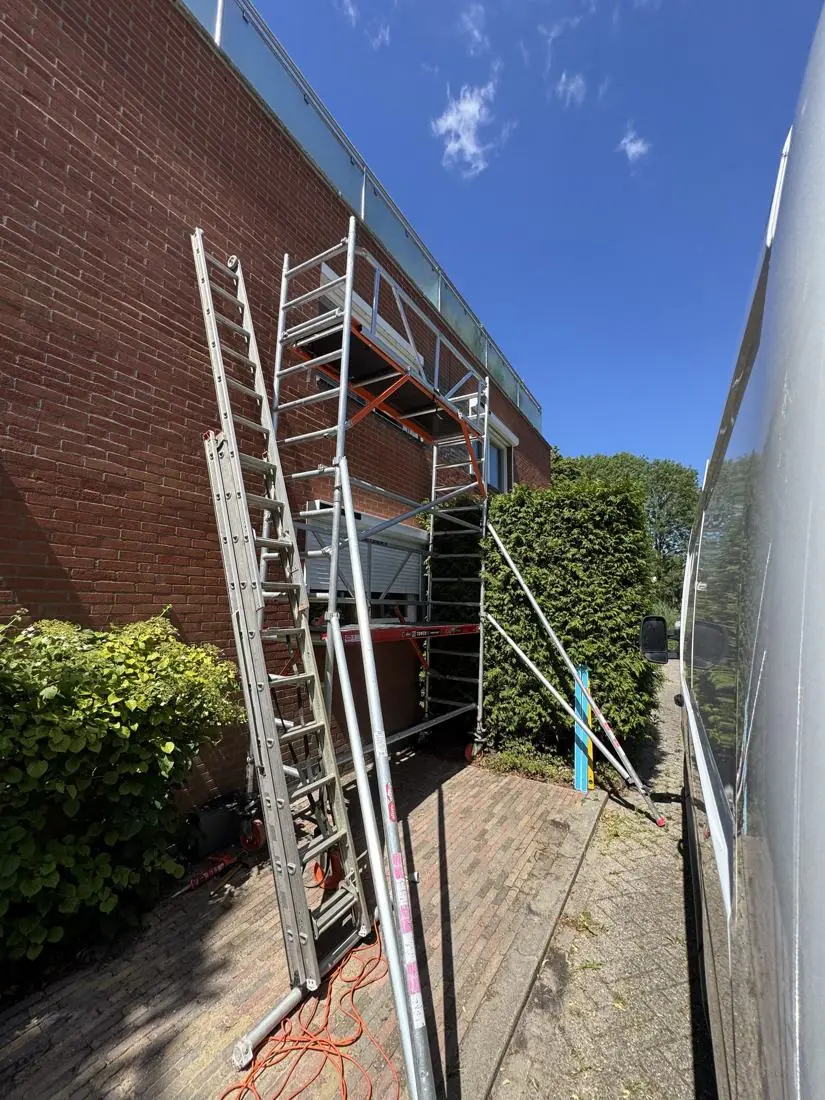
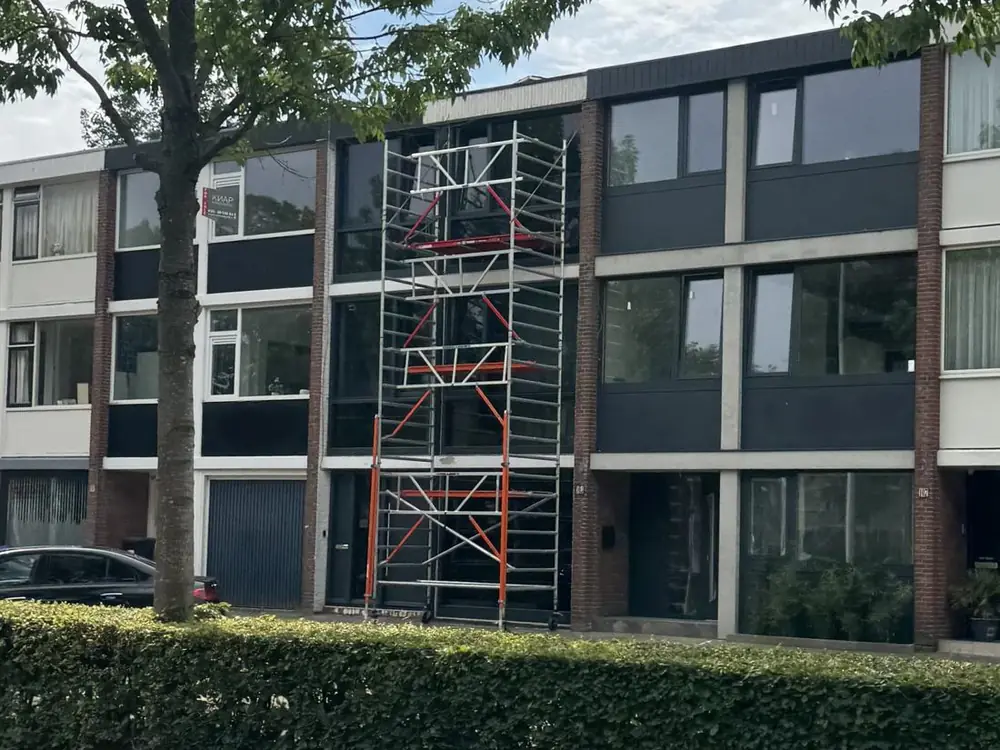
Narrow 75 cm mobile scaffold standing along a brick elevation, the position you shift between repair points in the wall

You only reach for the RS52 and its 135 cm deck when the damage stops being individual bricks. Think of a whole panel of wall coming out, of two bricklayers working side by side, or of a stock of bricks you would rather keep upstairs than carry one at a time. If it is a single patch around six metres up, the MiTower is worth weighing: also 75 cm slim, meant for one person, topping out at 6.2 metres. That covers a single repair point and little else.
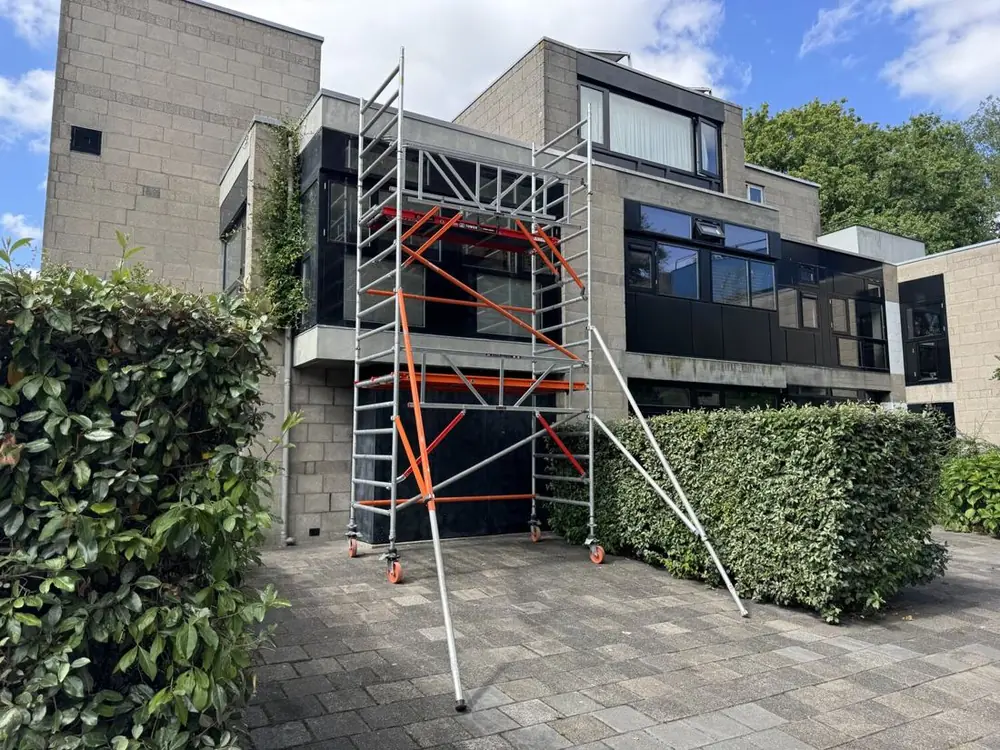
Working height to hire up to the highest loose brick

Walk the elevation first with binoculars, or with a photo blown up on your phone, and find the topmost spot you have to deal with. On a two storey house that is usually just under the eaves or beside a downpipe bracket, and a build for 6 to 8 metres of working height covers it. That leaves the deck at 4 to 6 metres, because a platform gives you about 2 metres of reach above itself. Which parts go into that is set out on the page for an eight metre build.

When repairing brickwork it is not only the highest broken brick that counts, but whether you can still see above it. To judge where a crack has come from you want the course above it close to your eyes, and that fails if your build stops level with the damage. Take your highest repair point, then add half a metre to it. In practice that difference amounts to one extra section, which you simply include when you reserve the tower and forget about again.

Mobile scaffold built up to just below the eaves, the height at which loose bricks in a facade get replaced

Book too tight and you end up chiselling with your arms above your head, which is doubly unpleasant on cutting work. You lose the feel of the hammer and knock the sound brick next door to pieces, while the dust lands in your face instead of at your feet. And you will be adding a section for that top course anyway, which eats half a working day. If the damage sits at first floor level, go for the taller of the two builds.

Hiring a mobile scaffold and siting it at damaged brickwork

The strip under a repair point has to be empty, because everything you cut out lands there: lumps of old joint mortar, shards of the broken brick and a fine dust that gets into everything. So no bike, no wheelie bin and certainly no car, and lay a sheet you take with you every time the tower moves. That sheet saves you half an hour of sweeping between the paving later, where loose mortar otherwise beds itself into every gap.

Then look at where the four stabilisers land. They splay outwards and all four want firm ground under them, and along a wall with damaged brickwork that strip is often soft: a border, a gravel path or a sunken run of slabs against the plinth. Put a thick board or a spare paving slab underneath each one, and check with a spirit level that the build really is upright before anybody climbs. Sloping ground is dealt with in the note on ground that is not level.

Stabiliser legs splayed out under a mobile scaffold, and the clear strip that cutting out old brickwork demands around it

One detail keeps coming back on this job: damage in brickwork usually sits right beside a leaking downpipe or under a gutter bracket that has worked loose. That is exactly where you now want your build to stand, and such a pipe must never be used as a support or jammed under a castor. Bear in mind too that you will come back to the same spot a second time to point, so keep the route to that position clear for the whole hire period.

How many hire days does repairing brickwork need

The cutting out and the bedding go quicker than most people expect: a practised hand manages four to six bricks a day, including brushing out the cavity and mixing small batches. After that the work stops. The new brick has to be solid before you can press the joint around it, otherwise you shove it out of line or pull it loose again. For a house with a handful of damaged spots that puts you at three to five hire days.

Not all of those are working days, and that is precisely the point. Reckon on a day of cutting and bedding, then a day when you leave those patches alone, then half a day of pointing and checking. If it freezes, or the brickwork stays wet after a day of rain, the rhythm slips further, because fresh mortar and frost do not mix. Since you nominate the first and the last hire day yourself, you build those waiting days straight into the booking.

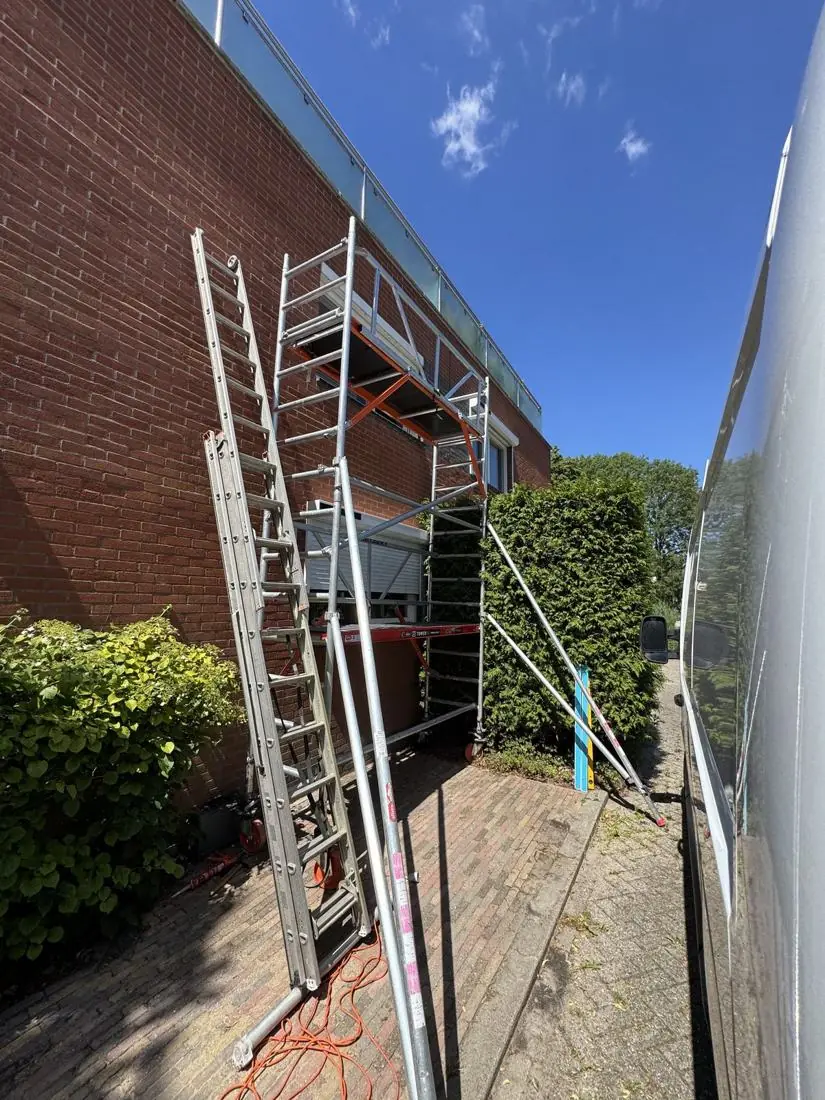
Mobile scaffold left standing along a side wall, as on the hire days when fresh bedding mortar has to cure

Your wallet barely notices the wait. The full amount covers your opening 24 hours and nothing beyond it; from the second day onwards, 95 per cent is knocked off the day rate, so a generous booking costs a fraction of what a second assembly takes in time and temper. The page of fixed rates shows how the rental price works out per build. Booking tight and then having to return is easily the dearest route through a brickwork repair.

Which mobile scaffold suits repairing brickwork?

Kamersteiger RS44
  • Working height up to 4 metres
  • Compact and narrow
  • Great for indoor and small jobs
View and calculate →
Most chosen
Smalle rolsteiger RS51
  • Working height up to 14.2 metres
  • Narrow (75 cm)
  • Ideal for narrow passages
View and calculate →
Brede rolsteiger RS52
  • Working height up to 14.2 metres
  • Wide platform (135 cm)
  • Extra stability and workspace
View and calculate →
1-persoons steiger MiTower
  • Working height up to 6.2 metres
  • Very compact
  • Quick and easy to assemble
View and calculate →

Repairing brickwork from the 245 cm scaffold platform you hire

With a deck length of 245 cm you cover a band of brickwork a good two metres wide without moving. In height you reach about a metre and a half of wall from one fixed position, and that rectangle is the panel in which you group your repair points. If two broken bricks sit close together, do them from the same position even if it only saves half a metre sideways. Every move you skip is half an hour gained, and those hours add up to whole hire days.

Go up with a fully loaded bucket rather than with odds and ends in your pockets: bolster and hammer, a brush for sweeping the cavity out, a sponge, some water and no more mortar than you will use within the hour. The replacement bricks travel up separately and go against the end of the deck, never loose along the edge. A brick falling from five metres is not only ruined itself, it is lethal for anyone walking beneath the tower.

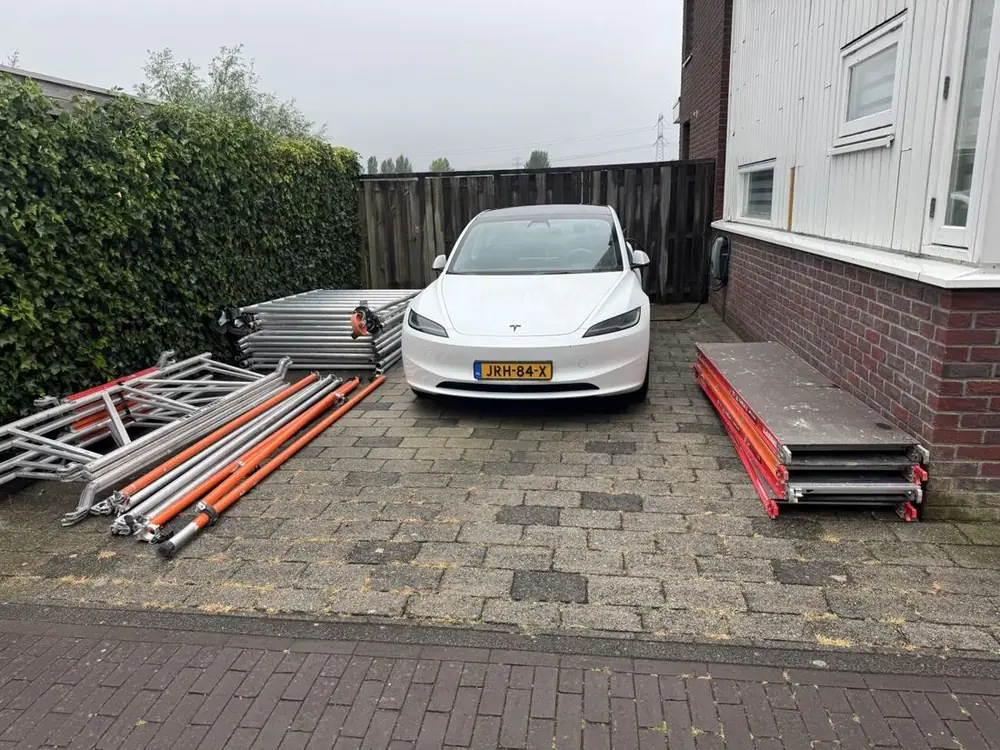
Guardrail frames and a brace on a brick pavement, the hire set built up before a panel of brickwork is tackled.

Where people usually misjudge this job is the number of trips up and down the ladder. Forgotten mortar, a brick of the wrong size and a bolster left on the ground easily cost an hour a day between them, and that comes straight off your hire period. So run through your list out loud before you climb, every single time. If the repair turns into repointing the whole wall, count on extra positions and extra days as well.

Mobile scaffold hire with delivery for loose brickwork repairs

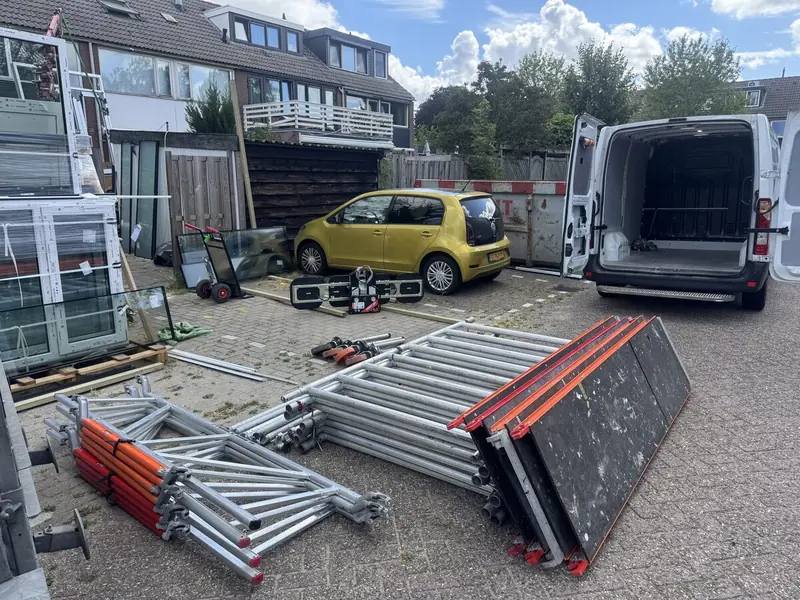
What gets dropped off is a package of loose parts, counted and complete, not a ready made tower. Settle in advance on a spot for that stack, and leave the ground below your repair points free, since the rubble ends up there. A drive, a bit of lawn or the front garden all serve, as long as you can get past with a barrow. An order that reaches us on a weekday before 15:00 goes out to you the next working day.

The day everything arrives and the day it leaves again are yours to pick. That helps with brickwork repairs, because you want to assemble at a moment when no cutting is due yet: put the tower up calmly, look at the wall from close range and take out the first brick the following morning. Assembly is your side of the deal, working from the booklet and the film supplied with it. With a second pair of hands, half a day covers it.

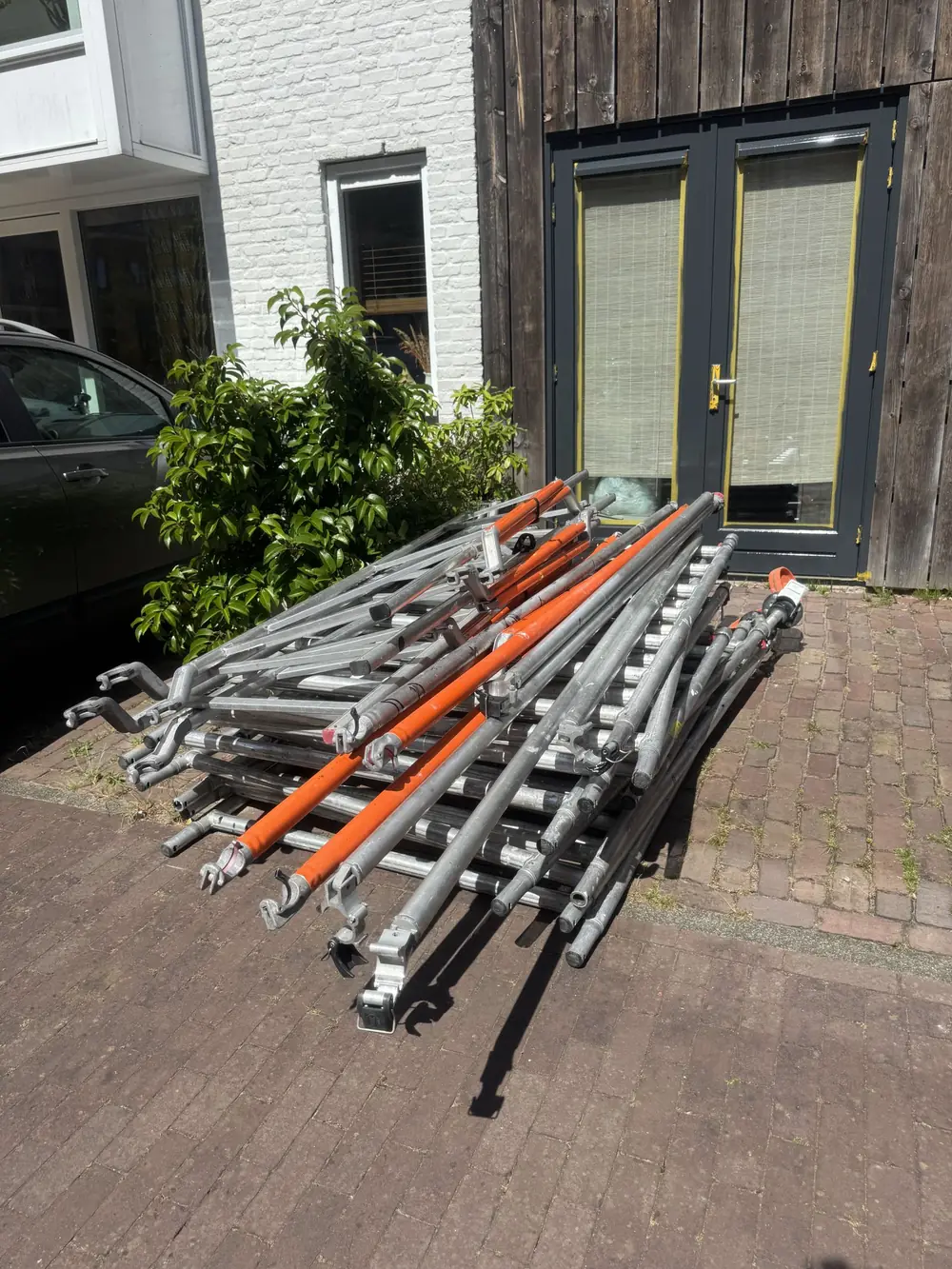
Scaffold parts delivered on site, counted and complete, from which you raise the build for your brickwork yourself

Once the repairs are finished you break the build down and stack the parts somewhere dry, after which we come by to take them away. Hold off until your last joints feel dry, or you will smear wet mortar down the tubes and be scraping at them on the final morning. The figure for carting a set to your province and bringing it home again appears on the page about delivery costs, so it lands in your sums at the start instead of turning up as a surprise at the end of the job.

Repairing brickwork safely on a hired mobile scaffold

These deck boards are rated at 200 kg per square metre, which is what load class 3 of EN 1004 comes down to, and that is the ceiling you work under. On this job in particular you creep up on it without noticing, because a tub of mortar, a small stack of facing bricks, your cutting tools and you together weigh more than it looks. Spread that load along the full deck rather than piling it against one guard rail, and take down whatever this round no longer needs.

The usual agreements apply to cutting work too, and they are easy to forget when you only want a quick go at one brick. Lock the castors before you climb, never roll the tower even half a metre while someone is up there or your tub is still aboard, and get off as soon as the wind really picks up. After each move, check that all four stabilisers are back under proper tension. What the standard asks beyond that is set out in the article on this scaffold standard.

Hired tower up in a narrow gap beside brickwork, an extension ladder against the wall next to it, not within.

The risk that genuinely belongs to replacing bricks plays out above and below at once. Up top you work with hammer and bolster close to your face, so goggles and stout gloves are not a luxury here. Down below lies the zone where shards and lumps land, and you fence that off with tape or a few cones before the first blow. Warn the neighbours as well if you are close to the boundary, since dust travels further than the sheet reaches.

In 5 steps

How hiring a mobile scaffold works

1
Choose working height

Pick the height that suits your job.

2
Book online

Sorted in 60 seconds, price shown instantly.

3
We deliver

At the agreed spot the next working day.

4
Assemble safely

Assembled by you, with a manual.

5
We collect

One call and we collect the scaffold.

Good to know

Practical tips for repairing brickwork

1

Find a matching brick before you cut anything out. On an older facade that often means a demolition yard or the back of a shed, and waiting with a hole in the wall can cost you a whole hire day.

2

Always cut the joint right around a brick away before you touch the brick itself. Start on the brick and you push the stress sideways, dragging the healthy neighbours loose out of the wall with it.

3

Mix mortar in batches you will use up within the hour. A bucket left stiffening on the deck only gets carried back down at the end of the day, and that is time you never get back.

4

Wet the cavity and the new brick just before you bed it. Dry brickwork sucks the water straight out of your mortar, and then the brick is loose again before you even reach the joint.

5

Mark the made good spots on a rough sketch of the elevation. After the waiting day you know exactly which tower position to return to, even once the new brick has dried and barely shows.

6

Book the collection day two clear days beyond your final bedding day. That gives room to walk the elevation once more, brush the deck boards off and stand every part ready, dry and counted, for the van.

Frequently asked questions

Frequently asked questions about repairing brickwork

Which mobile scaffold should I hire to replace loose bricks?+

For a two storey home you take the RS51, the mobile scaffold that is 75 cm wide. It gets you past a side gate and along a narrow path to the flank and rear walls, and you push it to the next repair point on your own. That last part matters here, because you reposition more often than on other facade work. If a lot of material goes up, or two of you stand on the deck, hire the wide 135 cm version instead.

How does hiring a scaffold for repairing brickwork actually work?+

Online you pick the version and the working height, put a date against the drop off and another against the pick up, then settle a fixed amount including VAT before anything moves. We leave the parts at your house, you raise the tower, cut out the bricks and lay new ones back in. On your final hire day everything lies broken down and ready for the van. The one moment that needs sharp planning is the pointing day, because that hangs on your mortar.

How many hire days should you book for repairing brickwork?+

Count on three to five hire days for a handful of damaged bricks. The cutting and the bedding fill a day, then comes a day when you leave those patches alone, and after that you check the lot over and point. If the bricks sit far apart, or two elevations need doing, add a day to the total. Hiring a scaffold for repairing brickwork is better done as one unbroken block than in separate stretches with a gap between them.

What does the rental cost, and why is an extra day so light?+

The figure for the mobile scaffold follows two things, which version leaves the yard and how many metres you stack it to, with carriage out and home added. Every amount online includes VAT. The way the rate is put together suits this job: nearly all of the money is spent before the first brick is out of the wall. A waiting day for hardening mortar therefore costs little, while two separate periods make you pay that opening amount twice over.

Which working height to hire if the damaged bricks sit at the eaves?+

On a two storey home that puts you at 6 to 8 metres, with the scaffold deck at four to six metres. Your tape starts on the ground where the castors will rest and ends half a metre above your highest bit of damage, so you can also judge the brickwork above it. If the garden sits lower than the pavement, begin measuring at that lower point. The overview of every working height on offer shows the matching build.

Do you have the hired parts delivered, or collect them yourself?+

That choice sits with you when the booking goes in. If we deliver, the mobile scaffold lands on the date you set and travels back with us once your last pointing day is done, against a fixed figure for your province. If you would sooner fetch it, the set can be picked up without charge from Zeeburgerpad 89 in Amsterdam once a time is agreed, provided the trailer you bring is long enough for the tubes. With waiting days in the middle, most people have it brought.

Does the hire include putting the scaffold up for me?+

The building is on your side of the job. Our part is the rental, the delivery and taking it away again; you clip the parts together yourself with the video and the booklet beside you. Allow half a day with two people, and bear in mind that no brick comes out of the wall that day. Cherry pickers, facade scaffolds and system scaffolds sit outside our range altogether, so at this height a mobile tower is simply the tool for the work.

Can I extend the hire if more bricks turn out to be damaged?+

You can. Let us know the moment you see it and we push the collection date back, unless the tower has already been booked out to the next customer. On brickwork repairs this happens regularly, because only once the first brick is out do you see how far the damage runs behind the joint. To get ahead of it, put an extra day in at the reservation stage; giving the set back before your end date is never a problem.

How much room do I need to clear to hire a scaffold here?+

Start from how wide the tower is and add the reach of the stabilisers to left and right. With brickwork you then add the strip where the rubble falls and where your tub, your water and your bricks stand. In practice you want a flat, clear run of a few metres along the wall. Shift water butts, planters and bicycles somewhere else before the delivery lands, because moving them mid job costs you more time than it saves.

Is it still worth hiring if frost is forecast during the job?+

Cutting out still works in light frost, bedding does not: fresh mortar that freezes never sets and your new brick sits loose in the wall. Use a day like that to map the damage, clear out cavities and hunt down bricks of the right size, and lay as soon as the temperature climbs. Because you nominate the end date of your hire period, the damage stays at one extra day and the tower need not go up twice.

How is the deposit handled on this rental?+

A deposit is set against the hire at the reservation stage, and it goes back to you within 1 working day of the return, as soon as the parts count adds up. With brickwork, watch two things: hand the set back complete, and leave no dried mortar on the deck boards and the tubes. A wet cloth over them on the day saves scraping on the last morning. That process is covered in the article on getting your deposit back.

Must the hired scaffold stay up between bedding and pointing?+

That is exactly why you keep the tower a few days longer. It stays at the same panel while the mortar goes hard, castors locked and stabilisers out. A day later you climb up and finish the joints from the identical position, with no measuring and no lining up to redo. Anyone who breaks it down in between pays for a second assembly in time and still ends up standing a few centimetres out from where they were.

Hire a mobile scaffold for repairing brickwork today?

Calculate your rental price now or ask for free advice.

Rolsteiger van SteigerTaxi geleverd op locatie
Book it online

Your scaffold sorted in 2 minutes.

Choose your scaffold and working height, see the price instantly and book online.