
See your price
Application

Pointing brickwork? Choose the right scaffold.

Pointing brickwork happens panel by panel. You rake the old joints out of a stretch of wall, blow the grit clear, mist the brick and press fresh mortar in, and that whole circuit has to finish before the mix starts to go off. So the size of a panel is dictated by your mortar and not by how fast you feel like working. On a two storey house you hire the 75 cm slim RS51, assembled to reach 6 to 8 metres up the elevation.

  • Order before 3 pm, delivered tomorrow
  • Professional Altrex scaffolds
  • Up to 14.2 metres working height
  • Easy to assemble yourself
4,2 tot 14,2 mWorking heights available
12Provinces served
7Days a week
200 kg/m²Load class 3
In short
  • For pointing brickwork we recommend the Narrow mobile scaffold.
  • For pointing brickwork across two storeys you hire the narrow RS51, built up to give 6 to 8 metres of reach.
  • You work in panels as wide as the deck, because mixed pointing mortar only stays workable for a limited stretch of time.
  • Raking out and filling both happen from one position, so your hire days for pointing brickwork follow the panel count.
  • First 24 hours from €150 incl. VAT and delivery; every day after that 95% off.
Key facts for this job
FeatureValue
Recommended scaffoldNarrow mobile scaffold (Altrex RS TOWER 51)
Working height for this job6 to 8 metres
Available working heights4.2 to 14.2 metres
StandardEN 1004, load class 3 (200 kg per m²)
DeliveryOrdered before 3 pm, delivered next working day
Each extra day95% off, from €7.50 a day
Why a mobile scaffold for pointing brickwork?

Safe, stable and professional work at height

With pointing work your measure is not the elevation but the panel you can finish inside the working life of your mortar. You mix a batch, rake out a stretch of wall, brush and damp it, then get the joint in before the mix begins to stiffen. Miss that window and you either throw the rest away or end up with a band in a different shade. So hiring a scaffold for pointing brickwork comes down to a build you can shift one panel along quickly, with a deck sitting at the right height against the wall. How many panels your elevation holds then dictates the whole hire period, from the delivery date you name to the day the parts go back.

  • Panel size follows the working life of your mortar
  • Raking out and filling from a single position
  • Grit from the cutter drops onto the deck
  • One mix ratio throughout to avoid colour banding
Read more about working safely →

Which mobile scaffold to hire for pointing brickwork on two storeys

The Altrex RS51, built slim at 75 cm, is the obvious model for this job. Pointing advances one panel at a time, which means the build gets nudged along six or seven times in a day. A narrow tower like that you push on your own, even when it has to pass between a fence and the brickwork or squeeze by a hedge you would rather not damage. You can hire a mobile scaffold by the day, and the full range of rolling towers is listed with the dimensions beside each one.

On the deck, pointing brickwork calls for a tub, a bucket of water, a pointing iron, a stiff brush and your raking tool. All of that stands happily on 75 cm, so long as you keep one tub up there at a time rather than your entire stock of sand and cement. Working close to the wall pays off in another way as well: you press the joint home from the shoulder instead of at arm's length, and after half a day your wrist will thank you for it.
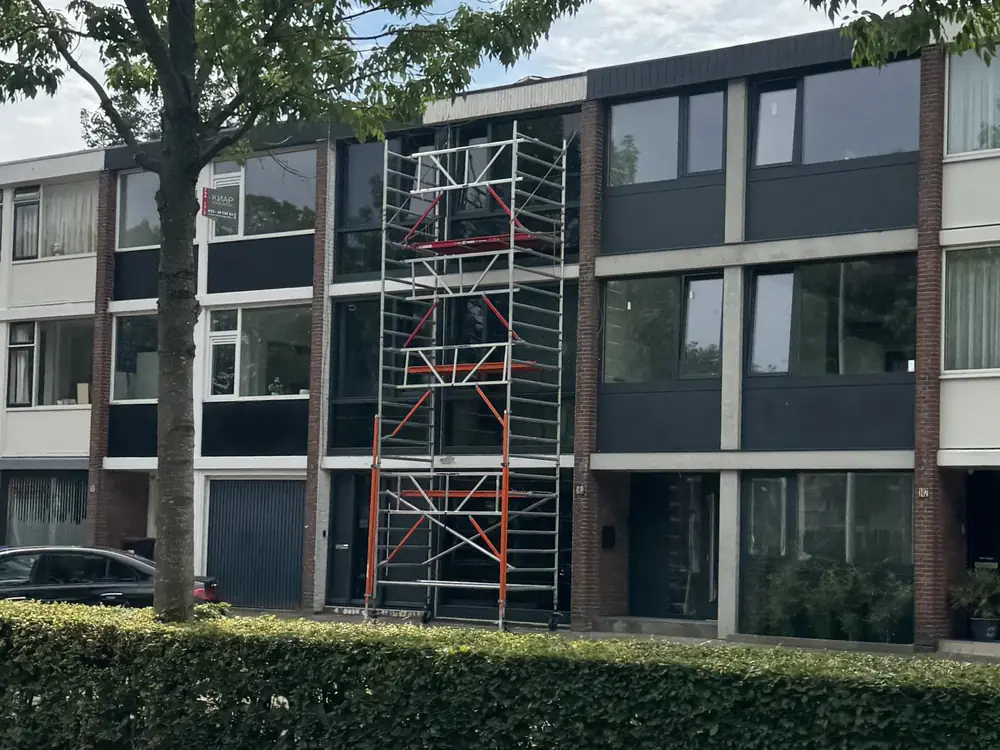
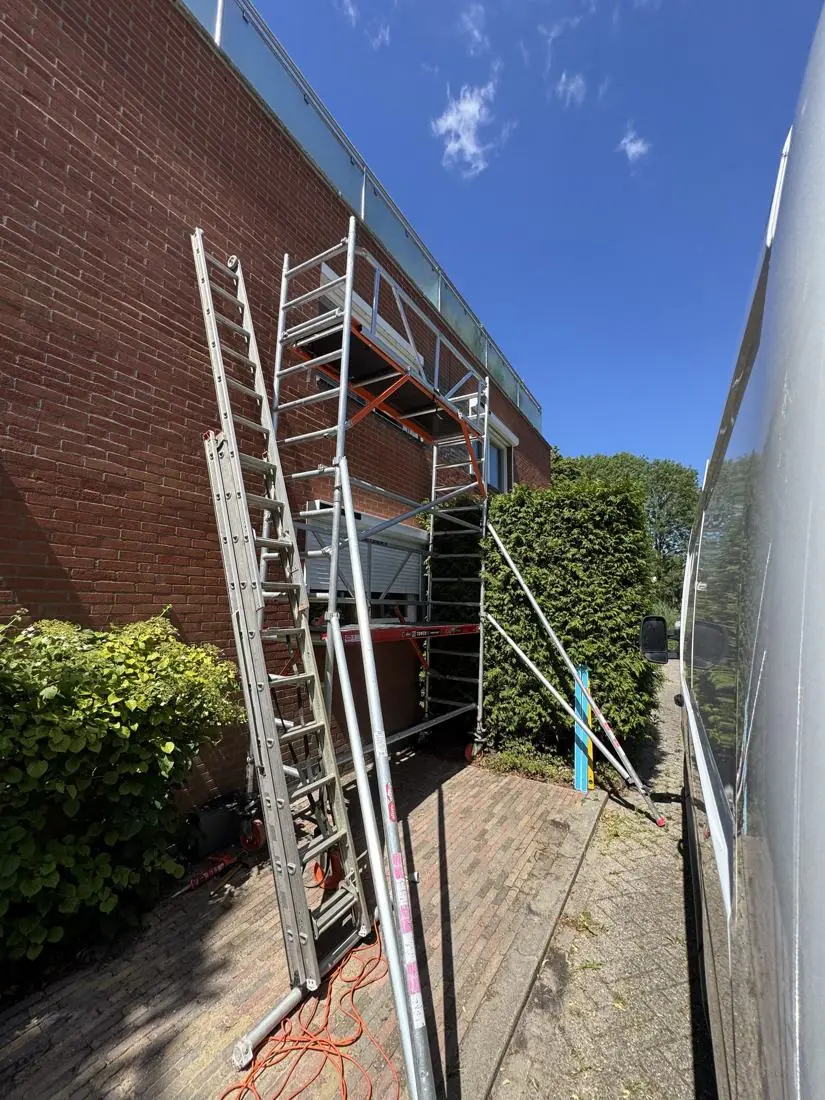
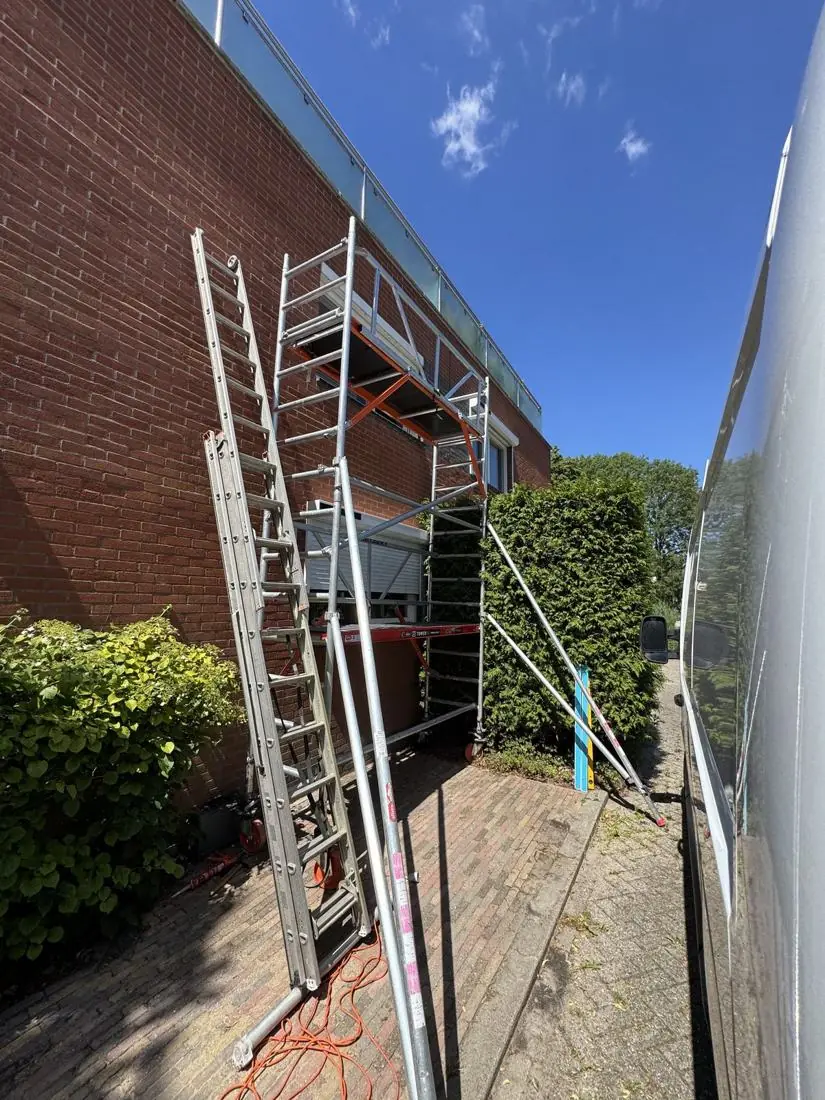
Slim mobile scaffold assembled against a brick elevation, the position from which you renew the joints panel after panel

If two of you work together, one raking out and the other filling, the wider RS52 and its 135 cm deck become interesting. On that you pass one another without stepping over the tub, and the second person can carry a bucket by the first. For a single elevation on a terraced house that width is usually overkill: more parts to haul round the back, a wider gap to get through, and you lose exactly the nimbleness this work rewards. Judge it on how many people share the deck at once.
Hiring the working height for pointing brickwork up to the eaves

The highest joint you intend to touch is what you order against. On two storeys the brickwork usually runs up to just below the eaves or to the underside of a fascia board, and a working height between 6 and 8 metres covers that comfortably. Your deck then finishes somewhere between 4 and 6 metres. Reach above the deck runs to roughly 2 metres, so platform height plus 2 gives the figure you book. The parts list that goes with it appears on the page for a six metre build.

Pointing asks for a little more reach than you would guess by eye. It is not enough to touch the top joint; you need to see it square on. A joint pressed home from below turns hollow or proud, and that difference shows across the whole elevation once you stand back on the pavement. So choose a build that puts the top course at chest height rather than above your crown, and count in a spare section if you are torn between two.

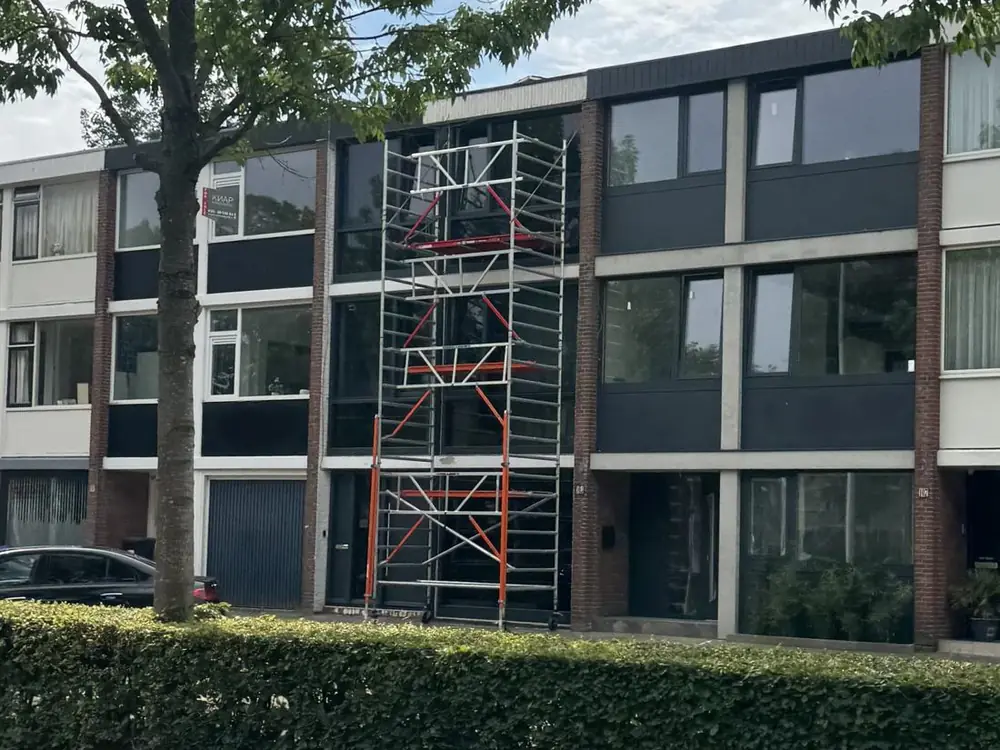
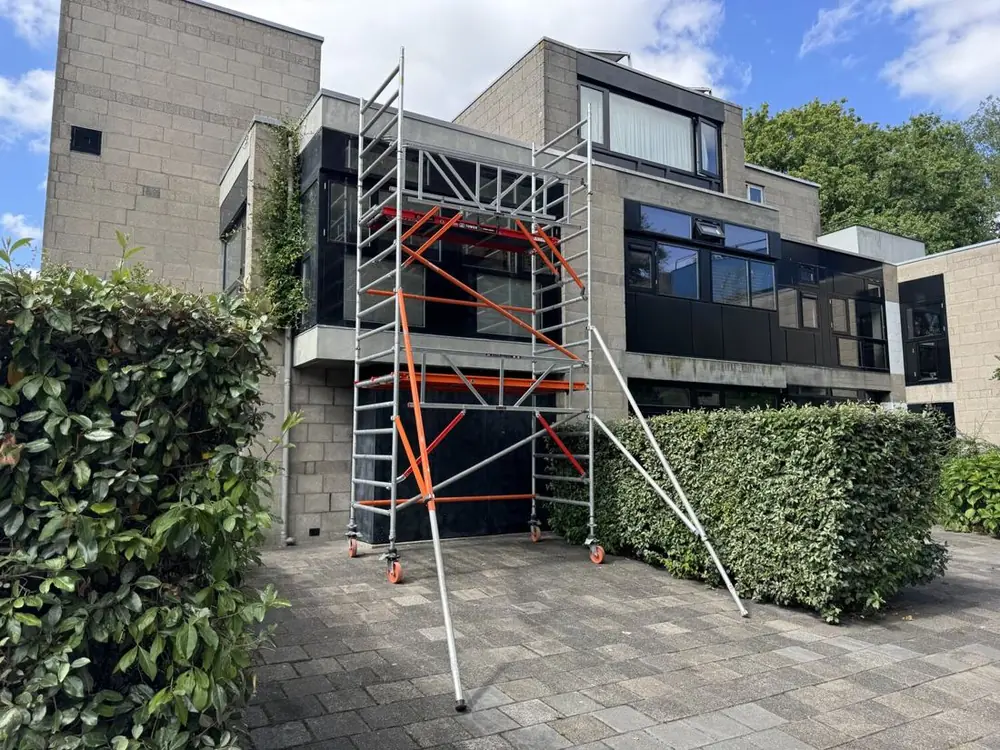
Mobile scaffold raised along a front elevation past the topmost joints, the height that pointing two storeys calls for

Set your tape on the firm ground under the build, not on a raised terrace, because a garden falling away towards the street can quietly cost you half a metre of reach. A threshold or a sunken light well counts the same way. If only the upper part of the wall is left, because the lower courses were done last year, take the build that suits first floor height and leave the rest of the wall alone. Height you never stand on is only extra parts to carry.

Siting your hired mobile scaffold for raking out old joints

Pointing makes a mess in a way you have to arrange for beforehand. Every running metre of joint gives up a fistful of dry grit, and all of it ends up below, in the border, between the slabs and in the channel along the path. So before assembly starts, lay a long sheet that runs a metre past the feet, and drag it with you as you move a panel along. At the end you roll it up and tip the grit into a sack.

The legs of the build want a flat, solid footing. Along a brick elevation that is often a narrow run of slabs or a gravel bed, and that is precisely where the garden furniture, the water butt and the bike rack live. Clear those away over the whole length you plan to point, not just at the first panel, or you will be shifting things again at every move. Four stabilisers splay outwards and each wants its own patch of clear ground.

Wheels and stabilisers standing on a slabbed path beside a wall, on the narrow run you have to keep free

Spare a thought for the people around you too. Raking out with a cutter throws up dust and noise, so tell the neighbours, keep windows shut and cover an open rooflight before you start. If the build overhangs the pavement, leave a walking route open and check what your street requires of you. Agree a start time too, since raking from eight in the morning makes for a long fortnight next door. Where the strip under the wall is sloped or has sunk, the piece on uneven ground points the way.

How many hire days for pointing brickwork on a house

Think in panels rather than square metres. A panel is as wide as your deck and about a metre and a half tall, and raking one out, blowing it clear, damping it and filling it completely takes a practised worker half a day to a full day. The elevation of a two storey terrace easily holds eight to twelve of those. That brings pointing brickwork out at four to six days of hire, and more on a corner house with a flank wall.

Some of those days are days when nothing happens. Fresh joints must not freeze through, and equally must not bake dry in full sun, so a heatwave or a night of frost pushes your programme back without asking. Driving rain against the wall washes a young joint partly out, and then you get to rake it again later. Build a margin into the hire period instead of gambling on a whole week of cooperative weather, and treat that margin as part of the job rather than as slack.

Mobile scaffold along a flank wall staying put for days, matching a pointing job that advances one panel at a time

You can do that without worrying, because a long booking is not punished. Day one is charged in full and that is where the weight of the bill sits; every further day on the booking is discounted by 95 per cent, so a full week lands barely above a long weekend. What the rental price comes to for your build is set out on the page of rates per model. Two short bookings back to back always cost more than one continuous run, quite apart from putting the tower up twice.

Which mobile scaffold suits pointing brickwork?

Kamersteiger RS44
  • Working height up to 4 metres
  • Compact and narrow
  • Great for indoor and small jobs
View and calculate →
Most chosen
Smalle rolsteiger RS51
  • Working height up to 14.2 metres
  • Narrow (75 cm)
  • Ideal for narrow passages
View and calculate →
Brede rolsteiger RS52
  • Working height up to 14.2 metres
  • Wide platform (135 cm)
  • Extra stability and workspace
View and calculate →
1-persoons steiger MiTower
  • Working height up to 6.2 metres
  • Very compact
  • Quick and easy to assemble
View and calculate →

Pointing panel by panel from the deck you hire

The 245 cm deck length is your yardstick on this job. From one fixed position you point a band a good two metres wide and roughly a metre and a half tall, and that is exactly the size of a panel. Before you start, decide where the vertical joins between panels fall and put them on a natural line: the edge of a window, a corner, or the top of a soldier course. A seam in the middle of a clean field of brick always shows.

Work a panel from the top down and finish it before the build rolls on. That way the grit from raking lands on joints you still have to do rather than on your fresh work. Mix your mortar the same way every time, with the same bucket and the same measure of water, because a panel mixed wetter dries lighter. You only see that difference days later, when the tower is already several panels further along and the earlier work has dried out completely.

Mobile scaffold standing tight against brickwork, its deck marking out the width of one pointing panel on the wall

Carry everything a panel needs up with you: a tub you will use inside the hour, water, your pointing iron, a stiff brush and a hand sweeper. Anyone who has to climb down halfway for a forgotten bucket loses precisely the working life of the mix and is left with a visible join. If loose brickwork turns up in between, look at repairing the brickwork first, or the hired tower will stand at the same panel twice.

Mobile scaffold hire with delivery for a pointing job

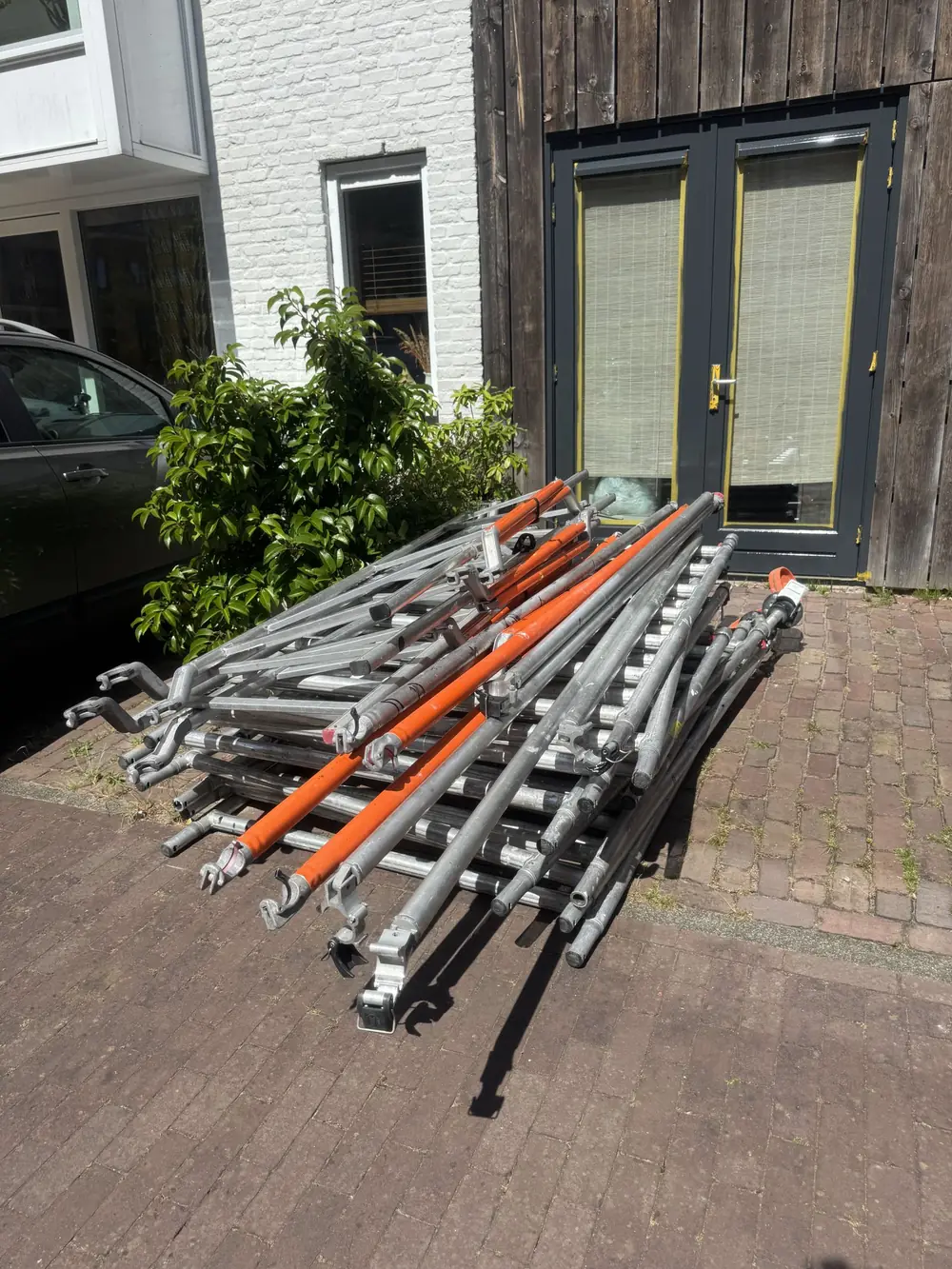
You do not receive a standing tower but a neatly counted stack of tubes, decks, guard rails and braces. Find that stack a spot clear of the sheet where your grit will land, and keep the way through to the back garden open if that is where you mean to begin. Orders logged before 15:00 on any working day go out with the next working day round. Which day that is, and when it all goes again, you specify yourself.

Choose the delivery day with the forecast beside you. Pointing starts with raking out, and a light shower is survivable, but filling joints through a wet week is not. Better to have the parts a day early than a day late: you assemble, hang your sheet, empty the border and start fresh on your first panel next morning. Putting it up is your own work, using the supplied manual and a video that walks through the order step by step.

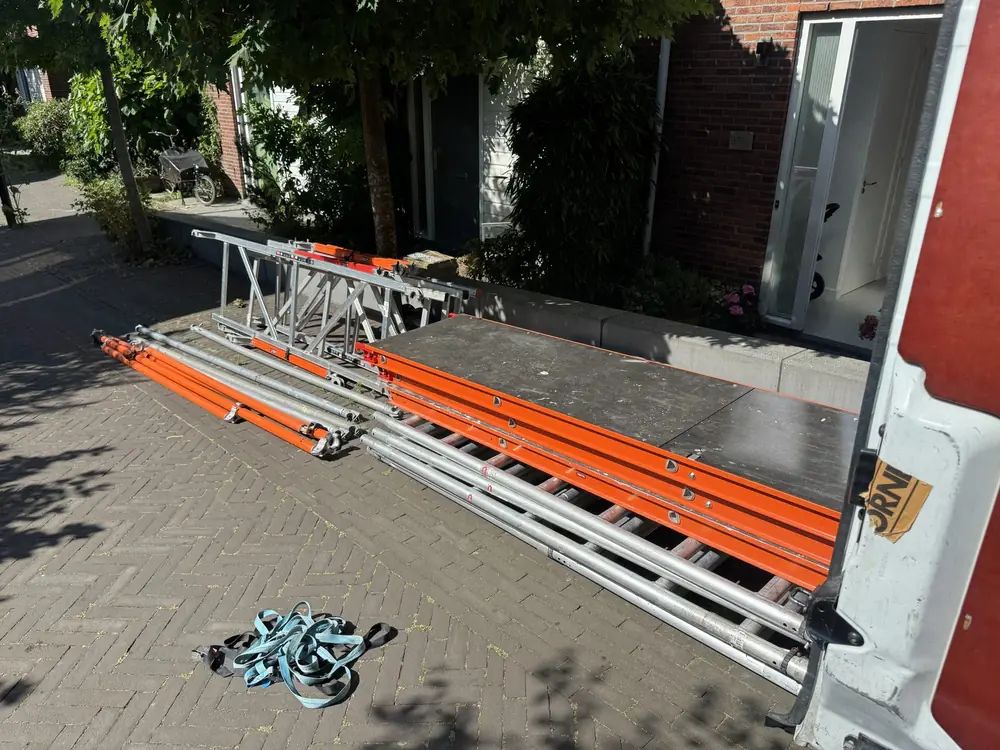
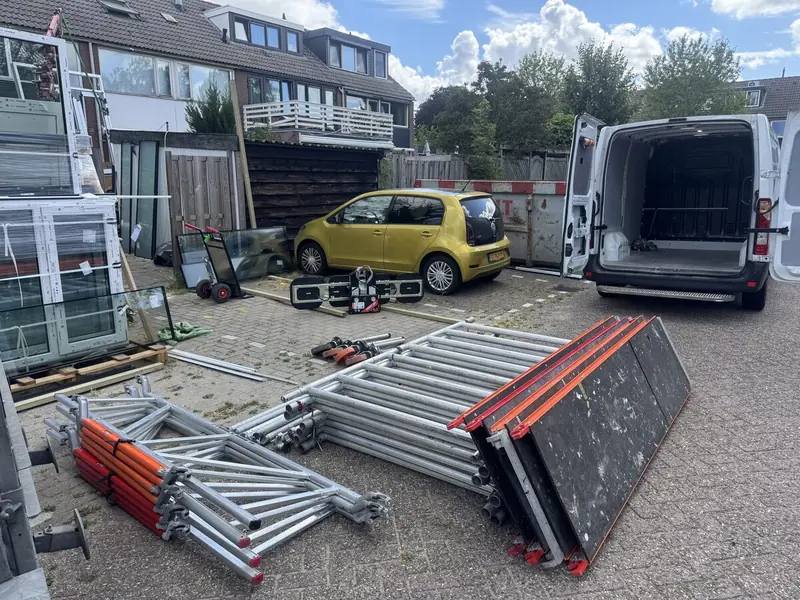
Scaffold parts coming out of the van, the stacked components from which you build your own pointing platform

Once the last panel is filled you take the tower apart and lay the parts together where our van can reach them. Wait until your fresh joints feel dry before you do. Knock the decks out and brush the sand off before stacking, because mortar that has dried onto a deck board is next to impossible to shift afterwards. The charge for carriage within your province is stated on the the page of carriage charges, VAT included and with nothing added on later.

Dust, grit and safe work on a hired mobile tower

EN 1004 sorts this type of build into load class 3, and that class lets a square metre of deck carry 200 kg, which is where your limit sits. On pointing you reach that sooner than on painting, because sand, cement and water together weigh a good deal and your cutter and hand tools come on top. So set the tub in the middle of the deck rather than in a corner against the rail, and take empty buckets down with you at every move instead of leaving them up there.

The grit thrown out by raking behaves like ball bearings under your soles and makes the deck treacherous. Sweep after every panel, even if it costs a few minutes at each position. Wear a dust mask and glasses as well, because a mortar cutter blows dust straight up the wall and therefore into your face. Brake the castors before you climb, and only move the hired tower when nobody is left standing on it. Gloves matter too, since a raking tool that snatches will take your knuckles into the brickwork.

Assembled mobile scaffold with guard rails and a ladder to the deck, the way up you use on dusty pointing work

Underneath the build is no place to be on this job. Grit comes down continuously, and sometimes half a brick that the cutter has taken with it. Keep that zone empty, fence it off if children are playing in the garden, and let nobody walk beneath you while you are raking. If it is blowing hard, stop cutting: the dust then goes everywhere at once. The rest of the agreements are gathered in the overview of safe work at height.

In 5 steps

How hiring a mobile scaffold works

1
Choose working height

Pick the height that suits your job.

2
Book online

Sorted in 60 seconds, price shown instantly.

3
We deliver

At the agreed spot the next working day.

4
Assemble safely

Assembled by you, with a manual.

5
We collect

One call and we collect the scaffold.

Good to know

Practical tips for pointing brickwork

1

Lay a trial joint somewhere out of sight and let it dry for two days, ideally before your hire period starts. Only then do you see the true colour and know whether your mix ratio is right.

2

Rake out no more per tower position than you can fill the same day. A panel left open overnight draws in damp and catches rain, and the next morning starts with drying instead of pointing.

3

Blow or brush every raked joint clean down to sound mortar. Leave dust behind and your new joint bonds to that, and a few winters later it drops out of the wall again all the same.

4

Keep one bucket for measuring water and use no other for the whole job. Your mix ratio then stays constant across the panels and you avoid light and dark bands running over the finished wall.

5

Damp a panel just before filling with a plant sprayer instead of the garden hose. A soaked wall lets the mortar slump, a dry one drains it, and a sprayer lets you steer between the two.

6

Put your collection day one day past the final day of pointing brickwork. That leaves time to clear the sheet away, knock out the deck boards and check whether any joint still wants a second pass.

Frequently asked questions

Frequently asked questions about pointing brickwork

Which mobile scaffold should you hire to point brickwork?+

On a two storey house you take the RS51, 75 cm across. Pointing advances a panel at a time, so the tower gets moved several times a day, and a narrow one you push alone and thread past a fence or a hedge. The 135 cm version earns its keep mainly when two people are on the deck together, one raking and the other filling. For a single elevation, narrow works out faster in practice, because the time you save on moves outweighs the extra room on the deck.

How does hiring a scaffold for pointing brickwork work?+

You choose the version and the working height online, name the day the set may turn up and the day it may go again, then pay a fixed sum including VAT. On the agreed morning we set a complete counted set down for you, after which you build the tower and start on your first panel. Once the last panel is filled you take it apart and we drive the material away. Beyond reserving, assembling and stacking, this rental asks nothing of you.

How many hire days does pointing brickwork on one elevation take?+

Count panels, not square metres. A panel is as wide as the deck of the tower and costs half a day to a whole day, raking and filling together. A two storey terrace holds eight to twelve of them, so reckon on four to six hire days. A corner house with a flank wall adds a few more. Book them back to back, because a second assembly costs you more time on site than the shorter hire period ever gives back in money.

What does hiring a tower for pointing cost, and how does the daily discount work?+

It follows from the version and the height you settle on, with transport to your province and back on top of that. The amounts for the tower are shown online including VAT, so the hire line in your budget is known in advance. For pointing the structure matters most: the bill is made almost entirely on the day the tower arrives, and the rest of the week trails behind it cheaply. Planning a generous week therefore beats booking two short spells and paying carriage twice over for the same elevation.

Which working height do you hire to replace every joint?+

For a two storey elevation you are on 6 to 8 metres, with the deck of the tower between four and six. Find your highest joint, add half a metre, and start measuring on the ground beneath the build. That way you look straight at the top course instead of pressing it closed from below. Ground that slopes towards the street counts against you, so measure at the lowest point the castors will stand on. The list of working heights you can order shows which parts belong to which build.

Is the hired tower delivered to the job, or do you collect it yourself?+

It is your call at the booking stage. We bring the parts on the date you gave us, at a fixed price per province, and take them back after your final hire day. Anyone driving themselves may load up free of charge, by arrangement, at Zeeburgerpad 89 in Amsterdam, as long as the vehicle can take the longest tubes. On pointing work almost everyone has it delivered, because sand, cement and tools are already arriving that week and one more journey is one too many.

Do I have to erect the hired tower myself for pointing?+

Yes, assembly falls under your own preparation. We deliver, we collect again and we make sure the set is complete; you raise the tower following the enclosed instructions and the film. With two people that takes roughly half a day, and you plan that half day in advance so it does not eat into your first pointing day. Assembled towers are not something we hand over, and facade scaffolds and cherry pickers sit outside the range too, so the building really is yours.

Can I hire for longer if the pointing needs more panels than expected?+

Certainly. Give us a call the moment the job starts to look like overrunning, and the collection date moves back, unless that tower is spoken for by the following customer. On pointing this happens often: only when the first joints are out do you see how deep the erosion goes and how many panels really need doing. So book generously from the start, since handing the set back before your end date is always allowed and costs you nothing.

How much of the wall run has to be cleared for your hire period?+

Take the width of the tower, add the splayed stabilisers on both sides, then add the strip carrying your sheet where the grit lands. In practice you keep a clear run of a few metres along the whole elevation. Clear that run in one go for the full hire period, because every plant stand and every wheelie bin you shift at each panel adds up to more time than the assembly itself took. Do it once and forget about it.

Can I keep the hire running if it freezes or turns very hot?+

The tower stands there quite happily; it is the filling you postpone. Fresh mortar that freezes never sets, and in blazing sun it dries so fast that it later crumbles away. Use days like that to rake panels out, blow them clean and get them ready, then fill as soon as the weather plays along. Because the collection date is in your hands, that delay costs you at most one extra hire day rather than your whole programme, and the tower simply waits where it stands.

How is the deposit arranged when you hire for pointing?+

You leave a deposit when the booking is made, and it is transferred back within 1 working day of the set coming home, once every part has been counted. This job does ask for care: mortar residue dried onto the deck boards does not belong there, and neither does a cement haze over the tubes. Sweep the deck each evening and rinse your tools down at ground level, and handing the tower back at the end of the hire is a formality.

Can you point an elevation in stages and remove the hired tower between them?+

You can, but it rarely turns out well. Every fresh period starts with assembly, measuring and setting up again, and mortar mixed weeks later almost never matches the tint of the first round. The line between two stages stays visible on the wall for years afterwards, in any light that rakes across it. Hiring a mobile scaffold for pointing brickwork in one continuous period gives a calmer face, and with the discount on each following day it is the cheaper route as well.

Hire a mobile scaffold for pointing brickwork today?

Calculate your rental price now or ask for free advice.

Rolsteiger van SteigerTaxi geleverd op locatie
Book it online

Your scaffold sorted in 2 minutes.

Choose your scaffold and working height, see the price instantly and book online.