
See your price
Application

Replacing cladding? Choose the right scaffold.

Replacing cladding is two jobs in one: first the old comes off, then the new goes on. Both movements run along the scaffold. Old boards and nails have to go down, new planks of three or four metres have to go up, and they will not fit on a deck of 245 cm. For two storeys you take the slim RS51, 75 cm across, and build it to a reach of 6 to 8 metres. Below: how to handle those planks, how many rental days this asks and where the skip stands.

  • Order before 3 pm, delivered tomorrow
  • Professional Altrex scaffolds
  • Up to 14.2 metres working height
  • Easy to assemble yourself
4,2 tot 14,2 mWorking heights available
12Provinces served
7Days a week
200 kg/m²Load class 3
In short
  • For replacing cladding we recommend the Narrow mobile scaffold.
  • For replacing cladding over two storeys you take the RS51 from hire: 75 cm wide, built to reach 8 metres.
  • Planks of three to five metres overhang the 245 cm deck by a long way, so you do not lay them on it.
  • Keep the foot of the tower clear, because old boards, nails and offcuts come down all day long.
  • First 24 hours from €150 incl. VAT and delivery; every day after that 95% off.
Key facts for this job
FeatureValue
Recommended scaffoldNarrow mobile scaffold (Altrex RS TOWER 51)
Working height for this job6 to 8 metres
Available working heights4.2 to 14.2 metres
StandardEN 1004, load class 3 (200 kg per m²)
DeliveryOrdered before 3 pm, delivered next working day
Each extra day95% off, from €7.50 a day
Why a mobile scaffold for replacing cladding?

Safe, stable and professional work at height

When you replace cladding the wall changes while you are standing on it. The moment the old boards are off, the battens lie open, and that is not a state you want to leave for days. So your rental period has to run unbroken, and the same pitch has to serve for stripping out and for fixing. That sets different demands from cleaning work. You need a clear route down for the old material, a dry place for the new planks and enough swing room to tilt a four metre board without hitting the fence. Hiring a scaffold for replacing cladding therefore starts with the logistics around the base.

  • Narrow mobile scaffold you can shift alone
  • Reach above the highest row of boards
  • Long planks will not fit the deck
  • Clear route down for the strip out waste
Read more about working safely →

Which mobile scaffold to hire when you replace cladding

On a house of two storeys this job lands you at the slim Altrex RS TOWER 51, 75 cm across the deck. That sounds meagre for work with long material, but going wider solves nothing here: a four metre plank does not lie on 135 cm either. What narrow does win you is weight. A light pitch is one you move on your own, and while replacing cladding you move it endlessly. The offer is set out at mobile scaffolds standing ready to hire.

There is one situation where the wide RS52 at 135 cm still wins: when two of you are up top and one holds the board to the line while the other drives screws. Then you want to stand alongside each other without tripping over tools. The condition is that the way through to the side elevation or the back garden takes that width, and on this sort of house there is often a gate or a slim path exactly there. Measure it before fixing a model.
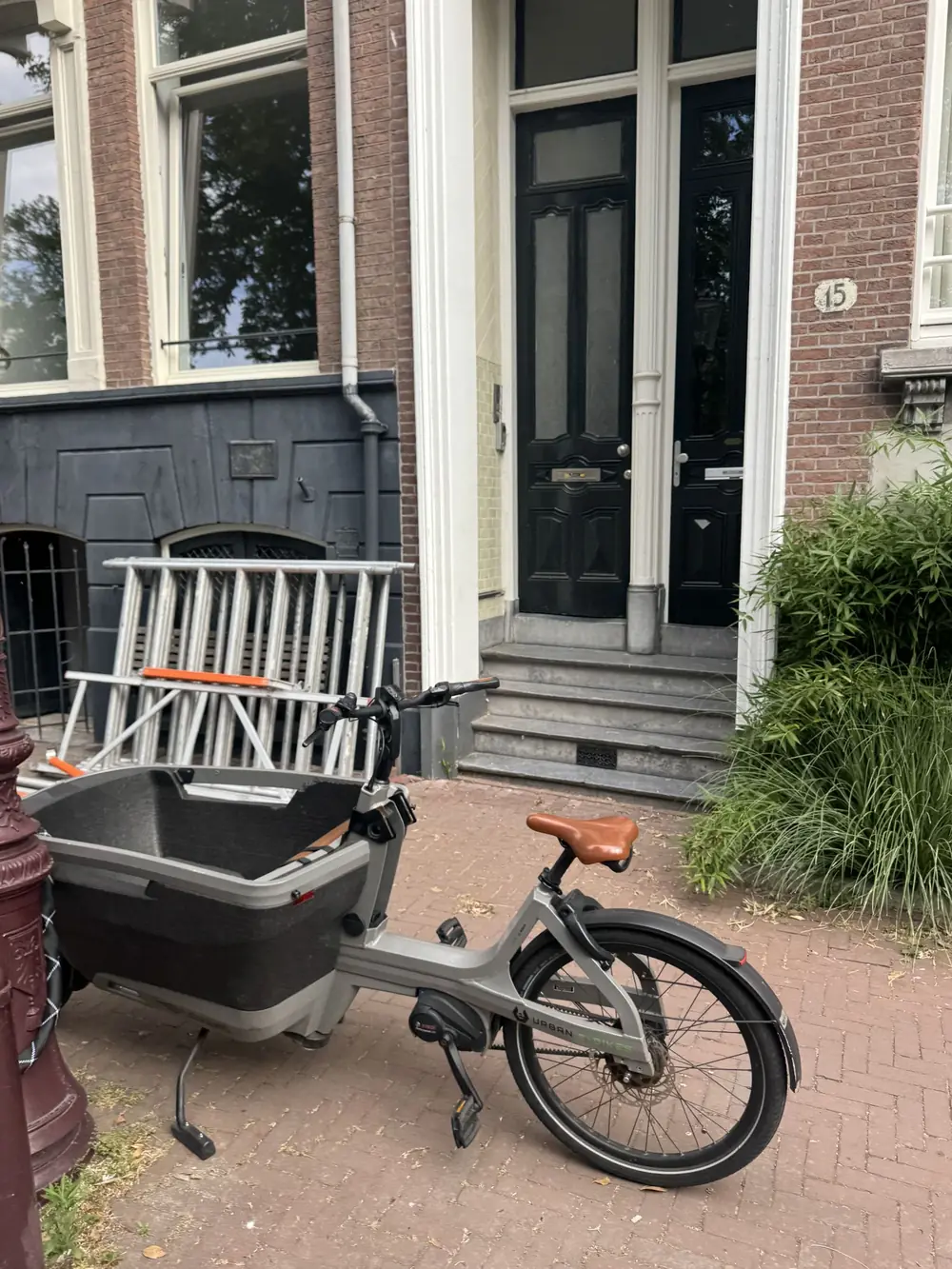
Scaffold frames on a pavement beside a cargo bike, parts of the narrow 75 cm build you shift single handed

What does earn a place on the 245 cm deck per set up is your tooling: a cordless driver, a box of screws, a wrecking bar, a hammer and a short level. Put those in a tray rather than loose, because loose tools slide along when you roll and drop off the edge. A second tray for what comes off is no luxury either: old screws and bent nails are not something to mix through your new fixings. Sizes are compared in the comparison of scaffold formats.
Working height to hire up to the top row of cladding

Your highest point is the top row of boards, and it finishes tight under the fascia or behind a closing batten. That is the row you must be able to reach properly, because it often sits captive under a profile you have to free first. Over two living storeys that comes to 6 to 8 metres of working height, with the deck at 4 to 6 metres, and above the platform you count on roughly 2 metres of extra reach. See the build for eight metres for that.

Measure the level of the wheels, not the level of your front door. With cladding on a side or rear wall the pitch often sits on a path lying below the terrace, or on a strip of gravel beside a sunken garden. Look as well at whether the boarding carries on into the gable end. If it does, your reach has to get there too, and that can easily mean a whole extra lift compared with a wall that stops at the gutter.

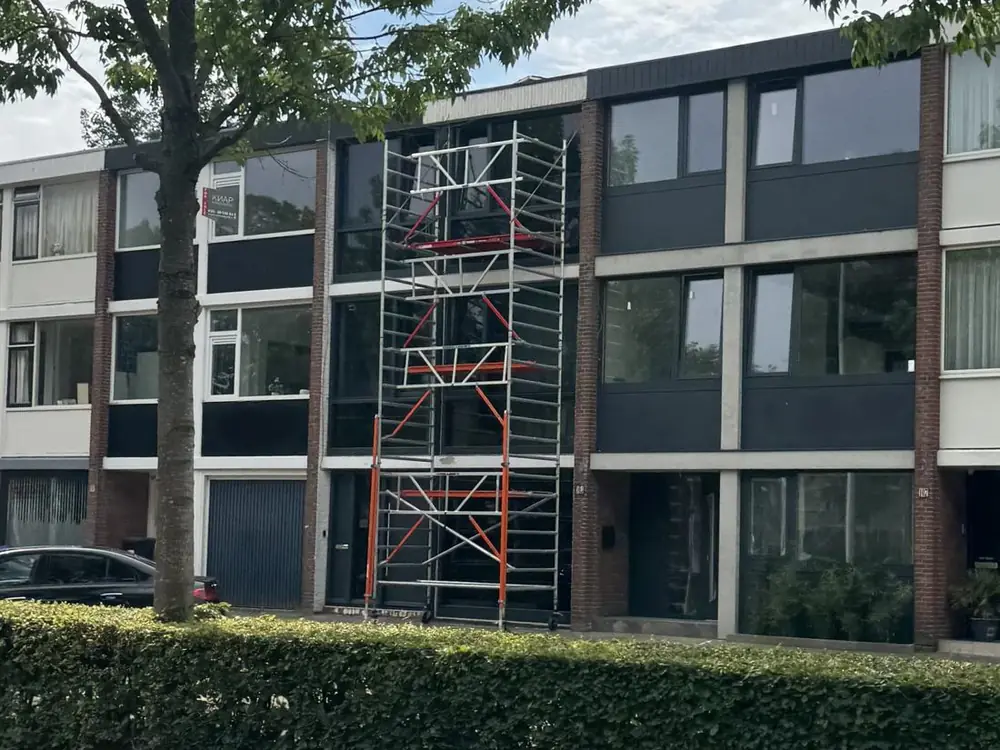
Tower reaching the roof edge of a dwelling, the reach needed to free and refit the highest row

Hiring tight punishes you in its own way on this job. Fixing is done with both hands on the plank and a driver between your teeth or on your belt, and you do not then want to be up on your toes as well. A row sitting just too high forces an intermediate pitch on you, and that costs more than the height you could have booked. On a wall of two living storeys you take the roomier option.

Hiring a scaffold with a skip and a stack of boards

Three things compete around the base of the pitch on this job: the tower itself, the skip for the old material and the stack of new planks. That stack wants to lie dry and flat, not in the grass and not in the sun, because boards that have twisted will never pull tight to the battens again. Lay them on bearers under a sheet, somewhere you can pick them up along the wall without swinging them round in a cramped corner.

The four stabilisers angle outward and want room the skip may not take. So put the skip a few metres further off, in line with the direction you are working, rather than tight beside the pitch. On soft ground the foot points get plates under them, and on a falling path you correct with the spindles. Walk right round before you lever off the first boards, because once stripping starts nobody gets near the feet in peace. There is more in the guidance on an uneven path.

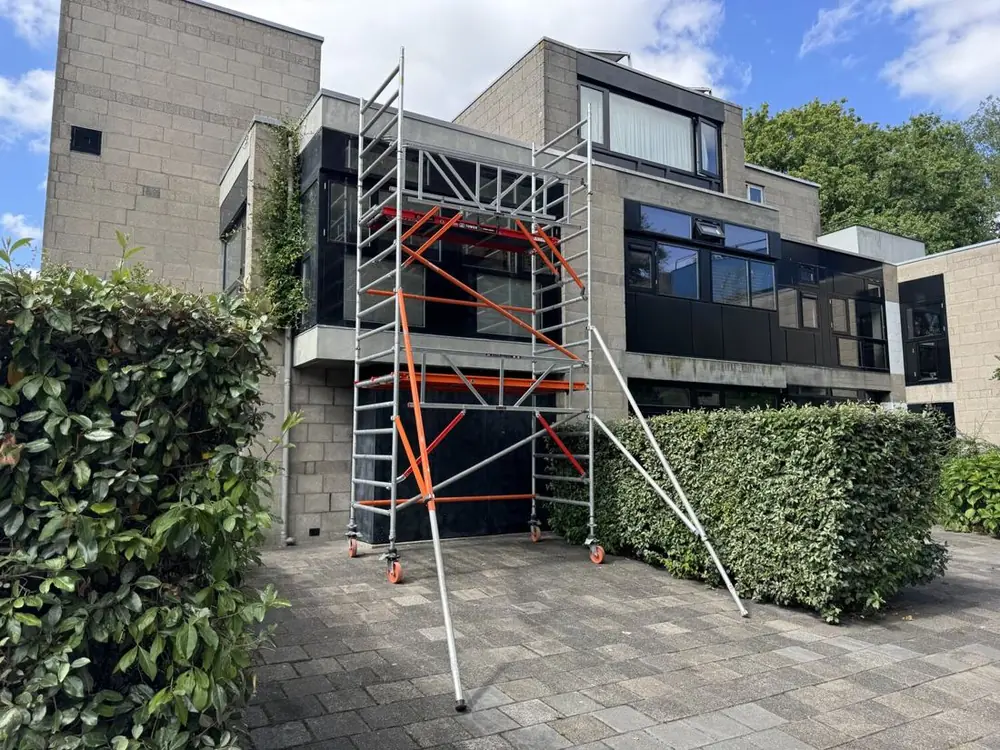
Tall narrow mobile scaffold at a modern house, its long stabilisers reaching out across the paving and claiming that ground

Think as well about the room you need to tilt a plank. A four metre board does not turn in a corner two metres by two, so keep the run along the wall free and agree with the neighbours that you may cross their path if it truly cannot be helped. Finally, make sure there is no window, outside lamp or roof light inside the swing circle, because otherwise you will find it with the end of a board.

How many days to hire a scaffold for replacing cladding

Count on more days than for any other job on a wall. Freeing a run of old boards still goes briskly, but then comes the work nobody schedules: screws and nails out, the battens checked over, membrane repaired, rotten timber renewed, and only after that the new rows fixed. For a side elevation of two storeys you hire the tower for three days; for a whole house you are nearer a week than four days. Add the build day, which goes almost entirely on the scaffold.

Those days want to run back to back as well. A wall left half open is vulnerable to rain and wind, so you do not begin a run you cannot close again the same day. Plan a quantity of work per set up that fits inside a day, and keep an eye on the forecast. New boards are best fixed dry, because moisture you build in stays in there for years. A run two metres wide and a storey high is a realistic day's task for most people.

Tower pitched at the flank wall of a dwelling, left standing for a job that runs on for days

The hire arrangement helps over a longer period. Only the first twenty four hours is billed in full; after that 95 per cent comes off each further rental day, so a week does not mount up the way that opening day suggests. Book with margin, then, because a run you cannot close costs you more than an extra day of tower. On a wall whose condition only shows once the first boards are off, that margin is no luxury. The piece on rental periods sets out how to work it out.

Which mobile scaffold suits replacing cladding?

Kamersteiger RS44
  • Working height up to 4 metres
  • Compact and narrow
  • Great for indoor and small jobs
View and calculate →
Most chosen
Smalle rolsteiger RS51
  • Working height up to 14.2 metres
  • Narrow (75 cm)
  • Ideal for narrow passages
View and calculate →
Brede rolsteiger RS52
  • Working height up to 14.2 metres
  • Wide platform (135 cm)
  • Extra stability and workspace
View and calculate →
1-persoons steiger MiTower
  • Working height up to 6.2 metres
  • Very compact
  • Quick and easy to assemble
View and calculate →

Long boards on a 245 cm platform: how that works

This is the point the whole job turns on. Deck length comes to 245 cm, and a cladding board very often does not. A four metre length therefore does not go on it: it overhangs at both ends, it tips the moment you tread on the middle of it and it shoves the guard rail away. The practical route is to cut to size below and carry up only the lengths that stay inside the deck, with the joints landing on a batten.

Where that is impossible, because you want continuous boards with no visible joint, you work with two pitches side by side or with a second person on a second tower. You then lift the plank up along the wall, rest it on two points and drive screws from both ends. That takes talking and patience, and it is the reason so many people do this job in a pair rather than alone. Agree who leads before the first board leaves the ground.

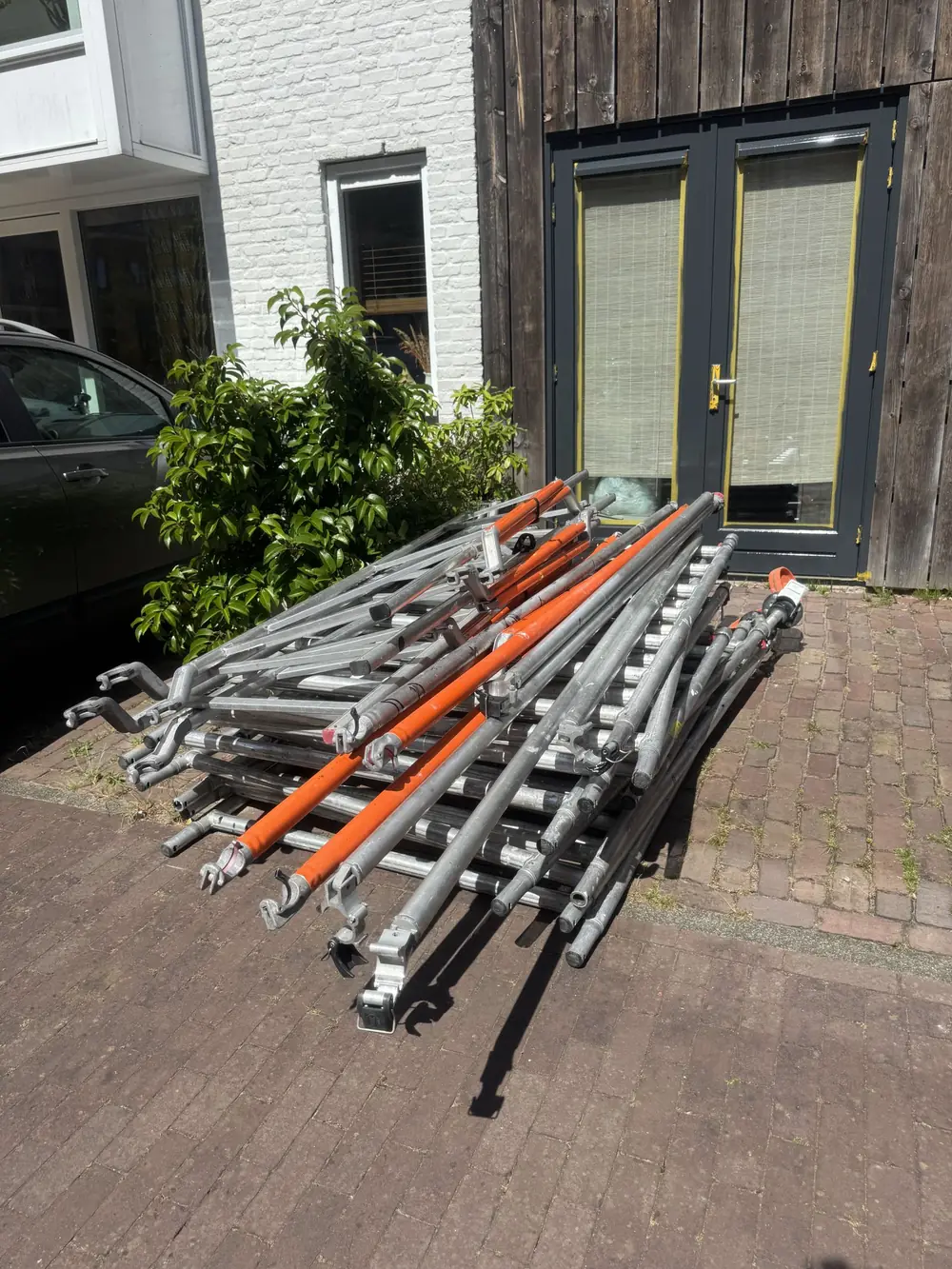
Scaffold parts on a paved drive by a clad elevation, a set whose finished platform runs no longer than 245 cm

The old material travels the other way. Lower it rather than throwing it, because a board with nails in it bounces unpredictably and takes a window or a planter with it on the way. A bucket on a rope serves for small pieces; for the rest you use a second person below. Agree that nobody walks under the tower while material is coming down. Where the wall runs into masonry the approach differs; see repairing a facade.

Hire a mobile scaffold with delivery when replacing cladding

The tower arrives in parts, counted and complete, and on this job that is the first of three stacks. Point out a place for it now that does not coincide with the skip or with your new planks, or you will spend the whole of the build day shuffling everything about. If it suits your planning, get the order in on a working day well before 15:00 and delivery follows on the next working day.

Delivery date and collection date you set yourself. Put the delivery a day ahead of your first stripping day, so you can build calmly without the wall already lying open. And set the collection well after your last fixing day, because on this work there is always one more batten, corner profile or bead of sealant to come. Do not book it for the same morning as the new timber, either, since two lorries on one drive does not work. Build times are in the step by step guide.

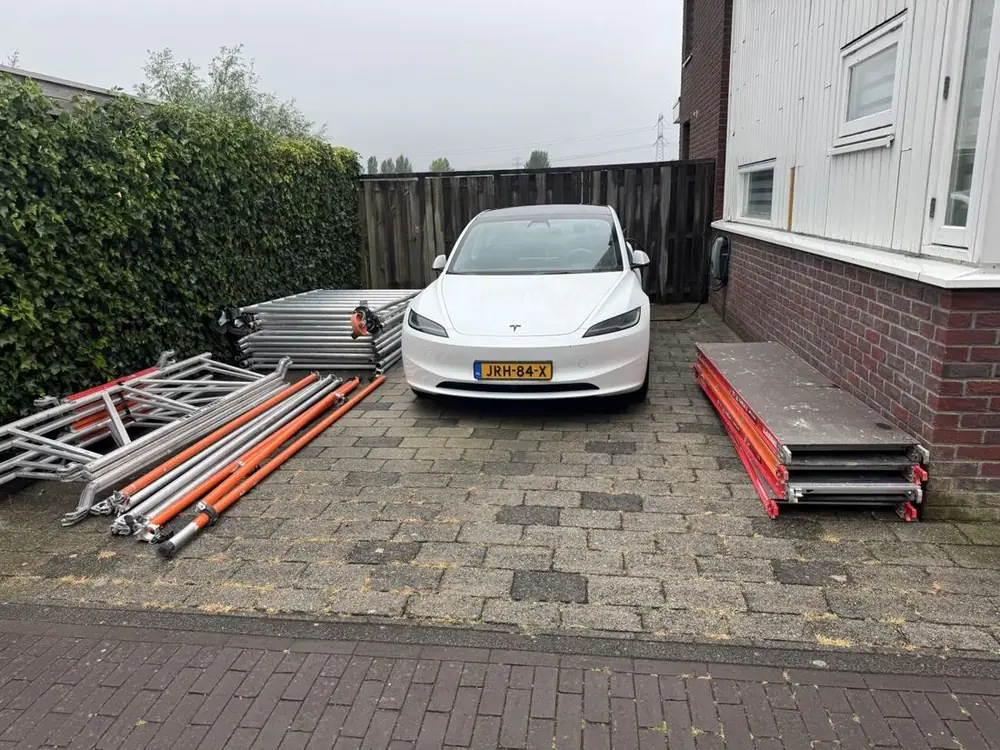
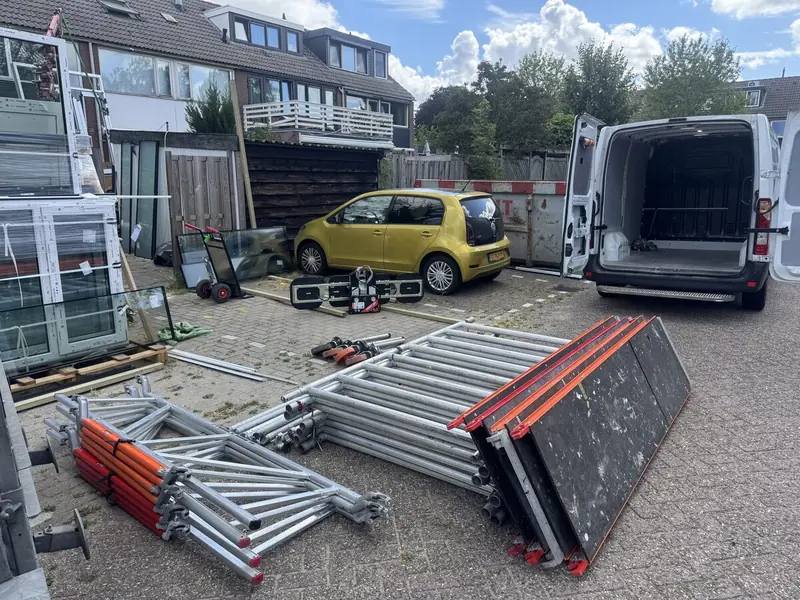
Scaffold components delivered on site at a house, the first stack beside the skip and the new planks

With the last boards in place the van comes for the mobile scaffold. Dismantling and laying it out complete is down to you. Check first that no screws, nails or slivers of timber are wedged between the deck boards, because those drop out during loading anyway. Wipe the parts down too if you have been working with sealant, and you will have nothing to scrape later. What bringing and fetching costs per province is at the delivery charges.

Replacing cladding safely on a rented tower with strip out waste

A square metre of deck may hold 200 kg. That is load class 3, the rating EN 1004 puts on towers like this one. On building work the ceiling comes closer than on cleaning: a bundle of planks, a case of tools and two people mount up fast. So never park a whole pack of new boards on the deck to work through later, but bring up what that hour actually needs. The explanation sits in the note on this standard.

The basic rules stand: wheels blocked before anyone climbs on, the pitch not rolled with a person or with material aboard, and no working on in a strong wind. That last one matters extra here, because a loose four metre plank in your hands acts as a sail and pulls you with it. At every new run, check the four stabilisers and the spindles before you drive the first screw. That is also the moment to see whether anything from the previous run is still lying on the boards.

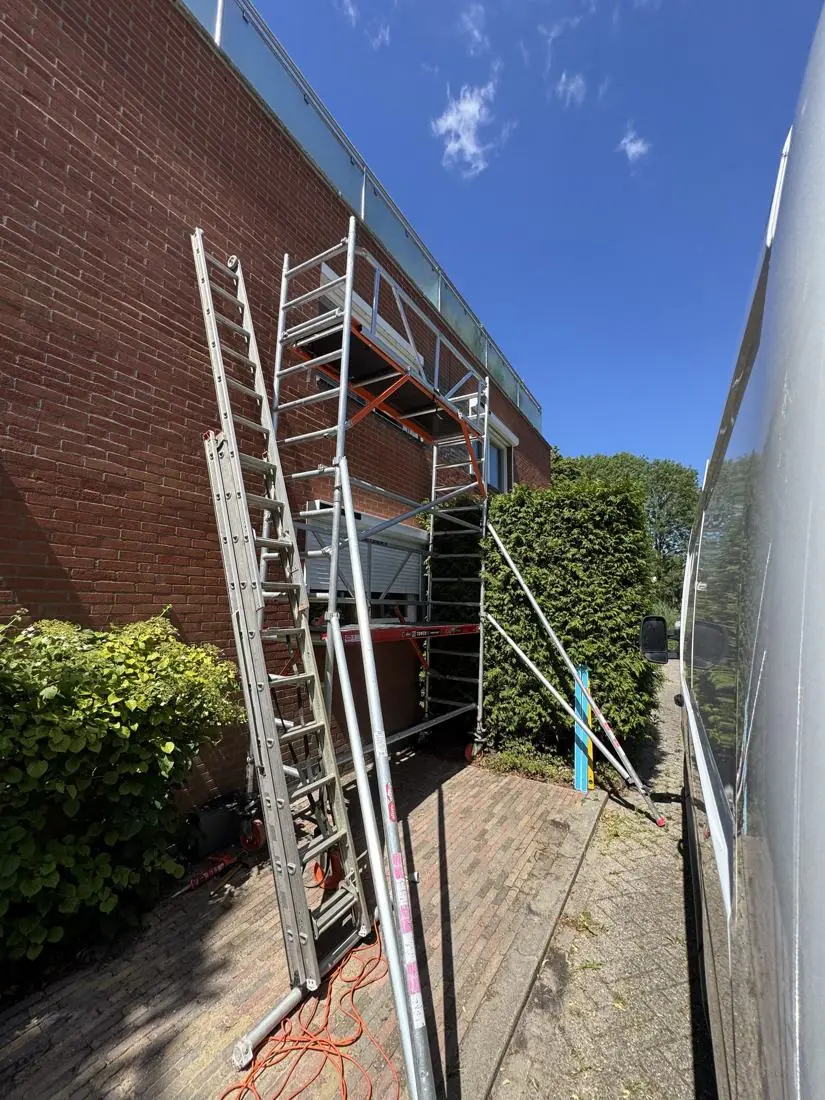
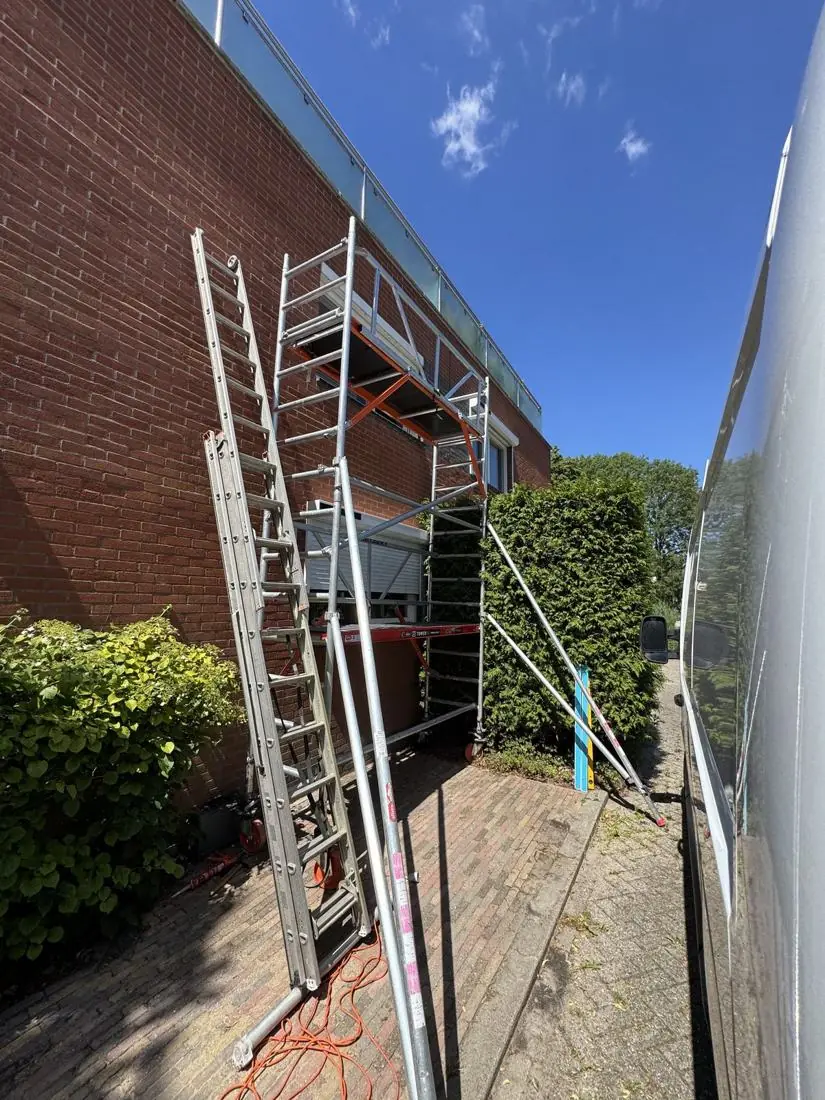
Erected scaffold in a narrow gap beside brickwork, with an extension ladder standing apart against the wall, deck rated 200 kg

The hazard that belongs to replacement is what falls. Old nails, snapped off pieces and a driver that slides off the deck all land in the same strip. Fence that strip off, let nobody walk through it and cut below rather than on the platform. Wear gloves against splinters and rusty points, and stow your tools the moment you climb down. A plank propped against the guard rail is not there when you come back. Further rules are in the regulations for work at height.

In 5 steps

How hiring a mobile scaffold works

1
Choose working height

Pick the height that suits your job.

2
Book online

Sorted in 60 seconds, price shown instantly.

3
We deliver

At the agreed spot the next working day.

4
Assemble safely

Assembled by you, with a manual.

5
We collect

One call and we collect the scaffold.

Good to know

Practical tips for replacing cladding

1

Cut every board to size before you erect the mobile scaffold, and set them out in bundles per set up. Hunting for the right length up top costs more time than the cutting itself ever did.

2

Screw a temporary batten under the row you are working on. It carries the plank while you line it up, so you are not holding on with both hands and trying to drive screws from the tower at once.

3

Hang a magnetic tray on the guard rail for loose screws and old nails. Everything that goes in there does not fall, and you are not fishing it out of the grass at the end of the rental day.

4

Per set up, work downward while stripping and upward while fixing. That way the tower only has to be positioned once per run and you save yourself a good deal of repositioning.

5

Drape an old blanket over the wall side of the guard rail. New boards lifted across it keep their coating, and the tube leaves no mark on the face work. That saves you touching up afterwards.

6

Hold back a few new planks until after the collection day. If damage turns up later you replace that board off a ladder instead of having to book a tower all over again.

Frequently asked questions

Frequently asked questions about replacing cladding

Which mobile scaffold should you hire to replace cladding?+

Over two storeys you usually take the RS51 at a width of 75 cm. That is a narrow tower, and the width sounds slight for long material, but even a wide deck is too short for a four metre plank. The gain lies in the weight: you shift it on your own, and on this job you shift it a great deal. Standing up top in a pair and wanting to work side by side, you choose the broader RS52 at 135 cm.

How does hiring a scaffold go if you are re-cladding a wall?+

Online you settle the model and the working height you want, mark the arrival date and the return date on the calendar, and pay one fixed price with VAT included. We bring the components round, you erect the mobile scaffold and get going, and afterwards everything stands dismantled and ready for us. Book the skip in the same week, because without disposal you are stuck inside a day. Tell us at booking where the van can get to as well.

How many days do you hire a tower to re-clad a wall?+

A single side elevation of two storeys asks three days of scaffold hire, and for a complete house you land nearer five to seven days. Stripping goes quickly, but checking the battens, making good the membrane and trimming round frames takes longer than expected. Because you do not want a wall left open, you book those days back to back. Build in a spare day too, for the finishing that always turns up at the end.

What does a mobile scaffold cost to hire while you replace the cladding?+

Model and working height decide what you pay; alongside that, transport out and back is a fixed amount per province. The price page states the rental price including VAT. On a job lasting a week the structure works out well: the opening day weighs heaviest and the days after it hardly add up. On work that can run over that is welcome, because a spare day on the tower costs you next to nothing.

Can you have it delivered when hiring if a skip is already there?+

Yes, just say at booking where the van can get to. We set the components down on the day you choose and take them away afterwards, for a fixed amount per province. If the skip already occupies the drive, point out another spot for the stack. Collecting it yourself is allowed too. You then pick the mobile scaffold up by appointment and without charge, at Zeeburgerpad 89 in Amsterdam, if your trailer can handle the volume.

Does erecting come with the rental, or do you do it yourself?+

No, building stays with you. We set the components down and fetch them later; putting up, moving and taking apart the mobile scaffold is your own work, helped by the manual and the video. Two of you will spend half a day on that. Our range covers mobile scaffolds and nothing besides, so a system scaffold, a scaffold fixed to the facade or a cherry picker is not something we carry. At this height that suits you exactly. Schedule that build time before your first stripping day.

Can you hire for longer once the wall is open?+

Yes, and report it a day early rather than a day late; we move the collection date as long as the tower is still free. Overruns arise here almost always at the moment the battens disappoint or rotten timber shows up behind the old boards. You choose the end date yourself, so bringing it forward is equally fine. A day of slack at booking stops you having to leave an open run behind.

Can you lay long planks on the platform of the scaffold?+

Boards longer than the 245 cm deck do not belong there. They overhang, they tip when you step on them and they press against the guard rail. So cut to size below and take up only what stays inside the deck length, or work with two pitches if you want a continuous board. A mobile scaffold is a workplace and not a store: anything you will not use within the hour belongs on the ground.

May you keep the hire running if it rains while the wall is open?+

The tower stays standing, but you do not leave an open run lying in the rain. At the end of each working day close up to a point where the wall is sound again, or screen the exposed battens off temporarily with sheeting. New boards go on dry by preference. So shift your work by a day if it really keeps raining; since you decide when the mobile scaffold is collected, that costs little.

How do you avoid damage to the scaffold and to your deposit?+

The deposit you settle at booking arrives back with you after one working day, once the set of the tower checks out. On building work it tends to go wrong with sealant, adhesive and paint on the deck boards, and with a screw left wedged between them. Cover the deck where you are working with sealant and sweep it clean at the end of every day. More is in the explanation of the deposit.

Where do you put the strip out waste while the scaffold is there?+

In a skip you place a few metres from the pitch, not against it, so the stabilisers keep their room and you can roll freely. Lower old boards instead of throwing them; a plank with nails in it bounces in every direction. Sweep the zone under the mobile scaffold every day, because nails on a drive turn up later in a tyre. That keeps the workplace usable for the whole rental period.

Is one tower enough, or do you need to hire two for long boards?+

For boards that stay within the deck length, one is plenty and you simply roll along the wall. Wanting continuous lengths with no joint changes that: then a second mobile scaffold beside the first gives both ends support at once, and two people can drive screws simultaneously. Weigh that against cutting to size on a batten, which is cheaper and works fine on most walls. Ask yourself first whether a visible joint really bothers you.

Hire a mobile scaffold for replacing cladding today?

Calculate your rental price now or ask for free advice.

Rolsteiger van SteigerTaxi geleverd op locatie
Book it online

Your scaffold sorted in 2 minutes.

Choose your scaffold and working height, see the price instantly and book online.