
See your price
Application

Repairing a facade? Choose the right scaffold.

Repairing a facade is spot work. There is a crack above a window, a few loose bricks at the corner and a crumbling edge under a sill, and those places are rarely next to each other. Every damaged spot gets its own setup, and that number, not the length of your wall, decides how many days you hire a mobile scaffold. Over three storeys you book the wide RS52 in a build that lands between 8 and 12 metres. Below you find which build fits, where it stands and how long you keep it.

  • Order before 3 pm, delivered tomorrow
  • Professional Altrex scaffolds
  • Up to 14.2 metres working height
  • Easy to assemble yourself
4,2 tot 14,2 mWorking heights available
12Provinces served
7Days a week
200 kg/m²Load class 3
In short
  • For repairing a facade we recommend the Wide mobile scaffold.
  • For damage repair over three storeys you hire an RS52, 135 cm wide, with a build between 8 and 12 metres working height.
  • Count your damaged spots rather than your facade metres, because each spot asks for its own setup and therefore extra rental days.
  • Reckon on four to six days of hire, because repair mortar has to cure before you can finish the mended patch.
  • First 24 hours from €175 incl. VAT and delivery; every day after that 95% off.
Key facts for this job
FeatureValue
Recommended scaffoldWide mobile scaffold (Altrex RS TOWER 52)
Working height for this job8 to 12 metres
Available working heights4.2 to 14.2 metres
StandardEN 1004, load class 3 (200 kg per m²)
DeliveryOrdered before 3 pm, delivered next working day
Each extra day95% off, from €8.75 a day
Why a mobile scaffold for repairing a facade?

Safe, stable and professional work at height

Anyone repairing a facade works in points rather than in runs. You climb to a crack, cut it open, brush it out, fill it and come back down to roll the tower to the next spot. That rhythm drives the whole hire: which model you pick, how many setups you make and how many days everything stays standing. A ladder will not do, because chopping out needs two hands and you want your tools and your mortar standing beside you. Hiring a scaffold for facade repair is therefore about a firm, roomy deck you can shift a few metres without a fuss, and about a rental period matched to your damage list instead of to the width of your wall.

  • Roomy deck for mortar tub, bricks and breaker
  • Reach up to the highest damaged spot
  • Every defect gets a setup of its own
  • Rental days follow the damage, not the facade length
Read more about working safely →

Hiring a mobile scaffold for facade repair: why the wide RS52

When you repair a facade you stay in one place a long while and haul a lot up with you: a chisel, a hammer, a tub of repair mortar, a few replacement bricks and a bucket of water. That is why the Altrex RS TOWER 52 stands outside the door, a mobile scaffold 135 cm wide. On that deck your kit sits beside you and you can still step past it, which saves a climb down at every damaged spot. What else stands ready is set out in the range of mobile scaffolds for hire.

The narrow RS51 at 75 cm lacks that elbow room. You choose that size only when the route to the facade forces it, a gate of a metre to the back garden, say, or a path squeezed between two sheds. So measure the tightest gap on your route before you reserve, because a wide build that jams halfway gets you nowhere. If the wall faces the street, a drive or a generous side passage, there is usually room to spare and the broader deck pays for itself.
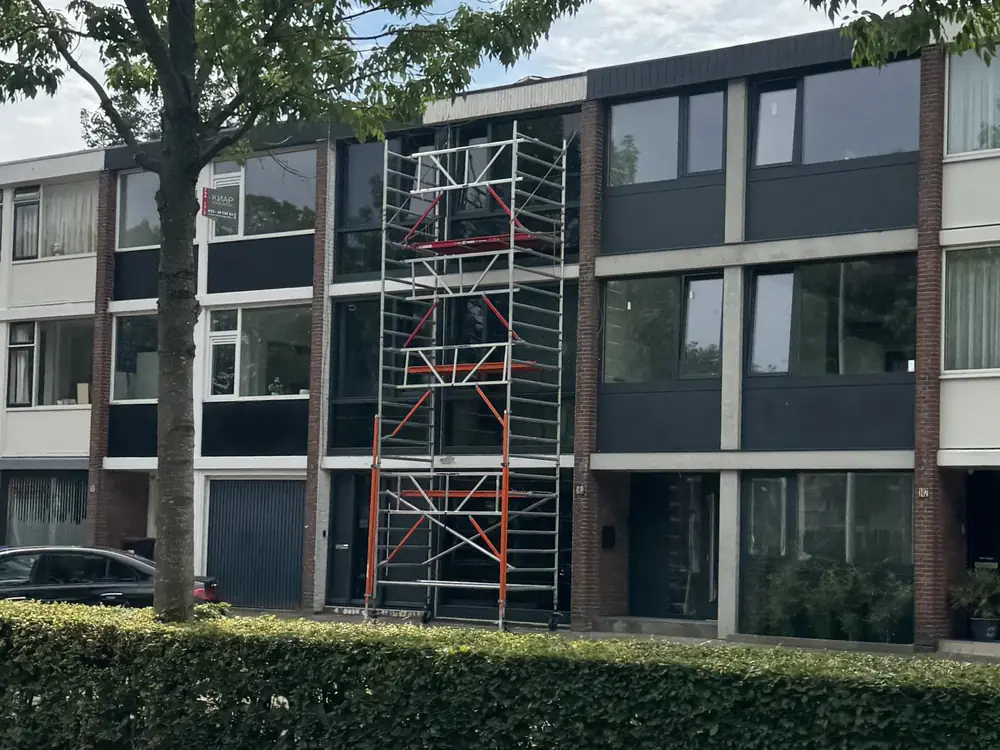
Wide mobile scaffold standing along a brick facade, the setup you shift from one damaged spot to the next

When you book, keep the model and the build you order apart in your head. As a model the RS52 goes up to 14.2 metres and works with platforms 245 cm long, but for repairs to a house of three storeys you stay well under that. You hire exactly as much build as your highest damaged spot demands, in practice between 8 and 12 metres. The sizes sit side by side in this overview of mobile scaffold dimensions.
Hire enough working height for the highest damaged spot

In facade repair the ridge of the roof does not set your working height; the highest point with damage does. Walk the wall first from across the road, binoculars in hand if need be, and note at what height every crack, every loose brick and every crumbled section sits. If the top one reaches just under the roof edge of a third storey, you land on 8 to 12 metres. If everything stays below the first floor, you order a much lower build and save half a day of assembly.

You work that height out by adding roughly two metres of reach to the height of your deck. For twelve metres the platform therefore stands at around ten. In chopping work that reach counts for less than in painting, because a crack has to be worked with two hands and a chisel rather than just touched with your fingertips. So put the deck at eye level with the damage. What a build to twelve metres of working height takes in parts is shown on that height page.

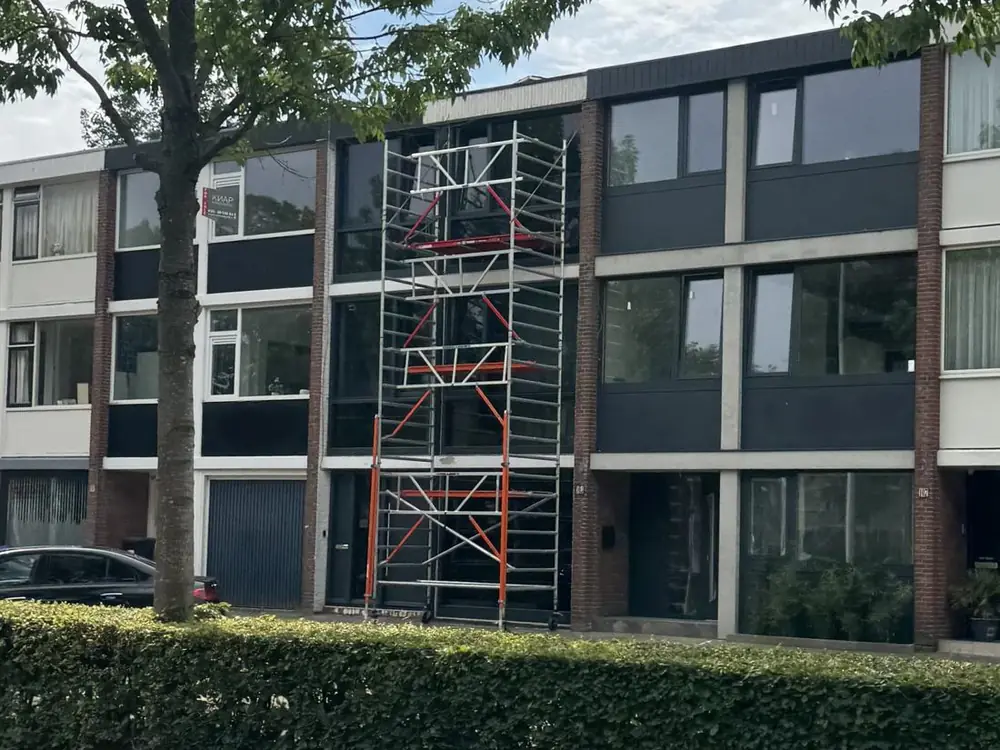
Front wall with a tower carried up close under the eaves, the reach that high cracks in brickwork ask for

Ordering too tight punishes you straight away on this job. Half a metre low and you are chopping with your arms stretched above your head, with the grit landing in your face instead of on the sheet. On top of that a crack almost always runs further than it looked from the pavement, sometimes right into the reveal of a window. So take the build that matches your highest point, not your average one. If the damage sits on the second floor, measure to the top edge of that face.

Setup per damaged spot: where the mobile scaffold stands

Because you move from defect to defect, it is not a single standing place that counts but the whole strip along the wall. You want that strip level, clear and wide enough for the four stabilisers that splay outwards. A bike rack, a water butt or a low hedge sitting exactly under your third spot will cost you more time later than moving it now. So walk the route once from end to end before you order the scaffold, with your list of damaged spots in hand.

Then look at what lies under the wheels. Setts, slabs and concrete carry fine; a planting strip against the plinth does not, certainly not once you stand on it with a full tub of mortar. If you roll the setup along a falling footpath to the next spot, your deck height changes at every stop and the adjustable legs need setting again. What you can do about that is taken step by step in the article on working over uneven ground.

Four stabilisers swung out on paving beside a tower, showing the clear run a facade repair needs at ground level

Under the damaged spot itself you keep room free for everything that comes down. Cutting out produces brick rubble and old material, and you do not want that in the border or on the car next door. Lay a sheet there and take it with you at every move, and keep the paving underneath empty. If the setup stands partly on public ground, ask the council beforehand what the rules are in your street, and do that well before your delivery date is fixed.

How many rental days you need to repair a whole facade

How many days you hire a mobile scaffold follows straight from your list of damaged spots. A wall of twelve metres with two cracks is less work than a wall of six metres with eight loose bricks, even though you would guess the opposite by eye. Allow one round of cutting out, one of brushing clean and one of filling per spot, and about half a working day per setup. On an ordinary house with a handful of defects that puts you at four to six days.

Inside that period sit waits you cannot speed up. Mortar that has been applied must cure before you can finish it or put anything over it, and at low temperatures that takes noticeably longer. In frost, or through days of rain, the filling stops altogether. So pin your end date not on the day the job could in theory be done, but on the day every spot is certainly seen to, with a morning after it for clearing up, sweeping and counting parts.

Tower standing assembled at a house wall, the position that holds still between one chopping round and the next

Booking generously costs you almost nothing here. The full rate covers only the opening 24 hours; every day you add behind it comes in with 95 per cent off. A margin for bad weather, or for a crack that turns out bigger than you thought, therefore barely registers in your total. Booking again does, because then you start a second opening day and a second transport. Estimating a longer period is easier with the rules of thumb in this piece on rental days.

Which mobile scaffold suits repairing a facade?

Kamersteiger RS44
  • Working height up to 4 metres
  • Compact and narrow
  • Great for indoor and small jobs
View and calculate →
Smalle rolsteiger RS51
  • Working height up to 14.2 metres
  • Narrow (75 cm)
  • Ideal for narrow passages
View and calculate →
Most chosen
Brede rolsteiger RS52
  • Working height up to 14.2 metres
  • Wide platform (135 cm)
  • Extra stability and workspace
View and calculate →
1-persoons steiger MiTower
  • Working height up to 6.2 metres
  • Very compact
  • Quick and easy to assemble
View and calculate →

Repairing a facade from a platform of 245 cm

From a single setup you cover a face 245 cm wide, the length of the platform, and roughly two metres high. Most defects fall well within that, so per damaged spot you position the tower once and finish that spot completely. Cut out, brush the grit away, wet the surface, fill and work the repair back. Only when there is nothing left to do do you go down and roll the mobile scaffold on to the next point along the wall.

Take up in one climb whatever has to be up there: a bucket of mixed mortar, chisel and hammer, a trowel, a sponge and some water. Everything you forget means an extra trip, and with five or six spots in a day that mounts up. Mix your mortar down below and carry it up in portions, because a filled tub weighs more than it looks and climbing the built-in ladder with both hands occupied is no way to work.

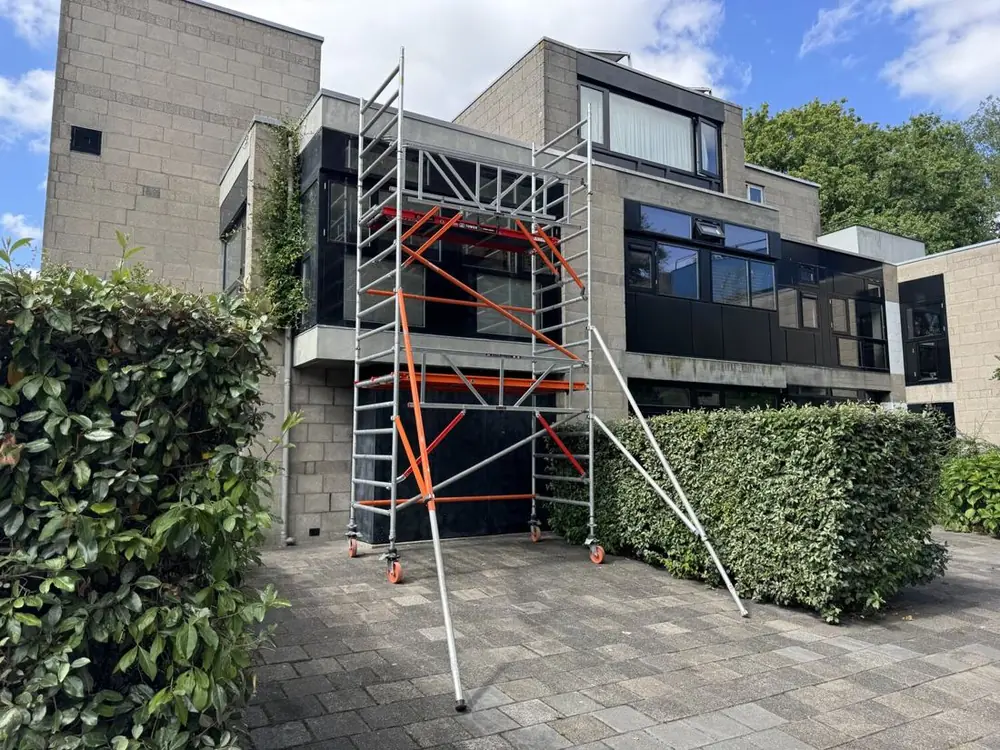
Mobile scaffold along a side elevation with the platform at height, the 245 cm working face that covers one damaged spot

The number of setups is nearly always underestimated. From the pavement you see three cracks; once you stand beside them at eye level there turn out to be six, and one runs on round the corner. So add a quarter to your setup count when you plan. Combine this work in the same period with renewing the pointing in the same wall and your rhythm changes completely, because then you work in continuous faces instead of separate points.

Delivery and build: hiring the scaffold around your repair work

The parts arrive at your address as a complete, counted set. Decide in advance where that stack may land, because the strip along the wall is exactly what you keep clear for shifting. A drive, a garage or a corner of the front garden serves better than the pavement right by your door. Reservations that come in on a working day before 15:00 can be delivered the next working day, and which date that turns out to be is for you to say.

Putting it up belongs to your side of the job. You work with the manual beside you and the instruction video on your phone, and two people need half a day for it. Let the set land a day ahead of your first chopping day: you then build at your leisure, look at the damage close up and adjust your list before any mortar is mixed. If you work on spots all round the house, say at reservation which side the van can unload on.

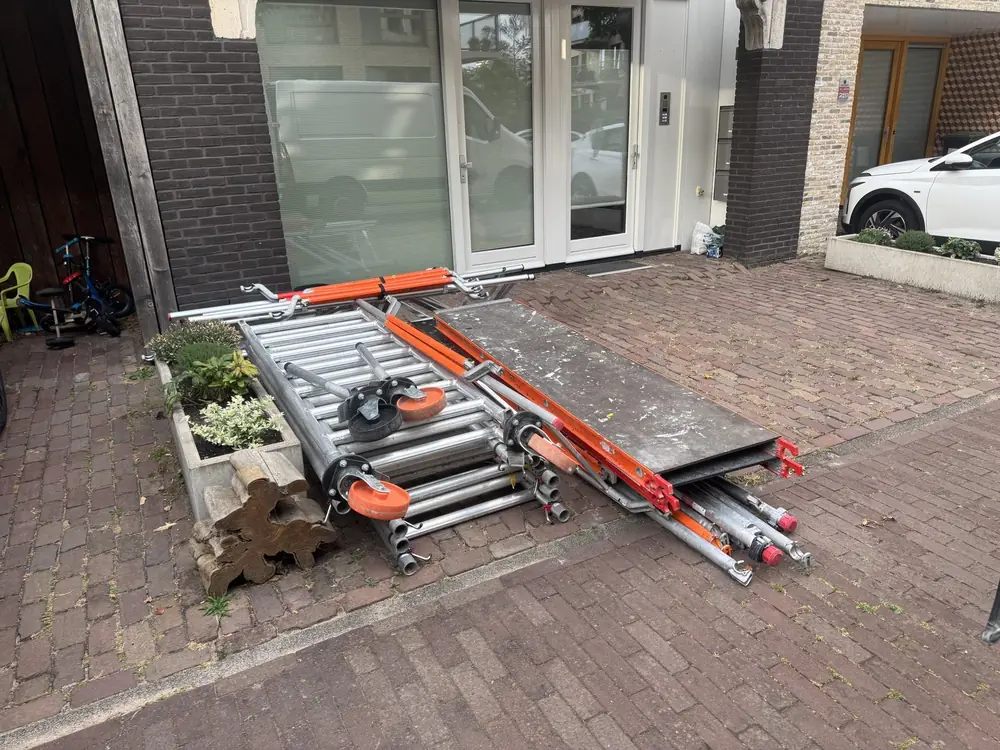
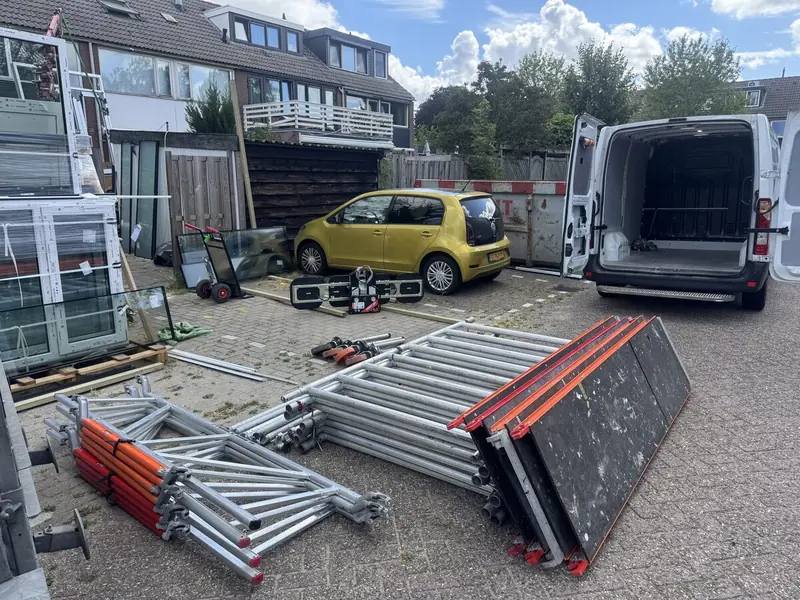
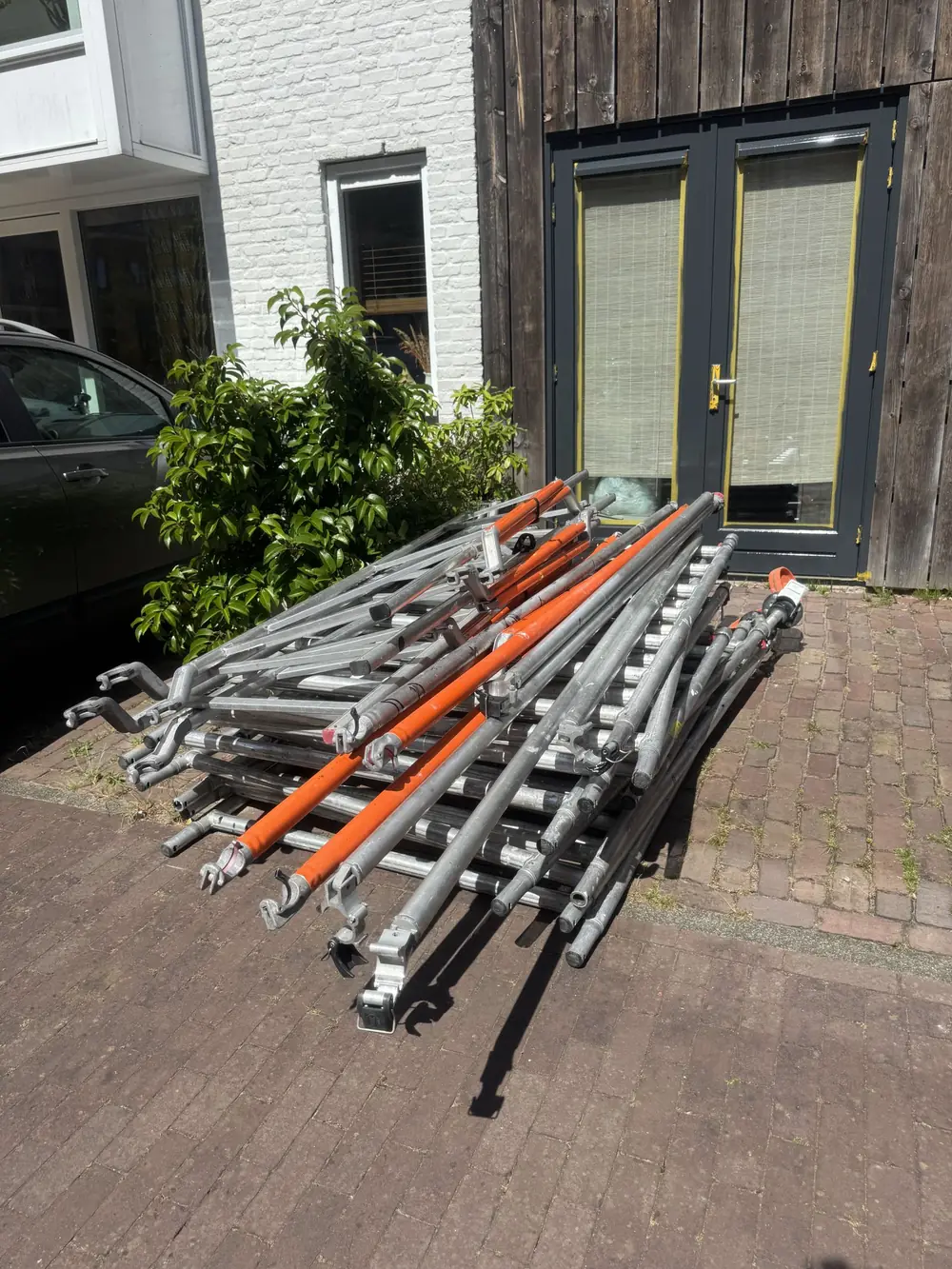
Counted set of scaffold parts stacked on the kerb, the way a facade repair hire is dropped off at the address

On your collection day you lay everything back dismantled and complete where it was dropped. Sweep the platforms first, because dried mortar on a trapdoor is next to impossible to get off later. Count the parts as you take the tower down; that way you know well before the van arrives that nothing is left behind a shrub or in the shed. What the round trip to your province comes to is set out under the cost of delivery and collection.

Safe on the scaffold during facade repair: weight and falling rubble

Every square metre of these platforms may carry 200 kg, load class 3 as the EN 1004 standard sets it out for mobile scaffolds. On repair work you meet that limit sooner than you expect: yourself, someone helping, a tub of mortar, a box of replacement bricks and a breaker add up without you noticing. So spread the load over the deck instead of putting everything down by the hatch. That class is unpacked in the explanation of the mobile scaffold standard.

The fixed rules hold here too. Brake the wheels before you take the first rung, never move the setup with someone on it or material on the deck, and get off as soon as it starts to blow hard. Because you reposition again and again on this job, that is no formality: clear the platform before you roll and then set the four stabilisers firmly out again. After every move check the adjustable legs, the brakes and whether the guard rails still close all the way round.

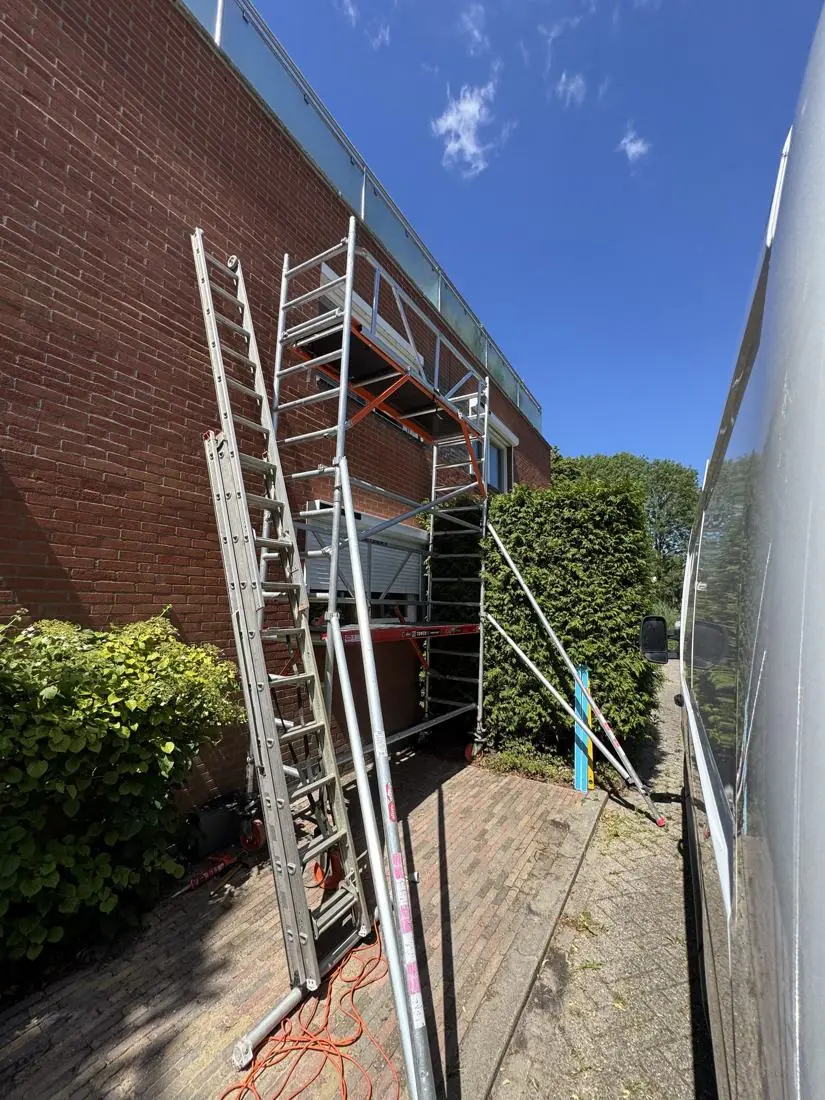
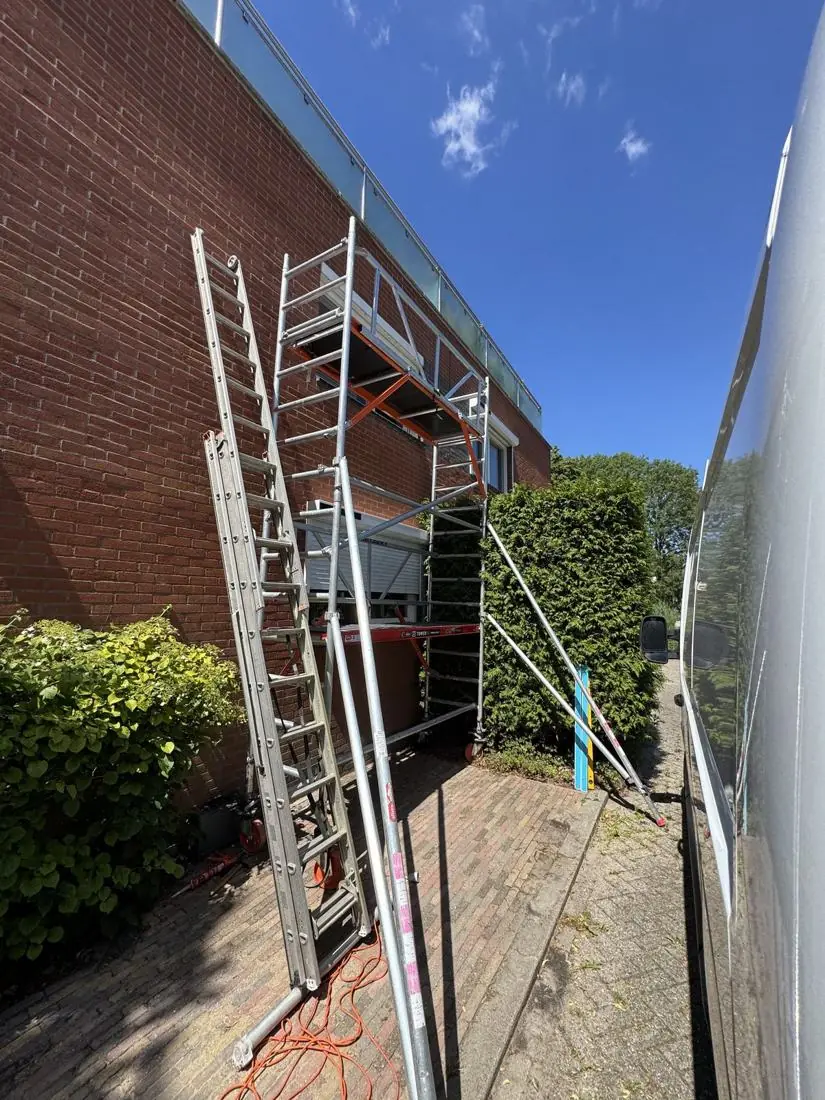
Mobile scaffold standing in a side passage, a separate ladder leaning on the brickwork, decks rated at two hundred kilos each

The hazard that really belongs to chopping work comes from above. Lumps of brick and old material drop straight down below you, so keep that zone empty and put out tape or a cone if need be, certainly along a pavement people walk past. Wear goggles and gloves, because grit bounces back off the wall. Think about your soles as well: wetted brick makes the deck slippery. The remaining rules are gathered in the ground rules for work at height.

In 5 steps

How hiring a mobile scaffold works

1
Choose working height

Pick the height that suits your job.

2
Book online

Sorted in 60 seconds, price shown instantly.

3
We deliver

At the agreed spot the next working day.

4
Assemble safely

Assembled by you, with a manual.

5
We collect

One call and we collect the scaffold.

Good to know

Practical tips for repairing a facade

1

Photograph the facade from across the street and mark the damaged spots on that print. From that one image you settle the number of setups and with it your rental period.

2

Mix no more mortar per setup than that one damaged spot will take. Whatever is left over you carry down or throw away, and that costs more minutes than mixing a second bucket.

3

Chalk a mark on the setts wherever the wheels have stood. Come back after a shower of rain and you roll the scaffold straight to exactly the same position without measuring again.

4

Open up all the damaged spots before you start filling. You then clean your tools only once per round, and you move the scaffold each time with a cleared deck and nothing to knock over.

5

Lay a sheet under the setup that travels with you at every move. That saves you half an hour of sweeping at the end of the day and keeps sharp rubble out of the planting.

6

Set your collection date two days behind your last day of chopping. That leaves time to walk the cured patches, touch up small things and dismantle the tower dry and complete.

Frequently asked questions

Frequently asked questions about repairing a facade

Which mobile scaffold do most people hire for repairing a facade?+

For facade repair over three storeys you take the RS52, the scaffold with a deck 135 cm wide. On this job more stands on your platform than in painting: a tub of mortar, replacement bricks, a breaker and often a second pair of hands. On a deck that wide you walk past it all without shifting anything. If the route to the wall will not pass 135 cm, you fall back on the narrow RS51 and carry less per climb.

How does hiring a scaffold for facade repair work, from booking to collection day?+

Online you fix a model and a build height, name the delivery day and the collection day yourself, then pay one fixed amount with the VAT already in it. On the agreed morning the parts are waiting at your house, after which you build and work through your damaged spots one at a time. At the end the scaffold stands dismantled and we drive it away. The one thing to steer tightly in your planning is the curing time between rounds.

How many days of hire does it take to mend every damaged spot?+

Four to six days is a realistic estimate for a terraced house. What decides it is the number of defects, not the length of the wall: every point asks for its own setup of the scaffold, and per setup you soon lose half a working day. Add more elevations, or find that a crack runs much further, and you add days at once. Two small repairs at eye level are sometimes wrapped up inside two days of hire.

What does hiring a scaffold for facade repair cost from the second day on?+

Your rental price follows from the chosen model, the build height and the round trip to your province. All those amounts sit together including VAT on the page with rental rates, so you know before you commit what you are in for. For repair work the shape of it matters: that opening day weighs heavily, while every further day with the tower on your ground adds almost nothing. Booking one generous period is therefore kinder than two short ones.

What working height should you hire when the cracks sit just under the roof edge?+

If the top defects sit under the roof edge of a three storey house, you fix a build of 8 to 12 metres and your deck lands at six to ten. Measure from the level where the wheels will rest, so from the pavement or the drive and not from your threshold. Which build of the scaffold goes with which height is set out on the overview of working heights for every step.

Can I have the parts delivered, or do I collect them myself?+

You decide that yourself when you reserve. With delivery the scaffold stands at the door on the day you picked and goes back after your last day of repair. A fixed amount per province applies. Prefer to drive yourself? Then by appointment the parts wait for you in Amsterdam at no charge, as long as your van or trailer swallows the longest lengths. On repair jobs most people choose delivery, because the drive is already full of rubble and material.

Is putting it up included when you hire a mobile scaffold for facade repair?+

No, assembly belongs to your part of the job. We handle only the transport there and back; building, moving and taking down are yours. So allow half a day on the first day, because you will rarely get to any chopping that morning. Neither a facade scaffold nor a system scaffold nor a cherry picker is on offer from us, so for repairs at this height the mobile scaffold remains the workable tool. If the damage is indoors, look at the room scaffold in the hire range.

Can I hire for longer if more damaged spots turn up?+

Yes. Tell us and the collection day moves back with you, unless the scaffold has already been promised to the next customer. On facade repair that happens regularly, because only from close up do you see how far a crack runs or how many bricks are really loose. To get ahead of that risk, book an extra day straight away. The collection date is yours to set in any case, and handing the tower back early is always allowed.

How much clear space does the setup along the facade need?+

Take the width of the scaffold, add the splay of the stabilisers on both sides and reserve room besides for your mixing spot and the sheet that catches the rubble. In practice you want a level, empty run of a few metres along the whole wall, because the setup travels from point to point. Shift water butts, bikes and planters out of the way before delivery day, because once the tower is standing you block your own route.

Can you keep hiring when it freezes and mortar will not cure?+

The scaffold may stand there quite happily; you only postpone the filling. Repair mortar is not worked in frost, nor on a frozen surface, because the bond suffers for it. Use a day like that to chop, brush out and take away loose material, and fill as soon as the temperature climbs. Because you decide yourself what date you keep the tower to, a shift like that as a rule costs you only one extra day.

After hiring a scaffold for chopping out, when does the deposit return?+

A deposit stands open as soon as you hire the mobile scaffold, and once every part has been counted the amount is repaid within one working day of the return date. On facade repair watch two things: hand back all the parts you received, and leave no cured mortar on tubes and platforms. A wipe during the work saves you scraping on collection day. How that is settled is described in the explanation of the deposit.

Do you really have to move the mobile scaffold at every damaged spot?+

Usually yes, and that is exactly why this work can be counted in setups. Your deck measures 245 cm, so two cracks close together are done from the same position. If the next point lies four metres along or a storey higher, you climb down and roll the tower on. So reckon with the number of moves when you book, because that figure predicts your hire far better than the square metres of wall.

Hire a mobile scaffold for repairing a facade today?

Calculate your rental price now or ask for free advice.

Rolsteiger van SteigerTaxi geleverd op locatie
Book it online

Your scaffold sorted in 2 minutes.

Choose your scaffold and working height, see the price instantly and book online.