
See your price
Application

Pointing a façade? Choose the right scaffold.

Pointing a facade is heavy, dusty work that goes in small pieces. You rake out a bay of joints, brush it clean, wet it and press fresh mortar in, and that whole run has to be finished before the mixed mortar stiffens. So you work not in long runs but in manageable bays, with a tub and buckets beside you on the deck. For three storeys you hire a wide RS52 of 135 cm, with a build height that comes out between 8 and 12 metres.

  • Order before 3 pm, delivered tomorrow
  • Professional Altrex scaffolds
  • Up to 14.2 metres working height
  • Easy to assemble yourself
4,2 tot 14,2 mWorking heights available
12Provinces served
7Days a week
200 kg/m²Load class 3
In short
  • For pointing a façade we recommend the Wide mobile scaffold.
  • For pointing work over three storeys you hire an RS52, a deck of 135 cm, with a build of 8 to 12 metres.
  • Reckon on four to eight days of hire, because raking out and repointing are two separate rounds along the same wall.
  • Work in small bays, because mixed pointing mortar stays workable only for a limited time before it begins to stiffen.
  • First 24 hours from €175 incl. VAT and delivery; every day after that 95% off.
Key facts for this job
FeatureValue
Recommended scaffoldWide mobile scaffold (Altrex RS TOWER 52)
Working height for this job8 to 12 metres
Available working heights4.2 to 14.2 metres
StandardEN 1004, load class 3 (200 kg per m²)
DeliveryOrdered before 3 pm, delivered next working day
Each extra day95% off, from €8.75 a day
Why a mobile scaffold for pointing a façade?

Safe, stable and professional work at height

With pointing everything turns on weight and on pace. A tub of mortar, a couple of buckets of water, an angle grinder or joint raker and your tools all stand on the deck at once, and you walk round them all day. At the same time you can never work far ahead, because the mortar you mix stays usable for a limited time only. That makes pointing a facade a job of many short circuits: mix, up, fill a bay, back down. Hiring a scaffold for pointing therefore means watching the load capacity, the walking room round your tub and above all how quickly you can get up and down, because you do that dozens of times a day.

  • Load capacity for a mortar tub, buckets and tools
  • Walking room round the tub on the platform
  • Working height to the highest joint in the wall
  • Short circuits because mortar has a working time
Read more about working safely →

A wide platform to hire for raking out and pointing

Of all the jobs at a wall, pointing puts the most weight on your deck. A tub of mixed mortar, two buckets of water, a jointer, an angle grinder with dust extraction, a hand brush and a sponge all lie there at the same time. On the Altrex RS TOWER 52, whose deck measures 135 cm, you put that lot down on one side and keep a free walkway on the wall side. What else there is to hire in mobile scaffolds is set out with the dimensions.

The narrow 75 cm version pinches sooner on this job than on other work at the wall. Once the tub is standing you stand beside it and not past it, and you feel that at every movement with a loaded jointer. Even so that narrow size is sometimes the only option, for instance if the wall lies behind a gate that 135 cm will not pass. Measure that stretch out completely first and count on working with smaller quantities more often.
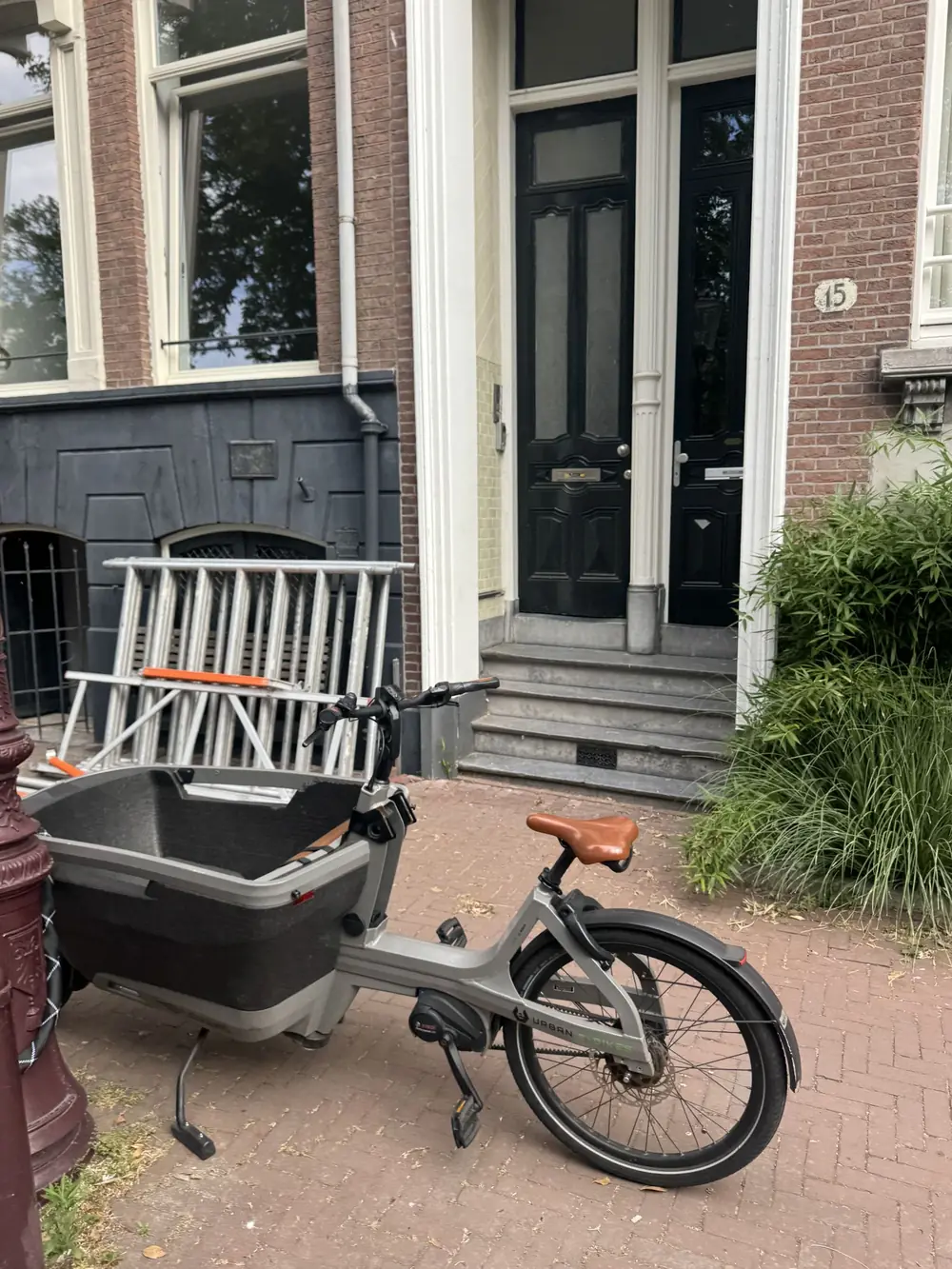
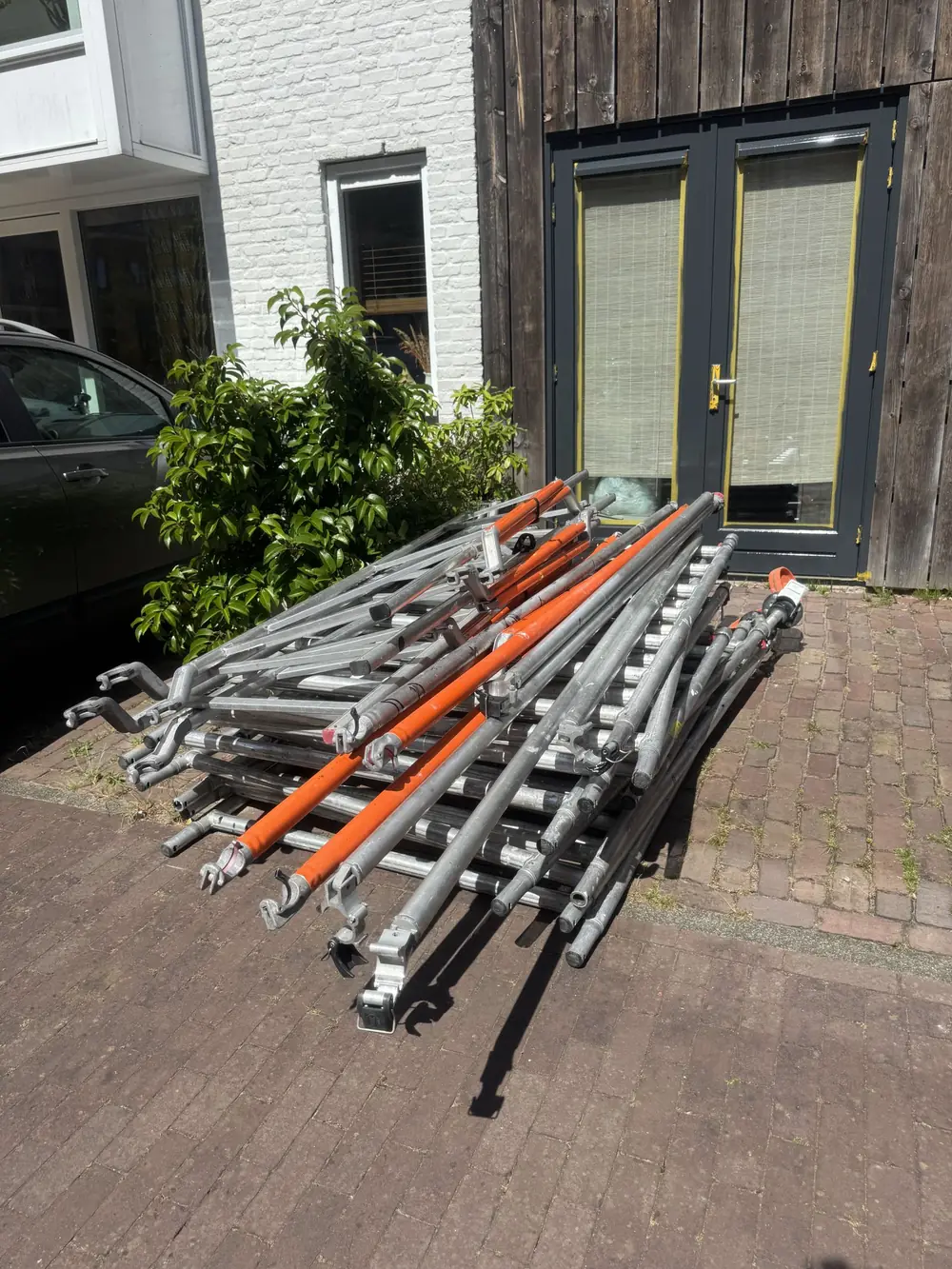
Frames resting against a house front by a cargo bike, delivered parts of the 135 cm wide RS TOWER 52

Watch the difference between the type and the build when you commit. The RS52 as a model is good to 14.2 metres and uses platforms 245 cm in length, but you do not get that high at a terraced house. You hire the build that fits the highest joint due for renewal, and at three storeys that lies between 8 and 12 metres. The sizes of every version are set out clearly in the piece on scaffold measurements.
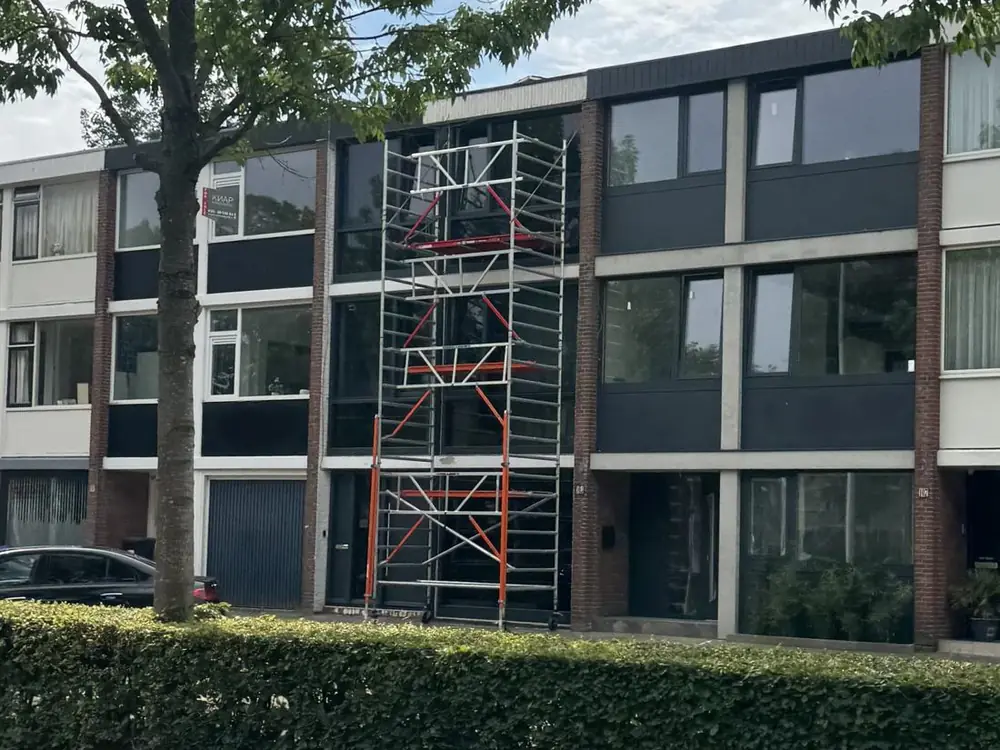
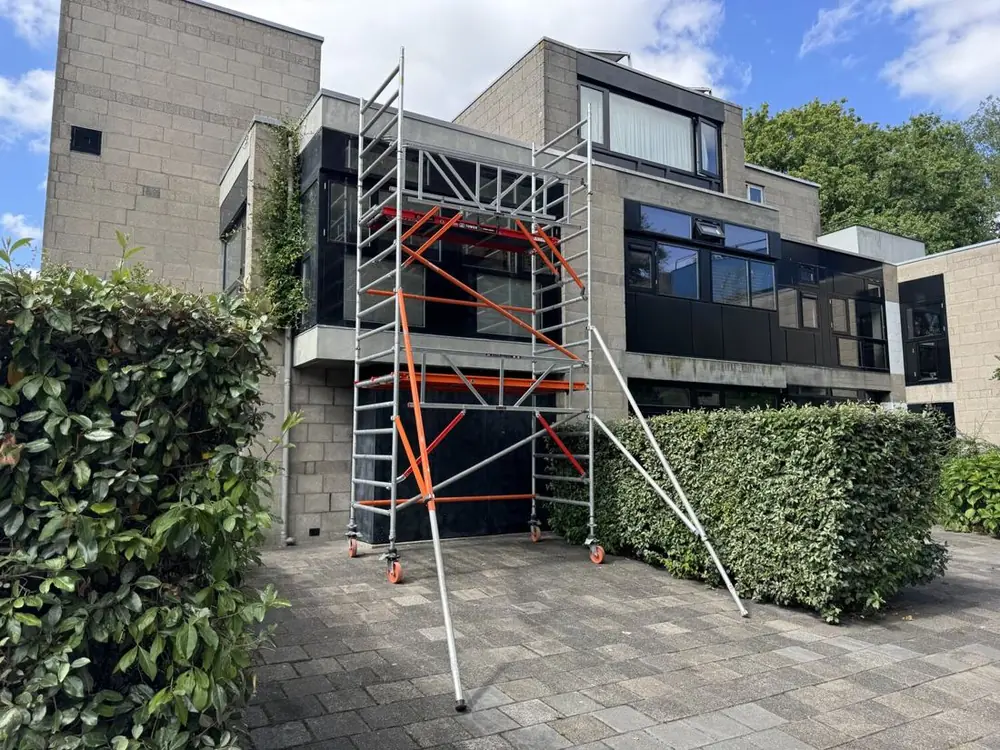
Working height up to the top joint under the roof edge

First settle how far up the pointing runs. Sometimes it is only the bottom few metres where the brickwork has weathered, sometimes the whole wall up to the gutter. That difference easily saves you two platform layers in your build and half a day of assembly. If the work runs on to just under the roof edge of three storeys, you come out between 8 and 12 metres of working height. Count a gable or a chimney in if that is due as well.

The height you order you calculate by adding a good two metres of reach to the height of the deck. For nine metres of working height your platform therefore stands at around seven. Unlike painting you can barely use that reach: pointing is done with force and with short tools, so you want the joint between hip and shoulder height. Choose your platform on the high side for that reason. The build to nine metres of working height is described on that page.

Mobile scaffold built up a front wall to the roof edge, the height at which the topmost joints come within reach

Measure from the point where the wheels will come to rest and not from a raised patio. A garden that lies a step lower than your back door takes half a metre off your reach just like that. Come up short and you finish the top joints with your arms raised, which goes wrong quickly on chopping work and wrecks your wrist besides. If the brickwork carries right on to the second floor, order one platform layer too many rather than one too few.

Standing position and stabilisers when pointing a facade

Pointing a wall asks for more space at ground level than you would think at first sight. Besides the setup itself, with the four stabilisers angled outwards, you need a mixing spot: a tub, a bag of mortar, a bucket of clean water and a place for the drill with a paddle. Put that mixing spot beside the scaffold and not under it or between the legs, because then you need not move the tub and the bags as soon as you shift a bay.

The ground has to be able to take the weight. Setts and concrete carry fine, grass and topsoil give under the wheels, certainly with a full tub above and a second person up there as well. If there is a path with a fall along the wall, adjust the legs per position; on that adjusting there is the article on uneven ground. Look as well for manhole covers, gullies or loose slabs you would rather not rest a stabiliser on.

Stabilisers under a mobile scaffold on street paving, showing how much load bearing room a pointing job needs at its foot

A great deal comes down under the setup on this job. Raking out produces sharp grit, old lime mortar and dust that creeps in everywhere. So lay a sheet you slide along per bay, keep the windows below shut and warn the neighbours who have washing out, because brick dust travels far. If the tower stands partly on the public road, check with the council beforehand what is arranged in your street, and do that well before you let the delivery be scheduled.

Four to eight days hiring a mobile scaffold for pointing

Pointing counts in square metres of wall, but the number of days you hire follows from the number of rounds. You pass the same bays twice: first raking out and brushing clean, then pointing and finishing. An ordinary front wall of a terraced house costs about two days per round when you work with two people. That brings you out at four to eight days of hire, depending on how hard the old mortar sits and how much wall goes under the hand.

The weather decides besides when you can point at all. In freezing cold you do not work mortar, and on a wall roasting in the full midday sun the mix dries out so fast that it does not cure properly. Rain during or just after pointing washes part of the fresh joint out again. You almost always lose a few half days that way, and they usually fall not neatly at the end but somewhere in the middle of your planning.

Mobile scaffold built along a side wall, the position from which you carry out both the raking round and the pointing round

That is why reserving generously is sensible here. You settle the full rate over the first 24 hours; what you add in days after that counts towards your total each time with 95 per cent off. Two days of slack for frost or a heavy shower therefore cost you little, while stopping halfway means leaving a half raked wall open while you wait on a new delivery. There are rules of thumb for judging such a period in the explanation of the number of rental days.

Which mobile scaffold suits pointing a façade?

Kamersteiger RS44
  • Working height up to 4 metres
  • Compact and narrow
  • Great for indoor and small jobs
View and calculate →
Smalle rolsteiger RS51
  • Working height up to 14.2 metres
  • Narrow (75 cm)
  • Ideal for narrow passages
View and calculate →
Most chosen
Brede rolsteiger RS52
  • Working height up to 14.2 metres
  • Wide platform (135 cm)
  • Extra stability and workspace
View and calculate →
1-persoons steiger MiTower
  • Working height up to 6.2 metres
  • Very compact
  • Quick and easy to assemble
View and calculate →

Small bays of pointing from a platform of 245 cm

The platform under your feet is 245 cm long, and that length is exactly the width you work in. Divide that strip once more into bays of roughly a metre wide and a metre high, and mix no more mortar per bay than will go into it. Mixed mortar stays properly workable for a limited time only, so anyone who mixes a full tub and then starts three bays at once inevitably throws part away or works with a mix already stiffening.

Decide deliberately whether you do both rounds per setup or rake the whole wall out first. The first saves moves, the second keeps your tools apart: you then need not keep swapping the grinder and the jointer and you clean up only once a day. On a wall ten metres wide you are talking about four or five standing places, and that number doubles as soon as you pull the two rounds apart over the rental period.

Mobile scaffold against a brick wall, with a deck that covers a 245 cm strip of pointing per setup

Do not carry a full tub up with you. Send it up on a rope, or refill at the top from a bucket you can carry in one hand, because climbing with both hands occupied is the biggest risk on this job. At the end of every day clear all mortar residue off the deck, because hardened mortar on a platform cannot be got off later. If you combine this work with making good the loose bricks, plan those repairs into the same round.

Delivery and build when hiring a scaffold for pointing work

The mobile scaffold turns up at the address in loose parts, counted through and complete to the last coupler. Reserve a dry place for that beforehand, preferably not on the strip along the wall, because that is where your mixing spot and your sheet full of grit are going. A drive, a carport or the side of the house works better. Book on a weekday with the reservation in before 15:00 and the delivery may fall on the very next working day, at the moment you chose yourself.

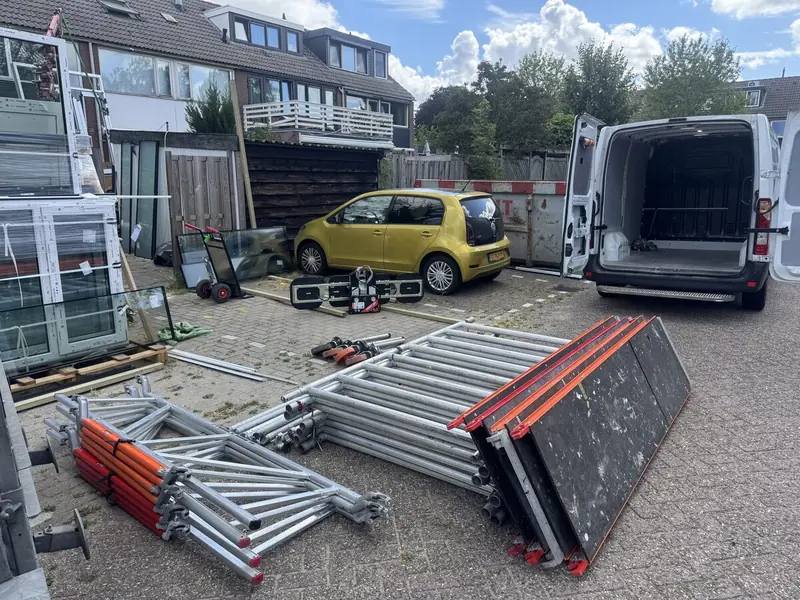
Building the tower is your own affair. The manual comes along with the set and the instruction video is there to watch; two people are busy with it for roughly half a day. Put that assembly in your planning a day before your first day of raking, so you start fresh at the dustiest work instead of after a morning of humping tubes and platforms. Note in your reservation where the van can unload, because the frames and deck parts for three storeys make a considerable stack.

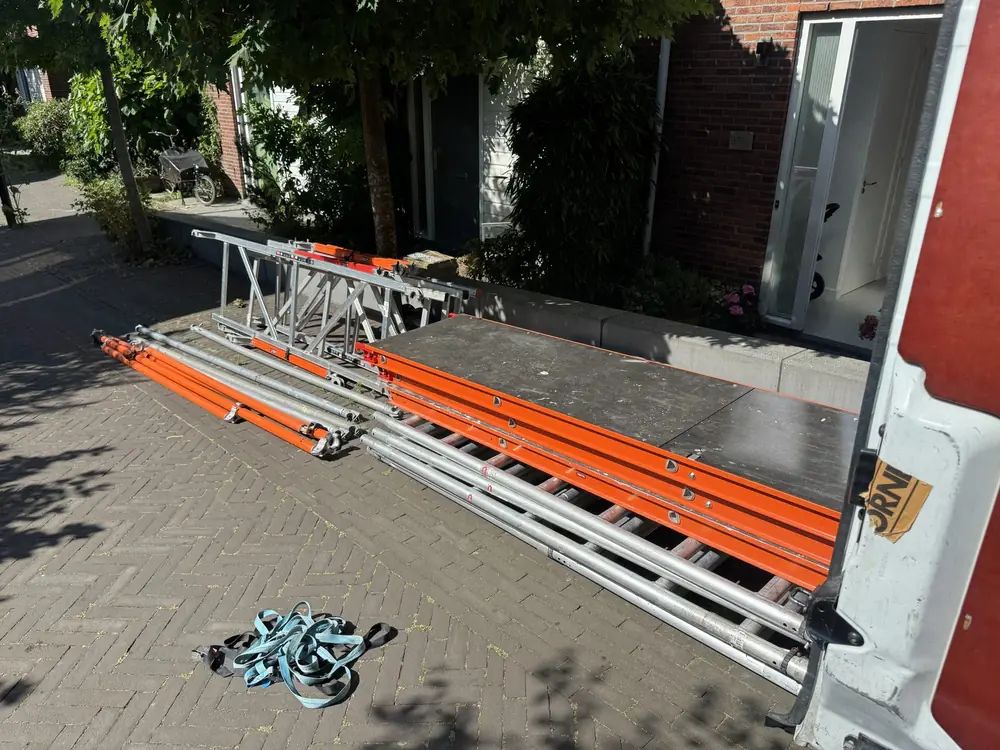
Scaffold parts beside the delivery van in the street, the loose components you build up yourself for pointing a wall

Once the last joint is set and has pulled up, you dismantle everything and lay the parts out complete for the collection day you chose, after which we take them away again. Hose or brush the platforms down first: dried mortar on aluminium is next to impossible to shift. Count all the parts off while you dismantle, then you are certain no brace or coupler has stayed behind in the garden. What the run to your province costs is stated at the cost of delivery per province.

Weight, dust and safety on the scaffold you hire for pointing

These platforms are rated at 200 kg for each square metre, which EN 1004 calls load class 3. Pointing is the job at a wall where you come closest to that: a filled mortar tub weighs a lot, and with two people, buckets of water and a grinder besides you add up fast. So do not put all the heavy things down by the hatch, but spread the weight over the length of the deck. What that class means you can read in the notes on this standard.

The basic rules weigh extra heavily on this job. Brake all the wheels before anybody goes up the ladder, never move the setup with material or people on it, and come off it once the wind gets up in earnest. Because you shift a bay so often when pointing, clearing the deck before you roll soon starts to grate; do it anyway, because a tub tipping while you drive cannot be caught. Set the four stabilisers fully out again before you go up with a new bucket.

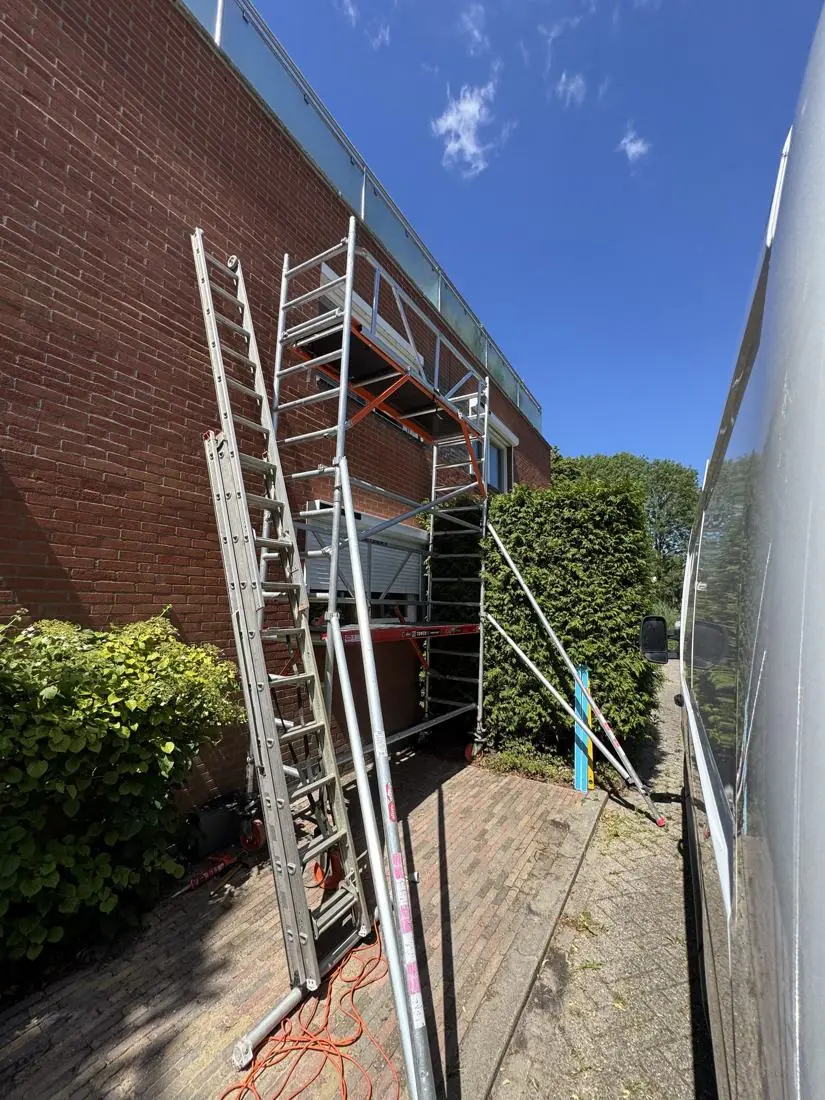
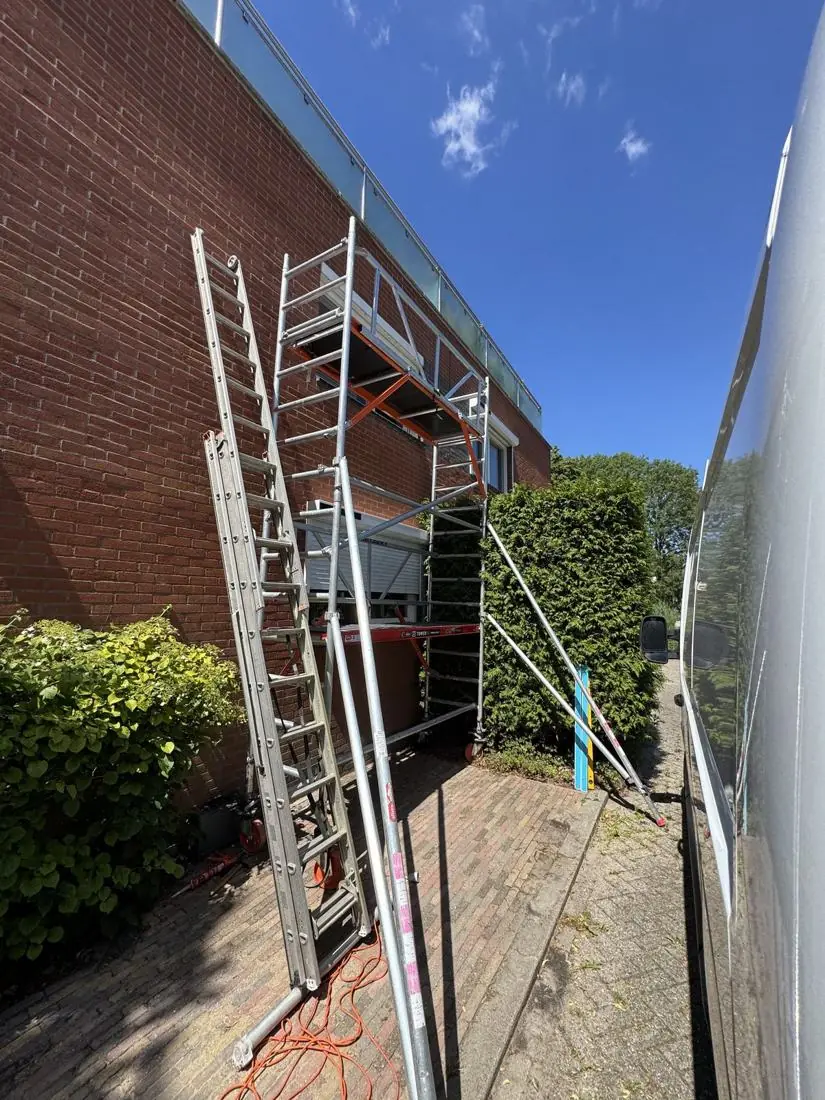
Built up mobile scaffold against a side wall, a loose ladder propped nearby, every square metre of deck rated 200 kg

The particular risks of this job sit in the dust and the grit. Chips of old mortar drop straight down, so keep that zone clear and wear goggles, gloves and a dust mask yourself. Wetted brickwork lets water run over your deck, which makes the platform slippery and makes mortar stick to it. So wipe the deck dry a few times a day, under the tub as well. The rest of the agreements you find at the guidelines for working safely at height.

In 5 steps

How hiring a mobile scaffold works

1
Choose working height

Pick the height that suits your job.

2
Book online

Sorted in 60 seconds, price shown instantly.

3
We deliver

At the agreed spot the next working day.

4
Assemble safely

Assembled by you, with a manual.

5
We collect

One call and we collect the scaffold.

Good to know

Practical tips for pointing a façade

1

Mix a bucket of mortar per bay instead of a full tub for the whole strip. You throw less away and you need not rush on the scaffold with a mix that is already pulling.

2

Wet the raked out brickwork just before you point and not hours earlier. A dry brick sucks the water out of your fresh joint and then it will not bond as it should.

3

Put a second person down at the mixing spot and let them pass the buckets up. That saves you dozens of trips up and down the ladder of the scaffold per setup.

4

Rake out a whole standing place before you pick up the jointer. You then let the dust settle only once and work on cleanly in the same bay afterwards without stopping.

5

Lay a piece of sheeting on the platform under your tub. Spilled mortar you scoop straight off it, and you hand the scaffold back at the end of the rental period without caked residue.

6

Follow the forecast before you begin pointing. If a chance of night frost remains, use your rental days for the raking out first and only point once the temperature climbs.

Frequently asked questions

Frequently asked questions about pointing a façade

Which mobile scaffold do you hire for pointing a facade?+

The wide RS52, with its platform of 135 cm, is the logical thing to hire for pointing. On this job a tub of mortar stands on your platform, plus buckets of water, an angle grinder and your hand tools, and you want to walk past all that with a loaded jointer. On the narrow version of 75 cm you spend the whole day shifting things. Only when the way through to the wall does not allow it do you hire the narrower one.

How does hiring a scaffold for pointing work at a facade go?+

You fix online which version and which build height you want, state yourself when the mobile scaffold may be brought and collected again, and pay a fixed price in advance with the VAT already worked in. The parts come to your address, you assemble them, rake out and point, and at the end the parts go back dismantled and counted. What you must judge well at hire is the weather, because frost and fierce sun both get in the way of working mortar.

How many rental days does repointing one facade take?+

Four to eight days is usual for one wall of a house. You walk the wall twice, after all: one round of raking out and one round of pointing, and both rounds take about the same time. If the old mortar sits very hard or several elevations are involved, you hire longer at once. Because the tower stays standing between the two rounds anyway, you book those days as one continuous period rather than two separate blocks.

What does hiring a scaffold for pointing cost and how does the discount work?+

Your rental price hangs together with the version and the build height you fix, plus the run to your province. You find all the amounts, VAT and all, on the page with hire rates before you pin a date. For pointing the shape of that rate works out well: only the first day weighs in fully and the days after it barely. Precisely on a job that has to wait for dry weather, that is the reason to book generously.

What working height should you hire if only the top joints are bad?+

Then the highest bad joint sets your build and not the whole wall. If that work sits just under the gutter of three storeys, you hire 8 to 12 metres of working height and your platform stands at six to ten. If it is limited to the bottom two storeys, a considerably lower mobile scaffold will do and that saves you a lot of assembly time. The different heights sit side by side on the page about working height.

Is the scaffold brought, or do I have to fetch it myself?+

Either arrangement suits us. Choose delivery and the set lies ready on the day you name and goes back in the van after your last day of pointing. A fixed amount per province applies for that. Drive yourself and the parts wait by appointment at no cost in Amsterdam, provided your trailer can take the longest components. On pointing work most people have the mobile scaffold brought, because the drive is already occupied with bags of mortar and grit.

Does hiring a scaffold for wall work include putting it up?+

No, assembling, moving and dismantling you do yourself; we see to transport there and back. Set aside half a day on the first day and only then start raking out, because both on one morning will not work. We do not hire out cherry pickers, system scaffolding or scaffolding fixed to a wall, so for pointing over three storeys the mobile scaffold is the means. Working indoors? Then the room scaffold in our range is the better tool, since a doorway of roughly 70 cm indoors is enough for it.

Can I hire for longer if the pointing goes slower than expected?+

Yes, just report it and your collection day shifts along, unless the tower is already fixed for a following customer. On pointing work it regularly overruns: old mortar sometimes sits so hard that raking out takes twice as long, or frost throws two days away. So book a bit more generously than you think you need on paper. Moving on within your reserved period costs nothing extra, and returning early is allowed too if you finish sooner.

How much room must be free beside the wall on a pointing job?+

Besides the width of the setup you count in what the stabilisers occupy, then a mixing spot with tub, water and bags of mortar, and finally the sheet that catches all the grit. In practice a level, empty run of a few metres beside the brickwork is the least you can manage with. Clear garden furniture, bikes and flower boxes before the scaffold is delivered, because once you start raking everything lies under brick dust within hours.

Can I keep hiring if it starts to freeze during the pointing job?+

The mobile scaffold may stay standing; only the pointing is put off. You do not work mortar in frost and not on a frozen wall either, because then the joint simply comes out again later. Use such a period to rake out further, brush everything out well and prepare the rest of the wall. Because you choose the collection date yourself, that waiting as a rule costs you no more than a few extra days of hire.

How does the deposit work if you want to hire a mobile scaffold for pointing?+

As long as the mobile scaffold stands with you a deposit runs alongside. Once the returned set has been counted through, you get that deposit back within one working day. On pointing work we look above all at caked mortar: mix that has hardened on platforms and tubes does not belong there and weighs just as heavily as a missing part. A wipe during the work prevents it entirely. The further settlement is in the article on the deposit.

Do I have to leave the scaffold standing between raking out and pointing?+

That is by far the handiest. You do not leave a raked out wall open for weeks, so you want to get back to exactly the same standing places within the same rental period. Leave the mobile scaffold standing between both rounds, then, and mark where the wheels stood. That way you need measure nothing again and each bay joins the next neatly. Two separate rental periods cost you more and leave the wall open far too long.

Hire a mobile scaffold for pointing a façade today?

Calculate your rental price now or ask for free advice.

Rolsteiger van SteigerTaxi geleverd op locatie
Book it online

Your scaffold sorted in 2 minutes.

Choose your scaffold and working height, see the price instantly and book online.