
Knowledge base · reading time 9 min
Mobile scaffold or MiTower: which to choose?
The MiTower and the mobile scaffold solve the same problem: standing safely at a height where a ladder becomes unsteady. They do it for different kinds of work. The MiTower is a one person scaffold up to 6 metres working height that you put up on your own, while a mobile scaffold goes higher and offers room for two people with material. The choice comes down to height, to space and to whether you work alone.
- Mobile scaffold or MiTower to hire? Compare working height, width, assembly and use, and pick the scaffold that fits your job and your site.
- No, the MiTower is a one person scaffold.
- Around four metres, because the working height goes up to 6 metres and working height is platform height plus two metres.
- That depends on the height and hire period you choose.
What the MiTower is built for
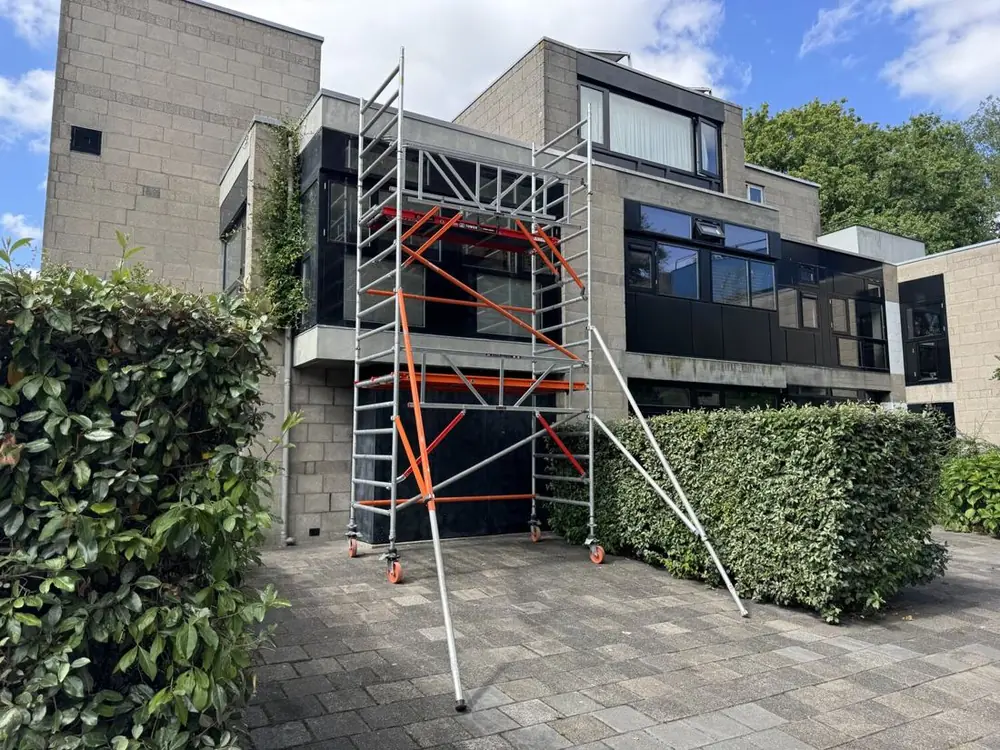
The MiTower is meant for work where you are on your own and do not stay in one place for long. Think of hanging an outdoor light, replacing a smoke alarm, adjusting a sensor or refitting a ceiling panel. The model is compact, passes through narrow openings and you set it up alone, without having to call someone in to hand you frames.
That design also sets the limit. The MiTower reaches 6 metres working height, and working height is platform height plus two metres for the reach of an adult. Your platform therefore sits at around four metres, enough for a ceiling, a low gutter or a light above a front door. Anything higher and you end up with a mobile scaffold instead.
The number of people is fixed too: the MiTower is a one person scaffold. That is not a detail but the core of the design, because the whole assembly method assumes a single person at work. For jobs where two of you sand a surface or lift out a window frame, a mobile scaffold is the logical choice. We do not assemble for the customer either, so being able to carry on alone is the point of this model.
Key facts
| Feature | Value |
|---|---|
| Core answer | Working alone up to 6 metres: MiTower; higher or with two people: mobile scaffold |
| MiTower | One-person scaffold, up to 6 metres working height |
| Available working heights | 4.2 to 14.2 metres |
| Platform width | 75 cm (RS51) or 135 cm (RS52) |
| Standard | EN 1004 |
What a regular mobile scaffold adds
A mobile scaffold is bigger in every direction. The range covers working heights from 4.2 to 14.2 metres, so it reaches a gutter on the second floor just as easily as a ceiling in a hallway. The platform is 245 centimetres long, which means you finish a decent stretch of facade per setup before pushing the tower along. On a two storey facade that easily saves a couple of moves over a working day.
That platform length feeds straight into your pace. When painting you keep paint, brushes and rollers beside you instead of climbing down each time. On gutter work you have somewhere to put the removed section and your tools without them getting underfoot. The load class is 3, which works out at 200 kilos per square metre of platform, so two people with material stay well below it.
You also choose the height yourself on a mobile scaffold. You decide how many sections you need based on where you have to reach, which is easy to work out via the working height page. If you think in storeys rather than metres, the translation is at the right height per storey. Count the sections once too often rather than finding yourself short on the day itself.
Six metres is the line that usually decides
In practice the decision is already made while measuring. Measure from the ground to the point your hands need to reach and subtract two metres: that is the platform height you need. If you land under four metres of platform, the MiTower fits. If you land above it, it becomes a mobile scaffold, even when the rest of the job looks small.
Watch what exactly you are measuring. A gutter on a terraced house often sits at around six to eight metres, which puts the MiTower out of range. A living room ceiling, a light in a hall or a roof window from inside usually stays comfortably below it. If you are unsure about the height of your facade, see working on the first floor for a reference point.
One thing people forget is that the ground counts towards that height. If you stand on a raised terrace or on a driveway that slopes away, the distance to the gutter changes noticeably. So measure from the spot where the castors will stand, not from the lowest point of the garden. For an in between size you can use the separate height page, for example 6 metres working height, and match the setup to it.
Width, openings and the space on the ground
A scaffold has to be tall enough, but it also has to physically stand there. The narrow RS51 is 75 centimetres wide and fits along a garden path, between a shed and a fence or through a gate. The RS52 is 135 centimetres wide and gives noticeably more room to work, but it claims that room on the ground and while carrying parts in.
The MiTower takes up less space again and passes through narrow openings where a mobile scaffold gets stuck. That makes it suitable for corridors, stairwells and rooms full of furniture. For indoor work through a standard internal door there is also the RS44 room scaffold, which goes through from about 70 centimetres of door width. So measure not only the facade, but also the narrowest point on the route towards it.
On a mobile scaffold, do not leave the stabilisers out of your calculation. They stick out at the sides and help decide whether the tower fits in a tight spot. The full dimensions per model are listed at mobile scaffold dimensions and sizes, useful when you want to know in advance whether it clears your corner. On a driveway or a pavement it also matters whether you keep the way clear for others.
Working alone or with two people
The MiTower is for one person and that changes how you plan a job. You fetch material as you go, you do not load the platform in advance and you order your work around that. For a short task this is fine; for a full day of painting it costs a lot of unnecessary walking, and then a mobile scaffold works out better.
On a mobile scaffold two people can stand together when the work calls for it, for instance when lifting out a window frame or fitting a roof window. The platform is long enough and the load class allows the weight. What you can safely keep on a platform without overloading it is set out at loading and weight on a mobile scaffold.
The MiTower and the mobile scaffold side by side
The points where the two differ are all practical: how high you get, how many people fit, how much room you need and how you put it together. What a table cannot show is the feel of the work: on a MiTower you are done quickly and gone, on a mobile scaffold you set up a workplace you stay on all day.
Both models are made by Altrex, both are aluminium and both are built to EN 1004, so on safety requirements there is nothing to choose between them. The difference is in size and use, not in quality. If you first want to know what a mobile scaffold is and which parts it consists of, read what a mobile scaffold is.
| Point | MiTower | Mobile scaffold RS51 or RS52 |
|---|---|---|
| Working height | Up to 6 metres | 4.2 to 14.2 metres |
| Number of people | 1 person | Room for two with material |
| Width | Compact, passes narrow openings | 75 cm or 135 cm |
| Platform per setup | One working position | 245 cm platform length |
| Assembly | Manageable on your own | Easier with two people |
| Deposit on delivery | 500 euro | 500 euro |
| Typical work | Lights, sensors, short maintenance | Facade, gutter, dormer |
You assemble both of them yourself
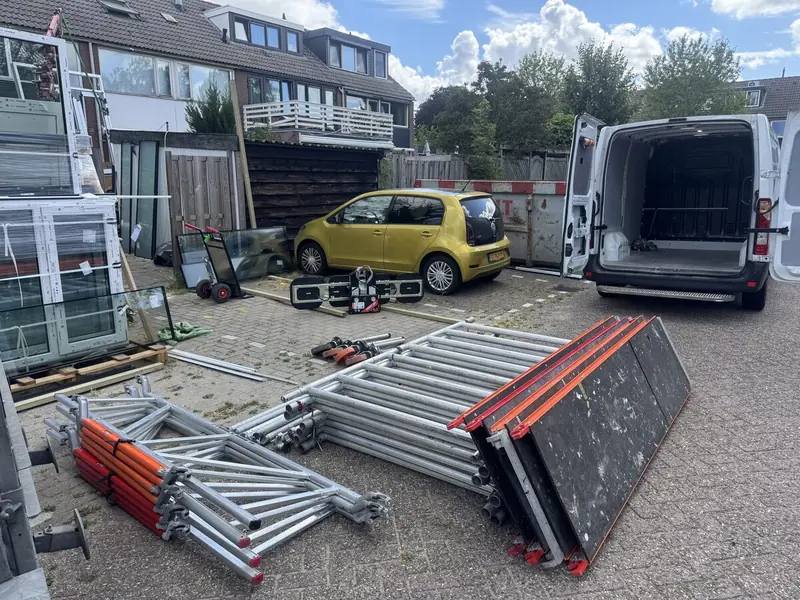
What you hire from us is equipment, not a crew. We do not assemble for the customer and never deliver a ready built scaffold, whether you take a MiTower or a mobile scaffold. You get the separate parts, a manual and an instruction video showing the sequence step by step. That is deliberate: you decide where and when it goes up, and you move it just as easily.
The MiTower is designed so that one person can do that build. On a mobile scaffold it is more comfortable with two, especially when passing frames overhead on the upper sections. Building alone is possible on the lower configurations, but allow more time for it. The full step by step assembly guide walks through the sequence. Agree in advance who stands on top and who passes parts up; it saves time and lifting.
The same rule applies to both: you build upwards from a protected platform, you lock the castors before climbing and you walk the finished tower through once more. If you are coming from a ladder and doing this for the first time, the difference in method is covered at ladder or mobile scaffold. Check the guardrails, the toe boards and the hatch as well before you start the job.
Indoors: MiTower, room scaffold or narrow tower
Indoors, different things matter. Door openings, thresholds, stairwells and a floor you would rather not damage decide what fits. The MiTower passes through narrow openings, the RS44 room scaffold is made to go through a standard internal door from about 70 centimetres, and a narrow RS51 fits in roomier halls and stairwells. A MiTower therefore reaches places where a wide mobile scaffold will not even enter the corridor.
Which of the three you pick depends on the height you need and on the route to the workplace. Walk that route once with a tape measure: the narrowest door on the way decides the model, not the room itself. The points to watch indoors are covered at using a mobile scaffold indoors and at mobile scaffold or room scaffold.
- Measure the narrowest door or opening on the route to the workplace
- Check whether there is a threshold or a step along that route
- Check the clear height under a light, beam or stairwell
- Put down base plates or cardboard on a vulnerable floor
- Lock the castors before you step onto the platform
Moving the scaffold during the job
Both models sit on castors, and that is exactly why they work so well for maintenance. You roll to the next spot instead of dismantling and rebuilding. The rule is the same for both: nobody on the scaffold while it moves, no loose tools on the platform, and the castors locked again afterwards. Note the brake on each castor rather than assuming the tower will stay put on its own.
The difference is the distance you cover. With a MiTower you move from light to light through a building; with a mobile scaffold you shift one platform length at a time along a facade. That second situation brings in stabilisers and, above a certain height, anchoring. What that involves is covered at stabilising and anchoring. At height that often means retracting the stabilisers and setting them out again afterwards.
The ground decides how smoothly that rolling goes. On tiles and paving a mobile scaffold rolls nicely, while on grass or sand the castors sink in and you need base plates to spread the load. Indoors the opposite applies: there you want to avoid the castors marking a wooden floor or a poured floor. On a MiTower that weight matters less, but the rule never to move it with someone on board stays exactly the same.
Delivery, collection and the deposit per model
Delivery works the same for both models. Order before 15:00 and the scaffold is at the agreed spot the next working day, anywhere in the Netherlands. Delivery and collection together are a fixed amount per province, which you find on the delivery costs page. Collecting it yourself is free by appointment at Zeeburgerpad 89 in Amsterdam. Make sure someone is there who can point out where the parts may be put down.
The deposit differs per model and per method. On delivery it is 500 euro for the MiTower and for the RS51 and RS52, and 150 euro for the room scaffold. If you collect yourself, the deposit is 750 euro for the MiTower, 1000 euro for the RS51 and RS52 and 150 euro for the room scaffold. It is returned within one working day after the scaffold comes back.
What you arrange beforehand is mostly practical: a level spot to unload, a route to the back of the property and someone at home at the agreed time. The deposit conditions are at the scaffold deposit page, and other delivery questions at the frequently asked questions. A clear passage of roughly a metre is usually enough to carry everything to the back.
- Ordered before 15:00 means delivery on the next working day
- Collection is free by appointment at Zeeburgerpad 89 in Amsterdam
- MiTower deposit: 500 euro on delivery, 750 euro on collection
- RS51 and RS52 deposit: 500 euro on delivery, 1000 euro on collection
- The deposit is back on your account within one working day after return
Hire period and where to compare the rates
The hire period works the same way for both models. The first hire day is charged in full and every following day costs 5 percent of that daily rate. Keeping the scaffold a few days longer is therefore rarely a problem when a job runs over. For a MiTower job you finish in a morning, the first day remains the deciding cost.
What the two cost depends on the model and, for a mobile scaffold, on the height as well. How those costs are built up is explained per model at the cost of hiring a MiTower and at the cost of hiring a mobile scaffold. Current amounts come from the configurator on the pricing page. Work out the number of days you expect to need first, and the difference shows immediately.
If you cannot work out which of the two suits your job, send a message on WhatsApp with the height you need and a photo of the workplace. A picture of the facade or the hallway is usually enough to see whether the MiTower will do or whether you are better off with a mobile scaffold. Mention whether you work indoors or outdoors as well; that often answers half the question.
Frequently asked questions
Can two people stand on a MiTower?
No, the MiTower is a one person scaffold. The design assumes a single person working on it from the outset. If two of you work together or pass material to each other, choose a mobile scaffold with a 245 centimetre platform.
What platform height does a MiTower reach?
Around four metres, because the working height goes up to 6 metres and working height is platform height plus two metres. That covers ceilings, low gutters and lights above a door. For a gutter on the second floor you end up with a mobile scaffold.
Is a MiTower cheaper than a mobile scaffold?
That depends on the height and hire period you choose. The configurator on the pricing page works out both options, including delivery for your province. On short jobs the first hire day weighs most, since every following day costs 5 percent of that daily rate.
Does a MiTower fit through a normal internal door?
The MiTower is compact and passes through narrow openings, but the RS44 room scaffold is made specifically for this and goes through a standard internal door from about 70 centimetres. Measure the narrowest door on your route and choose accordingly. If in doubt, send us the measurement on WhatsApp.
How much deposit is there on a MiTower?
It is 500 euro on delivery and 750 euro if you collect it yourself. The amount is back on your account within one working day after return. The RS51 and RS52 carry different figures, namely 500 euro on delivery and 1000 euro on collection.
Which scaffold do I need for the gutter of a terraced house?
Usually a mobile scaffold, because a terraced house gutter often sits at around six to eight metres working height. That is beyond the MiTower. Measure from the ground to the gutter and add nothing, since the two metres of reach are already included in working height.
Will you assemble the MiTower for me?
No, we do not assemble and never deliver a ready built scaffold. You receive the parts with a manual and an instruction video. The MiTower is designed precisely so that you can do that build on your own, without tools.