
Knowledge base · reading time 11 min
Hiring a scaffold cheaply without cutting corners on safety
Hiring cheaply is rarely about the lowest day rate. It is about the right working height, a model that suits your job, a period you do not have to book twice, and a sound choice between collecting the equipment yourself and having it delivered. Below are the dials you can genuinely turn, with the dimensions, deposits and sequences that go with them.
- Hire a scaffold cheaply? Choose the right working height and model, book consecutive days and keep delivery cost down with these practical tips.
- Financially yes, because self-collection is free by appointment in Amsterdam and you then pay no amount for delivery and collection.
- Every extra day costs 5 percent of the first-day rate.
- Yes, the deposit is separate from the hire amount and is included with the order.
What a scaffold hire bill is actually made of
The price of a scaffold hire consists of three separate parts: the hire rate, delivery and collection, and the deposit. The hire rate works with a full rate on the first day and 5 percent of that day rate for every following day. Delivery and collection sit in a fixed amount per province, so there is no charge per kilometre. The deposit is entirely separate from the hire and comes back after return. Current amounts are listed on the prices page.
Anyone who wants to hire economically is turning three dials at once. There is little to gain on hire duration, because every extra day counts only lightly. There is more to gain on delivery, especially if you can collect the equipment yourself. And the model you choose determines not only what you pay, but also how much working space you keep on the platform. Work through all three together before you commit to a model.
A fourth dial is often forgotten: the planning of the job itself. A scaffold that stands idle for three days because paint still has to cure costs hire days without any work progressing. Put your working order on paper first and reserve a period afterwards. The mobile scaffold cost page shows how the structure works out per model. Booking the delivery for the morning you actually start is part of that same exercise.
Key facts
| Feature | Value |
|---|---|
| Saving | Pick the right height and hire consecutive days (5% per extra day) |
| Each extra day | 95% off: €2.50 to €16.25 a day |
| Collection | Free by appointment, Zeeburgerpad 89 Amsterdam |
| Delivery | Ordered before 3 pm, delivered next working day |
| Available working heights | 4.2 to 14.2 metres |
Calculate your working height first, pick a model second
Working height is platform height plus 2 metres, because an adult reaches roughly two metres above the platform they stand on. If you want to reach a gutter at 6 metres, you do not need a platform at 6 metres but at around 4 metres. That often saves a full assembly section. The range covers working heights from 4.2 to 14.2 metres, so there is nearly always a size just below the one you first had in mind.
Measure your work, not your house. What matters is the highest point your hands have to touch, not the ridge of the roof. For paintwork on a first floor window frame that is the top rail, not the roof edge several metres above it. The working height page and the overview for the first floor help you get that step right.
Choosing one size lower is possible, but it means repositioning more often. Repositioning costs time and, on a tall set-up, attention as well, because the stabilisers go in and out each time. On a short facade that hardly matters; on a terraced house with a wide roof surface it does. Count how many set-up positions you would need and weigh that against the time a taller set-up would save.
- Measure the highest point your hands need to reach, not the ridge or the chimney.
- Subtract 2 metres from it, because that is the platform height you actually need.
- Check whether a size lower still reaches everything if you reposition the scaffold once more.
- Confirm that the ground at every set-up spot is level and able to carry the load.
- Only then look at models, because the required height decides which ones remain.
Narrow or wide: what separates the RS51 from the RS52
The RS51 is the narrow mobile scaffold at 75 cm wide, the RS52 the wide one at 135 cm. Both have a platform length of 245 cm, so lengthways you cover the same distance before repositioning. The difference is the space beside you. At 75 cm your tools sit against your legs; at 135 cm you can place a bucket, a case and a roll of sheeting next to each other without stepping over them.
For a facade with a narrow strip of garden, a side path or an alley, the narrow version is often the only one that physically fits. If you do have the room, the wide version is more comfortable for jobs where you carry a lot of material up with you. Both models are made by Altrex and comply with EN 1004, in load class 3: 200 kg per square metre of platform.
Hiring cheaply does not automatically mean choosing the narrowest option. If a narrow platform sends you down for every fresh bucket or length of timber, you lose hours that come back as hire days. Compare the versions on mobile scaffold hire and choose the width that matches the work you are doing. Half a day of climbing up and down weighs heavier than the difference between two models.
Consider what the scaffold has to pass under and between as well. A narrow version rolls past a shed, over a tiled path or between two hedges where the wide version gets stuck. Measure the passage at its narrowest point, including the stabilisers that stick out at the bottom. If it only just fails to fit, the narrow model is not a saving but simply the only workable option.
The room scaffold and MiTower as a cheaper alternative
For interior work the room scaffold, the RS44, is usually the sensible choice. It fits through a standard interior door from around 70 cm. That means you do not assemble it in the living room only to discover it will not leave through the hallway. For ceiling work, a stairwell or high interior walls that is the difference between half a day of carrying and half an hour.
The MiTower is a one-person scaffold up to 6 metres working height. For an outside light, a roof window or a section of gable it works perfectly well, and you do not need a second person to reposition it. Once you go above 6 metres working height you end up with the mobile scaffolds from the RS range. For assembly and repositioning that makes a noticeable difference, particularly when you work alone and have nobody to hand components up.
The deposit also differs per model and counts towards what you transfer up front. For the room scaffold it is 150 euro, both for delivery and for self-collection. For the RS51, RS52 and MiTower the deposit is higher. The page on the scaffold hire deposit lists every amount together, so you know what is temporarily tied up. Knowing that figure before you order prevents a surprise at the moment of payment.
Hire consecutive days instead of separate blocks
The first hire day costs the full rate, every following day 5 percent of that day rate. Your average price per day therefore drops as soon as you hire several days in a row. Hiring two days twice with a week in between gives you two full first days and two rounds of delivery and collection. A single block of four consecutive days gives you one full first day, three small additions and one delivery.
That makes generous booking almost always wiser than tight planning with your fingers crossed. Rain, disappointing ground conditions or a coat of paint that refuses to cure otherwise cost you a second hire period. See how the structure works out on price per day and on price per week. A day of slack in your planning costs you far less than a second delivery round later in the month.
Do estimate realistically how many days you need. The guide on how many days to hire a scaffold gives guidance per type of job. Include time for assembly, repositioning and dismantling. That is not working time at the facade, but it is hire time that runs inside your period. On the facade of a terraced house, assembly, two repositions and dismantling easily take half a day.
The models, their characteristics and the deposit side by side
The overview below places the four models next to each other with the characteristic that matters most in practice, plus the deposit that goes with it. The deposit is not a hire cost, but it is money that is tied up temporarily, so it helps to look at both together before you order. The dimensions in the table are exactly the ones you use to check in advance whether a model suits your job.
Notice that the room scaffold carries the same deposit either way, while the deposit on the other models rises as soon as you collect the equipment yourself. That is because the equipment then travels without one of our drivers. Factor that difference in when you weigh up whether self-collection works for you. For the room scaffold the amount stays at 150 euro either way, which keeps that model attractive for short interior jobs.
The overview also answers a second question: which model the job lets you rule out immediately. Working indoors, the choice falls almost always on the room scaffold. Working alone and staying below 6 metres working height, the MiTower is the logical candidate. Going higher, or carrying material up with you, leaves the RS51 and the RS52. Two of the four models therefore drop away almost immediately for most jobs.
| Model | Characteristic | Deposit on delivery | Deposit on self-collection |
|---|---|---|---|
| RS51 | Narrow mobile scaffold, 75 cm wide, 245 cm platform | 500 euro | 1000 euro |
| RS52 | Wide mobile scaffold, 135 cm wide, 245 cm platform | 500 euro | 1000 euro |
| MiTower | One-person scaffold, up to 6 metres working height | 500 euro | 750 euro |
| RS44 room scaffold | Fits through an interior door from around 70 cm | 150 euro | 150 euro |
Collecting at Zeeburgerpad or having the scaffold delivered
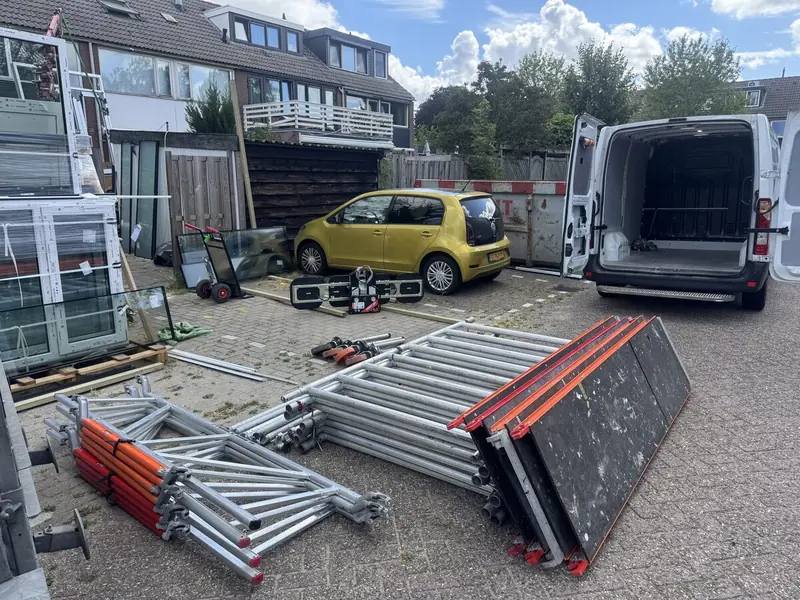
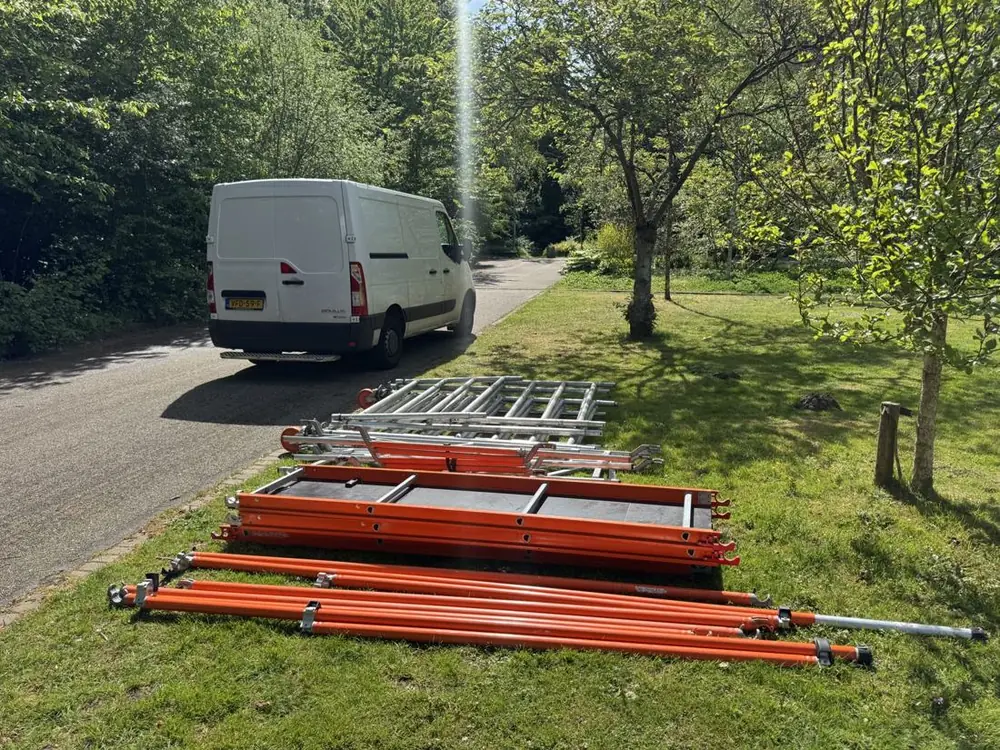
Self-collection is free by appointment at Zeeburgerpad 89 in Amsterdam. That removes the amount for delivery and collection, and for many jobs it is the largest saving available. The condition is that your transport fits. The scaffold travels dismantled, but the longest components decide how much loading length you need in your van or trailer. Measure the interior length of your load space before you make the appointment.
If you have it delivered, you pay a fixed amount per province. Whether you live in the middle of a province or at its edge, the rate is the same. Order before 15:00 and the scaffold is delivered the next working day, anywhere in the Netherlands. The delivery cost page and the page on the cost of delivery show what applies to your province.
Self-collection does come with a condition to budget for: the deposit is higher. For the RS51 and RS52 it is 1000 euro instead of 500 euro, and for the MiTower 750 euro instead of 500 euro. If you are unsure about transport, read hiring a mobile scaffold without a trailer. Bear in mind as well that collection is by appointment, so plan the moment you can be at Zeeburgerpad.
Getting your deposit back without any fuss
The deposit is not a hire cost, but it does have to be in your account at the moment you order. On delivery that means 500 euro for the RS51, the RS52 and the MiTower, and 150 euro for the room scaffold. After return the deposit is back within 1 working day. For most customers that is short enough not to need separate planning around it.
Keeping your deposit intact is straightforward: return the equipment complete and undamaged. When dismantling, count the components against the same list you used during assembly, so a brace, a toe board or a stabiliser does not stay behind the hedge. The guide on getting your deposit back covers where it usually goes wrong. If in doubt, photograph the stack before the driver arrives, so you can check later what went back.
If you plan several jobs close together, remember that the deposit is tied up again for each hire period. For anyone buying on behalf of an association or a small company, that is a reason to bundle jobs rather than spread them. A broad overview of the rates sits on the prices page. On a job of a few days you barely notice it; across three separate periods in the same month you certainly will.
Combine jobs within one and the same hire period
Group jobs that need the same scaffold. Cleaning the gutter, painting fascia boards and washing the upper windows all happen from roughly the same working height along the same facade. Split across three separate hire periods you pay three full first days and three rounds of delivery and collection. Within one period you pay that once. That saves not only money but also the scheduling of three separate delivery appointments.
This does require preparation. Buy paint, sealant, gutter brackets and cleaning agent before the scaffold arrives, because a day spent waiting on an order is simply a hire day. Under applications you can see which jobs combine well, for instance gutter cleaning together with painting fascia boards. Lay out the tools you need up top the evening before, in a case you can lift up in one go.
Plan the order from top to bottom. Whatever you do high up drips or drifts downwards, and then you are back on the same spot a second time. Start at the roof edge and the gutter, work the facade next and finish with frames and windows. That way you roll the scaffold around the house once instead of twice. On a tall facade it pays to finish everything at one position before you roll the scaffold on.
Bundle in the work you normally postpone because there is no scaffold up anyway. Fitting bird protection, replacing an outside light, refastening a loose gutter bracket: on their own these are ten minute jobs you would never start a hire period for. While the scaffold is standing they cost you only those ten minutes. Write them on a note before you begin, because up on the platform you will forget them.
Assembly and dismantling are part of the hire
You assemble the scaffold yourself. Every hire comes with a manual, and an instruction video shows the assembly step by step. Steigertaxi does not deliver the equipment assembled and does not dismantle it for you either. That is exactly where a large part of the price difference sits compared with a scaffold erected by a crew: you pay no assembly hours.
Do count assembly time in your planning. At greater heights you are faster with two people and you work more safely than alone, if only because someone can hand components up. The step-by-step assembly guide and the hire checklist walk you through the order. On a tall set-up, also allow time for extending the stabilisers and levelling the base section.
The same pace works in your favour when dismantling. Put the components down sorted right where the driver loads or where your van stands, so frames with frames and platforms with platforms. That saves a quarter of an hour on loading and prevents anything being left behind that has to be sent on afterwards. Walk the spot where the scaffold stood one more time afterwards, because small components disappear into the grass.
Where customers pay more than they need to
Most unnecessary cost comes not from the choice of model, but from the planning around it. A scaffold that arrives a day early, a job that stalls halfway on a missing tin of paint, or a second hire period because the first was booked too tightly: those are the items that stand out on your final amount. Nearly all of them are avoidable with half an hour of preparation.
The second source is choices that look thrifty at first glance. A scaffold that is slightly too low, forcing you to reach, or a platform too narrow so you climb up and down constantly, costs working time and therefore hire days. The guide on what hiring a mobile scaffold costs shows how that trade-off works out in practice. Reckon with the time your job takes, then, not only with the difference between two models.
A third source is the assumption that private customers pay more than companies. They do not: the same rates, the same deposit and the same lead time apply to everyone. What differs is how often you hire and how much routine you have in assembling. The guide on hiring a scaffold as a private customer covers what to watch as a one-off hirer.
- Booking too tightly and then needing a second hire period, including a second delivery.
- Choosing a model that is just too low, so you have to reach and work more slowly.
- Ordering materials only once the scaffold is up, losing hire days to waiting.
- Planning self-collection with transport that cannot load the longest components.
- Not counting components while dismantling, which delays the handling of your deposit.
- Spreading jobs on the same facade across different months instead of bundling them.
Frequently asked questions
Is self-collection always cheaper than delivery?
Financially yes, because self-collection is free by appointment in Amsterdam and you then pay no amount for delivery and collection. You do need transport that fits the longest components, and the deposit is higher on collection. If you live far from Amsterdam, travel time and fuel belong in the comparison.
What does it cost if my job overruns by a few days?
Every extra day costs 5 percent of the first-day rate. Extending is therefore considerably cheaper than starting a second hire period. Let us know as soon as you know you will overrun, so the return date in your order is correct.
Do I pay the deposit separately from the hire?
Yes, the deposit is separate from the hire amount and is included with the order. On delivery it is 500 euro for the RS51, RS52 and MiTower and 150 euro for the room scaffold. After return the amount is back in the same account within 1 working day.
Do I pay more for delivery if I live further from Amsterdam?
No, delivery and collection sit in a fixed amount per province. Within a province it makes no difference whether you live in a village or a city. The rates per province are listed on the delivery cost page.
Which scaffold is cheapest for interior work?
The RS44 room scaffold is usually the best choice indoors, because it fits through a standard interior door from around 70 cm and carries the lowest deposit. For a single high wall or a ceiling in a spacious room it is more than enough. For work above 6 metres you look at the mobile scaffolds.
How quickly can a scaffold be delivered?
Order before 15:00 and the scaffold is delivered the next working day, anywhere in the Netherlands. Plan delivery for the morning you actually start, because the day the equipment arrives counts as a hire day. For a weekend job you therefore book from Friday.
Can I do high work from a lower scaffold?
Only if you stay within the working height that belongs to the set-up, which is platform height plus 2 metres. Reaching from a scaffold that is too low is unsafe and makes the work slow as well. Choose one size up, or reposition the scaffold once more along the facade.