
See your price
Application

Painting fascia boards? Choose the right scaffold.

Paint on fascia boards only covers after several coats, which turns this job into a series of rounds rather than one pass along the roof edge. Primer, undercoat, topcoat: each time you take the tower past the same standing positions. The scaffold that suits that pattern is the RS52, the wide model with a deck of 135 cm and a build reaching somewhere between 8 and 12 metres. Below you will read how many setups an average roof takes, how many hire days go with them and how to plan those rounds back to back.

  • Order before 3 pm, delivered tomorrow
  • Professional Altrex scaffolds
  • Up to 14.2 metres working height
  • Easy to assemble yourself
4,2 tot 14,2 mWorking heights available
12Provinces served
7Days a week
200 kg/m²Load class 3
In short
  • For painting fascia boards we recommend the Wide mobile scaffold.
  • For painting fascia boards the RS52 fits best: a deck of 135 cm and a build reaching somewhere between 8 and 12 metres.
  • Opaque paint goes on in two or three coats, so you drive the same marked positions along the roof edge several times over.
  • Allow four to six hire days, because between one coat and the next the tower simply stands there waiting for the paint to harden.
  • First 24 hours from €175 incl. VAT and delivery; every day after that 95% off.
Key facts for this job
FeatureValue
Recommended scaffoldWide mobile scaffold (Altrex RS TOWER 52)
Working height for this job8 to 12 metres
Available working heights4.2 to 14.2 metres
StandardEN 1004, load class 3 (200 kg per m²)
DeliveryOrdered before 3 pm, delivered next working day
Each extra day95% off, from €8.75 a day
Why a mobile scaffold for painting fascia boards?

Safe, stable and professional work at height

The difference with a single pass is the repetition. One covering coat is never enough: only when the second and often the third are on is the colour even and the timber sealed again. Every position along the roof edge is therefore needed more than once, with waiting time in between. From a ladder you pay for that repetition each round: dragging, lining up, standing at a slightly different point again, and all of it with a tin hanging off your hand. Hiring a scaffold to paint fascia boards means you set the route out once and afterwards only drive it, on a deck where an open tin can safely stand.

  • Opaque paint needs two to three coats
  • The same standing positions return every round
  • Roof edge sits at 8 to 12 metres
  • Wide deck for tin, roller and brushes
Read more about working safely →

Which mobile scaffold to hire for painting fascia boards

For this paintwork you take the Altrex RS52, the wide model with a working deck of 135 cm. That width is no luxury here. Opaque paint comes out of a tin that stands open beside you, and around it lie a roller, two brushes, a scraper and a roll of tape. On a cramped deck you push that lot ahead of you all day and set the tin down somewhere new each time. What else stands ready is set out on the page about mobile scaffolds you can hire.

The deck is 245 cm long, and you use that length along the roof edge, exactly the direction a fascia board runs in. The extra width you use the other way round: a step backwards to judge whether your coat really covers. On 135 cm you have that step and on 75 cm you do not. With two of you up there, one working the end grain and the other rolling the face, the room is taken up straight away.
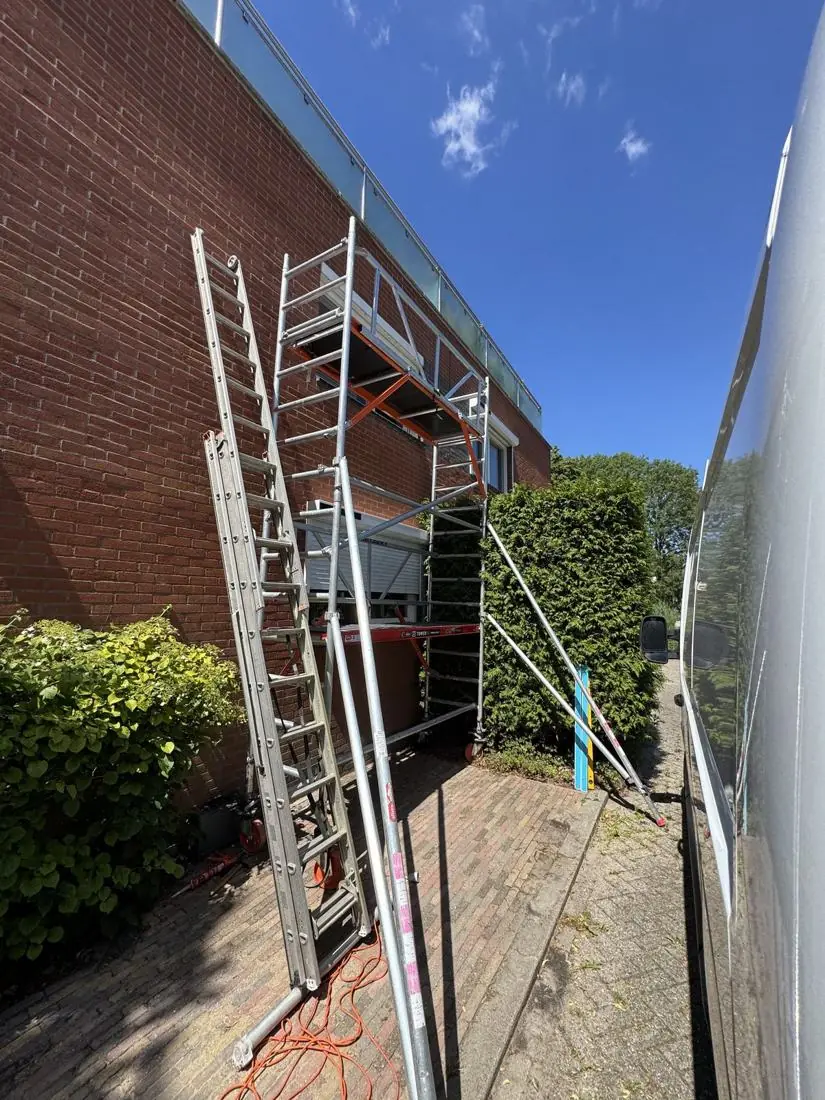
Assembled mobile scaffold with a wide working deck and guard rails, the setup where an open tin of paint stands beside you

If you still pick the narrow 75 cm version, it is because the way round the back forces it: a gate, a path between two fences, a hinge that will not give. You give up working room and the tin ends up between your feet. Where both models fit past the house, paint in coats favours the wide deck, if only because you stand on it for three rounds. All the sizes sit together in this overview of mobile scaffold dimensions.
What working height to hire for a fascia board edge

The top edge of the fascia board is the highest thing you have to reach, up where the timber closes against the tiles or the zinc capping. That sits above the gutter hanging in front of it, and you need to see over it to judge whether the top few centimetres are covered. Across two or three storeys that edge lands somewhere between 8 and 12 metres of working height. What that means for the build is shown on the page about ten metres of working height.

Your tape does not start at the front door step but at the point where the wheels will stand. A drive falling away towards the street, a sunken terrace at the back or a garden half a metre below the path all push that starting point down. Then work the stated figure back to your feet, because between platform height and the number you book sits roughly two metres of reach, so twelve metres at the top means standing at about ten.

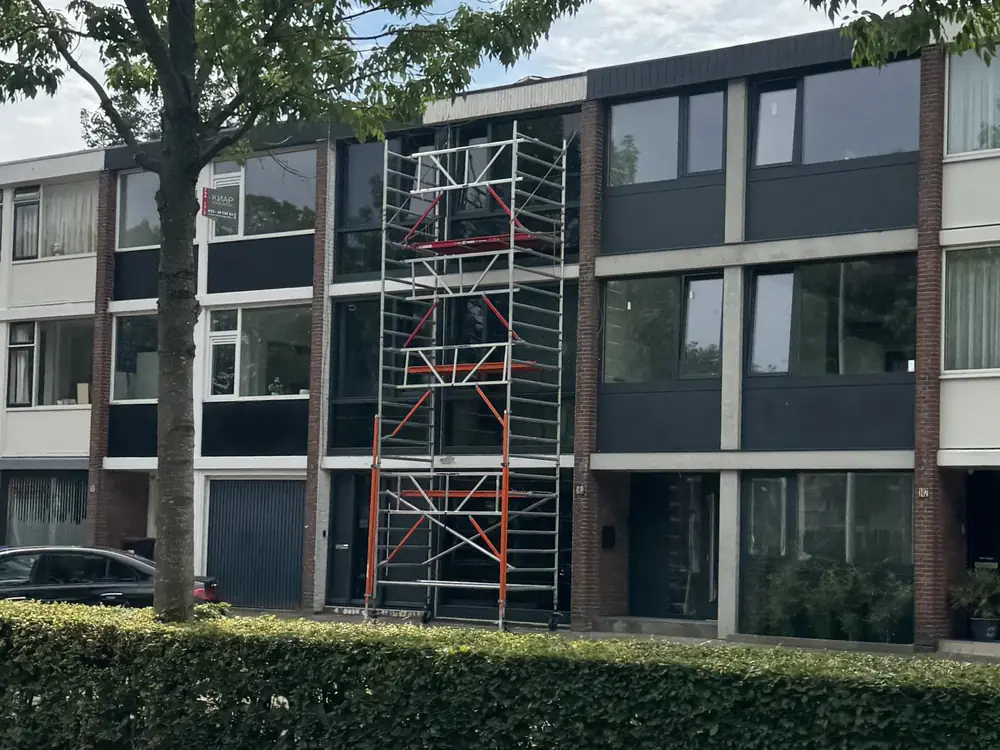
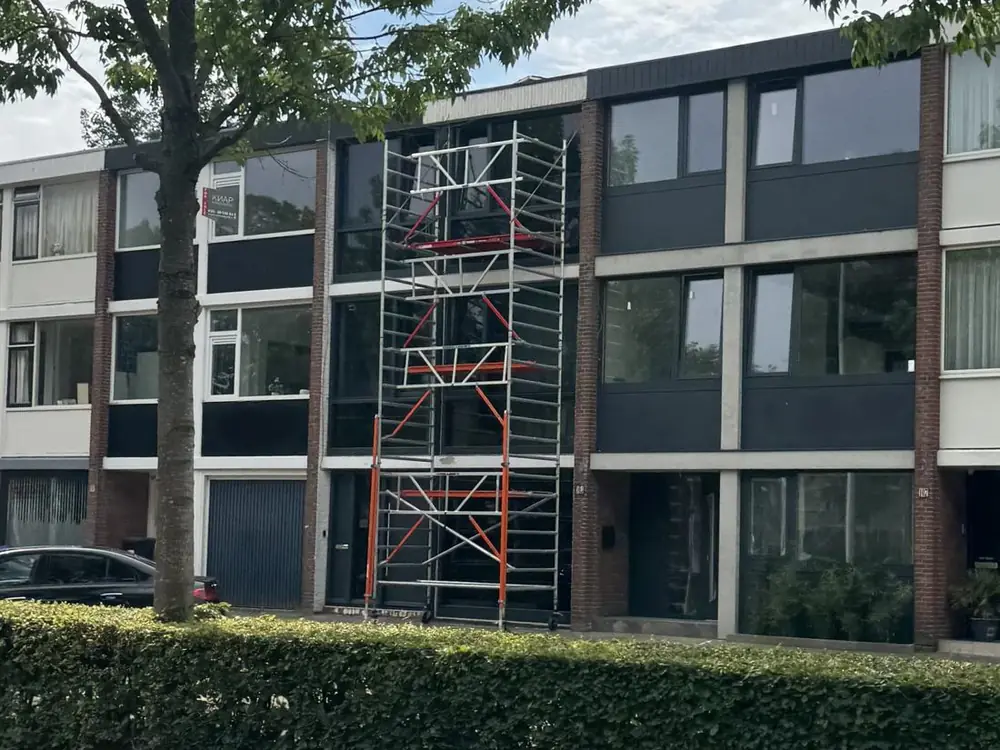
Mobile scaffold running up a front elevation past the gutter, the height at which fascia boards meet the roof

Choosing too tight punishes you harder with opaque paint than with other work. Half a metre too low and you brush the top band with your arm raised, the paint runs back down the handle and the coat stays thinner there than on the rest of the board. You only notice once everything is dry, and then that band has to come along in the next round anyway. Over three rounds you pay for a wrong height three times.

Hiring a mobile scaffold and marking out positions round the house

What is unusual about this job is that you work out your standing positions once and then come back to them two or three more times. So walk the whole roof before delivery and chalk on the paving where the tower goes each time. Number those spots from left to right. In round two you then drive the scaffold to number four without thinking about it, and your fresh coats fall in with the joins of the previous ones.

Where you put those spots depends on the ground. Block paving, slabs and a solid drive carry the load fine; grass that sinks under the wheels after a wet night does not, and over a job of several days that goes wrong more often than over one morning of work. The four stabilisers stick out at an angle, so every side needs more room than the tower itself takes up. A falling stretch you level as described in working on uneven ground.

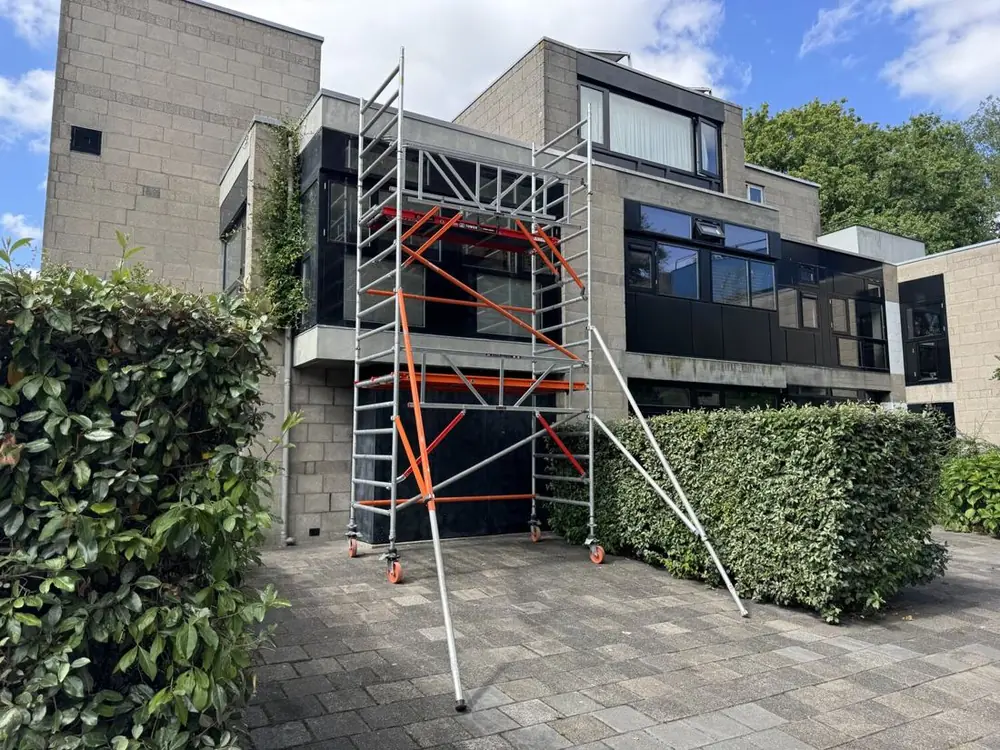
Stabilisers swung out beneath a mobile scaffold, the fixed footprint kept clear at every marked standing position

Around a roof edge the obstacles nearly always sit in the same places. A hedge grown against the wall, a shed roof in the corner, a flat roofed extension you cannot get round, a downpipe on the corner and the neighbours' boundary fence. If a position lands on the pavement, ask the council whether that is allowed in your street, and let the neighbours know that the hired tower stays there for a number of days.

How many days to hire a scaffold for fascia boards

Count your rounds first and your days second. A terraced house with fascia boards front and back easily takes six to eight setups per round, and you repeat that round for the primer, the undercoat and the topcoat. In practice a complete roof therefore comes out at four to six hire days. On a detached house where the timber also carries round both corners, add two days, certainly if the side elevations have to be set out separately.

Inside that period sit hours in which nothing happens. A covering coat has to be hard enough before the next one goes on, and the tin in your hand decides that time, not your diary. Then there is the weather: in full afternoon sun paint skins over too quickly on a warm wall, and after a cold night you are looking at damp timber until gone ten. So plan the painting itself in blocks of half a day.

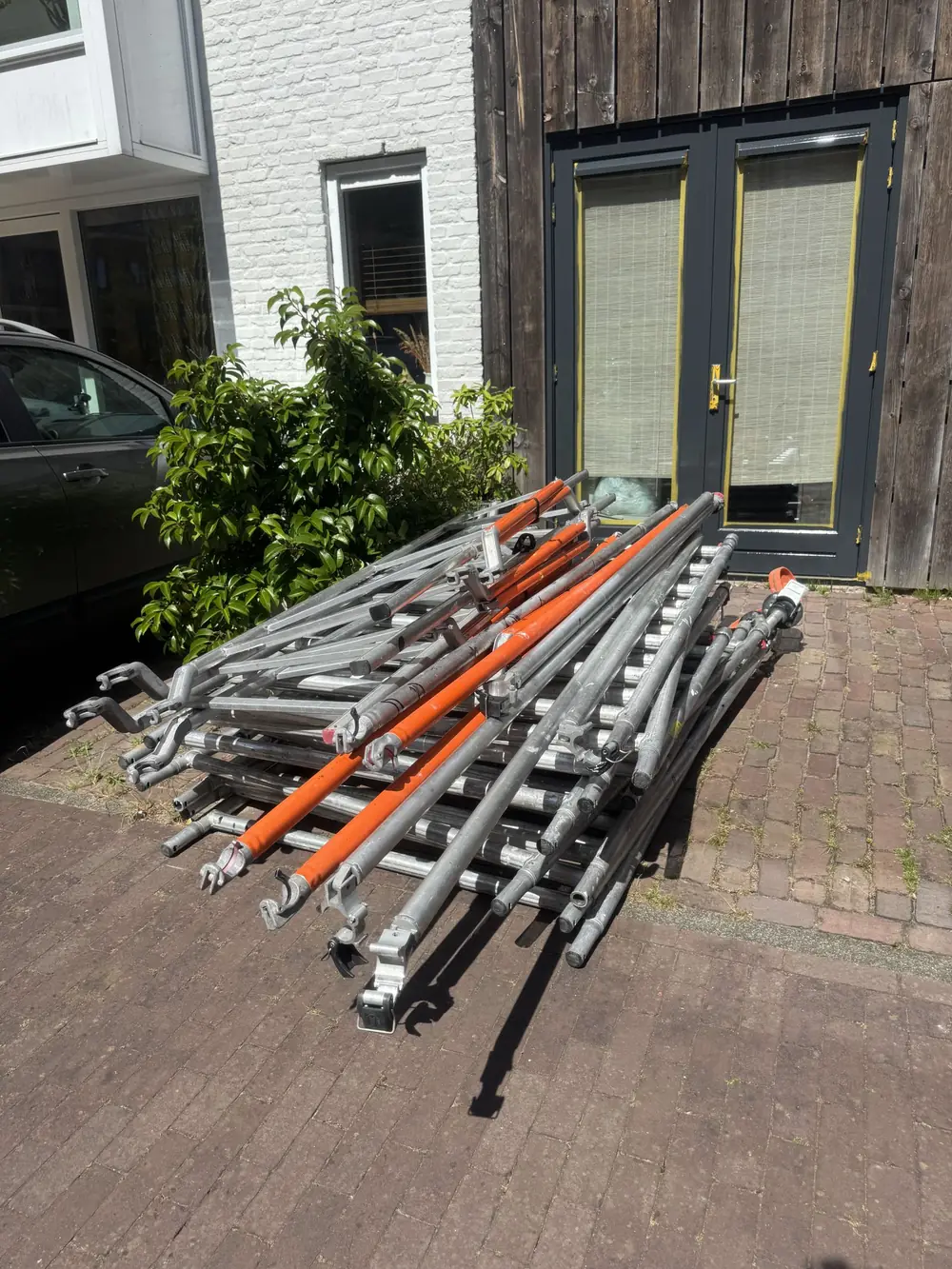
Frames of a hired scaffold left by the front wall, the parts that stay with you through every hire day

The way the rate is built up helps here. Over the first 24 hours you pay the full amount; every hire day you stick behind that carries 95 per cent off, so a waiting day between two coats hardly registers. Book too tight and a half finished roof edge is left standing while the collection day has already arrived. Set your end date well past the day the topcoat has to go on. What a long job means for planning is in this explanation of hire days.

Which mobile scaffold suits painting fascia boards?

Kamersteiger RS44
  • Working height up to 4 metres
  • Compact and narrow
  • Great for indoor and small jobs
View and calculate →
Smalle rolsteiger RS51
  • Working height up to 14.2 metres
  • Narrow (75 cm)
  • Ideal for narrow passages
View and calculate →
Most chosen
Brede rolsteiger RS52
  • Working height up to 14.2 metres
  • Wide platform (135 cm)
  • Extra stability and workspace
View and calculate →
1-persoons steiger MiTower
  • Working height up to 6.2 metres
  • Very compact
  • Quick and easy to assemble
View and calculate →

Painting fascia boards per 245 cm scaffold deck, round after round

Per standing position you treat a stretch of roof edge of 245 cm, the length of your deck. That sounds little for a roof of twelve metres, but it is exactly the distance you bridge left to right without stretching. Finish that stretch completely in one go: the end joint first, then the underside you never see from the ground, then the face. Stop halfway along a board and the next round starts with a lap mark in the middle of the timber.

Always put your transition on a joint between two boards or on a corner piece. Then the place where one setup stops coincides with a line that was there anyway, and after three coats you still see nothing. Within a setup you work from top to bottom, so drips land on untreated timber and not on a coat that has just gone on. If the same visit also covers painting the gutter with a brush, do that setup by setup.

Mobile scaffold close against a wall with a deck of 245 cm, the stretch of roof edge treated per setup

Before you shift along, take everything off the deck. Close the tin, lift roller and brushes off the guard rail and carry them down before you move the tower. That feels laborious for a move of two metres, but a toppled tin of opaque paint on the block paving costs you half a day. Take up only what that particular round uses, too: the primer round needs no topcoat, and on the last round the abrasive paper can stay below.

Hire a mobile scaffold with delivery, build and collection

What arrives is not an assembled tower but a stack of parts counted out beforehand. Decide in advance where that stack may lie, because the strip along the wall you would rather keep free for your painting kit. The drive, a corner of the front garden or the piece of pavement you are not using all do the job. Put the booking through before 15:00 on a working day and everything is there the day after, provided that is a working day as well.

Which day it turns up and which day it goes back are yours to name, and with paintwork you hang that choice on the forecast. Find a dry, not too cold day for putting it up, and you can carry straight on with sanding and dusting. Raising it is your part of the job: two people spend a half day on it, manual and instruction video propped up nearby. Count that half day in, because little paint reaches the timber then.

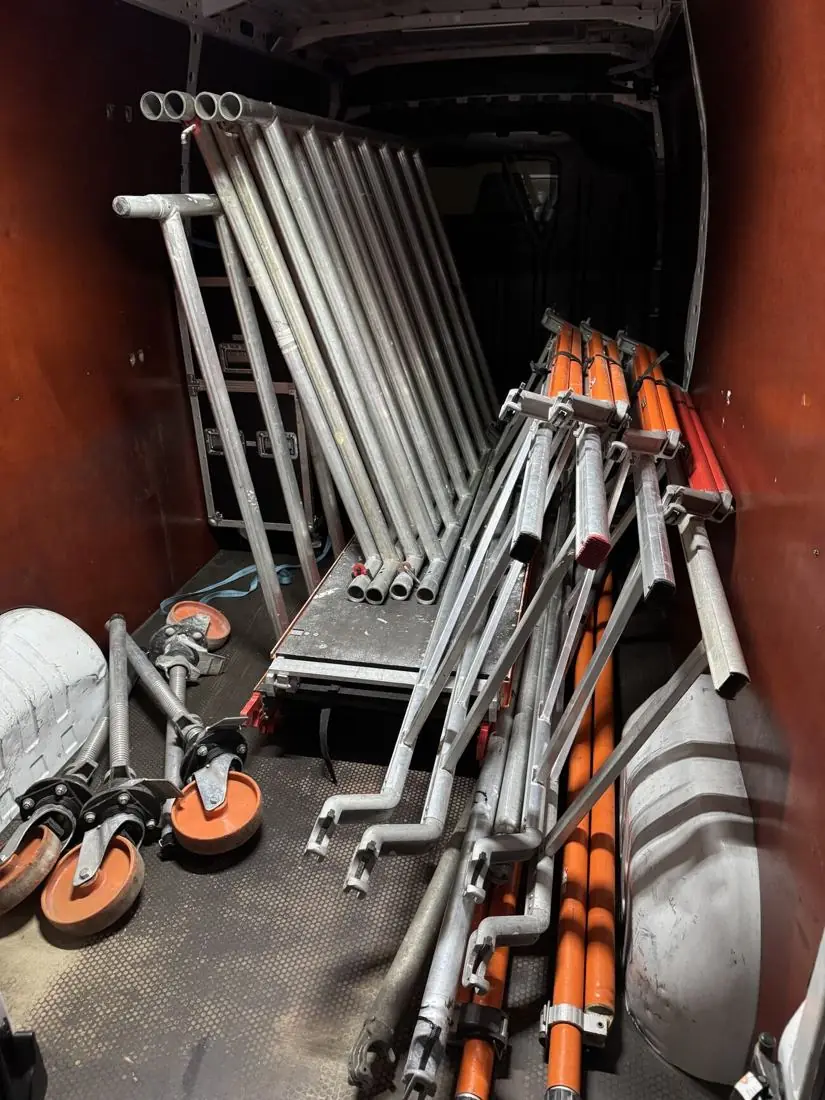
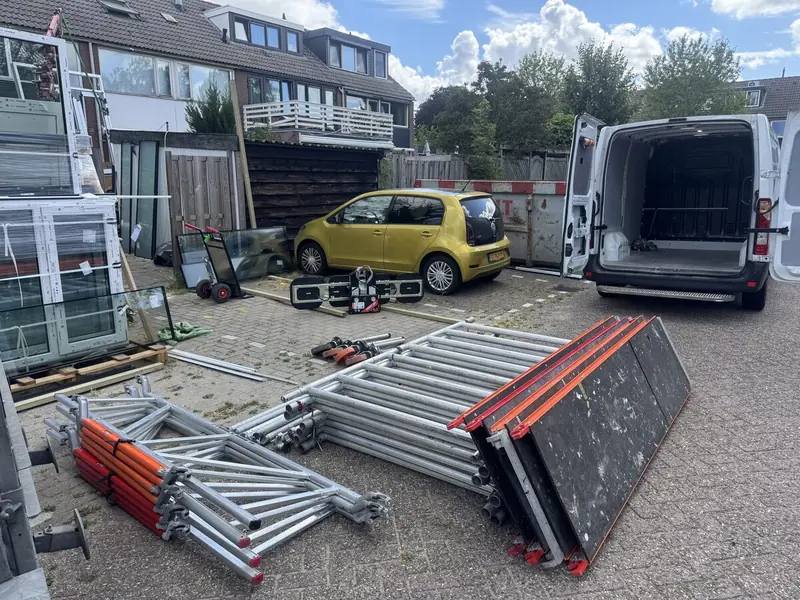
Scaffold parts counted and bundled ready for transport, the way the hired set arrives and goes back again

On the agreed date we come to collect the mobile scaffold. Taking it apart and stacking it is yours to do, somewhere reachable from the road. Only start on that once the topcoat feels genuinely hard, otherwise you press fresh paint against the tubes while you are carrying. Count the parts as you dismantle and you know the set is right before it goes on transport. What delivery and collection come to in your province is in the overview of delivery charges.

Safe painting at height on the scaffold along your fascia boards

You stand on a working deck rated at two hundred kilos per square metre, which the EN 1004 standard calls load class 3, and with coats in rounds you creep closer to that than you would think. Two people, a full tin of opaque paint, a bucket with brushes and water and a box of sanding kit all add up. Do not put the heavy items in one and the same corner either. How that class is laid down is in the article on the standard for mobile scaffolds.

The fixed rules apply again every round, even when you shift the tower a metre for the tenth time. Brake all the wheels before you put a foot on the ladder, never leave anyone or anything on the deck while you move along, and come down as soon as it starts to blow hard. Wind is doubly awkward with opaque paint, because it drives dust and seed into a wet coat that will never come smooth again.

Assembled mobile scaffold in a side passage, its stabilisers reaching out well beyond the 75 cm build width

What actually goes wrong with this paintwork happens on your own deck. After three rounds a film of spatter has built up that you slip on, so lay cardboard down and change it as soon as it shines. Keep the zone under the roof edge clear as well, because a brush you let go of at ten metres arrives below at some speed. Tell the household not to walk underneath. The rest of the rules sit at working safely at height.

In 5 steps

How hiring a mobile scaffold works

1
Choose working height

Pick the height that suits your job.

2
Book online

Sorted in 60 seconds, price shown instantly.

3
We deliver

At the agreed spot the next working day.

4
Assemble safely

Assembled by you, with a manual.

5
We collect

One call and we collect the scaffold.

Good to know

Practical tips for painting fascia boards

1

Number your standing positions in chalk on the paving before you put on the first coat. In rounds two and three you drive the tower to exactly the same spot and every transition falls on the same joint again.

2

Sand and dust a whole board during the previous round, not just before you put the brush in. Sanding dust that lands in a wet covering coat only comes out again by rubbing the whole board back.

3

Stand your tin on a sheet of hardboard or in a tray with a raised rim. A tin that tips off a smooth plank while you are shifting along costs you more time than all the transitions put together.

4

Begin every round on the side that stays in shade longest. You then reach the sunny elevation once the wall there has warmed up, instead of working against morning damp sitting in the timber.

5

Write down for each position which coat is already on. With a roof of eight setups and three coats you lose track of where you were after one wet day, and end up painting a board twice.

6

In the final round look at the top edge from the ground through binoculars. What you cannot see from your own deck is exactly the band where rainwater later works its way into the timber first.

Frequently asked questions

Frequently asked questions about painting fascia boards

Which mobile scaffold should I hire for painting fascia boards?+

Take the wide RS52 with its deck of 135 cm. With opaque paint an open tin stands next to you, plus a roller, brushes and sanding kit, and you do not want to be shoving that aside all day. If the only way to the roof edge is through a narrow gate or a path round the back, there is little else for it than the 75 cm version and less working room. Measure that opening before you hire a mobile scaffold.

How does hiring a scaffold work for paintwork done in coats?+

Booking goes online: you pick a model, a working height, a delivery day and a collection day, at a fixed price including VAT. The parts come to your address, you raise the tower yourself and drive it past the numbered positions while you paint. At the end it comes apart again and stands ready complete. Because you work in rounds, the only date that is genuinely fixed is the day the topcoat goes on.

How many days should I hire a mobile scaffold for three coats?+

For a terraced house with timber on two sides you come out at four to six hire days. Each round takes about a day, and there are two or three of them, with drying time in between during which the tower stays exactly where it is. If the timber runs round every elevation of a detached house, reckon on six to eight days. Better one day extra than stopping halfway through a coat because the van is at the door.

What does it cost to hire, and what decides that amount?+

The figure follows from the scaffold model and the height you book, with bringing and fetching on top at a fixed rate per province. The full rental price including VAT sits on the page with rates. For fascia boards it pays to compare the wide and the narrow deck at the same height before you decide, because the difference in working room over three rounds counts for more than the difference on your booking.

What working height should I hire for fascia boards along the roof edge?+

With two or three storeys you are right with 8 to 12 metres of working height, and that is therefore the scaffold height you hire. Measure from the level where the wheels come to stand up to the top of the fascia board, so to where the timber closes against the roof and not to the gutter in front of it. If an overhang projects above it, count its depth in as well. Each height shows its matching build on the page with working heights.

Can I choose between delivery and fetching the hired set myself?+

You may do either, and both are used on this job. With delivery the set is ready on the date you name and goes back after the last coat has hardened, at a fixed price per province covering both journeys. Prefer to fetch it, and that is free by appointment at Zeeburgerpad in Amsterdam, as long as your trailer swallows a complete set. For painting spread over several days, most people would sooner have the mobile scaffold brought to them.

Do you put the mobile scaffold up, or is that not part of the hire?+

Building it is yours to do. We drop off the parts and you raise the tower with the manual and the instruction video beside you, preferably with two of you. Moving between your standing positions and dismantling on the last day belong to that as well. We supply no facade scaffolding, no system scaffolding and no cherry pickers. For timber along a roof edge at this height the mobile tower is the obvious route.

Can I hire for longer if the last coat does not get finished?+

Let us know about an overrun as soon as you see it coming, and the collection day for the mobile scaffold moves with it, as long as the set is not already down for the next hirer. With work in coats it runs over more often than with a single pass, because one wet afternoon shifts an entire round. To stay ahead of that, book a spare day when you reserve: handing back early is fine too.

How much clear space does each standing position round the house need?+

Take the width of the setup, add the spread of the stabilisers on all sides and keep a walkway beside it where you can pass with a tin in your hand. On this job that applies to every spot round the roof, not only to the first. So walk the route before you have the scaffold brought out, and move bikes, planters and a water butt aside now. That saves shuffling in every round.

Are my hire days wasted if the weather turns?+

No, the tower may stay up; only the painting shifts. Opaque paint on wet or cold timber bonds poorly and dries out chalky, and those hours you never get back. Spend such a day sanding, dusting or making good the sealant lines and put your coat on the next morning. Because you decide yourself how long the hired scaffold stands there, that shift usually costs you no more than a single extra day.

What should I watch out for with the deposit when hiring?+

A deposit is settled when you reserve. Once the scaffold set has come back and been counted through as complete, that money is with you again inside one working day. With covering paint two things matter: are all the parts there, and are there no dried spatters left on deck boards and tubes. A sheet of cardboard under your tin saves an hour of scrubbing on the last day. More on that in this explanation of the deposit.

May the hired mobile scaffold stay up while a coat cures?+

Yes, and that is why fascia boards are reckoned in hire days rather than in working hours. You leave the tower on its marked spot, wheels braked and stabilisers out, while the previous coat hardens. Do take the tin and the loose brushes off the deck when you stop for the day, certainly with wind forecast. The next morning you step back on in the same place, without measuring anything out again.

Hire a mobile scaffold for painting fascia boards today?

Calculate your rental price now or ask for free advice.

Rolsteiger van SteigerTaxi geleverd op locatie
Book it online

Your scaffold sorted in 2 minutes.

Choose your scaffold and working height, see the price instantly and book online.