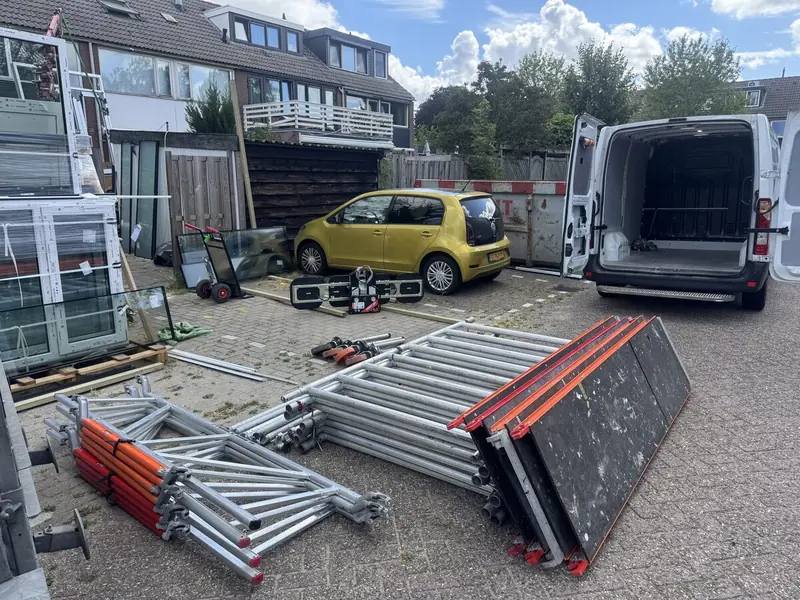

Knowledge base · reading time 12 min
Fall protection on a mobile scaffold
Fall protection on a mobile scaffold is not a separate accessory but a set of parts that together keep you and your tools from going over the edge. Guardrails, toe boards, a closed hatch and a stable set-up each do their own job. Below you will find them one by one, with the order in which you fit them and the mistakes most often made in practice.
- Fall protection on a mobile scaffold: guardrails, toe boards, the platform hatch, safe climbing and the stability underneath it all.
- Guardrails around the working level, toe boards on all four sides and platforms with a hatch.
- Yes.
- A correctly assembled mobile scaffold protects you with guardrails and toe boards all round, so you work inside an enclosed area.
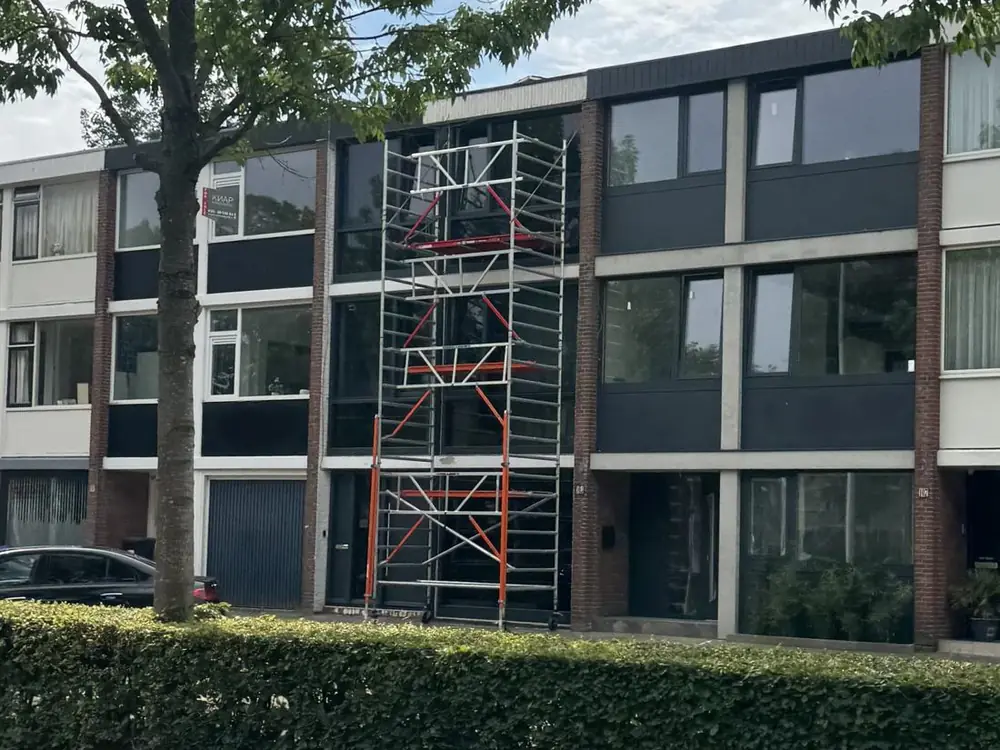
Where the fall risk on a mobile scaffold comes from
A mobile scaffold is safer than a ladder because you stand on a flat platform instead of on a rung. That does not mean there are no risks, but it does mean they sit at a few recognisable moments. Falls almost always happen while climbing, while coming through the hatch, while reaching out beyond the guardrail, or because the tower itself moves while someone is standing on it.
Then there is the danger of falling objects. A hammer or a tin of paint dropping from a platform at eight metres arrives with real force, and on facade work someone is often standing right beside the tower. Toe boards exist for exactly that, along with the habit of never leaving anything loose on the edge. So on work above a pavement or a driveway, cordon off the area under the tower with tape or cones.
The third category is assembly errors. A missing diagonal brace, a platform without a hatch or a stabiliser that was never extended make the tower unsafe without being obvious from the outside. That is why the checks during assembly count as fall protection just as much as the guardrail itself. The full assembly step by step runs through those points in order.
Key facts
| Feature | Value |
|---|---|
| Core answer | Guardrails and toe boards are the fall protection; always climb on the inside |
| Standard | EN 1004 |
| Load class | Class 3: 200 kg per m² |
| Castors | Swivel castors with brakes, locked while in use |
| Wind | Work up to wind force 6 |
Guardrails all around the working level
The guardrails are the first and most important layer of your fall protection. They belong all around the working level, so on all four sides, including the side facing the building. That is exactly where people assume it is unnecessary because the wall is there, while the gap between tower and facade stays wide enough to step through. They come as standard with our mobile scaffolds.
Fit them before you work on that level, not after. The order in the assembly instruction is built around that: you fit the rails from the level below or from a protected position on the platform, so you never stand unprotected on an open floor. It takes a few extra actions, but this is the moment where the difference is made.
Never stand on a guardrail to gain that last half metre. A guardrail is designed to take sideways force, not to carry a person. If the assembled height falls just short of your work point, add a level or move the tower. How to calculate the height you need beforehand is set out in how high a mobile scaffold can be.
Toe boards keep tools on the platform
Toe boards are the upstands you fit around the platform. They catch whatever rolls or gets kicked across the floor: screws, brushes, a roll of tape, a tube of sealant. Without them such items disappear over the edge at the first movement, and there is often someone below who never sees it coming. That is also why you cordon off the area under the tower on facade work.
Fit them on all four sides, just like the guardrails, and check that they meet at the corners. A ten centimetre gap in a corner is exactly wide enough for the tool you use most often. Toe boards belong to the standard equipment of the scaffold, so if one stayed behind in the van, fetch it before you start. If a board will not sit flush, check whether the platform under it is properly locked in.
Put heavy materials in the middle of the platform rather than against the toe board. That not only helps against knocking things over, it keeps the load where it belongs. Load class 3 allows 200 kilos per square metre, and that allowance is best used spread out evenly. More on that is in loading and weight. On painting a facade that means the bucket in the middle of the floor, not on the edge beside you.
The platform hatch belongs closed
The platform has a hatch through which you reach the working level. That is the safe way up, but it is also a hole in the floor as long as it stands open. Climb through, stand on the platform and close the hatch straight behind you. After that you walk on a closed floor and can turn round without thinking about it.
In practice the hatch often stays open because someone else is coming up or materials have to pass through. Agree then that whoever comes up last closes it, and never wedge anything in the opening to hold it open. A hatch folded back against a guardrail can also drop shut at a moment you are not expecting it. Materials go up in a bucket instead, which keeps the opening free.
If several of you are working on the tower, keep sight of each other while climbing through. Call out before you open the hatch, so nobody is walking across it. That sounds excessive on an hour long job, but it is precisely on those short jobs that habits slip. Agree as well who comes down first if the weather turns.
Climb on the inside, using the rungs
Always climb up inside the tower, using the rungs in the frames, and never on the outside. On the inside your weight stays within the base and the structure works with you. On the outside you pull the tower towards you, exactly the direction it can tip in. That holds for the last metre too, and for a climb that only takes a moment.
Use both hands and climb empty handed. Tools do not travel on the rungs, they go up in a bucket on a rope or you put them up there beforehand. Wet aluminium is slippery, so wipe your soles before you start and take your time in rain or frost. Hiring a scaffold in winter covers what frost does to a platform. Go over the difference with a ladder again in ladder or mobile scaffold.
On higher set-ups you climb in stages using the intermediate platforms. Close each hatch behind you and use the level below as a resting point instead of going up in one go. That way of working costs half a minute extra and keeps you inside a protected space at every moment. On a ten metre set-up that soon means four or five stages.
A complete, flat platform without gaps
The floor you stand on has to be fully closed. A platform lying askew, not clicked in place or half hanging over a frame is the most underestimated cause of a misstep. Check during assembly that every platform rests on its brackets and that the lock is engaged, including intermediate platforms you only use to climb through. Look under the platform too, to see that the lock really engages over the bracket.
Keep the platform clear enough to move on as well. Cables, hoses and paint rollers spread across the floor are a trip hazard in exactly the place where you cannot step aside. Work with a bucket or a crate for loose items, and take everything down at the end of the day. That also saves damage if the wind gets up. If you work indoors on a room scaffold, exactly the same applies to the floor you stand on.
Stability is the basis under all fall protection
Guardrails and toe boards only do their work if the tower itself stays put. Stability starts with the wheel brakes and ground that carries the load, and runs through levelling and diagonal braces to the stabilisers that widen the base. Each of those steps is in the assembly instruction that comes with the scaffold under EN 1004. That order is not optional, because every step holds the next one up.
Run through the points below before the first person climbs up, and repeat them after every move. It is a two minute round in which you walk once around the tower and look up. What exactly you check is also covered in stabilising and tying in and in the hire checklist. Do the round together with whoever climbs up first, so someone with a stake in it is watching.
- All wheel brakes are on and the spindles are locked
- The tower stands level, checked in both directions
- All four stabilisers are extended and touching the ground
- Diagonal and horizontal braces are on every level
- Guardrails and toe boards are all around the working level
- The ground is flat and load bearing, with base pads where needed
Wind and tying in to the facade
Wind is the force that sets an assembled tower moving soonest, and the effect grows with height. For work along a facade you therefore secure the tower to the building above a certain height. Such a tie takes the sideways force, so the tower cannot start moving while you are working on top of it. Where the tie points go and how many you need depends on the facade and on the height.
If the wind picks up during the job, stop working, clear the platform and come down. If it keeps blowing, dismantle to a lower level. Take sheeting and covers right off in that case, because they enlarge the area the wind can grip. Never leave the scaffold standing with materials on it at the end of the day. Materials standing at the foot of the tower are secured or laid flat as well.
Which part covers which risk
The table below sets each part against the risk it covers and the moment you fit it. Useful if several of you are assembling and want to agree who does what, or if you want to check afterwards that nothing was skipped. Use it as well when you pick a job back up after a few days and want to know whether everything is still in place. Work down the rows while you assemble.
All the parts named come as standard with the scaffold you hire and are included in the delivery. If something is missing, you stop building until it has been made up. What to check on delivery is listed in the hire checklist. On delivery, sort the parts by type so that a missing guardrail, toe board or brace shows up at a glance.
| Part | What it prevents | When you fit it |
|---|---|---|
| Guardrails all round | Falling from the working level | Before you work on that level |
| Toe boards | Falling tools and materials | Together with the guardrails |
| Platform hatch | Falling through the floor opening | Close it right after climbing through |
| Diagonal braces | Distortion and racking of the tower | On every level while stacking |
| Stabilisers | Tipping of a slim tower | From the height the instruction states |
| Wheel brakes | Rolling away during the work | As soon as the tower is in position |
| Ties to the facade | Movement from wind on high work | Before working on the top level |
Getting tools and materials up safely
Anything you carry while climbing costs you a hand and your balance. So use a bucket on a rope, or pass items up from the level below if there are two of you. Heavy items such as roof tiles, paint tins or tool cases certainly do not travel up the rungs with you. Working alone, hang the bucket on a hook within reach of the hatch.
Take up only what you need that day and spread it across the platform. Material standing against the guardrail can go over it at the first knock, and material in a corner puts unnecessary weight on a small area. Put loose parts in a tray, even if it is only a handful of screws. Whatever you no longer need that day goes back down at the end of the afternoon.
Run cables and hoses down the outside and secure them, rather than hanging them loose over the edge. That keeps them out of the way while climbing and stops you pulling something over from the other side of the platform. For work above a pavement or a driveway, cordon off the area underneath as well. Check the run again after you move the tower, because a taut hose pulls at the frame. Per job, applications sets out what to watch for in that respect.
Checking before, during and after a move
The fall protection you fitted during assembly only holds if the scaffold does not change. Every move and every change of height is a moment to check again. You move with an empty platform, nobody on it, and always by pushing at the bottom of the frames. Adding a level or taking a platform out counts as a change too.
After moving, run through the list below before anyone climbs up again. It is the same round as after the first assembly, only shorter because the tower is already standing. In practice this is the moment where stabilisers stay where they were and wheel brakes never go back on. Take the time for it, because a three metre move costs less time than the consequences of a fall.
- Platform empty and nobody on the tower before you push
- Clear the route of thresholds, cables and manhole rims first
- Re-level the tower on arrival and lock the spindles
- Brakes back on and stabilisers extended again
- Check guardrails, toe boards and hatch before climbing
Missing or damaged parts, and where to turn
If during assembly you come across a part that is missing, cracked or will not close properly, stop building and do not substitute something from the shed. Our equipment is made by Altrex and built to EN 1004, and that only holds as long as the parts belong together. A borrowed board or a tube from another set undermines that basis.
Report it straight away and we will sort it out. Call or email through contact, or send a photo of the part via WhatsApp, so we can see immediately what it concerns. That works faster than improvising and it stops you discovering halfway through the job that the scaffold cannot be made complete. Give the model, the height and the address of the job, so what is needed is clear immediately.
If you are unsure whether your assembly is right, send a photo of the standing tower. We will look at the braces, the stabilisers and the working level. To read on, the knowledge base is at knowledge base, for instance working safely at height, and the practical questions are on frequently asked questions. Before your next job, look at the options on hiring a mobile scaffold as well, since the model determines which parts you receive.
Frequently asked questions
Which fall protection comes as standard with a mobile scaffold?
Guardrails around the working level, toe boards on all four sides and platforms with a hatch. Those parts are included in the delivery and belong to the assembly as the instruction prescribes. Stabilisers and wheel brakes form the basis underneath.
Do I need a guardrail on the building side as well?
Yes. The gap between the tower and the facade is usually wide enough to step through, so that side is not left open. If you stand so close to the wall that it will not fit, move the tower rather than leaving the rail off.
Do I need a harness on a mobile scaffold?
A correctly assembled mobile scaffold protects you with guardrails and toe boards all round, so you work inside an enclosed area. Make sure that assembly is complete before you climb, because that is the protection the system is designed around.
May I stay on the scaffold while it is being moved?
No, never. The platform must be empty, with no people, tools or loose parts on it, and you push from the bottom of the frames. After moving, put the brakes on and level the tower again before anyone climbs.
What do I do if a toe board is missing?
Stop building and have the part made up before you start work. Do not use a plank you cut yourself as a substitute, because the parts belong together. Report it to us and we will arrange a replacement.
How do I stop tools falling to the ground?
Fit the toe boards all round, put materials in the middle of the platform rather than against the edge, and use a tray for loose screws and small parts. Hoist items up in a bucket on a rope instead of carrying them on the rungs.
When do I stop working because of wind?
As soon as you feel the tower move or find it hard to keep your balance. Clear the platform, come down and dismantle to a lower level if it keeps blowing. Take sheeting and covers right off in that case.