
See your price
Application

Painting a front facade? Choose the right scaffold.

Painting a front facade is work done on the street side, and that mostly changes the question of where your tower may stand. The setup lands on the footway or in a parking bay, with pedestrians and cyclists underneath and a council that has a view on it. For a frontage of three storeys the wide RS52 is the model, put up to a reach that lands somewhere between eight and twelve metres. Below you will read what the street asks for in room, which notification you arrange, and how many rental days you fix.

  • Order before 3 pm, delivered tomorrow
  • Professional Altrex scaffolds
  • Up to 14.2 metres working height
  • Easy to assemble yourself
4,2 tot 14,2 mWorking heights available
12Provinces served
7Days a week
200 kg/m²Load class 3
In short
  • For painting a front facade we recommend the Wide mobile scaffold.
  • On the street side you pick the RS52: a deck 135 cm wide, built to a reach somewhere between eight and twelve metres.
  • With your tower on the footway or in a parking bay, tell the council first and leave a walking route free.
  • Agree with the neighbours where your colour stops, because in a terrace the brickwork simply runs on without a break.
  • First 24 hours from €175 incl. VAT and delivery; every day after that 95% off.
Key facts for this job
FeatureValue
Recommended scaffoldWide mobile scaffold (Altrex RS TOWER 52)
Working height for this job8 to 12 metres
Available working heights4.2 to 14.2 metres
StandardEN 1004, load class 3 (200 kg per m²)
DeliveryOrdered before 3 pm, delivered next working day
Each extra day95% off, from €8.75 a day
Why a mobile scaffold for painting a front facade?

Safe, stable and professional work at height

The front is the one elevation you share with the whole street. The ground under your tower is public, the people walking beneath it are not yours, and the colour you put on stops at a neighbour who has an opinion of his own about it. On top of that, nowhere does more air move along a house than at the front, where nothing breaks the gust that shoots between two blocks. So anyone who hires a scaffold for painting a front facade watches more than height alone: the place in the street, what the council counter asks for, and the days on which it is calm enough outside to lay paint on at all.

  • Public ground beneath tower and stabilisers alike
  • Council notification or permit arranged in advance
  • Colour boundary that matches the neighbouring frontage
  • Wind and paint mist above a public footway
Read more about working safely →

Hiring the wide RS52 for painting a front facade

At the front of a house you seldom work on an empty surface. There is a bay below, a canopy over the door, frames with glazing bars and a downpipe that has to go along in the colour. That is why painting a front facade points at the RS52, whose deck measures 135 cm. On that width a paint kettle, a roller tray and your abrasives stand side by side and you can still get past them, even with somebody working the same stretch of wall beside you.

The usual objection to a wide model is getting it through, and that objection does not apply here. The van stops at the kerb, you carry the components from the pavement edge across to the wall, and nowhere do you have to manoeuvre through a gate or past a shed. Only at a house on an alley, or with a tree planted hard in front of the frontage, would you still take the 75 cm version. Everything else we hire out is gathered on the page about hiring a mobile scaffold.
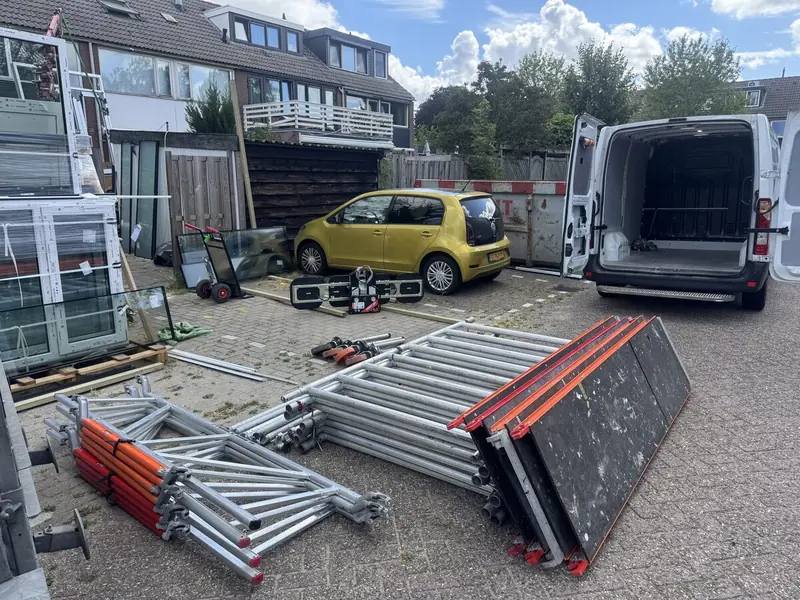
Scaffold frames, wide platform decks and guardrail tubes spread out on a driveway next to a parked car

The room scaffold and the one person MiTower both drop out for this job. The first is meant for indoor work and reaches no further than about four metres, the second stops well below the eaves of a building with three floors of living space. The front is also where somebody stands on the pavement asking questions while you are up top, and a generous deck with a second pair of hands then works more pleasantly than a little tower for you alone. Compare the dimensions of each model before you book.
Working height to hire when the frontage runs three storeys

The highest point when painting a front facade is almost never the top window sill. There is a gutter fascia above it, often a band of brickwork above that, and on an older building a moulding or a gable top with a hoisting beam. Measure to the edge that still gets paint and not to where the roof tiles begin. With three storeys of frontage the reach you need therefore climbs to somewhere between 8 and 12 metres, and that figure goes on your booking.

Count back from the top to know which build belongs with it. The deck you stand on ends up roughly two metres under whatever your outstretched hand can still touch, so subtract that reach from your working height and the platform height is what remains. Measure from the street level where the castors land, not from your own threshold: a footway that drains towards the gutter of the carriageway soon costs half a metre. The page on a reach of 12 metres shows what such a build looks like.

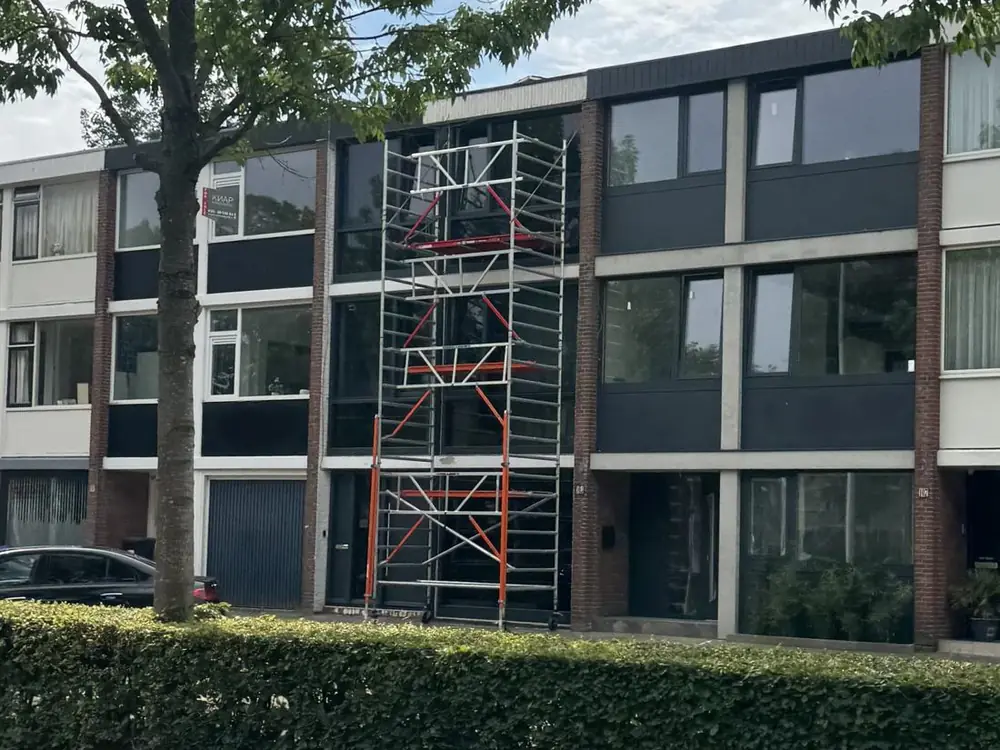
Tall mobile scaffold standing against the street front of a three storey terrace, its decks reaching above the top windows

Hiring too little height only shows up on the last strip under the gutter. You end up rolling with your arms above your head, the coat goes on unevenly and paint runs back down your sleeve. Worse still: that strip is not something you touch in later from the pavement, because you have to add a deck on top and level the whole setup afresh. Caught between two sizes on a frontage of three floors, take the roomier of the two.

Hiring a scaffold that stands on the public footway

The ground in front of your house belongs to the council, and that is where painting a front facade begins. Put the tower on the pavement and you are expected to report that it is there, and sometimes you need a permit; put it in a parking bay and that bay has to be kept free, which you arrange with an application and usually with signs a few days ahead. Every council does this slightly differently, so ring before you fix a date.

Then look at what is in the way. In front of a frontage two square metres are seldom simply free: there is a lamp post, a waste container, a cycle stand, a thirty centimetre strip of pavement garden or a car that comes back every evening. The stabilisers splay out of the base and it is exactly those points that need clear slabs beneath them. So measure the strip between wall and kerb before you order, and always leave enough for somebody with a pushchair.

Base of a mobile scaffold with its stabiliser legs folded out across block paving, each foot resting on clear slabs

On the street side the ground itself is usually the smallest problem, though that is far from true everywhere. Pavement slabs sit askew around tree roots, a drive slopes towards the carriageway and alongside some buildings runs a band of gravel in which a castor sinks. Make sure all four castors are bearing and that nothing gives before the first tin goes open, because a tower that settles on one point only shows it once you stand on the deck. A sloping or uneven spot is dealt with at setting up on uneven ground.

How many days to hire for painting a front facade

A front is less work than a whole house, but a great deal more than an afternoon. First the dirt comes off and you sand the loose patches back, then you prime everything that has come bare, after that you run along the sealant joints at the frames, and only then does the first coat get its turn. For a terraced house of three storeys three to five rental days is where you end up, and with a lot of timber in the frontage that figure climbs again.

Inside that run of days sit hours you simply cannot shorten. A coat has to dry through before the next may go over it, and on the street side the weather has a heavy say: a frontage on the north side holds its damp long after a wet night, while one facing south stands too hot at midday for you to keep up with a roller. So set your closing date on the day the work is certainly done, and not on the earliest day it could in theory be finished.

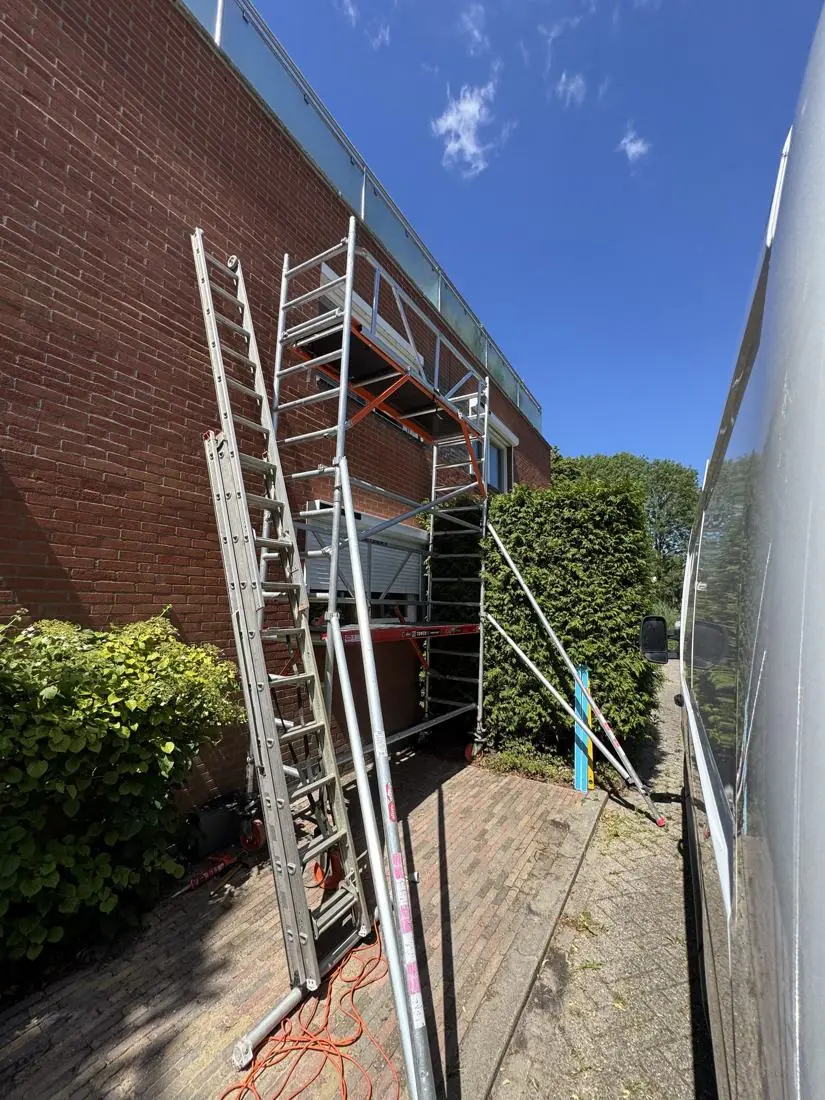
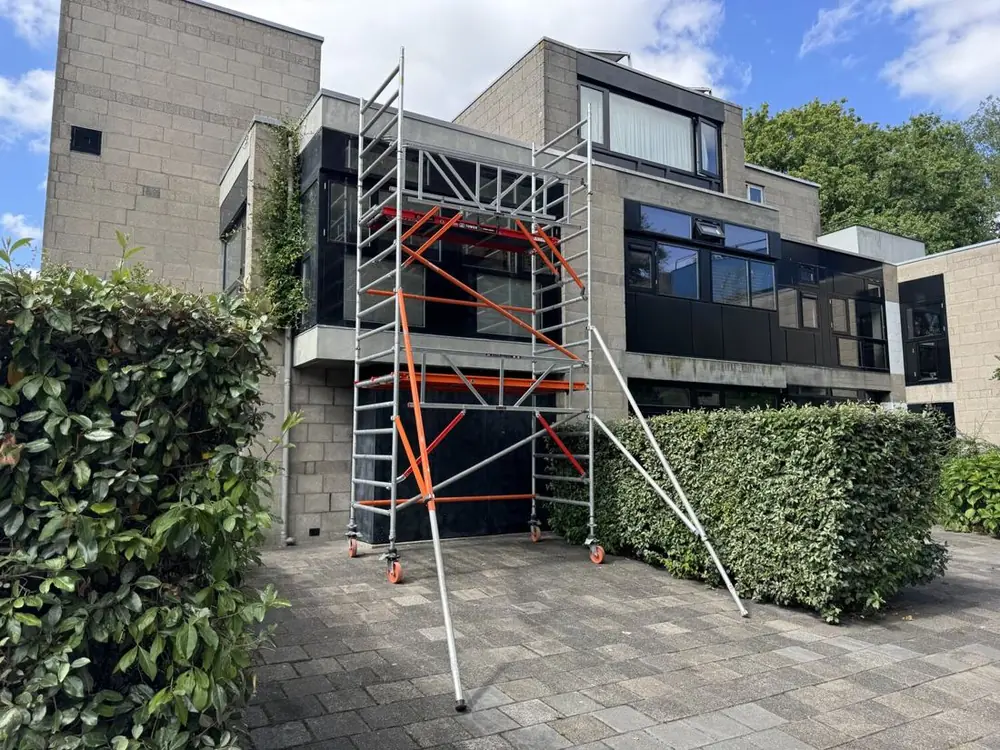
Erected tower squeezed into the gap between a brick building and a hedge, ladder sections propped against the wall

In the booking that works out less dear than it sounds. Only the opening period of twenty four hours counts for the whole amount; the days you add after it come in at ninety five per cent below that, so a little slack for rain or a late colour decision adds almost nothing. Booking sharply does cost you, because then you stand at a half finished frontage waiting for the van. What a realistic period is for this kind of work is explained at the number of days you fix.

Which mobile scaffold suits painting a front facade?

Kamersteiger RS44
  • Working height up to 4 metres
  • Compact and narrow
  • Great for indoor and small jobs
View and calculate →
Smalle rolsteiger RS51
  • Working height up to 14.2 metres
  • Narrow (75 cm)
  • Ideal for narrow passages
View and calculate →
Most chosen
Brede rolsteiger RS52
  • Working height up to 14.2 metres
  • Wide platform (135 cm)
  • Extra stability and workspace
View and calculate →
1-persoons steiger MiTower
  • Working height up to 6.2 metres
  • Very compact
  • Quick and easy to assemble
View and calculate →

Painting a front facade from each 245 cm standing place

Every standing place gives you a strip of 245 cm, because that is how long the platform is that you stand on. At an average terraced house that means two to three positions for the full width of the frontage, and you walk that series again at every coat. Finish a strip completely before you move along: the top metres first and then downwards, so that spatters and drips land on a surface you still have to work over anyway.

The colour boundary asks for attention here that you never need round the back. In a terrace the brickwork simply runs on and the division with the neighbours falls in the middle of a surface or just on a rendered edge. Agree before you start where your colour stops and mask that line if there is no natural joint in it. If your setup stands half in front of the building next door, a word about that belongs there too, well before the first parts land on the pavement.

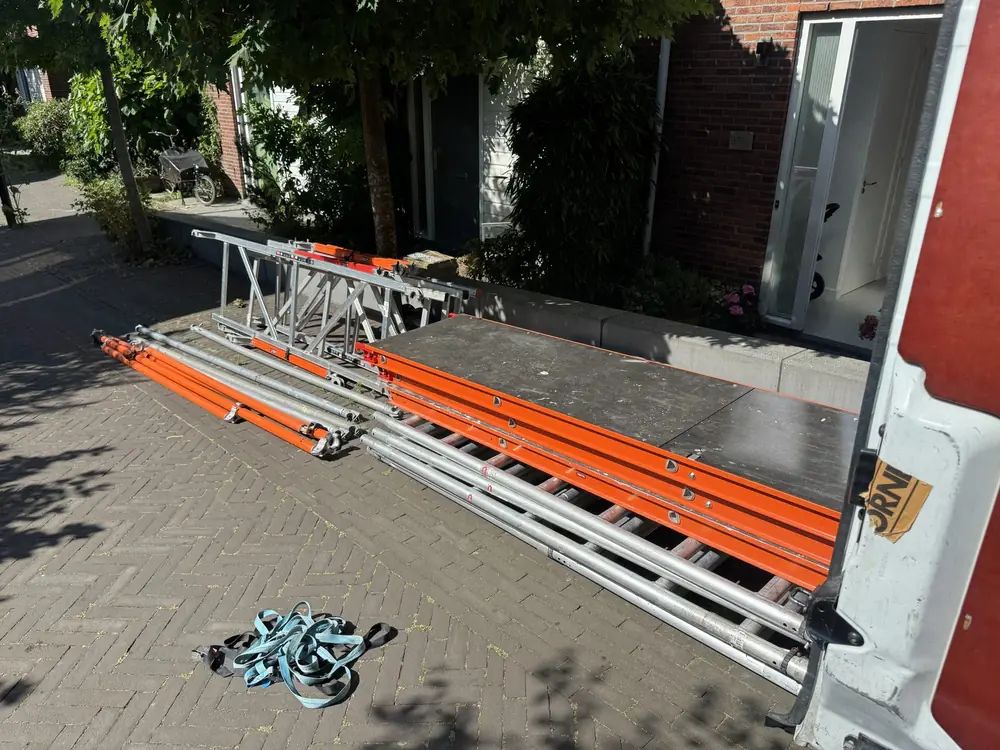
A full length platform deck and orange braces laid out on herringbone paving beside the open back of a delivery van

Moving along costs more time on the street side than you allow for beforehand. You take the buckets off the deck, fold the stabilisers in, check that nobody is cycling past right behind you and then set everything down firmly again. Three of those moves per coat and you have easily spent an hour. Take the window frames at the front along in the same round and the tower stands still for longer, so you get more out of every position.

Scaffold hire and delivery in a street parking bay

The set comes out of the van as loose, counted components, and those have to go somewhere. At the front that is often harder than round the back: you do not leave a stack of tubes on the pavement overnight, and in a parking bay it is in the way the moment somebody parks there anyway. So point out a spot in advance, in the front garden, in the hall or behind a gate, and make sure somebody is at home when the driver pulls up.

The delivery day and the collection day you pin yourself. An order that comes in on working days before 15:00 is with you the working day after. Rather have the set arrive a day before you want to start painting, so the building goes at your own pace and you begin cleaning down first thing the next morning. With two people that build takes a couple of hours. If your permit for that parking bay hangs on a fixed date, keep the delivery tight to it.

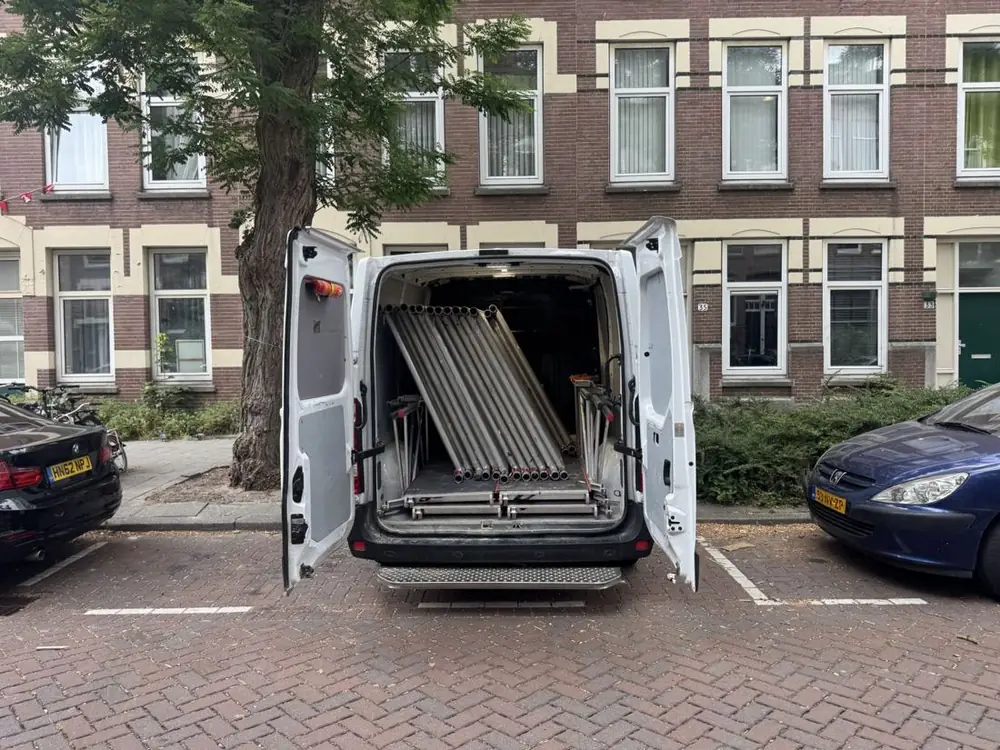
White van with its rear doors open in a street parking bay, stacked scaffold frames visible inside the load space

The collecting is ours, the dismantling is yours: at the end of your rental period you put the complete set ready. On the street side that means stacking the parts neatly against the wall rather than spreading them across the footway, because until the van is there everybody still walks past. Run through the count while you take it down and you know for certain that nothing has ended up in the hedge or under a car. The amount that belongs with your province you can read at the rates for bringing and fetching.

Working safely above a pavement the public still uses

Under a front there is somebody walking past all day, which makes falling tools the biggest risk when painting a front facade. A brush that comes down from eleven metres lands on a pavement where a child may just be standing. So leave nothing loose on the edge of the deck, hang your kettle on a hook inside the guardrail and close off the bottom metres with cones or tape as soon as you go up. Someone who walks round the barrier is safer than someone standing underneath to watch.

The tower itself answers to EN 1004, which places it in load class 3, so two hundred kilos is what one square metre of deck may carry. With two painters, a full bucket and a box of tools you stay comfortably below that, but do count it up once filler, primer and a jug of water go up as well. Brake the castors before you put your weight on the deck, and roll it not a metre while anybody is up top or anything is still lying there.

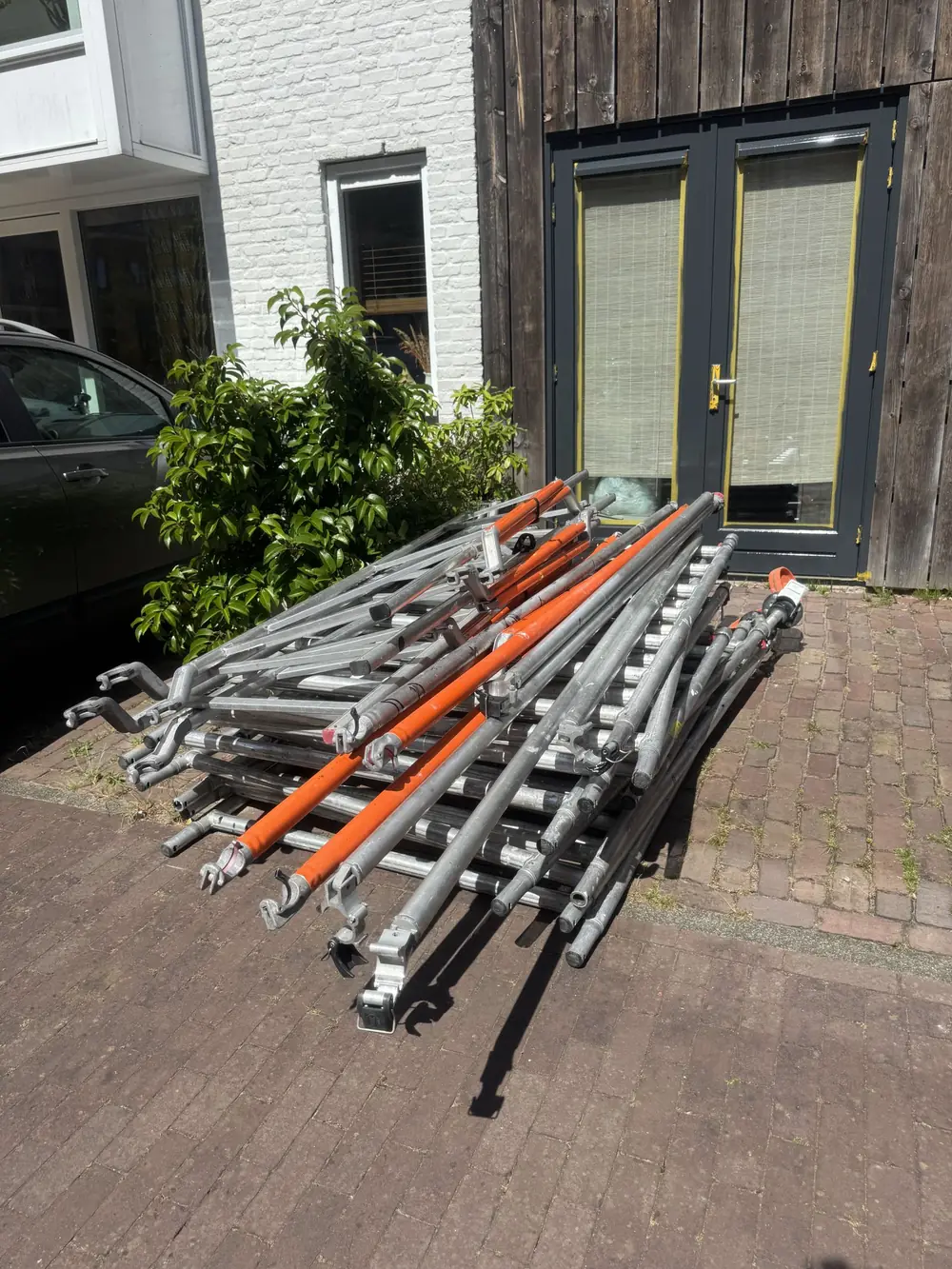
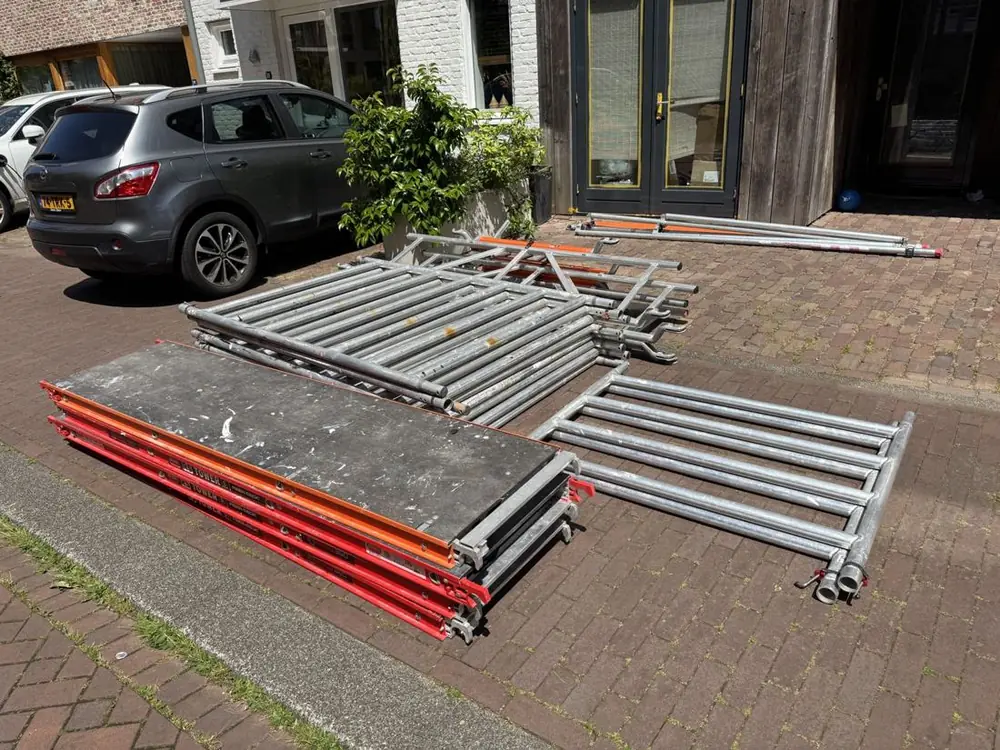
Loose scaffold tubes, frames and ladder sections stacked on paving directly in front of a house and its glazed doors

Wind is the second point of attention at the front. Between two blocks of housing there is often a draught you do not feel at ground level and do feel above, and then the mist off your roller carries into the street, towards parked cars and the windows opposite. Stop in hard wind, even if the wall is really dry enough to carry on with. The rest of what applies is set out in the explanation of working at height and the rules for it.

In 5 steps

How hiring a mobile scaffold works

1
Choose working height

Pick the height that suits your job.

2
Book online

Sorted in 60 seconds, price shown instantly.

3
We deliver

At the agreed spot the next working day.

4
Assemble safely

Assembled by you, with a manual.

5
We collect

One call and we collect the scaffold.

Good to know

Practical tips for painting a front facade

1

Ring the council before you choose a delivery date. What may stand on the pavement, and whether you may close off a parking bay, differs by town, and such an application sometimes takes a few working days.

2

Photograph the frontage from across the road before you start painting a front facade, and draw your standing places onto that picture. From below you cannot see which moulding above the top windows still wants a coat of paint.

3

Ask the neighbour with the car at the door whether it can stand somewhere else during your painting days. Paint mist on a polished bonnet calls for a conversation you would rather have beforehand.

4

Haul your paint and your tools up with a rope and a bucket. On a busy footway you would sooner climb with two hands on the ladder than with a tin between your fingers.

5

Start at the top on the side the sun is off. A frontage facing south dries away so fast in the afternoon that you cannot keep the wet edge and bands stay visible in the surface.

6

Plan the collection a day later than your final coat. Then you have a morning to dismantle, sweep the pavement and take the tape away again without walking into fresh paint.

Frequently asked questions

Frequently asked questions about painting a front facade

Which mobile scaffold do you hire for the front of a terraced house?+

For a frontage of three storeys you take the RS52, with 135 cm of deck under your feet. On the street side you need not pass through any gate or along a narrow path, so you can simply use that width, and you need it for a bucket, a roller tray and the sanding you do along the way. If the pavement is very narrow or a tree stands right in front, you hire the 75 cm tower instead.

How does hiring a scaffold for work on the street side actually go?+

Online you choose a model and the reach you need, fix your delivery day and your collection day and pay in advance, with VAT already worked into the rate. The complete set comes to your kerb, you build the mobile scaffold and paint your frontage, and on the last day everything stands taken apart ready for the van. Alongside that you arrange permission for the place in the street yourself, preferably before you hire anything at all.

How many days do you want the scaffold on hire for a front facade?+

Three to five days is a normal period for painting a front facade on a terraced house of three floors. Cleaning down and sanding fill the first day, then two coats follow with drying time between them, and finally you need a morning to take the tower apart again. With a lot of timber in the frontage, or with the window frames taken along in the same round, reckon on a week. On the street side the weather counts for more than round the back.

Hiring a tower for a frontage: what does it cost, and what changes from day two?+

The rental price follows from the model you choose and from how high you build the tower; bringing and fetching comes on top as a fixed amount per province, VAT included. All the rates sit together on the page with our prices. For this job what counts most is that the first day carries nearly all of the amount and that very little is added after it. One generous booking therefore lands better in the total than two short periods back to back.

What working height should I hire if the frontage runs up to the fascia?+

Measure to the topmost edge that still gets paint and add nothing further to it. With three storeys the answer lands between 8 and 12 metres, which is the reach you state when you hire the tower. Start measuring at the point where the castors will stand on the street, because a footway that falls away costs you half a metre. Which build belongs with it you will find on the page that sets out working heights.

Do you deliver the hired scaffold, or do most people collect it themselves?+

Both routes stay open here. If you hire a mobile scaffold with delivery both the arrival and the departure are dates you enter yourself, and the rate is fixed per province. Anyone who would rather drive is welcome to pick the set up at Zeeburgerpad 89, 1019 AD Amsterdam, by arrangement and at no cost, if car or trailer will hold it all. At a front most choose delivery, if only because the street holds no space for a trailer that day.

Does the tower arrive built up, or do you do that yourself after hiring?+

The latter. You get the mobile scaffold delivered in parts and stand it up yourself; a manual and an instruction video walk you through it step by step. Keep a couple of hours free in your schedule, because no paint goes on until the tower stands. Facade scaffolds, system scaffolds and cherry pickers are simply not part of what we hire out, so on a three storey frontage this is the equipment you work with.

Can you hire for longer if painting the front facade overruns?+

Let us know and the collection day moves back, unless that set is already booked in with the next customer. At a front it overruns more often than planned, because you are dealing with rain, with wind and with a wall that will not dry through. So book a day extra straight away rather than having to stop halfway through your second coat. Signing off early is fine too: then we fetch the mobile scaffold sooner than agreed.

How much pavement or parking bay does the hired tower need?+

Add the width of the tower to how far the stabilisers reach out on both sides, and count a walking route for pedestrians on top of that. In practice that comes down to a broad piece of footway or to a whole parking bay, and on a narrow pavement it means missing the cars for a few days. Bicycles, a container, planters and a pavement garden you clear away before the set is brought.

Can you keep hiring on a day too windy to paint?+

The tower stays standing, only the painting shifts. At the front there is often a draught between the blocks of housing, and then the mist off your roller settles on cars and on the windows opposite. Spend such a day sanding, sealing or masking and pick the paint up again the following morning. Because you decide yourself how long the scaffold stays, a delay like that usually stops at one extra rental day.

Do you get the deposit back after a rental period at the front?+

A deposit is added to your rental amount at the booking. Once the collected set has been counted through and nothing proves to be missing, we transfer that amount back to you inside one working day. With painting, watch two things above all: leave no component in the shed and no dried paint on the deck boards and tubes. A sheet of card under your bucket saves cleaning afterwards. More about it stands at getting the deposit back.

May the scaffold you hire overhang the neighbours' frontage?+

On the street you stand on public ground, so this is about arrangements rather than about boundaries. A build that spans nearly two and a half metres along the wall inevitably reaches partly in front of the building next door at a narrow house, and that is fine as long as the neighbours know when it comes and how long it stays. Say at the same time where your colour ends. Anyone who hires with that conversation behind them works the rest of the week more calmly.

Hire a mobile scaffold for painting a front facade today?

Calculate your rental price now or ask for free advice.

Rolsteiger van SteigerTaxi geleverd op locatie
Book it online

Your scaffold sorted in 2 minutes.

Choose your scaffold and working height, see the price instantly and book online.