
Knowledge base · reading time 12 min
Hire a scaffold including assembly
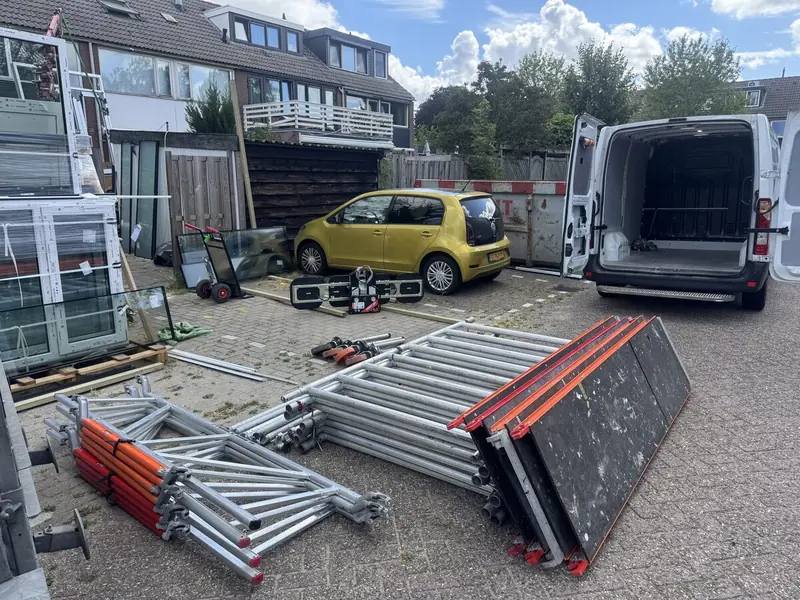
Many people look for a scaffold including assembly, expecting a crew to turn up and put it together. That is not how it works with us: we deliver the scaffold in parts and you assemble it yourself, using the manual and the instruction video supplied. Below you will find why that is perfectly doable with a mobile scaffold, what exactly is delivered, what you arrange yourself and when another type of scaffold suits you better.
- Hire a scaffold including assembly? We deliver in parts and you assemble it yourself with a manual and instruction video. How that works.
- No.
- No, it arrives at your site in separate parts.
- No, the parts click together without tools.
We deliver in parts, you assemble it yourself
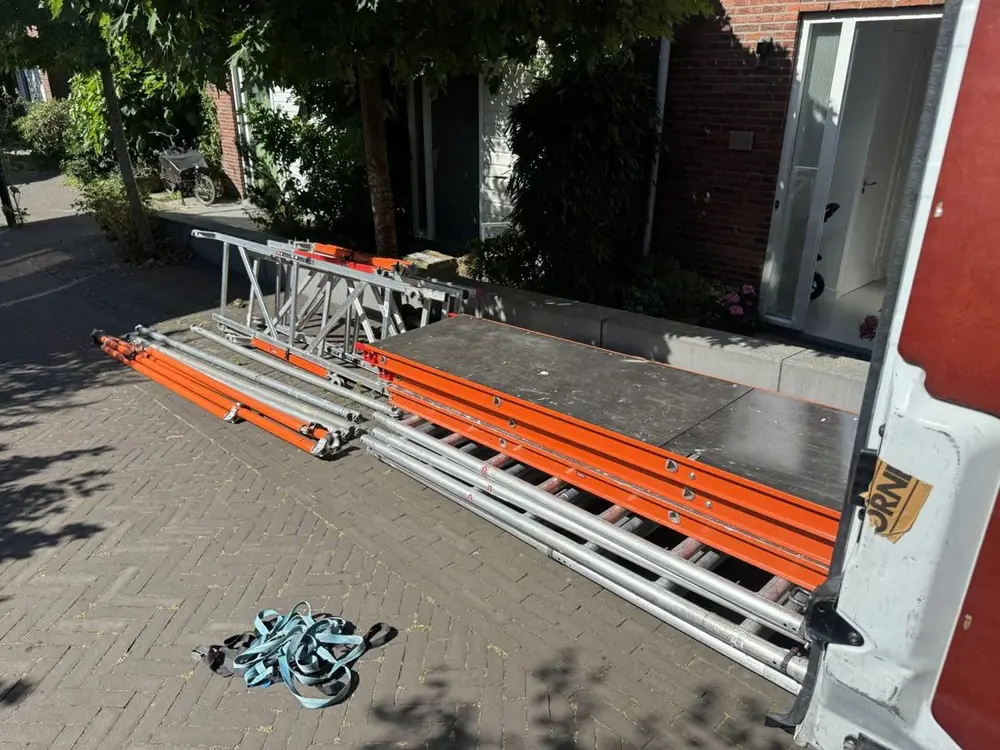
A mobile scaffold is a system tower: the parts are matched to each other and click together without bolts and without tools. That makes assembly less of a trade in itself and more a matter of following the order in the instruction. So we deliver the scaffold to your site in parts and do not assemble it for you, and we do not deliver it ready assembled either.
That saves you two things. You are not tied to an appointment slot with a crew, and you pay no assembly hours on top of the hire. You decide when the tower goes up, and you can move it during the job or take a level off without anyone having to come out for it. If your job overruns, the tower simply stays up without a new appointment being needed.
For anyone who has never done it, that sounds more daunting than it is. You get a manual and an instruction video, and the parts only fit one way. What you mainly need is a bit of calm, a flat spot and someone keeping an eye on it with you. The full assembly step by step runs through the actions in order.
Key facts
| Feature | Value |
|---|---|
| Core answer | Self-assembly is the standard: no tools, with manual and video |
| Assembly time | 15 to 45 minutes, no tools needed |
| Delivery | Ordered before 3 pm, delivered next working day |
| Standard | EN 1004 |
| Each extra day | 95% off: €2.50 to €16.25 a day |
What exactly gets delivered to you
You receive everything that belongs to the chosen height, in separate parts on a pallet or stacked loose. That is more than frames and platforms: the guardrails, toe boards and stabilisers are just as much part of it, and they are not optional. The equipment comes from Altrex and is built to EN 1004, in load class 3, meaning 200 kilos per square metre of platform.
Count the parts on delivery and sort them by type before you start. That way you see at a glance whether anything is missing, and during assembly everything is within reach. If a part is missing or damaged, report it straight away and do not build on. The hire checklist goes through that inspection with you. Lay them out in the order you will use them, with the frames nearest the set-up point.
- Aluminium frames in the number that belongs to your height
- Platforms with a hatch, so you climb up inside the tower
- Diagonal and horizontal braces for the stiffness of the tower
- Guardrails and toe boards for the complete working level
- Stabilisers to widen the base at the bottom
- Castor wheels with brakes and base pads for soft ground
The manual and the instruction video
Every hire comes with a manual and an instruction video. The manual is the assembly instruction that belongs with the scaffold under EN 1004: it states per height which parts go on which level, in what order and where the stabilisers come in. The video shows the same actions, which helps most with recognising the parts. Both belong to the model you hired, so do not reach for the video of a different tower.
Watch the video through once before you start, rather than reaching for it midway. You then know which parts you need first and what the bottom level looks like, and that saves most of the searching. Keep the manual with the scaffold during the job, because dismantling runs in reverse order. Watching it once with the parts in front of you works better than reading alone.
Do not deviate from what it says, even if you think there is a quicker way. The structure was tested in that configuration, with those braces in those places. A skipped diagonal brace or a stabiliser left unextended removes exactly the stiffness the rest leans on. What else the standard covers is in EN 1004 explained. If something will not fit, that is usually a sign a part from a lower level is missing.
Assembling without tools: the order of work
The principle is the same at every height: you build from the bottom up, and a level is only finished once its braces are on. You start with the wheels and the first frames, level those, and from then on you build on from the platform below each time. Guardrails and toe boards go on before you work on a new level.
Sort the parts before you lift the first frame. Hunting for the right brace while you are standing halfway up costs more time than the sorting itself. Work with two people where you can: one passes parts up, the other places them, and there is always someone watching whether the tower is still level and complete. Lay the braces out in the order of the level they belong to, so you do not have to count while stacking.
- Fit the wheels into the bottom frames and lock the brakes at once
- Level the first layer, using base pads if the ground is soft
- Fit diagonal and horizontal braces before stacking any higher
- Lay the platform with hatch, climb through and close the hatch
- Fit guardrails and toe boards all around the working level
- Extend the stabilisers and check the whole tower before starting
What you arrange on site yourself
The scaffold arrives at your door, and the spot where it will stand is your preparation. Provide flat, paved ground and clear away what is in the way: bikes, planters, a garden hose or a loose slab. On grass or sand you need base pads, because a wheel sinks in there and the whole tower ends up out of level.
Look at the space around the tower too. The stabilisers stick out on all sides, so right up against a fence or a wall a set-up sometimes just will not fit. Also measure the route to the place the scaffold has to stand, certainly for a back garden you can only reach through a gate or a passage. Allow some extra room on every side, so you can still walk around it during the job.
If you work indoors, door width and flooring decide. The RS51 is 75 centimetres wide, the RS52 135 centimetres, and the RS44 room scaffold fits through a standard interior door from around 70 centimetres. Measure the narrowest opening on the route, handle included. Will a mobile scaffold fit through the door checks those dimensions. Look at the clear height in the hallway as well, because an assembled tower has to pass under it.
Delivery: order before 15:00, delivered the next working day
Order before 15:00 and the scaffold is delivered the next working day, anywhere in the Netherlands. Delivery and collection together sit in a fixed amount per province, so you know the transport cost in advance. The amounts are on delivery costs, with the explanation under the cost of having a scaffold delivered. Say where the parts may be left when you order, so the driver puts them in the right spot.
Make sure someone is there at delivery and that the spot for the parts is clear. A driveway, a garage or a strip of garden beside the facade works best, so you do not have to carry every component through the house. Lay the parts down so you can pick them up in assembly order, with the frames closest to the set-up point.
The same goes for collection: the scaffold has to be dismantled and the parts ready in a reachable spot. That is a quarter of an hour of tidying, but it saves trouble when the driver is at the door. How to dismantle and hand back neatly is set out in dismantling and returning. Book the collection for a day you are home, so you can put something right if a part is missing.
Collecting yourself at Zeeburgerpad in Amsterdam
You can also collect the scaffold free of charge and by appointment at Zeeburgerpad 89 in Amsterdam. That saves the delivery amount, but you need transport that can take the lengths: the platforms are 245 centimetres long. So a trailer or a long van is the minimum, and the load has to be securable. Bring ratchet straps as well, because loose frames start sliding at the first corner.
Bear in mind that the deposit is higher when you collect than when we deliver. For the RS51 and RS52 it is 1000 euro, for the MiTower 750 euro and for the room scaffold 150 euro. On delivery the deposit is 500 euro for the RS51, RS52 and MiTower and 150 euro for the room scaffold. More on that is on the deposit for hiring a scaffold.
If you have no trailer but would rather not have it delivered, check first what will fit. A complete tall mobile scaffold will not go in a car, a room scaffold sometimes will. Hiring without a trailer sets out the options before you book a collection slot. Count on two trips of your own, there and back, where a delivery handles it in one go.
Who does what: the split of tasks
The table below shows which part of the process sits with us and which part with you. That makes clear at a glance what to allow for when planning your job, and which moments you have to put in your own diary. It is also a useful list to go through with whoever helps you, so you know in advance who is needed on which day.
The split is the same for every model, whether you hire a room scaffold for indoors or a tall tower for a facade. The only difference is the number of parts and therefore the time assembly takes. What the hire itself costs depends on model, height and number of days, and the configurator on prices works that out. With a room scaffold you are done after a few parts, with a tall tower there are more levels waiting.
| Step in the process | Steigertaxi | You |
|---|---|---|
| Putting together the complete set for the chosen height | Yes | No |
| Delivering on site or having it ready for collection | Yes | No |
| Supplying the manual and instruction video | Yes | No |
| Assembling the scaffold at the work area | No | Yes |
| Moving it during the job | No | Yes |
| Dismantling and laying out the parts | No | Yes |
| Collecting afterwards and refunding the deposit | Yes | No |
What the hire costs and how the days count
The first hire day is charged at the full daily rate, and every following day costs 5 percent of that daily rate. A job that overruns therefore barely gets more expensive, which makes it sensible to plan a few days of margin. Certainly on outdoor work, where a rainy day easily costs you a day. Count the delivery day if you intend to assemble the same day.
Because you assemble it yourself, you pay no assembly hours. What you do count is the time it costs you: the day of assembly and the day of dismantling are hire days too. See how the rates build up on mobile scaffold hire costs and the comparison between price per day and price per week. Days on which you do not work but the tower stays up count as hire days as well.
If you are unsure how many days you need, work back from the job rather than from the scaffold. Painting a facade takes more days than the painting days alone, because drying time counts as well. How many days to hire a scaffold helps with that estimate. On installation work it is often the other way round and you finish sooner than expected, as long as the weather holds. Plan generously rather than tightly in that case.
Dismantling, collection and the deposit back
Dismantling runs in reverse order: first the toe boards and guardrails of the top level, then the platform, then the braces, and the stabilisers only once the tower is low. Work down level by level and throw nothing off, not even a guardrail coming from half a metre up. Damaged parts are one of the few reasons a deposit does not come back in full.
Then lay the parts out sorted in a spot the driver can reach. Frames together, platforms together, small items in a tray. That keeps loading short and stops something being left behind in the garden and later logged as missing. Keep small items such as wheels and toe boards together, because those go missing first. Then walk the garden and driveway once more.
The deposit is back in your account within one working day after return. What you have to do for that, and what goes wrong when parts are missing, is set out in getting your deposit back. On delivery it concerns 500 euro for the RS51, RS52 and MiTower, and 150 euro for the room scaffold. Photograph the sorted stack before the driver arrives, so you have your own record of what went back.
When a mobile scaffold is not the right answer
Assembling yourself works well up to the limit of our range, which covers working heights from 4.2 to 14.2 metres. If you have to go higher, or you want to wrap a facade across its full width in one go, you end up with a fixed facade scaffold erected by a scaffolding company. That is a different product with a different way of working.
On a roof with many awkward shapes, a facade without flat ground beneath it, or a job where several crews have to be on the scaffold at once, a mobile tower is not always the answer either. The trade off between the two is set out in hiring a tower or having a scaffold built and in mobile scaffold or facade scaffold.
Stay inside those limits and assembling yourself is almost always the quickest route to a working set-up. You pick the moment, you can move it as you go and you do not depend on a crew's diary. For a one person job up to six metres working height, the MiTower is the fastest model to work with. For the higher set-ups you end up with the RS51 or the RS52, depending on the room along the facade.
Making sure you order the right set-up
Work out your working height first: platform height plus two metres of reach. Measure the point your hands have to reach, subtract two metres and you know the platform height you need. On working height you can see which set-up belongs to each metre, and the pages per floor level help if you think in storeys. Measure that point once too often rather than once too few, with a tape and not by eye.
Then choose the width based on the space and the materials going up with you, and check the route to the set-up point. If you fall between two options, send a photo of the situation via WhatsApp with the height, and we will tell you which model fits. Calling or emailing works too, through contact. Mention the ground and the access route as well, because those often decide more than the height.
If you would rather read on first, the other guides are in the knowledge base and the practical answers are on frequently asked questions. Ready to order, and you will find the models and heights under hiring a mobile scaffold. For indoor work the options are under hiring a room scaffold and for a job you do alone under hiring a MiTower.
Frequently asked questions
Do you come and assemble the scaffold?
No. We deliver the scaffold in parts and you assemble it yourself. With the hire you receive a manual and an instruction video giving the order and the parts for each height, so you know exactly what goes where.
Is the scaffold delivered ready assembled?
No, it arrives at your site in separate parts. That also makes sense: an assembled tower several metres tall does not fit on a lorry and would have to be taken apart again on the way.
Do I need tools to assemble it?
No, the parts click together without tools. What does help is a second person to pass parts up and keep an eye on things, and a flat spot where you can lay the components out sorted.
What if I get stuck during assembly?
Stop stacking and go back to the manual or the video. If that does not solve it, send us a photo of the tower as it stands via WhatsApp. We will look at the braces, the platforms and the stabilisers with you.
Can I move the scaffold myself during the job?
Yes, on flat, paved ground. The platform has to be empty and nobody may be standing on it. Push against the frames at the bottom, then put the brakes back on and level the tower again.
Do I have to dismantle the scaffold before it is collected?
Yes. Dismantle in reverse order and lay the parts out sorted in a spot the driver can reach. That keeps loading short and stops components being left behind in the garden.
When do I get the deposit back?
Within one working day after return the deposit is back in your account, provided the parts are complete and undamaged. On delivery it concerns 500 euro for the RS51, RS52 and MiTower and 150 euro for the room scaffold.
For which jobs is assembling yourself not practical?
For work above 14.2 metres working height, or a facade you want to wrap across its full width in one go, you end up with a fixed facade scaffold erected by a scaffolding company. That is a different product from a mobile scaffold.