
Knowledge base · reading time 9 min
Aluminium or steel scaffold: which is better?
Aluminium or steel is a question that usually comes from people who have seen steel scaffolding on a building site and wonder whether the same applies at home. For maintenance on a house or a commercial building, aluminium is the more practical option in almost every case: lighter to carry, faster to assemble and free of rust spots after a wet week outdoors. Steel certainly has its place, but that is a different type of project with a different schedule and budget.
- Aluminium or steel scaffold to hire? Compare weight, assembly, strength and use, and see why aluminium mobile scaffolds dominate maintenance work.
- Yes.
- At the lower configurations that works, and the MiTower is designed for exactly that.
- Because those projects run for months and the scaffold stays up.
Why almost every hire scaffold is aluminium
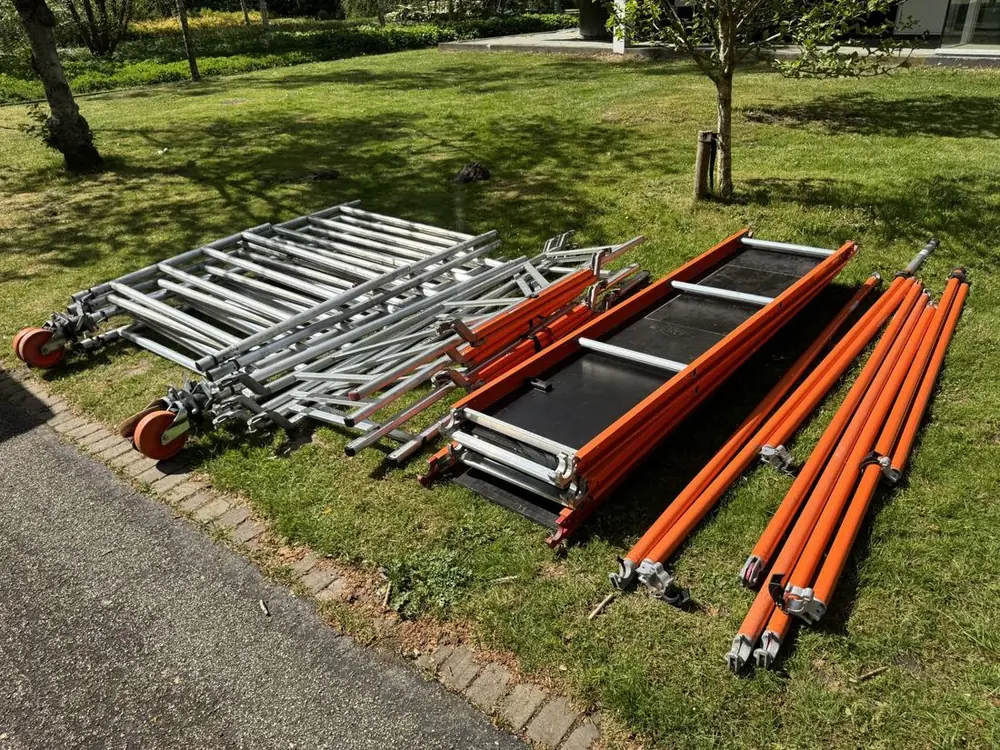
Put a hire scaffold next to a steel construction scaffold and the difference is mainly about who has to move the material. In hire, the customer carries everything to the back of the house, through a gate or along a garden path. Aluminium parts can be lifted one by one by a single person, they stay straight after hundreds of assemblies and they do not rust away in a shed or on a trailer. Our mobile scaffolds are made by Altrex and built to EN 1004.
Steel has the same properties in a different balance. A steel tube of comparable stiffness weighs considerably more, and you carry that weight through the garden yourself. On a building site with a crew and machinery that barely matters. On a job where you and perhaps one helper have to move everything, it is the difference between a morning of hauling and half an hour of setting out. In practice that decides the choice more often than the strength of the material does.
For most customers the material question is settled there, and the conversation moves on to height and width. The working height you need depends on where you have to reach: working height is platform height plus two metres, the reach of an adult. If the difference between the models is not clear yet, start with the basic explanation of a mobile scaffold and pick the size afterwards.
Key facts
| Feature | Value |
|---|---|
| Core answer | For self-assembly aluminium is lighter and fast, meeting the same strength rules |
| Standard | EN 1004 |
| Load class | Class 3: 200 kg per m² |
| Assembly time | 15 to 45 minutes, no tools needed |
| Models | Altrex RS Tower 51/52, RS44 and MiTower |
You notice the weight difference while unloading
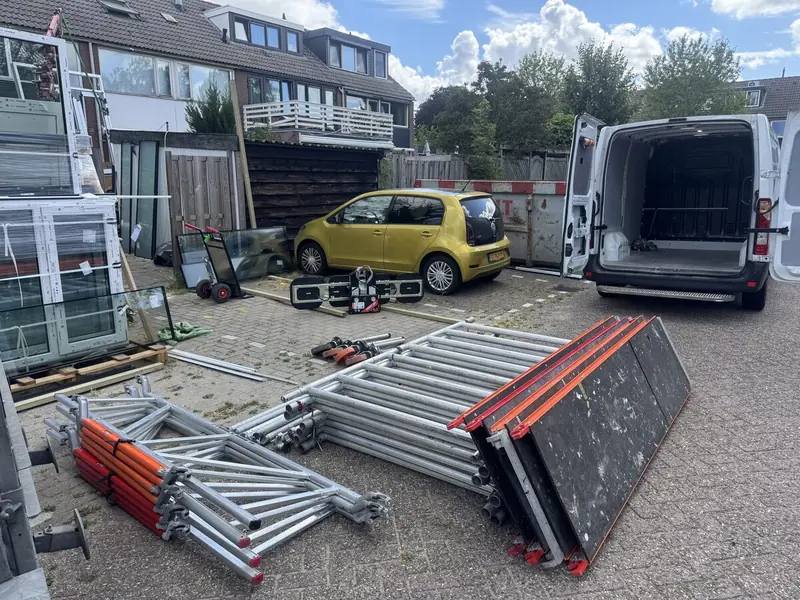
The moment the material really counts is not while you work but while you unload. A mobile scaffold arrives as separate frames, platforms, braces and stabilisers. You put that pile down near the facade and build upwards from there. With aluminium you carry two frames at once; with steel every part becomes a separate trip there and back. Anyone who has to get the material through a narrow gate or a hallway feels that difference on every run.
The same weight decides how high you can still build comfortably. On the upper sections you lift parts above your head to the next layer. Aluminium keeps that workable right up to the tallest configurations in our range, which covers 4.2 to 14.2 metres of working height. With steel the same work at height becomes heavy enough that you want a second person as standard, which makes the job both slower and more expensive.
- Frames and platforms can each be lifted by one person
- The whole package is laid out by the facade in one go
- Passing parts overhead stays manageable into the top sections
- A narrow passage or a staircase costs fewer trips back and forth
- Dismantling and loading takes roughly as long as assembly did
Strength and loading: what load class 3 means
Light material immediately raises the question of whether it is safe to stand on. Our scaffolds fall into load class 3, which works out at 200 kilos per square metre of platform. That is the service load the scaffold is designed for: yourself, your tools and the material you take up with you. For painting, gutter work, installation work or fitting a roof window you stay comfortably below that, even with two people on the platform.
That class says nothing about aluminium versus steel, incidentally, but about the scaffold as a whole. EN 1004 sets requirements for the structure, the guardrails, the toe boards and the way you climb up. An aluminium scaffold that meets it is no less solid for this kind of work than a steel one. What the standard actually contains and why it exists is set out in our explanation of EN 1004.
What does deserve attention is how you spread those 200 kilos. A stack of roof tiles on half a square metre is not the same as an evenly spread load, and bringing material up calls for a spot where you can put it down without blocking the hatch. If you work with heavier goods, read the page on loading and weight first and adjust your setup accordingly.
Aluminium and steel side by side
The differences are small one by one, but they stack up into two very different ways of working. Aluminium is equipment you handle yourself, hire by the day or the week and hand back afterwards. Steel is equipment that is erected and stays up until the project is finished. The table lists the points you actually notice during an ordinary maintenance job, not the specifications that only exist on paper.
What a table cannot show is the lead time. You put up an aluminium mobile scaffold yourself and take it down yourself, which keeps hiring by the day or the week sensible. Steel only starts to pay off once the structure stays up for weeks or months and several crews use it. The difference between those two routes is worked out further under hiring versus having a scaffold built.
| Feature | Aluminium mobile scaffold | Steel scaffold |
|---|---|---|
| Weight per part | Liftable by one person | Heavy, usually a two person job |
| Assembly | Clamps and braces, no tools needed | Tubes and couplers to be tightened |
| Corrosion | Does not rust | Coating that can rust once damaged |
| Moving | On castors, rolled along during the job | Stays put, moving means dismantling |
| Transport | Fits on a trailer or in a van | Needs a separate delivery load |
| Typical hire period | A day to a few weeks | Weeks to months |
| Suits | Maintenance, painting, installation work | Long running construction and renovation |
Rust, damp and salt in the air
Aluminium does not rust. That sounds like a detail until you leave a scaffold outside for a week in autumn, or until you work on the coast where salt hangs in the air. A steel scaffold needs a protective coating, and the moment that coating is damaged by scraping, drilling or grinding sparks the process starts anyway. With aluminium you simply do not have to think about it during a hire period.
For you as the hirer that mostly means convenience: you do not have to sheet the scaffold when rain is forecast and you do not have to dry it off before collection. A wet platform is still more slippery than a dry one, so account for that in your footwear and your pace. If you are working in the cold season, read what changes under hiring a scaffold in winter.
For steel parts you buy or borrow yourself the opposite applies. A trestle or loose tube that has spent a winter in the garden leaves rust marks on painted brickwork or on freshly laid paving. Aluminium avoids that, which matters above a light coloured facade or a terrace that has just been cleaned. If you are weighing a trestle against a tower, see scaffold or trestle.
Tool free assembly versus tightening couplers
You assemble an aluminium mobile scaffold by stacking frames, hooking in platforms and clamping braces. That needs no tools and no previous scaffolding experience, which is why hire customers manage it themselves. Every hire comes with the manual, and an instruction video shows the sequence step by step. We do not assemble for the customer and we never deliver the scaffold ready built; you put it up yourself.
A steel scaffold of tubes and couplers works differently. Every connection has to be positioned and tightened, and the build is work for someone who does it regularly. That is exactly why steel scaffolds are usually erected by a scaffolding firm rather than by the user. What is involved in outsourcing the build is covered under hiring a scaffold including assembly.
The sequence on a mobile scaffold is fixed, and it exists for a reason: you build upwards from a protected platform rather than from the ground with a ladder alongside. If this is your first build, keep the step by step assembly guide to hand and walk the finished tower through once more, checking braces, guardrails and locked castors, before anyone climbs on.
Rolling and stabilising during the job
The biggest advantage of aluminium on castors is that you take the scaffold with you instead of rebuilding it. Along a facade you push it on by one platform length and carry on working. You then lock the castors again, and while it moves nobody is on the scaffold and no loose tools are left on the platform. That is a habit you pick up in the first ten minutes.
Stabilisers are part of that way of working. They widen the supporting base and keep the scaffold upright when you push sideways. The higher you build, the more they matter, and above a certain height anchoring to the facade is added. The practical side of that, including how far they should stick out and when anchoring applies, is covered under stabilising and anchoring.
The ground decides how smoothly that rolling goes. On paving or tiles a mobile scaffold rolls nicely, while on grass or sand the castors sink in and you need base plates to spread the load. A slight slope also means adjusting the spindles so the bottom frame sits level. The approach per surface type is covered under a mobile scaffold on uneven ground.
Transport, storage and handing it back
Aluminium is light enough to move yourself, which makes collection a realistic option. That is free by appointment at Zeeburgerpad 89 in Amsterdam. If you have no trailer, or no appetite for one, have it delivered instead: order before 15:00 and the scaffold is at the agreed spot the next working day, anywhere in the Netherlands. Delivery and collection together are a fixed amount per province, shown on the delivery costs page.
Between working days you normally just leave the scaffold standing. Lock the castors, clear loose tools off the platform and make sure it is not in a walkway where children or couriers pass. If you have no trailer but still want to drive it yourself, the options are set out under hiring a mobile scaffold without a trailer. Bear in mind that a tall configuration takes more load space than most people expect.
- Collection is free by appointment at Zeeburgerpad 89 in Amsterdam
- Ordered before 15:00 means delivery on the next working day
- Delivery and collection sit in one fixed amount per province
- Leave the scaffold standing between days with the castors locked
- Stack the parts for collection where the driver can reach them
When a steel scaffold really is the better choice
There are jobs where aluminium on castors does not fit. A facade renovation running for months, a building wrapped in scaffolding sheets, a structure that runs around the whole property or work where heavy material stays on the scaffold for long periods: then a scaffolding firm erects a fixed structure tailored to the facade. It stays up until the project is done and is used by several crews at once.
For maintenance on a house that rarely applies. Painting a facade, replacing a gutter, laying solar panels or painting a dormer is work measured in days rather than months, and a rolling aluminium tower is faster and cheaper. The difference between the two types is described further under mobile scaffold or facade scaffold, and what private customers should know is at hiring a scaffold as a private customer.
The aluminium models you can hire from us
The range consists of a few clearly different models. The RS51 is the narrow mobile scaffold at 75 centimetres wide and fits along paths and through gates. The RS52 is 135 centimetres wide and gives more working room and a broader base. Both have a platform length of 245 centimetres, so you cover the same stretch of facade per setup. Choosing between them is mostly about the space you have and how much material goes up with you.
Then there is the RS44 room scaffold, which fits through a standard internal door from about 70 centimetres and is therefore used indoors. The MiTower is a one person scaffold up to 6 metres working height, meant for short jobs where you are on your own. If you are weighing a wide mobile scaffold against a room scaffold, the comparison at mobile scaffold or room scaffold helps.
Every model is aluminium, so the material question no longer plays a role within the range. What remains is how high you need to reach and how much ground space you have. If you cannot work it out, send a message on WhatsApp with the height of your facade and a photo of the spot where the scaffold has to stand, and we will think along about the setup.
Hire period, deposit and where to find the rates
The hire period works differently from a steel construction scaffold. The first hire day is charged in full, and every following day costs 5 percent of that daily rate. That means keeping it for a week is rarely a problem when the job runs over because of rain or paint that will not dry. Worked examples are at hire per day and hire per week.
With delivery you pay a deposit: 500 euro for the RS51, the RS52 and the MiTower, and 150 euro for the room scaffold. If you collect yourself, the deposit is 1000 euro for the RS51 and RS52, 750 euro for the MiTower and 150 euro for the room scaffold. It is back within one working day after return. The conditions are set out at the scaffold deposit page.
Rates themselves depend on model, height and duration, so you take those from the configurator on the pricing page. A few clicks show what your combination costs, including delivery for your own province and the number of days you expect to need it. If you first want to see what makes up the cost of an ordinary mobile scaffold, look at the cost of hiring a mobile scaffold.
Frequently asked questions
Is an aluminium mobile scaffold strong enough for professional use?
Yes. Our Altrex mobile scaffolds are built to EN 1004 in load class 3, which works out at 200 kilos per square metre of platform. That is ample for two people with tools and material. Painters, installers and roofers work on them daily.
Can I assemble an aluminium scaffold on my own?
At the lower configurations that works, and the MiTower is designed for exactly that. On taller mobile scaffolds it is more comfortable with two people, especially when passing frames overhead. You always assemble it yourself, with the manual and the instruction video at hand.
Why do building sites still use steel scaffolding then?
Because those projects run for months and the scaffold stays up. A fixed steel structure is tailored to the facade by a scaffolding firm and used by several crews at once. For a few days of maintenance that is unnecessarily heavy and far too slow.
Does aluminium suffer from wind and weather?
No, aluminium does not rust and has no protective coating that can be damaged. A hire period outdoors in the rain is perfectly fine. The platform does get more slippery when wet, so adjust your footwear and your pace to that.
Which width should I pick for a facade with a narrow path?
Usually the RS51 at 75 centimetres, because it fits along paths and through gates. If you have more room and want to take material up, the RS52 at 135 centimetres is more comfortable. Platform length is 245 centimetres on both.
How much deposit is there and when do I get it back?
With delivery the deposit is 500 euro for the RS51, RS52 and MiTower and 150 euro for the room scaffold; on collection it is 1000 euro for the RS51 and RS52, 750 euro for the MiTower and 150 euro for the room scaffold. The amount is returned within one working day after the scaffold comes back.
Will you assemble the scaffold if I would rather not?
No, we do not assemble and we never deliver a scaffold ready built. You receive the separate parts with a manual and an instruction video, which makes the build very manageable. If you get stuck, we will think along with you on WhatsApp.