
See your price
Application

Chimney maintenance? Choose the right scaffold.

Chimney maintenance is not something you do once but something you come back to, a few years apart. You run over the joints, check whether the cowl still sits square and sound, replace the mesh when it has rusted through and touch up small patches before they turn into damage. That work sits all round the stack, so standing on one side will not do; you have to get at it from several. For two storeys the answer is to hire a mobile scaffold 135 cm wide, built to between eight and twelve metres.

  • Order before 3 pm, delivered tomorrow
  • Professional Altrex scaffolds
  • Up to 14.2 metres working height
  • Easy to assemble yourself
4,2 tot 14,2 mWorking heights available
12Provinces served
7Days a week
200 kg/m²Load class 3
In short
  • For chimney maintenance we recommend the Wide mobile scaffold.
  • On a maintenance round the stack has to be reached from several sides, and every side is a standing position of its own.
  • You hire the RS52 at 135 cm wide, because brush, sealant gun, mesh and a small bucket of mortar all go up.
  • Reckon on three to four hire days: shifting between the faces takes longer than the work on the stack itself.
  • First 24 hours from €175 incl. VAT and delivery; every day after that 95% off.
Key facts for this job
FeatureValue
Recommended scaffoldWide mobile scaffold (Altrex RS TOWER 52)
Working height for this job8 to 12 metres
Available working heights4.2 to 14.2 metres
StandardEN 1004, load class 3 (200 kg per m²)
DeliveryOrdered before 3 pm, delivered next working day
Each extra day95% off, from €8.75 a day
Why a mobile scaffold for chimney maintenance?

Safe, stable and professional work at height

Chimney maintenance consists of many small operations on a small object you want to see from every side. A joint that looks closed from one angle turns out worn from the other; the cowl is held by four screws you cannot all reach from the same spot. On top of that you need two hands and somewhere to put your tools down. Hiring a tower for this round therefore means paying attention not only to working height but above all to how many standing positions your period can hold. That second question shapes your planning and your costs far more than the height itself. The tower is the decision; the stack is only the reason.

  • Four faces of a stack, not one
  • Brush, sealant and mesh carried up together
  • A maintenance round that returns every few years
  • Eight to twelve metres on two storeys
Read more about working safely →

Hiring a wide mobile scaffold for chimney maintenance

For a round on the stack you take the RS52, the wide 135 cm model that the hire fleet can build as high as 14.2 metres. For this work it stops at 8 to 12 metres. You need that width because so much goes up with you and stays lying while you work: a wire brush, a sealant gun, a roll of mesh, a screwdriver set and a small bucket of pointing mortar. Which versions are otherwise ready is on the page with mobile scaffolds from the hire fleet.

The 245 cm of deck that comes with it gets used differently here than on flat work. You do not shuffle along a wall with it; inside that length you look for the spot with the best view of one face of the stack. Working with two of you it pays off: one holds the new mesh in place while the other drives the screws, without anybody having to stand on the edge of the platform. You pick the tools up in turn, so everything must stay within arm's reach.
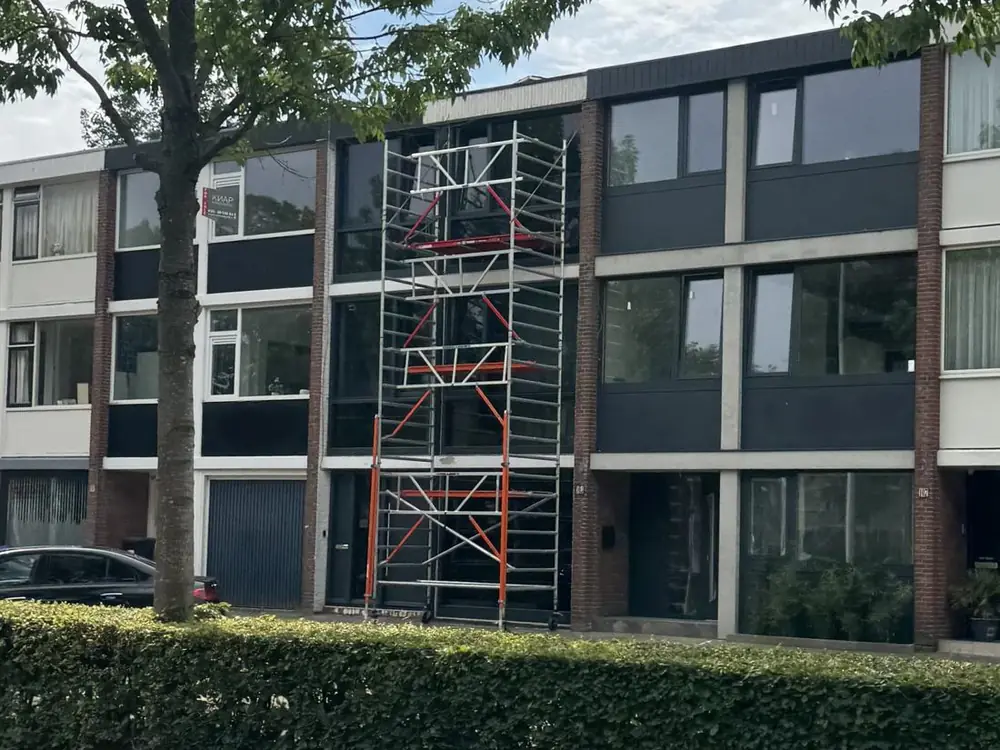
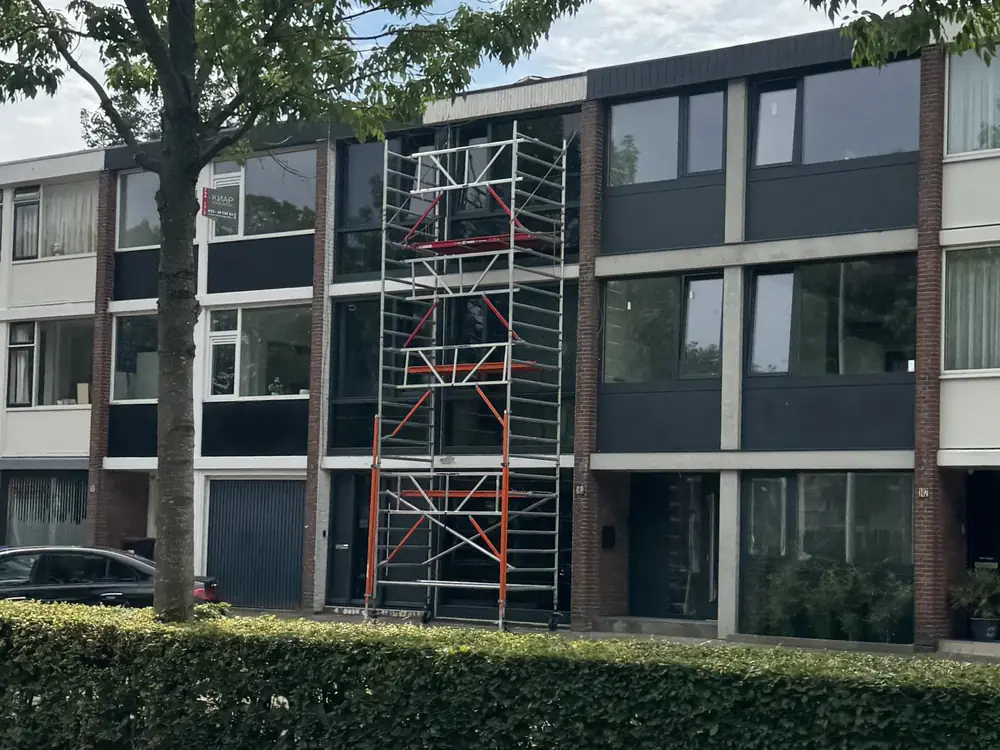
Assembled mobile scaffold at the front of a dwelling with its top deck close to the roof edge, hired for stack work

If the route to the right elevation runs through an alley or along a narrow path, you end up with the RS51 and its 75 cm. The same work goes perfectly well from it, only you lay less down beside you and climb down more often for something you forgot. Weigh that against how many times a round makes you change position, because those climbs add up. Indoor models are a different matter; for a stack on the roof this is the lower limit.
Working height to hire up to the top of the stack

On chimney maintenance your highest point lies above the roof edge: the top course of bricks or the rim of the cowl, because that is where a brush and a screwdriver have to reach. So it is higher than the gutter, where most other roof jobs stop, and that easily makes a whole build's difference in what you reserve. On two storeys it comes to a reach between 8 and 12 metres. Which builds belong to that is shown at ten metres of reach.

The platform sits about two metres under the working height figure, but bear in mind that you do not work straight up at a stack. You stand to one side of it and reach forward at an angle, which takes you less far than the sum suggests. So prefer a build where the top bricks come out around chest height to one where you can only just touch them. That half metre decides whether you work comfortably for an hour or spend an hour stretching.

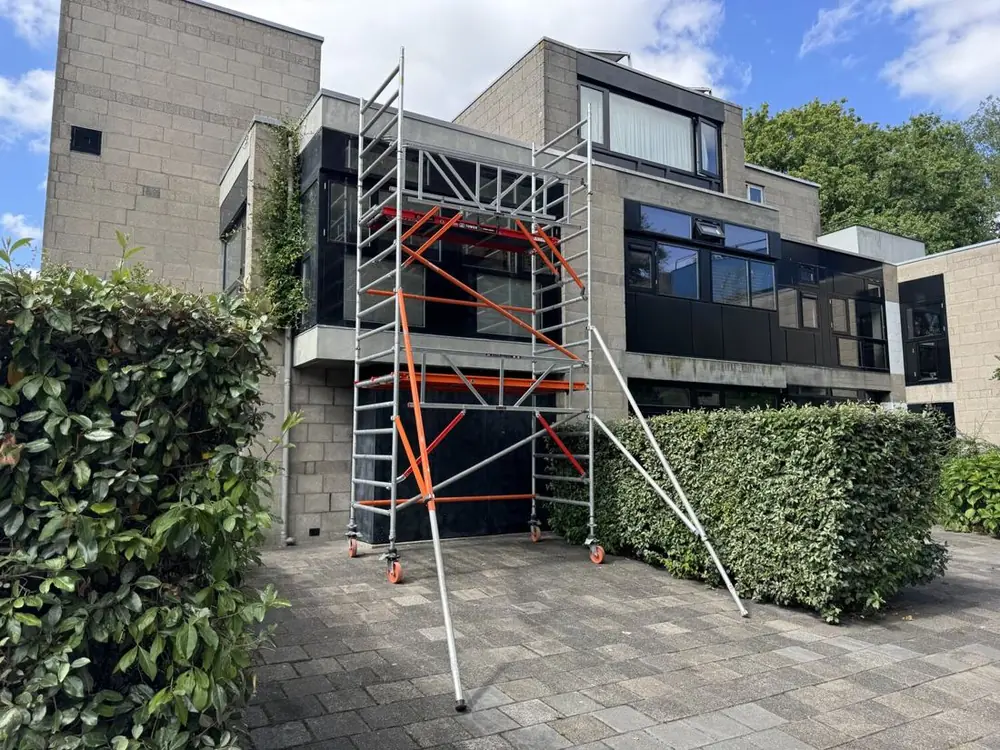
Mobile scaffold standing along a wall above the roof edge, the reach a stack top asks of a hire build

Hiring too low takes its revenge on precisely this work. Running over joints with your arms above your head goes well for a quarter of an hour, after which you look sloppily and fill sloppily; the spots you skip come back in three years. So take the tape from the ground beneath your wheels up to the top of the cowl, and count in a sloping path or a sunken slab. For a roof that starts above the second floor hire a build more generous than you would guess from the street.

Several hire positions around one stack: where the tower goes

This is the hardest question on chimney maintenance, because a stack has four faces and your build stands against one. Walk round the house before you reserve and work out which elevations lie close enough to the stack to work from. On a mid terrace with the stack on the party wall that is usually two: the front and the back. The flanks of the stack you then reach at an angle, or not at all. The tower cannot stand where there is no ground for it.

Per standing position the usual story applies afterwards: level ground under the wheels, room for the stabilisers that stand out, and no bin or shed exactly where you need to be. Behind the house that ground is more often soft than at the street, so keep base plates or sound boards to hand. A wheel that sinks a centimetre after a wet night puts your whole build out of true. How to get a build solid on ground that gives is set out in the explanation of bracing and tying in.

Stabilisers set down on block paving under a mobile scaffold, the base each hire position around the house needs

Count on changing sides costing time. Rolling along the same elevation goes quickly, but front to back means dismantling, carrying and rebuilding at most houses. That is half a day each time, and it is the main reason this round asks for more hire days than the work itself would suggest. Skip it in your planning and you are rushing on the last day or leaving a face untouched. So decide beforehand which sides really need doing. Two faces means building the tower twice, and that is the honest sum.

How many hire days a chimney maintenance round takes

The work on one face is done in a few hours: brushing down, running over the joints, making good a worn stretch, checking the cowl and mesh and fixing them. Add building, changing to the next side and striking, and you are quickly at three to four hire days. Checking only the front and nothing else gets by on two. So it is not the size of the work that sets your period but the number of faces you want to tackle. The tower stands idle for much of each of those days.

There are waiting moments inside that period. Fresh pointing mortar or a bead of sealant wants to cure quietly before rain falls on it, and in frost you do not start at all. A sweep coming the same week can also cost you half a day in which you cannot go up. So plan this round for autumn or early spring, and allow for a day when the weather stops you. That is not a lost day as long as you booked it in advance. A hired tower waiting out a frosty morning costs little.

Mobile scaffold standing against a side elevation, the second hire position in a round about the house

Booking wide is cheap on this job. The opening date is charged at the ordinary rate and everything after it drops away by ninety five per cent, so the day you do nothing because of rain costs you little. What does work out dear is a second transport run because you had to stop halfway, since you then pay for bringing and fetching twice and build everything again. Put your end date behind the face you mean to do last. Estimating a period like that is covered in the piece on hire days.

Which mobile scaffold suits chimney maintenance?

Kamersteiger RS44
  • Working height up to 4 metres
  • Compact and narrow
  • Great for indoor and small jobs
View and calculate →
Smalle rolsteiger RS51
  • Working height up to 14.2 metres
  • Narrow (75 cm)
  • Ideal for narrow passages
View and calculate →
Most chosen
Brede rolsteiger RS52
  • Working height up to 14.2 metres
  • Wide platform (135 cm)
  • Extra stability and workspace
View and calculate →
1-persoons steiger MiTower
  • Working height up to 6.2 metres
  • Very compact
  • Quick and easy to assemble
View and calculate →

Joints, cowl and mesh checked from the platform deck

Start every standing position by looking and only then by working. Run a screwdriver along the joints: where the tip sinks straight in, the joint is due for making good. Brush the stack down so you can see what is under the moss, and watch for bricks discolouring because they take up water. What you leave today you note for the next round, with a photograph, so that in three years you know where to look first.

The cowl and the bird mesh then ask their own attention. Check whether the cowl still sits firm and level on the stack, whether the fixing has not rusted through and whether the mesh is still closed; a hole a bird can pass means a nest in your flue. Take new mesh, stainless screws and sealant up in a bucket and hang it on the guardrail, so your platform floor stays clear to stand on and nothing rolls about.

Assembled mobile scaffold with platform and guardrails at a dwelling, the deck a stack is worked over from

What you do not do from a hired tower is step onto the roof slope to reach the far side. If the angle will not give it to you, move the build or leave that face until another time. A tower is a working place at the edge of the roof, not a way onto it. When the pointing needs a chisel and a hammer it is no longer maintenance, and your hire period changes with it. What that involves is at chimney repair work from a tower.

Hiring with delivery for your chimney maintenance round

The parts come to you loose, counted and complete, and on this job they do not stay in one place. Because you move to another elevation partway through, pick a gathering spot where the stack of frames can stand in between without blocking the way to the back. Confirm the order on a working day ahead of three in the afternoon and the set arrives the following working day. That helps when you want to plan a round as soon as the week looks settled.

When you book you say which day the parts should come and which day they should go, and you choose them with the forecast beside you. For chimney maintenance have the parts arrive a day ahead of your first working day, because a tall build takes two people half a day. The scaffold goes up in the manual's order, not yours. That building, the changing to each next face and the striking are yours; manual and video show the way. How the order runs is in the step plan for building up.

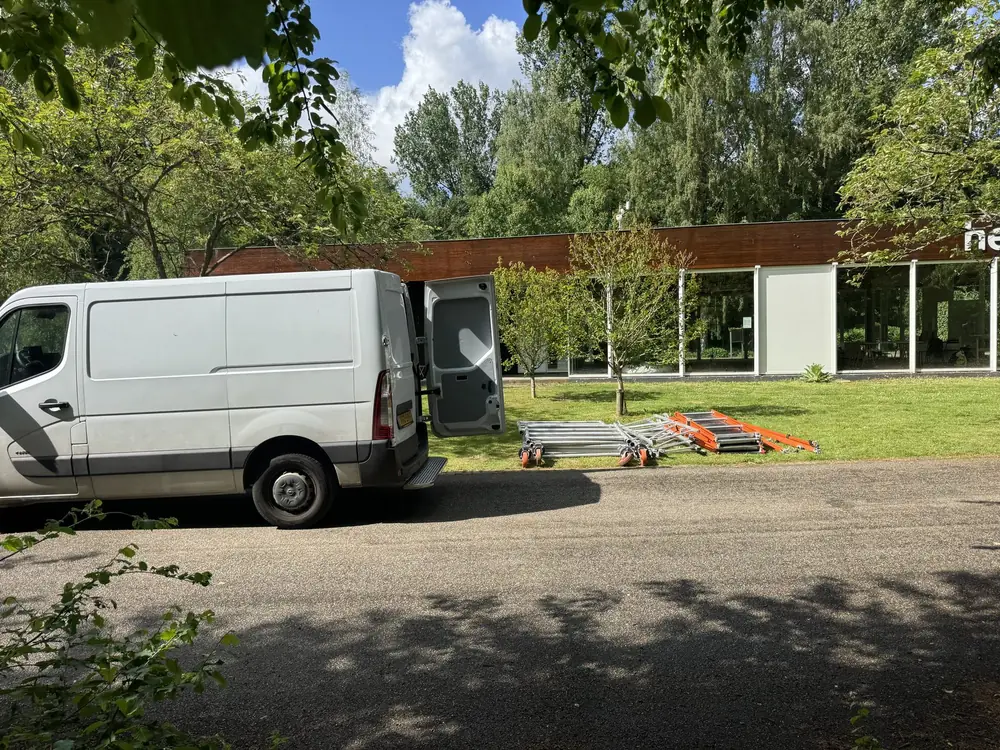
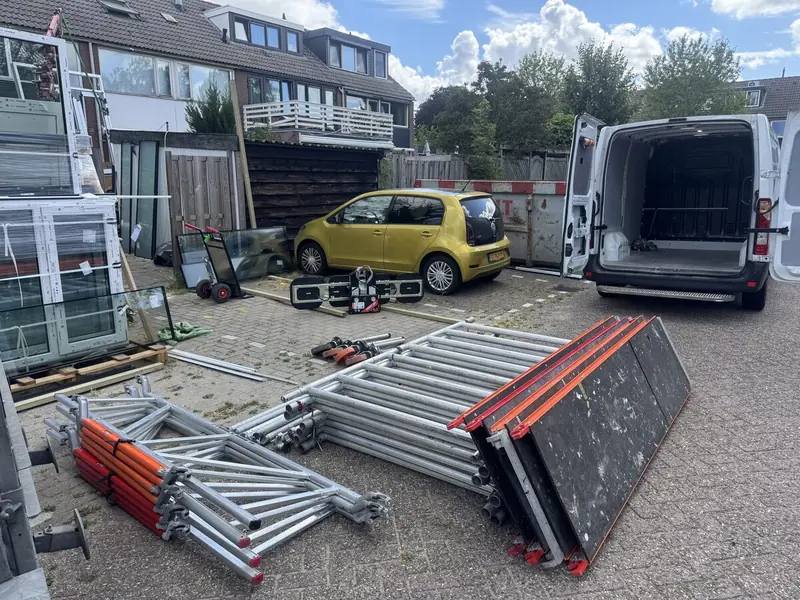
Van loaded with scaffold material at a dwelling, the delivery that opens a hire period on the house

With the last face finished you take the build apart and we put it back on the van. Wait until your fresh joints and sealant have had a night, so you do not scrape past them with a frame. Count the parts while you stack and nothing stays lying among the shrubs at the back. That count is what the yard checks the returned scaffold against. Transport there and back has a fixed rate per province, which you can read at the cost of bringing and collecting.

Working safely at height during chimney maintenance

A hired platform under EN 1004 load class 3 will take 200 kg spread over a square metre. On this round you come closer to that than you would think once two people stand up there with a water bucket, a mortar bucket and a tool box. Water in a bucket weighs more than anything else you take up. Spread that weight out. A hired tower is not a shelf for buckets you are not using. More about what the class means is at the note explaining the load classes.

Above the ridge there is nearly always more wind than down at the wall, and you feel that with a sheet of mesh in your hands. Stop in hard gusts and do not carry on with wet gloves on a cowl you have to hold. The fixed rules hold entirely: wheels locked first and only then up, never anybody or anything aboard while you roll, and at every new standing position the stabilisers set again. On this job you change often, so that check keeps returning.

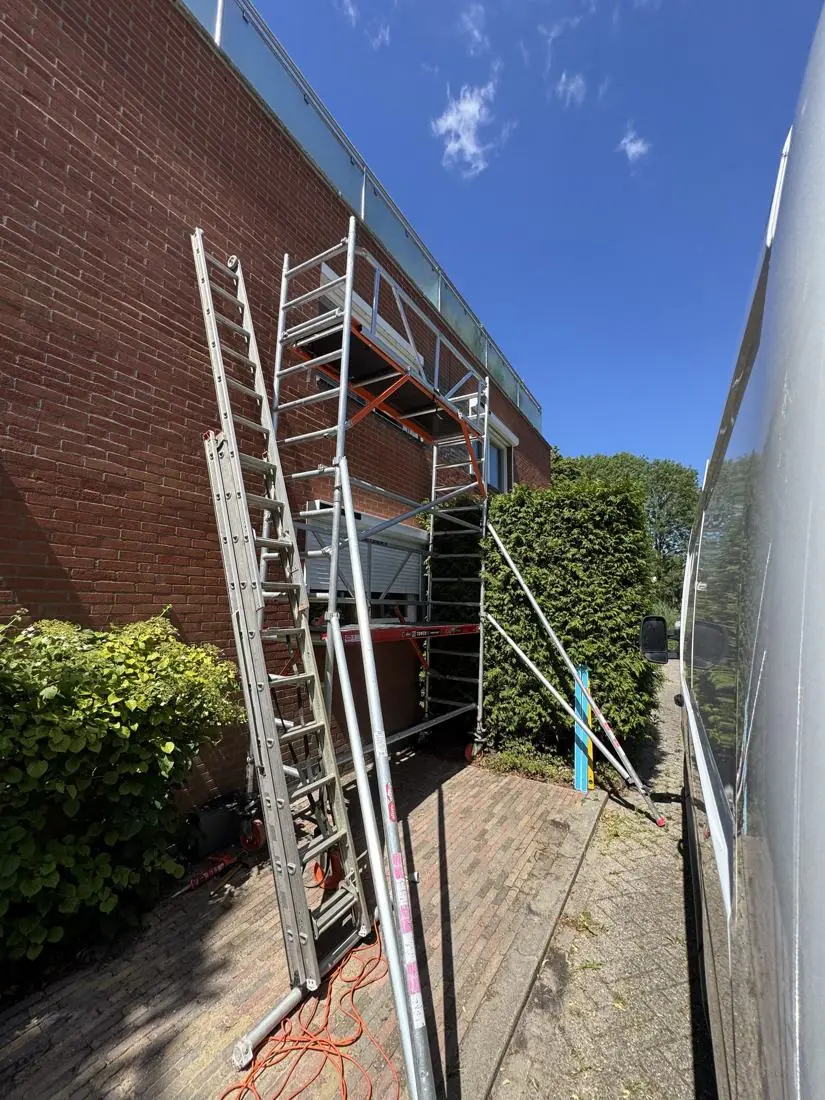
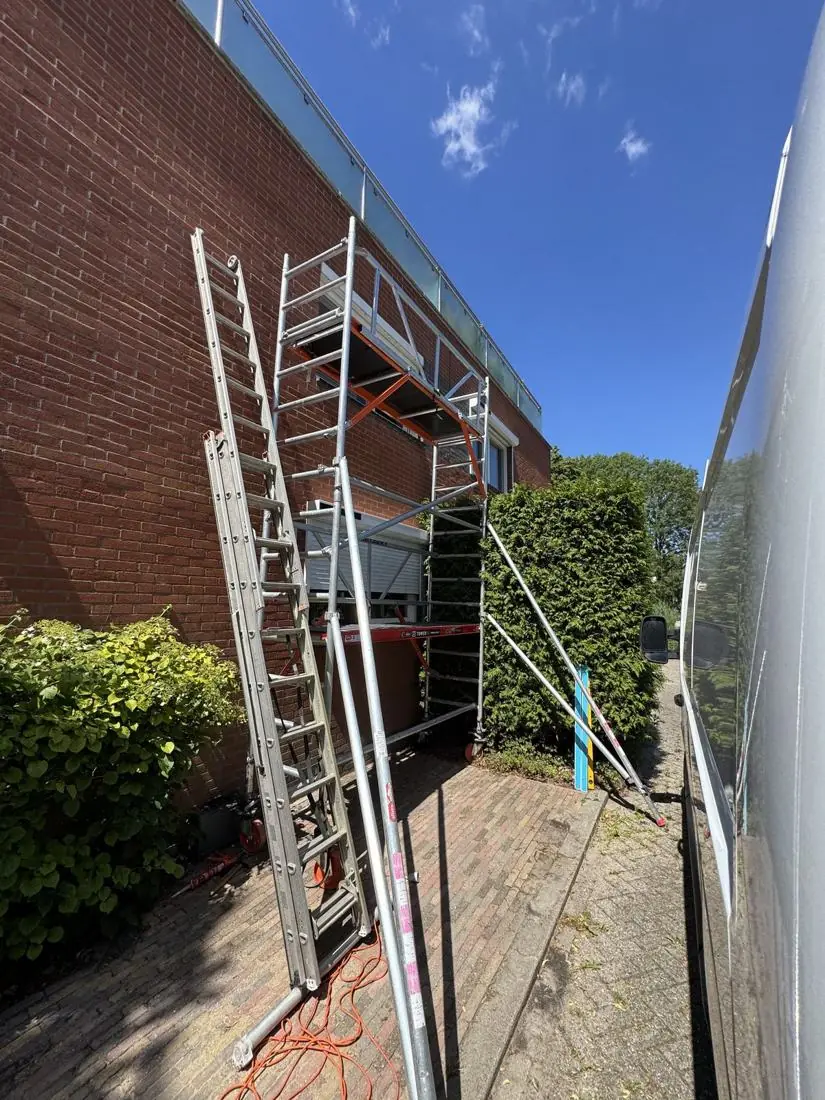
Tower built beside a brick wall in a passage, with an extension ladder leaning on that wall as a separate item.

Finally, think about what can fall. Work on a stack loosens grit, moss and old mesh, and it lands at the foot of the tower or where somebody walks past. Lay a sheet, close off the way underneath and throw nothing down, not even a loose lump of mortar. Lower the waste bucket on a rope instead. Nobody should be under the tower while a face is being brushed. Which further agreements apply you will find in the article on safe work at height.

In 5 steps

How hiring a mobile scaffold works

1
Choose working height

Pick the height that suits your job.

2
Book online

Sorted in 60 seconds, price shown instantly.

3
We deliver

At the agreed spot the next working day.

4
Assemble safely

Assembled by you, with a manual.

5
We collect

One call and we collect the scaffold.

Good to know

Practical tips for chimney maintenance

1

Photograph each face of the stack before your first day on the tower and again when the round is done. At the next round you see at once which joint has moved and which side is going back fastest.

2

Hang two buckets on the guardrail: one with your tools and one empty for moss, grit and old mesh. Nothing then falls to the ground and your floor stays clear to stand on.

3

Take new stainless screws up with you straight away. The old fixing of a cowl rarely goes back in, and you do not want to make that ten metre climb again for three screws.

4

Do every face you can reach from one standing position in one go, including the parts that still look sound. Moving back to the same side later costs you half a day you can avoid now.

5

Finish a maintenance round before the heating season starts. A cowl standing askew or mesh lying open only shows itself in winter, when a nest or a leak has joined it.

6

Set your collection day a day after your last bead of sealant. Fresh sealant and new pointing want to cure quietly, and you do not want to slide a frame past them while striking.

Frequently asked questions

Frequently asked questions about chimney maintenance

Which mobile scaffold should you hire for chimney maintenance?+

Choose the wide model with its 135 cm. Tools, mesh, sealant and sometimes a small bucket of mortar go up with you, and you would rather lay those beside you than leave them on the ground. Working with two of you makes that floor welcome as well. When a narrow path is the sole route to the right elevation, hiring the slim version is the one option and you climb up and down rather more often.

What do you arrange when you hire for a maintenance round?+

You choose the model and the reach online, give us the arrival date and the return date and pay a set price with VAT already in it. We bring the counted hire parts. After that you build, finish the first face of the stack, move to the next standing position and take everything down at the end. On the agreed day we collect the tower again from where you left it stacked, counting the parts back in as they load.

How many hire days does chimney maintenance on a stack take?+

Reckon on three to four days when you want to tackle more than one face. The work on the stack itself is a matter of hours per side, but building, moving to another elevation and striking fill the rest. Checking only the front and fixing the mesh brings you down to two days on hire. When in doubt book an extra day on hire, because stopping halfway through a round is expensive. A tower left standing is always cheaper than a tower fetched twice.

What does hiring a tower for chimney maintenance cost?+

It comes down to which model goes out and how high the tower is built, with a transport amount per province on top. The rental price stands with VAT in the overview of prices for each build, so you know beforehand what a round will come to. Handy here is that the opening day counts heavily and the days behind it lightly: curing time and bad weather then cost you almost nothing extra.

Which working height should you hire to reach the top of the stack?+

Measure to the upper rim of the cowl, not to the gutter, because your hands have to get at the top bricks. On two storeys you hire 8 to 12 metres of reach for that. Remember that you work towards the stack at an angle and so reach less far than straight overhead; half a metre disappears there. Take the build above when unsure. Which model makes which reach is in the working height list.

Can you have the tower brought, or collect the hire yourself?+

Delivery and collection are both possible. With delivery you pay a set amount per province, we set the frames down on your starting date and take the hired tower away after your last working day. By arrangement you can load the parts yourself at Zeeburgerpad 89 in Amsterdam without paying for transport, provided the frames fit in your vehicle. With a twelve metre build that is a serious load of frames and platform sections.

Is building the tower included, or does it eat into your hire days?+

That is your work, and on this job the moving to each next side of the house belongs to it as well. We look after the bringing and the fetching only. With two people a tall build costs half a day, using the manual and the instruction video. Neither a cherry picker nor a system scaffold is something we hire out, so at this height you arrive at a mobile tower. Measure the tightest of your positions and hire to that.

Can you hire on if the maintenance round overruns?+

Yes. Let us know and we shift your collection day, unless the set is already reserved for somebody else. On chimney maintenance it regularly runs over: you pull the mesh off and see the fixing has gone, or a joint proves deeper worn than you thought. Because the days after the first weigh lightly, you cover that risk at once with an extra day. That beats handing the hired tower back and starting again in a fortnight.

How much space per hire position must be clear around the house?+

Take the width of your build and add the reach of the stabilisers on both sides. The stack decides the round; the hire only makes it reachable. Per side you want a flat patch of about three by three metres in practice, with somewhere beside it to put the parts down while you move. Behind the house that spot is often tighter than at the street, so look there first to see whether it fits before you order a tower at all.

Can the hire simply continue when frost or rain stops the pointing?+

You may, and on this job it is almost standard. Fresh mortar and sealant want neither frost nor driving rain, so you push the work a day while the build simply stays standing. Use such a day to brush, to look and to take photographs; that works in nearly any weather. Do take your materials off the floor before you climb down, because a bucket left on an empty tower blows over. The hire simply runs on while the mortar waits.

What do mortar and grit on the hired parts mean for your deposit?+

Fresh spatters rinse or wipe straight off, dried mortar does not. So lay a piece of sheeting on the floor where you work with your bucket and go over the guardrails at the end of your working day. One working day after the returned scaffold is checked off, your deposit is back with you, so a quick clean on the last day of hire genuinely pays. The handling is described in this piece on deposits.

How often do you need to hire a scaffold for this, every few years?+

A stack in good order can be left alone for three to five years, provided you look up from the ground after a heavy storm. Because you photograph at every round, you see next time straight away what is actually moving. That saves hire days: you know in advance which side wants attention and which standing position you need for it, so you keep the tower no longer than necessary. One round tells you how many hire days the next one needs.

Hire a mobile scaffold for chimney maintenance today?

Calculate your rental price now or ask for free advice.

Rolsteiger van SteigerTaxi geleverd op locatie
Book it online

Your scaffold sorted in 2 minutes.

Choose your scaffold and working height, see the price instantly and book online.