
See your price
Application

Fitting a chimney cap? Choose the right scaffold.

Fitting a chimney cap onto a head that has never carried one is measuring and drilling in the same breath. A sizeable plate goes up with you, along with a cordless drill and stainless anchors, and it has to finish dead level once it is up there. A ladder offers no room for any of that. On a house of two storeys you book the RS52 with its 135 cm deck, built high enough to work at 8 to 12 metres. What follows covers measuring the head, the hire period and the standing place.

  • Order before 3 pm, delivered tomorrow
  • Professional Altrex scaffolds
  • Up to 14.2 metres working height
  • Easy to assemble yourself
4,2 tot 14,2 mWorking heights available
12Provinces served
7Days a week
200 kg/m²Load class 3
In short
  • For fitting a chimney cap we recommend the Wide mobile scaffold.
  • A new cap goes on from the RS52: a deck measuring 135 cm across, standing somewhere between 8 and 12 metres.
  • Take the head from outside face to outside face, both diagonals included, because a brick stack is rarely truly square.
  • Allow two to three hire days, since a delivery of the cap usually sits between the measuring and the fitting.
  • First 24 hours from €175 incl. VAT and delivery; every day after that 95% off.
Key facts for this job
FeatureValue
Recommended scaffoldWide mobile scaffold (Altrex RS TOWER 52)
Working height for this job8 to 12 metres
Available working heights4.2 to 14.2 metres
StandardEN 1004, load class 3 (200 kg per m²)
DeliveryOrdered before 3 pm, delivered next working day
Each extra day95% off, from €8.75 a day
Why a mobile scaffold for fitting a chimney cap?

Safe, stable and professional work at height

A cap travels up once and then becomes millimetre work. You lay it loose on the head, check whether the legs or the brackets meet the brickwork all round, drill the holes, drive stainless anchors and set the whole thing horizontal. None of that works unless you have somewhere to put the plate down while your hands stay free, and unless you can walk around the head to study all four faces. On top of that a flat plate behaves like a sail the moment there is any breeze, even on a still morning at ground level. A wide tower on hire supplies that deck, and with it the height to look down on the head from above.

  • Getting a cap up needs a flat, clear deck
  • Drilling, anchoring and levelling with both hands free
  • Outside dimensions and both diagonals written down
  • Fitting a chimney cap means reaching four faces
Read more about working safely →

Hiring a wide mobile scaffold for fitting a chimney cap

On this job the cap is the largest object travelling upward, and that settles the choice. A plate of sixty by sixty centimetres or more wants to lie down beside you, together with the drill, a box of stainless anchors, a spirit level and a socket set. So the pick is the Altrex RS52, a deck 135 cm across and 245 cm long. Hiring a tower for a cap comes down to that floor area: the plate lies next to you rather than against your shins.

The narrow RS51 at 75 cm reaches identical heights, yet a large plate will not lie flat beside your boots on it. You end up standing the cap on edge against the guardrail, which is precisely what you want to avoid once the breeze picks up. Only go narrow when the route to the back garden leaves no other option, and pace out that route between the boundary and the wall first. Both widths sit together in the choice of towers available to hire.
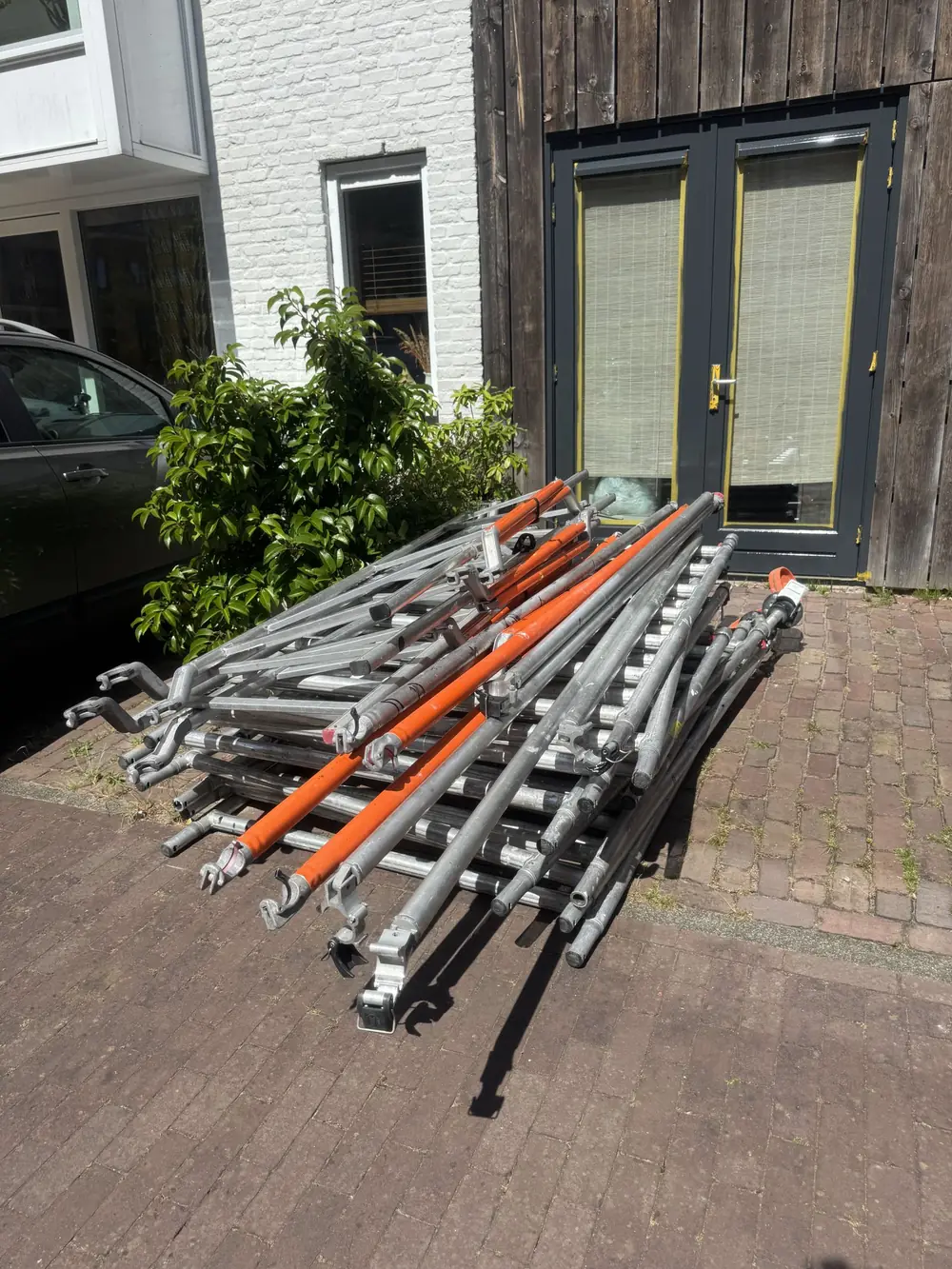
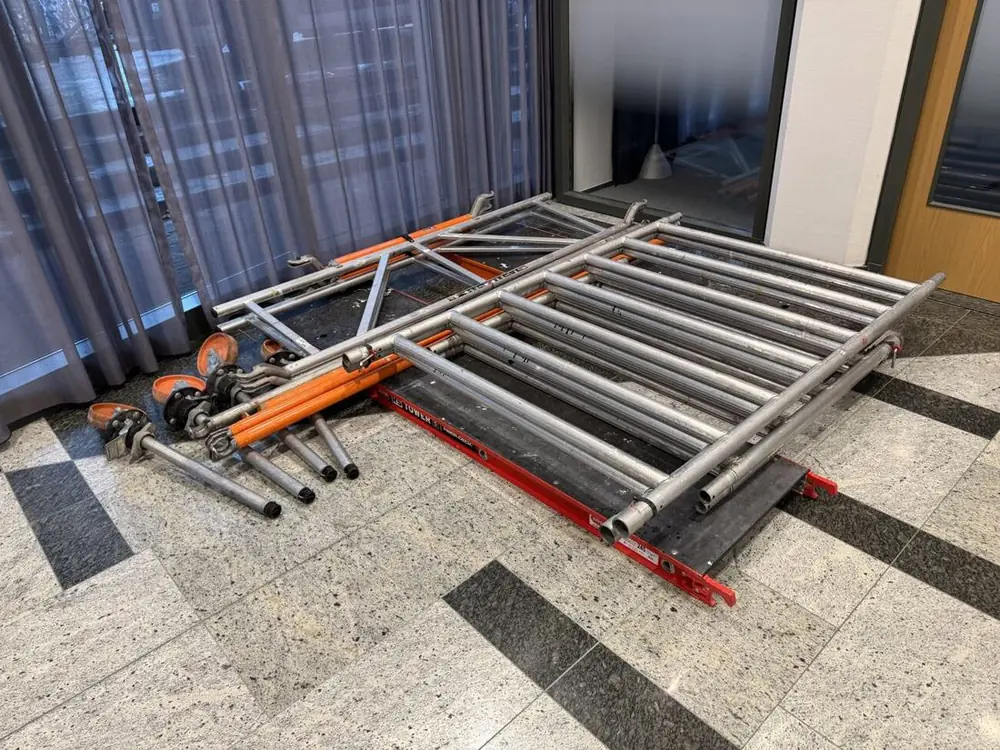
A stack of frames and tubes on a brick drive, the way the wide hire set turns up before you build it.

The rest of the range falls short here. An RS44 room scaffold tops out between 3 and 4 metres and slips through an interior door from roughly 70 cm, which makes it a model for indoor jobs. The MiTower is a one person build topping out at 6.2 metres, and with a heavy plate in your arms you would not want to be alone on a deck anyway. The RS52 carries on to 14.2 metres and gives you the surface the cap can lie on while you line it up.
Working height to hire so the tower clears the stack

With a cap you do not want to be just level with the top edge; you want to look comfortably over it. The plate gets laid down, nudged square and lifted again a few times before it sits right. So the top of the head belongs somewhere between your hip and your waist, and certainly not up at your chin. On a house of two storeys the answer sits in the 8 to 12 metre working height band, so the deck lands at 6 to 10 metres.

The gap between those two figures is the reach you get above the boards: add roughly 2 metres to the platform height and you have the working height. On this job the rule bites differently than it does for painting, because you are reaching down onto the head rather than up at a wall. Measure to the topmost brick and then add half a lift, so the plate can be lowered rather than heaved. The matching build sits on the page about a twelve metre working height.

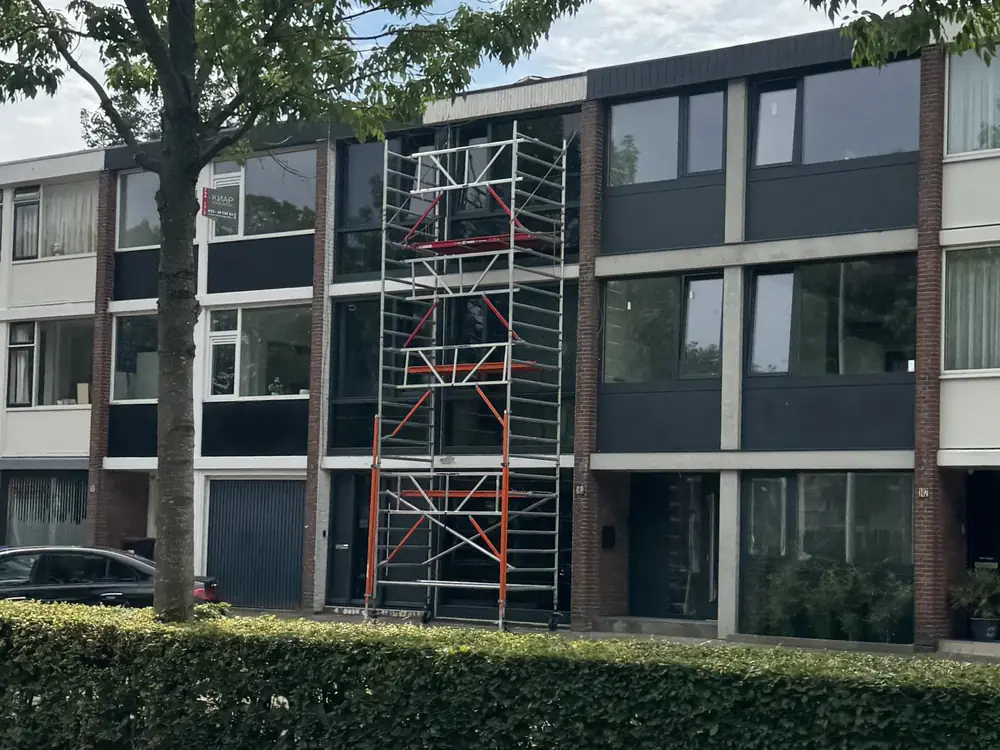
Tower built up along a side elevation past the roof edge, roughly the height class a chimney cap job is booked at

Your tape starts on the ground beneath the castors. Where the drive falls away towards the pavement, or the back garden lies below street level, you book one lift more than the arithmetic suggests. Come out short and you are standing on tiptoe with a plate in your arms, which is exactly when a cap slips off square or scrapes down the brickwork. If you are hesitating between two builds above a room on the second floor, take the taller one without debate.

Ground and standing space when fitting a chimney cap

Set the build along whichever elevation the chimney breaks through closest to the roof edge. On an end of terrace that is the flank wall; on a mid terrace it is usually the back garden. Where the head rises out of the middle of a pitched slope, nothing on castors gets sensibly near it and ordering a tower for the job achieves little. Take a look from the opposite pavement before anything else, because the position of the head governs the entire approach and the width you hire with it.

Beneath the tower belongs level ground that carries weight, with clearance all round for the stabilisers that angle outwards. Reserve extra width on one side as well, because the cap rides up most comfortably on a line run down the outside of the tower rather than under your arm on the ladder. A shed, a thick hedge or a carport hard against the wall makes that manoeuvre impossible and pushes your whole build round to another face of the house.

Loose scaffold components stacked on the pavement outside a dwelling, the footprint you clear before any tower goes up

Think about the paving underneath you too. Drilling into brickwork sends dust drifting down, and a plug or a washer does now and then slip out of your fingers at ten metres. Keep that strip empty, park no car on it and tell the neighbours if a path is shared. Should part of the build stand on the footway, ask the council in advance what your street allows, so nothing has to be shifted on the morning of delivery.

Hire days to reserve around fitting a chimney cap

This job splits into two visits to the head. First you go up to take the outside dimensions and to see how the brickwork is lying; then you order the cap; and only once it has arrived do you bolt it down. The measuring costs an hour and the fitting a half day, but the lead time on the cap sits between those two moments. So do not reserve a day, reserve the stretch you need in order to make both visits.

Anyone taking a cap off the shelf can do the lot in one go: measure it, collect it and fit it the same afternoon. Where the plate is made to the dimensions you supplied, days pass between the two visits. You are free to leave the tower standing through that gap, which usually works out cheaper and safer than having it brought twice and building it twice. What each height and model comes to, VAT included, is listed with the current rental prices, so the comparison can be made with figures.

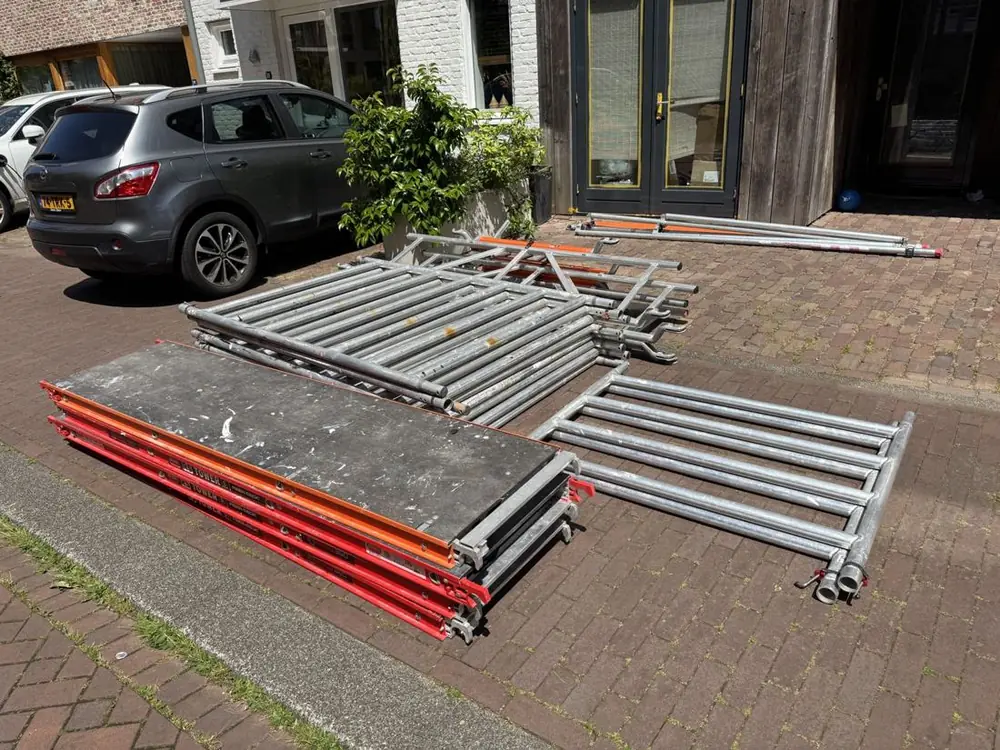
Complete inspected set of scaffold components ready to go out, the counted stack a hirer receives for the whole period

That choice is open to you because the charge drops away after the first twenty four hours, with 95 per cent off from the second date onwards. Waiting days between measuring and fitting therefore add very little to the bill, while a second delivery and a second assembly cost you real time. Put your end date behind the day the cap is due, not in front of it. If the cap slips, the collection date simply moves further out.

Which mobile scaffold suits fitting a chimney cap?

Kamersteiger RS44
  • Working height up to 4 metres
  • Compact and narrow
  • Great for indoor and small jobs
View and calculate →
Smalle rolsteiger RS51
  • Working height up to 14.2 metres
  • Narrow (75 cm)
  • Ideal for narrow passages
View and calculate →
Most chosen
Brede rolsteiger RS52
  • Working height up to 14.2 metres
  • Wide platform (135 cm)
  • Extra stability and workspace
View and calculate →
1-persoons steiger MiTower
  • Working height up to 6.2 metres
  • Very compact
  • Quick and easy to assemble
View and calculate →

Fitting a chimney cap from the hired scaffold platform

Measuring is done to the outside: across the four faces of the head, outer edge to outer edge, and then both diagonals. Where those diagonals differ by more than a centimetre the head is not square, and you allow for that when ordering. Note the height of the projecting section as well, and where the flues sit inside it. On 245 cm of decking your tape and your notebook can be set down while you copy the figures out, with nothing rolling off the edge.

The cap itself you haul up on a line outside the tower, and not tucked under one arm while you climb. Up top you lay it flat, check the fit and mark the holes. Drill into the brick rather than into the joint, drive stainless anchors and use stainless nuts and washers, because ordinary steel is rusted solid into the brickwork after two winters. Lay the level on before you tighten, since a cap sitting off true is not corrected later.

Mobile scaffold standing beside a house, the working position from which the head is measured and the cap bolted

Moving the tower is rarely necessary on this job. A chimney head is narrower than your platform, so one position generally serves two faces and half a turn often reaches the third. If you want a proper look at the fourth, roll the build round once over the paving. Carry your mesh or bird guard up on the same trip, so that fitting a chimney cap is finished in a single visit to the head rather than two.

Scaffold hire, delivery dates and building the tower yourself

The scaffold arrives as a counted set of separate components, never as a finished structure. Choose a spot for that pile beforehand where it is in nobody's way, the drive for instance, and keep the route to the wall clear for the cap itself. Book on a weekday and beat 15:00, and the parts land on your drive the working day after that. Ideally, pick a delivery date that falls before the cap is due to turn up.

Putting it together is your work and not the driver's. With the manual supplied and the video to hand, two people stand the build up in a half day, stabilisers and guardrails included. Keep that half day to itself, because erecting the tower and then bolting a cap down the same afternoon nearly always runs over. Collection we arrange again once you have taken the components apart and set them out complete, in the place where they were dropped off.

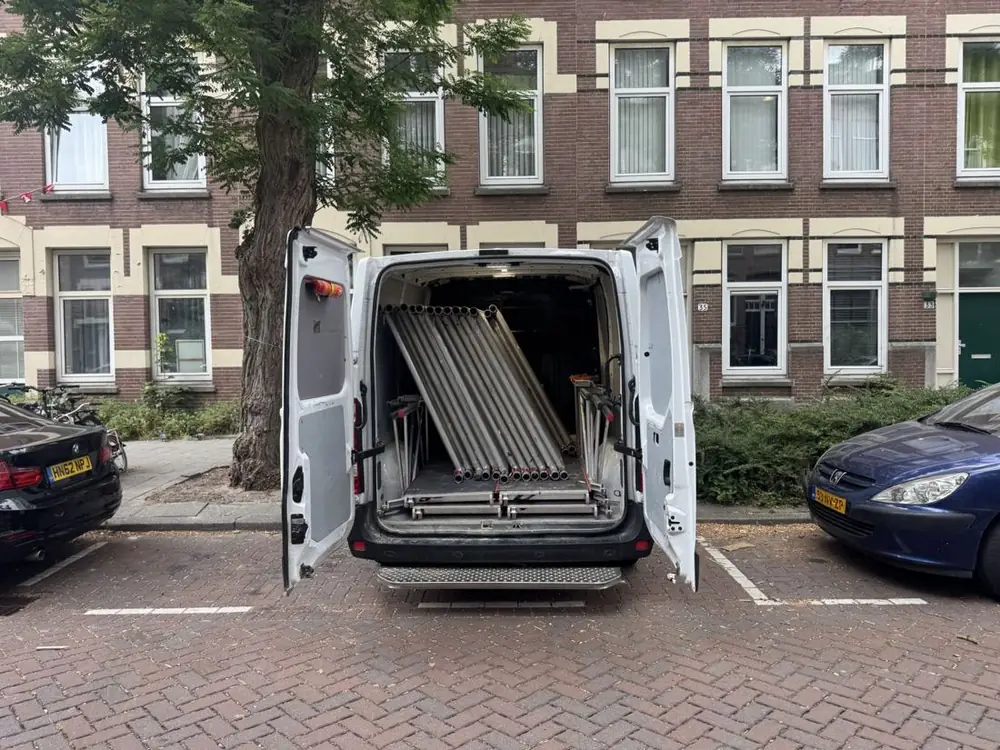
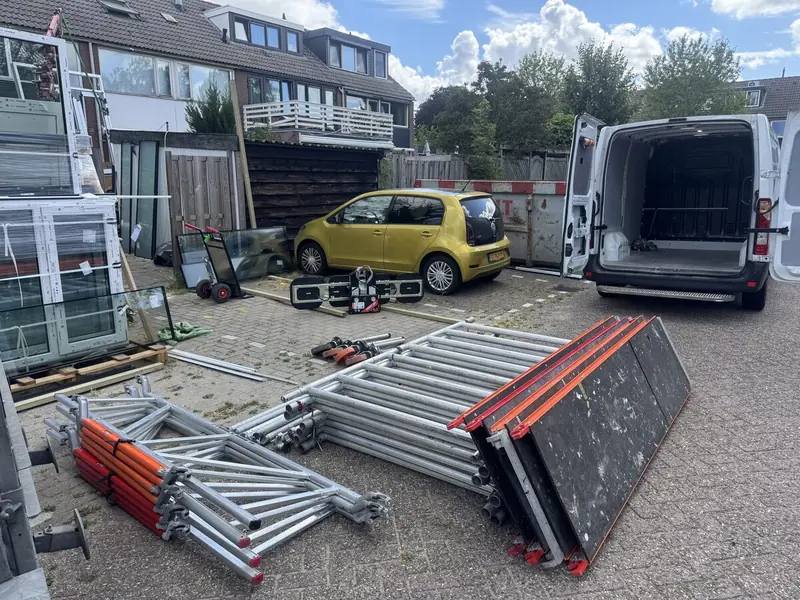
Delivery van loaded with scaffold components standing at a front door, the arrival a hirer wants a day beforehand

Look at the forecast for your fitting day before you book anything. Putting a plate up in a force five is not a matter of pressing on but of waiting, and it helps enormously if the tower is already standing and only the collection date has to shift. That is allowed, so long as the build is not down for the next hirer, and you know within a day. The run itself is a fixed provincial figure, listed under delivery charges by region with VAT.

Fitting a chimney cap safely on a hired tower

These decks sit in load class 3, the EN 1004 category that allows 200 kg on each square metre. A concrete cap weighs a good deal, and together with two people, a cordless drill and a case of anchors you reach that limit sooner than on most work at height. Lay the plate down in the middle of the boards rather than against a guardrail, and leave it there until the moment it goes onto the head.

Wind is the biggest risk on this job, because a flat plate catches like a sail. Lift it while it is blowing and it tugs at your arms at exactly the moment you are leaning out over the edge of the head. Postpone the fitting in a strong wind and keep the cap lying flat until then. Beyond that, lock the castors before anybody climbs, never roll the build along with a person or tools still up on the boards, and put the stabilisers back out after every move.

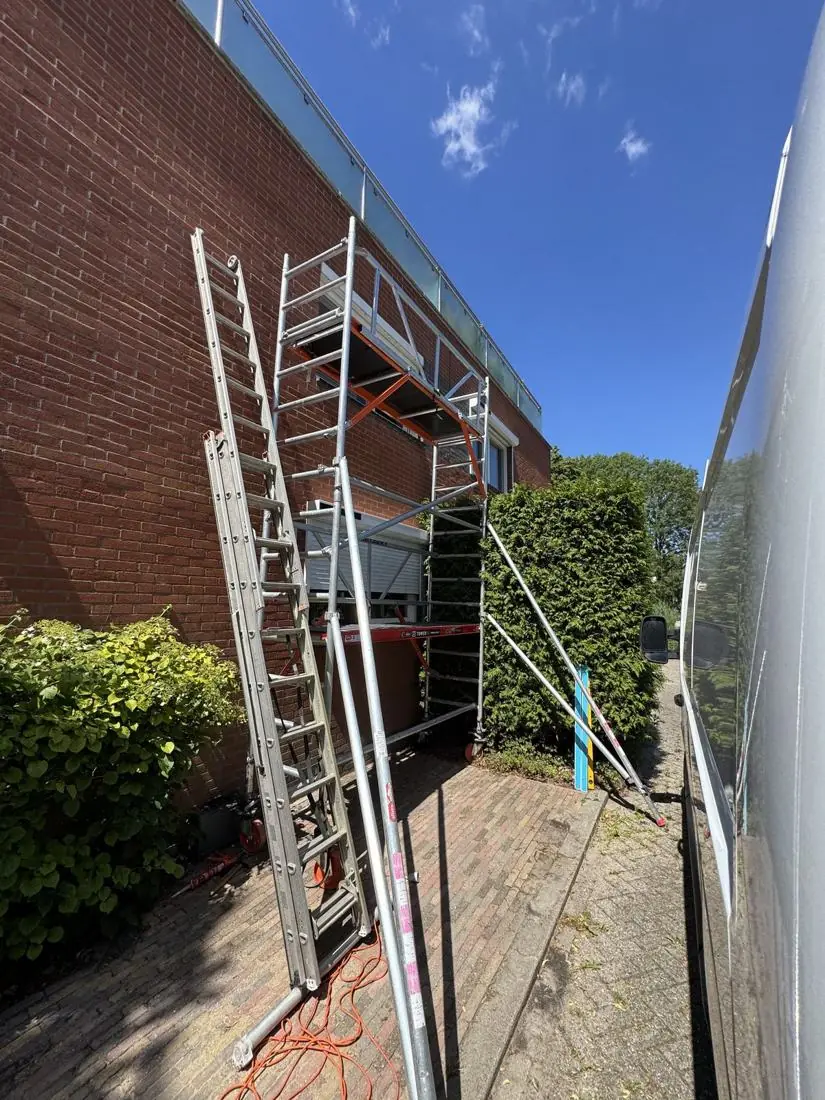
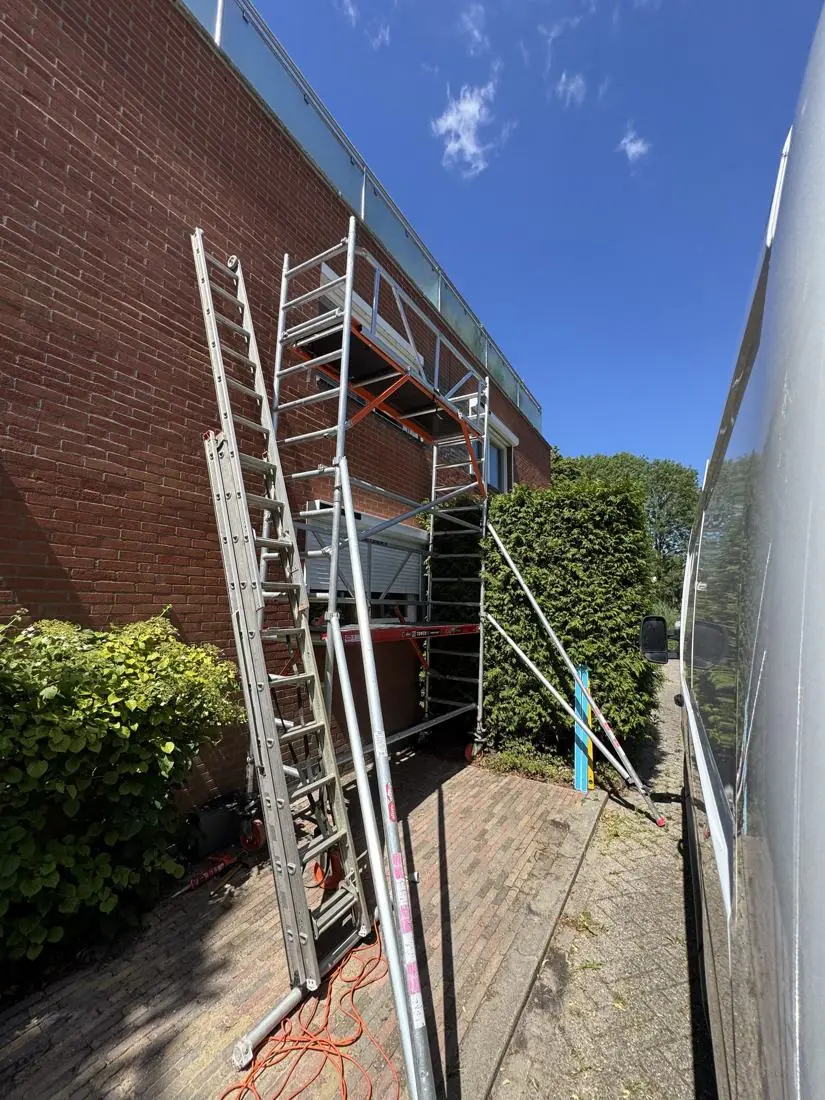
Assembled tower against a brick gable, guardrails at the boards and a separate ladder leaning on the wall beside it.

Finally, pay attention to the head itself. A chimney that has never carried a cap has stood open for years, so the top courses of brickwork may well have worked loose. Push against them before you drive any anchors in, or you are fixing a heavy plate onto bricks that were never going to hold it. The order of assembly and the checks that go with it are covered under safe assembly of a mobile tower.

In 5 steps

How hiring a mobile scaffold works

1
Choose working height

Pick the height that suits your job.

2
Book online

Sorted in 60 seconds, price shown instantly.

3
We deliver

At the agreed spot the next working day.

4
Assemble safely

Assembled by you, with a manual.

5
We collect

One call and we collect the scaffold.

Good to know

Practical tips for fitting a chimney cap

1

Type the four outside dimensions and both diagonals straight into your phone instead of writing them on an offcut. A note like that goes missing up on the head and then you are measuring again a day later.

2

Knot a rope to the cap before you lift it and have somebody pay it out from below. That way the plate never has to be held in one hand while the other reaches for the ladder.

3

Take a spare battery for the drill up with you. A hole in hard brick asks more of a battery than you expect, and walking back down at this height costs five minutes every time.

4

Put an old blanket or a strip of bubble wrap down before the cap goes on the boards. A coated plate scratches against a scaffold deck, and that scratch is still visible from the street a year on.

5

Order stainless anchors, nuts and washers well before the tower is delivered. Discovering at ten metres that the bolts in your pocket are the wrong size can swallow half a fitting day on its own.

6

Pencil in a collection date one day after the fitting is planned. If it blows too hard to lift a plate on the day itself, you simply move along without the tower having gone already.

Frequently asked questions

Frequently asked questions about fitting a chimney cap

Which tower is the right one to hire for fitting a chimney cap?+

Take the RS52, the wide build with a deck measuring 135 cm across between the guardrails. You need that room because the cap lies flat on the boards while you mark and drill the holes, and because the drill, the anchors and the level all have to fit alongside it. On a narrow 75 cm tower the plate ends up on edge, which is awkward in any breeze. Only a tight garden path is a fair reason to hire a mobile scaffold in the narrow width.

How does the hire run when you are fitting a chimney cap?+

You settle the build and the height online, name the days on which the set may arrive and leave, then pay in advance, VAT included. Once the components have been dropped off you erect the scaffold yourself, take the head from outside face to outside face and, later on, bolt the cap down onto it. On your last day everything lies dismantled and we take it away. The hire mainly asks that you think the order of those steps through beforehand.

How many hire days does fitting a chimney cap normally take?+

Two to three days is usual. Day one goes on assembly and on taking the head from outside face to outside face; then you wait for the cap; and on the final day you bolt it down and strip the tower. Where the plate comes off the shelf it sometimes fits into a single day. Where it is made to your figures, book more generously or leave the hired build standing until the delivery lands, which saves a second assembly.

What is the rental price of a tower used for a chimney cap?+

It follows from the model you pick and the lift you build it to, with a fixed provincial amount for bringing the scaffold round and taking it away. All figures are shown with VAT alongside them, so the sum can be worked out before you commit. What counts on a cap is that the days after the first barely register, which makes waiting for your plate cost almost nothing across the hire. One unbroken period is nearly always the cheaper route.

Which working height should you hire to fit a cap on the stack?+

Work from 8 to 12 metres working height on two storeys, with the scaffold deck between 6 and 10 metres. What matters is looking over the top edge of the head rather than at it, since the cap has to be laid down and nudged square. Measure from your castors to the topmost brick and take the taller build if you are unsure. The page of working heights lists every build with its platform height set out beside it.

Do you have to collect the tower, or is delivery part of the hire?+

Delivery happens on the date you nominate, at a fixed provincial amount in which the collection is already accounted for. Collecting it yourself is equally fine: with an appointment the set waits free of charge in Amsterdam, at Zeeburgerpad 89, assuming your trailer takes the full load. A build reaching above a chimney head is a considerable stack of tubes and boards, so most people hiring would rather have the tower brought round than make two journeys.

Does the hire include building the scaffold for fitting a chimney cap?+

No, the assembly is left to you. We bring the complete set round and take it away later; putting it together and stripping it down belong to what you hire. The instructions supplied run through the steps and with two pairs of hands you are up top inside a morning. Budget that time separately, because hardly anyone manages to erect a tower and then bolt a cap down on the very same afternoon. Nor do we hire out cherry pickers.

What if the cap arrives late and the tower is needed on hire for longer?+

Pass the new date on to us and we move the collection accordingly, provided the build is not already promised to somebody else that week. With a made to measure plate that is a realistic prospect, since the delivery depends on the figures you sent in. Anyone who can see it coming books a few extra days from the outset, because the end date may always be brought forward once the cap turns up early. That way the scaffold never stands waiting for nothing.

How much space has to be clear under the chimney for the hired tower?+

Allow the footprint of the scaffold itself and then the outward reach of the four stabilisers, and keep room on one side for hauling the plate up. Beyond that you want a strip where drilling dust and a dropped plug may land. A shed or a dense hedge against the wall shifts the whole build to another face of the house, and sometimes the approach with it. Walk that spot over with a tape before you hire the tower, rather than afterwards.

Can you fit a chimney cap on a windy day during the hire period?+

Better not. A flat plate catches the wind like a sail and pulls at your arms just as you lean over the edge of the head. The tower stays standing regardless, so you move the fitting to the next calm morning. Use a blustery day to clean the head off, run through your figures again, or lay the anchors and washers out ready in order. An extra day on hire costs less than a plate fixed out of true.

What happens to the deposit once the cap is bolted down and the hire ends?+

Your deposit returns 1 working day after the tower is back with us and every part of the set has been counted through. Watch, on this job, that no drilling dust or cement haze is left behind on the boards and that each component goes back on the van. A cap nut or a brace left lying in the garden shows up at once in the count and slows the whole thing down.

Can you bolt down every side of the cap from one hired tower?+

Usually yes. A chimney head is narrower than a 245 cm platform, so from one position you reach two sides and often three. For the fourth you roll the scaffold round once, which takes little time with the cap already secured. Where the head sits in the middle of the slope rather than near the edge, you cannot get at it from below at all, and hiring a tower for this particular job serves no purpose. Check that point before you look at anything else.

Hire a mobile scaffold for fitting a chimney cap today?

Calculate your rental price now or ask for free advice.

Rolsteiger van SteigerTaxi geleverd op locatie
Book it online

Your scaffold sorted in 2 minutes.

Choose your scaffold and working height, see the price instantly and book online.