
Knowledge base · reading time 11 min
Which scaffold do you use for washing windows?
Washing windows at height needs two free hands, a stable place to stand and room for your bucket, squeegee and cloths. A mobile scaffold gives you all three, and you roll it along the facade so you work the windows strip by strip. Below is how to set the working height, which model suits your facade, where to position the set-up and how to plan the round so you are not climbing up and down needlessly.
- Washing high windows? How to set the working height, choose between a narrow or wide mobile scaffold and work safely along the facade.
- Measure to the head of the highest window and subtract 2 metres for the platform height.
- You can, provided you spread the load with boards and level the set-up after the stabilisers are extended.
- That depends on your facade, but count on the strip matching the 245 cm platform length, plus some reach to the side.
Why glass work is faster from a mobile scaffold than from a ladder
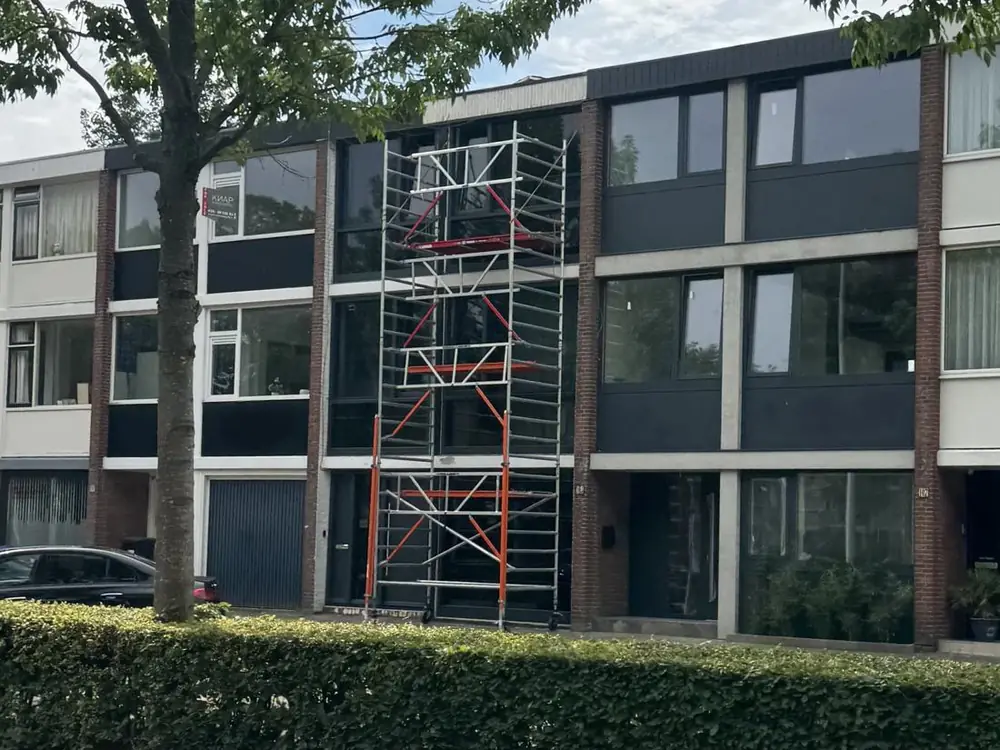
Washing windows is work where both hands are busy and your weight shifts at the same time. On a ladder that is impossible: one hand holds on, you reach sideways and you lose the pressure needed to pull a squeegee across the glass in one pass. On a platform you stand still, use both hands and work the window in strips the way it should be done.
The second difference is how often you go up and down. From a ladder you reposition for every window, sometimes for every pane, and each move costs you climbing down, shifting and checking again. From a mobile scaffold you work a strip of facade from one position and take several windows in a row, including the frames and the sills beneath them.
On top of that, you have somewhere to put your kit. Bucket, squeegee, applicator, scraper, cloths and a roll of paper sit on the platform instead of hanging from a hook on a ladder. That saves mess, and above all it saves the moments where you have to climb with a full bucket in one hand. See also ladder or mobile scaffold.
Key facts
| Feature | Value |
|---|---|
| Core answer | For high windows a platform beats a ladder on safety and speed |
| Working height | Platform height + 2 metres |
| Available working heights | 4.2 to 14.2 metres |
| Castors | Swivel castors with brakes, locked while in use |
| Each extra day | 95% off: €2.50 to €16.25 a day |
Setting the working height for your highest window
Working height is platform height plus 2 metres, because an adult reaches roughly two metres above the platform they stand on. For glass work, though, what counts is not only what you can touch but what you can work comfortably. A window that just falls within reach gets washed with outstretched arms, and that leaves streaks. So choose a platform height that puts the top of the window somewhere between shoulder and eye level.
Measure to the head of the highest window you want to do, not to the roof edge or the ridge. Subtract 2 metres for the platform height and then choose a set-up just above or just below it. The working height page lists set-ups per metre, and 8 metres working height is a size that reaches the top windows on many houses.
The range covers working heights from 4.2 to 14.2 metres, so there is a suitable set-up for virtually every house and many commercial buildings. If you are between two sizes, choose the height that also lets you take in the top of the frame and the sill below it. Each floor level shows the heights that go with it. If you are in doubt, take the height at which you still reach the top light without stretching.
Narrow or wide: which mobile scaffold fits along the facade
The RS51 is the narrow mobile scaffold at 75 cm wide, the RS52 the wide one at 135 cm. Both have a platform length of 245 cm, so from one position you reach the same strip of facade. The difference is what you can put beside you: on the wide version a bucket of water stands next to you without being stepped over constantly, and on glass work you notice that immediately.
You choose the narrow version when the space along the facade forces it. A path of 80 cm along the side wall, an alley between two houses or a planted border often leaves no room for a wider base. Measure the passage at its narrowest point and remember that the stabilisers extend outwards at the bottom, because they set the real footprint.
Both models are made by Altrex and comply with EN 1004, in load class 3. That comes down to 200 kg per square metre of platform, so one person with a bucket of water, tools and a stock of cloths stays well inside the limits. What that means for what you take up is covered in load and weight on a mobile scaffold.
The models side by side for glass work
The overview below shows which model belongs to which kind of glass work. The choice depends mainly on two things: how high the highest window sits and how much space there is along the facade or in the room. The rest, such as platform length and load capacity, is identical across the mobile scaffolds. Read the rows from top to bottom and the model that suits your facade stands out on its own.
When you read it, pay attention to the last column in particular. Many people choose on height while accessibility of the set-up position is what decides in practice, certainly on a rear facade with a garden, a terrace or a shed in between. So measure that space before you choose a model, and allow for the extended stabilisers, which stand wider at the bottom than the frame itself does.
| Model | Width | Platform length | Working height | What you use it for |
|---|---|---|---|---|
| RS51 | 75 cm | 245 cm | 4.2 to 14.2 metres | Windows along a narrow path, an alley or a border |
| RS52 | 135 cm | 245 cm | 4.2 to 14.2 metres | Windows and facade glass where you take up material |
| MiTower | One-person scaffold | Single platform | Up to 6 metres | A single high window or roof window, done alone |
| RS44 room scaffold | Fits an interior door from around 70 cm | Single platform | Indoors | High interior windows, a conservatory or a stairwell |
What you take up onto the platform
Window cleaning takes little strength but a lot of kit. You need water, something to apply it with, a squeegee, cloths for the edges, a scraper for paint specks and usually something for the frames. Take it up in one go rather than in three trips, because every climb is time you are not spending on the glass. Two trips instead of five is the simplest saving there is on a window round.
Put your bucket down where you will not step into it walking backwards, so against the guard rail on the side you came from. Water on an aluminium platform makes it slippery, and that is the main reason people lose their footing on a scaffold. So take a dry cloth up as well to mop spills before you carry on.
- A bucket you can set down stably, preferably with a wide base.
- An applicator and squeegee in the size that suits your panes.
- Dry cloths for the edges and a separate cloth for spilled water.
- A scraper for paint specks, limescale or bird mess that has set.
- Something to clean the frames and sill with while you are up there anyway.
- A closable bottle for your cleaning agent, so nothing tips over on the platform.
Repositioning along the facade and the number of positions
With a platform length of 245 cm you work a strip of facade of a little over two and a half metres from each position, plus some reach to the left and right. On an average house facade that means two to three positions per elevation. Count those positions in advance, because they decide how much time you need and therefore how many days you hire the equipment.
You reposition with nobody on the scaffold. Take your kit off the platform, retract the stabilisers, roll to the next position, extend the stabilisers again and check that the set-up is level. That takes a few minutes each time, and those minutes are exactly why you want to finish everything at one position before moving on. Do not leave a bucket or squeegee on the platform while you roll either, because it falls off.
Work from top to bottom as you go. Water used higher up runs down the facade, and if you start at the bottom you get to do those panes twice. On a facade with several rows of windows, wash the top row across the full width first and take the row below it afterwards. That way no pane has to be done twice, which easily saves you half a day on a full house.
High windows indoors, in a conservatory or a stairwell
Not all glass sits on the outside. High interior windows, a void, a conservatory and the glass in a stairwell are places where a ladder stands awkwardly or not at all. The room scaffold RS44 is made for exactly that: it fits through a standard interior door from around 70 cm, so you assemble it in the room where the work is.
Working indoors does call for protecting the floor and whatever stands around it. Lay sheeting or cardboard down before you assemble, including under the spot where you put components temporarily. Water and cleaning agent on a wooden floor or a staircase are harder to put right than outdoors on paving. More on that is covered in using a mobile scaffold indoors.
In a stairwell or beside a void the floor is rarely level throughout. Check first whether the whole set-up fits on a flat section and whether you can still get past the structure through the doors you need. Also see the application page on conservatory cleaning for the attention points on sloping glass. On sloping glass, work from the ridge downwards, or the water runs over what you have just finished.
The ground beneath the windows: borders, paving and gravel
Windows rarely sit above a level terrace. Beneath a front elevation there is often a planted border, beneath a rear elevation grass or gravel, and along the side a narrow path falling away towards the garden. In practice that decides where the scaffold can stand, and therefore how many positions you need to reach every window. So look at the ground beneath your windows first and at the height of the facade afterwards.
On soft or loose ground, put boards under the castors to spread the load, and level the set-up again after the stabilisers are extended. On gravel the castors sink as soon as you put weight on the platform, so check once more after assembly. The guide on a mobile scaffold on uneven ground covers the approach. If in doubt, put one board too many under the castors rather than one too few.
Walk the route along the facade once on foot before you order. Watch for manhole covers, a cellar hatch, a sunken paving slab and the point where the downpipe discharges, because those are where a set-up ends up not quite level. On an apartment or a shared walkway there is also the question of whether you may use the position; see which scaffold for an apartment.
Water, grip and safe working on the platform
The biggest risk in washing windows at height is not the height but the water. An aluminium platform with a film of soapy water on it is slippery, and you only notice when you step sideways with your attention on the glass. Take a cloth, mop spills straight away and set your bucket down where it cannot tip over when you turn round.
Never reach past the guard rail to just catch a pane. That is precisely the moment people lose their balance, and it is unnecessary as well: repositioning takes a few minutes and gives you a better working posture. What else to check before you climb is set out in working safely at height. Reposition once more rather than trying to catch a pane with your arms outstretched.
If you work with an extension pole or a hose-fed system, keep the hose off the platform and do not let it hang over the edge where it can snag. In wind, glass work stays awkward, because the wet surface dries faster and you get streaks. For the result, an overcast, still day beats bright sunshine. Check the forecast the evening before, because a still morning is worth more than a dry afternoon.
When something other than a mobile scaffold makes more sense
For a single high window you do once a year, a full mobile scaffold set-up is sometimes more than you need. The MiTower is a one-person scaffold up to 6 metres working height that you assemble and reposition alone, and for a single window or a roof window it is often exactly enough. Above that height you end up with the mobile scaffolds anyway.
If the glass sits where no set-up can stand level and load-bearing, for instance above an extension or a conservatory, a mobile set-up is not the answer. In that case compare the options in mobile scaffold or cherry picker before you book anything. Look at whether the glass is easier to reach from the inside than from the garden as well.
For large areas of glass in a facade, on a commercial building for example, it pays to work out the number of positions in advance. Beyond a handful of moves per day the nature of the work changes. The application page on facade washing describes that kind of work in more detail. Allow for more water on surfaces like that, and therefore more trips down for a full bucket.
Hiring, delivery and the period for a window round
Washing the windows of a house is usually a day of work, sometimes two if you take in frames and sills as well. Order before 15:00 and the scaffold is delivered the next working day, anywhere in the Netherlands. Delivery and collection sit in a fixed amount per province, so you know the figure before you order; see delivery cost for your address.
If you want to collect the equipment yourself, that is free by appointment at Zeeburgerpad 89 in Amsterdam. You then need transport that fits the longest components, and the deposit is higher on collection than on delivery. On delivery the deposit is 500 euro for the RS51, the RS52 and the MiTower and 150 euro for the room scaffold; every amount is on the scaffold hire deposit page.
The first hire day costs the full rate and every following day 5 percent of that day rate. So book a day extra rather than too tightly, certainly if you also want to go over the outside frames or the forecast is changeable. Rates per model are on the prices page, and the deposit comes back within 1 working day after return.
Mistakes that cost you time on glass work at height
Most time is lost to unnecessary climbing. Anyone who leaves the bucket at the bottom, forgets the squeegee or discovers halfway that there is no dry cloth left goes down an extra time per window. Across three positions that is soon ten descents, which is more time than assembling the whole scaffold takes. So before you climb, lay out everything that position needs, spare cloths included.
The second category is choices that spoil the result. Working in full sun lets the water dry before the squeegee reaches it, and working bottom to top means doing the lower panes twice. For the approach per job, the attention points are set out under window washing and glass cleaning. Start on the shaded side of the house as well and work with the sun rather than against it.
- Take everything up in one go rather than climbing for each item.
- Finish every window at one position before you roll the scaffold on.
- Work top to bottom so dirty water does not run over clean panes.
- Avoid working in full sun, because the water dries too quickly.
- Mop spilled water immediately instead of stepping around it.
- Never reach past the guard rail for the one pane just out of range.
Frequently asked questions
What working height do I need for the top windows of a house?
Measure to the head of the highest window and subtract 2 metres for the platform height. Then choose the set-up that puts the top of the window between shoulder and eye level, so you do not have to stretch. The range covers working heights from 4.2 to 14.2 metres.
Can I put the scaffold on a border or on gravel?
You can, provided you spread the load with boards and level the set-up after the stabilisers are extended. Check again after assembly, because castors sink into loose ground as soon as weight goes on the platform. Walk the route in advance to find sunken slabs and manhole covers.
How many windows do I do from one position?
That depends on your facade, but count on the strip matching the 245 cm platform length, plus some reach to the side. On an average house facade that works out at two to three positions. Finish every window at a position, including frame and sill, before you move on.
Can I stand on the platform with a bucket of water?
Yes, the load capacity is more than sufficient: load class 3 means 200 kg per square metre of platform. Watch spilled water above all, because it makes an aluminium platform slippery. Put the bucket against the guard rail on the side you came from and take a dry cloth up.
Is a MiTower enough for my windows?
For a single high window or a roof window up to 6 metres working height it is often exactly enough, and you assemble and reposition it without help. If you want to do a whole facade or keep material beside you, a mobile scaffold is more practical. Above 6 metres working height you need the mobile scaffolds anyway.
How long should I hire the scaffold for a window round?
For the windows of an average house a day is usually enough, two if you include frames and sills. Book an extra day rather than too few, because every following day costs only 5 percent of the day rate. That gives you slack if it rains or the wind gets up.
Can I use the scaffold indoors for high windows?
Yes, the RS44 room scaffold is intended for that and fits through a standard interior door from around 70 cm. Cover the floor before you assemble, because water and cleaning agent on wood or a staircase are hard to put right. Check as well that the set-up passes doors and a stair rail.