
See your price
Application

Washing a conservatory? Choose the right scaffold.

Washing a conservatory is the round you repeat two to four times a year. It is not a deep clean, simply glass that has to read clear again: the sloping roof first, then the upright panes, and last of all the inside against the light. It goes quickly, provided you are not climbing down every few minutes to shift your stand. That is why you hire the MiTower here, one person and light enough to nudge along yourself, put up between 4 and 6 metres of reach and rolled along the glazing in stages.

  • Order before 3 pm, delivered tomorrow
  • Professional Altrex scaffolds
  • Up to 14.2 metres working height
  • Easy to assemble yourself
4,2 tot 14,2 mWorking heights available
12Provinces served
7Days a week
200 kg/m²Load class 3
In short
  • For washing a conservatory we recommend the 1-person scaffold.
  • For a wash round along the glass you rent the MiTower, the one person 75 cm tower, and build it low.
  • Work from the ridge down to the gutter, so dirty water never runs across panes that you have just finished.
  • One hire day usually covers washing a conservatory, as long as you begin early and the sun is not yet on the glass.
  • First 24 hours from €100 incl. VAT and delivery; every day after that 95% off.
Key facts for this job
FeatureValue
Recommended scaffold1-person scaffold (Altrex Mi Tower)
Working height for this job4 to 6 metres
Available working heights4.2 to 14.2 metres
StandardEN 1004, load class 3 (200 kg per m²)
DeliveryOrdered before 3 pm, delivered next working day
Each extra day95% off, from €5 a day
Why a mobile scaffold for washing a conservatory?

Safe, stable and professional work at height

Washing a conservatory is all about flow. A single pane takes half a minute with the squeegee and then you want the next one along, so time lost to climbing, braking and shifting counts for more than the washing itself. A tower you can nudge a metre without calling anyone over therefore beats one that two people have to shoulder. On top of that you go up with wet hands and a bucket on your arm, and on the sloping roof surface you reach further than you would at an upright window. A ladder cannot keep that pace: it moves pane by pane and leaves you one hand.

  • Ridge to gutter, and never the other way
  • Streaks only ever show from inside the room
  • Suds that dry off leave lime rings behind
  • Washing a conservatory means shifting every few minutes
Read more about working safely →

Which tower to hire for washing a conservatory yourself

For washing a conservatory you hire a mobile scaffold built around a single user, the Altrex MiTower at 75 cm across the frame. Its whole merit on this job is weight. You shift it a metre between two panes on your own, without calling anybody out of the house, and over a morning that saves the better part of an hour. The 245 cm deck still takes two or three panes per stand, so you move less often than the glazing suggests. The choice appears in the overview of mobile towers for hire.

Up on the deck this work asks very little of you: a bucket of suds, an applicator, a squeegee and a chamois in your back pocket. All of that sits easily on a floor 75 cm across, and any more width would only push you back from the glass you are trying to reach. Length is the measurement that earns its money, because over 245 cm you walk two or three panes off in a single stand without shifting your feet. Anything else waits at ground level.
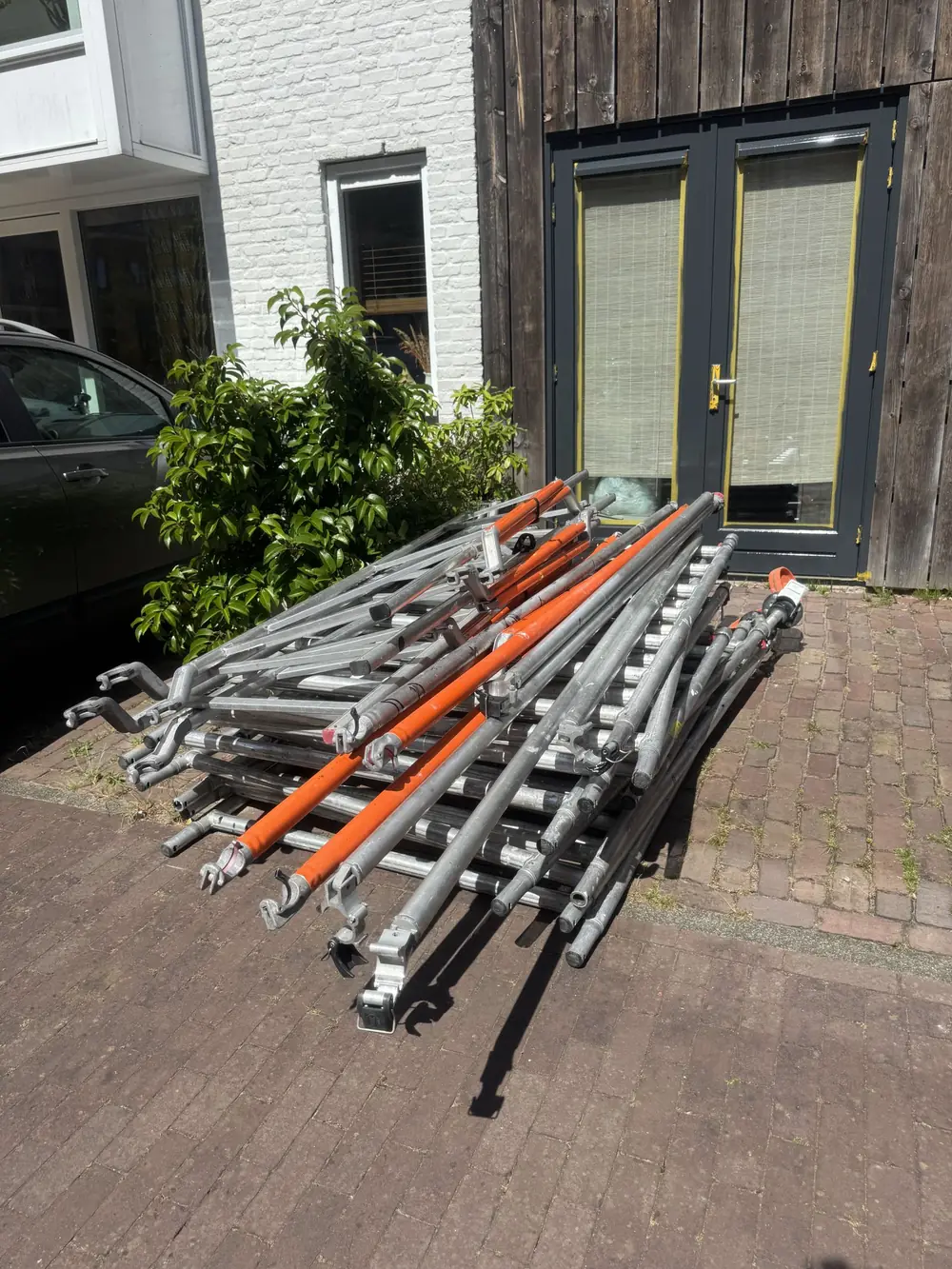
Narrow mobile scaffold standing along the wall of a house, the rented set-up you roll along while washing a conservatory

There is one case for stepping up to the RS51, the rolling tower of the same 75 cm that carries on far above 6.2 metres: a wash round that does not stop at the conservatory but runs on up the wall to take the first floor windows in the same session. Moss grown into the joints and silted drainage holes are a different booking again, slower and drier, laid out day by day on the deep clean round on a conservatory.
Deck height and reach when you hire for conservatory glass

The top of the job is the line where the glazed roof meets the brickwork, and that is also the dirtiest pane on the whole structure, since everything running off the wall passes over it. Put the end of your tape on that line rather than on the house gutter far above it. A garden room on the ground floor usually brings you out between three and four metres, and a 4 to 6 metre build answers that neatly. Booking a taller tower than the glass needs gains you nothing at all.

The number you book is not the height of the floor you stand on. Working height on the order is the deck plus about two metres of arm, so a deck at two and a half metres has you squeegeeing comfortably to roughly four and a half. That is the right band for a single storey garden room with a low pitched roof over it. Which build goes with which figure appears on the page about a five metre working height.

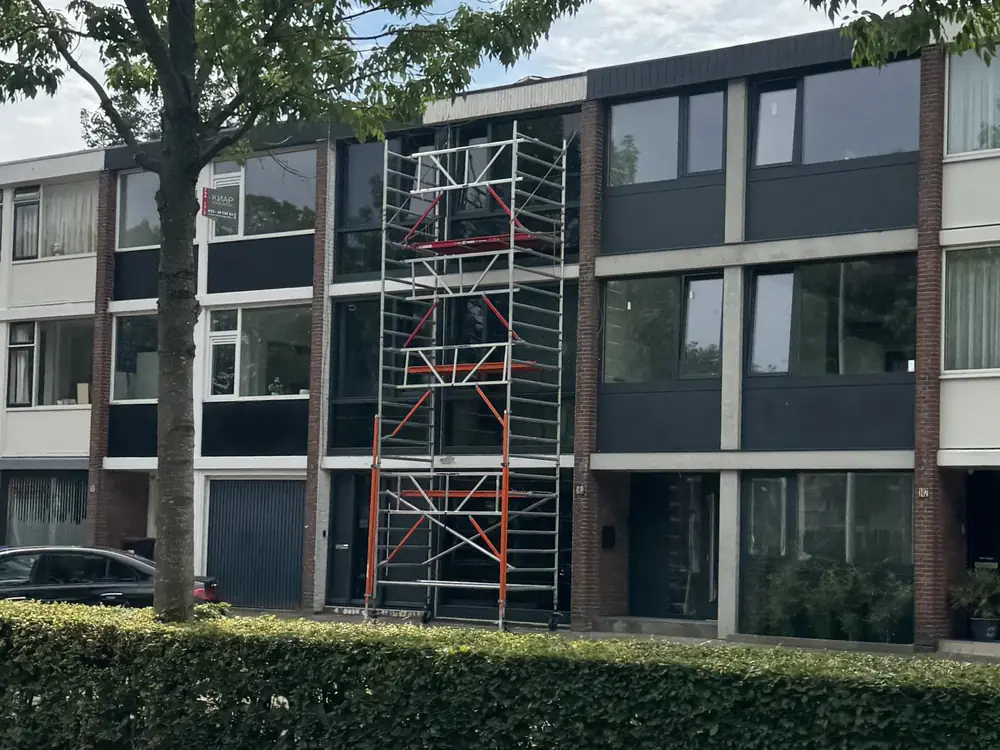
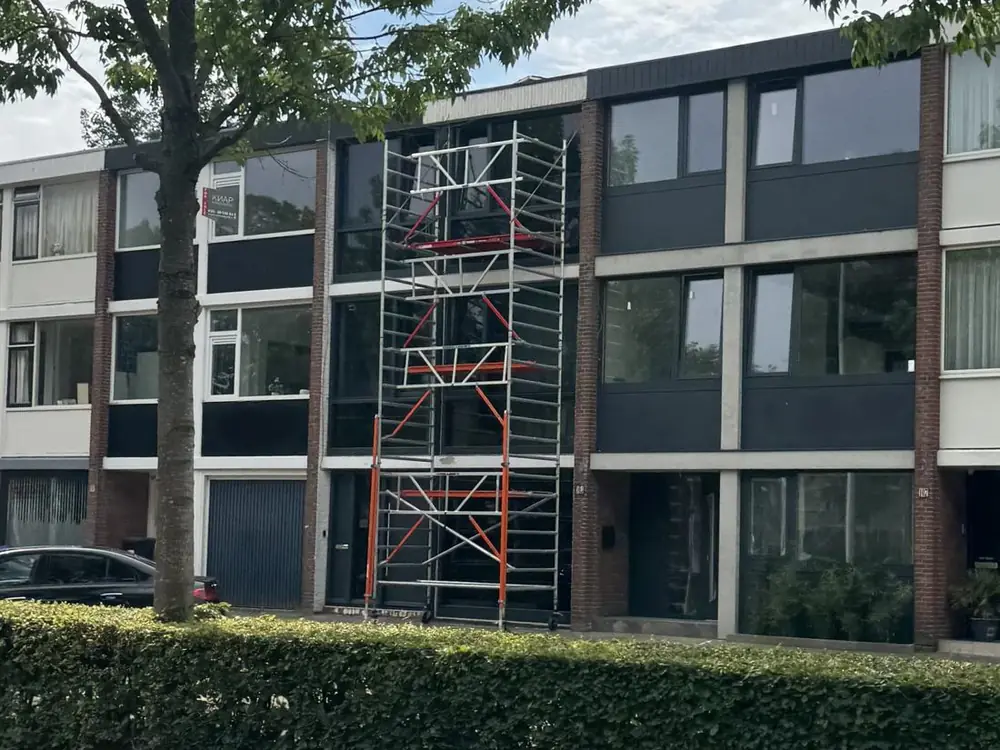
Mobile tower built against a front elevation, the deck height set from the line where a glazed roof meets the wall

There is a second reason not to book tight. On the sloping roof surface you reach further out than at a flat pane, and that extra arm length has to come from somewhere. Standing higher you look down onto the glass and see at once where suds are still lying; standing low you look along it and miss exactly those patches. Where two builds would both do the job, take the taller of the two, because an extra section costs minutes while a second visit costs you a whole morning.

A rolling run beside the glass for your hired tower

On a wash round one perfect position matters less than an unbroken run. You shift a deck length at a time, so walk the whole line beside the glazing beforehand and check that the castors can roll everywhere along it. A loose slab, a sunken corner of patio or a raised threshold onto the lawn stops you halfway along, and then you are standing up there with a full bucket waiting. Clear any obstacle before the tower goes up rather than halfway through the round with a bucket in hand.

The garden hose belongs in that picture too. You want to top the bucket up at ground level without walking to the tap every time, so lay the hose on the side where you start and drag it along with you. Make sure it never lies under a castor or across a stabiliser leg, because that is where it snags the moment you move the tower. The same goes for the extension lead of a vacuum; coil both of them up as soon as a stand is finished and before you release the brakes.

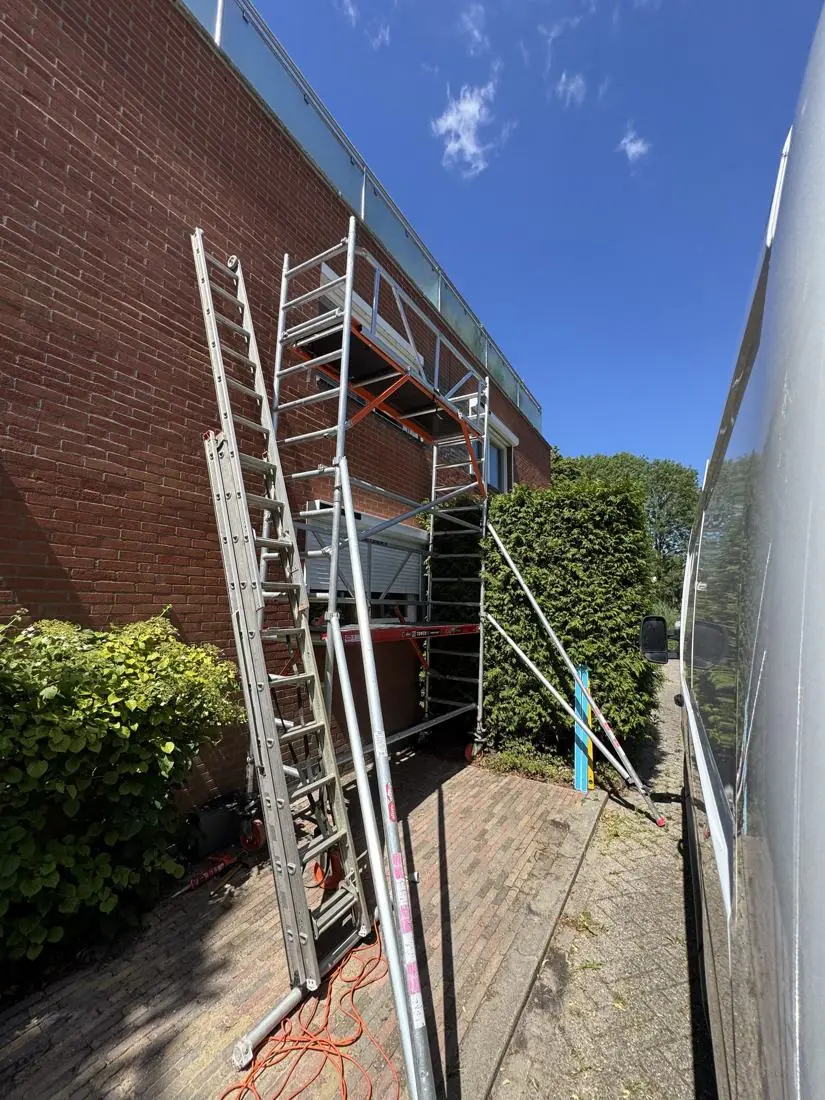
Rolling tower put up beside a side elevation, the unbroken run of ground its castors have to travel along

Think about what happens below you as well. Suds running off the sloping roof land on the border, on the garden furniture and on the paving below, so move chairs and cushions aside and cover anything tender. Where the conservatory sits on the boundary, warn the neighbours before you start rinsing anything down. And check whether the ground still carries after rain: on soaked grass the castors sink in and the tower leans out of true before you notice it.

One hire day, or two, for a conservatory wash round

An average conservatory washes down in a day, and often in a single morning. Allow a quarter of an hour to twenty minutes on each stand for the roof and the upright panes together, plus the time it takes to move along. With three or four stands you are finished by early afternoon, the inside of the glass included. Only a conservatory that turns a corner, or one nobody has touched for two seasons, pushes the work into a second day of hire.

Even so, hardly anyone books exactly one day. The weather steers this job harder than you would expect: sun on the glass dries your suds before the squeegee arrives, and frost freezes the pane shut on you. A day of slack in the hire lets you swap mornings around without rebooking anything at all. A generous period makes sense here for a second reason as well, since day one carries the standard figure and 95 per cent is taken off each further day you keep the tower.

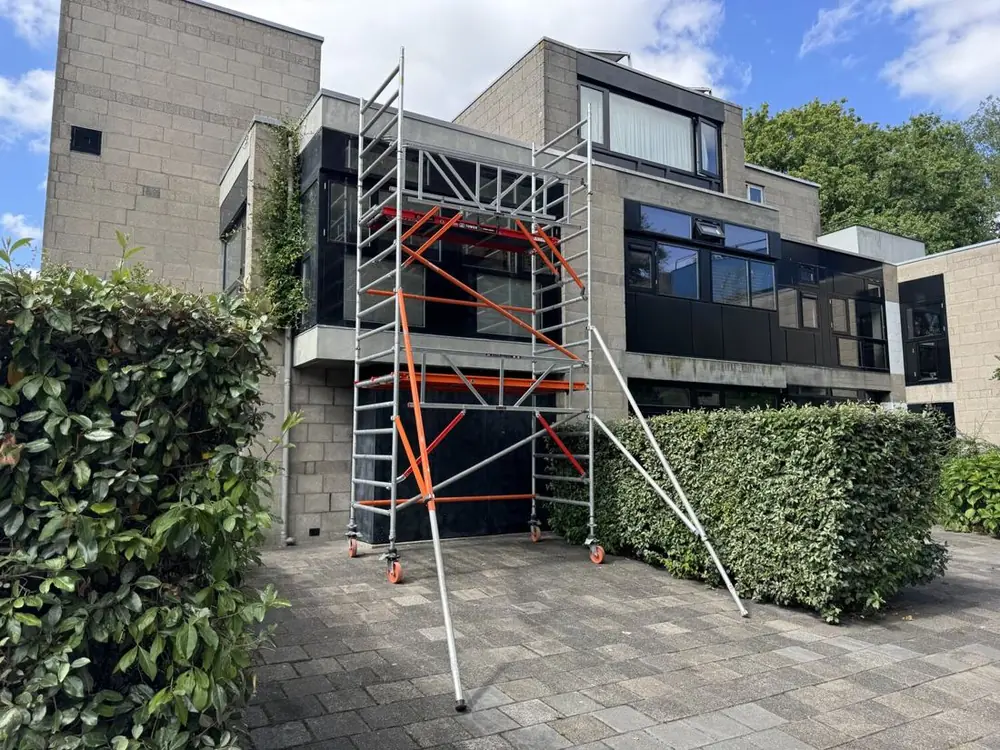
Assembled tower beside a modern house, the single hire day a wash round usually keeps it standing there

If washing a conservatory is only part of a full clean round the house, count further. Doing every elevation of a dwelling soon takes two days, and you do not want the tower collected halfway through. Which jobs need how long is laid out in the guidance on judging a hire period. Push your end date a day further out rather than a day nearer, because rebooking the same tower later starts you again on a full opening day.

Which mobile scaffold suits washing a conservatory?

Kamersteiger RS44
  • Working height up to 4 metres
  • Compact and narrow
  • Great for indoor and small jobs
View and calculate →
Smalle rolsteiger RS51
  • Working height up to 14.2 metres
  • Narrow (75 cm)
  • Ideal for narrow passages
View and calculate →
Brede rolsteiger RS52
  • Working height up to 14.2 metres
  • Wide platform (135 cm)
  • Extra stability and workspace
View and calculate →
Most chosen
1-persoons steiger MiTower
  • Working height up to 6.2 metres
  • Very compact
  • Quick and easy to assemble
View and calculate →

Ridge to gutter along the 245 cm tower deck

Washing a conservatory means coming down the glass, never up it. Start at the ridge profile where the roof closes against the wall, do the sloping panes next and finish at the conservatory gutter. Turn that round and dirty water runs off the top over panes you had already finished, and you are starting over again. For the same reason you complete the full height of one stand before rolling the tower a metre, instead of doing a whole band of roof lights end to end.

The enemy of this work is suds drying on you. With sun on the pane your water has gone before the squeegee reaches it and you polish streaks in rather than out. Work the shaded side, or start early in the day, and wet no more glass per stand than you can pull off again in one movement. Hard mains water leaves lime rings as it dries, so pull each pane straight after wetting it and leave no drops standing on the gaskets.

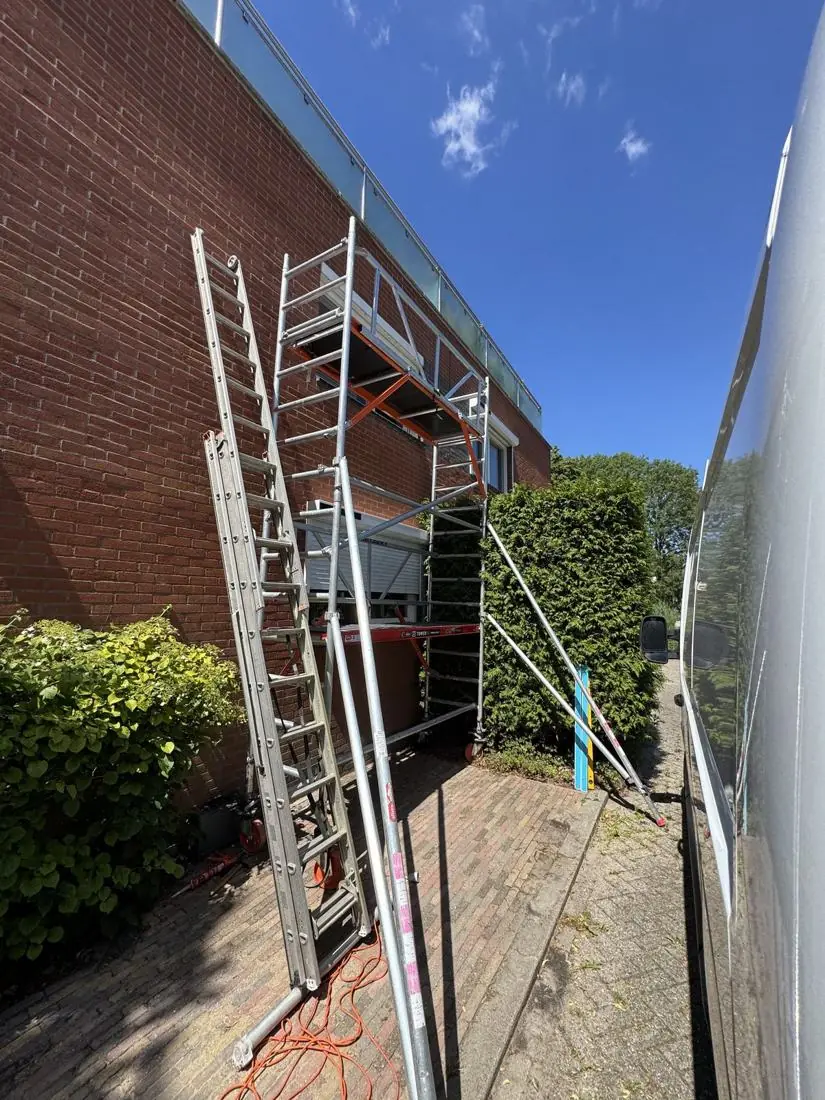
Ladder set inside the frame of an assembled tower, the way up you take with a bucket on your arm

The verdict is passed indoors. A streak on the outer pane is barely visible from the deck, yet from a chair inside the conservatory, looking up against the light, it jumps out at you. Give the outside horizontal strokes and the inside vertical ones, and any streak then announces which face of the glass it sits on. Walk the inside only once the outside is properly dry, and keep the hired tower standing until then in case a pane needs doing again.

Rental delivery timed a day before washing a conservatory

For this job you want an early start, so have the set brought a day ahead rather than on the morning itself. Then you build the tower in the late afternoon and stand ready with a bucket at first light the next day. An order that lands ahead of the 15:00 mark on a working day goes out for the next one, so the set can be waiting on the drive when you get home. Which day they arrive, and which day they leave again, is entirely for you to place in the diary.

What turns up is loose, counted parts, and the building is down to you, with the Altrex video as your guide and the manual beside it. Set the components down on the drive or against the fence, and never on the strip the tower has to roll along later. Allow an hour the first time you build one and appreciably less once you have done it before. What to run through before you climb on is gathered in the checklist for anyone booking a tower.

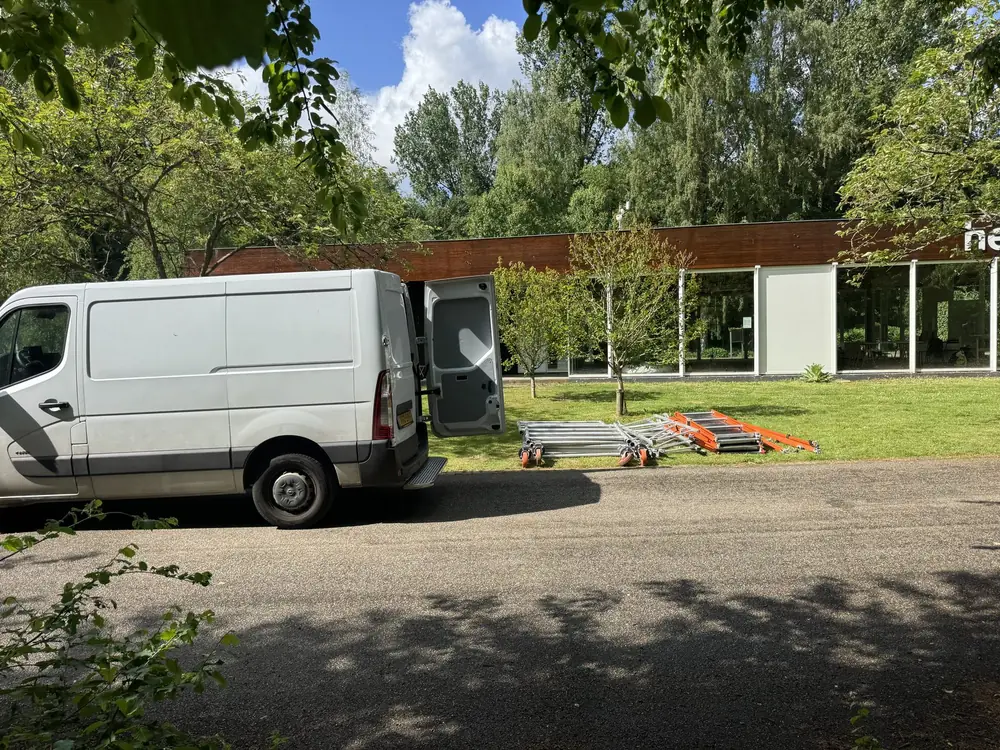
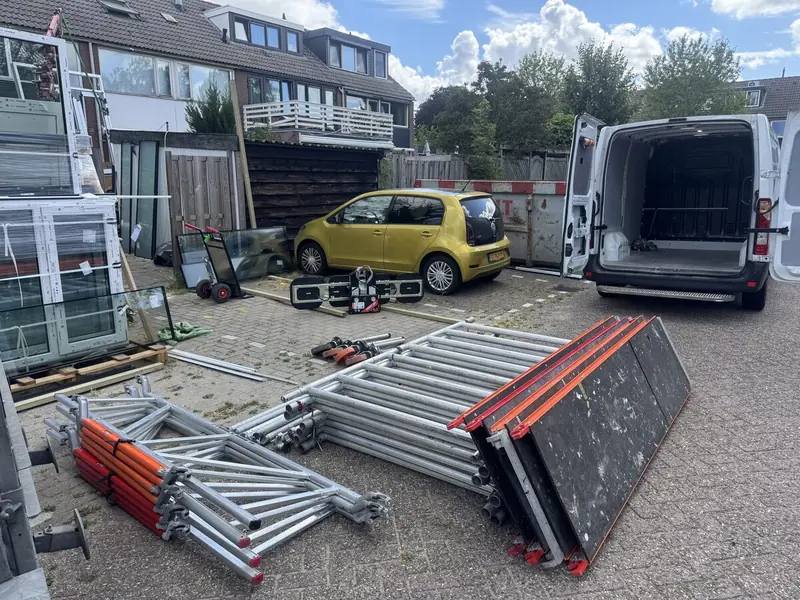
Delivery van loaded with scaffold parts, the drop-off you book for the day before your wash round starts

When you are done, stack the parts complete in one place and the set is collected on the agreed day. Take the tower apart only once the glass is dry, so you are not bundling wet tubes together for the return. Anyone living close by can fetch the set instead: by arrangement it stands waiting at Zeeburgerpad 89 in Amsterdam at no charge for transport. What carriage comes to in your province is shown at the fixed rates for bringing and collecting.

Soap, water and safety on a hired mobile scaffold

Water weighs more than you think. Two full buckets and yourself still do not trouble the deck, which is proved at 200 kg per square metre and falls into load class 3 of EN 1004. Where you do meet a limit is the head count, because this model is designed around one user, so let your helper wash out and rinse down at ground level instead of coming up. What the standard covers is explained at the page on tower classes.

Three things happen without thinking on wet work. The brakes go on before a foot touches the first rung, you never roll the tower with the bucket still up there, and you come down as soon as the wind starts pulling at the sloping roof. Walk round the stabilisers after every move, because short frequent shifts of the tower are exactly when that gets forgotten. A tower you nudge twenty times in a day deserves the same check twenty times over.

Stabilisers wound out under a tower base, the check you repeat after every short shift along the glazing

The particular hazard of this job is soapy water under your soles. Soap on the deck makes it more slippery than a wet roof, and you only notice once you are already sliding. Put a towel down where you stand and wring the chamois out over the bucket rather than onto the deck itself. Mind the glass beneath you too: nothing dropped from the deck lands kindly on a sloping pane. Rails and edge protection are covered at the page on guard rails and fall protection.

In 5 steps

How hiring a mobile scaffold works

1
Choose working height

Pick the height that suits your job.

2
Book online

Sorted in 60 seconds, price shown instantly.

3
We deliver

At the agreed spot the next working day.

4
Assemble safely

Assembled by you, with a manual.

5
We collect

One call and we collect the scaffold.

Good to know

Practical tips for washing a conservatory

1

Start washing a conservatory on the shaded side and follow the sun round. That way you work all day on glass out of full sunlight and your suds never dry anywhere before the squeegee has passed.

2

Take two chamois up: one for the pane and a dry one for the edges and the gaskets. The moment the first is too wet to absorb anything you lose more time than the second one ever cost.

3

Fill your bucket with lukewarm water rather than cold. On a chilly morning the suds keep working longer and you see better on the glass where you have already been, which is awkward on a slope.

4

Hook the bucket over the rail rather than leaving it underfoot on the deck. You will not kick it over when you step sideways, and you are not bending down with a wet squeegee in your hand.

5

Rinse the sloping roof with clean water before you climb down. Lime rings form in the last few minutes, while the suds dry on a warm pane and you are already setting up the next stand.

6

Note which face you gave horizontal strokes before you go inside. Spotting a streak later then tells you immediately which side of the glass it is on, and saves you a pointless climb back up.

Frequently asked questions

Frequently asked questions about washing a conservatory

Which mobile scaffold do you rent for washing a conservatory?+

In practice it comes down to the MiTower, the one person tower of 75 cm. On a wash round like this you are counting stops rather than square metres, and a frame you can shift alone between two panes buys you more than any extra width ever would. The 245 cm deck still takes several panes at a stand. Where the round carries on up the wall to the first floor windows, the taller RS51 in the hire range is what you book instead.

What do you arrange in advance when you rent a tower for this?+

You choose the model and the build online, pick the date it arrives and the date it goes back, and the rental price appears with VAT included as you go. On the day of delivery you receive a counted set of parts, which you put up behind the house. From then until the tower is collected it is yours to use, so you can wash all morning and walk the inside later that day. Stacking the parts up in one place again is the last thing you do.

How many days do you rent a tower for washing a conservatory?+

One day is usually enough for a wash round. A conservatory four to six metres across takes three or four stands, which is a morning of work plus a run round the inside. Many people still add a second day to the hire, because with sun or frost you would rather shift a half day than press on with a poor result. That second day weighs very little against the first, so what you buy is mostly peace of mind.

What does a rental cost for one wash round, and how does the daily discount work?+

The figure depends on which model and build you take; bringing and collecting are charged as a fixed amount for your province. Everything is shown with VAT before you confirm, and the separate figures sit on the page of tariffs per model. For a short job like this it helps to know that the opening day of any tower booking counts for far more than all the ones behind it.

Which working height should you rent to reach the ridge of a conservatory?+

Start the tape at ground level, on the spot the castors will occupy, and run it to the top edge of the glass where the roof meets the house. On a ground floor garden room that lands at around three metres, so the build you rent is the 4 to 6 metre one. If a stretch of wall above the conservatory comes along in the same round, run the tape there instead. The working height overview shows how build and reach relate.

Do you set the delivery day yourself when you rent the tower?+

Yes. You place both dates in the booking yourself, the arrival and the collection alike, and nothing is fixed for you. For a wash round the day before is the best choice: you build the tower late in the afternoon and start early next morning, before the sun reaches the glass. Fetching the set yourself is possible if your car takes the parts. Most people have it brought, because a full set does not fit in an ordinary car.

Do you have to build the scaffold yourself after renting it?+

Building it is your side of the arrangement. A van drops the counted parts off and returns for them when you have finished, but raising the tower, rolling it and taking it apart stay with you. Allow an hour for it, with somebody passing components up to you from the ground. There are few parts on this model and you can handle them alone. Facade scaffolds, system scaffolds and powered access platforms are outside our range, so at conservatory height this narrow tower is where you land.

What if the panes are worse than expected and you want to rent longer?+

Say the word and the collection day moves back, unless somebody is already waiting on that tower. On a wash round it is rarely the glass that causes the overrun but the weather: one shower on your only booked day stops everything for a full twenty four hours. Anyone who would rather not depend on that books two days of hire from the start and hands the set back early when things go well.

How much clear space does a rented tower need on the spot?+

You need a flat run along the whole length of the glazing, wider than the frame itself because the stabiliser legs angle outwards. In practice that means a metre and a half to two metres of clear, free ground at the foot of the tower. Put garden chairs, pots and the barbecue aside beforehand, since you shift position more often here than on other jobs. The bucket, the hose and your spare chamois live in that strip as well.

Can you go on renting the tower when the sun is too strong on the glass?+

The scaffold stays where it is; only the washing gets pushed back. Bright sunlight dries your suds off before the squeegee arrives, so you end up polishing streaks in rather than out. Move round to the shaded side, carry on in the early morning instead, or start with the inside. Since the closing day of the booking is one you set, a shift like that costs a day at most and no fresh reservation.

When is the deposit back on your account after the rental ends?+

Once the parts are counted back in, the deposit follows within a working day. On a washing job watch two points: hand over everything you received, and rinse dried suds off the tubes and the deck before you dismantle the tower. Soap residue and garden mud are by far the usual reasons something has to be sorted out first. What gets looked at is described at the notes on handing your set back.

How does washing differ from a deep clean, and does the hire change?+

Washing is glass maintenance you repeat a few times a year: ridge to gutter, checked against the light, with nothing left to dry on. A deep clean deals with what has grown into the structure itself, with dry preparation in the joints and care for the profiles. For washing a conservatory you take the tower for a day; for the deep round you book two. That job runs on the sister page about cleaning a conservatory.

Hire a mobile scaffold for washing a conservatory today?

Calculate your rental price now or ask for free advice.

Rolsteiger van SteigerTaxi geleverd op locatie
Book it online

Your scaffold sorted in 2 minutes.

Choose your scaffold and working height, see the price instantly and book online.