
See your price
Application

Cleaning a conservatory? Choose the right scaffold.

Cleaning a conservatory is slow work, and that is what settles the tower you hire. The dirt gathers in the joints between the panes, in the green film on the aluminium profiles and in the drainage holes at the foot of the sills, which silt up with moss and grit after a few seasons. Every metre holds you in one spot for minutes on end, dry tools in hand. For the glazed roof and the wall above it you hire a mobile scaffold built to reach 4 to 6 metres.

  • Order before 3 pm, delivered tomorrow
  • Professional Altrex scaffolds
  • Up to 14.2 metres working height
  • Easy to assemble yourself
4,2 tot 14,2 mWorking heights available
12Provinces served
7Days a week
200 kg/m²Load class 3
In short
  • For cleaning a conservatory we recommend the 1-person scaffold.
  • For cleaning a conservatory you hire the MiTower, a single person tower of 75 cm that covers the lower part of its range.
  • Do the dry work first: brush moss and grit out of the joints before water arrives, or you flush it all deeper in.
  • Allow two hire days, because blocked drainage holes and film on the anodised profiles take longer than the glass itself does.
  • First 24 hours from €100 incl. VAT and delivery; every day after that 95% off.
Key facts for this job
FeatureValue
Recommended scaffold1-person scaffold (Altrex Mi Tower)
Working height for this job4 to 6 metres
Available working heights4.2 to 14.2 metres
StandardEN 1004, load class 3 (200 kg per m²)
DeliveryOrdered before 3 pm, delivered next working day
Each extra day95% off, from €5 a day
Why a mobile scaffold for cleaning a conservatory?

Safe, stable and professional work at height

With cleaning a conservatory it is dwell time, not speed, that settles which tower you hire. You shift half a metre, pick a drainage hole open, brush out a joint and check whether the gaskets still seal. That is one person's work, both hands free, with nobody waiting at the bottom. A ladder against a glazed roof is out of the question anyway: there is no load bearing edge to lean it on and you have no hand to spare. So what you rent here is a free standing tower you can move on your own, stand still on for long stretches, and lay your tools out on instead of pocketing them.

  • Moss packed into the joints between panes
  • Drainage holes in the sills opened again
  • Film on the anodised profiles without abrasives
  • Cleaning a conservatory means long dwell per metre
Read more about working safely →

Hiring a MiTower for cleaning a conservatory: why one person

For cleaning a conservatory you book the Altrex MiTower, a tower only 75 cm wide and built around a single user. That suits this job, because there is room for one pair of hands along a run of glazing and no more. The frame is light, rolls on four castors and can be shifted along a patio or a garden path without calling anyone over from indoors. What the model offers across its build range appears on the page about booking a one person tower.

The narrow width earns its keep twice over here. A conservatory nearly always sits at the back of the house, and the route to it runs through a gate, down a side path between the wall and the boundary, or past a fence with a hedge behind it. At 75 cm the parts go through in your hands and you still have room to turn at the corner. On the deck itself you need little: a bucket, a soft brush, a set of probes for the drainage holes and a cloth beside you.
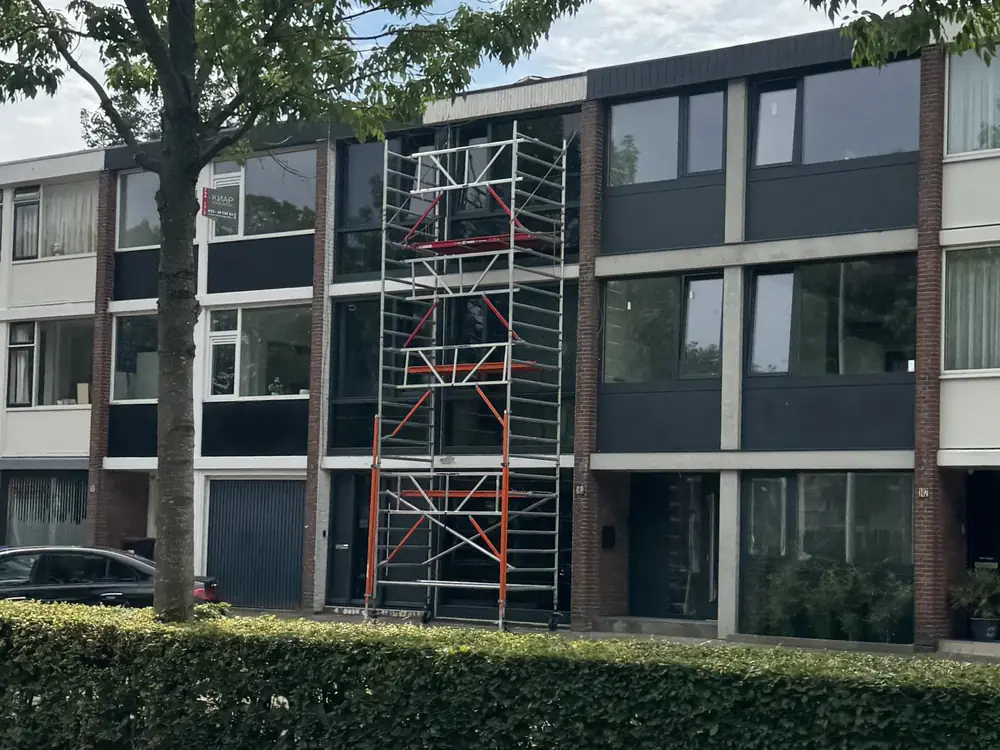
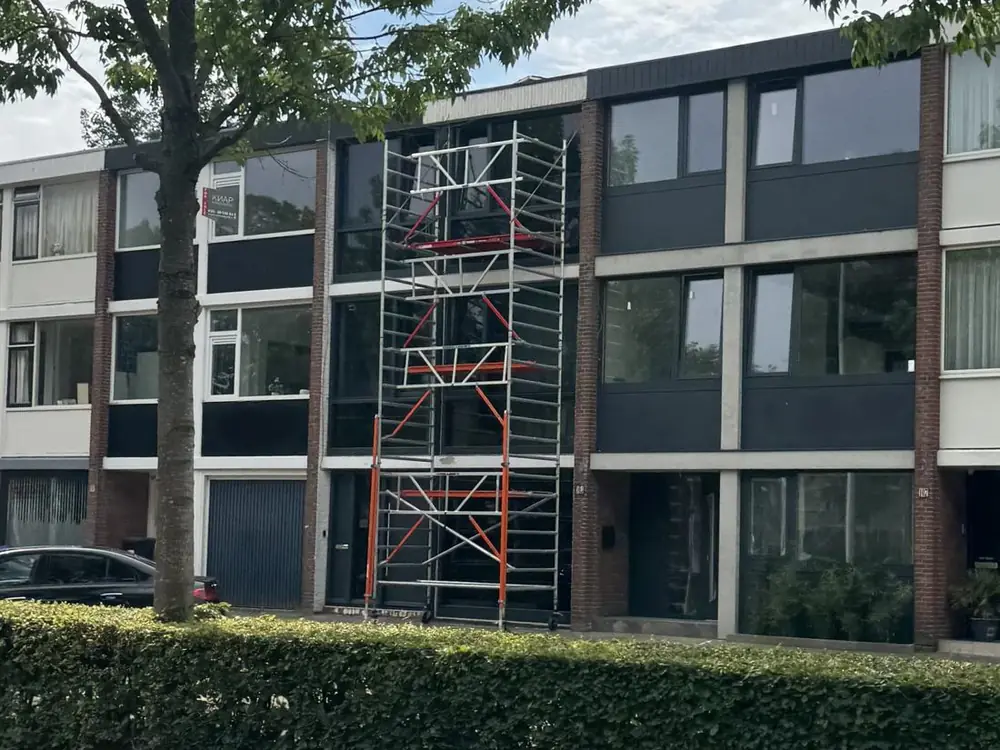
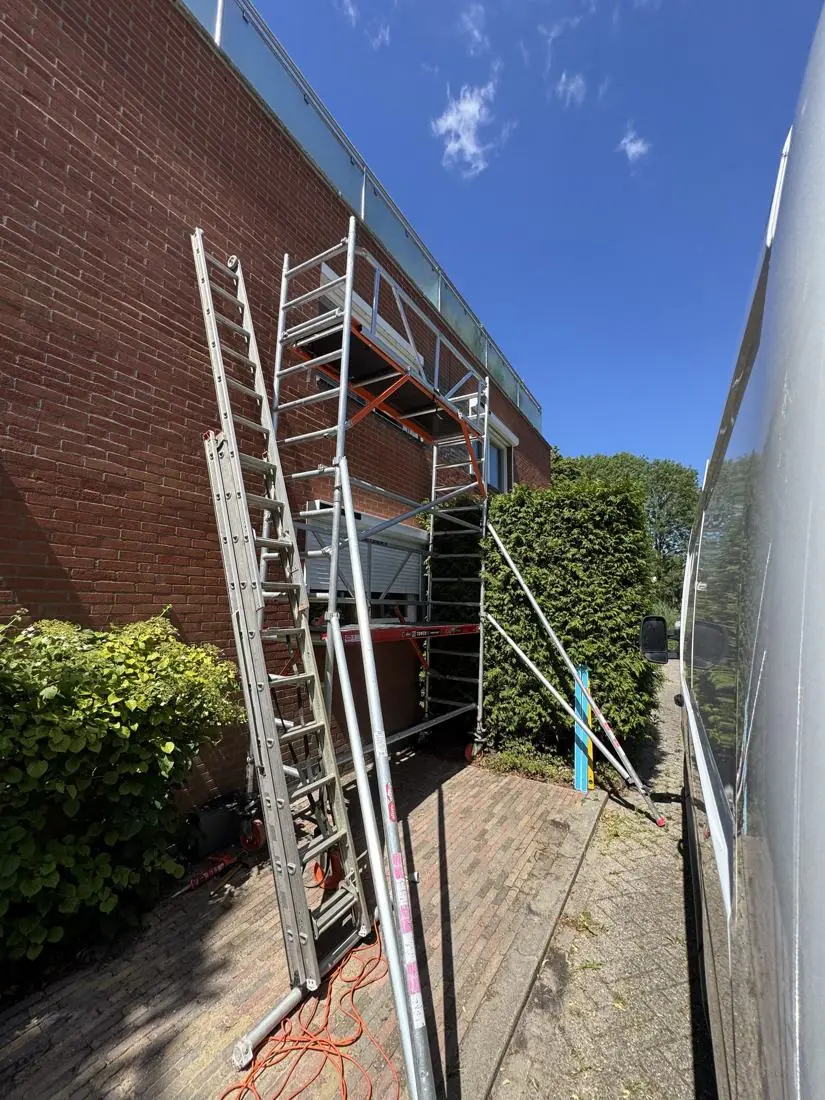
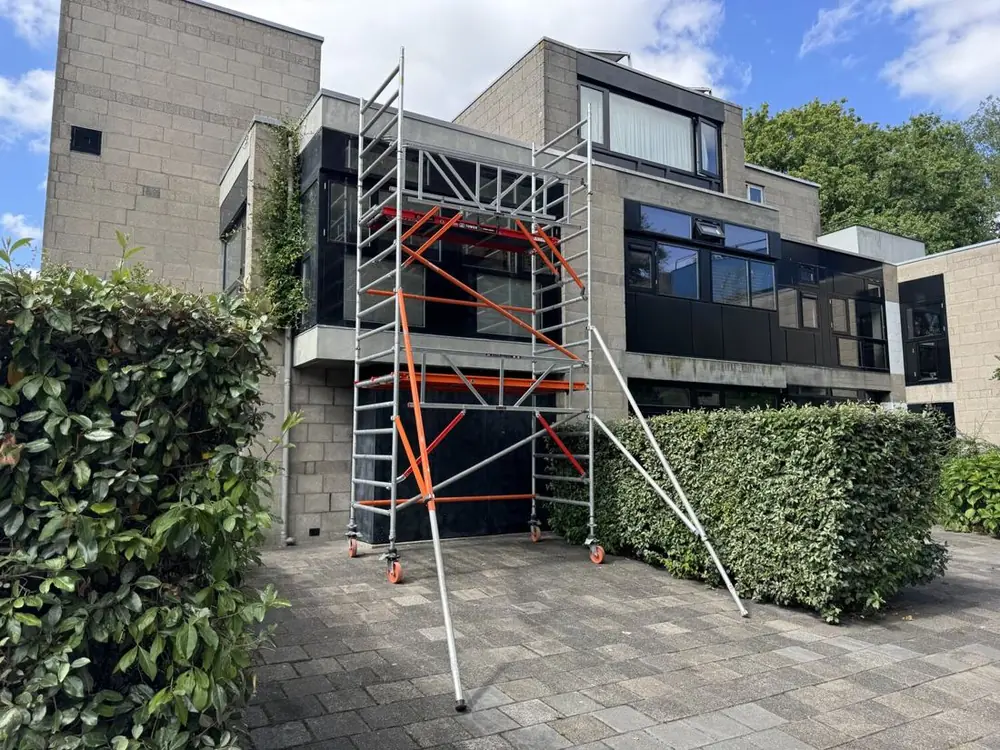
Narrow mobile scaffold built beside a modern house, the type of stand you hire for cleaning a conservatory

Only move up to the RS51, which shares the 75 cm width but carries two, for instance if you are also renewing sealant or lifting out a pane and both tools and materials travel up with you. If all you want is to keep the glass clear between deep cleans, that is a lighter round of its own, described on the page about the routine wash round on a conservatory. For a deep clean the one person tower stays the sensible hire.
Which working height to hire for the conservatory ridge

On a conservatory you do not measure at the gutter but at the highest edge of the glazed roof, where it closes against the back of the house. That closing profile gathers the most dirt of all, because everything washing off the brickwork above runs across it. On a single storey addition that edge usually sits between three and four metres, which puts you in a 4 to 6 metre build. If you want the wall above it as well, measure to the point where you intend to stop brushing.

Working height is not the floor under your feet. It is the deck you stand on plus roughly two metres of reach above it, because your arms carry on well past the guard rail. With the deck at three metres you are comfortable up to about five, and that gap of two metres is exactly why a three metre conservatory does not call for a six metre tower. Which builds match which figure is set out on the page about a six metre working height.

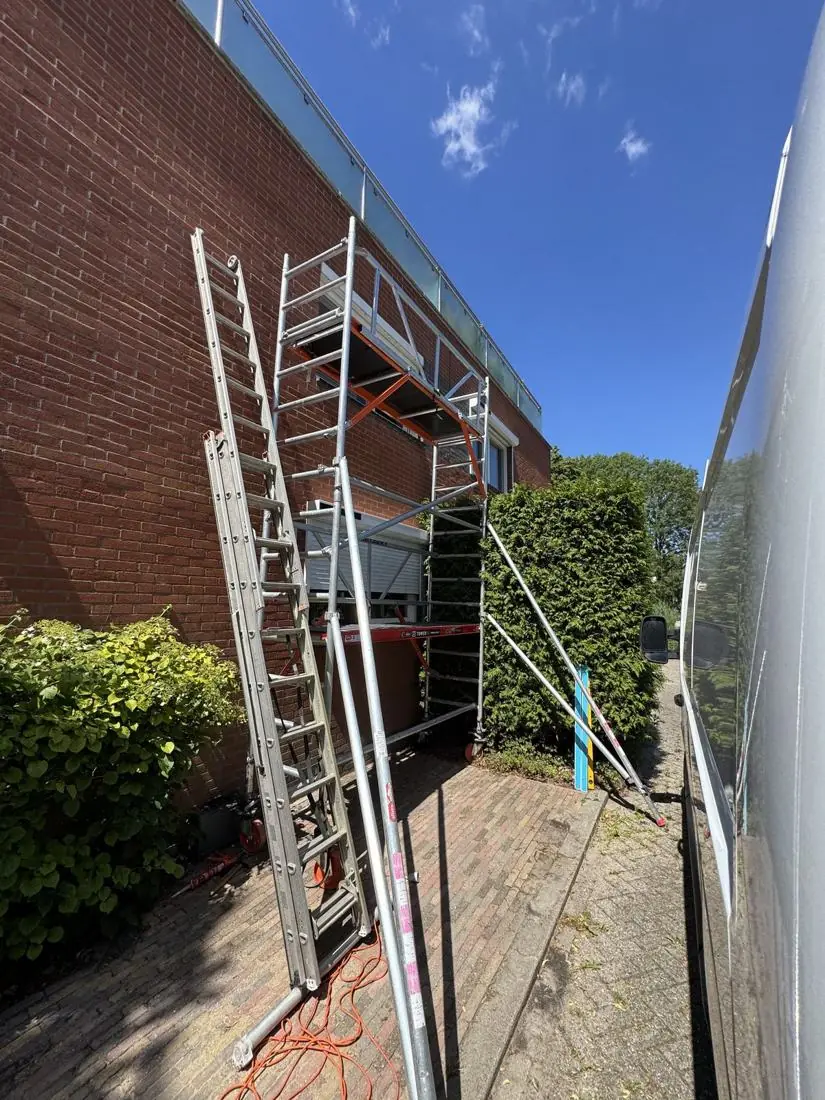
Mobile scaffold standing against the flank wall of a house, the build height you reserve for a conservatory clean

Hiring too short bites harder here than it does on a plain brick wall. The roof falls away from you, so the higher you stand the further you see across the glass and the better you spot the moss still in place. Stand too low and you reach over that slope with your arms above your head, which is precisely how the top joints end up skipped. Between two builds, take the higher one, because an extra section costs you five minutes of assembly and nothing else.

Where the hired scaffold stands around a conservatory and its beds

There is rarely a strip of hard standing all the way around a conservatory. A border runs along it, or grass that softens after rain, and that is exactly where the tower has to go. Lay slabs or sound boards under the castors so they cannot sink and the build stays level. Watch the step between patio and lawn as well, because five centimetres out of true at the base is obvious once you are up. Uneven ground is covered in the guide to soft and sloping footings.

Stabilisers splay outwards from the feet and ask for more room on each side than the frame is wide. Around a conservatory they meet the things that live there: a water butt under the downpipe, planters ranged against the side, an outside tap, garden furniture and the roots of a climber. Move all of that well before the delivery arrives. Shuffling an assembled tower along a wall of glass because a pot stands in the way is the one manoeuvre worth avoiding.

Stabiliser legs angled out from a tower base, showing how much clear ground a hired conservatory set-up needs

Never park the hired tower against the conservatory itself. Stand it parallel to the glazing, with a hand's width of air between the guard rail and the glass. Aluminium glazing bars and beads were never meant to take a scaffold leaning on them, and one knock from a tube against a pane turns into an expensive afternoon. Working on the sloping roof surface you stand back from the edge and reach across, so measure that distance first, because it decides which deck height sits best.

How many hire days cleaning a conservatory really takes

A deep clean of an average conservatory runs to two days. The first goes on dry preparation: brushing leaves and moss out of the joints, vacuuming the sills and clearing every drainage hole until air passes through again. Only then does water come into it, because wet moss smears and disappears into gaps you can no longer reach with a brush. Day two is the wet round, with rinsing and drying off afterwards in the same order. On a large conservatory you add half a day to that.

Book those two days as one unbroken period, because that is where the tariff works in your favour. The rate stands in full for a single day, after which 95 per cent drops off each following day of the period. A spare day in case the dry preparation overruns therefore adds very little, while a second short booking starts at full price all over again. Judging a period is explained in the guide to counting your hire days.

Scaffold frames at the kerb outside a brick house, the hire set booked as one unbroken period of two days.

Count on the weather having a say in all this. Wet glass and wet profiles are hard to read, and after a shower the conservatory has to dry before you can see where the film still sits. Frost is worse, because water in a joint expands and pushes sealant beads loose. Put your hire days in a dry spell and keep the day after free as reserve. Since you decide yourself how long the tower stays, moving it along is no trouble at all.

Which mobile scaffold suits cleaning a conservatory?

Kamersteiger RS44
  • Working height up to 4 metres
  • Compact and narrow
  • Great for indoor and small jobs
View and calculate →
Smalle rolsteiger RS51
  • Working height up to 14.2 metres
  • Narrow (75 cm)
  • Ideal for narrow passages
View and calculate →
Brede rolsteiger RS52
  • Working height up to 14.2 metres
  • Wide platform (135 cm)
  • Extra stability and workspace
View and calculate →
Most chosen
1-persoons steiger MiTower
  • Working height up to 6.2 metres
  • Very compact
  • Quick and easy to assemble
View and calculate →

Lifting moss from the joints off a 245 cm deck

The 245 cm deck decides how wide a strip of conservatory you finish per position. Complete that strip from top to bottom before you roll: first the joint at the house wall, then the seams between the panes, then the sill along the bottom. Six metres of glazing therefore means three positions, and a corner model adds the short side on top of that. Each move costs a quarter of an hour, so count those stops into the hire period you book.

Aluminium conservatory profiles carry an anodised layer, a thin hard skin that holds the colour and the protection together. Take sandpaper or a wire brush to it and that layer is gone for good, and the profile starts staining within a single season. Work with a soft brush and a mild product, and let it stand rather than pressing harder. The drainage holes in the bottom sill take a length of plastic line pushed through them, never the tip of a screwdriver.

Mobile scaffold assembled against a front elevation with deck and guard rails, the 245 cm stand you reposition per strip

What you carry up decides how often you climb back down. Take the brush, the product in a bottle you can hold, the probes, a cloth and an empty bucket for the debris, and leave everything else at ground level. Do not set the tower moving until the deck is clear and the bucket hangs on its hook below. That painstaking pace is why cleaning a conservatory asks for more hire days than a straight wash of the same glass.

Hiring a MiTower with delivery to the back garden

The scaffold turns up counted and complete, in loose parts. Decide in advance which square metres that pile may land on, because the strip beside the conservatory is what you are keeping clear for the build itself. A corner of the drive beats the lawn, where tubes sink in and carry mud up to the deck on your boots. A booking confirmed before 15:00 on any working day puts the set at your door the working day after, and you choose the delivery date yourself.

Assembly falls to you, with the manual open on your knee and the video playing beside it. On the MiTower this goes quicker than on a wide tower, since there are fewer parts and the frame is light enough for one person to handle unaided. Do carry the components through in two trips if the side path is narrow and a gate sits halfway along it. The running order appears in the guide that walks through each build stage.

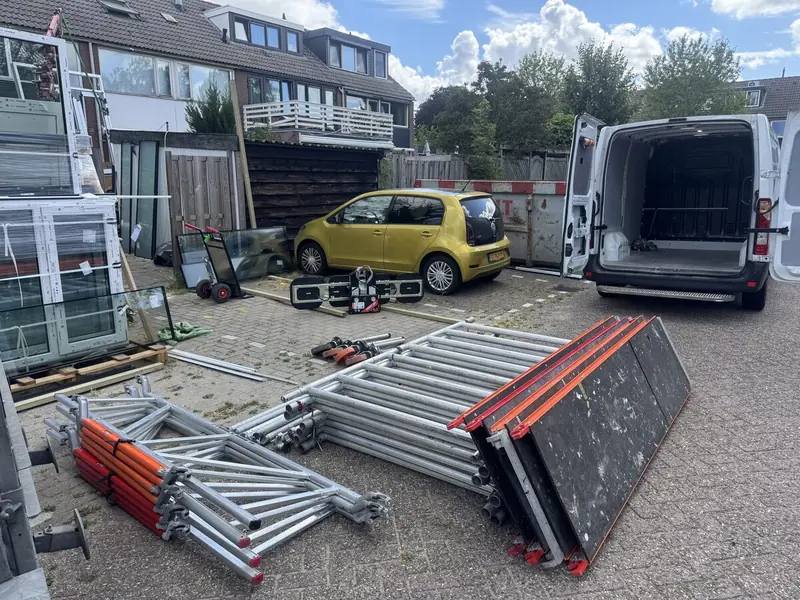
Counted scaffold parts delivered on site and laid out ready, the set you hire for cleaning a conservatory

Afterwards the set is collected again, and your side of it is to take the tower down and stack the parts complete where they were dropped. Do that with the conservatory dry, so you are not packing wet tubes into a bundle. The reverse also works: an appointment at Zeeburgerpad 89 in Amsterdam lets you pick the parts up yourself at no transport cost, provided tubes of that length fit your car. Provincial rates sit on the page of fixed transport charges.

Cleaning a conservatory safely from a hired mobile scaffold

The weight you bring up, a bucket of suds and a sack of wet moss on top of it, is nothing against the 200 kg per square metre that load class 3 of EN 1004 allows on this deck. The limit you do meet here is a different one: the MiTower is made for one person, so nobody climbs up alongside you to be finished sooner. What sits behind that classification is set out in the explanation of the tower standard.

Two habits make all the difference. Brake all four castors before your weight goes on the ladder, and never roll the tower a metre while buckets or you yourself are still up there. Stop as soon as it begins to blow properly, and check all four stabilisers again each time you have rolled it along. On a conservatory there is one more: the glass below you is not a hand rail. Do not lean on it, stand on it or rest a bucket on it.

Mobile scaffold with the ladder fitted inside the frame, the route up and down that a deep clean repeats often

The risk that belongs to this job is going slippery without noticing it happen. Wet moss makes a deck treacherous, and it travels up there on the soles of your shoes. Sweep the floor before you move the tower and keep a dry cloth to hand. Think about what is under you too, because a garden chair or a glazed roof catches dropped tools badly. The rest of what applies at height is on the page with the rules for working off the ground.

In 5 steps

How hiring a mobile scaffold works

1
Choose working height

Pick the height that suits your job.

2
Book online

Sorted in 60 seconds, price shown instantly.

3
We deliver

At the agreed spot the next working day.

4
Assemble safely

Assembled by you, with a manual.

5
We collect

One call and we collect the scaffold.

Good to know

Practical tips for cleaning a conservatory

1

Push a length of stiff wire through the drainage holes in the bottom sill, then run water in. If nothing comes out below, the blockage sits further along and the profile has to come up.

2

Vacuum the joints out with a narrow nozzle before any brush touches them. Dry moss lifts away in one go, while damp moss smears itself into the corners of the profile and stays there for the rest of the day.

3

Test your cleaner first on a profile nobody ever looks at, behind a planter for instance. On an anodised surface something too aggressive leaves a dull patch within the hour that never comes out again, whatever you try on it.

4

Finish the joint where the roof meets the house wall before the rest of the strip. Everything you brush loose up there drops onto glass you would otherwise have to go over a second time before the day ends.

5

Take an empty bucket up for the moss and leaves you pull from the joints. Otherwise the stuff blows across the garden and you sweep it all up again from the lawn at the end of your hire day.

6

Set your collection date a day after the last wet round. That leaves you a dry morning to walk the conservatory once more and to take the hired tower down without any rush at all.

Frequently asked questions

Frequently asked questions about cleaning a conservatory

Which scaffold should you hire to deep clean a conservatory?+

For a deep clean you hire the MiTower, the single person tower 75 cm across. You work on your own, every metre keeps you still a while, and the parts must pass a garden gate to reach the back of the plot. Those three things point at this model. If renewing sealant or a glazing bead is on the list as well, the RS51 in the hire range is handier: no wider at 75 cm, but rated for two and for the tools and materials that travel up with you.

How does hiring a mobile scaffold work when cleaning a conservatory?+

The booking runs online: you settle on a type and a build stage, mark a date for delivery and one for collection, and the rental price including VAT appears straight away. The counted set then comes to you, you put it together behind the house yourself and start on the dry round the following morning. On your last hire day you take it apart and stack the parts together in one place. Nothing beyond that is asked of you as the hirer.

How many hire days does the MiTower need for this conservatory job?+

Two days covers an average conservatory. The first is for dry work: vacuuming the sills, brushing the joints and clearing the drainage holes one by one. The second is the wet round with a rinse after it. If your conservatory is large, if there are several roof planes or if years of film have built up, add half a day. Booking the hire period a little wide rather than tight saves you asking for more time midway through a roof plane.

What does hiring this tower cost when you tackle a conservatory?+

Two things drive it: the model and build you choose, and what carriage to and from your province comes to. Those figures appear with VAT included on the page listing every tariff, so nothing shifts while you are booking a tower. For a conservatory the point worth knowing is that one continuous hire is charged far more kindly than two separate bookings, so keep your two days together instead of splitting them across a fortnight of odd mornings.

For a conservatory of three metres, which working height should you hire?+

Your tape starts on the paving under the castors and finishes at the top edge of the glazed roof, where it closes against the house. With that edge around three metres you reserve a 4 to 6 metre build, and the deck of the hired tower then sits well clear above the ridge. Taking in a dormer or the wall above means running the tape to that point instead. The overview of working heights pairs each build with the figure you reserve.

Can you have the MiTower brought out, or collect the hire yourself?+

Delivery and self collection both work here. If it is brought out, the driver sets the counted parts down on the spot you have pointed out, at a fixed price for your province. Fetching them yourself runs by appointment and only works if your car swallows tubes of that length. With a conservatory tucked behind the house most people have the scaffold brought, because otherwise the whole set gets carried twice over. The morning it stands there is fixed when you book the hire.

Is assembly included when you hire the MiTower for this?+

No. The MiTower comes to you as a complete set and goes back the same way, but raising it, moving it and dismantling it are yours to do. Allow an hour for it, and get the tower standing before any cleaning starts. A second pair of hands makes the carrying easier, though one person can manage the frame. Powered access platforms, system scaffolds and facade scaffolds are not in our range, so at this height a single person tower is the obvious thing to hire.

What if the conservatory is worse than expected and you hire longer?+

Let us know as soon as you can see it coming and the pick-up day shifts with you, provided nobody else has this tower booked behind you. On a deep clean the job overruns far more often than it comes in short, because only from alongside can you judge how much really sits in the joints. Anyone who wants that covered reserves an extra day up front, and handing the hire back early is always allowed if the work goes quickly.

How much clear ground does the hire need alongside a conservatory?+

Keep a flat run beside the conservatory that is wider on both sides than the hired frame itself, because the stabilisers point out into the garden. In practice that comes to about two metres, and your buckets need somewhere on top of that. Borders, garden furniture and a water butt go aside before the scaffold arrives on the drive. Think about where the loose parts may lie as well, or you will be shifting them once more halfway through the hire.

Can you keep the tower on hire when rain interrupts the work?+

The tower can stay standing; it is the work that waits. A wet conservatory hides where the film still sits, and moss full of water only smears deeper into the joints. Spend it laying your materials out at ground level, or working on the inside, and pick up the outside the day after. Because the last day of the hire is a date you fix yourself, losing a morning to rain costs very little.

How quickly is the deposit returned once the hired set is back?+

The deposit settled at the start returns within one working day of the returned set being counted through. On a conservatory job two things matter: every part goes back, and no dried cleaner or garden soil is left on the tubes or the deck of the tower. A rinse with clean water while you dismantle saves trouble on collection day. What else gets checked appears in the notes on getting that sum returned.

Is cleaning a conservatory the same as washing one, and does the hire differ?+

No, and the difference decides your hire period. Cleaning is the deep round: dry preparation, moss out of the joints, drainage holes opened and the profiles treated without harming the anodised skin. Washing is the routine that follows, squeegeeing from ridge to gutter with an eye on streaks. For the deep round you hire the tower for two days; a wash round fits inside one. That job sits on the sister page about washing a conservatory.

Hire a mobile scaffold for cleaning a conservatory today?

Calculate your rental price now or ask for free advice.

Rolsteiger van SteigerTaxi geleverd op locatie
Book it online

Your scaffold sorted in 2 minutes.

Choose your scaffold and working height, see the price instantly and book online.