
See your price
Application

Cleaning windows? Choose the right scaffold.

Cleaning windows properly is more than wiping the glass. The dirt you want gone sits in the rebate, behind the trickle vent, in the mesh of the insect screen and in the corners where green growth settles. That puts a quarter to half an hour into each window, with bucket and brushes within arm's reach. For windows spread over two storeys you hire the slim RS51 of 75 cm, taken up to 6 or 8 metres. Below is what that decides about where the tower stands and how long you keep it.

  • Order before 3 pm, delivered tomorrow
  • Professional Altrex scaffolds
  • Up to 14.2 metres working height
  • Easy to assemble yourself
4,2 tot 14,2 mWorking heights available
12Provinces served
7Days a week
200 kg/m²Load class 3
In short
  • For cleaning windows we recommend the Narrow mobile scaffold.
  • Cleaning windows over two storeys, you hire a mobile scaffold of the RS51 sort: 75 cm across, reaching 6 to 8 metres.
  • You stay put at each opening because rebate, vent and screen all want separate attention, so you shift the tower less often.
  • With a bucket, brushes and a screwdriver all going up with you, a fixed deck with rails around it beats a ladder every time.
  • First 24 hours from €150 incl. VAT and delivery; every day after that 95% off.
Key facts for this job
FeatureValue
Recommended scaffoldNarrow mobile scaffold (Altrex RS TOWER 51)
Working height for this job6 to 8 metres
Available working heights4.2 to 14.2 metres
StandardEN 1004, load class 3 (200 kg per m²)
DeliveryOrdered before 3 pm, delivered next working day
Each extra day95% off, from €7.50 a day
Why a mobile scaffold for cleaning windows?

Safe, stable and professional work at height

With cleaning windows the work is not in the glass but in everything around it. You slide the screen out of its runner, undo the vent, brush out the rebate, poke the drainage slots clear and wipe the seals afterwards, all of it with wet hands and a bucket at your feet. A ladder gives you neither the room nor a spare hand for that, and climbing down each time you swap a brush eats the whole morning. Hiring a scaffold for this job therefore comes down to one thing: a deck where your kit stands beside you while both hands are down in the rebate.

  • Cleaning windows starts in the rebate, not the glass
  • Bucket, brushes and screwdriver all go up together
  • Green growth gathers in the two bottom corners
  • Six to eight metres along the highest openings
Read more about working safely →

Cleaning windows from a narrow tower you hire

For a cleaning round the RS51 is the most practical model: 75 cm wide, with a build that climbs from 4.2 metres to 14.2 metres of reach. You need that slim width because a lap past every opening takes you round the back as well, through a gateway or along the path between the hedge and the brickwork. A broad stand jams there and you end up levering it about instead of cleaning. The full series appears on the page about hiring a rolling tower by the day.

Up on the platform that narrow width suits you just as well. Two buckets, a few brushes, a squeegee and a screwdriver take almost no floor, and anything else loitering up there gets kicked over sooner or later. For cleaning windows the measurement that counts is the deck length of 245 cm. It lets you cover one complete opening plus the piece of wall beside it from a single position, so the screen slides out and the vent comes off without you touching the castors at all.

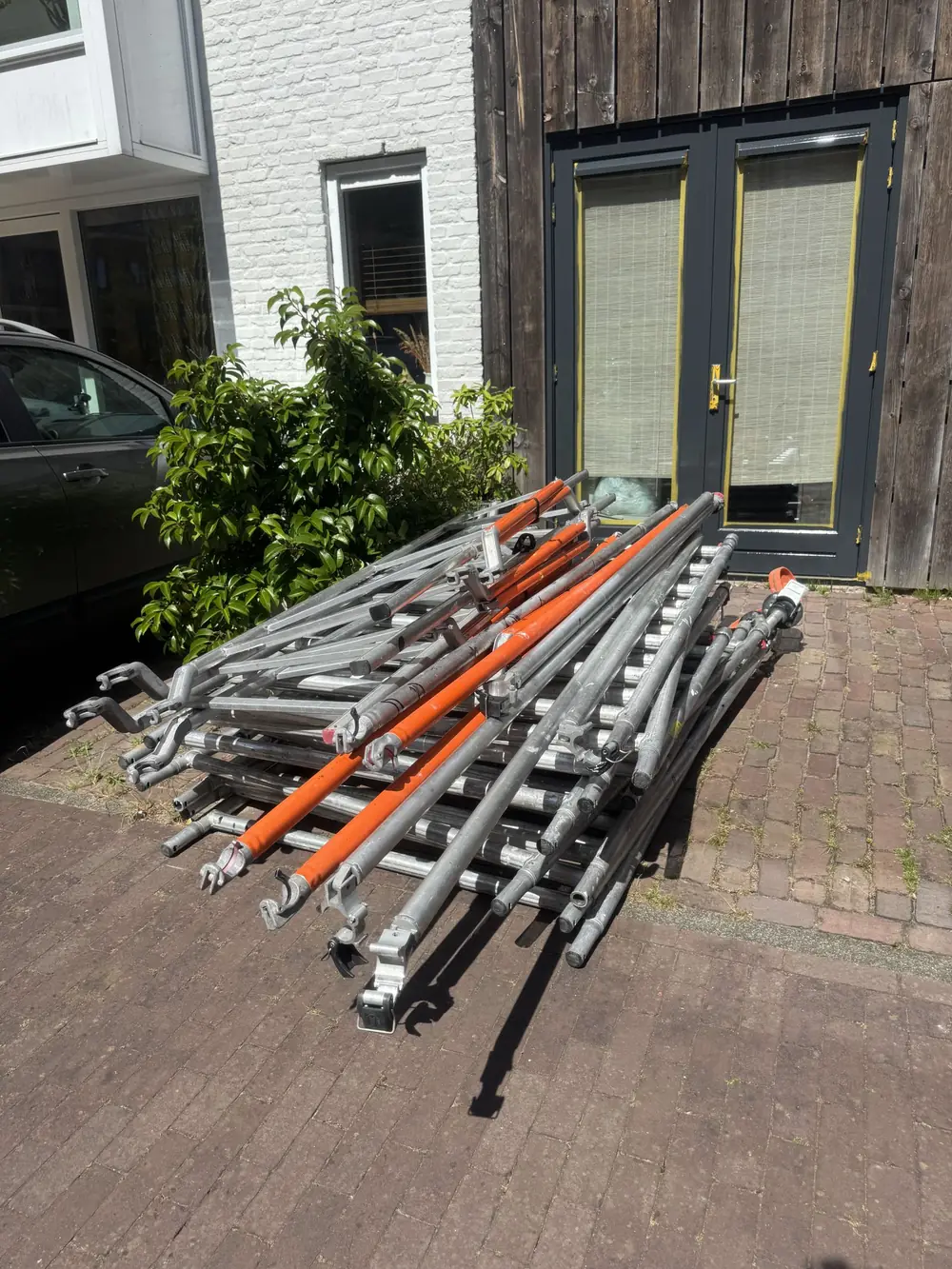
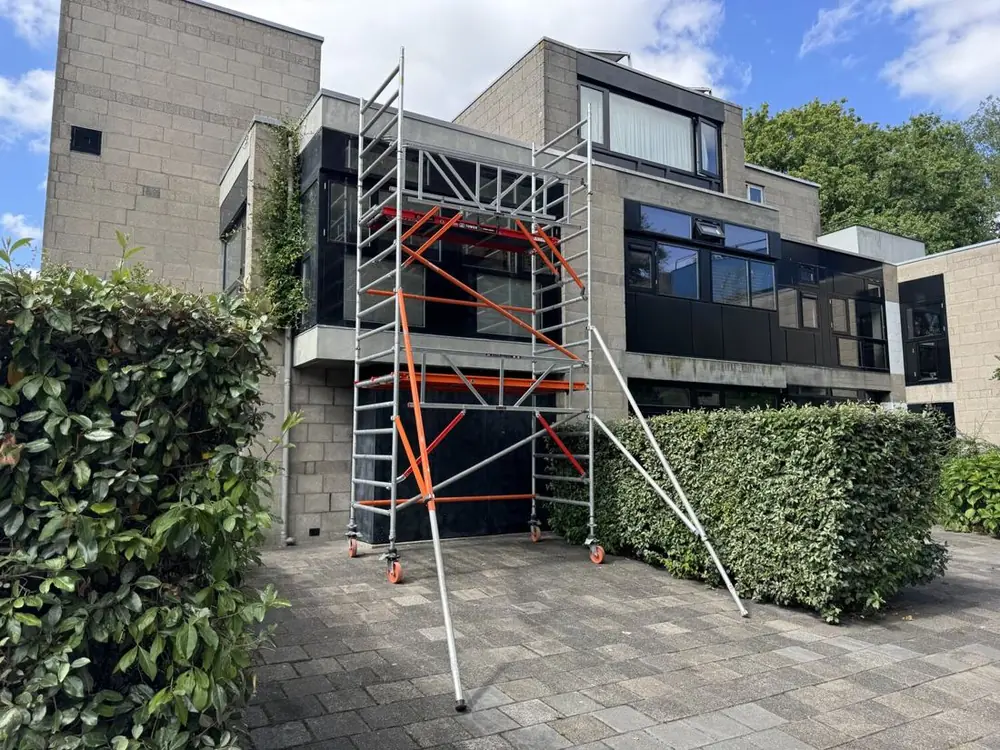
Frames for a 75 cm build propped against a house front, the narrow hire set that passes a gateway to the back.

Where two of you are working up top at once, or where a wet vacuum goes up to suck the rebates out, the broader RS52 at 135 cm serves better. For an ordinary lap past the openings of a terraced house that is overkill, and you pay for it in agility every time you move along. How the models compare is set out in the overview of sizes per version. Count the openings you intend to do before you decide.
The build to hire when rebates sit two storeys up

The point you must get to on this job is the head of the highest window, and usually a trickle vent sits directly above that. In a two storey house it hangs four to six metres up, so the build you order wants a working height of 6 to 8 metres. Your deck finishes a good deal lower than that figure, since roughly 2 metres of it is reach: your arms and upper body added together, measured from the boards you stand on.

Even so, a thorough round is not only measured upwards. Cleaning windows also means getting at the bottom rail and the two lower corners of the rebate, which is exactly where that green film takes hold. End up standing too high and you are looking down into the opening with a brush that no longer meets the corner. Better to finish the top deck just under the head of the frame, because then the whole window sits within reach from top to bottom.

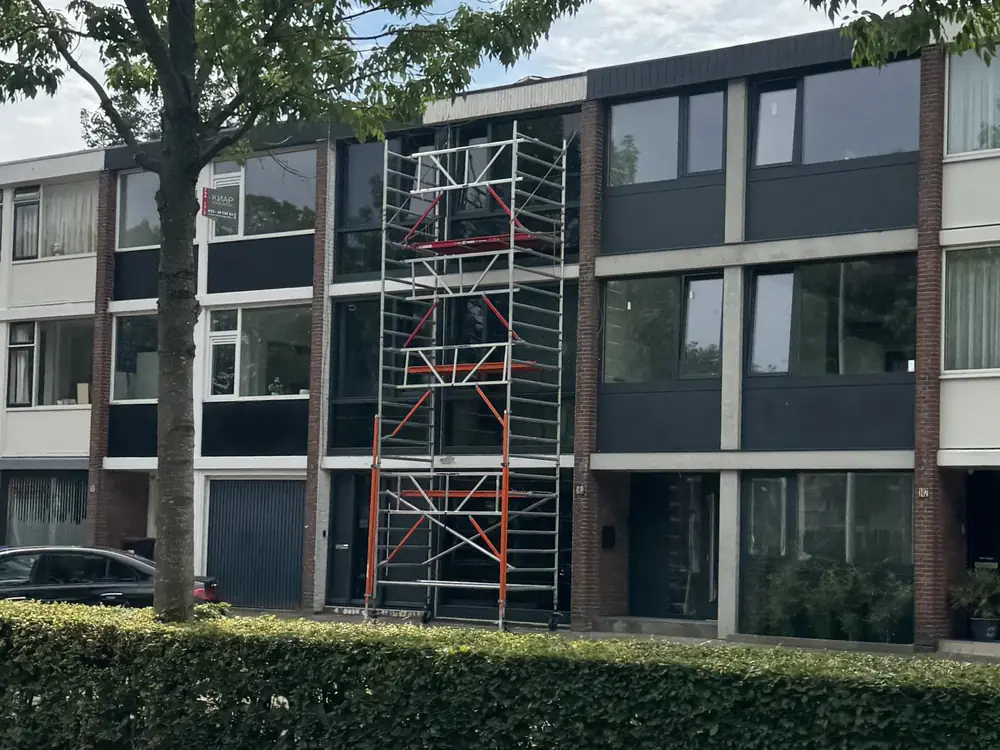
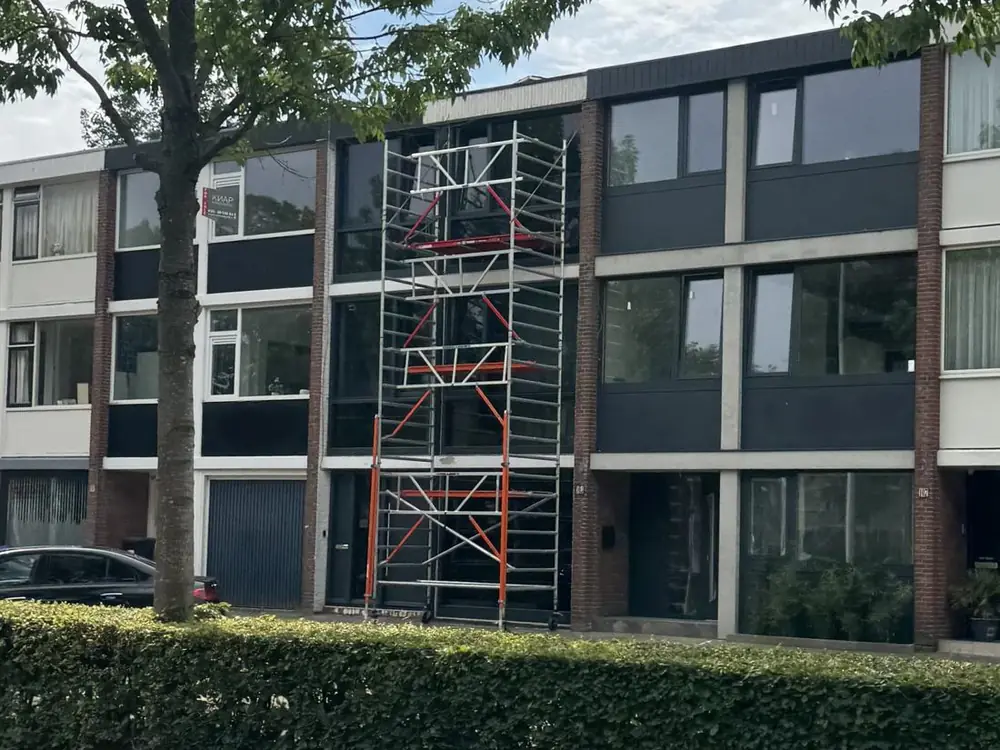
Rolling tower built along a front elevation up to the highest frames, the height a thorough round is hired for

Start the tape at whatever the castors are going to rest on. A garden path falling away towards the fence, or a terrace laid one slab higher than the lawn, moves your starting point, and on an elevation with three rows of openings that difference stacks up. If you are unsure which build to hire for your upper windows, add a section rather than guess, and look at the page on openings at first floor level and add a storey where another row sits above them.

Cleaning windows above a border, a deck or wet grass

Underneath an opening there is nearly always something that does not care for water: a planted border, a timber deck, a bike rack, or a patch of paving where dirty rinse water simply lies. So pick your standing place for drainage as much as for levelness, since litres of it come down on this job and none of it lands where you expect. Keep the bucket of dirty water on the ground rather than on the platform as well, and leave room around the base for the four stabilisers that splay outwards.

Then take note of everything screwed to the wall. An outside tap is a gift on a cleaning round, but a dish, an exterior light or a downpipe right beside the frame governs how close you can bring the stand. Measure the gap between the brickwork and the boundary, certainly in a narrow side passage, and check the meter cupboard and the garden tap stay reachable once the tower is in place with its legs out. A shed door that no longer opens is otherwise discovered halfway through the day.

Stabilisers set out beside the foot of a hired tower, on the level strip of ground kept clear below the opening

Then there is the ground under the castors. Wet grass turns to mud within an hour of you rinsing above it, and a wheel settling into it while you stand above with a full bucket puts the tower out of true. On soft going put levelling plates or slabs under them and check with a spirit level before kit goes up. Repeat that at each move, because the ground beside the next opening may sit differently. Dealing with a sloping path is explained on the page about setting up where the ground is uneven.

Counting hire days when each window takes half an hour

Allow a quarter to half an hour per opening, and more where the screen has not left its runner in years. That quarter of an hour covers undoing the vent, brushing the rebate out, poking the drainage slots clear and washing the glass afterwards. Twelve windows front and back fill a complete working day, and with seized screws in the vents you reach a day and a half without trying particularly hard. So count your windows before you commit to a period, and count the awkward ones twice.

Weather settles the rest of your planning. In a frost, cleaning windows leaves the rinse water frozen on the cill. With full sun on the wall the product dries on the pane before you have it off. And in a strong breeze the spray blows back into your face while you are down in the rebate with a brush. The best days are overcast and still, and since you cannot order those, you would rather hire with a spare day inside the period than lose the tower halfway.

Tower left built along an elevation with large panes, standing through the days of a thorough cleaning round

In money terms that spare day amounts to very little. You pay in full for one day only, and from the second onwards ninety five per cent comes off the daily figure, so a reserve day costs less than a bottle of cleaning product. Booking too tightly means the opposite: striking the tower halfway round the house, with one elevation gleaming and the other still filthy behind its screens. Judging that span is covered under planning the days you book.

Which mobile scaffold suits cleaning windows?

Kamersteiger RS44
  • Working height up to 4 metres
  • Compact and narrow
  • Great for indoor and small jobs
View and calculate →
Most chosen
Smalle rolsteiger RS51
  • Working height up to 14.2 metres
  • Narrow (75 cm)
  • Ideal for narrow passages
View and calculate →
Brede rolsteiger RS52
  • Working height up to 14.2 metres
  • Wide platform (135 cm)
  • Extra stability and workspace
View and calculate →
1-persoons steiger MiTower
  • Working height up to 6.2 metres
  • Very compact
  • Quick and easy to assemble
View and calculate →

Rebates, vents and screens tackled from a hired deck

This part of cleaning windows is exactly why you hire a platform instead of shuffling a ladder along. Each opening keeps you in one spot for twenty minutes or more, with the screen out of its runner and lying flat beside your boots, the vent off and its screws dropped into a lidded tub. On a ladder there is nowhere to put any of that, so you climb down for every single part. From a deck you set the whole window down around you and work through it once.

The corners are precisely why you stand on a hired tower for this. Green growth sits in the two lower corners of the rebate and under the lip of the seal, and reaching those means bending down with both hands while your feet stay planted. That is a stance no ladder ever gives you. Set the deck just under the head of the frame so the bottom rail stays within comfortable reach, and a single hire position then covers the window from top to bottom.

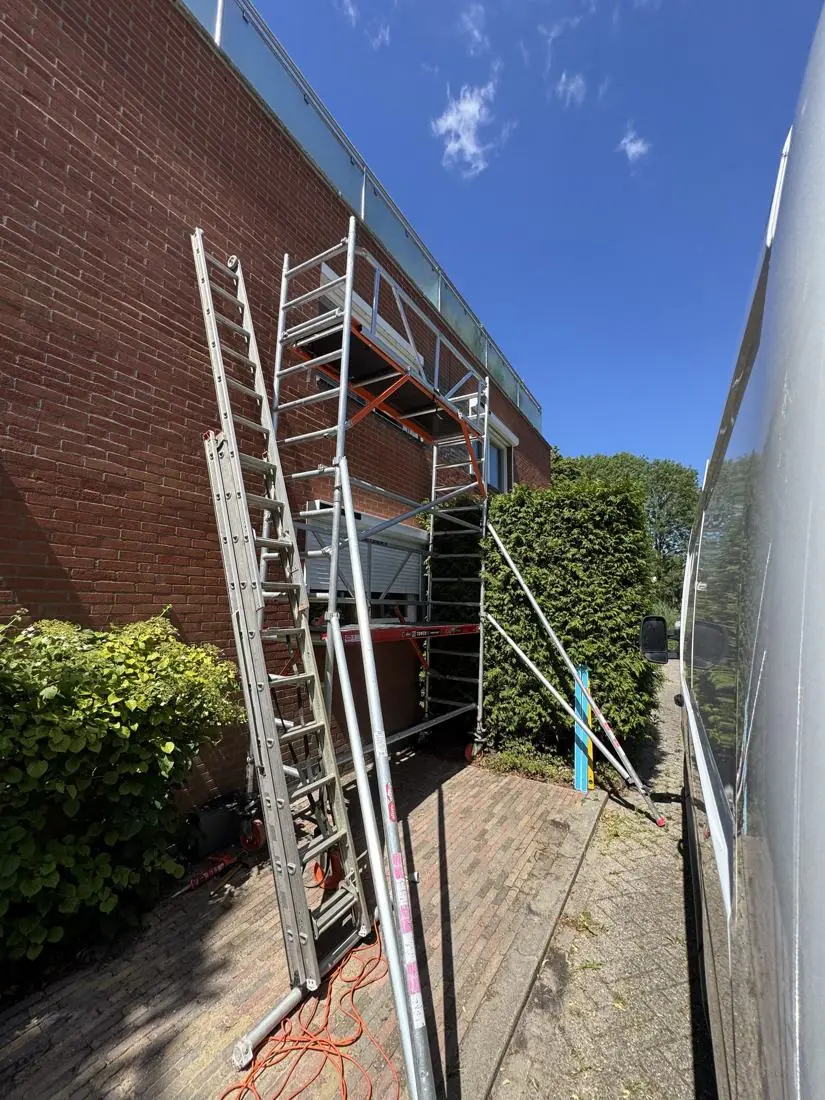
Tower built along a side wall of a house, the stand you take a screen and a vent off from

Carry up in one trip everything the opening needs. Two buckets, three brushes, a stack of cloths, a squeegee, a screwdriver and that tub of screws all sit comfortably on 245 cm of platform. Every descent for something you forgot costs five minutes, and across twelve windows that mounts up faster than you would think. Put your kit down on the same side each time so your hand finds it without looking. If you go on to washing the glass itself, keep that as the closing lap.

Delivery of the hire set before your cleaning round starts

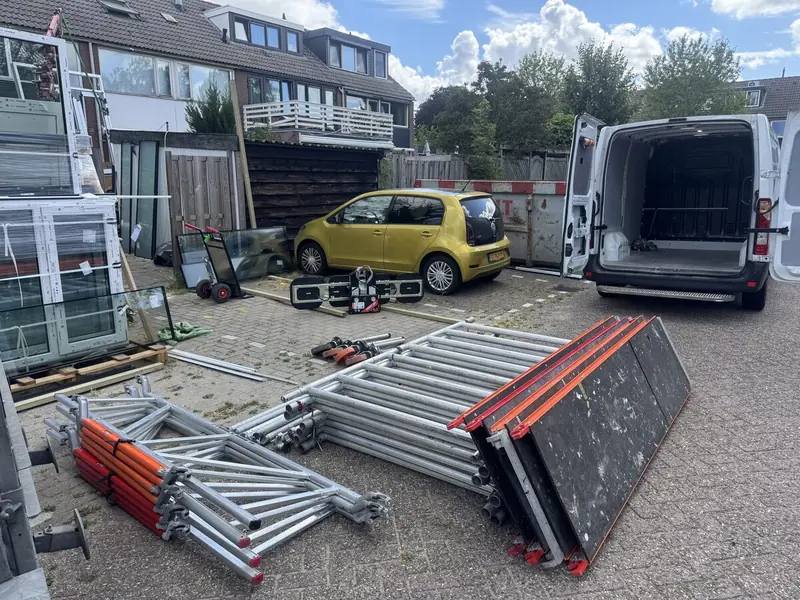
A counted bundle of loose components gets dropped off and the driver checks it before leaving; the tower itself you build. Find a dry corner for that pile in advance, because under the openings is a poor spot: that is where your bucket goes and where the rinse water runs. Send the booking through on a weekday and, provided it is in before three o'clock, everything travels out to you on the next one. You enter the date it turns up and the date it travels back when you reserve the tower.

Erecting it falls to you, with the manual open beside you and an instruction film showing the order of the components. At this height a pair of people take roughly an hour before the tower stands and the stabilisers are out. Do it the day before you start, since you do not want to open your cleaning day with an hour of carrying tubes and turning spanners. Look at the forecast while you are about it, because an overcast, still day is worth more here than a sunny one.

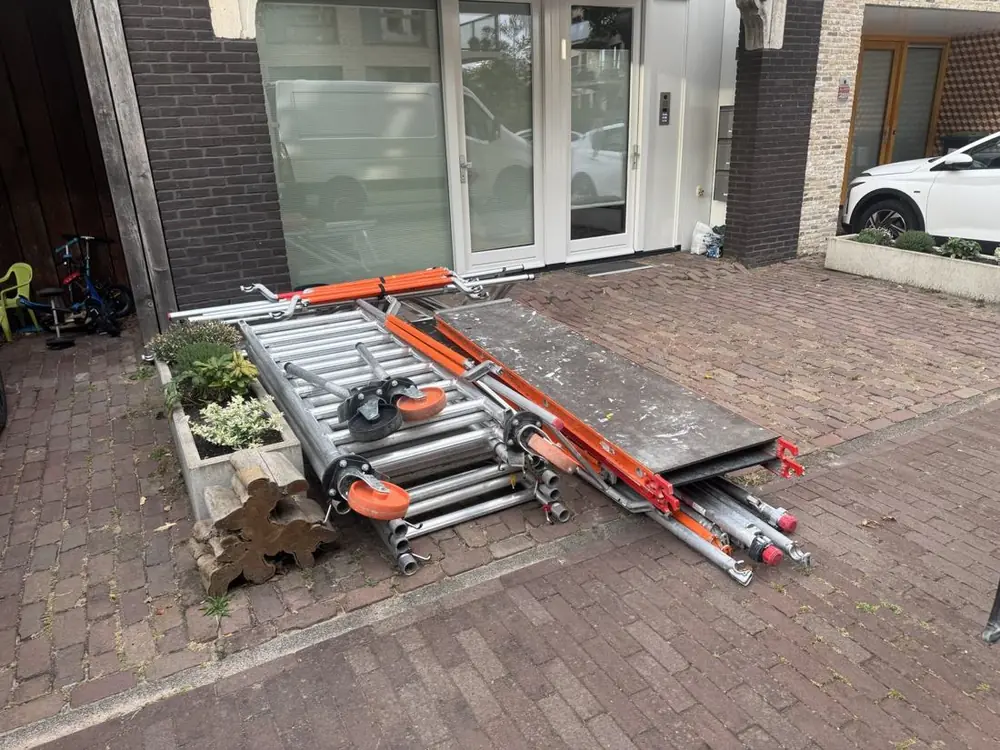
Scaffold components set down by the front door of a house, the counted hire set you build before starting

When your round is finished we come out to take it all away again. You dismantle and stack the components where the van can reach them, ideally not in the middle of a wet border and not across the path the neighbours use. Rinse the decks off before you break them down, because dried limescale streaks are hard to shift afterwards. Each province has a fixed sum for bringing and fetching, which you will find under what delivery costs.

Wet decks, buckets and safe footing while cleaning windows

Load class 3 in EN 1004 signs a deck off for 200 kg spread across one square metre. On a cleaning round you rarely go near that ceiling, since two buckets of water and a handful of brushes weigh little between them. The hazard here sits somewhere else entirely: all that water ends up on the platform, and aluminium decking under a film of suds is as slippery as ice. So wear boots with a sole that keeps its grip on wet metal.

Beyond that the familiar rules hold. Lock the castors before your first foot touches the stair, never roll the stand along while somebody or a full bucket is riding on it, and come down once the wind gets up in earnest. Clip your bucket to a rail tube as well rather than letting it balance loose on the edge, because one tipping from six metres is dangerous for everyone below. At each new position along the wall, confirm the four stabilisers are bearing firmly again before you climb back up.

Mobile scaffold with guard rails standing tight against a wall, the hired platform you work a cleaning lap from

Take a look downwards before you begin, too. Water, dirt and now and then a screw off a vent land where people walk past or where the washing hangs out. Bring the washing in, cover the bikes and keep children out of that strip for the day. Electricity and water are poor company, so leave an exterior light beside the frame alone and certainly do not play a hose along it. Further requirements are gathered under the rules for working up high.

In 5 steps

How hiring a mobile scaffold works

1
Choose working height

Pick the height that suits your job.

2
Book online

Sorted in 60 seconds, price shown instantly.

3
We deliver

At the agreed spot the next working day.

4
Assemble safely

Assembled by you, with a manual.

5
We collect

One call and we collect the scaffold.

Good to know

Practical tips for cleaning windows

1

Undo every trickle vent on one elevation before you begin cleaning windows. The screwdriver then goes up only once, and each vent dries off while you work through the rest of the round.

2

Take two buckets up: one of suds for the rebate and one of clean water to rinse behind it. With a single bucket you spread the dirt from the corners over the rest of the pane.

3

Poke the drainage slots in the bottom rail through with a length of wire. Left blocked, water stands in the rebate again next winter and the growth simply starts over.

4

Lay the insect screen flat on the platform rather than leaning it on a rail. Mesh resting against a tube bows, and after that it never slides back into its runner sweetly again.

5

Work an elevation from the top down instead of up and down at each window in turn. Dirty water running along the brickwork otherwise lands on the frame you have only just finished cleaning.

6

Rinse the platform off with clean water at the end of the day. Dried soap makes the deck slicker next morning than yesterday's suds did, and you only discover that once you are standing on it.

Frequently asked questions

Frequently asked questions about cleaning windows

Which mobile scaffold do I hire for cleaning windows thoroughly?+

The RS51 at 75 cm suits this best. You need very little floor area up top, only room for two buckets and a handful of brushes, while that slim width still takes you through a gateway and past a hedge to reach the rear elevation. A deck length of 245 cm is enough to slide a screen aside and lift a vent off without touching the castors. Working with two people up there at once, you can hire a broader version instead.

How does hiring a tower for a cleaning round work in practice?+

Online you state which model you need and how high you will build it, enter the two dates for dropping off and picking up, and pay a set sum with VAT already worked in. We unload the counted components at your door, you build the tower from them and then work through the windows one at a time. At the end you take it apart and we carry it off. Water, buckets and cleaning products you naturally bring to the job yourself.

How many hire days do all the windows of one house take?+

With only a front and a rear elevation to do, most people finish inside a single working day, at least where the screens and the vents cooperate. Meet plenty of seized screws, or take a side elevation on as well, and two days becomes the realistic figure. Because you pick the collection date at the moment of hiring, that second day slots in as a reserve without the amount climbing noticeably. Giving the tower back sooner also stays possible.

What rental price applies to a couple of cleaning days?+

Three things decide it: the model chosen, how high it goes up and which province the van drives to. Tariffs are fixed, displayed with VAT and gathered on the page listing what each tower costs. Across a round of a day or two it is chiefly the first day that weighs in the total. Put a reserve day behind that for poor weather and you barely notice it on the bill, while you do work at a calmer pace.

What working height should I hire for the upper storey windows?+

Two storeys of windows are covered by a build of 6 to 8 metres. Your tape starts on the surface under the castors and finishes at the head of the highest frame, taking in the vent that often sits above it. Where the tower will stand in a garden lying below street level, run the tape from that garden and not from the pavement. The page about working at eight metres shows which build to enter when you book.

Do you deliver the tower or do I fetch it myself when hiring?+

That is up to you. We drive it to the address you give on the date you choose, and come back past once the last opening is done to take it away. What the run costs depends on the province and is fixed beforehand. Fetching it yourself costs nothing and happens by arrangement, from Zeeburgerpad 89 in Amsterdam. On a cleaning job most people still have the scaffold brought, since the car is better kept free that day.

Do you build it, or is that mine to do after hiring?+

Erecting the tower sits firmly on your side of the agreement. We do the driving in both directions; you assemble it, shift it along the wall and take it down again, guided by the supplied instructions and a short film. Two people need about an hour at this height, and that hour is best spent on the day before you start. Cherry pickers and facade scaffolds are not in our hire fleet, so for openings at this height you work from a rolling tower you push along the wall yourself.

Can I rent for longer if the screens and vents disappoint?+

In most cases that is straightforward. Give us a call and the collection date moves, unless another customer already holds the tower for those days. On this work a screw spinning uselessly in its hole, or a screen jammed solid in its runner, is more normal than not, so reserve generously when you hire. Bringing it back before your end date is allowed too, so no period ever traps you.

How much clear space does a hired tower need under an opening?+

You need the tower's own footprint plus the ground the four stabilisers reach out onto, and beside that a dry spot for your buckets and materials. In practice it comes to a level run a couple of metres wide below the frames. Bear in mind that water is coming down throughout, so move planters, garden furniture and bicycles well before the hired tower arrives rather than once you are already standing up there with a brush.

Can I keep the hire running if it turns to frost or a gale?+

The tower need not go anywhere for that; only the cleaning shifts. Rinse water freezes on the cill, and in a gale the spray blows back at you, so all you achieve is moving muck about. Use such a day to undo vents at ground level or to rinse the screens indoors under a tap instead. Since you set the end date at the point of hiring and each further day costs little, a delay mostly costs time.

What happens to the deposit when the hired tower gets soaked?+

A soaking does the tower no harm, since these components stand outdoors in all weathers for most of the year anyway. A deposit is settled alongside the reservation, and once every part has been counted back in you receive that amount within 1 working day. Do watch for dried soap and limescale marks on the decking: a quick rinse before you dismantle saves any discussion. Make sure no brush, sponge or cloth stays behind wedged between the parts either, since that turns up in the count.

Can the screens and vents be cleaned indoors instead?+

A screen almost always comes indoors to be rinsed under a tap or in the bath, and that spares you a good deal of work at height. The vent and the rebate are different: they are fixed to the outside, and for those you genuinely stand on the hired tower. So reckon on climbing the tower once per window to take things off and a second time to refit them dry.

Hire a mobile scaffold for cleaning windows today?

Calculate your rental price now or ask for free advice.

Rolsteiger van SteigerTaxi geleverd op locatie
Book it online

Your scaffold sorted in 2 minutes.

Choose your scaffold and working height, see the price instantly and book online.