
Knowledge base · reading time 9 min
Which scaffold for gutter work?
Gutter work is almost always work along a length. You start at the corner, move on leaf by leaf or bracket by bracket, and finish at the other end of the building. A mobile scaffold suits that well, because you take it with you instead of rebuilding it each time. The question that remains is which height and which width you need, and where the tower can stand next to a garden, a driveway or a shed.
- Which scaffold do you need for the gutter? Work out the working height, choose a narrow or wide tower and work safely along the whole gutter.
- Choose a platform height of about five metres, since working height is platform height plus two metres.
- No, you roll the scaffold along the facade one platform length of 245 centimetres at a time.
- The RS51 at 75 centimetres, because it fits along paths and through gates.
What gutter work asks of your setup
Cleaning, repairing, painting and replacing a gutter are four different jobs, but they make the same demand on your setup: you need both hands free at roughly hip height relative to the gutter. Stand too low and you work above your head, losing both force and sight of what you are doing. Stand too high and you spend the day bent over the guardrail, which starts to hurt after an hour.
On top of that, material goes up with you. For cleaning that is a bucket and a scoop; for replacement it is gutter sections, brackets and sometimes a few metres of zinc or pvc. On a mobile scaffold you lay that beside you on the platform instead of hauling it up piece by piece. The platform is 245 centimetres long, so a decent length of gutter fits next to you.
The load class of our scaffolds is 3, which works out at 200 kilos per square metre of platform. Two people with tools and gutter material stay well below that. What you can take up and how to spread it is covered at loading and weight on a mobile scaffold, useful when you want to lift a long gutter section up in one go. Heavy lifting overhead is not part of that: use a rope or have two people pass it up.
Key facts
| Feature | Value |
|---|---|
| Core answer | Pick the platform height that brings your upper body above the gutter edge |
| Working height | Platform height + 2 metres |
| Available working heights | 4.2 to 14.2 metres |
| Platform width | 75 cm (RS51) or 135 cm (RS52) |
| Each extra day | 95% off: €2.50 to €16.25 a day |
Measuring: ground to gutter, then subtract two metres
The sum is short. Working height is platform height plus two metres, because that is the reach of an adult standing on the platform. If you want your hands at the gutter, measure from the ground to the underside of the gutter and pick a working height that just clears it. With a gutter at seven metres you work comfortably from a platform of around five metres.
Measure from the spot where the castors will stand, not from the lowest point of the garden. A terrace one step higher, or a driveway sloping away, changes the answer by tens of centimetres. When in doubt, half a metre of extra working height is more pleasant than half a metre too little, because standing too low is not something you can fix on the day itself. Write the measured height down before you open the configurator, so you are not guessing later.
If you think in storeys rather than metres, the separate pages help. For a gutter above the first living floor look at working on the first floor, and for a taller building at the second floor. The general explanation of the term is on the working height page, including how platform height and working height relate. Compare your own measurement with the setups listed there and the right section becomes obvious.
Working heights that suit a gutter
The range covers working heights from 4.2 to 14.2 metres, so everything from a carport gutter to the gutter of a multi storey building is included. In practice most houses land between six and nine metres of working height. The table shows which platform goes with that and roughly what you can reach, so you can work from your measured height towards a model. If you land exactly between two options, take the higher of the two.
Choose your height from the gutter, not from the ridge of the roof. The roof surface often continues several metres above the gutter, and you do not need to bridge that. If you also have to be on the roof surface itself, for moss or tiles, read working on a sloping roof before you settle on a height. Going onto the roof surface itself brings different rules than working at the gutter from a platform.
| Platform height | Working height | Often enough for |
|---|---|---|
| 2.2 metres | 4.2 metres | Gutter of a garage, carport or extension |
| 4 metres | 6 metres | Gutter of a house with one upper floor |
| 6 metres | 8 metres | Gutter of a house with two upper floors |
| 8 metres | 10 metres | Gutter of a building with three storeys |
| 10 metres | 12 metres | High gutter or a gable end |
| 12.2 metres | 14.2 metres | The tallest setup in the range |
Why a ladder disappoints on gutter work
On a ladder you need one hand to hold on and your body leans in under the gutter. That works for undoing a single bracket, but not for scooping ten metres of leaf litter or hooking in a new gutter section. On top of that you move a ladder every few steps, and it is precisely that repositioning where most things go wrong. On ten metres of gutter that adds up to dozens of climbs up and down.
A mobile scaffold gives you a flat platform with guardrails all round, so you work with both hands and put tools down beside you. There is no need to reach out, which removes exactly the movement that costs people their balance. The difference in method is set out further at ladder or mobile scaffold. On a platform with guardrails you can also stand still for a moment to look at something, which a ladder does not allow.
A ladder has one more drawback specific to gutters: you often lean it against the gutter itself. On a full or aged gutter that means weight on the very part you came to repair. With a scaffold the gutter stays unloaded and you can take it down, inspect it and hang it back without your setup depending on it. On a zinc gutter with old brackets that is the difference between a repair and a full rehang.
Narrow RS51 or wide RS52 along the facade
The RS51 is 75 centimetres wide and the RS52 is 135 centimetres wide. Both have a 245 centimetre platform, so each setup covers the same stretch of gutter. The difference is in working room and in the space you need on the ground. Along a narrow garden path, between a fence and a wall or through a gate to the back garden, the RS51 gets through where the RS52 often does not.
If you do have that space, the RS52 works better for gutter work. You can lay down sections several metres long without them getting in the way, and two people stand side by side without shuffling past each other. When replacing a complete gutter, that is the difference between a day of steady progress and a day of measuring and fitting. A bucket of water, a saw and a box of screws also fit without shuffling them around.
Count the stabilisers on both models, because they stick out at the sides and help decide whether your setup fits. Walk the route to the facade once with a tape measure first. Full dimensions per model are listed at mobile scaffold dimensions, so you know in advance whether you clear the corner of the shed. Measure the height of the gate as well, because the frames have to pass through it.
Moving the tower along the gutter
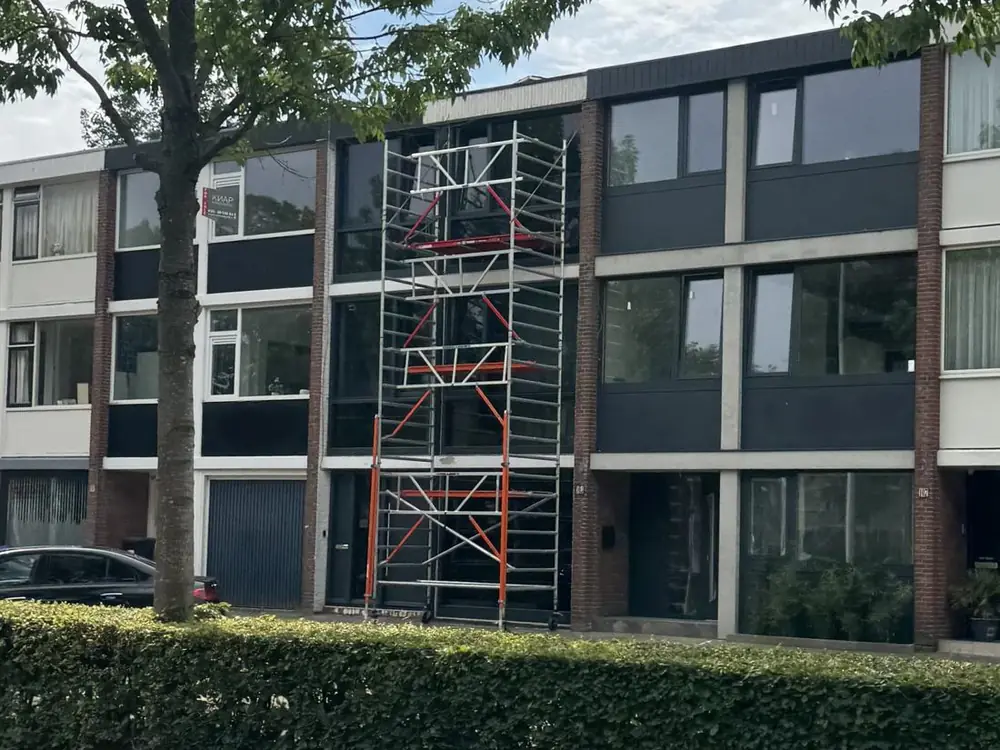
You finish a stretch of gutter, come down and push the scaffold on by one platform length. That is how you work a whole facade without ever reaching out. The rules while moving are short: nobody on the scaffold, no loose tools or buckets on the platform, and the castors locked again before anyone climbs up. Run that check out loud with whoever is working with you, so nobody skips a step.
On taller setups stabilisers and sometimes anchoring to the facade come into play, and those have to be set correctly again at every move. That costs a few minutes, and those minutes are worth it. How it works and what to watch is covered at stabilising and anchoring. Set the stabilisers out as far as they were before and check that all of them touch the ground, including on a sloping drive.
Plan your moves along the facade before you start. A downpipe, an extension, a conservatory or a low outbuilding can block the way, and it is easier to reverse the order than to get stuck halfway. Where there is an extension under the gutter the setup differs from a flat facade, so walk that stretch first. A paved path that stops halfway is the sort of thing you would rather see beforehand.
Roof overhang and distance to the facade
Many houses have a roof edge that projects well beyond the facade. That overhang decides how close you can put the scaffold to the wall, because the top guardrail still has to pass it. Measure the overhang before you assemble and take it into account when settling your setup, certainly on older houses with a wide roof edge. On a dormer or a projecting bay the overhang also changes partway along the facade.
Standing further from the facade increases the distance between you and the gutter. That is exactly the moment people start reaching, and reaching is what you want to avoid. Choose a setup with a little extra platform height instead, so you look down into the gutter rather than grabbing sideways at it. More on that is at fall protection on a mobile scaffold. Looking down at your work is nearly always more comfortable than looking up at it.
Ground conditions: grass, gravel, paving and a sloping drive
Around a house a scaffold rarely stands on a flat concrete floor. Grass gives way, gravel shifts, paving sits unevenly and a driveway slopes towards the street. The bottom section has to be level before you build any higher, because a couple of centimetres out at the base becomes a serious lean at the top. Adjust the spindles and check with a spirit level before adding the next layer. A base that is three centimetres out of plumb is immediately noticeable at the top.
On soft ground you spread the load with base plates so the castors do not sink into the lawn while you work. If you are unsure about the surface, look through the options first at a mobile scaffold on uneven ground. Gravel needs a plate under every castor, otherwise the stones roll away under the load. After a rain shower, check whether the ground has become softer than it was during assembly.
- Level the bottom section before you build any higher
- Use base plates on grass, sand or loose ground
- Check that paving or tiles do not tilt under a castor
- Keep clear of a drain cover, crawl space hatch or freshly laid paving
- Lock the castors as soon as the scaffold is in position
Leaves, water and tools on the platform
Gutter work is wet work. Leaf litter that has sat there for half a year is heavy and slippery, and it ends up on the platform the moment you scoop it out. Take a bucket you can hook onto the guardrail and do not simply throw the contents down, certainly not while someone is on the scaffold or walking along the facade. Hang the bucket on the inside of the guardrail so it does not knock against the gutter.
Keep the platform clear otherwise. Loose pliers, drills and screws slide off during a move, and an open hatch is a hole you can step into. Close the hatch once you are up and keep tools in a container rather than loose. For the remaining rules of use, the mobile scaffold hire checklist helps. A screwdriver falling from ten metres is more dangerous than most people estimate.
- Take a bucket you can hang on the guardrail
- Scoop leaf litter out rather than throwing it down
- Close the hatch once you have stepped onto the platform
- Keep tools in a container, not loose on the platform
- Sweep wet leaf residue off the platform before moving
When a smaller model is enough
Not every gutter sits high. The gutter of a garage, a carport, a shed or a low extension is often under four metres, and then a full mobile scaffold is more than you need. For that kind of work the MiTower can be enough: a one person scaffold up to 6 metres working height that you set up alone and roll around the building easily. For a shed gutter beside a garden path that is often the handiest choice.
The limit lies at those six metres and at the number of people. If two of you work together, or long gutter sections have to go up, you end up with a mobile scaffold anyway. What separates the two is set side by side at mobile scaffold or MiTower, including the point where the MiTower runs out of height. For the gutter of a dormer you often end up higher than the MiTower reaches, so measure first.
For the job itself there are separate pages per type of gutter work. Look at gutter cleaning for clearing work, or gutter replacement when the gutter comes off. Each explains which setup is usual and what to allow for when planning. Painting a gutter calls for a slightly different setup, because you also need to reach the fascia boards. For that, see gutter painting.
Delivery, hire period and deposit
Order before 15:00 and the scaffold is at the agreed spot the next working day, anywhere in the Netherlands. Delivery and collection together are a fixed amount per province, shown on the delivery costs page. Collecting it yourself is free by appointment at Zeeburgerpad 89 in Amsterdam, handy if you are nearby with a trailer anyway. Tell us at the order stage where the parts may be put down, so the driver does not have to search.
The first hire day is charged in full and every following day costs 5 percent of that daily rate. On gutter work that helps, because rain can cost you a day and so can a gutter in worse shape than expected. Current rates come from the configurator on the pricing page, including delivery for your province. Keeping a spare day in hand is needed more often on gutter work than on indoor jobs.
We do not assemble for the customer and never deliver a ready built scaffold. You get the separate parts with a manual and an instruction video showing the sequence. On delivery the deposit is 500 euro for the RS51, the RS52 and the MiTower; the conditions are at the scaffold deposit page. If you get stuck, send a photo on WhatsApp. On collection those deposit amounts are higher, so take that into account.
Frequently asked questions
How high should the scaffold be for a gutter at seven metres?
Choose a platform height of about five metres, since working height is platform height plus two metres. You then look down into the gutter instead of reaching sideways towards it. Always measure from the spot where the castors will stand.
Can I reach the whole gutter from one setup?
No, you roll the scaffold along the facade one platform length of 245 centimetres at a time. Each move takes a few minutes, including resetting the stabilisers. Never move it with someone on board or with tools on the platform.
Which width do I need if a narrow path runs along the house?
The RS51 at 75 centimetres, because it fits along paths and through gates. The RS52 at 135 centimetres gives more room to work but needs that room on the ground as well. When measuring, remember the stabilisers stick out at the sides.
What do I do when the roof edge projects far past the facade?
Stand the scaffold a little further out and choose slightly more platform height, so you look down into the gutter. Measure the overhang before assembly, because the top guardrail still has to pass it. Reaching over the guardrail is never the answer.
Can the scaffold stand on grass or gravel?
Yes, provided you use base plates and level the bottom section. Otherwise the castors sink in unevenly and the whole setup leans. Check that again after every move along the facade.
How many days do people usually hire for a gutter?
That depends on the length of the gutter and on the weather. The first day is charged in full and every following day costs 5 percent of that daily rate, so keeping a spare day in hand costs little. The configurator works it out per period.
Do you assemble the scaffold at the gutter?
No, we do not assemble and never deliver a ready built scaffold. You get the parts with a manual and an instruction video showing the sequence step by step. If the setup puzzles you, send a photo on WhatsApp.