
See your price
Application

Fitting solar panels? Choose the right scaffold.

Fitting solar panels is a job where the mounting system goes up first: roof hooks, rails, clamps and a string line to set the grid out with. That means you need room up top to lay things down and to work with both hands free. For a pitched roof on a two storey house you hire the 135 cm wide RS52, built so that you reach between 8 and 12 metres of working height. Below you will find which build suits your roof, how many hire days to allow and where the tower stands best.

  • Order before 3 pm, delivered tomorrow
  • Professional Altrex scaffolds
  • Up to 14.2 metres working height
  • Easy to assemble yourself
4,2 tot 14,2 mWorking heights available
12Provinces served
7Days a week
200 kg/m²Load class 3
In short
  • For fitting solar panels we recommend the Wide mobile scaffold.
  • For fitting solar panels take an RS52 with the 135 cm deck, standing at 8 to 12 metres of working height.
  • The mounting system goes up before anything else, so allow deck space for rails, roof hooks and boxes of clamps.
  • Allow three to four hire days: setting the grid out and levelling the rails take longer than the panels themselves.
  • First 24 hours from €175 incl. VAT and delivery; every day after that 95% off.
Key facts for this job
FeatureValue
Recommended scaffoldWide mobile scaffold (Altrex RS TOWER 52)
Working height for this job8 to 12 metres
Available working heights4.2 to 14.2 metres
StandardEN 1004, load class 3 (200 kg per m²)
DeliveryOrdered before 3 pm, delivered next working day
Each extra day95% off, from €8.75 a day
Why a mobile scaffold for fitting solar panels?

Safe, stable and professional work at height

When you are fitting solar panels most of the work happens not on the roof slope but at its edge. The hooks land on the rafters or the tile battens, the rails have to run dead straight and every clamp belongs inside the zone the manufacturer marks. That only works if you can stand at eye level with the bottom row and put your tools down beside you. A ladder gives you neither of those, and it forces you to carry everything up in one hand. Hiring a mobile scaffold for this job therefore comes down to deck width, to the working height up to the gutter and to the number of days the levelling takes.

  • Set the grid out with a string line
  • Roof hooks onto rafters or tile battens
  • Working height of 8 to 12 metres
  • Wide deck for rails, clamps and tools
Read more about working safely →

Hiring a wide mobile scaffold for fitting solar panels

For fitting solar panels you hire the Altrex RS52, the wide model with a 135 cm working deck. You genuinely use that width here, because the mounting material lies beside you while you work: a bundle of rails, a box of roof hooks, the mid clamps and end clamps and a cordless driver with its bits. On a narrow floor you are forever sliding all of it aside to get past. What else stands ready is listed under the towers available to hire from us.

On a pitched roof the tower stands along the gutter and you work over the roof edge inwards. You lean forward while you do it, and a broader floor is a great deal more pleasant then: behind you there is still a clear strip where nothing lies and where you can move a foot. Fitting solar panels also usually means two people up top, since a sheet of nearly two metres is awkward to lay on the rails on your own.
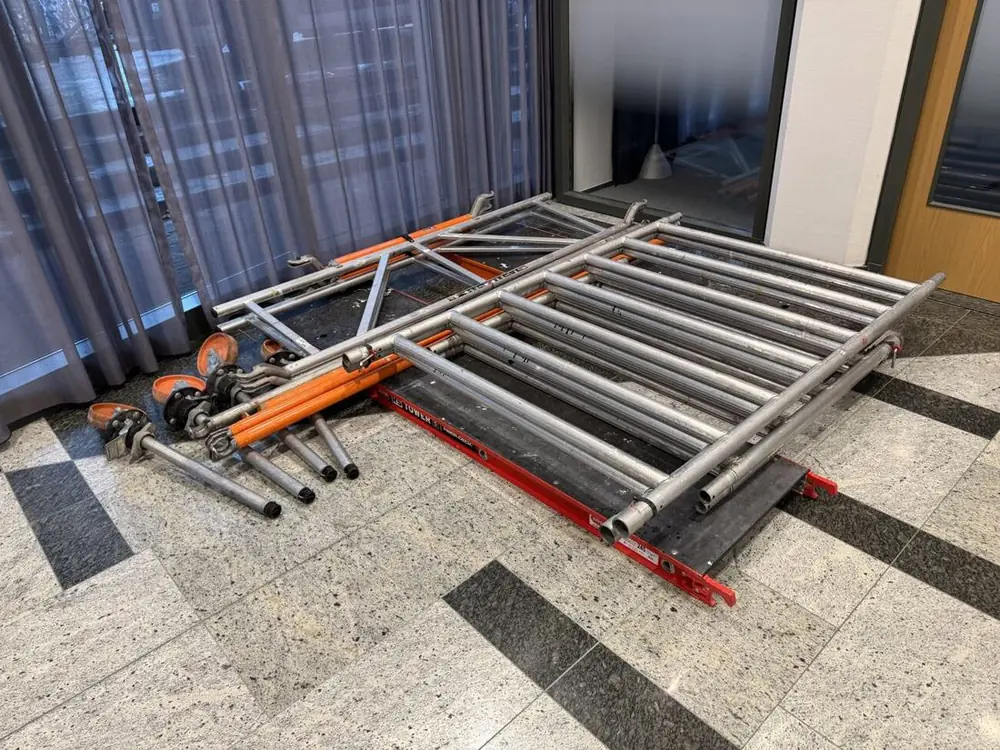
Scaffold frames, castors and orange braces laid out on a tiled floor beside a glazed wall before hire

If the route to the back of the house is full of obstacles, a narrow gate or a path between two fences, only the 75 cm wide RS51 will get through. You give up deck space by doing so, so measure that passage before you reserve anything. For the fixing work itself the wide build remains the better choice in almost every case. Which build suits which roof is worked through in the piece on the right tower for a solar array.
Working height to hire when fitting solar panels on a slope

Your highest working point is the top row of roof hooks, and that sits a fair way above the gutter. Measure to that line, then, and not to the roof edge. On top of the platform height comes another 2 metres or so of reach, because that is how high you get standing with your arms up. For a two storey house with a pitched roof that puts the working height somewhere between 8 and 12 metres, depending on the pitch and on where the top row lands.

Your measurement starts at the ground beneath the castors, not at the threshold of the back door. A garden that falls away towards a ditch, or a sunken patio, easily costs you half a metre that you never make up later on. If the roof faces the street and the tower stands on the pavement, you measure from the paving. What that means in parts and lifts is set out under a ten metre working height, which sits in the middle of this band.

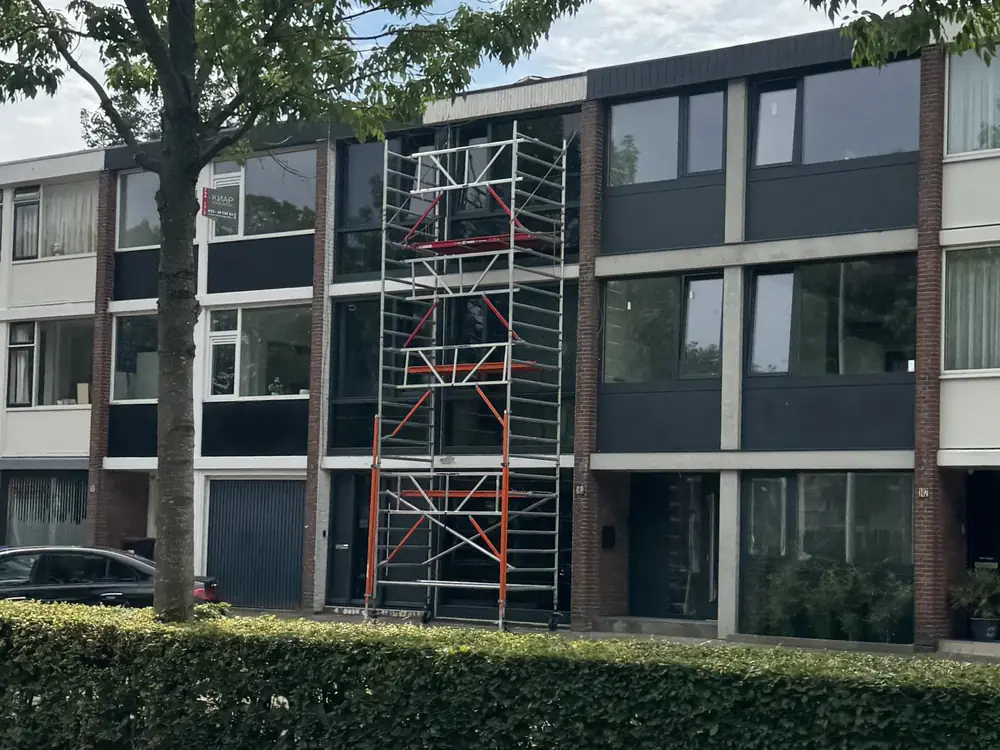
Mobile scaffold standing against a modern three storey block behind a street tree and a clipped hedge

Build too low and you end up at the top row with your chest against the roof edge, levelling the rails by feel. That comes back at you immediately: a rail a centimetre out of true shows up across five panels as a crooked edge. One lift higher costs a few extra parts and half an hour of building; starting too low costs you a whole extra set up. If you sit between two builds on a roof at second floor level, take the higher of the two.

Where the hired tower stands along the gutter line

For this job the tower almost always ends up in the back garden or on the drive, because that is usually where the roof slope with the array sits. Before delivery, work out where you can put it on flat, load bearing ground. Paving and blockwork are fine; a lawn that gives way under the castors after a wet week is not. If the garden lies lower than the patio, allow for that step when you level the base. Measure it rather than guessing at it.

At the foot the ground has to be sound as well as flat, since all four stabilisers press down through small feet that sink into anything soft. On a rear elevation that space is usually full of the fixtures that live there: a water butt below the downpipe, the outdoor unit of a heat pump, a border of tall planting or a canopy that runs out a metre from the wall. Clear all of that before the parts arrive.

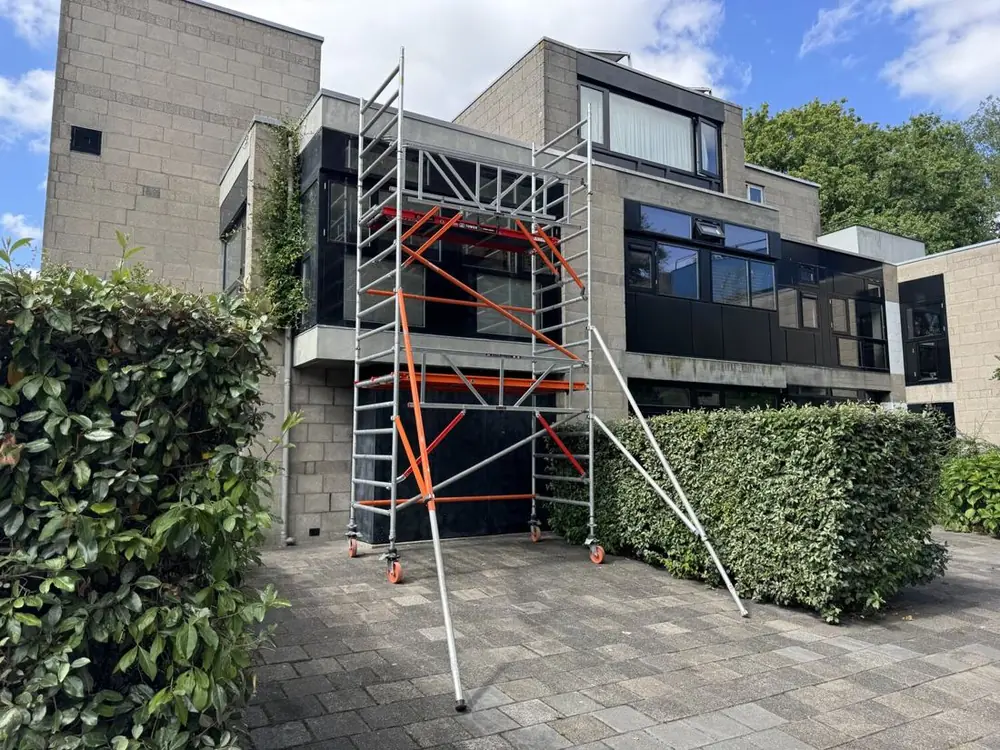
Built mobile scaffold on block paving with its four stabilisers angled outwards towards the hedge and the wall

Do not push the tower hard against the gutter but leave a hand's width, or the top guardrail will not pass when you move along. If you work a roof in rows you shift a little way along the elevation for each one, and that goes fastest when no slab is loose and no hosepipe lies across the route. Walk that strip once from end to end before you first climb up. What to do on a slope is covered in the notes on uneven ground.

Hire days you need for setting out and fitting panels

A set of ten to fourteen panels on a pitched roof takes two people about three days, and most of that time goes at the start. First you set the grid out: you stretch a string line across the width of the slope, count off the rafters and decide where each hook lands. Only when that line is true do you screw the first hooks down. Rush it and you correct it later along the whole row, which costs a hire day of its own.

Then comes the number of set ups. A roof slope eight metres wide takes three or four positions, and each move costs a good half hour once you have cleared the deck and stabilised again. There are also waits that are not yours to control: the installer who connects the inverter comes on his own day, and on wet tiles or in a stiff wind you stand still. Plan your period on the date you would still make with setbacks. Nobody plans for a wet Tuesday, yet everybody meets one.

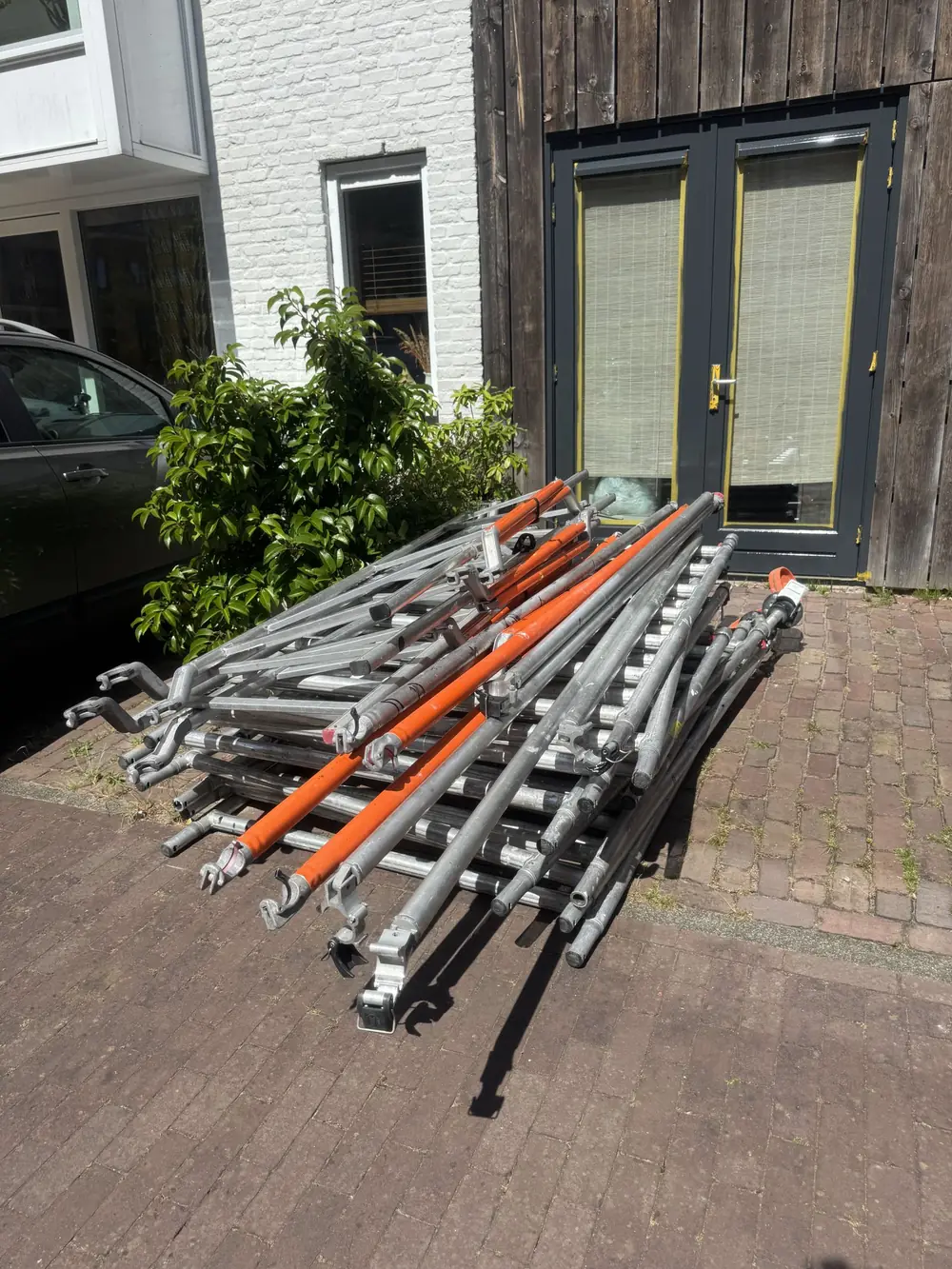
Loose scaffold tubes and orange braces stacked on brick paving in front of a house with timber cladding

Planning generously costs little. The first day of the hire carries the full amount; each day you add after it is cut by 95 per cent, which leaves a fourth or fifth day almost invisible on the total. Book too tight and the van is at the door while the top row still lies loose, and then you really are stuck. How to judge the length of a period is set out in the guide to the number of hire days. A spare day at the end is worth more than an early start.

Which mobile scaffold suits fitting solar panels?

Kamersteiger RS44
  • Working height up to 4 metres
  • Compact and narrow
  • Great for indoor and small jobs
View and calculate →
Smalle rolsteiger RS51
  • Working height up to 14.2 metres
  • Narrow (75 cm)
  • Ideal for narrow passages
View and calculate →
Most chosen
Brede rolsteiger RS52
  • Working height up to 14.2 metres
  • Wide platform (135 cm)
  • Extra stability and workspace
View and calculate →
1-persoons steiger MiTower
  • Working height up to 6.2 metres
  • Very compact
  • Quick and easy to assemble
View and calculate →

Fitting solar panels row by row from the platform

Each position gives you 245 cm of platform length, and that sets your rhythm. From one set up you reach roughly two panels side by side plus the hooks that belong to them. Start at the top of the row with the setting out: lay the string line horizontally across the tiles, lift the tile above each hook position and find the rafter or batten the hook screws onto. Finish that whole strip before you move, because coming back to a position costs double.

Onto the hooks go the aluminium rails, and two things there have to be visible from the deck. Aluminium expands in the sun, so long runs get a joint between two rail lengths instead of a hard coupling. And every panel has a clamp zone from the manufacturer: a band along the long edge within which the mid clamp and the end clamp must sit. Clamp outside it and the frame carries the load in the wrong place entirely.

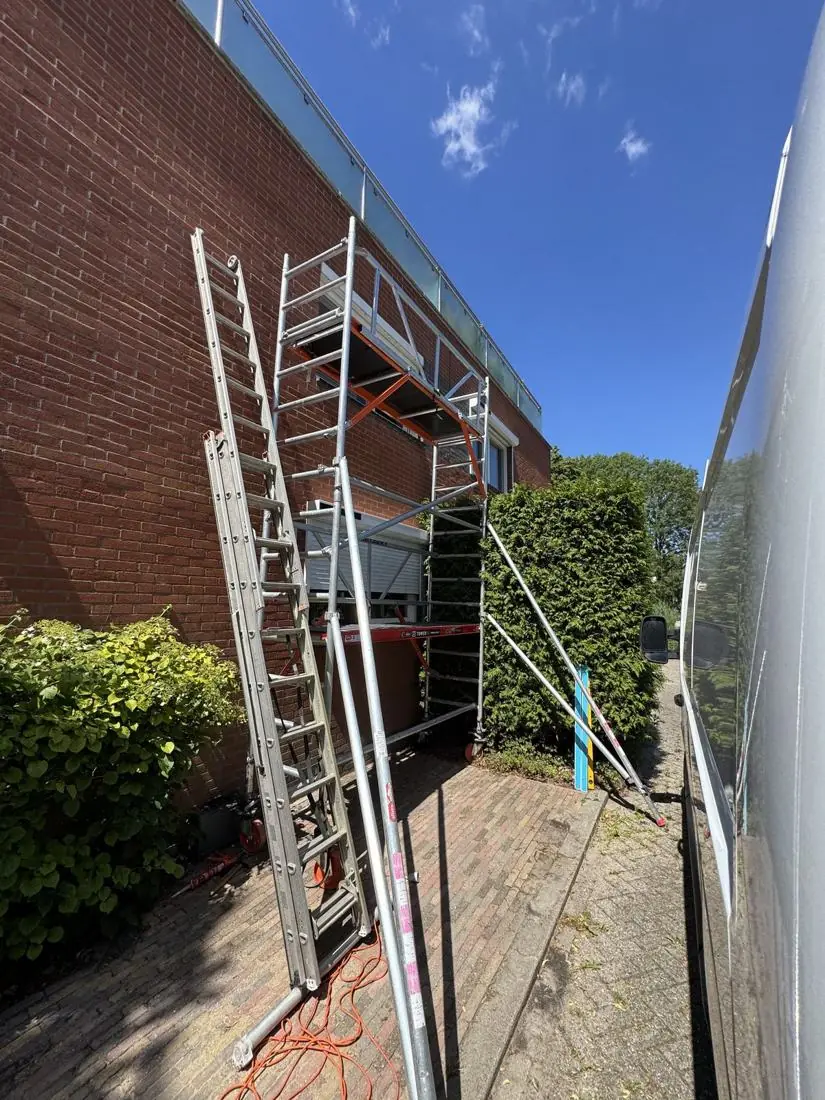
Mobile scaffold built in a narrow passage beside a brick wall, an extension ladder and a van alongside it

The third point is the distance to the roof edge. At the edges and in the corners of a roof the wind pulls hardest at a panel, so you keep a strip clear there and move the whole row towards the middle. That sometimes changes your layout while you are already at work, and then a wide deck lets you shift a row without stripping everything back. If the sheets still have to reach you, read on about the handover of panels at gutter level.

Delivery and collection of the scaffold you hire

What arrives is a complete, counted set of parts: uprights, diagonals, platforms, guardrails and the stabilisers loose alongside. If your order leaves before the 15:00 deadline on a weekday, it is delivered the working day after. Agree in advance which square metres that stack lands on, because the strip along the elevation is needed for the panels themselves. A corner of the drive suits far better than the grass under the roof slope. Mark that spot out with a couple of pallets if the drive is shared.

The build is your job, with the manual and the instruction video to guide you through the order. Two hours of work for two people gets you to this height, so set the delivery for the day before your first fixing day. You choose both the delivery date and the collection date, which suits solar work because the panel shipment is rarely nailed down. If that delivery shifts, the tower shifts with it. Which part goes on when is laid out in the step by step build.

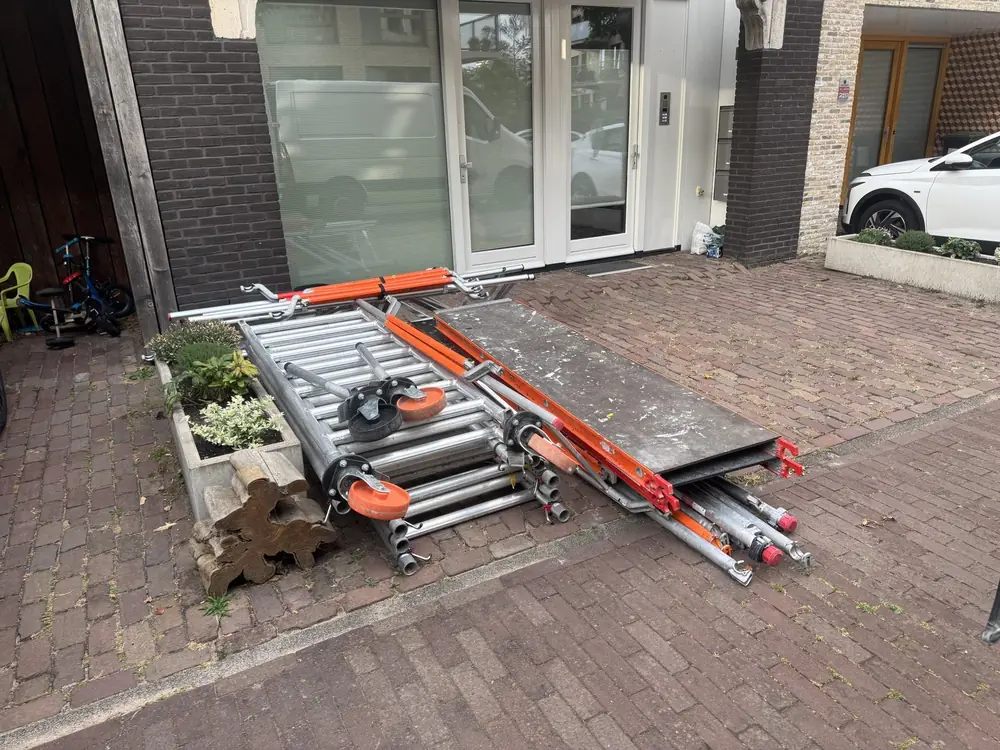
Uprights, orange diagonal braces and a single scaffold deck board stacked on paving before a glazed front door

We come to collect the tower at the end of your period; you take it apart and put the parts together in one place. Do not leave that to the morning itself, in among clearing cable trunking and packaging, because that is exactly when a brace goes missing under a pile of film. Count while you dismantle, not once everything lies on the pavement. The amount for bringing and fetching depends on which province you are in and is listed under the delivery charges per province.

Working safely on the tower while fitting solar panels

The deck under you will take 200 kg on any one square metre, a figure that comes straight from class 3 of the EN 1004 standard. With solar work you reach that limit sooner than expected: a panel weighs a good twenty kilos and there are usually two people on the platform. So do not lay the whole stack of rails and sheets up there, only what that one set up needs. What that means in practice is covered in the notes on load and weight. Take up only the rails that row actually swallows.

The basic rules apply in full. Brake every castor the moment you step on, never move the tower with anybody or anything on the deck, and stop when the wind picks up. That wind limit arrives sooner here than on other roof work, because a panel carried upright behaves like a sail. After each move fold the four stabilisers out again and check that all four touch the ground; on block paving one of them likes to drop into a joint. Lay a scrap of ply over that joint before the foot goes down.

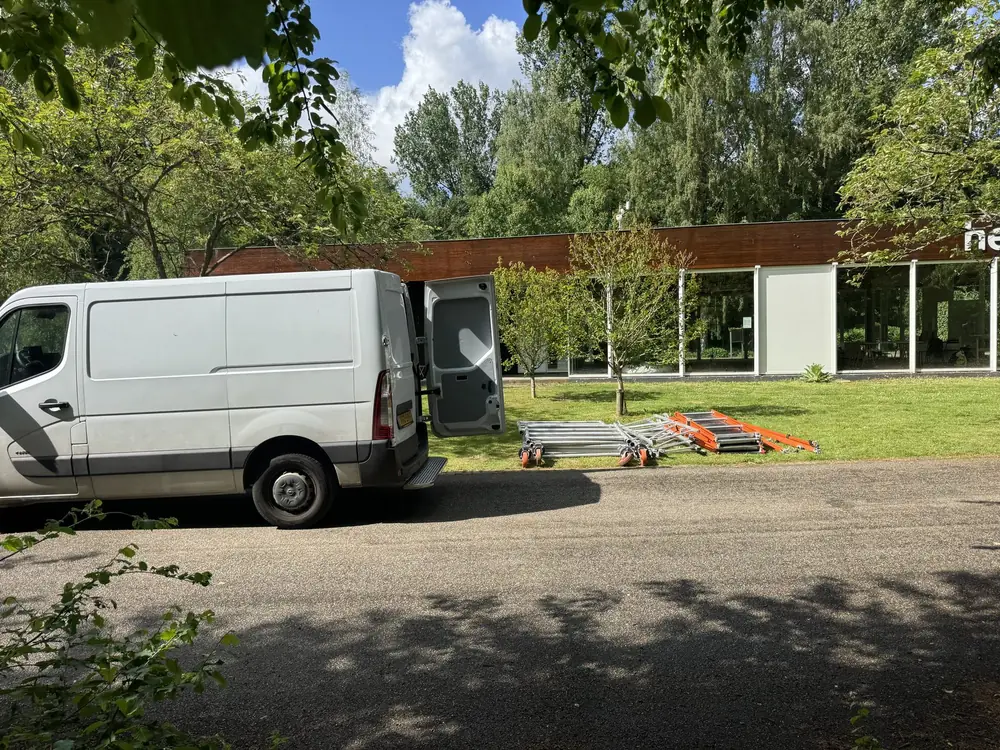
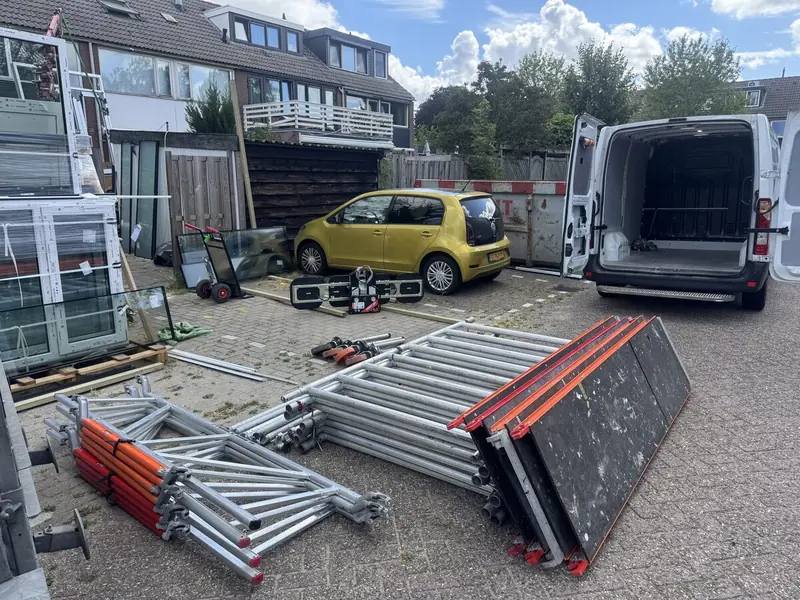
White van with a rear door swung open on tarmac, scaffold frames and orange stabilisers on the grass

What actually goes wrong while fitting solar panels usually involves the small parts. A mid clamp or a bolt that rolls off the roof edge arrives on the ground at speed. So keep the strip under the platform clear and stand a cone or a barrow there if children are about in the garden. Do not work on the cabling while the array lies in full sun, and never step from the guardrail onto the tiles. Wet pantiles give way before you notice.

In 5 steps

How hiring a mobile scaffold works

1
Choose working height

Pick the height that suits your job.

2
Book online

Sorted in 60 seconds, price shown instantly.

3
We deliver

At the agreed spot the next working day.

4
Assemble safely

Assembled by you, with a manual.

5
We collect

One call and we collect the scaffold.

Good to know

Practical tips for fitting solar panels

1

Stretch your string line before the first hook is fixed and check it from two set ups. A line that is true across the full width saves you half a hire day of correcting the top row later.

2

Lay the roof hooks and clamps in separate trays on the deck instead of loose in a box. Searching costs far more time up top than down below, and loose parts roll off the edge.

3

Ask the panel supplier for the mounting drawing with the clamp zones before the tower is delivered. Once you are on the platform you want those dimensions in your head, not at the bottom of the ladder.

4

Never lift a panel upright over the guardrail when there is any wind about. Lay it flat on the deck and turn it only on the roof slope, or the glass catches the air like a door swinging open.

5

Fix the first hook of every row and hang a length of rail on it straight away to see whether the line is true. Discover an error at hook twelve and you begin the row again.

6

Set the collection day for the day after the inverter has been connected. If a clamp still needs adjusting then, the tower is happily still standing and you need not hire anything a second time.

Frequently asked questions

Frequently asked questions about fitting solar panels

Which model of mobile scaffold do you hire for fitting solar panels?+

Take the RS52, the version with a 135 cm working deck. On solar work there is material beside you the whole time: rails, roof hooks, a box of clamps and your tools, and you usually share the floor with a second person. On the narrow RS51 of 75 cm you are constantly shuffling all of it about. Only when the way through to the back garden is too tight does narrow outweigh roomy, and then you hire that slimmer tower after all.

How does hiring a mobile scaffold for solar work actually go?+

You arrange it online. First you pick the model and the build height, then a day for the set to be delivered and a day for it to leave; what you pay is fixed at that point, VAT included. On the chosen morning the parts lie ready at your house. You build the tower, you fix your array and on the last day you take it apart again. We drive it away afterwards. Run through what you need with the checklist for anyone reserving a tower.

How many hire days does fitting solar panels on a pitched roof take?+

Reckon on the tower standing for three to four days for an average set on a pitched roof. Setting the grid out and levelling the rails fill the first day, after which the panels go on at a decent pace. If a second roof slope joins in, or the installer has to come at a moment of his own for the inverter, add a day. Book that day when you reserve, not when you notice you need it.

What makes up the rental price and how does the day discount work?+

Two things drive the amount: your choice of model, and the height you take it to. On top of that comes a fixed charge for bringing and fetching, which is settled in advance and includes VAT. All the amounts are listed under our rates per build height. When you hire a mobile scaffold the first day weighs by far the heaviest; every following day falls away sharply. One generous booking is therefore cheaper than two short ones back to back. Nothing about the amount changes once your dates are set.

Which working height should I hire for panels on a pitched roof?+

The measuring point is the top row of roof hooks, not the ridge and not the gutter, and you begin at ground level, where the castors will end up standing. Two storeys with a pitched roof puts you between 8 and 12 metres. Within that range pick the build that brings you just above those top hooks, so your hands work at chest height. Which tower belongs to which height is shown on the overview of working heights. Enter that height as the figure you want, not as a maximum.

Do I choose myself whether the hired scaffold is delivered?+

We bring it, or you collect it. With delivery we drive the set to the address on your date and take it away again after the last fixing day, for one fixed amount with VAT already in it. If you come with your own transport you agree a time at Zeeburgerpad 89 in Amsterdam and take the parts away free of charge. Do remember that a set built to this height will not fit in an ordinary car. The hired set travels in one van load either way.

Is building the tower included when you hire the set?+

No, the build belongs to your work on site. We put the loose parts down at your place and take them back afterwards; assembling, moving and dismantling the tower stay with you. Allow for it in your planning, because you will not reach the first roof hook that morning. What we hire out does not run to system scaffolding, facade scaffolding or cherry pickers, so a tower you put up yourself is the normal answer here. Read the manual through once the evening before you start building.

The fixing is running late: can I hire the scaffold for longer?+

Tell us the moment it is clear you will be carrying on. As long as no next customer is down for that tower in the diary, we move the collection day. On solar work it happens often enough: a panel arrives damaged, or the installer can only come later for the inverter. To get ahead of that, many people book a spare day at once, and returning early is always allowed. Ring us early rather than late, because the diary fills from the front.

How much room must be free beside the house for the hired tower?+

Take the deck width of 135 cm and add how far the four stabilisers stand out. Beyond that you want a strip where the panels can lie for a while. In practice the hired tower asks for a flat run of several metres. If a shed, a water butt or a border blocks the run, move it ahead of the delivery day; shifting things halfway through easily costs an hour. A clear run also lets you wheel the parts round in one go.

What do I do with my hire days if it blows too hard to fix panels?+

Leave the tower where it stands; what you postpone is the work up top. Carrying panels in wind is the first thing to drop, because a sheet of nearly two square metres catches more air than you would think. Use a day like that at ground level: measuring cable, cutting rails to length, laying everything out for the morning. Because you set the collection day, moving a fixing day costs you at most one extra day. Nothing on the tower needs taking down for a windy afternoon.

When is the deposit back in my account after the hire?+

You settle a deposit along with the reservation. Once the set is back and the tally agrees, that amount is returned inside one working day. Two things matter here: hand back everything you received, and drill or screw nothing into the material of the tower to hang something from it. A cable bundle taped temporarily to an upright is fine, as long as you take it off again. Photograph the stacked parts once you have finished counting them back.

Can I use the same hired tower for connecting the inverter?+

Usually yes, as long as the inverter sits on the outside wall or in the loft just behind the roof slope. If it is in the meter cupboard you plainly do not need the tower for it, and you use the scaffold only for the cable penetration at the tile. Plan that connection inside the same hire period, because having a set delivered again for half an hour of work is a waste. Optimisers are covered under the fitting of optimisers on the same array.

Hire a mobile scaffold for fitting solar panels today?

Calculate your rental price now or ask for free advice.

Rolsteiger van SteigerTaxi geleverd op locatie
Book it online

Your scaffold sorted in 2 minutes.

Choose your scaffold and working height, see the price instantly and book online.