
See your price
Application

Installing solar panel optimisers? Choose the right scaffold.

Optimiser work is delicate work carried out a long way up. Under each panel goes a small box that clamps to the mounting rail on a bracket, with short direct current leads running to the panel above it and across to its neighbour. Paperwork comes with it: the serial number sticker off every unit goes onto a plan of the roof. That asks for a firm, wide workplace along the gutter, so hire the RS52 at 135 cm in a build giving 8 to 12 metres of working height.

  • Order before 3 pm, delivered tomorrow
  • Professional Altrex scaffolds
  • Up to 14.2 metres working height
  • Easy to assemble yourself
4,2 tot 14,2 mWorking heights available
12Provinces served
7Days a week
200 kg/m²Load class 3
In short
  • For installing solar panel optimisers we recommend the Wide mobile scaffold.
  • Installing solar panel optimisers calls for the wide RS52 on a 135 cm base, built to reach roughly ten metres.
  • The leads between a box and its panel are short, so every unit has to sit directly beneath its own plate.
  • One or two days on hire covers it, including the time spent noting serial numbers onto the plan of the roof.
  • First 24 hours from €175 incl. VAT and delivery; every day after that 95% off.
Key facts for this job
FeatureValue
Recommended scaffoldWide mobile scaffold (Altrex RS TOWER 52)
Working height for this job8 to 12 metres
Available working heights4.2 to 14.2 metres
StandardEN 1004, load class 3 (200 kg per m²)
DeliveryOrdered before 3 pm, delivered next working day
Each extra day95% off, from €8.75 a day
Why a mobile scaffold for installing solar panel optimisers?

Safe, stable and professional work at height

Optimisers sit in the least reachable spot there is: under the panels, on the rail, with a box you hold in one hand while the bracket is tightened with the other. The leads are deliberately short, so nothing can be carried down to the ground and dealt with there; it all happens where the box belongs. On top of that you peel a sticker off each unit and press it onto a plan, and paper is the last thing you want flapping about up there. A wide deck along the gutter buys you that calm. Hiring a tower for installing solar panel optimisers is therefore about room to work rather than reach alone.

  • Each box clamps to the rail beneath its panel
  • Short leads fix where every optimiser goes
  • Serial stickers pressed onto the roof plan
  • A step across to the roof edge near ten metres
Read more about working safely →

The tower you hire for installing solar panel optimisers

Very little weight goes up on this job, but a great deal of small stuff does: a box of units, cable ties, a cordless driver, a marker and a clipboard carrying the roof plan. You want that lot lying beside you, not swinging in a bag off the guardrail. So the choice falls on the RS52, the wide 135 cm base, where a crate can stand on the deck and you can still walk past it. Every base you can reserve is gathered in the range of mobile scaffolds for hire.

The narrow RS51 at 75 cm will do as well, and it is what you pick when the tower has to pass between a shed and a hedge to reach the back. You trade away deck area for that, exactly where the kit was meant to live. A MiTower is built for one person and stops at 6.2 metres, so a roof at ten metres rules it out. A room scaffold belongs indoors. What is left is a wide tower moved along the gutter in a handful of positions.
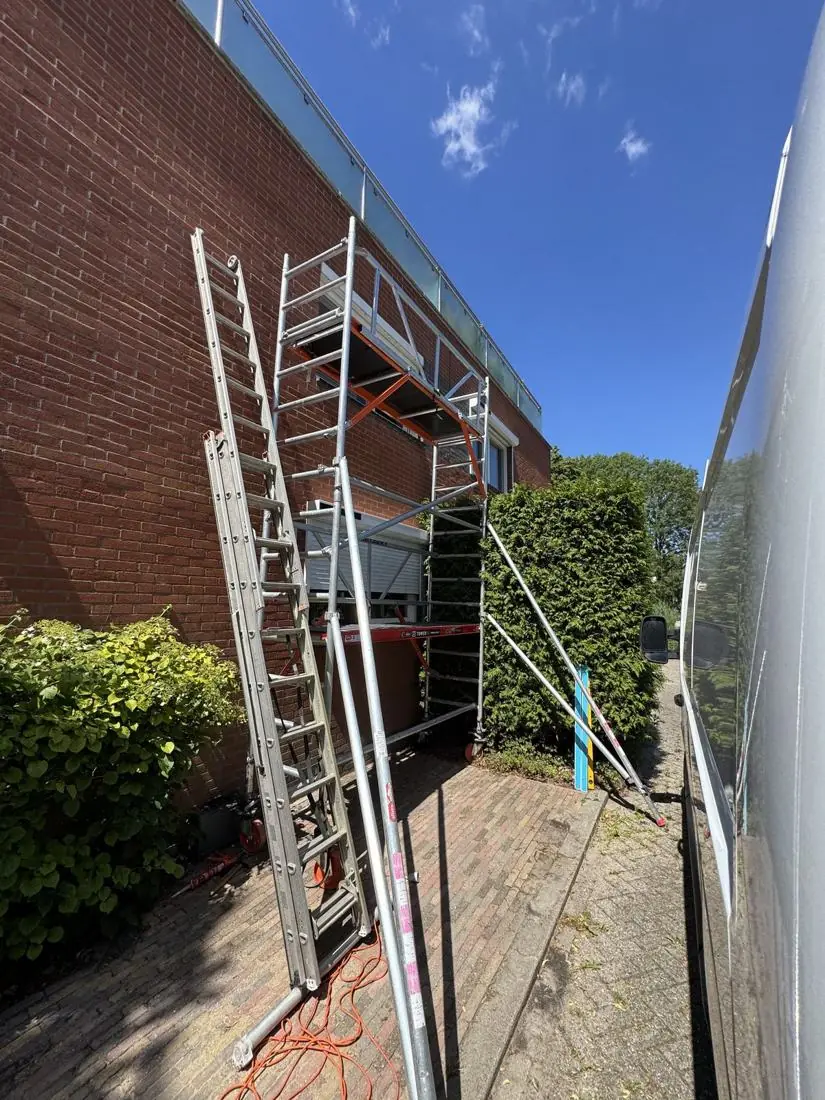
Tower built up in a tight passage beside a brick house, reaching the roof edge with a ladder standing next to it

Before you hire a mobile scaffold for this, think about where you step onto the roof. Installing solar panel optimisers on a pitched roof usually means standing on the tower and reaching over the gutter to the bottom row, while the rows above it call for going onto the tiles. The platform is then your starting point, your store and the place the roof plan lives. A wide deck makes that transfer a good deal calmer than a narrow one, particularly on the way back with both hands full.
Working height to hire to reach the mounting rail

The point you have to reach is the lowest mounting rail, and that sits a short way above the gutter. So measure to the gutter and add half a metre. The figure you enter when reserving is a working height, made up of the platform height with the roughly 2 metres your arms bridge on top. On a house of two storeys with a pitched roof that brings you out at eight to ten metres. With three storeys it climbs towards twelve, which is the top of this band.

That puts you squarely in the 8 to 12 metre range, and that is what installing solar panel optimisers asks for. To see which build matches, look at a build for ten metres of working height and count up how many platforms come with it. What you should not do is measure to the ridge: the top row of panels is reached across the roof rather than from the tower, so that height need not be hired at all. It saves you frames and assembly time.

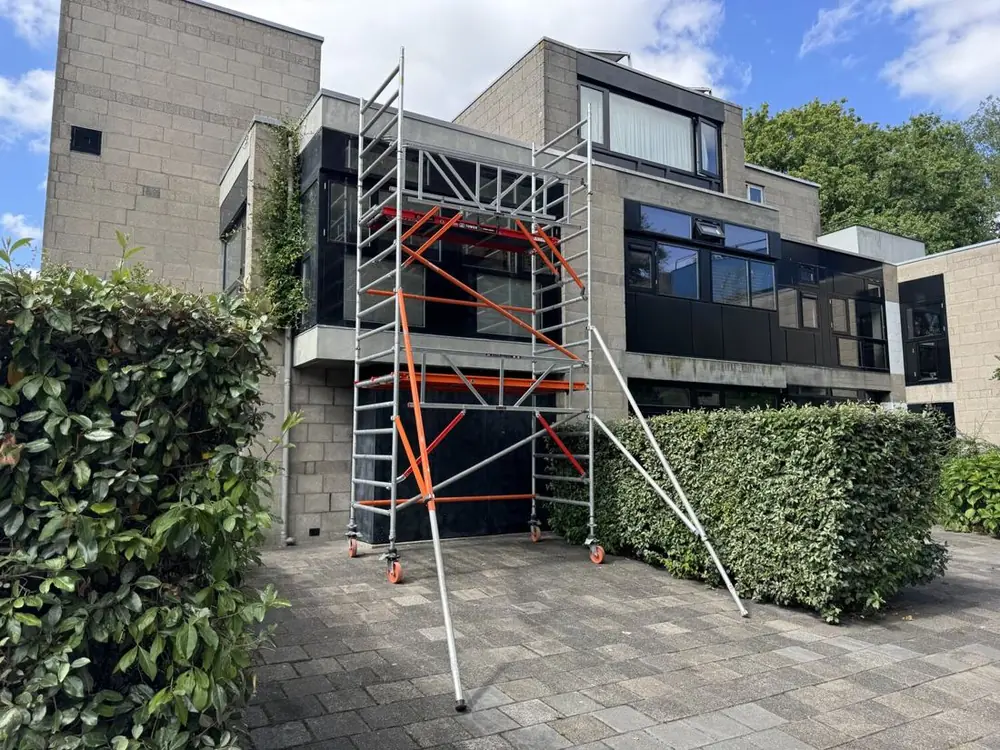
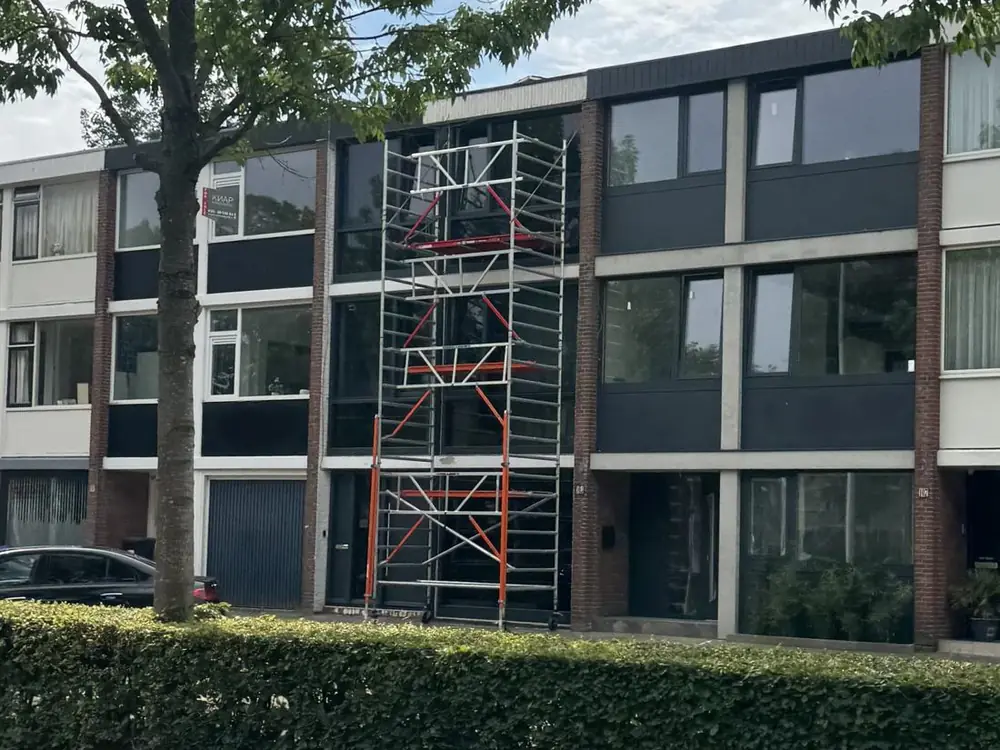
Mobile scaffold assembled against a three storey block with its decking level with the upper floor windows

Hiring a build that is too low works out badly here. Standing under the gutter, you reach up under the panels with arms fully extended and the bracket never seats properly, so more time goes into wrestling than into fitting. And if you do have to get onto the roof, you want your hip at gutter level as you step across, not to be hauling yourself upward. One extra platform costs almost nothing when you reserve; a second rental period costs a good deal more.

Hiring a tower to stand in the garden below the array

Panels lie on whichever pitch catches the sun, and that is by no means always the side with a drive. More often than not you end up in the back garden, on grass or on a terrace, with a shed or a summer house in the way. Walk that side before reserving anything and see whether a level patch of a few metres can be cleared, with room for the four stabilisers that reach out into the planting. Where there is a terrace, that is usually the best spot for installing solar panel optimisers from.

Grass is the most awkward ground of the lot. The castors sink in the moment it has rained a day, and then the tower no longer stands level while you are up there dealing with small components. Put trackway or thick boards under the feet and take up the rest on the spindles. Tightening a bracket demands precision, and precision does not come off a deck that gives. Setting a tower on ground like that is described in the piece on uneven ground.

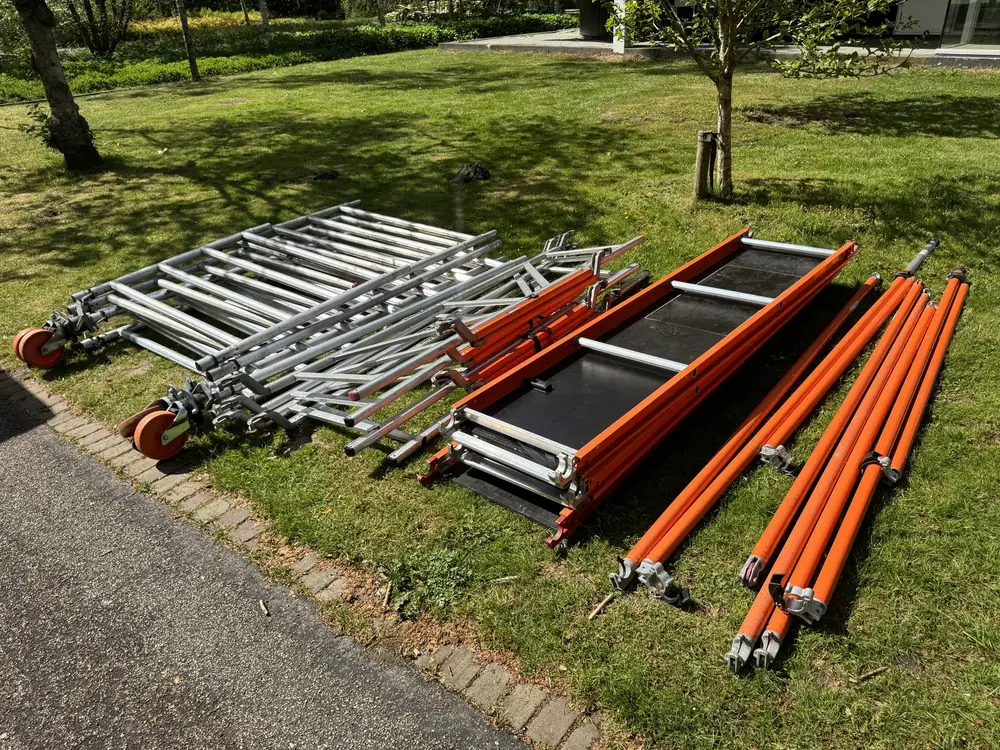
Frames, orange braces and decking spread across a garden lawn, the counted set as it waits on soft ground

Look at what hangs above the standing spot too. The flat roof of an extension, an awning or a branch from next door gets in the way more often than you expect, and you meet it only when the tower is half built. Work out as well where the box of units and the plan may live; a garden table beside the position does nicely. Tell the neighbours you will be along the boundary for a couple of days, which saves a discussion halfway through your hire.

How many hire days installing solar panel optimisers needs

The fitting itself moves along: clipping a box onto the rail, pushing two pairs of connectors home and looping through to the next takes only minutes per plate. The time goes into raising the tower, shifting it along the gutter and keeping the paperwork straight. For a roof of ten to fifteen plates you therefore hire one to two days, of which the first half day disappears into building. Where a second pitch on the other side also carries panels, add another day.

A spare day like that hardly registers on the bill. Full price applies to the opening twenty four hours alone, while every following day arrives with ninety five per cent taken off it, so a roomy reservation is close to free. Whatever rental price goes with your particular build is set out with VAT on the page of tower rates. Installing solar panel optimisers is not work to break off halfway, so take the longer booking and finish the array in one visit.

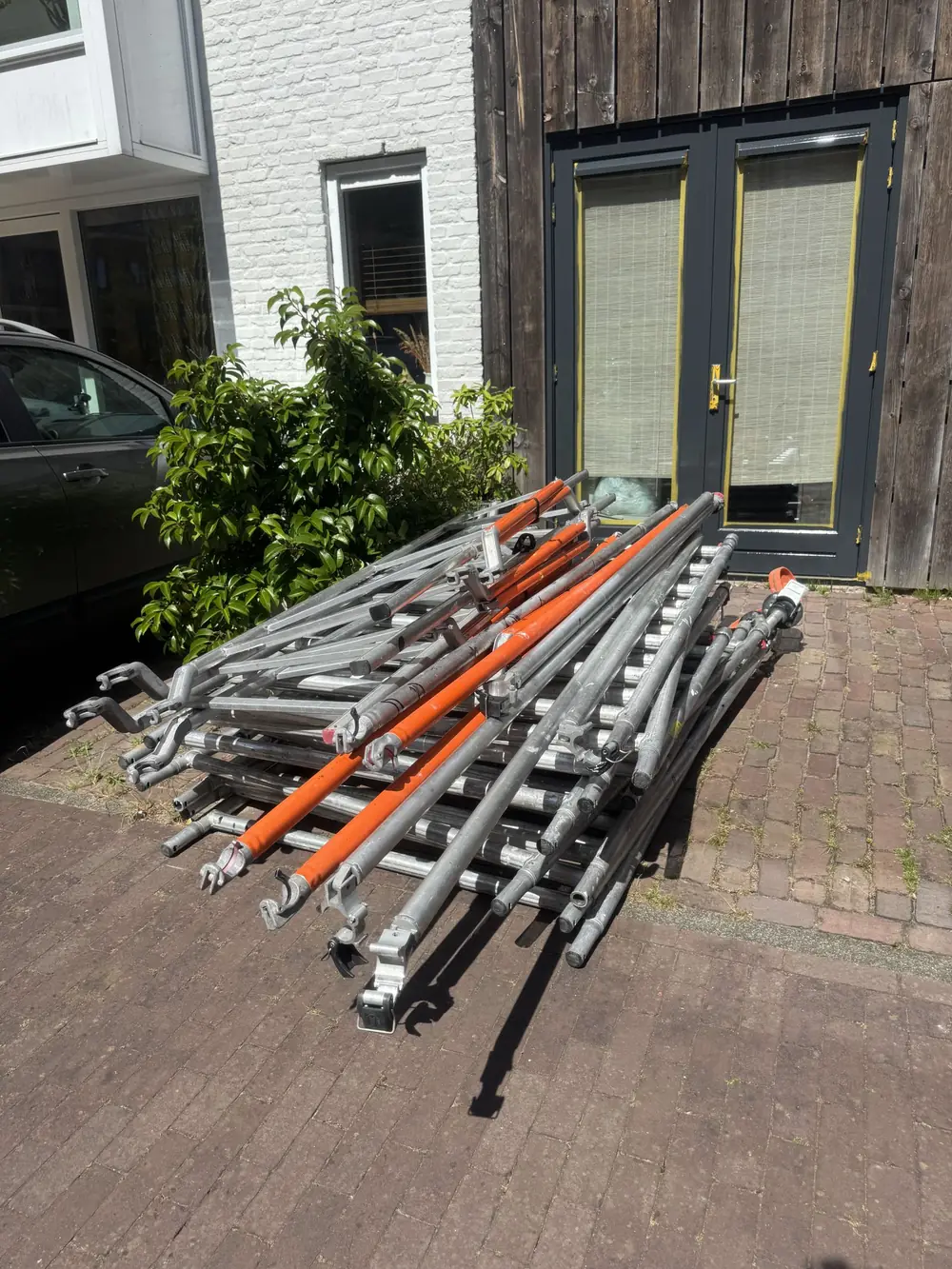
A stack of tubes, frames and orange bracing resting on brick paving by a dwelling, counted out before assembly starts

The weather plays its own part. You fit these units with the installation switched off, and you would rather not do it on a blazing afternoon, when the plates are too hot to handle and the rail burns your fingers. Rain is a different problem, since connectors want to be made up dry. Pick an overcast, dry day and keep a fallback day inside the booking. As the collection date is yours to choose, that fallback day costs you very little.

Which mobile scaffold suits installing solar panel optimisers?

Kamersteiger RS44
  • Working height up to 4 metres
  • Compact and narrow
  • Great for indoor and small jobs
View and calculate →
Smalle rolsteiger RS51
  • Working height up to 14.2 metres
  • Narrow (75 cm)
  • Ideal for narrow passages
View and calculate →
Most chosen
Brede rolsteiger RS52
  • Working height up to 14.2 metres
  • Wide platform (135 cm)
  • Extra stability and workspace
View and calculate →
1-persoons steiger MiTower
  • Working height up to 6.2 metres
  • Very compact
  • Quick and easy to assemble
View and calculate →

Installing solar panel optimisers from a 245 cm platform

A platform of 245 cm covers about two panels across. Each position therefore deals with the boxes for two plates, perhaps three: bracket onto the rail, unit into the bracket, leads up and across. After that the tower has to travel a little further. On a roof of fourteen plates, count on something like six positions, and that is precisely why the plan goes up with you: after the fourth move nobody remembers which number belongs where on the roof.

The looping through decides how you work along the gutter. Every optimiser has a short output to the next one, so you follow the order of the string rather than jumping about the roof. Lay each lead neatly into the clips beneath the rail as you go, because a loop left sagging cannot be retrieved from the ground afterwards. Anything you leave hanging costs you a further position, which means braking, setting the stabilisers out and climbing all over again.

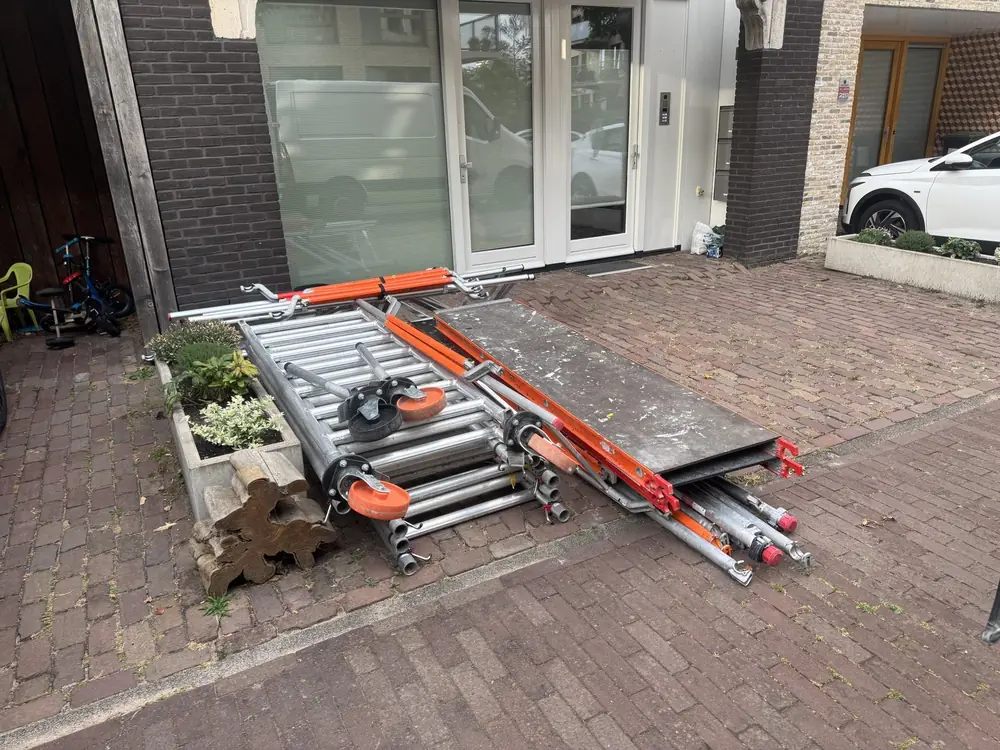
Decking, castor frames and adjustable legs set out across a driveway, the parts that give you a platform to stand on

The stickers are where things go wrong most often. From every unit you peel the serial number and press it onto the spot on the plan where that plate lies. Do it there and then, from the platform, and never afterwards from memory once you are back on the ground. Clamp the sheet to a clipboard and tuck it inside your jacket at every move, because a gust along the gutter takes loose paper off into the garden and the hunting starts. Paper and wind get on badly at this height.

Delivery and assembly when hiring a tower for optimiser work

The set arrives counted and complete, and you decide where it may lie. On optimiser work the tower usually ends up round the back, so point out a spot at the front where the van can unload and from which the parts go through in two or three trips. If the order is in the system by 15:00 on a weekday, the following working day is the earliest the set can stand at your door. Put the delivery a day ahead of your start.

Assembling the tower is your part; we do not come and build. A manual travels with the parts and the sequence is filmed as well; two people get a build of this height standing inside a couple of hours. Raise it the day before you begin, so the next morning opens with a working position instead of you waiting about with a box of units in your hand. Keep that assembly session as its own slot, because no bracket goes on the rail while it runs.

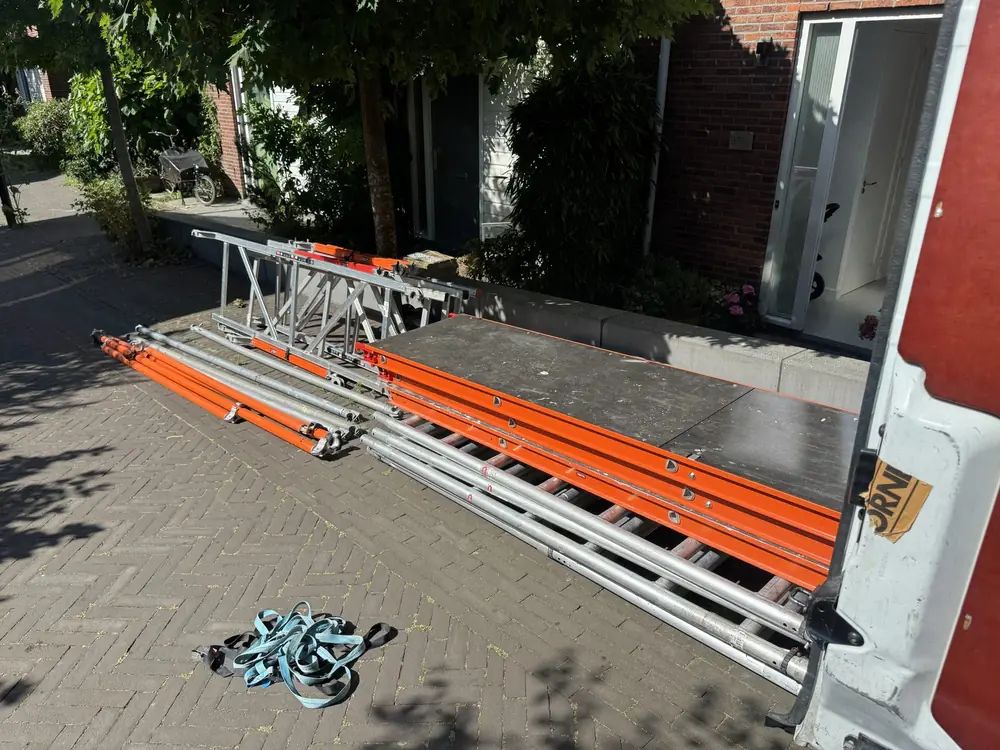
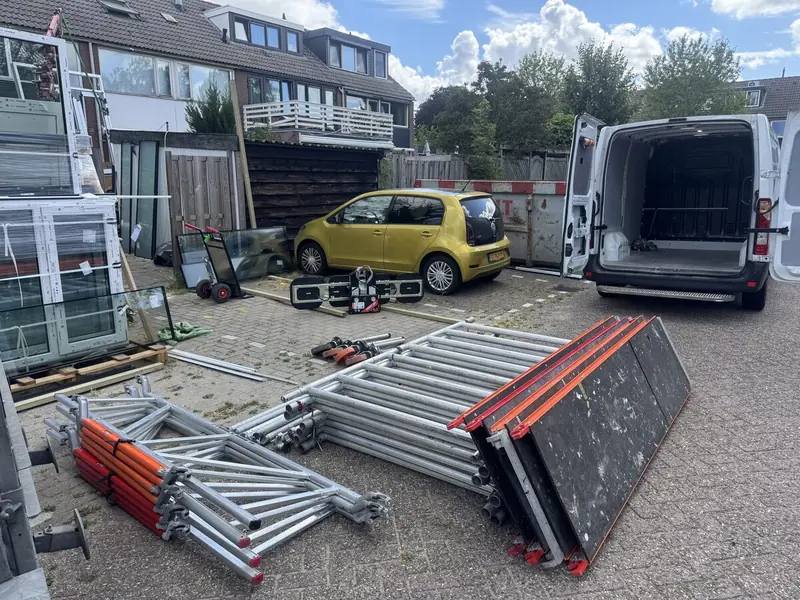
Long orange braces, tubes and decking lying on paving beside the open side of a white delivery van

Once the final box hangs and the plan is complete, you strip the tower and stack the parts where they were unloaded; on the agreed day we drive round to collect them. Check beforehand that no cable tie or connector cap has stayed behind between the platforms. What the journey out and back comes to varies by province, and the figure with VAT sits under delivery charges by province, so the total is known before you reserve.

Safe work on a hired tower with small loose parts

Load class 3 means the deck may bear 200 kg on each square metre, and that class comes from EN 1004. On optimiser work you get nowhere near it: a box of units weighs almost nothing. What does count is that two of you are often up there at once, one on the tower and one on the roof, with tools and a crate between you. There is more about that in this explanation of the standard for mobile towers.

The usual agreements apply here as well: brake the castors first and climb second, nobody aboard while the tower travels, and the work goes down when it starts to blow. Wind is a particular nuisance on this job, because stickers, roof plans and loose caps are the first things to go. Set all four stabilisers out again after every move, even when you have only shifted the width of one plate; that is exactly the moment people skip it.

Assembled tower standing on paving with all four stabiliser legs run out and resting firmly on the ground

The risk peculiar to installing solar panel optimisers is small items falling. A cap, a screw or an offcut of trunking coming down from ten metres is more dangerous than it sounds, so keep the ground under the tower empty and use a tool bag that closes. Work only on an installation that is switched off, and leave the connecting to somebody trained for it. Post somebody below to keep watch if there are children playing in the garden. Further rules sit on the page about working at height.

In 5 steps

How hiring a mobile scaffold works

1
Choose working height

Pick the height that suits your job.

2
Book online

Sorted in 60 seconds, price shown instantly.

3
We deliver

At the agreed spot the next working day.

4
Assemble safely

Assembled by you, with a manual.

5
We collect

One call and we collect the scaffold.

Good to know

Practical tips for installing solar panel optimisers

1

Print the roof plan on stiff paper or laminate it before you go up. Stickers will not take on damp paper, and a sheet that tears on the fourth position costs you the whole picture of the array.

2

Number the plates on your plan before the tower is delivered. Then all that remains up top is peeling and ticking, which saves a few minutes of searching on a flapping sheet at every position.

3

Take two sizes of cable tie up with you. Short ones handle the loop to the plate and longer ones hold the run under the rail, and with the wrong size you are back down for the other box.

4

Set the tower so that you begin at the first optimiser in the string. Looping through only runs one way, and working against that direction costs you an extra position at the far end.

5

Keep a bucket or a crate on the platform for caps and packaging. Every plate throws off a little waste, and from ten metres up that waste travels the length of the garden in a single gust.

6

Check the installation in the app before the tower comes down. If a unit is missing from the overview, the tower is still in place and you are back at it within ten minutes.

Frequently asked questions

Frequently asked questions about installing solar panel optimisers

What sort of tower do you hire for installing solar panel optimisers?+

That is the RS52 on a 135 cm base. Up there you have a box of units, tools and a clipboard with the plan, and a wide deck keeps the lot within reach instead of in your walking line. If the tower has to pass a narrow gate to reach the back garden, the slim RS51 comes into play and you work with less deck. Measure that route before ordering a scaffold, because an eighty centimetre gate settles the choice for you.

What is there to arrange when hiring a tower for optimiser work?+

You put a build together online, set the date for the drop and the date for the pick up, then pay in advance at a price carrying VAT. The set of scaffold parts comes to the house, you raise the tower behind it and work from plate to plate along the array. At the end of your hire period everything stands dismantled and ready. Nothing else needs sorting out, beyond somewhere for the van to unload and a garden firm enough to be walked across while carrying frames.

How many hire days does installing solar panel optimisers take?+

For a roof of ten to fifteen plates you come out at one to two days on hire. Clipping a unit on takes minutes, but raising the tower, moving it along the gutter and filling in the plan take up most of the time. Where the other pitch carries an array as well, allow a day more. Better to hire the tower a day too long than too short, since stripping out and coming back costs half a day.

What does hiring a mobile scaffold for optimiser work come to?+

It follows from the build you select and from the province the van drives to; the total with VAT appears before you pay. What suits this job is that the weight of the rate sits in the first day and that each day after it adds very little. Anyone hiring the tower for two days straight away keeps room in hand for checking the installation in the app before it is taken away again.

What working height do I hire to reach the rail under the panels?+

Measure to the lowest mounting rail, so just above the gutter, and start the tape at the ground where the castors will stand. A house of two storeys puts you at eight to ten metres, three storeys at twelve. Measuring to the ridge is unnecessary, because the top row is reached across the roof. What each build gives you in height is listed on the page of working heights. Quote that figure when hiring.

Does the tower come by van, or do I fetch it myself when hiring?+

Delivery suits optimiser work best, because the set has to be carried round the back anyway and your own car stays free. The van comes on the day you picked, for a price per province fixed in advance. Preferring to fetch it, you may collect by arrangement at no cost from Zeeburgerpad 89 in Amsterdam. A build to ten metres runs to a great many parts, which weighs on the decision if you hire a scaffold without a trailer behind the car.

Do I have to assemble the hired tower myself?+

Yes, assembling it and stripping it out again are down to you. We supply the parts only, and building is not part of the hire. Set aside a separate session with two people for a tower up to gutter height, because no optimiser reaches the rail while the frames are going together. Steigertaxi keeps no facade scaffolds and no cherry pickers either, so along a pitched roof a mobile tower is the practical thing to hire.

What if the optimiser work overruns and the hire needs extending?+

Let us know the moment it is clear you will not finish on time, and we move the collection date, provided nobody else is waiting on that tower. On this work the overrun is usually something small: a lead that is just short, a unit that will not report in the app, a shower at the wrong moment. Anyone who dislikes that gamble hires the tower a day longer from the start. Handing back early is equally possible.

How much room does the garden need under the array for a hired tower?+

Add to the base what the stabilisers need on either side, and keep a place free besides for the box of units and the plan. In a back garden that comes down to a level patch of roughly three by three metres with nothing standing on it. If borders, a pond or a trampoline are in the way, clear them before the tower is delivered. Shifting a scaffold around garden furniture costs you more time than tidying up ever will.

Can I keep the scaffold on hire when it is blowing too hard?+

The tower stays where it is, but the work stops. Wind is doubly awkward with optimisers: you are high up with small components and loose paper, and both are gone in a moment. Use a day like that to bring the plan up to date, prepare leads at ground level or check over the inverter cabinet. While the tower remains on hire you simply pick up the next morning where you left off. An early, still morning is far the best time to start.

When is the deposit returned after hiring the tower?+

You put down a deposit at the point of booking, and once the tower has been collected and counted the money comes back within 1 working day. On optimiser work it rarely goes wrong through dirt on the parts, but it does through small items: a brace left lying in the grass, a platform stood behind the shed. Walk the whole garden over before the van arrives to load. There is more in the explanation of the deposit.

Could I fit optimisers off a ladder instead of hiring a tower?+

Technically it is sometimes possible, but it is a poor idea. Both hands are needed to hold the box while the bracket is tightened, and stickers have to be peeled and pressed onto a plan. A ladder underneath you will not carry that. A hired tower gives you a deck to stand things on and a place to step across the roof edge from, and on this work that is the difference between an hour and a day of struggle.

Hire a mobile scaffold for installing solar panel optimisers today?

Calculate your rental price now or ask for free advice.

Rolsteiger van SteigerTaxi geleverd op locatie
Book it online

Your scaffold sorted in 2 minutes.

Choose your scaffold and working height, see the price instantly and book online.