
See your price
Application

Cleaning solar panels? Choose the right scaffold.

Cleaning solar panels is not done because they look grubby but because the yield drops: a layer of pollen in spring, moss along the bottom edge and traffic film together cost you a few per cent. Washing asks for water, a soft brush and above all somewhere you can stand calmly and dry. On a two storey house the choice falls on the wide RS52 of 135 cm, hired in a build that reaches 8 to 12 metres. Below you can read where it stands and how many hire days to allow.

  • Order before 3 pm, delivered tomorrow
  • Professional Altrex scaffolds
  • Up to 14.2 metres working height
  • Easy to assemble yourself
4,2 tot 14,2 mWorking heights available
12Provinces served
7Days a week
200 kg/m²Load class 3
In short
  • For cleaning solar panels we recommend the Wide mobile scaffold.
  • For cleaning solar panels take a wide RS52 with a 135 cm floor and 8 to 12 metres of working height.
  • Always work from the top row downwards, so that no dirty water runs over glass you have just cleaned.
  • Allow one hire day per roof slope and pick a cloudy morning, since warm glass and cold water go badly together.
  • First 24 hours from €175 incl. VAT and delivery; every day after that 95% off.
Key facts for this job
FeatureValue
Recommended scaffoldWide mobile scaffold (Altrex RS TOWER 52)
Working height for this job8 to 12 metres
Available working heights4.2 to 14.2 metres
StandardEN 1004, load class 3 (200 kg per m²)
DeliveryOrdered before 3 pm, delivered next working day
Each extra day95% off, from €8.75 a day
Why a mobile scaffold for cleaning solar panels?

Safe, stable and professional work at height

Washing an array looks simple until you notice how far you have to reach. With a telescopic pole from the ground you get to the bottom row at best, and it is up at the top that the dirt sits where rain never rinses it away. You also want to see what you are doing: a black streak is sometimes moss and sometimes the shadow of a chimney, and that decides whether you brush at all. For that you stand with your eyes at panel height. Hiring a mobile scaffold for cleaning solar panels is therefore about reach, about a floor that takes a bucket and about the number of hire days a full roof asks for.

  • Pollen, moss and traffic film along the bottom edge
  • Work down from the top row of panels
  • No pressure washer and no cold water
  • Reach to the top row, 8 to 12 metres
Read more about working safely →

Cleaning solar panels: which tower you hire

On washing work there is always something standing on your floor: a bucket of lukewarm water, a second bucket to rinse with, a brush on a pole and a cloth. That is exactly why you hire the wide Altrex RS52 here, with its 135 cm floor. At that size a full bucket stands out of the way when you step sideways. On a narrow deck the bucket ends up on the ground and you climb down for every rinse, which on a roof of twenty panels is a morning wasted.

Anyone who has to reach the back garden along a narrow path ends up with the RS51 of 75 cm; it fits through anything but leaves you less room, and on wet work you feel that at once. Measure the tightest point of that passage first, because the frames go through by hand. The MiTower does not reach a pitched roof on two storeys, and a room scaffold is for indoor work. Which versions stand ready is listed among the towers in our hire fleet.
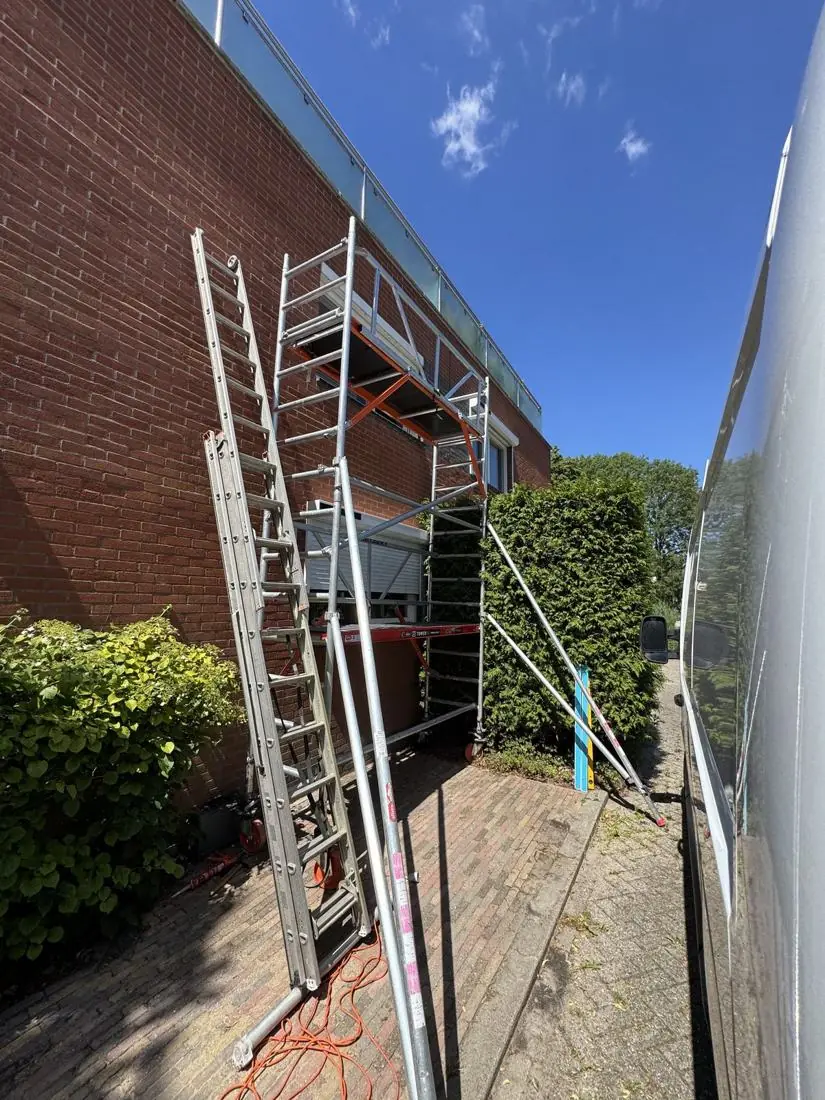
Tower assembled tight against a brick side wall, its top deck level with the flat roof edge above

For cleaning solar panels you hire a mobile scaffold rather than lean a ladder against the gutter, and the reason is your hands. On a deck both of them are free and you move sideways without climbing down. With a brush on a pole you also push against the glass, and that pushing force is not something you want to apply from a ladder. On castors you shift a little way after every few panels, which on a roof eight metres wide works out at three or four positions across the slope.
Scaffold height you hire to reach the top row

The dirt you really want gone sits at the top, because that is where water stands longest on the bottom edge of each panel. Your measuring point is therefore the highest row and not the gutter. A working height consists of the height of your platform with about 2 metres of reach above it, and while washing you use part of that reach with the pole of your brush. On a two storey house the figure works out between 8 and 12 metres, and a steep pitch pushes it towards the upper end.

Down below you start measuring at the castors. If the tower stands on a patio one step higher than the lawn, that shows up in your build, and the other way round just as much. If in doubt, take the higher position, because a wash in which you skip the top row is not really a wash and gives you the same view again within a month. Hiring one section more beats hiring the whole set twice. What belongs to which figure is on the page for eleven metres of working height.

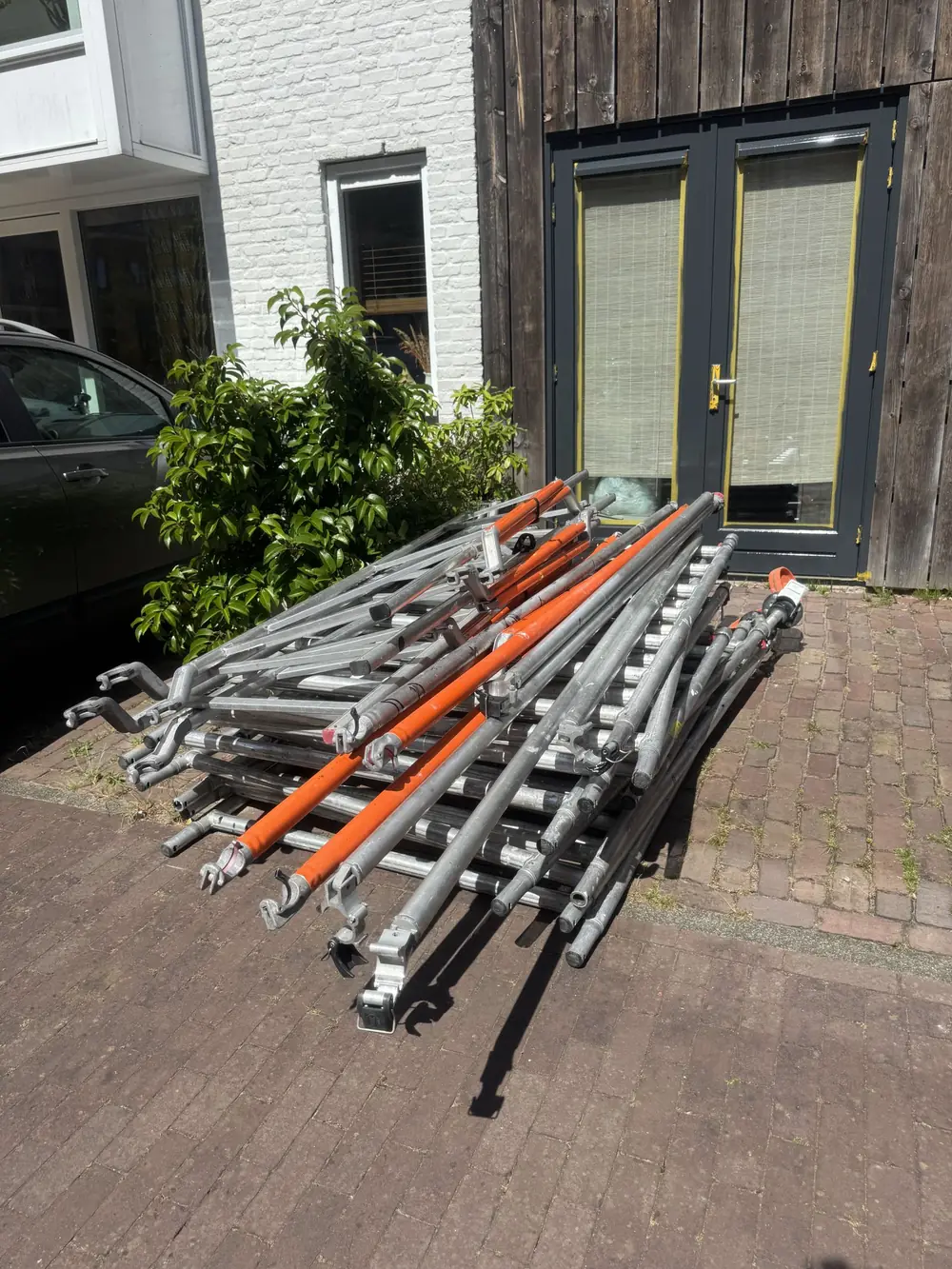
Scaffold tubes, frames and orange braces set down on paving beside the wall where the tower will be built

If your build does not get high enough, something happens that you only see afterwards. You get the bottom two rows gleaming and leave the top row as it was, so that at the first shower dirty water runs across the panels you cleaned. And you can start again. If your roof slope sits at second floor level, take a build above the one you thought you needed while measuring. Those few extra parts weigh nothing against a second round of cleaning solar panels.

Hiring a tower for a job with buckets and hose

On this job water runs down the whole time, and that decides where the tower goes. On slabs or block paving it drains away, on a timber deck it turns slippery and on grass you make a mud bath under your castors within an hour. So put the scaffold on hard standing and lay a couple of boards down if you must. Allow for the hosepipe too: it has to reach up without running under a castor or wrapping round a brace, and a hose under a wheel stops a move dead.

Around the foot the four stabilisers need clear ground, and on a washing round a bucket station and a tap connection come on top of that. Look at where the rinse water ends up as well: over the boundary into the neighbours' garden is unhelpful, and on a newly laid patio dirty water leaves streaks. Put an old sheet or a bucket under the spot where most of it comes down. Warn the neighbours if their car is parked alongside, because grit off a roof marks paintwork.

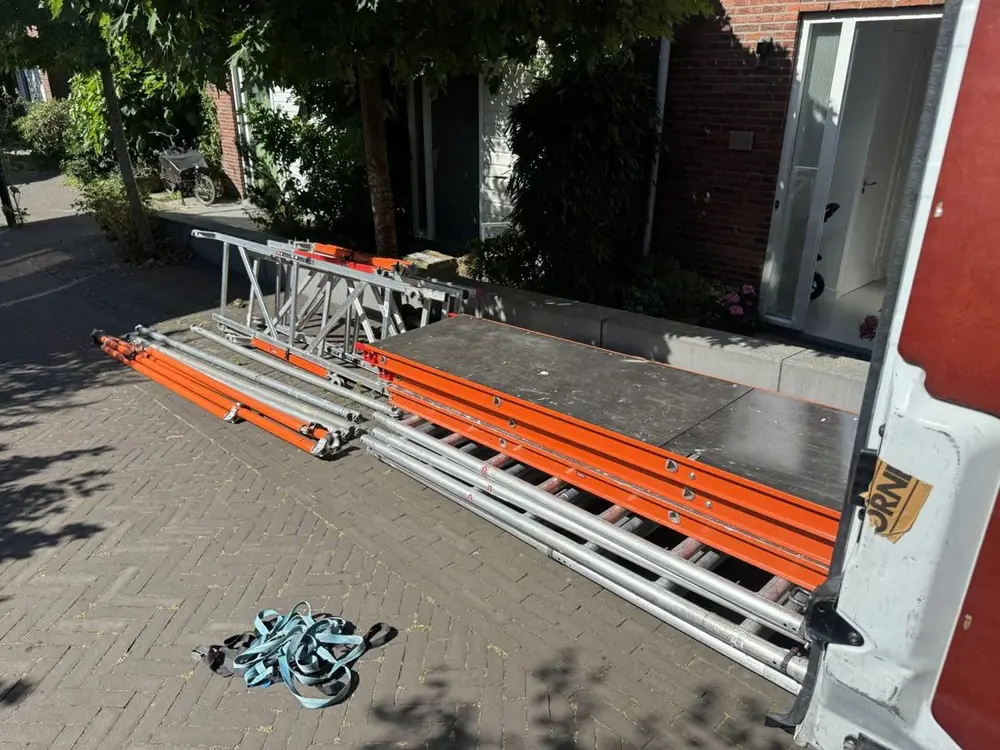
Scaffold tubes, orange braces and platform decks laid on paving beside an open van, lashing straps nearby

You move with dry castors on dry ground, so sweep the water ahead of you before you shift along. A tower sliding across a wet slab is exactly the surprise you do not want. Walk the run along the elevation beforehand looking for moss between the slabs, because that is every bit as slippery as it is on the roof. Note the drain covers and soft joints on that run as well. For a sloping patio or sunken slabs, the piece on stabilising and anchoring helps you on.

How many hire days cleaning solar panels asks for

A roof slope with twelve to twenty panels is clean in a day, the build included. The brushing itself takes a couple of hours; the rest of the day goes on building, fetching water, moving along and rinsing the bottom row afterwards. If there is a lot of moss along the edges, that brushing doubles, because moss only lets go after soaking and a second pass. Allow a day and a half in that case, and expect to refill and rinse your buckets halfway through.

The weather decides more here than on other jobs. On a sunny afternoon the rinse water dries before you have pulled it off, and you are left with streaks and limescale marks on the glass. So you want a cloudy day or the early morning, and that cannot always be planned on the day itself. Take a period of two or three days so that you can pick the right half day without the tower having to leave again. The days you add behind the first one hardly move the total.

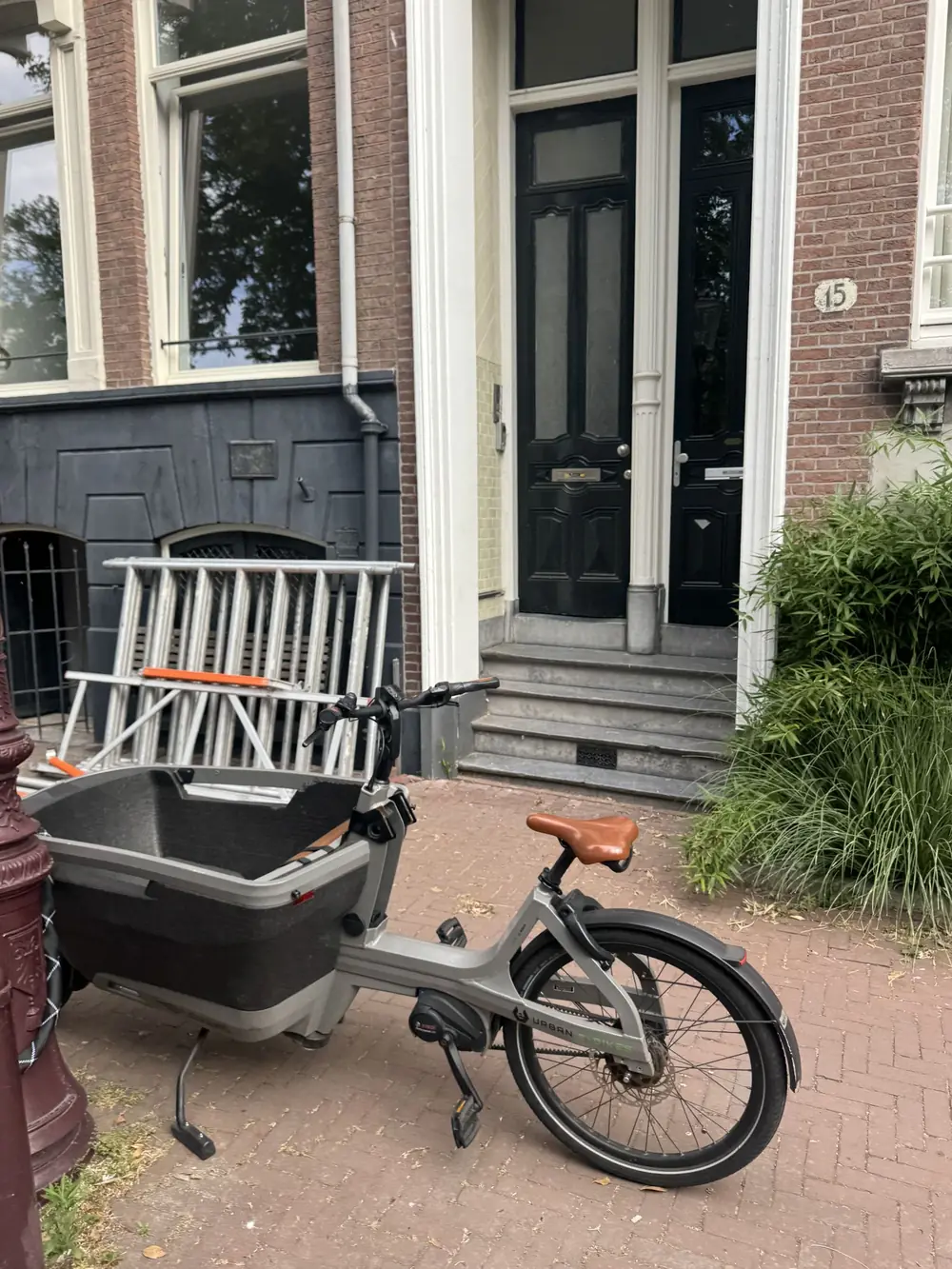
Scaffold frames and guardrails stacked against a wall by the front steps of a brick house, bike in front

A generous reservation costs little, while too tight a one forces you to start at the wrong moment. So set your collection date a day wider than you need on paper, and hand the set back early if it goes well. How to judge that period is described under the guidance on choosing your hire days. Combine the wash with a round along the clamps and that end date moves out by another day, which is still one hire and one journey.

Which mobile scaffold suits cleaning solar panels?

Kamersteiger RS44
  • Working height up to 4 metres
  • Compact and narrow
  • Great for indoor and small jobs
View and calculate →
Smalle rolsteiger RS51
  • Working height up to 14.2 metres
  • Narrow (75 cm)
  • Ideal for narrow passages
View and calculate →
Most chosen
Brede rolsteiger RS52
  • Working height up to 14.2 metres
  • Wide platform (135 cm)
  • Extra stability and workspace
View and calculate →
1-persoons steiger MiTower
  • Working height up to 6.2 metres
  • Very compact
  • Quick and easy to assemble
View and calculate →

Cleaning solar panels column by column from the deck

Each position covers 245 cm of platform length, good for roughly two panels side by side. Begin at the top row and work downwards, because everything you loosen rinses over the rows below and has to come off there again. Do that per column rather than per row, and then you only move the tower once per column. Rinse each column before you shift, or the loosened dirt dries back on and you face a second pass you would rather avoid. Count the columns beforehand and you know how many moves the day holds.

Three things matter about the water itself. Tap water contains lime, and that lime stays behind as white marks as soon as the glass dries in the sun; rinsing off and pulling dry with a squeegee prevents it. Cold water on a panel that has lain in the sun all morning gives the glass a shock, so start early or wait for cloud. And leave the pressure washer alone: that force drives moisture past the edge seal into the panel, and the recoil is the last thing you want up on a deck.

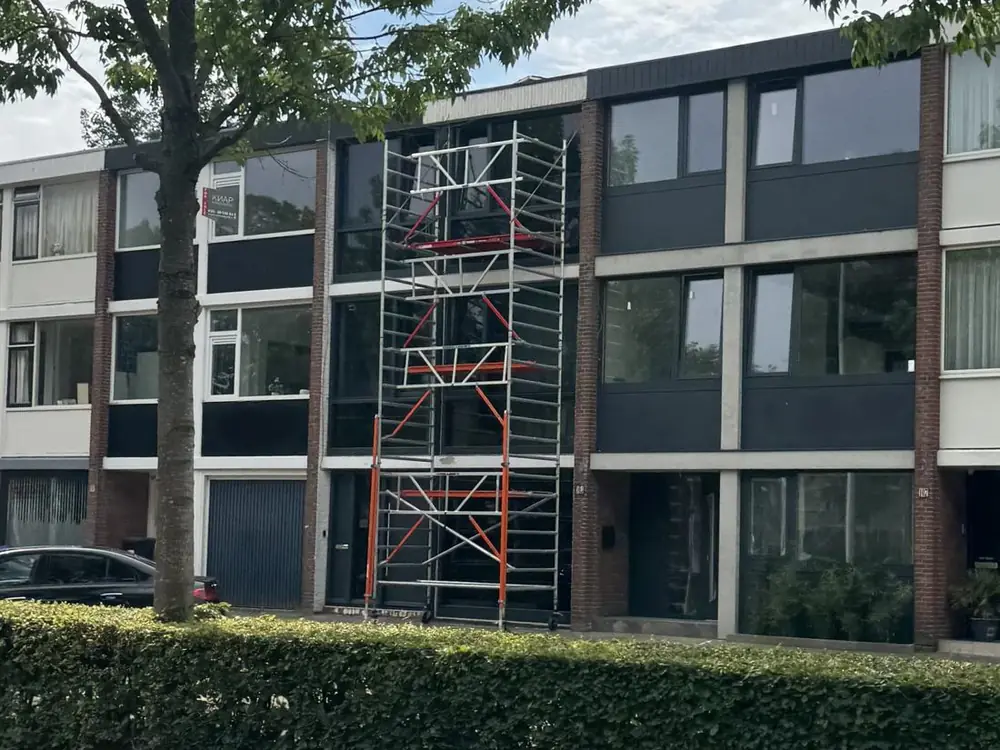
Tower built up in front of a three storey elevation, its upper deck standing level with the roof edge

Use a soft brush on a pole and no scouring pad, and work in long strokes in the direction the water drains. Moss along the bottom edge you first soak for a quarter of an hour with lukewarm water and then brush away without pulling at the frame. What people misjudge is the number of buckets a roof takes: with twenty panels you easily walk up and down ten times without a hose. Combine it happily with a check along the clamps and rails.

Delivery of a hire set for the washing round

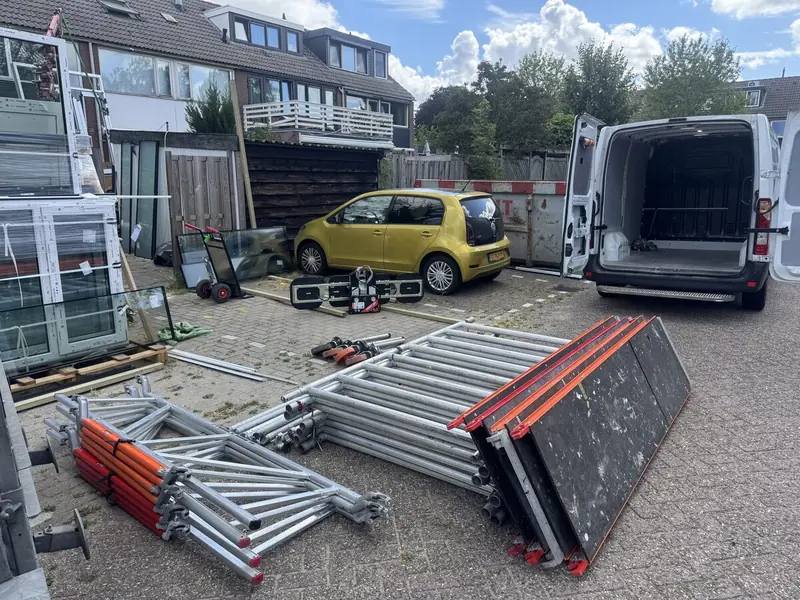
You get the tower delivered in loose parts, neatly counted on the note: uprights, platforms, guardrails, braces and a set of stabilisers. Find a dry spot for those parts, because they lie there for a few days and you do not want to put them down in the puddle you make yourself while rinsing the roof. Under a canopy or against the shed is better than in the middle of the patio, where the water heads and sometimes stands for hours after a rinse.

Anything ordered before 15:00 on a working day is dropped off the working day after. The day it appears in front of the house and the day it leaves are both yours to set. On washing work that is welcome, because you would rather line the delivery day up with a forecast that has cloud in it than with a week of hard blue sky. Moving a day costs you nothing as long as you let us know in time, and for cleaning solar panels that freedom is worth more than a fixed date.

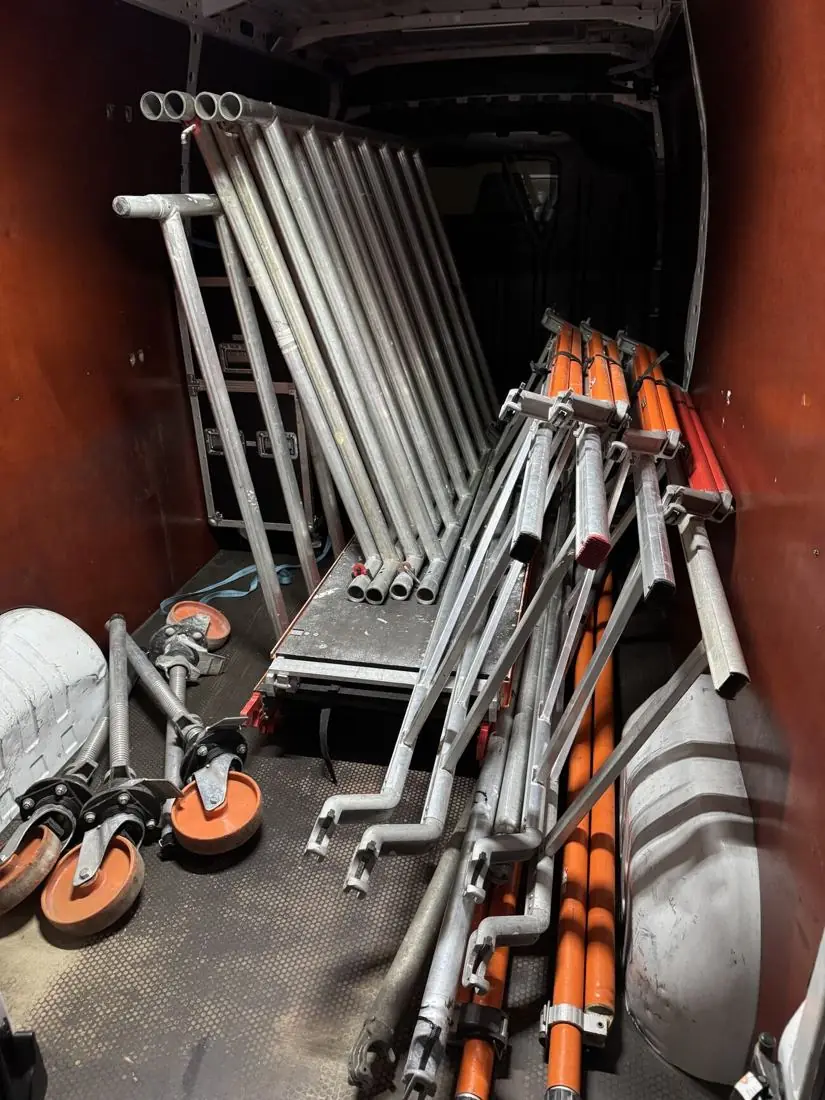
Scaffold uprights stacked upright inside a van with braces, platform decks and loose castors on the floor

Putting it up you do under your own steam, with the manual beside you and the video as a reminder; reckon on a couple of hours with two people. Afterwards you take the tower apart again and we load it on your collection day. Dry the parts off before you stack them, because wet aluminium and a closed load space are not a happy pair. What bringing and fetching costs is fixed per province and listed under the charge for the run, VAT included.

Safety on a wet platform while washing the array

The floor you stand on takes 200 kg per square metre, the level that load class 3 of EN 1004 requires for these towers. With two buckets of water and a second person you do not come close, so that is not your worry. What does count is that the same floor gets wet. An aluminium platform with a film of water and soap on it is slippery, so slide your feet instead of stepping and wipe it dry between times.

The ordinary rules apply with a bucket in your hand as well: brakes on as soon as you climb up, nobody on the tower while it moves, and in strong wind you stay down. On wet work there is one more: hang nothing on the guardrail that can fall. A bucket on a hook looks handy until it catches your knee as you climb on and empties itself. Fold the stabilisers out after every move and check all four find dry support before the next column.

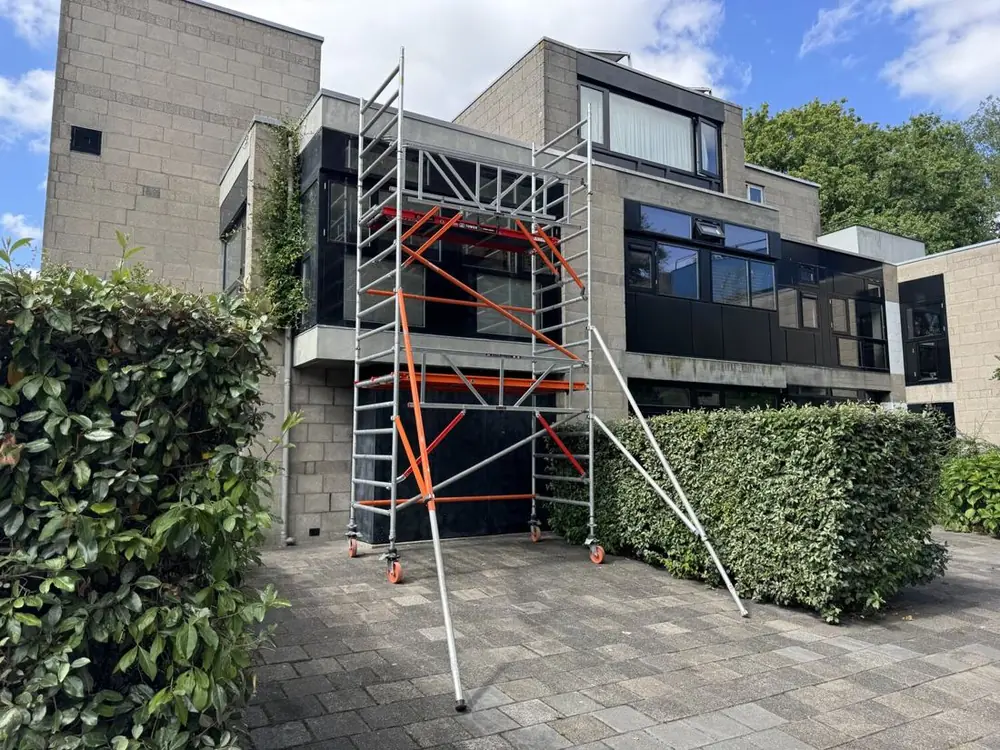
Built tower on block paving with four stabilisers reaching out to firm dry ground on every side

Water and a live installation ask for attention. Never spray directly onto the junction boxes at the back or onto the penetration in the roof, and do not work on the cabling in wet gloves. Keep the space under the platform clear as well, because a brush on a pole that slides off a wet deck comes down in an arc. Fence that strip off with a bucket or a bin if a path runs under it. The remaining rules you will find under working at height with a mobile scaffold.

In 5 steps

How hiring a mobile scaffold works

1
Choose working height

Pick the height that suits your job.

2
Book online

Sorted in 60 seconds, price shown instantly.

3
We deliver

At the agreed spot the next working day.

4
Assemble safely

Assembled by you, with a manual.

5
We collect

One call and we collect the scaffold.

Good to know

Practical tips for cleaning solar panels

1

Fill your buckets with lukewarm water rather than ice cold water from the outside tap. It saves the glass a shock and it dissolves grime faster than anything straight from the mains ever will.

2

Start on a morning when it is overcast and not on the first sunny day. Without sun on the glass your rinse water dries more slowly and you keep no lime rings on the panels you have just done.

3

Take a hosepipe with a spray head up with you and tie it loosely to the guardrail. That saves you climbing the ladder ten times with a full bucket during one round of cleaning solar panels.

4

Lay a towel on the platform of the hired tower and dry your soles before you step sideways. A wet sole on aluminium is more slippery than you expect, certainly with soapy water about as well.

5

Rinse the bottom row last of all, even if it already looks clean. All the dirt from above collects there and otherwise dries into a grey band along the frame that you never get off again.

6

Plan your washing round in the same hire period as scraping out the gutter. You are at that height anyway and you settle only once for the bringing and the fetching. That saves a whole run.

Frequently asked questions

Frequently asked questions about cleaning solar panels

Wide or narrow: which tower do you hire for cleaning solar panels?+

The wide RS52 with its 135 cm floor is the tower of choice here, because on washing work you have buckets, a brush on a pole and a cloth standing beside you. On a narrow floor that lot ends up on the ground and you climb up and down for every fresh bucket. Only if the way through to the garden is too narrow do you hire the RS51 of 75 cm and work with smaller amounts of water at a time.

How do you arrange hiring a tower for washing an array?+

Reserving happens online: you choose model and build height, give one date for dropping the parts off and one for picking them up, and pay in advance at a fixed price with VAT. On the agreed morning we set the counted parts down where you want them, you build the tower and then you wash the array. When the glass is done you strike the tower and we collect the parts. No inspection or handover comes into it.

How many hire days does a full roof of panels take?+

Washing one roof slope costs a day including the build, but most people hire two or three days. That is not because of the work but because of the weather: you want cloud or the early morning, and you would rather pick that inside a running period than gamble on it. With a lot of moss along the edges, reckon on a day and a half of brushing and rinsing anyway. Giving the set back before your last day costs you nothing extra.

What sets the rental price for a washing round?+

Two things drive the amount: the chosen model and the height of the build, with a fixed sum alongside for the run to and from your province. Your first twenty four hours form the dearest part of the rental price; on every hire day after that you get 95 per cent off, so two extra days waiting for cloud cost almost nothing. Every rate with VAT is on the page of prices per build.

Which working height should I hire to reach the dirtiest row?+

Measure to the top row of panels, because that is where the dirt sits that rain never rinses off. On two storeys that comes to between 8 and 12 metres. Choose the position from which you can draw the brush over that top row comfortably without stretching, since stretching costs you both force and precision. All the builds per tower stand on the overview of working heights. Fall between two builds and the higher one is safest here.

Is delivery or collecting the hired tower the better choice?+

Delivery costs a fixed amount per province including VAT and happens on the day you point out; after your last washing day we drive back to fetch everything. Collecting yourself is free and happens by appointment at Zeeburgerpad 89 in Amsterdam. Do make sure you have a van or a trailer that can load a set of this length. For a single wash most people still choose delivery of the tower. Check how a set of that length fits your vehicle before you pick that route.

Do I get the scaffold delivered assembled when I hire it?+

No, that job stays with you. We bring the parts and come to fetch them afterwards; building, moving and dismantling the tower are your tasks. Do not put that work on the same morning as the washing, or you will finish neither of them. Cherry pickers are not in the fleet, and neither are facade or system scaffolds, so a tower you raise yourself is the equipment this job runs on. Put the build on the day before and the washing keeps its full morning.

Can I hire for longer if the whole week stays sunny?+

Yes, tell us and we set the collection day later, provided nobody else has that particular set booked for the morning after. On washing work that comes up more often than you would think: a week of cloudless sky is poor weather for cleaning solar panels. So take one or two extra days from the outset, because it costs little and gives you the freedom to start at the right moment. We shift the date and nothing else about your booking changes.

How much room do the hired tower and the rinse water need?+

Start from the 135 cm floor width, add the sweep of the stabilisers on all four sides, and then leave a lane where rinse water can drain. A spot with a gully or with a fall towards the garden is ideal; an enclosed courtyard where everything stands is not. Walk the run along the elevation over which you move the tower as well and clear the furniture and pots away before the delivery arrives.

May I use a pressure washer from the hired tower?+

Better not. The jet from a pressure washer can force moisture past the edge seal of a panel and damage the coating, and the recoil pushes you backwards while you stand on a platform. Work with a hosepipe without pressure, a soft brush and a squeegee to dry off. That is slower, but it is precisely the reason you hire a tower instead of aiming a long lance from the ground at panel height.

How quickly do I get the deposit back after this hire period?+

A deposit hangs on the reservation, and as soon as the returned set counts out complete the deposit is back with you inside 1 working day. On wet work you watch two things: hand nothing back soaking and leave no soap residue on the platforms. Rinse the floor off with clean water before you dismantle, and the set goes back into the van dry and tidy. Your period then ends without argument.

How often should panels be washed, and how often do you hire a tower?+

For most roofs once every two or three years is enough, and on a shallow roof or with many trees nearby, yearly. Look above all at your yield figures across the years: if they drop without an obvious reason, it is time to take the array in hand again. Because you are hiring a tower anyway, walk the clamps at the same time; a combined round like that is the cheapest way to tick off both jobs.

Hire a mobile scaffold for cleaning solar panels today?

Calculate your rental price now or ask for free advice.

Rolsteiger van SteigerTaxi geleverd op locatie
Book it online

Your scaffold sorted in 2 minutes.

Choose your scaffold and working height, see the price instantly and book online.