
See your price
Application

Solar panel maintenance? Choose the right scaffold.

Solar panel maintenance means walking the whole installation once a year or once every two years: torquing clamps, following the rails, looking at connectors and cable ties and comparing the yield against last year. That work starts behind the inverter and ends on the roof, so you need a steady place along the roof edge. Over two storeys of pitched roof the 135 cm RS52 is the usual hire, in a stand that lets you work 10 to 12 metres up. Below is what that means for your hire days and for your standing place.

  • Order before 3 pm, delivered tomorrow
  • Professional Altrex scaffolds
  • Up to 14.2 metres working height
  • Easy to assemble yourself
4,2 tot 14,2 mWorking heights available
12Provinces served
7Days a week
200 kg/m²Load class 3
In short
  • For solar panel maintenance we recommend the Wide mobile scaffold.
  • For solar panel maintenance take an RS52 of 135 cm, with a working height somewhere between 10 and 12 metres.
  • Read the inverter out first, because those figures tell you exactly which part of the roof needs attention.
  • One hire day is often enough, but a second roof slope or a loose clamp pushes that out to two.
  • First 24 hours from €175 incl. VAT and delivery; every day after that 95% off.
Key facts for this job
FeatureValue
Recommended scaffoldWide mobile scaffold (Altrex RS TOWER 52)
Working height for this job8 to 12 metres
Available working heights4.2 to 14.2 metres
StandardEN 1004, load class 3 (200 kg per m²)
DeliveryOrdered before 3 pm, delivered next working day
Each extra day95% off, from €8.75 a day
Why a mobile scaffold for solar panel maintenance?

Safe, stable and professional work at height

Solar panel maintenance is largely looking, and you only look properly when you can stand still. A clamp that has backed off half a turn is invisible from the ground and invisible from a ladder where one hand is busy holding on. You want to walk the bottom row, feel every clamp, follow the rail down to the hook and look at the cables under the panel. That takes two hands and a fixed floor, plus somewhere to put a torque wrench, a lamp and your notebook. Hiring a mobile scaffold for this work is therefore about calm, about width and about enough height to reach the top row.

  • Read the inverter first, then go up
  • Torque the clamps and follow each rail
  • Working height up to the top panel row
  • Deck space for meters, lamps and spanners
Read more about working safely →

Hiring a wide tower for a round of solar panel maintenance

On an inspection round you carry more up than you do on a fixing day: a torque wrench, a multimeter, a cloth, a torch and often a tablet or phone with the yield figures on it. None of that fits in your pockets, and you do not want it in your hand while you are feeling a clamp. So you hire the Altrex RS52, at 135 cm the wide version, so that tools can stay lying on the deck while you shuffle along the row.

When the way through to the back garden forces it, the RS51 of 75 cm stays a usable alternative; it costs you working room up top, but it gets past everything. The MiTower is too low for this job, since it does not reach the top row of a pitched roof on two storeys. A room scaffold is out from the start, because this work happens outdoors. Which models stand ready and how they differ is shown among the towers we have for hire.
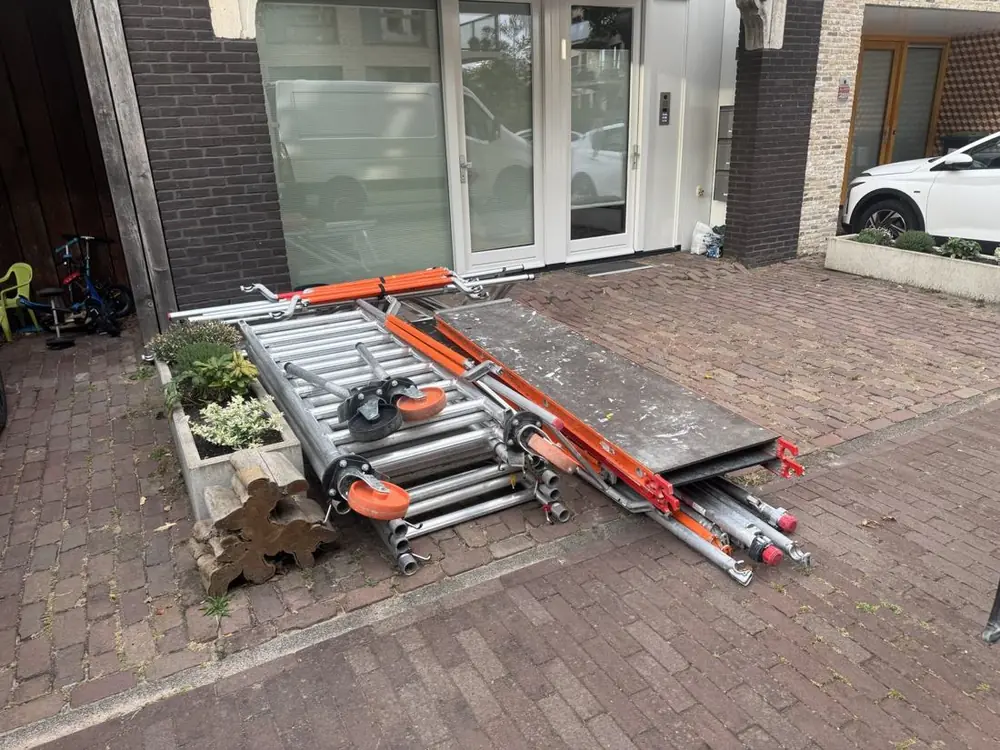
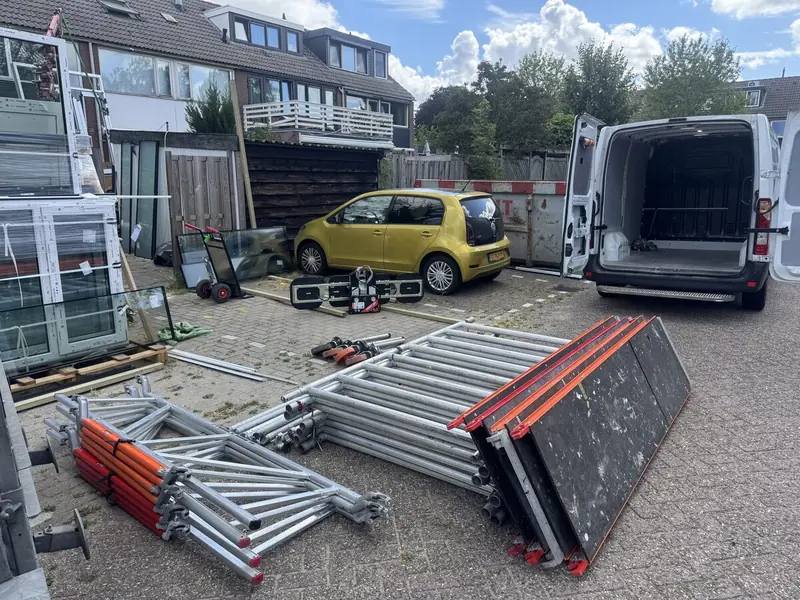
Counted scaffold parts, braces and one platform board resting on brick paving next to a glazed front door

A mobile scaffold has a second advantage during solar panel maintenance: you move it on its castors along the elevation without taking it apart. On an inspection you walk the whole slope, from the left corner to the right edge, and that is three or four positions one after another. With a ladder you shift every two metres and stand wobbling on the gutter each time. The wide version also rolls more steadily over a garden path, since the weight sits better across four castors.
Scaffold working height to hire for the top panel row

Unlike handing panels up, solar panel maintenance means getting to the top row. That is where the end clamps sit, and they take the most from wind and from expansion. So count the top of the array as your highest point, and not the gutter. The working height you enter is the platform height plus something like 2 metres of reach on top of it. For a pitched roof on two storeys the band runs from 8 to 12 metres, and the top row usually puts you at the upper end.

Down below your measurement starts at the castors, and they often stand somewhere different from where they stood during the installation. Gardens change: there is a new patio, a shed has appeared or the lawn has been raised with a layer of sand. So walk the standing place again before you reserve, even if you knew exactly where the tower fitted five years ago. Worked through lift by lift, that is a twelve metre working height. Old notes are no substitute for a fresh look at the ground.

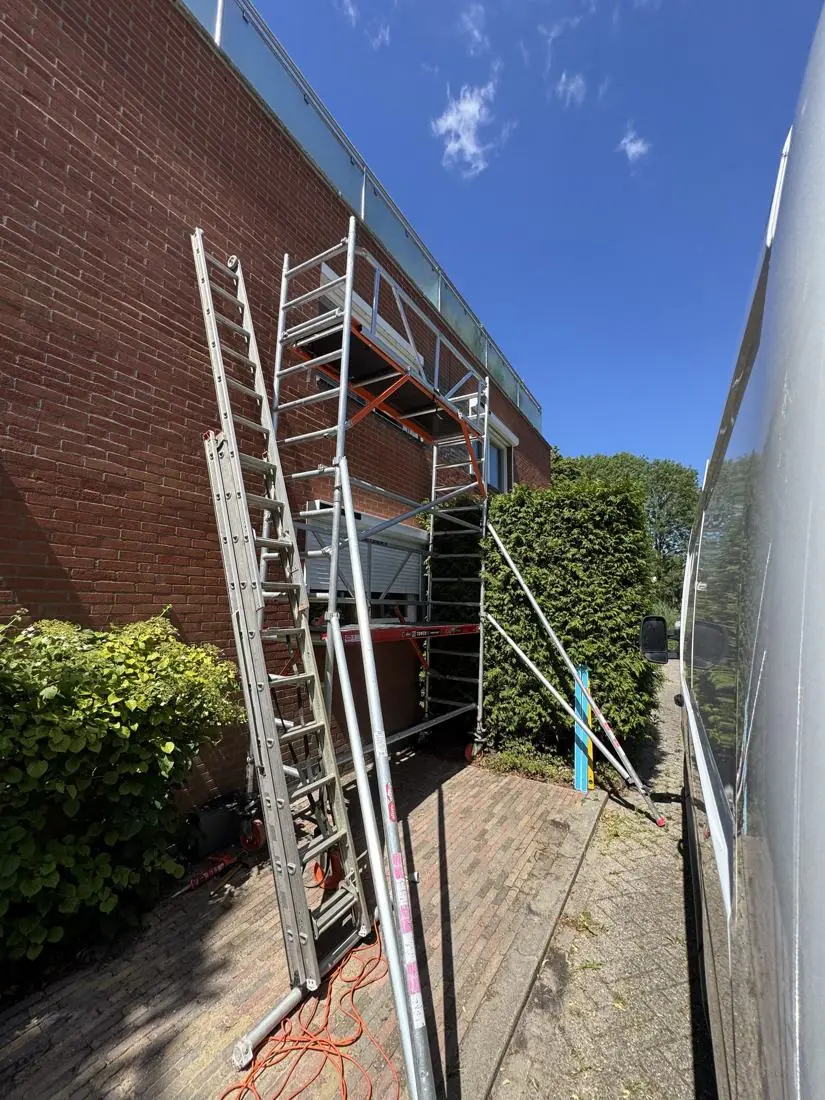
Tower built up beside a brick side wall to above the roof line, an extension ladder leaning next to it

Hire a build that is too low and you reach the top end clamps only at full stretch, and then you cannot feel whether a bolt is still tight. That feeling is the heart of this job. An inspection you carry out halfway also equals no inspection at all: you write down that everything is in order while you have barely looked at the top row. If your roof sits at third floor level, go one build above your first estimate.

Hiring a tower and finding its place in the garden

Maintenance is usually planned for spring or autumn, and you notice that in the ground. A lawn that is dry and hard in July is a sponge in November. So put the tower on the patio, the drive or a paved path rather than on grass, and slide a couple of slabs or a thick board under the castors if you must. What to do with soft or crooked ground, including running boards, is covered in the article on ground that is not level.

Around the foot the stabilisers must be able to fold out fully, and beside an existing installation that area is often already occupied. The cables from the inverter sometimes run along the wall to the inside, there is a water butt under the downpipe, and the garden has grown up in the years since the array went on. Cut that shrub back before the tower comes; with a scaffold against it you cannot, and you damage both the plant and your temper. Do that in good time, because the cuttings need clearing too.

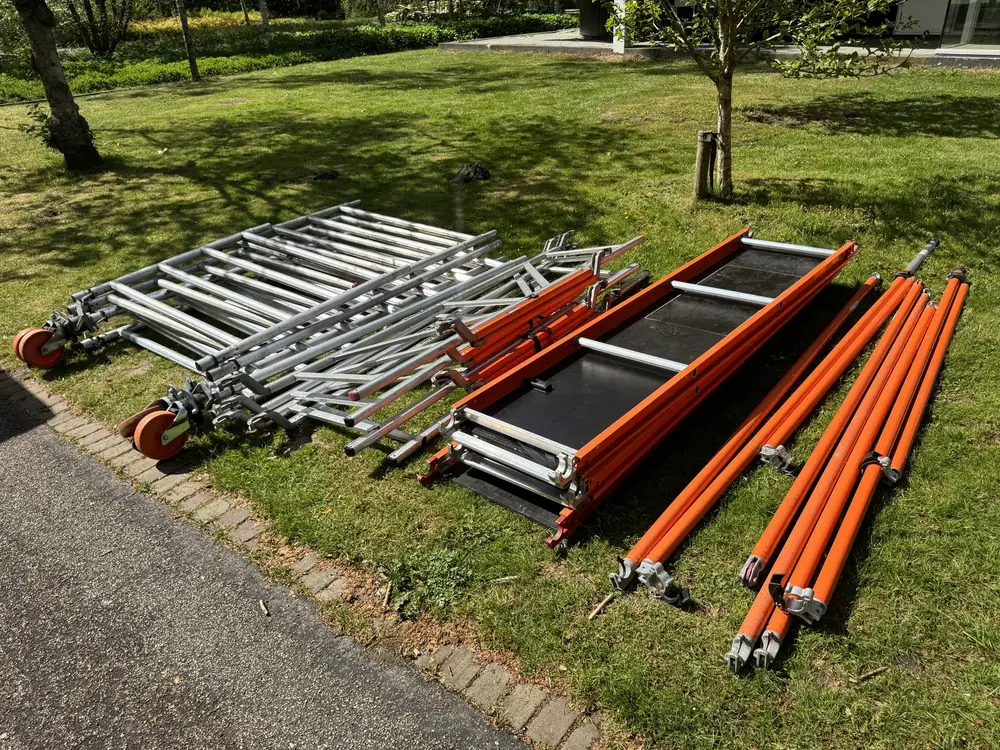
Loose scaffold frames, a platform deck and bundled orange tubes lying on a lawn beside a garden path

Set the first position at the end where the first string begins, so that your inspection and your meter readings follow the same order. Walk left to right while your inverter list runs right to left and you lose count halfway. Keep a few centimetres between the guardrail and the gutter as well; an older gutter has brackets and sometimes a fascia band that you otherwise pull off. So move gently and glance upwards at every position before you shift further along.

How many hire days solar panel maintenance really needs

An inspection round over one roof slope with twelve to twenty panels costs you a day, the build in the morning included. You read the inverter out the evening before, so that you know up top which string or which panel stands out. Without that preparation you walk the same row twice, and that is exactly why a maintenance day runs on to a day and a half. So reckon with a day of work and a day of slack in your reservation.

It becomes two days as soon as something has to be repaired. A clamp you torque takes a minute, but a rail that has dropped means taking panels off and levelling again. You only find that out standing up there with your hand on the line. A second roof slope on the other elevation counts as a separate day too, because the tower has to come partly apart and go up again on the far side. Take that possibility into your period.

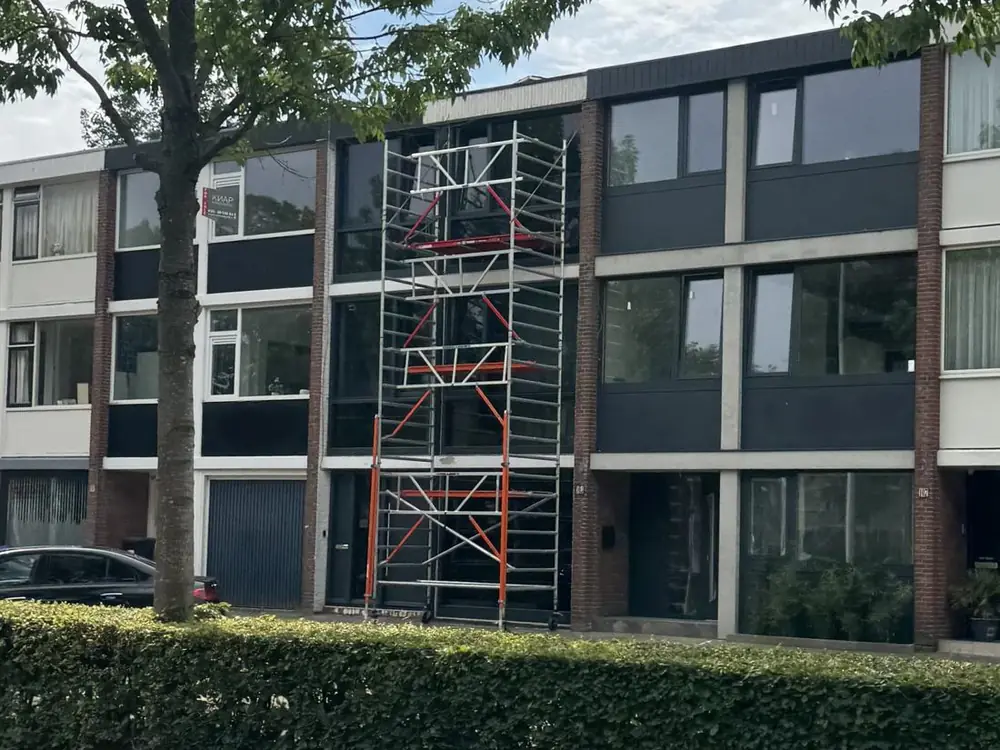
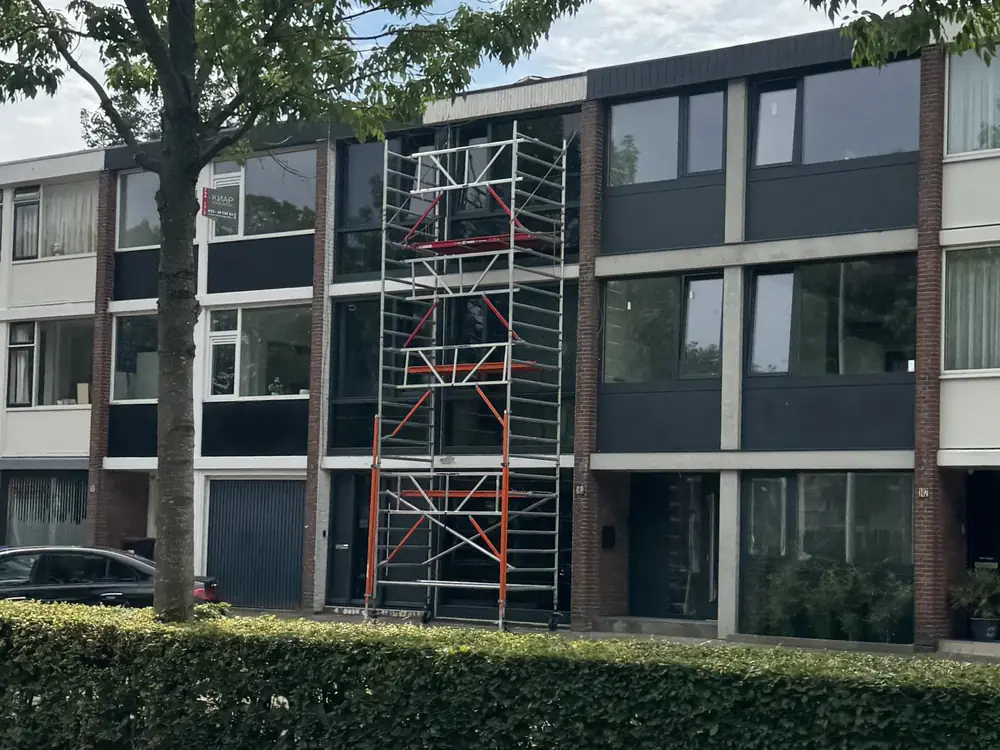
Mobile scaffold standing against a three storey front elevation with its top deck near the roof line

Booking generously is especially logical for solar panel maintenance, because you do not know in advance what you will find. You pay in full for the first twenty four hours; the discount on every hire day beyond that is 95 per cent, and a spare day in hand therefore costs next to nothing. If you never get to it, the set may go back early. How people judge that period is covered in the piece on setting your hire period. A round you rush is a round you repeat next month.

Which mobile scaffold suits solar panel maintenance?

Kamersteiger RS44
  • Working height up to 4 metres
  • Compact and narrow
  • Great for indoor and small jobs
View and calculate →
Smalle rolsteiger RS51
  • Working height up to 14.2 metres
  • Narrow (75 cm)
  • Ideal for narrow passages
View and calculate →
Most chosen
Brede rolsteiger RS52
  • Working height up to 14.2 metres
  • Wide platform (135 cm)
  • Extra stability and workspace
View and calculate →
1-persoons steiger MiTower
  • Working height up to 6.2 metres
  • Very compact
  • Quick and easy to assemble
View and calculate →

The inspection round along clamps and rails from the deck

From a platform of 245 cm you take in about two panels at once. Work each position from the bottom upwards: first the lower end clamp, then the mid clamps, then the rail and the hook beneath it. A clamp that has come loose shows itself in the play in the panel; a rail that has dropped shows in the line between two panels that no longer runs true. Note per position what you find, or by the end you no longer know where it was.

Under the panels runs the cabling, and that is often where the real work sits. Cable ties go brittle in sunlight, so after a few years a bundle hangs loose and rubs on the tiles. Connectors that were never fully closed let moisture in. From the wide deck you can look under the bottom row with a lamp without hanging your whole upper body over the gutter, and that is precisely why you hire a scaffold for this. A head torch leaves both hands free for the connectors.

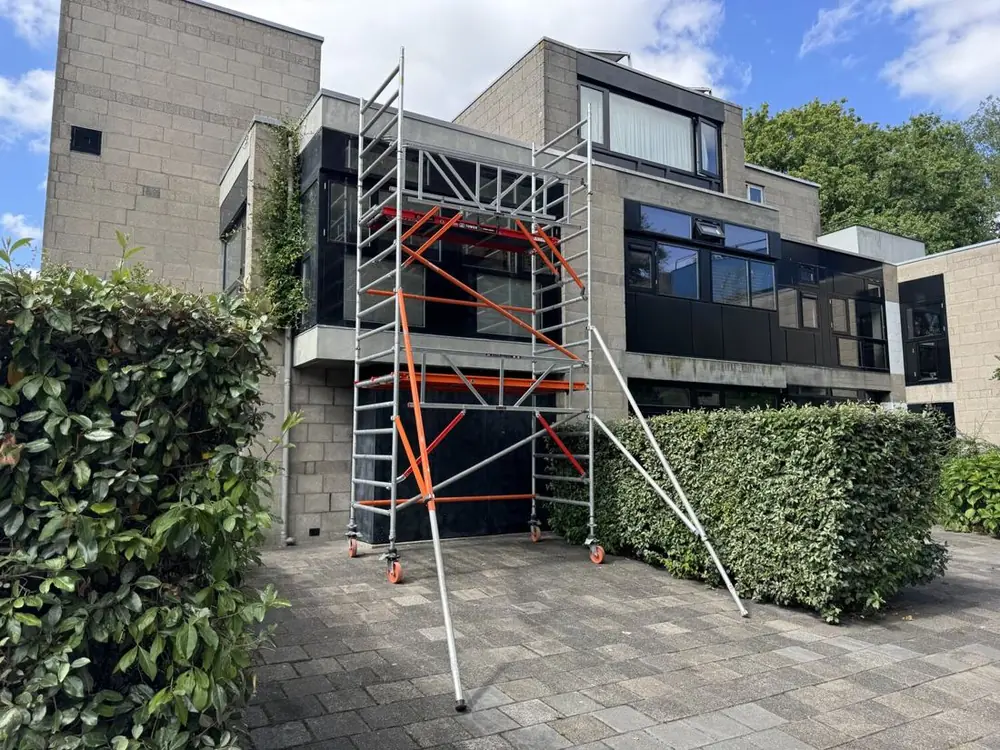
Slim mobile scaffold standing at a modern block, the kind of stand an inspection round is worked from

What people misjudge is the time that comparing figures takes. You have the yield per string, you have a roof with two orientations and you have to work out which panel belongs to which value. Do that at the kitchen table and then go up to the row that stands out. If there is dirt on the glass as well, put a wash of the array into the same period. Two jobs on one booking saves a whole delivery run.

Delivery and collection around your solar panel maintenance visit

We supply the scaffold as a set of loose parts counted off on the delivery note. An order that lands with us under the 15:00 mark on a weekday leaves the following working day, so an inspection you think of on Monday can happen on Wednesday. Drop the parts in a spot where they will not block the gardener or the wheelie bins, because they will lie there for a few days. A corner of the carport works well for that.

Putting it up stays your work. A manual comes with the delivered set and the instruction video shows the order online; two of you will have the deck at height well inside one morning. You decide the arrival day and the day the set may leave, which is handy for maintenance because a round like this often depends on the weather. In steady rain you shift a week, and moving it costs you nothing as long as you tell us. Weather forecasts change, and so may your chosen day.

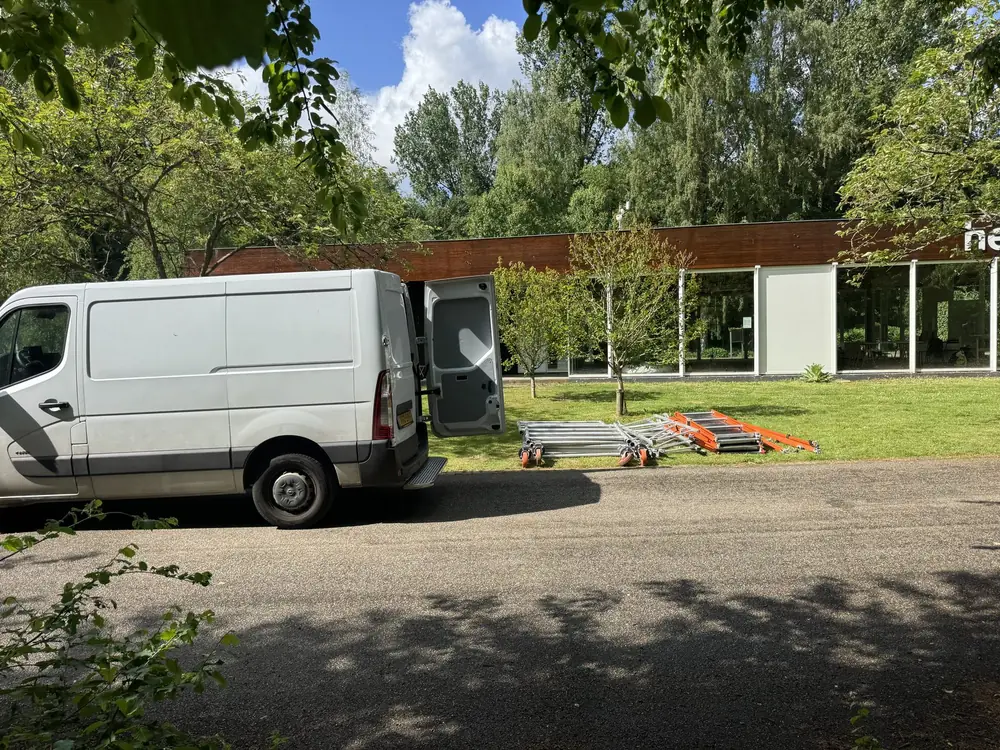
Delivery van with rear doors open beside a low building, scaffold frames and orange stabilisers on the grass

After the last round you take the tower apart and stack all the parts in one place; we come and take them away on the day you chose. Check while you do it that no cable tie or loose bolt has stayed between the platforms, because things like that vanish easily. What the journey there and back costs is set by province and shown, VAT included, under the transport charges. Collecting the set yourself is possible if your vehicle takes the length of an upright.

Safe solar panel maintenance from a mobile scaffold

Load class 3 is where EN 1004 places these towers: 200 kg permitted on each individual square metre of deck. A maintenance round rarely comes near it, because you are carrying tools and not building material, and you are usually up there alone. Watch something else instead: a tool you put down for a second on a sloping roof slides away. Lay everything on the deck or hang it on your belt. A dropped spanner is a hazard for whoever is below.

The fixed rules stand: brakes on as soon as anyone climbs up, nobody stays on the tower while it rolls, and in strong wind you do not go up at all. That last one counts double here, because most people plan this job for the autumn when it blows more often. So look at the forecast before you fix your hire days, and put them in a calm week rather than in a gale. Swing the stabilisers back out after each move.

Stabilisers angled down from a built tower onto paving, reset after every move along the elevation

One risk comes with this job that other roof work does not have: the installation is live as long as light falls on the panels. So never simply pull a connector, switch off properly in the order your inverter requires and do not work on the cabling with wet hands. If in doubt, leave that part to an installer and limit yourself to the mechanical check of clamps and rails. The remaining rules are in the rules on working at height.

In 5 steps

How hiring a mobile scaffold works

1
Choose working height

Pick the height that suits your job.

2
Book online

Sorted in 60 seconds, price shown instantly.

3
We deliver

At the agreed spot the next working day.

4
Assemble safely

Assembled by you, with a manual.

5
We collect

One call and we collect the scaffold.

Good to know

Practical tips for solar panel maintenance

1

Print the yield figures per string and take them up in a folder. Searching on a phone screen in bright sun does not work, certainly not with gloves on one hand and a spanner in the other.

2

Mark a line across clamp and rail with a permanent pen as soon as you have torqued it. At the next visit you see at a glance whether anything has shifted, without going over everything again.

3

Bring a second person who stays at the bottom and passes things up. That way you need not climb the whole height for a forgotten spanner or an extra cable tie and then climb back again.

4

Photograph every position before you leave it, with the row of panels and the rails in shot. A year later you compare those pictures with the new ones and see straight away what has changed.

5

Torque the clamps to the figure the manufacturer states and not by feel. Over tightening damages the frame, and that costs you more than the loose clamp you set out to cure in the first place.

6

Plan solar panel maintenance and your hire days in the same week as the annual gutter clean. The tower is standing there anyway and you pay only once for bringing and fetching the whole set.

Frequently asked questions

Frequently asked questions about solar panel maintenance

Which mobile scaffold do you hire for maintenance on a solar array?+

The wide RS52 comes first for this job: a 135 cm working deck, enough to lay your spanners, your lamp and your yield list beside you. On maintenance you stand in one place longer, and you keep reaching for something different. On a floor of 75 cm you end up walking over your own things. Only when the gate or the garden path is too narrow do you pick that slim tower and work in smaller steps along the row. Measure the narrowest point on the route before you decide.

How do you hire a mobile scaffold for an inspection round?+

It goes online and takes a few minutes. You select the model and the build height, pin down an arrival day and a departure day for the set, and settle a fixed amount including VAT. On the first day the tower stands at your place as loose parts, you build it and make your round along the array. Taking it away at the end is our task again, on the day you pointed out earlier. Nothing has to be signed and nobody has to visit beforehand.

How many hire days does a full solar panel maintenance visit take?+

For one roof slope a single day is usually enough: build in the morning, the round in the afternoon. It becomes two days if you find something that has to be repaired, or if there are panels on two slopes. Because an extra day of hire barely counts towards the total, most people book one as standard. If that day turns out not to be needed, you hand the set back sooner and nothing is lost. Two slopes and one tower rarely fit into a single day.

What is the hire cost of a tower for a round along the panels?+

The rental price rests on two choices: which model, and how high you stand it. Added to that is a fixed carriage sum for the run out and back. All the rates, VAT included, sit on the price page per model. Because a round often lasts only a day, that first day weighs heaviest; days you add behind it almost disappear in the total, so hiring generously works out well. Combining two jobs in one period spreads that first day further.

Which working height do you hire to check your panels?+

Your measuring line runs from under the castors to the top row of panels, where the end clamps you want to torque are fixed. On a two storey house that lands you in the band between 8 and 12 metres. Within it choose the position that brings your hands level with those top clamps, since reaching costs you accuracy. Every build per model is listed on the page of working heights per tower. Write the figure down at the castors before you open the booking screen.

Must I collect the scaffold or is delivery part of the hire?+

There is no obligation either way: having it brought or fetching it yourself are both fine. Delivery means we drop the set on your date and take it back after the maintenance day, for one settled amount that already has VAT in it. Collecting is possible too: by appointment everything stands ready at Zeeburgerpad 89 in Amsterdam at no extra cost. For a single day, delivery mainly saves time you would rather spend on the roof. Whichever you pick, the hired set leaves and returns counted.

Does the tower arrive built when you hire it?+

Building is on your list, not on ours. We drive the parts in and later away again; stacking, securing and dismantling the tower are yours. Put the build in your planning before the checking starts, so the two do not collide. Anyone who would rather have a ready made structure ends up at a facade scaffold, and we do not hire those out. Cherry pickers and system scaffolds are not in our range either. Everything you need for the hire arrives with the parts on the pallet.

Can I extend my hire period if more repair turns out to be needed?+

Yes, tell us and the collection day shifts, provided the set is not promised elsewhere straight after. On maintenance that happens more often than on other jobs: you climb up for a check and come down with a list of repairs. So book an extra day at the outset by preference, because extending in the middle of the work is not always possible. That keeps your period in your own hands. A repair list is easier to work through with the tower still up.

Will a garden a few years old still take the hired tower?+

Take the 135 cm of the working deck, then allow for how far the stabilisers reach out on every side. More important still: you move that tower a few times along the elevation during the round, so the whole run has to be clear and not just the first position. On an array a few years old the garden is fuller than on a new build: shrubs have grown, a shed has appeared and the furniture is already outside. Clear the whole run the weekend before the parts arrive.

What if the weather turns on the day of my solar panel maintenance round?+

Then you move the round and not the tower. Wet glass and wet tiles make an inspection unreliable and unsafe, and torquing a clamp in the rain mainly gives you cold fingers. The scaffold stays where it is meanwhile, castors braked and stabilisers out, so nothing has to come down. Because you fill in the collection date, a day of delay costs little and your hire period stays unbroken. A hired scaffold in the rain is safer standing still than being moved.

What happens to the deposit when I have finished the hire?+

Reserving comes with a deposit, and you have it back a working day after the returned parts are checked off. On maintenance the chance of damage is small, but do watch what you lay on the platforms: a tin of contact spray that tips over or a leaking battery leaves marks. Take your tools down after every position and hand the set back clean. Nothing you carry up should be able to tip over on its own. Then closing off your period goes without discussion.

Can I check the gutter and the inverter within the same hire period?+

That is exactly why people combine these jobs. With the tower standing there anyway you walk the gutter, check the penetration where the cables enter the roof and judge whether a swap of one panel is needed. Bringing and fetching is charged once only, and the extra hire days weigh light. Do put them in your reservation beforehand, because adding them afterwards is not always possible. Gutter, penetration and clamps in one visit is the cheapest round you will do.

Hire a mobile scaffold for solar panel maintenance today?

Calculate your rental price now or ask for free advice.

Rolsteiger van SteigerTaxi geleverd op locatie
Book it online

Your scaffold sorted in 2 minutes.

Choose your scaffold and working height, see the price instantly and book online.