
See your price
Application

Replacing solar panels? Choose the right scaffold.

Replacing solar panels is not the same job as filling an empty roof. A working array is already up there, you take one dead module or a whole row out of it, and the new sheet has to go back into exactly the same place. The old panel travels down while the replacement travels up, so deck room matters more than reach. On a pitched roof over two storeys most people hire an RS52, the 135 cm wide model, and stand it at 8 to 12 metres of working height.

  • Order before 3 pm, delivered tomorrow
  • Professional Altrex scaffolds
  • Up to 14.2 metres working height
  • Easy to assemble yourself
4,2 tot 14,2 mWorking heights available
12Provinces served
7Days a week
200 kg/m²Load class 3
In short
  • For replacing solar panels we recommend the Wide mobile scaffold.
  • For replacing solar panels, hire an RS52: its 135 cm deck taken out to between 8 and 12 metres.
  • The dead module has to lie flat on the platform while the replacement waits beside it, so deck room beats sheer reach.
  • Two or three hire days is honest, because isolating the string and solving a size difference take longer than the panel itself.
  • First 24 hours from €175 incl. VAT and delivery; every day after that 95% off.
Key facts for this job
FeatureValue
Recommended scaffoldWide mobile scaffold (Altrex RS TOWER 52)
Working height for this job8 to 12 metres
Available working heights4.2 to 14.2 metres
StandardEN 1004, load class 3 (200 kg per m²)
DeliveryOrdered before 3 pm, delivered next working day
Each extra day95% off, from €8.75 a day
Why a mobile scaffold for replacing solar panels?

Safe, stable and professional work at height

When replacing solar panels you are working on an installation that is already live, and that sets your pace. The string comes out first and the module gets covered before a single clamp is loosened. Meanwhile twenty kilos of glass sits on the deck that must not knock against anything. For that you need two free hands, a floor that does not move under your feet and a second person beside you. From a ladder it simply cannot be done, because nobody carries a sheet of glass and keeps their balance at the same time. Hiring a mobile scaffold for this job is a question of deck width, of the height of the bottom row and of how many days your array stays open.

  • String isolated and the module covered against daylight
  • A mid clamp lets the neighbouring panel go too
  • Eight to twelve metres of reach along the gutter
  • Dead sheet down, new sheet up onto the rail
Read more about working safely →

Renting the right mobile scaffold for replacing solar panels

On a pitched roof a swap lands you at the Altrex RS TOWER 52, whose deck runs to a full 135 cm across. Width is not a luxury here, because two modules are in play the whole time: the failed one going down and its replacement waiting to go up. On a cramped floor that ends with a sheet of glass stood on edge against the guard rail, and from then on you are shuffling round it. The full range sits on the page of mobile scaffolds we hire out.

Alongside the width, the deck length of 245 cm does real work. A common module runs to roughly 170 by 110 cm, so the old sheet lies flat on the floor while the new one waits on its edge next to it. Nothing has to be held while you hunt for the right clamps. With two of you up there, that floor still leaves enough room to pass one another without catching an elbow on a panel frame or knocking a spanner over the edge of the deck.
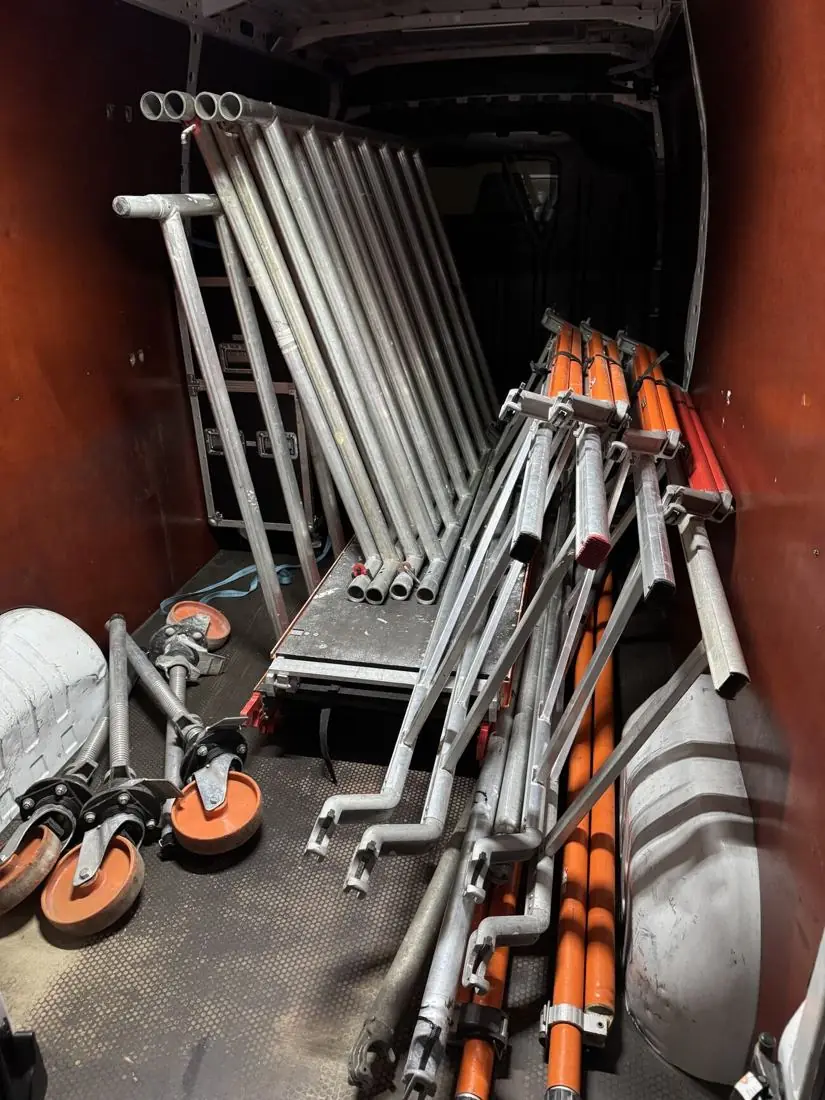
Frames, decks, braces and stacked castors loaded in the back of a van, the counted set hired for a swap

Where it is one small module on a garage roof and the way through to the back is genuinely tight, the narrow RS51 at 75 cm will do. For a complete set it is punishing, and you lose time turning and lifting at every position along the row. Which model suits which roof is compared in the guide to towers for panel work, so you can settle that before you book. Count how many modules are due to come off in total as well.
Hiring working height up to the lowest row of panels

Replacing solar panels starts at the bottom row, so your measuring point is not the ridge but that lowest line of modules. Stand with the deck level with the gutter and you look across the clamps and get a hand under the frame to reach the connectors. On a house of two storeys that puts you at 8 to 12 metres of working height. Work the figure back yourself if you like: the height of your platform plus roughly 2 metres of reach above it is the whole formula.

Which row has failed decides the rest of the choice. If the dead module sits in the second or third row up from the gutter, you can no longer touch it from deck level and have to build higher to reach over the row below it. So count the rows up from the gutter before you reserve anything at all. At a ten metre build you can see what that stage looks like on an average house, which tells you what to put on the booking form.

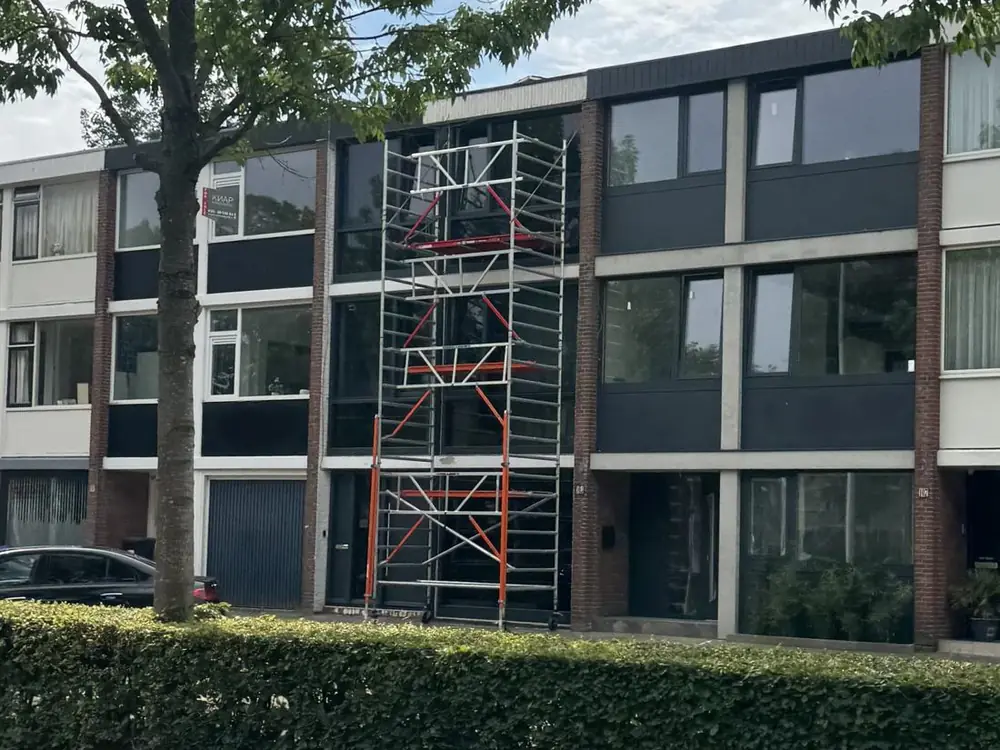
Mobile scaffold built up the front of a house to roof edge height, the reach hired to meet a low row

Lay your tape down on the exact spot where the castors will end up, not on the back door threshold. A garden sitting half a metre below the terrace counts towards your total just the same. Choose the build too low and you are hauling at twenty kilos of glass and aluminium with your arms straight above you, which goes wrong sooner or later. One extra stage costs a quarter of an hour while you assemble; a second delivery round costs a whole working day.

Where the hired tower stands beside a roof full of panels

The pitch for replacing solar panels goes on the gutter side where the failed module lies, and that is often round the back of the house. So look first at how the parts get there. A gate of 80 cm, a path squeezed past the shed, or a rear garden reachable only through the sitting room decides whether the wide model can be used at all. Anyone meaning to hire a mobile scaffold for this work studies that route to the back as closely as the height of the roof.

Under the tower you want level ground with something in it. Each of the four stabilisers angles away from the base and wants something firm under its foot. Block paving or a drive is ideal, a freshly dug border is not. Where the ground falls away towards the boundary you take that up on the spindles, and how far that can go is set out in the advice on ground that is not level. Keep an inspection cover or a gravel strip out of your footprint entirely.

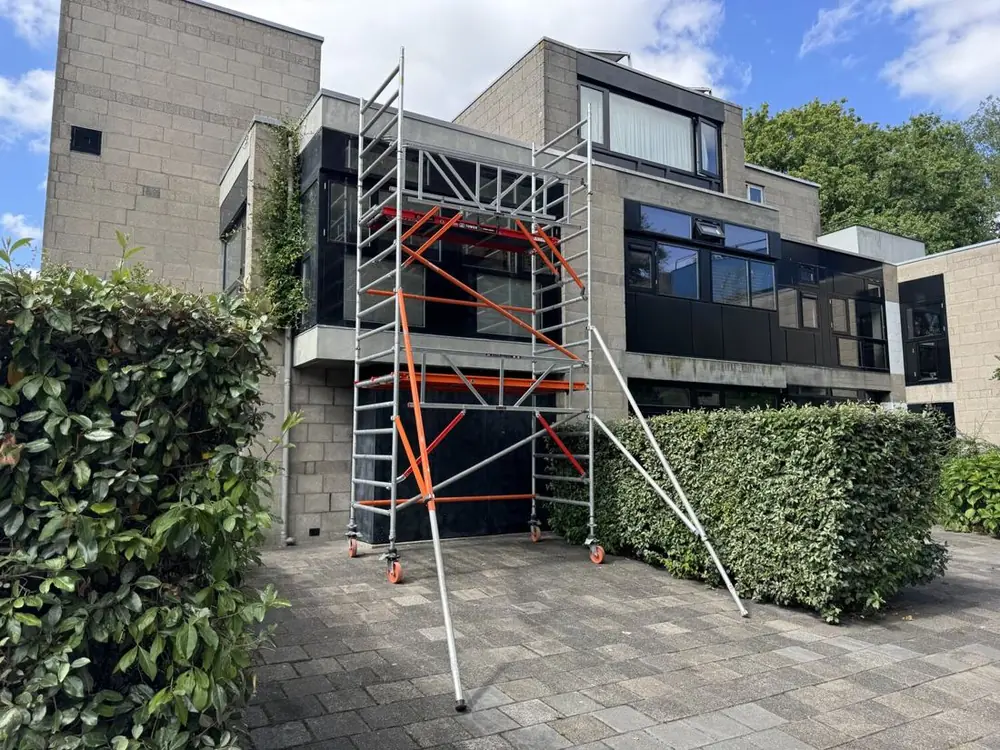
Stabilisers angled out onto block paving beneath an assembled tower, the firm footing wanted beside a panelled roof

Point out a resting place for the modules as well. The failed sheet goes down flat on two battens or a piece of board, outside the walking route and out of full sun. The new one stands upright against the wall right beside the way up, so you can pass it along in a single movement. Think too about the hose reel, the bikes and the wheelie bins that always sit precisely where the tower has to go. Shift that lot the evening before it arrives.

How many hire days a failed solar panel really takes

Hiring a tower for replacing solar panels comes down in practice to two or three days. Unclamping one module and putting the next one back takes an hour, but that is not where your time goes. It goes on making the string dead, on hunting for the right clamps, on the build on the first morning and the strip down on the last. Where a complete set has to leave the roof, allow half a day per row and add the clearing up on top of it.

A period like that contains pauses you have no say in. The replacement module has to be there, and sometimes you only discover up top that it differs by a couple of centimetres and wants other clamps. The engineer who restarts the inverter turns up at a moment of their own choosing. Take that day into your hire period, or the tower will be gone exactly when you need it one last time. Panel suppliers keep to their own lead times whatever your diary says.

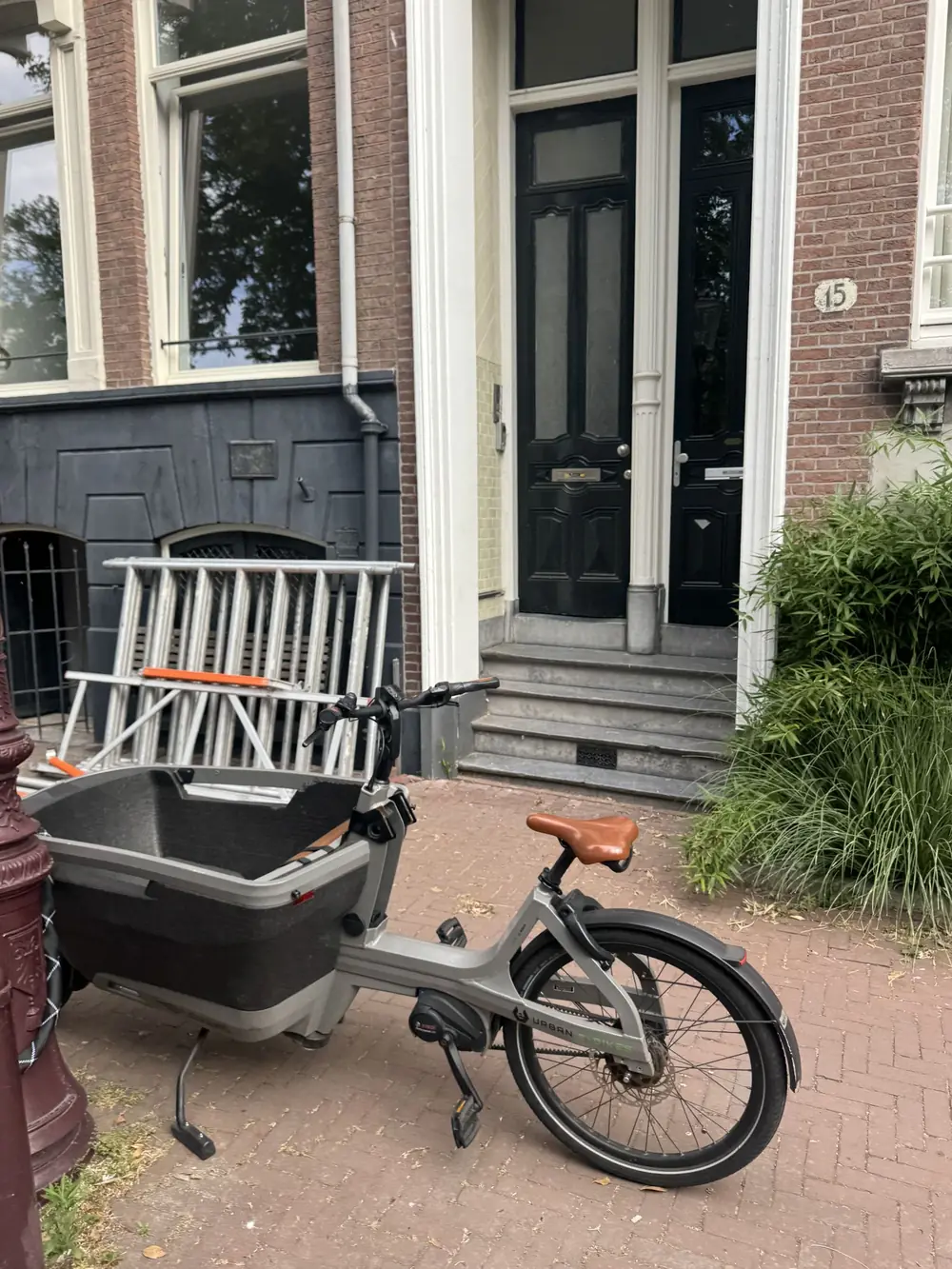
Bundled scaffold frames propped against the brickwork behind a parked cargo bike, at the foot of the entrance steps

The way the tariff is built helps here. Only the opening 24 hours is charged at the standard rate, while each hire day that follows drops by a full 95 per cent, so a margin around an uncertain delivery costs almost nothing. Booking tight does cost you, because your array then lies half open while the van is already on its way. How long people keep a set on average is covered in the piece on the length of a hire.

Which mobile scaffold suits replacing solar panels?

Kamersteiger RS44
  • Working height up to 4 metres
  • Compact and narrow
  • Great for indoor and small jobs
View and calculate →
Smalle rolsteiger RS51
  • Working height up to 14.2 metres
  • Narrow (75 cm)
  • Ideal for narrow passages
View and calculate →
Most chosen
Brede rolsteiger RS52
  • Working height up to 14.2 metres
  • Wide platform (135 cm)
  • Extra stability and workspace
View and calculate →
1-persoons steiger MiTower
  • Working height up to 6.2 metres
  • Very compact
  • Quick and easy to assemble
View and calculate →

Replacing solar panels from the deck: clamps, plugs, sizes

Make the installation dead before anything else. Inverter off, the DC side isolated, and the module covered with a tarpaulin or a sheet of card before you touch a connector. Daylight alone is enough to put voltage on it, even on a grey afternoon in November. So bring that cover up in the same trip, because climbing down halfway through a module is precisely what you want to avoid at this height. Lay it ready beside the way up before you take the first rung.

Then mind the mid clamps. A clamp like that grips two modules at once, so the moment you back it off you have released the neighbouring panel as well. Secure that one first with a spare clamp, or have your mate hold it steady. Beyond that you work in bites: from 245 cm of deck you reach roughly two modules side by side, after which you shift the tower along the gutter and set the stabilisers out again. Work from the edge of the field inwards.

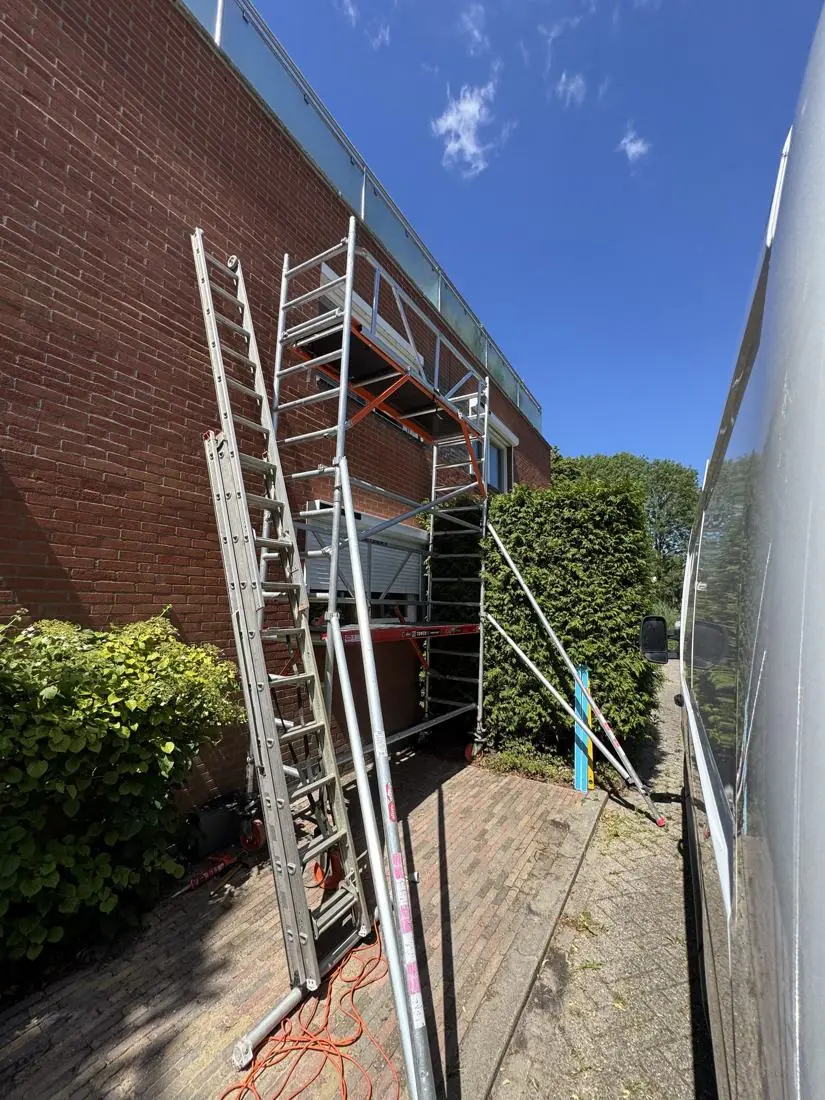
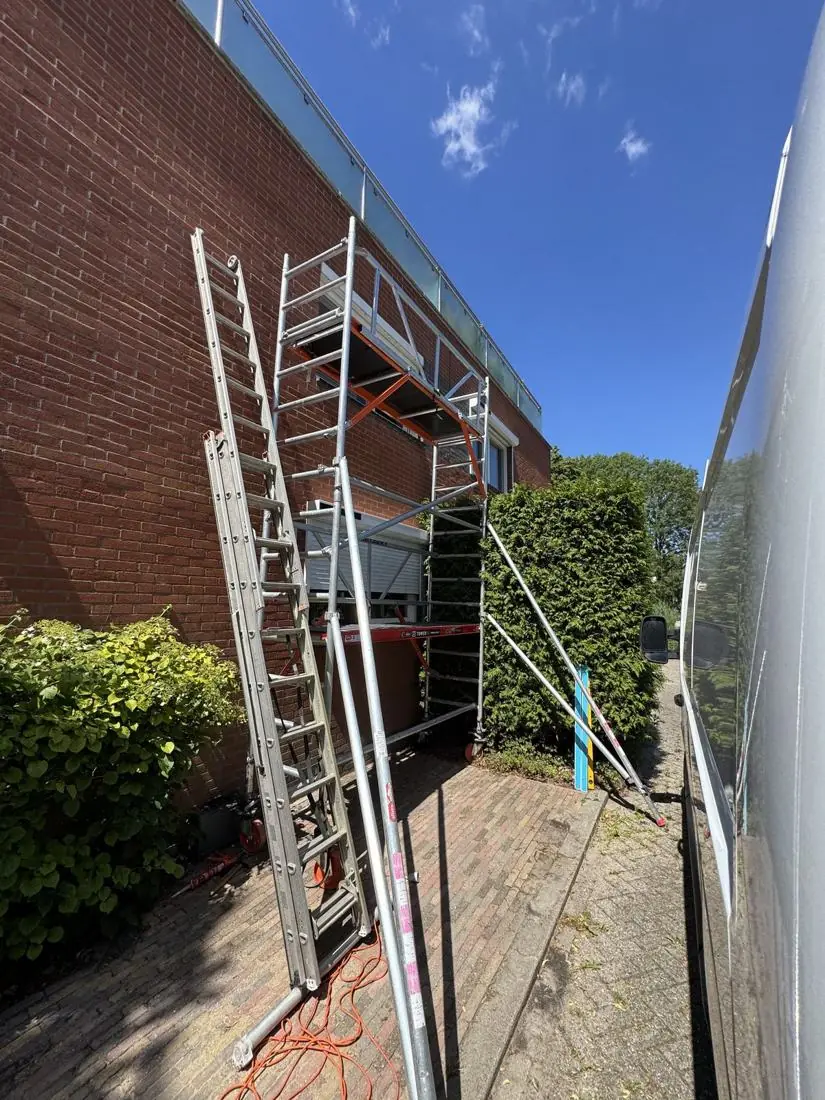
Assembled tower standing in a narrow passage beside a brick wall, with two ladders leaning against the brickwork

Reckon on a size difference while replacing solar panels. Modules from a newer series often run a few centimetres taller or thicker, which moves the clamping zone and means the rail has to follow. An odd one inside the same string also pulls the current down, since a series never delivers more than its weakest member. Ask for the outside dimensions and the frame thickness when you order. If the whole field is coming off, the page on stripping an array sets out the order of work.

Hiring a mobile scaffold with delivery for a panel swap

The parts reach you counted and complete, and they stay where the driver puts them down. So point out that spot beforehand and keep it clear of the stretch where the old module will land. Get the order booked on a weekday before 15:00 appears on the clock, and the parts land at your address the following working day. Bear the date your installer can attend in mind while you pick. A drive or the grass beside the gate beats the pavement, where you leave pedestrians nowhere to walk.

Assembly falls inside your own hire period. A manual comes with the set and a film online runs through the order stage by stage. With two people you are busy for the best part of two hours before the top deck sits at height. When replacing solar panels, put delivery a day ahead of the module itself where you can, and count that morning as your first day of hire. Carriage out and back is a fixed sum for your province, set out at the delivery charges by province.

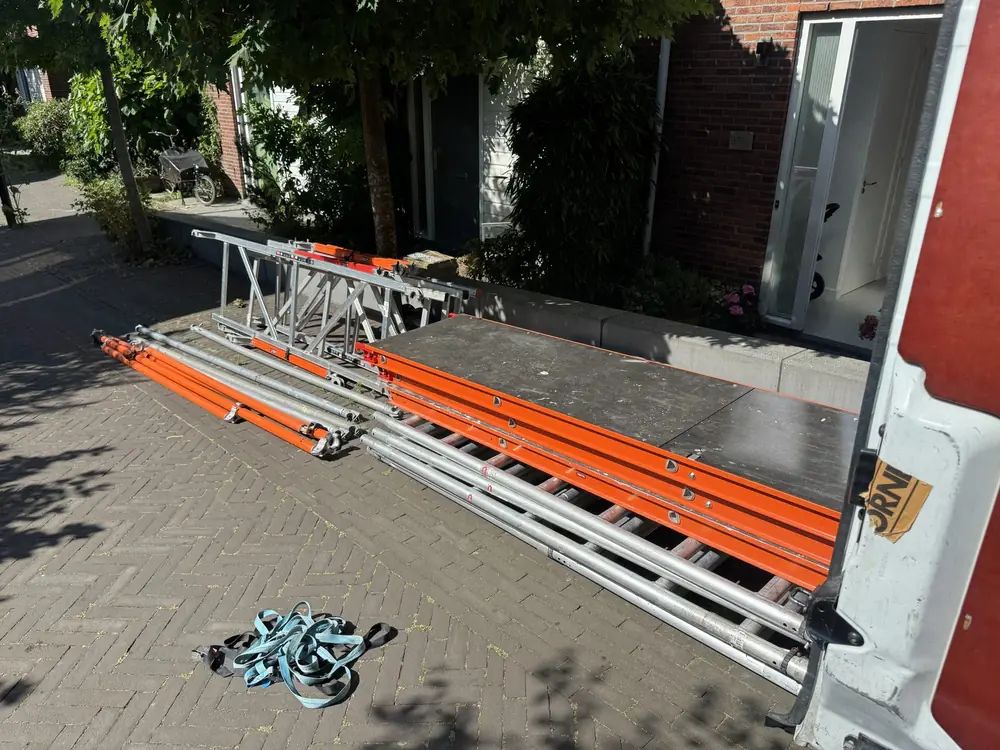
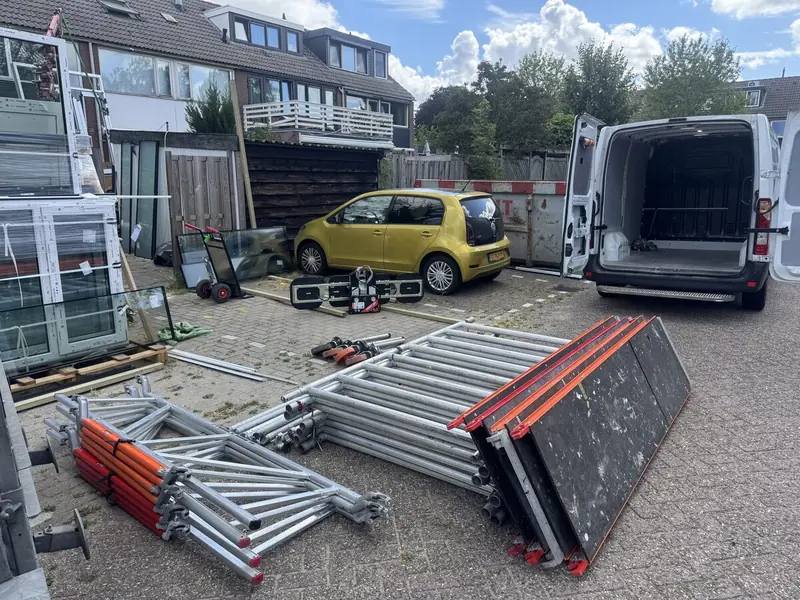
Long braces, aluminium frames and a deck laid out on paving beside an open van, with a webbing strap alongside

Taking it away again is our side of it, on the date you fixed at the start. You take the tower apart and pile the parts somewhere a driver with a sack barrow can get to them. Do that only once the scrap module has left the property, or your drive holds glass and aluminium at the same time. Count the braces and deck boards off as you take them down, so that nothing at all stays behind in the hedge or round the back of the shed.

Working safely at height while replacing solar panels

Each square metre of the floor you stand on is rated at 200 kg, the ceiling EN 1004 puts on load class 3, and on a panel swap it fills up faster than you expect: two people, an old module laid flat, the replacement on its edge and a tool box beside it. Spread that weight down the length of the deck instead of piling it all by the ladder opening. What that class allows is set out in the note on the scaffold standard.

Brake the castors before the first person climbs and leave them braked for as long as anybody is up there. Moving the tower with a module lying on the deck is not done, not even for the single metre to the next bay. If it starts to blow, put the work down: a sheet of that size behaves like canvas and pulls itself straight out of your hands. Panels go up between two people and never over the top of a guard rail.

Erected tower with guard rails and an internal climbing ladder, the way up taken repeatedly during a swap

Finally, respect the current itself while replacing solar panels. Work in dry gloves, let no loose connector hang in a puddle on the floor, and measure that the string really is dead before you unplug anything. Let nobody walk underneath the deck while you are busy above, because a clamp or a screwdriver arrives hard from that height. Stand a wheelbarrow in that spot as a warning if it helps. The rest is gathered at the rules for work at height.

In 5 steps

How hiring a mobile scaffold works

1
Choose working height

Pick the height that suits your job.

2
Book online

Sorted in 60 seconds, price shown instantly.

3
We deliver

At the agreed spot the next working day.

4
Assemble safely

Assembled by you, with a manual.

5
We collect

One call and we collect the scaffold.

Good to know

Practical tips for replacing solar panels

1

Photograph the failed module and its type plate before you book the tower. With the output and the outside dimensions in your hand you know whether the replacement fits and whether other clamps have to be ordered.

2

Carry the cover sheet up in the same trip as the clamp spanner and a spare clamp. Anything missing up top means one climb down and one climb back, the biggest thief of the day on a swap like this.

3

Lay two battens down where the dead sheet will land. Straight onto paving you damage the back of it, and propped at an angle against the wall a panel of that size slides away in the first decent gust.

4

Stick a strip of tape on the gutter at every castor position. Replacing solar panels in a set of ten means shifting the tower repeatedly, and the gap between deck and panel row then stays identical the whole way along.

5

Ask your installer in advance which string has to come off and where the DC isolator lives. Standing up there with a spanner in your hand is the wrong moment to go hunting through the meter cupboard by telephone.

6

Put your collection date a full day after the inverter is due back on. If the yield from that string still looks wrong, the hired tower is standing and you can go up again without making a fresh booking.

Frequently asked questions

Frequently asked questions about replacing solar panels

Which mobile scaffold do you hire to replace one dead panel?+

An RS52 with its 135 cm deck is the sensible pick here. Up top you need somewhere for the module coming off and somewhere for the one going on, and you do not want both of those in your arms at once. On a cramped floor that becomes a juggling act with glass in it. Only for a single panel on a low garage roof behind a tight passage does the narrow tower win outright. Measure the narrowest gate on your route before you hire anything at all.

How does the hire run around a panel swap on a pitched roof?+

You choose the model online, choose a build height, and enter both dates in the diary yourself. The parts arrive at the address, after which you assemble the tower along the gutter, change the module and stack everything dismantled for the return trip. The one thing worth planning sharply is the arrival of the replacement panel, because everything else in your hire period is pegged to that one date. Fix your delivery day once that is known. Then the hired tower stands before the courier turns up.

How many days should you hire for replacing solar panels?+

For one dead module two days covers it: a day for the build and the swap itself, a day of slack. Where a complete field has to come off, reckon on three to four days of hire, since you move along row by row and each sheet is unclamped and carried down on its own. If the new panel is late, your whole plan shifts with it. Booking a spare day beats ordering a tower twice and paying two lots of transport. Two builds also mean two mornings lost.

What decides the rental price for a job like this?+

Two things: the version you take and the height you finish at. On top of that comes the charge for bringing the set and fetching it. Those amounts are listed with VAT already in them at the rates for each tower. For a panel swap how the tariff is shaped matters more than the figures, because the first day holds nearly all of the cost and those after it hardly show up. Generous booking is therefore rarely the expensive mistake on a job of this kind.

Which working height do you hire for panels on a two storey roof?+

Hold to 8 to 12 metres. Measure from the paving under your pitch up to the bottom row of modules, because that is the line you actually work at. If the failed sheet sits higher in the field, you have to go up further to reach over the row below it. Look as well at whether the roof has an overhang, since that pushes the tower a good way back from the gutter and quietly costs you reach at the top. Overhangs are easily forgotten at the planning stage.

Do you deliver the hired tower, or is collecting it myself an option?+

The choice is yours. Delivery suits a panel swap best, because the hired set stands there on your date and disappears again afterwards without you lifting a thing. With a trailer of sufficient length you may fetch the parts yourself instead, with loading at Zeeburgerpad 89 in Amsterdam costing nothing once a time is agreed. Most people still have the scaffold brought to them, since the car is needed those days to take the scrap module away to a recycling point. Tell us if a van cannot reach your door.

Do you assemble the hired scaffold, or is that down to me?+

That is your own work, with your own hands. We deliver the counted set and fetch it once your final hire day has passed. Building it, shifting it along the gutter and taking it apart all sit inside the period you reserve, with the printed instructions showing the order step by step. Cherry pickers, system scaffolding and facade scaffolding sit outside the hire range, so at this height the rolling tower is what a swap runs on. Two people and the manual make short work of it.

Can I hire for longer if replacing solar panels overruns?+

You can. Tell us early enough and we will shift the collection day, provided nobody else has that particular set booked behind you. On a swap things go sideways often enough: the replacement does not fit, other clamps are needed, or the engineer for the inverter can only come later in the week. Since you name your own end date, build that slack in at the reservation. Handing a tower back early is equally fine, so most people add that day when they first book.

How much clear ground must I leave for the hired tower on a swap?+

Take the width of the deck, add what the stabilisers claim on every side, and then reserve the landing spot for the module coming down. In practice that means a level stretch of several metres along the wall with a clear run through to the gate. Bikes, bins and planters go away before the parts arrive. The corner where the loose parts lie during the hire belongs in that sum too, or you spend the delivery day carrying. A tidy footprint saves you shifting things twice.

Does the hire simply carry on when the wind gets up?+

The tower stays standing and the work waits. A sheet of 170 by 110 cm catches so much in a gust that you can no longer lift it under control, and on a wet roof surface you want nothing to do with connectors anyway. Use a day like that to lay your tools out and identify the string you are after. Because you decide when the scaffold goes back, a shift like that usually costs one more day. A still, dry hour is what a swap needs.

How soon after the hire is the deposit returned on a panel swap?+

A deposit is held when the period is booked and the money returns within 1 working day of the check on the returned set. On this job watch two things: hand the braces and the clamps of the tower back complete, and never prop a module against the tubes where it can slide and scratch. What happens at that check is set out in the note on getting your deposit back. Count the clamps and spanners into your own box while you dismantle the tower.

Can the optimiser be changed from the same hired position?+

Yes, and it saves you a second hire period altogether. The optimiser hangs under the module on the rail, so the moment the sheet is off you reach it from the same platform of the tower. Plan it into the same days, because ordering a scaffold again for a box weighing half a kilo wastes both money and time. Check first that the new unit suits your inverter, or you will be up there again within a fortnight. Doing both jobs inside one hire period is simply cheaper.

Hire a mobile scaffold for replacing solar panels today?

Calculate your rental price now or ask for free advice.

Rolsteiger van SteigerTaxi geleverd op locatie
Book it online

Your scaffold sorted in 2 minutes.

Choose your scaffold and working height, see the price instantly and book online.