
See your price
Application

Replacing a rainwater drain? Choose the right scaffold.

Replacing a rainwater drain is work in a straight line downwards: from the outlet in the gutter, along the facade, to where the pipe ends on the paving or in a gully. You do not shift sideways but work from top to bottom in one place, and on the way new brackets have to go into the wall. For two storeys you hire the RS51: 75 cm narrow, on a build of six to eight metres. Below you read where the scaffold goes, how many hire days you need and how the pipe travels up.

  • Order before 3 pm, delivered tomorrow
  • Professional Altrex scaffolds
  • Up to 14.2 metres working height
  • Easy to assemble yourself
4,2 tot 14,2 mWorking heights available
12Provinces served
7Days a week
200 kg/m²Load class 3
In short
  • For replacing a rainwater drain we recommend the Narrow mobile scaffold.
  • To replace a rainwater drain you hire the narrow RS51, 75 cm wide, built between 6 and 8 metres of working height.
  • You work from the gutter down to ground level on one line, so the scaffold largely stays in the same place.
  • Reckon on one to two hire days, because every bracket has to be drilled plumb into the facade one by one.
  • First 24 hours from €150 incl. VAT and delivery; every day after that 95% off.
Key facts for this job
FeatureValue
Recommended scaffoldNarrow mobile scaffold (Altrex RS TOWER 51)
Working height for this job6 to 8 metres
Available working heights4.2 to 14.2 metres
StandardEN 1004, load class 3 (200 kg per m²)
DeliveryOrdered before 3 pm, delivered next working day
Each extra day95% off, from €7.50 a day
Why a mobile scaffold for replacing a rainwater drain?

Safe, stable and professional work at height

The pipe of a rainwater drain runs the full height of the facade, and that is precisely why this is no ladder job. You have to drill brackets straight below one another, push sections together and get the top bend into the gutter, and none of that works while one hand grips a ladder stile. From a platform you stand still, with both hands free and the drill within reach. Hiring a mobile scaffold for this job therefore turns on three questions: how high the connection in the gutter sits, does the base fit beside the place where the pipe comes out, and how many days do you need to work down bracket by bracket.

  • Brackets go into the facade straight below one another
  • The pipe runs from gutter to ground level
  • Six to eight metres to the gutter outlet
  • You move down in height, not sideways
Read more about working safely →

Which mobile scaffold to hire for replacing a rainwater drain

For this job you hire the RS51, the narrow Altrex tower 75 cm wide with a range running from 4.2 metres up to 14.2 metres of working height. That narrow dimension is no side issue here, because a rainwater drain rarely sits in the middle of a flat front wall. Usually it runs away in a corner, past an extension or through the alley between two houses, and then every centimetre of width counts. The other models stand together in the range of mobile scaffolds for facade work.

The wide 135 cm version gives you more floor, but you will not get it through the same passages and you do not need that room at a pipe. After all, you keep working in the same place instead of sliding along a whole elevation. A room scaffold drops out: it is meant for indoor work and comes nowhere near the height at which the gutter connection of a rainwater drain sits. That leaves the narrow version, which you also carry to the back with fewer parts.
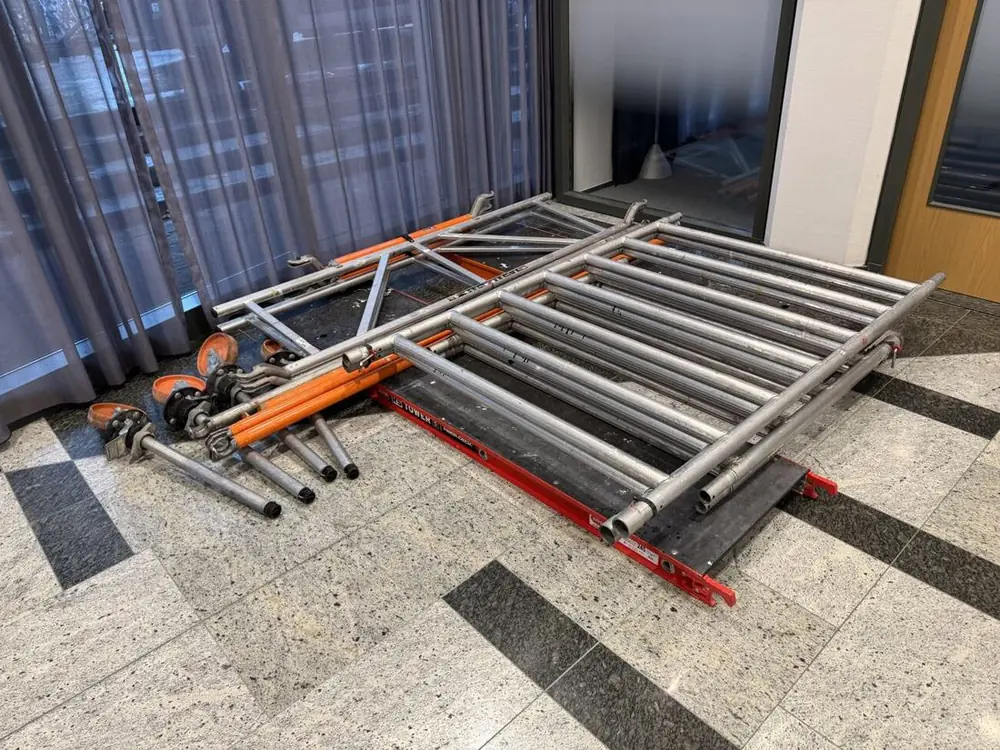
Checked and counted set of scaffold parts laid ready, the narrow mobile scaffold you hire for work on a downpipe

The 245 cm platform length you use differently here than on paintwork. You do not need it to reach far sideways, but you do need it as a shelf: a pipe section, the brackets, the drill and a bucket of rubble fit alongside one another without anything balancing on the edge. On a day full of loose components that saves you a good many trips up and down, and you notice it most towards the end of the afternoon.
Working height to hire up to the gutter outlet

The highest point on this job is where the pipe enters the gutter: the outlet, the bend and the top bracket. On a house of two storeys that point lies at four to six metres, and the build that suits it gives 6 to 8 metres of working height. That figure holds not only your platform but also the good 2 metres a grown adult still reaches standing up. More about that build is on the page with a working height of 8 metres.

Measure from the paving or the ground where the castors come, and watch the fall while you do. Paving round a house nearly always slopes slightly towards the gully, and that is exactly where a rainwater drain ends. If that leaves you standing half a step lower than the doorstep, you really do need that extra half metre to work comfortably at the gutter. So take your measurement at the spot the castors will occupy, and not up at the front door where the ground sits higher.

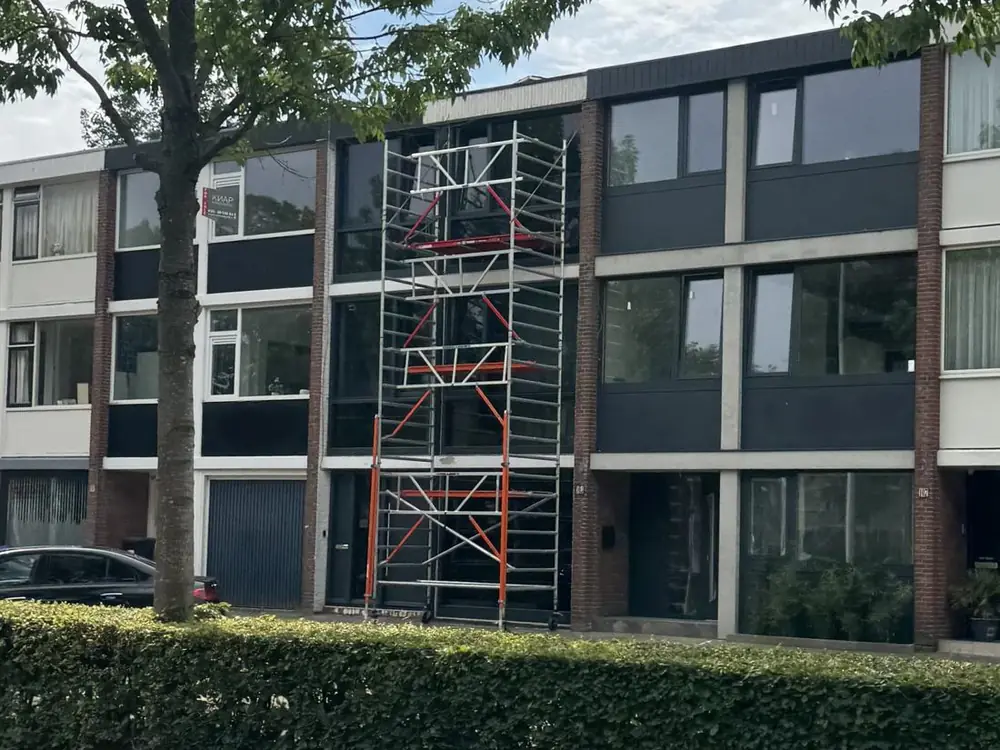
Front elevation with a mobile scaffold erected to just under the roof edge, the height at which a gutter outlet sits

Choosing too tight bites harder here than on other facade work, because the awkward part sits at the top. The bend in the gutter and the first bracket ask for precision, and you will not get that standing with your arms stretched above your head. The bottom metres of pipe you can manage from the ground at a pinch, but the connection into the gutter is no place to improvise with a short build. In doubt take the higher setting, which costs you barely more when you hire.

Where the scaffold stands beside the rainwater drain and gully

The base of your set-up and the end of the pipe fight over the same square metre. At the bottom the drain comes out over a gully, a ground pipe or a cast iron pot in the paving, and you want neither a castor nor a stabiliser on top of that. So stand the scaffold just to one side of the line of the pipe rather than square in front of it, so that you reach the outlet freely below and still face the gutter spout above.

Then look at the corner the drain disappears into. With a bay, an extension or a recessed porch you can often approach from one side only, and that one side decides how far the stabilisers can open. Measure that before you hire, because a scaffold that stands but cannot be braced is useless. Sometimes shifting the whole thing half a metre is already enough to get all four legs out without losing sight of the gutter spout above you.

Angled stabiliser legs opened out at the base of a tower, the clear ground you reserve beside a rainwater drain

The obstacles on this work sit almost always in the same places: the outside tap, a water butt plumbed into the drain, a bike rack against the wall and the border running right up to the brickwork. Clear that before the van pulls up. Look at the ground as well, because on loose decorative paving a stabiliser sinks askew and your set-up no longer stands square to the facade. A board under the foot usually solves it.

Hire days for replacing a rainwater drain

A single rainwater drain is generously served by one day. The old pipe comes off, the old brackets come loose, the holes in the pointing are made good, and after that you drill the new brackets and slide the sections together from the top down. Anyone who has done it before is finished in half a day. Even so you usually book two days, because building at the start and dismantling at the end belong to the job as well.

What stretches it is the facade itself. Soft pointing, weathered brick or a section that was repaired years earlier forces you to move brackets and fill holes. If a second pipe runs at the back, or the gutter outlet has to be renewed at the same time, another half day joins on. And the wall stands open during those hours: a shower in the middle of the work means water against the brickwork instead of into the gully.

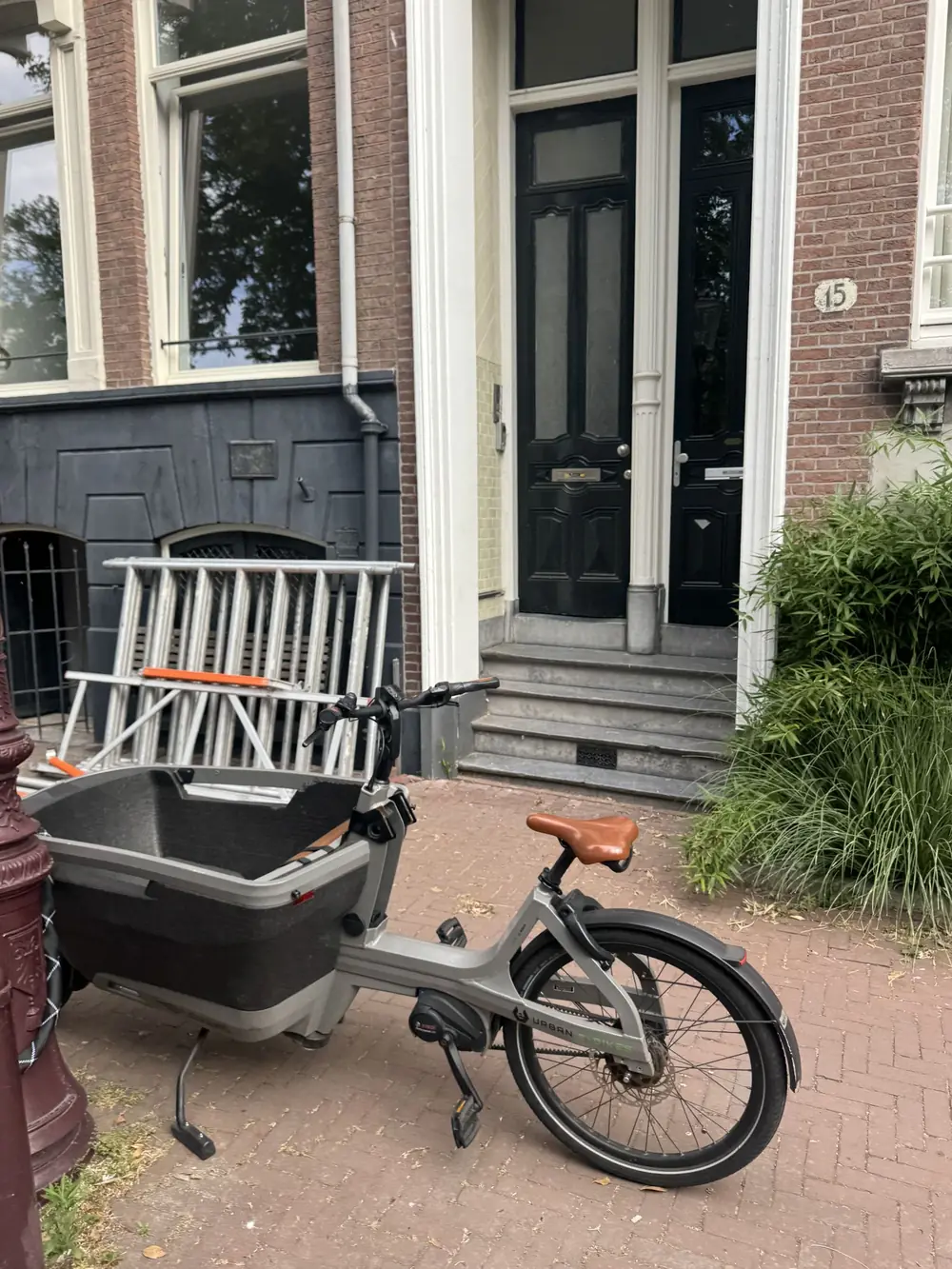
Frames propped by a doorway on the pavement, the kit you build and dismantle yourself inside the two days you book

Booking generously therefore costs little and gains much. The full rate is payable over the first 24 hours only, and everything after it comes with 95 per cent off, which leaves an extra day barely visible in your rental price. Put your collection date one day behind your last planned working day rather than exactly on it. That way you need not finish a joint that still leaks in the dark or during a shower, and you keep time to sweep the paving.

Which mobile scaffold suits replacing a rainwater drain?

Kamersteiger RS44
  • Working height up to 4 metres
  • Compact and narrow
  • Great for indoor and small jobs
View and calculate →
Most chosen
Smalle rolsteiger RS51
  • Working height up to 14.2 metres
  • Narrow (75 cm)
  • Ideal for narrow passages
View and calculate →
Brede rolsteiger RS52
  • Working height up to 14.2 metres
  • Wide platform (135 cm)
  • Extra stability and workspace
View and calculate →
1-persoons steiger MiTower
  • Working height up to 6.2 metres
  • Very compact
  • Quick and easy to assemble
View and calculate →

Fitting the rainwater drain from the 245 cm platform

Start at the top and work downwards. Fix the bend and the topmost bracket at the gutter first, because that point sets the whole line that follows below it. From there hang a plumb bob or stretch a thin cord along the facade, and you drill every next bracket exactly under the previous one. If that line runs out of true you see it at once over six metres, and then you are filling holes in brickwork that had just been tidied.

Moving on this job goes downwards instead of sideways. You finish the upper stretch from the highest setting, and for the last few metres you step down a platform or simply onto the ground. Clear the platform before you change anything: loose brackets, screws and a length of pipe do not belong on a scaffold you are about to alter. Take one pipe section up at a time rather than the whole stack, because a loose pipe rolls off a deck faster than you expect.

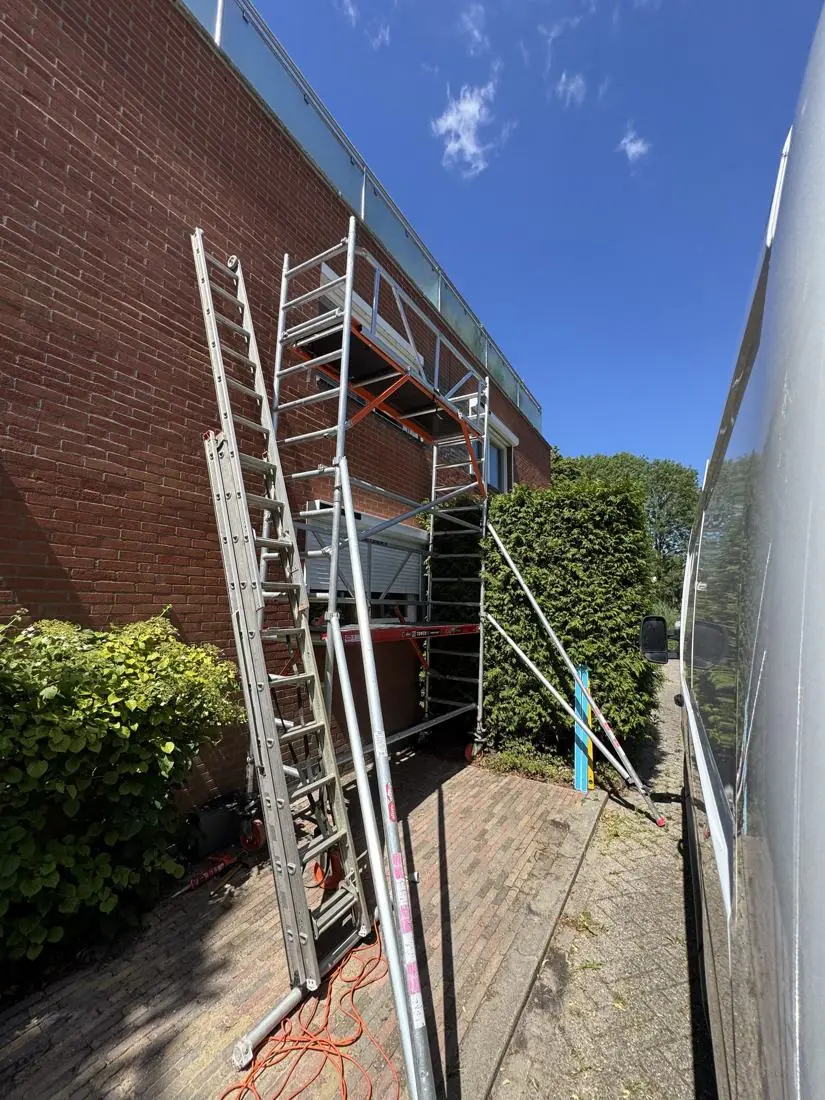
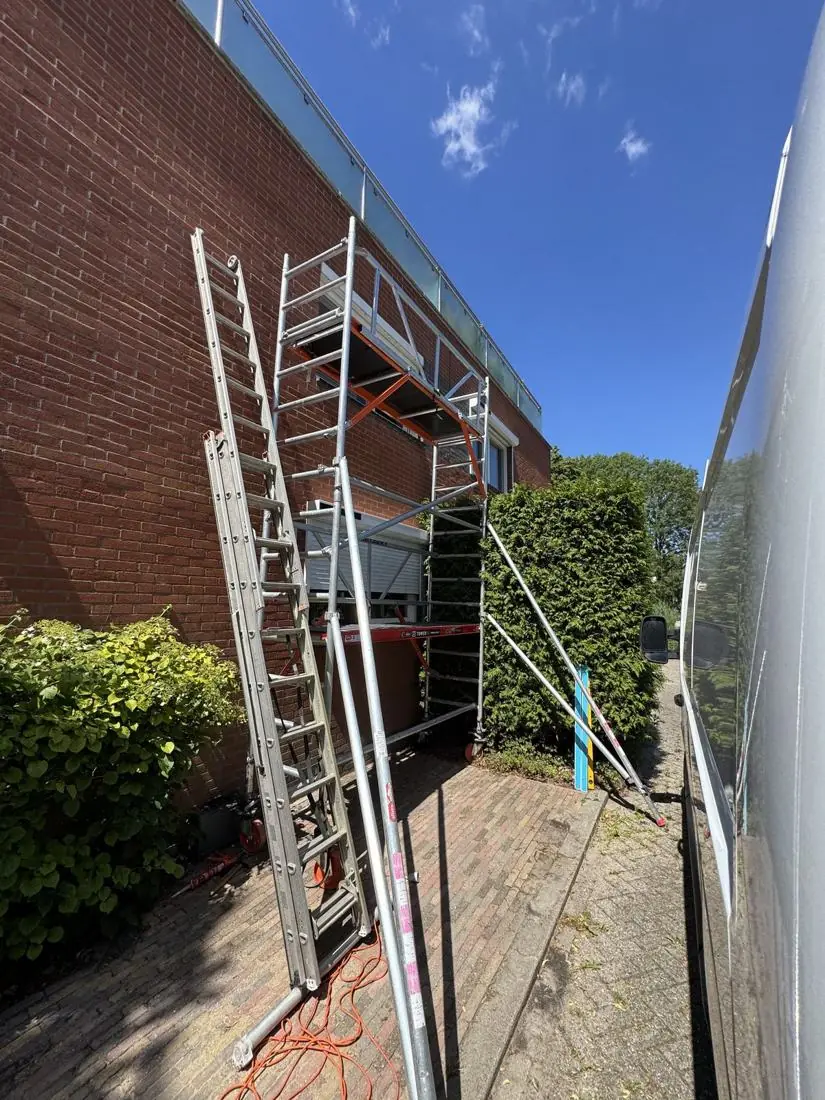
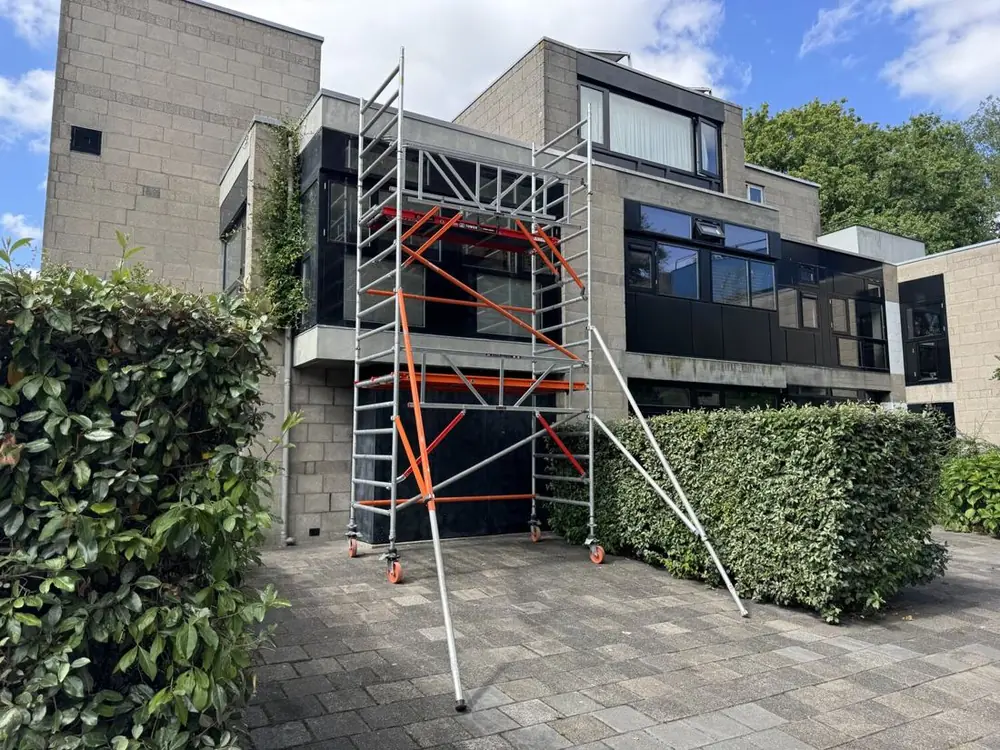
Mobile scaffold set up on a side elevation, the standing place from which brackets and pipe sections are fitted

Drilling at height takes more force than you are used to on the ground, certainly in hard brick. Take a spare battery up, and a box of plugs in two sizes in case a hole opens out. Reckon too with the dust each hole produces: it falls down the facade and lands precisely on the paving you will shortly be walking over with a pipe section. Sweep it up in between and you will not slide later.

Hiring a scaffold with delivery beside your new pipe sections

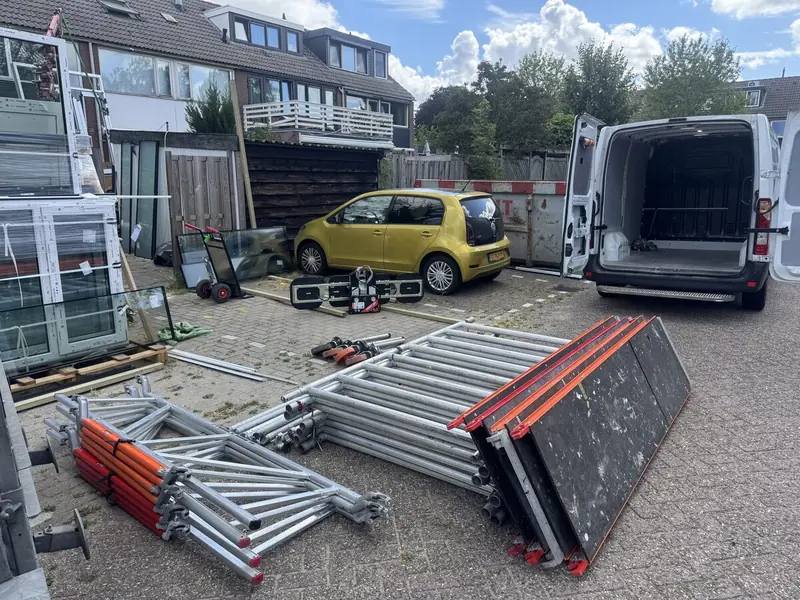
We bring the mobile scaffold as loose, pre-counted parts: uprights, platforms, braces, guard rails and castors. Point out a place where that stack may lie and keep the strip under the drain free while you do, because that is where you will be hauling pipe sections about. A drive or a piece of front garden works better than the path along the wall. Put the booking through on a working day, with 15:00 as the latest time, and the parts stand ready the next working day.

You set the arrival day and the day everything leaves again. It is handy to have the scaffold come on the morning your new pipe, brackets and bends are also in, so you can lay it all out at once. Building you do yourself, with the manual and the film to hand; with two of you it takes under an hour to be up at height. Pick a dry day by preference, because a facade without a drain is not something to leave standing in the rain.

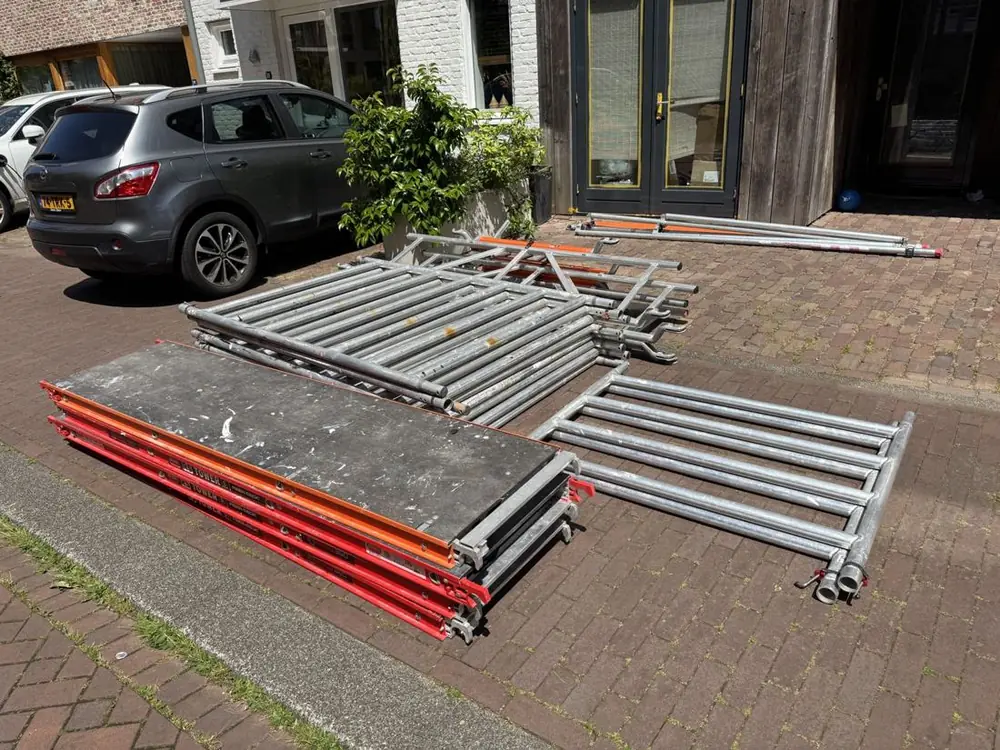
Scaffold parts unloaded on the street outside a terraced house, timed for the day your new pipe material arrives

Once the new rainwater drain is up we come to take the parts away. You dismantle, count everything through as you take it apart and set the complete set down on the spot you chose. Before then, check that the new pipe really is watertight, because you would rather look at that from the platform of the hired scaffold than later off a ladder. The cost of bringing and collecting per province is at the delivery rates including VAT.

Working safely on a hired scaffold along a vertical drain

The platform under your feet falls into load class 3 within EN 1004 and may therefore carry 200 kg per square metre. On this work you fill that faster than with paint: you, a drill, a box of brackets, a bucket of old material and a length of pipe all add up. So keep the heavy items towards the centre of the deck instead of stacking them against one guard rail, certainly if you are standing on that side drilling with your weight forward.

The standard rules hold here in full. Brake the castors as you step on, never move the mobile scaffold while somebody is up there or material is lying on the deck, and stop in strong wind. That last point matters extra on this job, because a three metre pipe section held up at arm's length behaves like a sail and takes your balance with it. Everything further on that score is collected in the rules that govern work at height.

Tower fitted with double guard rails and an inside ladder, climbed here with a drill and a box of brackets

The risks peculiar to this work lie in sharp edges and in falling parts. Old zinc pipe cuts, so wear gloves and do not let the removed lengths drop but pass them down or lower them on a line. Keep the zone beneath you clear, certainly while the gully is open. Drilling dust also makes the platform slippery rather than grippy, so brush it away before you turn round with a three metre length in your hands.

In 5 steps

How hiring a mobile scaffold works

1
Choose working height

Pick the height that suits your job.

2
Book online

Sorted in 60 seconds, price shown instantly.

3
We deliver

At the agreed spot the next working day.

4
Assemble safely

Assembled by you, with a manual.

5
We collect

One call and we collect the scaffold.

Good to know

Practical tips for replacing a rainwater drain

1

Measure the distance from the gutter to the paving before you order pipe and add half a metre to it. Cutting to length from the platform is fine, but making up a shortfall up there is not.

2

Hang a bucket on a string from the guard rail. Old brackets, screws and snapped plugs go into that instead of dropping onto the tiles or into the border below you.

3

Drill the top bracket first and only then hang your plumb line. Every other bracket you take off that one, so the new drain runs dead straight down the facade over its whole height.

4

Lay the new pipe sections beside the set-up in order rather than in a heap. You then pick them up from top to bottom without having to work out each time which piece comes next.

5

Keep a sheet of foil or a bucket ready under the gutter spout during the job. If a shower arrives unexpectedly while the drain is off, you at least lead the water away from the wall.

6

Ask for a collection date one day after your last working day. At the first rain you can then still check from the platform whether every joint is tight before the scaffold is taken away.

Frequently asked questions

Frequently asked questions about replacing a rainwater drain

Which mobile scaffold should you hire to replace a rainwater drain?+

The narrow RS51 at 75 cm is the right model here. A downpipe often sits in a corner, in an alley or beside an extension, and a wide tower simply will not fit there. You do not miss that extra width up top, because you work from one fixed place instead of sliding along a whole elevation. Do state the right working height when you hire, since the connection point in the gutter decides how high you must come, and that point sits above the top of the pipe.

How does hiring a mobile scaffold work when replacing a downpipe?+

You tick model and working height online, fill in when it should arrive and when it should go, and settle a fixed rate in advance with the VAT already worked in. We bring the parts to your address, you put the mobile scaffold together and do your job, and afterwards everything stands dismantled and counted ready for the return trip. Beyond that you only have to clear the strip under the drain in good time.

How many hire days does a rainwater drain take?+

For a single pipe on a two storey house one to two days is enough. The job itself takes half a day, but building, dismantling and filling old holes in the pointing take up the rest. If you take in the back at the same time, or a new gutter outlet has to go in, count on an extra day of hire. You pick the collection day yourself, so that margin costs you almost nothing and leaves you calm at the finishing stage.

What will hiring a tower for a downpipe cost me?+

What you pay for a tower depends on the model and the height, topped up with a fixed amount per province covering delivery and collection at once. On the page with all prices the amounts are stated with VAT included, so nothing appears at the checkout. With a job as short as this one, the opening day weighs most and what you stick behind it hardly counts. Booking generously is therefore seldom an expensive choice, and it spares you rushed work at the gutter.

Which working height to hire when the gutter hangs at five metres?+

With a gutter at five metres you hire a build reaching 6 to 8 metres of working height, so your platform sits at around four metres and you reach the outlet comfortably. Always measure to the point where the pipe goes into the gutter and not to the roof edge above it. Which build belongs to that figure is set out in the overview of working heights, worth a look before you place your booking.

Can the scaffold be delivered into the alley beside the house?+

The van stops on the street and the parts are set down there; carrying them round the back is your work. With a narrow alley that is quite doable, because the sections of this mobile scaffold can each be lifted by one person. Say when you hire where you would like them, and the driver puts them as close as he can to the start of the passage. Collecting them yourself is possible too, at no cost and on appointment, from Zeeburgerpad 89 in Amsterdam.

Do I have to build it myself if I hire a mobile scaffold for this?+

Yes, building and later dismantling belong to your side of the agreement. We deliver the complete set and take it back afterwards. With two people you are on the platform inside an hour at this height, and the manual and video supplied show the order step by step. Towers put up in advance we do not supply, nor do we stock facade scaffolding or cherry pickers, so along a downpipe at this height this is the answer.

What if the facade disappoints and I want to hire the scaffold longer?+

Tell us about it and your collection day moves, as long as that set is not already scheduled elsewhere. With old masonry it regularly happens that brackets will not hold where you had planned them and that repairs come first. You do not then want to be left without a set-up with half a drain hanging on the wall. Finishing early is fine as well: the mobile scaffold simply goes a day sooner than originally agreed.

How much space is needed at the spot where you hire the scaffold?+

Add the spread of the four stabilisers to the width of the set-up, and keep the gully at the foot of the drain clear as well. In practice that is a flat area of a couple of metres beside the wall. Move a water butt, a cycle rack or a border that runs right up to the brickwork before you hire, because shifting them halfway costs you half an hour. The place where the parts land on arrival belongs in that sum too.

Can I keep hiring if it rains during the job?+

The mobile scaffold may stay standing, but the work itself you would rather plan dry. For as long as the old pipe is off, gutter water runs uncontrolled down the wall, and you do not want that for hours on end. Use a wet day to set out brackets, fill holes or lay material ready, and couple the sections as soon as it clears. An extra day of hire is cheaper in the end than a wall taking a whole roof surface of water all afternoon.

After hiring for pipework, when is my deposit returned?+

Within one working day of the return trip of your hired mobile scaffold, as soon as everything is found complete. On this job watch for drilling dust and cement residue in particular: brush the platforms and the tubes clean before you set it all out, because dried mortar will not come off easily later. Count the small parts as you dismantle as well, such as locking pins and castor spanners, which vanish easily into a bucket of debris.

Can I take in the gutter and the outlet from the same set-up?+

That is exactly the reason to hire generously. Standing at gutter height anyway, touching up the gutter bed, replacing the outlet or refixing a loose gutter bracket is a small extra. Walk the roof edge over while you are there. If you want to renew the whole gutter it becomes a different job with far longer components, and then you had better hire the mobile scaffold a few days longer straight away.

Hire a mobile scaffold for replacing a rainwater drain today?

Calculate your rental price now or ask for free advice.

Rolsteiger van SteigerTaxi geleverd op locatie
Book it online

Your scaffold sorted in 2 minutes.

Choose your scaffold and working height, see the price instantly and book online.