
See your price
Application

Fitting brick slips? Choose the right scaffold.

Fitting brick slips looks like bricklaying and behaves like tiling. You set out the course spacing first, and from that moment on every slip has its place decided for it. So you need to run the same line across the full width of a wall with a notched trowel in your hand and a box of slips within reach. On a two storey front that points at the narrow RS51 of 75 cm, ordered in a build reaching 6 to 8 metres. Below: which build fits, and what the pointing round adds in hire days.

  • Order before 3 pm, delivered tomorrow
  • Professional Altrex scaffolds
  • Up to 14.2 metres working height
  • Easy to assemble yourself
4,2 tot 14,2 mWorking heights available
12Provinces served
7Days a week
200 kg/m²Load class 3
In short
  • For fitting brick slips we recommend the Narrow mobile scaffold.
  • Fitting brick slips over two storeys calls for the RS51: a 75 cm base, hired in a build good for 6 to 8 metres.
  • Your course spacing runs across the whole wall, so each new stand has to pick up seamlessly from the rows beside it.
  • Add hire days for the pointing round, because joints can only go in once the adhesive behind the slips has fully cured.
  • First 24 hours from €150 incl. VAT and delivery; every day after that 95% off.
Key facts for this job
FeatureValue
Recommended scaffoldNarrow mobile scaffold (Altrex RS TOWER 51)
Working height for this job6 to 8 metres
Available working heights4.2 to 14.2 metres
StandardEN 1004, load class 3 (200 kg per m²)
DeliveryOrdered before 3 pm, delivered next working day
Each extra day95% off, from €7.50 a day
Why a mobile scaffold for fitting brick slips?

Safe, stable and professional work at height

How much wall you finish from one stand is settled by the open time of your adhesive, not by your own pace. You comb out an area, press the slips into the bed and have to be done before a skin forms on it. On top of that the course spacing carries right across the elevation: whatever you lay on one stand has to tie into the next within a millimetre. Climbing down a ladder and back up does not fit in there, because both hands are busy and you shuffle sideways with the row. Hiring a scaffold for fitting brick slips is therefore about deck space, about the weight of full boxes and about enough hire days for the pointing afterwards.

  • A course spacing that carries across the whole elevation
  • Adhesive worked out inside its own open time
  • Corner slips and window reveals eat separate hours
  • Pointing as a round of its own after curing
Read more about working safely →

Which mobile scaffold to hire for fitting brick slips

Slips go up from the bottom, and on two storeys the pleasantest way to do that is off the Altrex RS51, whose base measures 75 cm across. On a slip clad front the width you build to is settled at the narrowest gate on your route. Boxes of slips, a tub of adhesive and a jerry can of water reach the back of most houses through a side gate or along a path, and a wider build simply stops there. The model overview in our mobile scaffold hire range pairs each width with its reaches.

A deck of 245 cm holds more clutter on this job than it would on painting work. Tub, notched trowel, spirit level, rubber mallet, an opened box and a cutter for infill pieces fill that length quickly. Even so the slim version suits the work: you finish the wall at arm's length and shuffle sideways with whichever row is under your hands. The open box goes at the far end, the tub sits right beside your feet, and the rest of the boards stay clear.
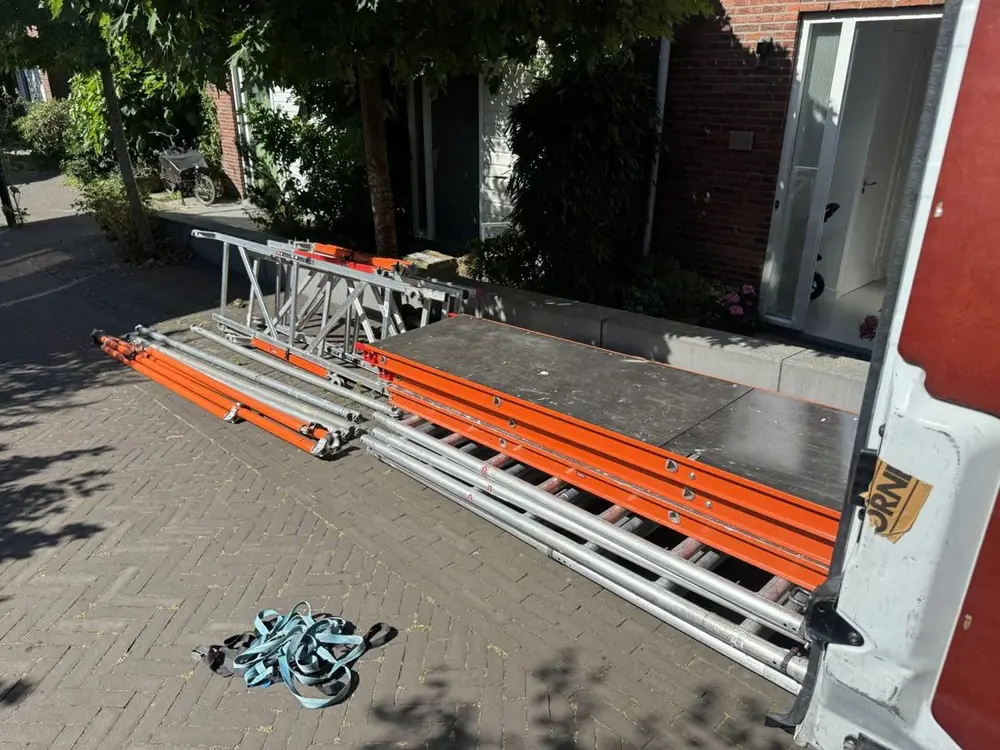
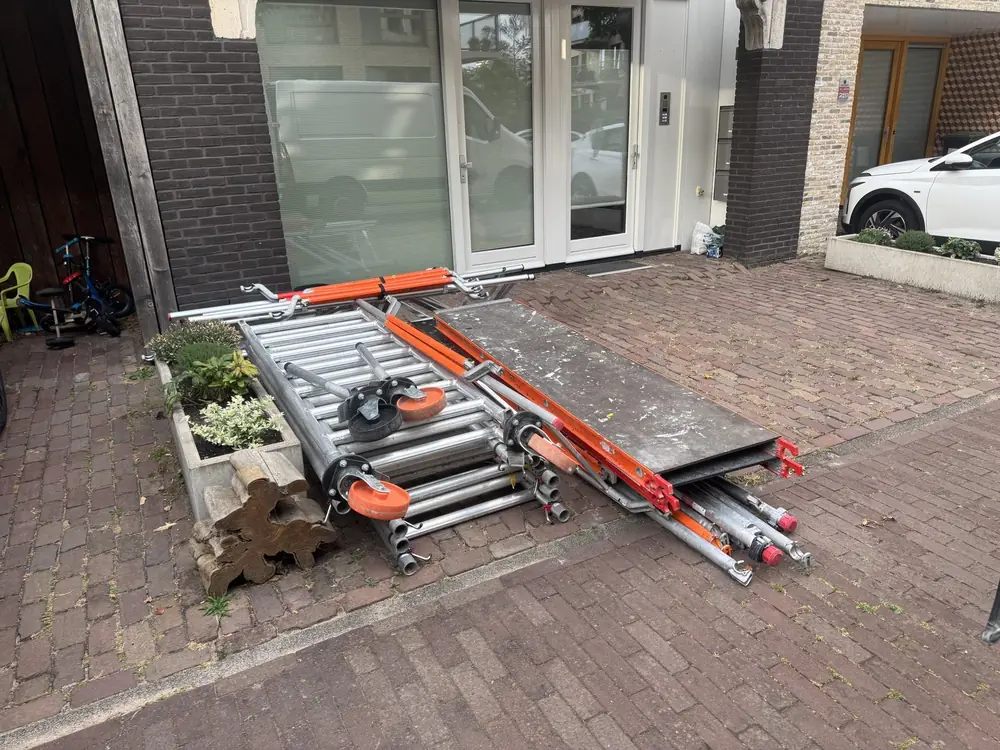
Scaffold components laid out in the street beside a house, the counted set that goes up before slip work starts

You only reach for the wide RS52 at 135 cm when somebody passes slips up from below while you stay aloft, or when two of you work the same panel together. You save climbing, but you are left with a build that has to be forced through every opening, which disappoints the moment a garden gate sits on your route. Working alone, the slim version is calmer and quicker. What a board may carry is explained under loading and weight on a tower.
Working height to hire for brick slips over two storeys

Your highest point here is the closing course of slips, and it rarely ends at the gutter; usually the panel stops at a capping trim or a profile sitting just under it. Reach that comfortably and the reach to book falls between 6 and 8 metres, the deck landing around four to six. The sum behind it is simple: deck height plus roughly two metres of reach from your shoulders. At eight metres of reach you see which build that takes and how many boards come with it.

Your zero point is wherever the castors finally come to rest, and not the threshold of your front door. Slips usually start just above ground level or on a sill course, and you divide the rows downwards from the top so the closing course stays a whole slip. If your drive falls away towards the pavement, the build stands lower than it did on paper and you genuinely need that extra metre up top for the closing course. Measure on site, never off a drawing.

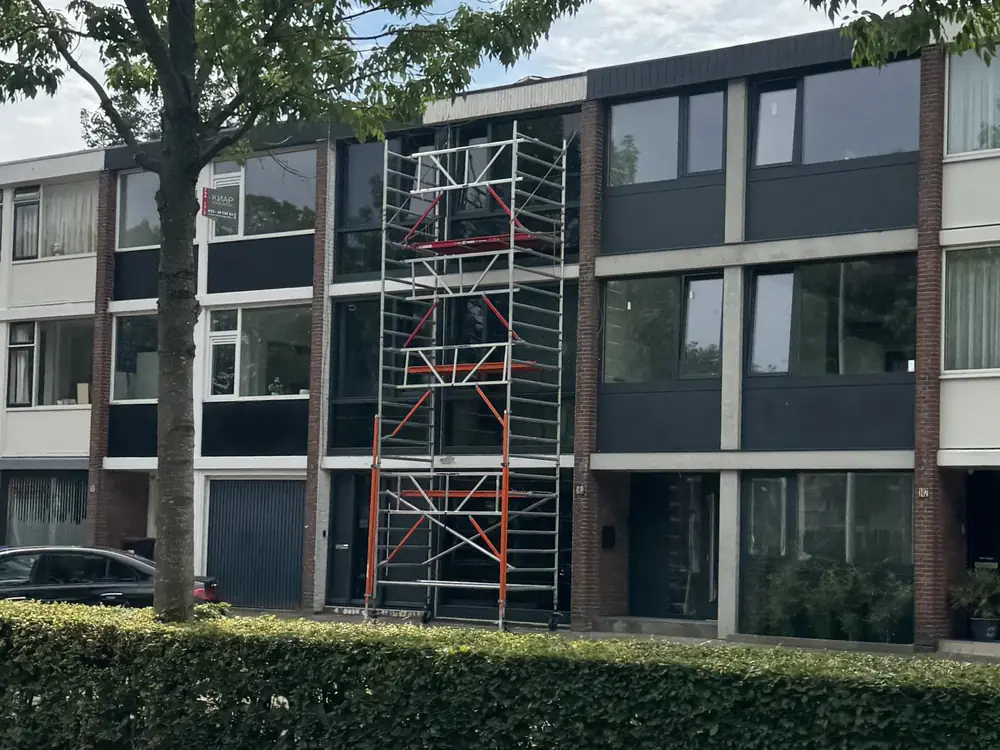
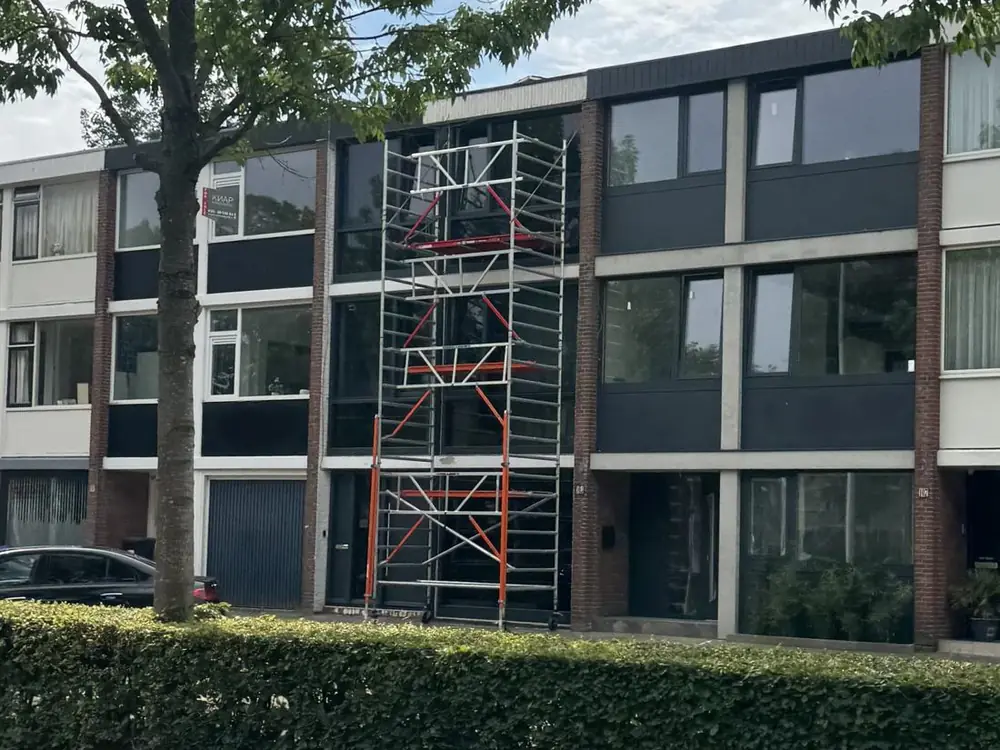
Tower built up to just below a roof trim on a house front, the reach a closing course of slips needs

Hiring tight gets paid back in the finished look. Work the upper rows with arms above your head and you press unevenly, so the joint width wanders row by row; sanding that out is impossible and cutting it out is not. Then that last half metre still costs you an extra stand, which is half a working day gone. Torn between two reaches on a wall with a storey above the ground floor, go up a lift rather than down one.

Hiring a tower: where the base and the pallets go

The strip along the bottom of the wall gets busier on this job than on any other kind of facade work. Four extended stabilisers live there, so does your tub of mixed adhesive, and so do the pallets you would rather not trundle about at every new stand. Keep a flat lane free along the wall that is wider on all sides than the build itself, and park the pallet beside your working area instead of squarely on the track you will roll along.

Before delivery day, look at where the castors will land. Block paving, concrete or a compacted gravel path carry weight fine; a border that softens after a shower does not. Watch the step between terrace and garden level, and everything that habitually stands against a house: water butt, cycle rack, outside tap and the one drain cover sitting exactly under a stabiliser foot. Clear that away first. On sloping ground, the approach to uneven surfaces helps.

Stabiliser legs reaching out around a tower base on paving, the footprint kept free of stored material

Set aside room for your mixing bucket and your cutting station as well. Infill pieces and corner slips get sized with a diamond blade, and that fine stone dust travels on the breeze, so do not put the bench directly under a neighbour's open window. If part of the build lands on public pavement, leave a walking route beside it and ask the council what is allowed there. Sort that out the week before you hire for fitting brick slips, not on the morning of your first adhesive day.

How many days to hire a scaffold for fitting brick slips

Once the bottom rows are down and your spacing is right, the adhesive work moves faster than most people expect. The days go before and after: checking and priming the background, marking out the rows, sizing corners and reveals and finally cutting all those infill pieces. For the front of an ordinary terraced house that lands you on three to four hire days, even though the tub is open for only part of that time and the sticking itself goes along briskly enough once you find the rhythm.

Pointing counts as a separate round here, and it is precisely that which stretches the period you book. Joints can only be filled once the adhesive bed behind the slips has cured, and how long that takes hangs on temperature and on how wet the wall was. In the meantime you leave the build standing, brakes on and stabilisers out, so afterwards you walk the same stands back along the wall. Erecting twice for one elevation is wasted time.

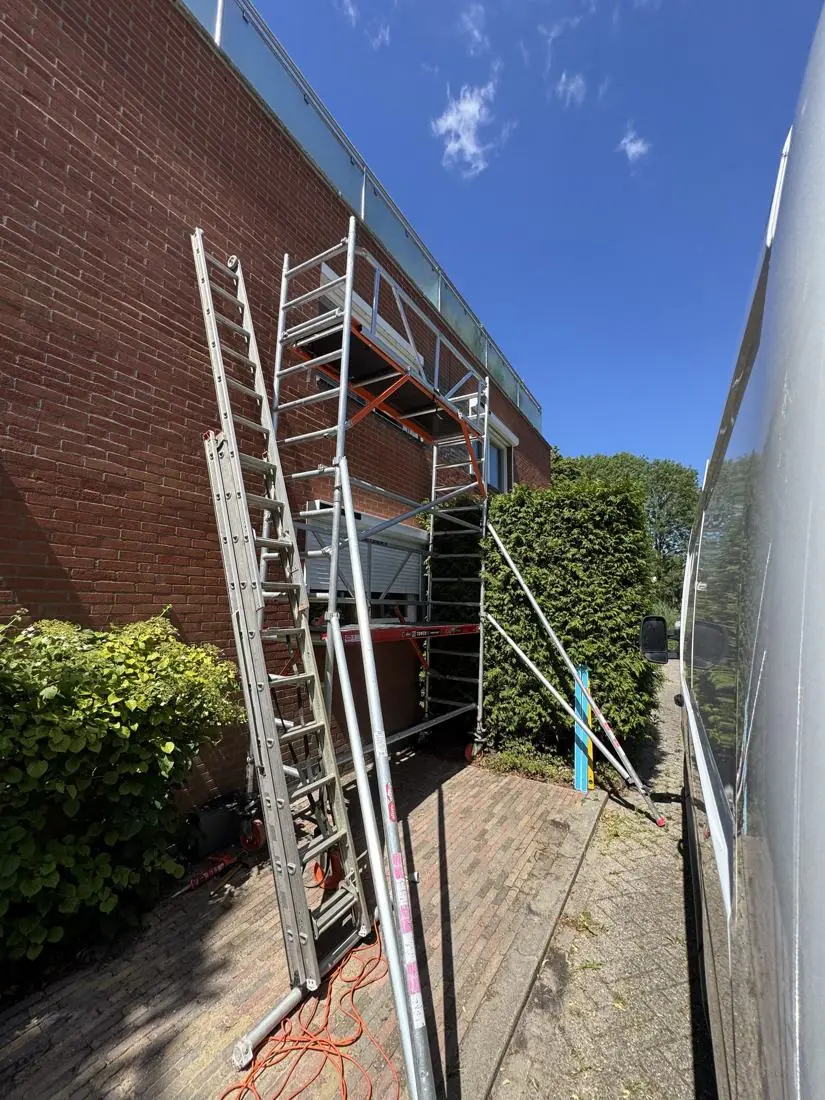
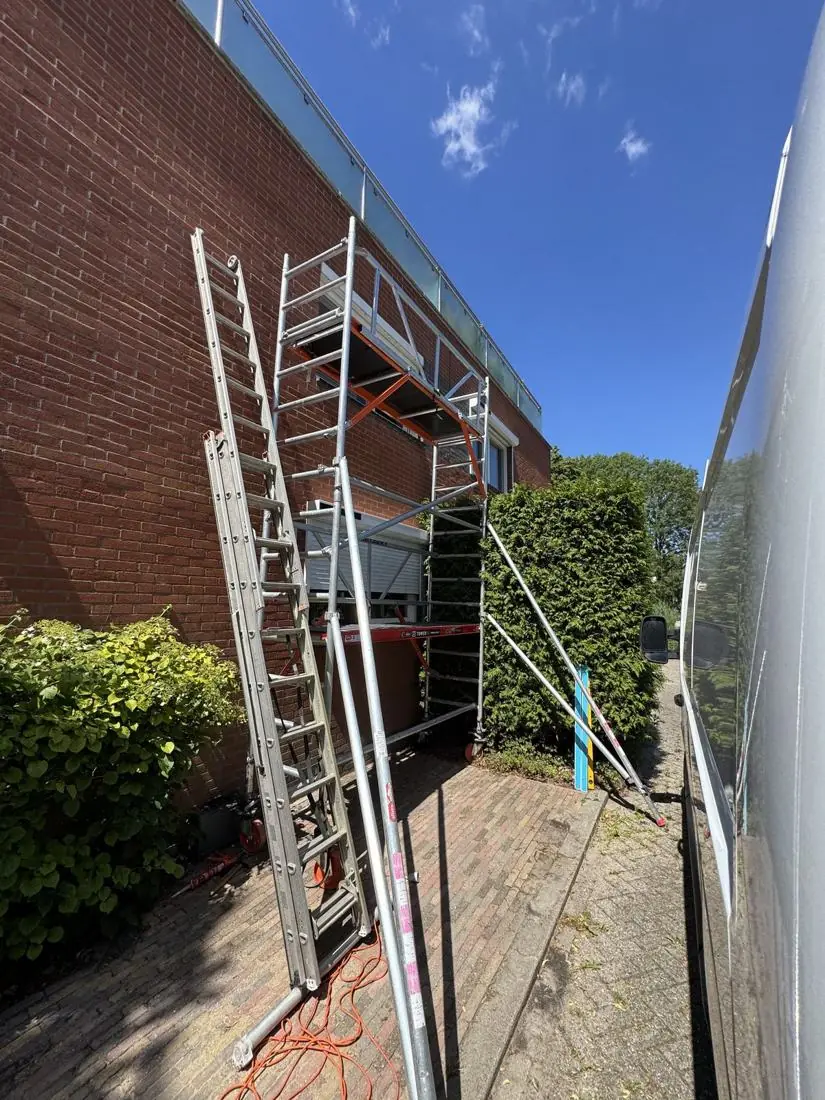
Tower positioned along the side wall of a house, where it stays between one stand and the next

Happily that waiting costs little. The opening twenty four hours carry the full tariff, and on each following day of your period 95 per cent of the price falls away, which makes slack for rain or a stubborn reveal barely noticeable in the total. So put your end date well behind the pointing round rather than on the afternoon the last slip goes into the bed. To sharpen that estimate, the guide to hire days per job helps.

Which mobile scaffold suits fitting brick slips?

Kamersteiger RS44
  • Working height up to 4 metres
  • Compact and narrow
  • Great for indoor and small jobs
View and calculate →
Most chosen
Smalle rolsteiger RS51
  • Working height up to 14.2 metres
  • Narrow (75 cm)
  • Ideal for narrow passages
View and calculate →
Brede rolsteiger RS52
  • Working height up to 14.2 metres
  • Wide platform (135 cm)
  • Extra stability and workspace
View and calculate →
1-persoons steiger MiTower
  • Working height up to 6.2 metres
  • Very compact
  • Quick and easy to assemble
View and calculate →

Fitting brick slips from a platform 245 cm long

A deck of 245 cm gives you a bay of a good two metres per stand. So do not set out your rows stand by stand; mark the whole division across the full elevation in one go, before the first slip touches the bed. Let the second stand wander by a couple of millimetres and the joint width visibly loses step where two stands meet. A line drawn on the wall stays put; a line on your deck board travels with you and helps nobody.

The open time of your adhesive decides how large a combed area may be. Never comb out more than you can cover inside that window, and keep the patches deliberately smaller in sun or in a drying wind. Corners and reveals come first: corner slips set the line for everything between them, and reveals around windows and doors need infill pieces you would far rather select dry than wet. Only once those fixed points stand do you fill the panels between them, so plan the corner stands into your day before the open runs.

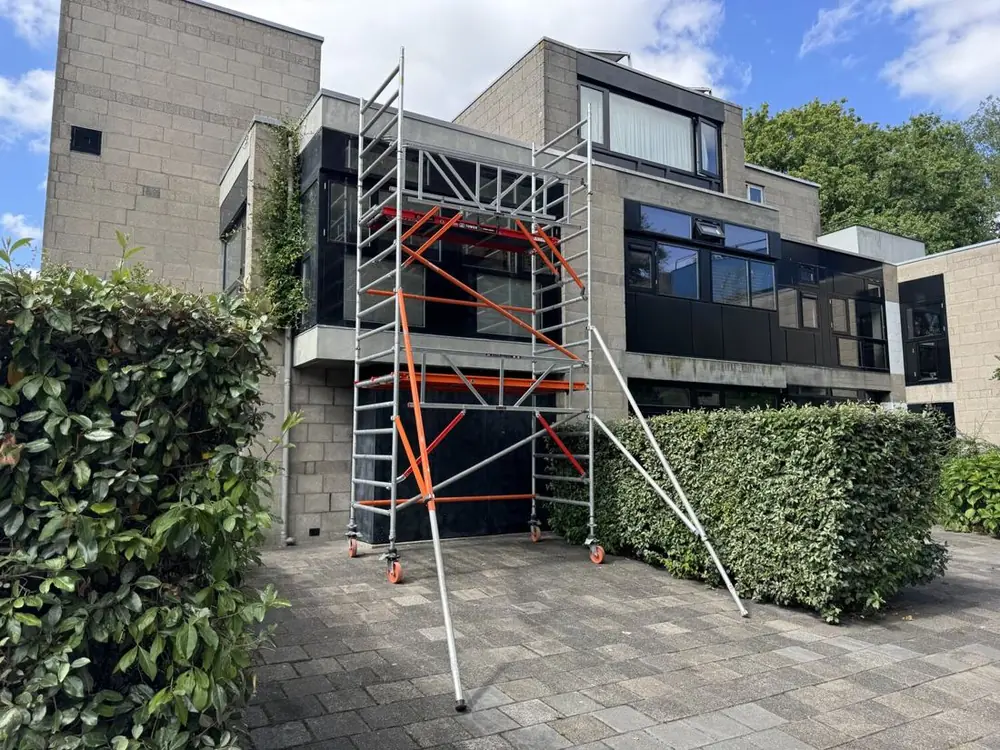
Mobile scaffold erected against a plain modern wall, one deck bay wide, the unit each stand covers

Finally, always carry slips up from several boxes at once. Shade varies from pack to pack, and emptying one pack before opening the next prints that change into the wall as a panel of another colour, right on the seam between two stands. Shuffle them together below and load your carrying box mixed. Fitting brick slips over a whole elevation is paced by the adhesive rather than by your own arms. Want to give the wall a water repellent treatment afterwards, plan it inside the same hire period.

Hired scaffold delivered in time for your first adhesive day

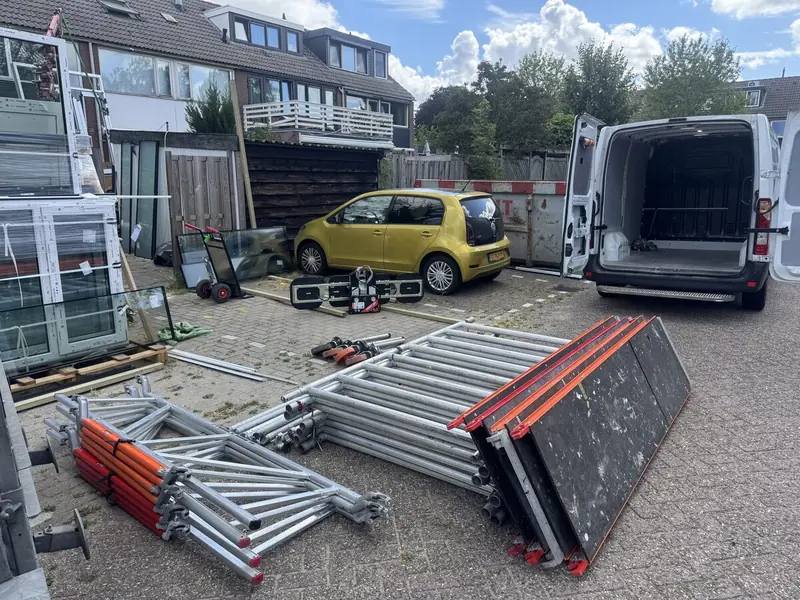
What gets dropped off is not a finished tower but a counted bundle of tubes, boards, braces and guardrails. Point out in advance where that bundle may land, because on this job your wall strip goes on pallets, tubs and a cutting bench. A corner of the drive you are not using serves better than the ground your boxes will need. Order before the 15:00 cut off on any weekday and the bundle stands on your ground when the next working day opens for business.

Arrival and departure dates go in the form yourself, and on a slip clad wall you match them to the thermometer rather than to the calendar. Adhesive and pointing mortar dislike frost, so look further ahead than your starting day alone. Better still, have the bundle brought a day before you begin: you assemble without rushing, hang your chalk line ready and start setting out first thing the next morning with nothing left hanging over you. Build it with the step by step assembly guide propped open beside you on a board.

Scaffold tubes and boards resting on the pavement outside a home, the bundle dropped off before assembly

With the pointing finished and everything taken apart, we come and fetch the load; you stack it complete and ready where the van can reach it. Anyone who would rather drive may collect a set by appointment at no charge from Zeeburgerpad 89, 1019 AD Amsterdam, though the longest pieces beat most cars and a trailer becomes essential. That is the practical reason people hire a mobile scaffold with transport included. Bringing and fetching is priced per province and listed with VAT in the delivery cost overview.

Working safely on the hired tower while fitting brick slips

A deck board carries two hundred kilos per square metre, a limit written into EN 1004 as load class 3. On slips that is not a paper number. A full box, a tub of mixed adhesive and a jerry can of water together weigh more than most people guess, and if somebody steps up beside you to pass material along you sit close to the line. So work with half boxes and accept one more trip up and down the ladder.

Brake the castors before your weight goes onto the first rung, and never roll anything while material or a person is still on the boards. If the wind gets up, stop: a closed elevation catches plenty of it and a tub starting to slide will take you with it. After each move, check all four stabilisers press firmly onto the ground again, because on block paving one of them always settles a little. There is more on this at the rules for work at height.

Guardrailed tower with its ladder set inside the frame, the access route climbed with both hands free

What can fall on this job is the slip itself. A piece of fired clay sliding off the edge lands hard, and an angle grinder on a taut lead will drag itself off your boards given half a chance. Tape a line off or set a cone out while anyone walks along the wall, and keep that zone empty. Wipe spilled adhesive away before it grabs: a cured lump makes your footing slippery and is still there on collection day.

In 5 steps

How hiring a mobile scaffold works

1
Choose working height

Pick the height that suits your job.

2
Book online

Sorted in 60 seconds, price shown instantly.

3
We deliver

At the agreed spot the next working day.

4
Assemble safely

Assembled by you, with a manual.

5
We collect

One call and we collect the scaffold.

Good to know

Practical tips for fitting brick slips

1

Strike your course spacing across the whole elevation with a laser or a chalk line before mixing the first tub. From the second stand onwards that line cannot be corrected without breaking whole rows out again.

2

Put the cutting bench on the windward side and well away from fresh work. Stone dust blowing back settles into wet adhesive and marks pale slips with a grey haze that will not brush off.

3

Finish the corner slips and the reveals around your window frames first. They set the line of every panel between them, and fitting a corner afterwards costs more hours than sticking a whole bay.

4

Carry slips up from three or four boxes mixed together. Empty one pack per stand and the colour variation between packs lines up exactly with the place where you repositioned the build.

5

Lay a sheet of plywood over the deck boards where the tub stands. Spilled adhesive scrapes off that easily, whereas cured material on the boards themselves causes trouble when the set goes back.

6

Give the pointing round a morning of its own rather than the tail end of an adhesive day. Pointing over slips that have not cured pushes them out of line, and you notice it once the elevation has dried.

Frequently asked questions

Frequently asked questions about fitting brick slips

Which mobile scaffold do you hire to clad a wall in brick slips?+

For two storeys the RS51 is the right tower for fitting brick slips, with a build width of exactly 75 cm. That lets you slip past a gate and along a garden path where wider builds snag, and up top the slim figure barely registers, since you work the wall at arm's length anyway. If somebody hands boxes up from below while two of you stay aloft, the 135 cm RS52 becomes the better hire. Measure your narrowest opening first, because that is where it goes wrong.

How does hiring a scaffold for a slip clad elevation work?+

You start from the height of your closing course, since that decides which build you click on. Then you pick a delivery day and a collection day, after which the amount appears on screen with VAT included. On the agreed morning the parts lie ready; you raise the tower yourself, then clad the wall and point it. On the final day of your hire everything goes back dismantled and counted. The only fixed moment in fitting brick slips is the adhesive curing before pointing starts.

Fitting brick slips: how many hire days does a front elevation need?+

For the front of a two storey house reckon on three to four days on hire. Setting out, priming and sizing corners eat more hours than the sticking does, and behind all that comes the pointing round, which starts only once the bed has cured properly. Take in a side wall or the reveal of a bay window and add a day straight away. That extra day weighs lightly and stops you leaving a panel half finished.

How is the rental price built up for a slip clad front?+

The rental price comes out of the version you choose together with the build height, and the run out and back within your province is added to it. Every tariff appears with VAT included at the current rates for our towers, so nothing unexpected turns up at the checkout. Your opening twenty four hours take the weight, and everything booked behind that barely moves the total at all. One generous period therefore beats two separate bookings.

What working height do you hire to lay the top course of slips?+

A pair of storeys sits inside the 6 to 8 metre range, with the deck itself four to six metres up. Measure from the level where the tower will stand on its castors to the top of your closing course, so to the capping trim and not automatically to the gutter above it. If an overhang projects, let that count too. Which build suits which reach is shown on the page listing every working height used at booking.

Do you have the tower delivered or collect it from the hire depot?+

Both work, though having it brought suits this job best. You choose your own delivery day, so let the bundle arrive the day before you set out your rows. That way you assemble the tower calmly and start the next morning on a dry wall with the build already standing. Driving yourself stays possible; the snag is that eight metres of parts defeat a family hatchback, so a trailer becomes the minimum.

Is putting it up part of the hire for fitting brick slips?+

No, that piece of work sits on your side of the arrangement. We put the tower down with you as a loose, counted set and take it away again afterwards; assembling, rolling and stripping it down is yours to do. With two people and the film running you are busy for a couple of hours, and you simply write that session into the plan. Neither system scaffolds nor cherry pickers are stocked, so a tower answers this.

What if the cutting overruns and you want the tower on hire longer?+

Tell us early enough and the collection date slides back, unless that particular set already has another customer waiting on it. With slips this happens regularly, because corner pieces and infills take more cutting than anyone budgets for and adhesive cures slowly in the cold. To remove the risk, count an extra day in when you reserve. You set the return date, and handing a tower back early is never a problem, so a generous margin pays.

How much clear space does the hired build need round its feet?+

Reckon on the build width plus the swing of your stabilisers on both sides, then add room for pallets, the tub and the cutting bench. Usually that means a flat, obstacle free lane a couple of metres wide along the brickwork. If a water butt, a cycle rack or a shed blocks that strip, move them before the tower arrives. Shuffling boxes around mid job easily costs an hour of a hire day, and you miss that hour at the end.

What happens on your hire days if it freezes or rains?+

Adhesive and pointing mortar want dry weather above a certain temperature, so in frost or steady rain you stand the work down. Your tower may stay up in the meantime, brakes applied and every stabiliser still bearing. Spend a day like that checking the background, pre cutting infill pieces or verifying your spacing. Because you decide the date the build goes back, shifting a working day usually costs no more than one day of hire.

How does the deposit work over a hire period like this one?+

Alongside the hire charge you settle a deposit. That sum returns to you within one working day of the set arriving back and being counted complete onto the racks. With slips two things matter: hand every part back, and leave no cured adhesive or pointing mortar on the tubes and boards. A sheet over the boards while you hire saves scraping on collection day. The rest is in the explanation of your deposit.

Does the hired tower stay up between the sticking and the pointing?+

Yes, and you size your hire period around exactly that. The tower stays put while the adhesive bed cures, so you walk back along the wall from precisely the same stands to point it. That saves setting out again and spares you a second round of erecting. Anyone taking a tower on hire for fitting brick slips books the pointing round into the same period. Do clear loose boxes off the boards whenever you stop, certainly if wind is forecast overnight.

Hire a mobile scaffold for fitting brick slips today?

Calculate your rental price now or ask for free advice.

Rolsteiger van SteigerTaxi geleverd op locatie
Book it online

Your scaffold sorted in 2 minutes.

Choose your scaffold and working height, see the price instantly and book online.