
See your price
Application

Insulating a facade? Choose the right scaffold.

External wall insulation changes the dimensions of your house. A package of boards goes onto the existing brickwork, a reinforcing layer over that and finally the render, and together they build out a hand's breadth. That thickness is exactly what decides where your tower ends up. For a house of two storeys you hire a slim mobile scaffold of 75 cm, built between 6 and 8 metres, with deliberate air between deck and wall. Below you will find which model suits, how many rental days to allow and where the build ends up standing.

  • Order before 3 pm, delivered tomorrow
  • Professional Altrex scaffolds
  • Up to 14.2 metres working height
  • Easy to assemble yourself
4,2 tot 14,2 mWorking heights available
12Provinces served
7Days a week
200 kg/m²Load class 3
In short
  • For insulating a facade we recommend the Narrow mobile scaffold.
  • To insulate a facade over two storeys you hire the RS51 of 75 cm, put up between 6 and 8 metres.
  • Stand the tower further off the wall than you are used to, because the insulation package comes between you and the brickwork.
  • Count on a generous rental period, since adhesive, fixings, reinforcing and finishing follow one another with curing time between every layer.
  • First 24 hours from €150 incl. VAT and delivery; every day after that 95% off.
Key facts for this job
FeatureValue
Recommended scaffoldNarrow mobile scaffold (Altrex RS TOWER 51)
Working height for this job6 to 8 metres
Available working heights4.2 to 14.2 metres
StandardEN 1004, load class 3 (200 kg per m²)
DeliveryOrdered before 3 pm, delivered next working day
Each extra day95% off, from €7.50 a day
Why a mobile scaffold for insulating a facade?

Safe, stable and professional work at height

Insulating a facade is work with bulk. A board weighs little but catches a lot of wind, a bucket of adhesive mortar is heavy and has to go up as well, and both must stay within arm's reach while you work against the wall with two hands. On top of that you cannot stand tight against the brickwork, because the package you are fitting takes up that room. A ladder is out on both counts, and a tower standing too close jams the moment the first row of boards hangs. Hire a mobile scaffold for insulation and the whole choice turns on keeping your distance, on a slim frame you move often, and on rental days for every layer.

  • Insulation boards catch the wind like a sail
  • The tower stands off the wall on purpose
  • A build to six or eight metres of reach
  • Adhesive, boards and render in several layers
Read more about working safely →

Which mobile scaffold to hire for insulating a facade

The Altrex RS51 is the slim version in our fleet: 75 cm across, and in its heaviest form this model climbs on to 14.2 metres of working height. For insulation over two storeys you stay well under that with a build of 6 to 8 metres. Narrow works in your favour here, because the delivery route usually runs along a path beside the house, and with a board under your arm you would rather not share that passage with a broad base.

There is a second reason to keep the frame small. On this job you deliberately set the tower some way off the wall so the insulation package fits in between. Every centimetre the build is wider pushes the feet further into the garden or the pavement. On the deck of 245 cm you will not lay down more than a bucket of adhesive, your notched trowel and a knife anyway, since boards stay below and go up one at a time.
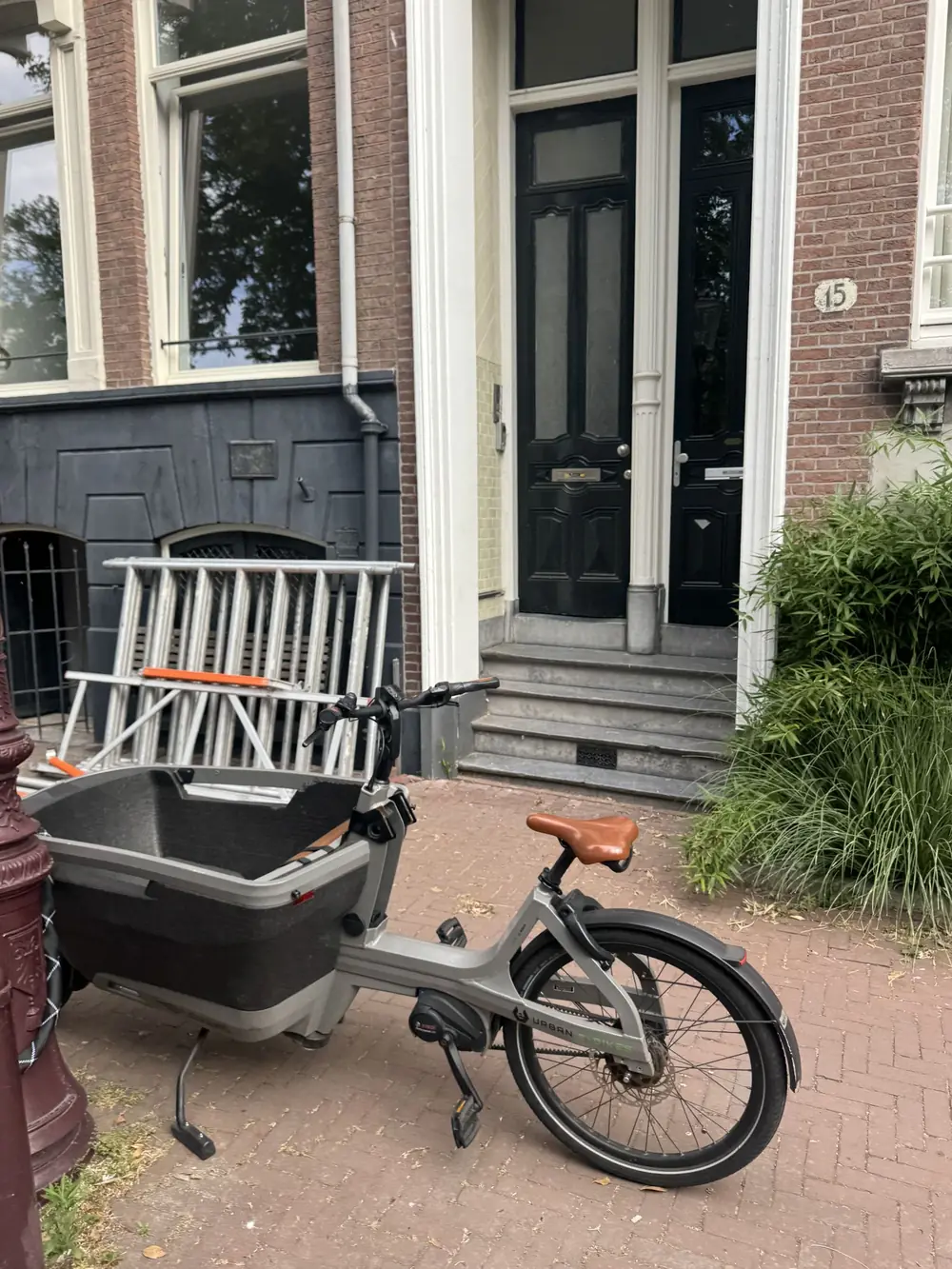
Frames on the pavement against a house, the slim RS51 kit carried along a side path only 75 cm wide

You only hire the wide RS52 of 135 cm when two people stand on the deck together and you want to pull the reinforcing layer in one continuous movement. That saves joins in the mortar, but it costs you room at the foot and it makes moving slower. Anyone working alone gets further with the slim one, and moves it in half the time. Which build belongs to which model you can read back on the page about hiring mobile scaffolds.
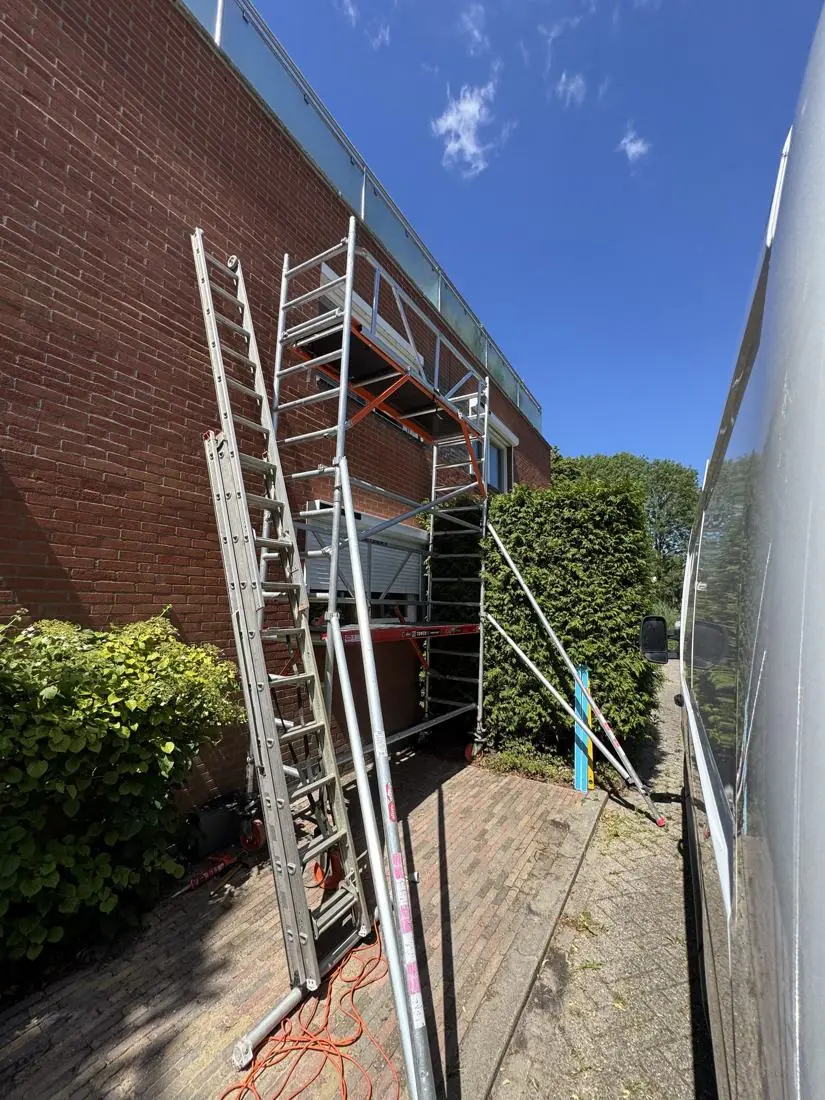
Choosing the working height when you insulate a facade

The highest point of an insulation job is where the top row of boards meets the roof edge or dies into the soffit. That is what you measure to, and not the ridge. Above the deck you still work about two metres comfortably, so a wall finishing at seven metres asks for a platform around five. That small sum settles which build you state when you hire and how many frames end up being delivered to you.

Measure from the lowest place where you still fit insulation, not from the floor indoors. The start profile often sits well below ground level or just above the plinth, and in a garden falling away towards the fence that zero differs per side of the house. Take the side with the biggest fall as your starting point, because thirty centimetres at the foot costs you exactly those thirty centimetres at the top. The build to match is laid out at eight metres of working height.

Side elevation with a mobile scaffold erected beside it, up to where the top row of insulation boards will finish

Choose too tight and you get stuck at precisely the awkward part. The top row of boards has to be fitted round the roof edge, with a closing profile and sometimes an adapted soffit finish, and that is work you want to do at eye level rather than with your arms above your head. Reckon too that this top row asks for the most cutting and fitting. In doubt on a wall of two storeys, sit a notch higher.

Hiring a scaffold for facade insulation: the place and the gap

The first question on an insulation job is not where the tower stands but how far off the wall it stands. Measure the thickness of your boards, add the reinforcing layer and the render, and keep a workable hand's breadth on top of that. That sum is your gap. Set the build closer and halfway through the first row of boards you are pressing your knees against your own insulation, and the lot has to be done again.

Because of that you need more ground at the foot than on other facade work. The four stabilisers stand further out than the base itself, and that spread comes on top of the gap you just measured. Around a house that often means borders, a bed of shrubs or a garden path have to give way for a while. On grass or loose soil put road plates or stout boards under the wheels; how that works sits in the explanation about an uneven surface.

Splayed stabilisers under the base of a mobile scaffold, the spread that comes on top of your gap when insulating

Think about storing your boards as well. They are light, large and sensitive to wind, so a loose stack behind the tower blows across the garden at the first gust. Lay them flat, out of the wind and covered, within walking distance of the build but outside the zone the stabilisers claim. The same goes for the bags of dry mortar, which must catch no rain while you are working. Do not put the stack directly under your position either, since everything you drop lands there.

How many rental days insulating one facade takes

An insulated wall comes about in layers that wait for one another. First the start profile is set and the boards are bonded, then the fixings once the adhesive grips, next the reinforcing mortar with mesh, then a base coat and finally the finish. Every step has its own waiting time, and that waiting runs on whether you are up on the tower or not. For one elevation of two storeys you therefore reach five to eight rental days quickly. Budget three and you will certainly be squeezed.

The weather stretches that period further than on dry work. Fresh mortar wants no frost, no driving rain and no full midday sun, because in all three cases the layer dries or sets wrongly. In spring and autumn almost every insulation job therefore slips once. So plan your rental period not around the days on which it just about fits, but around a block in which you can absorb a couple of setbacks without redoing your whole schedule.

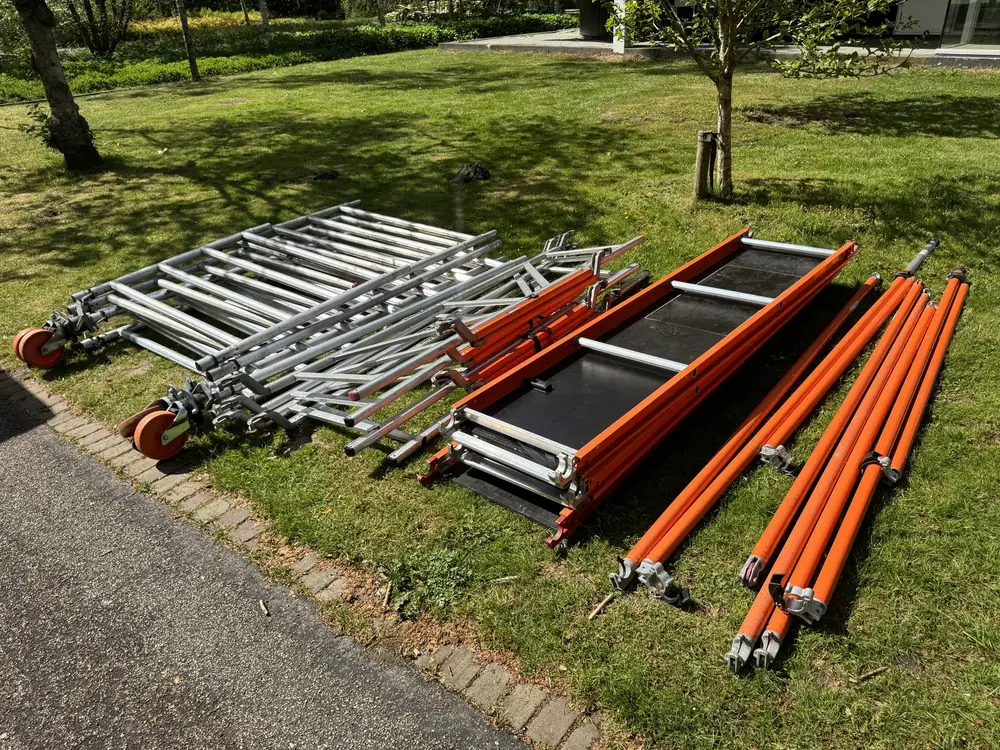
Loose scaffold parts set down on the grass by a house, ready for the build you insulate the wall from

Happily an overrun barely shows in what you pay. Only the opening twenty four hours carry the full rate; from there on ninety five per cent drops off every rental day that follows, which puts a fortnight far closer to a single week than you would expect. For insulation that is exactly the right nudge: better to book generously than to hunt for an extension halfway through the reinforcing layer. More on this sits in the comparison between hiring by the day or by the week.

Which mobile scaffold suits insulating a facade?

Kamersteiger RS44
  • Working height up to 4 metres
  • Compact and narrow
  • Great for indoor and small jobs
View and calculate →
Most chosen
Smalle rolsteiger RS51
  • Working height up to 14.2 metres
  • Narrow (75 cm)
  • Ideal for narrow passages
View and calculate →
Brede rolsteiger RS52
  • Working height up to 14.2 metres
  • Wide platform (135 cm)
  • Extra stability and workspace
View and calculate →
1-persoons steiger MiTower
  • Working height up to 6.2 metres
  • Very compact
  • Quick and easy to assemble
View and calculate →

Fitting insulation boards from a working deck of 245 cm

One set up puts a strip of wall of a good two metres in front of you, the length of the 245 cm deck. Insulation boards are laid in half bond, so your rows run on across the edge of that strip. Work each set up over its full height and let the side of every row end deliberately ragged, so the next strip drops neatly into it. A straight cut vertical joint over the whole height of the wall is precisely what you do not want.

Boards go up singly, not as a stack. Someone below hands them over, you take them and bed them, and that rhythm sets how fast you get on. Move with an empty deck: take the bucket, the trowel and the loose boards off before you release the brakes, because half a pallet aboard makes the build top heavy. On the reinforcing layer, plan the move at a natural stop in the mortar, and put the brakes back on before you pick up the first board.

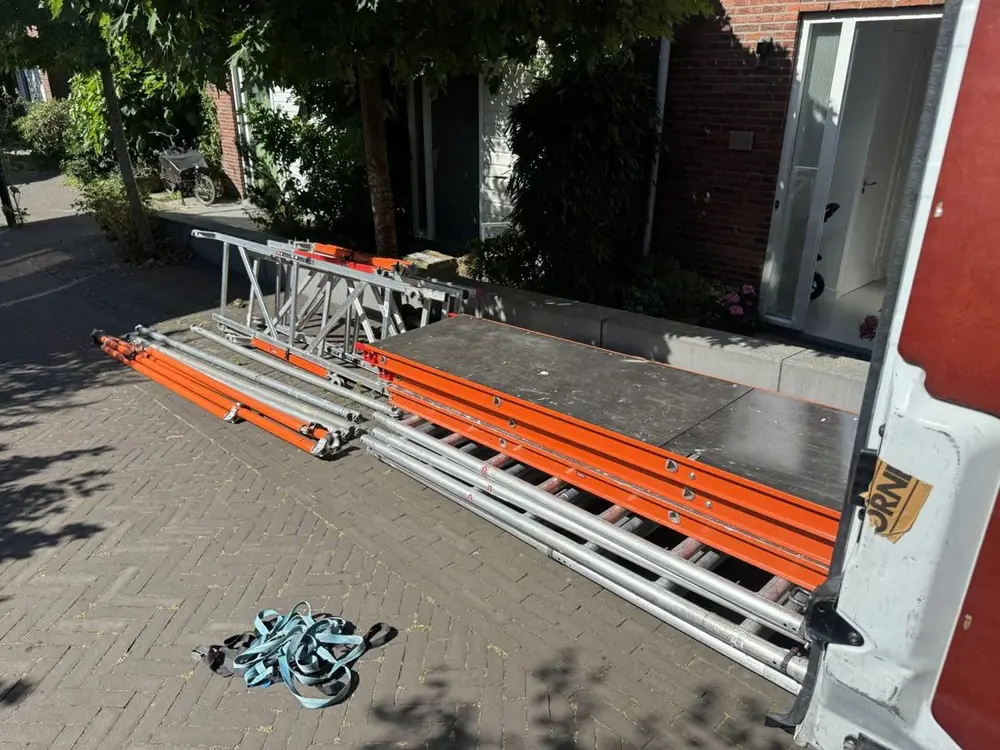
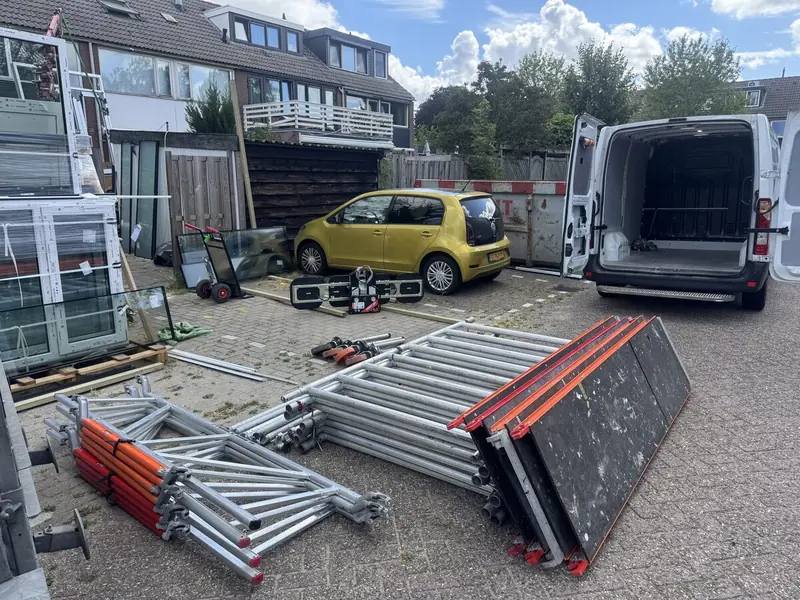
Platform sections, tubes and orange braces unloaded on the street beside a van, together making the 245 cm deck you hire

What holds insulation up is not the flat fields but the edges. Window reveals, sills, the junction at the meter cupboard and the passage of your downpipe each cost more time than a whole row of boards. Count those places separately in your planning and set your positions so you can reach them easily. Keep a separate stock of narrow strips and profiles for them too. If you go on to apply the render, you use the same division.

Hiring a mobile scaffold with delivery for an insulation job

A complete, counted set of parts arrives with you; erecting belongs to your side of it and happens with the printed manual and the video to hand. Find a spot for that stack in advance which does not clash with the pallets of insulation material, because both want room and the boards must not end up under the tubes. Whatever is booked on a working day and lands with us before 15:00 goes onto the van for the next working day, so planning far ahead is not needed.

Which date the set pulls up and which date it goes away again are yours to fill in, and for insulation work you tune that to your material. Let the scaffold parts come before the boards are unloaded, then the build already stands when the lorry with insulation arrives and you need not thread between two stacks. Half a day between the two deliveries is enough for that. Look at the outlook while you do: a week with night frost or steady rain is no week to start in.

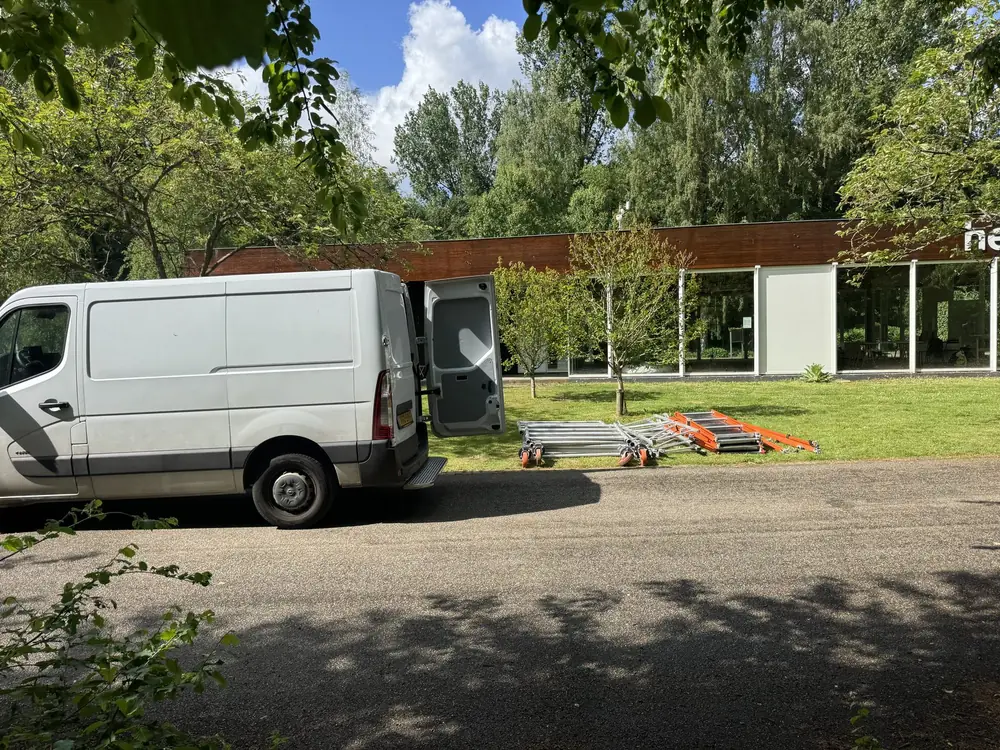
Delivery van with scaffold material at a house, the load you have arrive before the pallets of insulation boards

At the end of your job we collect the set again, and you take it apart into loose parts on the spot where they were delivered. Do not do that on the day the last coat of render is still wet, because a knocked corner means repainting a wall that had just been finished. Plan the dismantling a day later. What you pay for bringing and collecting differs per province and is stated at the cost of delivery.

Working safely on a hired tower with wind and boards

Load class 3 under EN 1004 caps what a square metre of deck may carry at 200 kg. On insulation work you reach that sooner than when painting, because adhesive mortar is heavy and buckets pile up. Add yourself, your helper, two full buckets and a tub of reinforcing mortar together and you sit higher than expected. What that class means for what you load sits in the explanation about weight on a mobile scaffold.

On this job the wind is the boss of your planning. An insulation board is in effect a sail, and that becomes true the moment you pick it up to set it on the wall. If it freshens, put the work down and store the loose boards rather than carrying on. Otherwise the ordinary rules stand: block the wheels first and only then go up, never roll the build along while anyone or anything is still aboard, and check the four stabilisers again after each move.

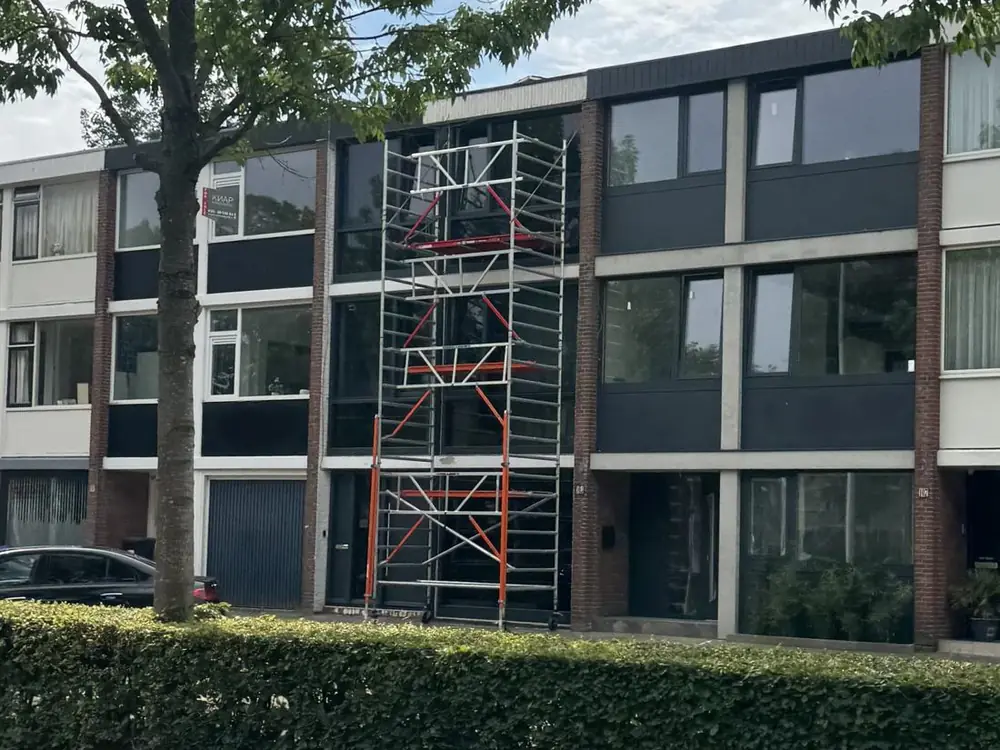
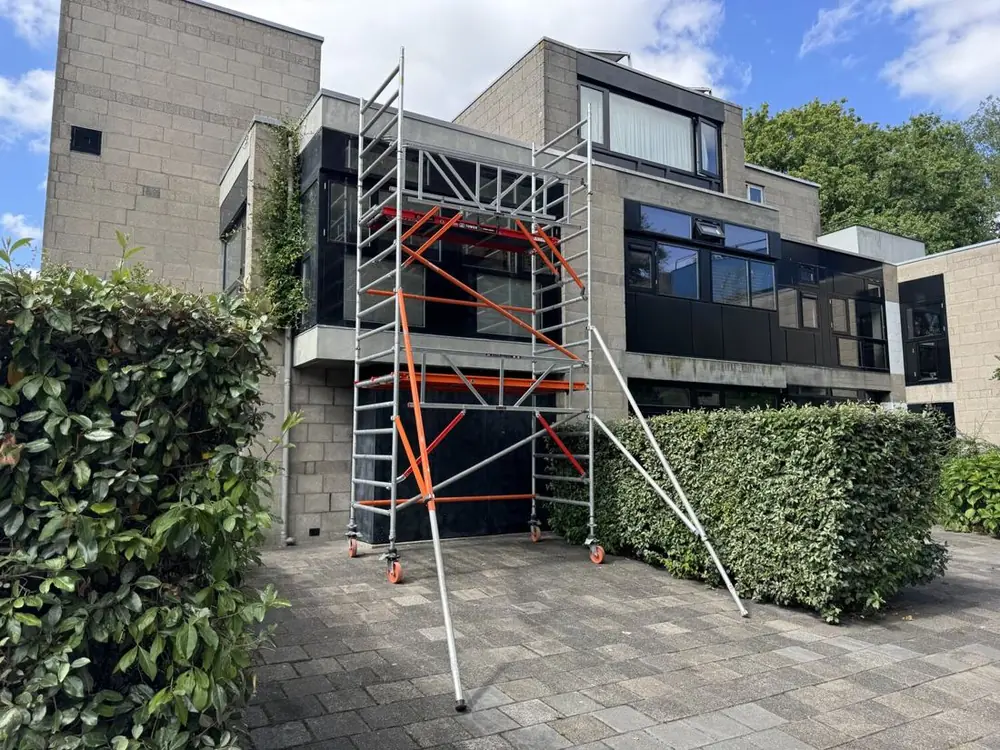
Mobile scaffold with guard rails erected in front of a facade, the build you leave empty when the wind freshens

Under the tower it is busier on insulation work than on other facade jobs. Someone stands handing boards up, bags of mortar lie about and an extension lead runs to your mixer. Keep that zone tidy and never work above anyone's head while cutting, because a trimmed strip of board comes down without warning. Agree that your helper steps back the moment you let go of something, and collect offcuts in a bucket. The full rules of use sit at the requirements for working at height.

In 5 steps

How hiring a mobile scaffold works

1
Choose working height

Pick the height that suits your job.

2
Book online

Sorted in 60 seconds, price shown instantly.

3
We deliver

At the agreed spot the next working day.

4
Assemble safely

Assembled by you, with a manual.

5
We collect

One call and we collect the scaffold.

Good to know

Practical tips for insulating a facade

1

Measure the thickness of your insulation package before you position the tower and chalk the gap onto the paving. Moving along afterwards then happens without you standing there estimating again each time.

2

Put one person permanently below to hand boards up. Anyone climbing up and down for every board loses half an hour per bay and knocks into fresh adhesive far more often.

3

Cut the boards that have to fit around frames and reveals to size on the ground. Working up on the tower with a long knife costs time and leaves you crooked edges.

4

Store loose boards away the moment you stop working, even during a short break. They are light enough to disappear over the neighbours' fence in a single gust of wind.

5

Keep the base and the wheels clear of adhesive mortar. Dried mortar on the tubes costs you time on handing back and can cause argument when the hired set is counted.

6

Book your period as one unbroken block instead of loose pieces per work phase. Curing time runs on, and dismantling in between and building again costs more than the extra days.

Frequently asked questions

Frequently asked questions about insulating a facade

Which mobile scaffold should I hire for insulating a facade?+

On a house of two storeys the RS51 at 75 cm is the logical tower. You deliberately set the build a good way off the wall here, and a slim base then keeps the feet inside the garden or the pavement. On top of that this profile gets you past a gate or a side path to the back wall. Working the reinforcing layer with two people, you might consider hiring the wide version, though moving gets slower.

How does hiring a scaffold for facade insulation work step by step?+

Online you pick the model and the build, after which you enter yourself on which day everything should come and when it may go again. The rates are fixed with VAT already counted in. On the chosen date the parts lie waiting, you erect the mobile scaffold and insulate your wall in layers, and at the close you stack it all back complete on the drop off spot. Do not forget to tune your material delivery to that same schedule.

How many days must you hire for insulating a facade?+

For one wall of two storeys you usually sit between five and eight days, and for insulation right round a whole house that grows to two or three weeks. The reason lies not in placing the boards but in the waiting between bonding, fixing, reinforcing and finishing. Add the dependence on weather to that. Hire the tower per block rather than per working day, and nothing in your schedule has to be shifted along the way.

How does hiring work out on a long insulation job at the wall?+

What the rental price becomes depends on the model and on the scaffold height, with bringing and collecting per province on top. All the amounts stand together, VAT included, on the page with the rates. On a long job like insulating the structure falls out well: after the opening day the following ones weigh only lightly, so three weeks is nowhere near three times the cost of one. That makes booking generously sensible here.

Which working height should you hire to insulate a wall of two storeys?+

Count on 6 to 8 metres, depending on where the insulation package stops at the top. If it runs through against the roof overhang, you need the upper half of that range. Take into account as well whether a closing profile still has to go along the roof edge. Measure from the start profile at the bottom to the highest row of boards. You see the matching scaffold build on the overview of working heights.

Must I have the scaffold delivered if I also have insulation material coming?+

You need not, but it is handy. With delivery you choose the date yourself, and you then let the scaffold parts arrive a day before the pallets of insulation boards, so the build already stands. Fetching it yourself is allowed too: by arrangement the set waits at no cost in Amsterdam, on Zeeburgerpad. Bear in mind only that on such a day your van is probably already full of building material for the wall.

Do you erect the tower, or does that belong to the hire?+

No, putting it up and taking it down falls to you. You get the build order on paper and there is a video that demonstrates every step; two people have enough in a morning at this height. Plan that morning before the day you start bonding. Scaffolding fixed to the wall, system scaffolding and cherry pickers fall outside our range, so for insulation on this scale the mobile scaffold stays the answer you need.

Can I hire for longer if the insulation is halted by the weather?+

Yes, pass the new return day on the moment you see it will not work out, and the arrangement shifts with you as long as no other customer is waiting on the same tower. On facade insulation that happens regularly, because frost and driving rain hold the mortar up. Anyone wanting to cover that plans a couple of spare days from the start and keeps an eye on the outlook.

How much room must be clear around the place where you hire the tower?+

Add up three things: the width of the base, the room the stabilisers claim left and right, and the gap you deliberately leave to the wall. On insulation the place for your boards and your mortar comes on top. In an average back garden that means shifting furniture, planters and sometimes a stretch of planting before the mobile scaffold is delivered. Walk the route to the back once beforehand with a tape.

Is it blowing too hard to insulate, and may the hired tower stay up?+

The scaffold may stay standing as long as it is properly stabilised and nothing lies loose up top. You do put the work itself down in a stiff wind, because an insulation board acts as a sail the moment you lift it. Use such a day to prepare indoors or to cut boards to size. Since you keep the return day in hand, a lost day costs you one extra rental day at most.

What happens to the deposit after a hire period for insulation work?+

You put down a deposit at the reservation, and what you leave is returned a single working day after the tower comes back and the count tallies. On insulating you watch above all for mortar residue: dried adhesive on the decks and tubes of the hired build has no business being there on handover. Cover the build where you stand with the tub. How that is settled is in the explanation about settling up afterwards.

Must I move the hired tower before the adhesive on the boards is hard?+

Rather not. As long as a row of boards is freshly bonded you do not want to shove past it with a rolling scaffold, because one knock shifts the whole row. So work each bay over its full height, let the adhesive grip and only move afterwards. That rhythm helps decide how many rental days you need, since you cover fewer metres a day than on dry facade work. Plan the move at the end of your working day.

Hire a mobile scaffold for insulating a facade today?

Calculate your rental price now or ask for free advice.

Rolsteiger van SteigerTaxi geleverd op locatie
Book it online

Your scaffold sorted in 2 minutes.

Choose your scaffold and working height, see the price instantly and book online.