
See your price
Application

Applying facade render? Choose the right scaffold.

Applying facade render is work against the clock. The material is wet, stays workable only for a limited time and has to be spread across a whole bay in one continuous movement, or you will see later exactly where you stopped. Your scaffold has to fit that. On most houses it comes down to a narrow mobile scaffold of 75 cm, in a build reaching 6 to 8 metres, so that per stand you can finish a complete bay top to bottom without adding sections or rolling anywhere.

  • Order before 3 pm, delivered tomorrow
  • Professional Altrex scaffolds
  • Up to 14.2 metres working height
  • Easy to assemble yourself
4,2 tot 14,2 mWorking heights available
12Provinces served
7Days a week
200 kg/m²Load class 3
In short
  • For applying facade render we recommend the Narrow mobile scaffold.
  • For applying facade render you hire the narrow RS51 of 75 cm, which shifts quickly from one bay to the next.
  • The 245 cm platform sets the width of your bay: that goes on in one pass, working downwards.
  • With 6 to 8 metres of reach you make the top edge without adding a lift halfway through a bay.
  • First 24 hours from €150 incl. VAT and delivery; every day after that 95% off.
Key facts for this job
FeatureValue
Recommended scaffoldNarrow mobile scaffold (Altrex RS TOWER 51)
Working height for this job6 to 8 metres
Available working heights4.2 to 14.2 metres
StandardEN 1004, load class 3 (200 kg per m²)
DeliveryOrdered before 3 pm, delivered next working day
Each extra day95% off, from €7.50 a day
Why a mobile scaffold for applying facade render?

Safe, stable and professional work at height

With facade render the working life of your material sets the pace, and the scaffold has to keep up with it. The moment you stop halfway across a bay to add a section or to roll the stand along, the edge of your last pass is already stiffening and the join stays visible. So here you hire a scaffold that lets you finish a bay from top edge to bottom edge in one go, with room on the floor for a bucket and a hawk, and with a mixing spot close by at ground level. Hiring a mobile scaffold for applying facade render therefore mostly means fixing your bay layout first and matching the height and the number of hire days to it.

  • Wet material with a limited working life
  • One complete bay finished per stand
  • Join lands on a corner or a downpipe
  • Working height 6 to 8 metres for the top edge
Read more about working safely →

Which mobile scaffold to hire for applying facade render

For applying facade render on a two-storey house you generally choose the RS51, the narrow Altrex at 75 centimetres wide. Your mixing tub stays on the ground anyway, so up top you only need room for yourself, a bucket and the hawk you work from. What the narrow version mainly buys you is speed between bays: fewer parts, less weight and a stand that two of you have moved sideways in a couple of minutes. Every model sits beside the others in what our hire fleet offers.

The wide 135 centimetre version comes into view if you want two people on the floor at once, say one laying on and one working the texture in before the bay tightens up. On that kind of job the extra walking room genuinely counts. The price you pay for it is a stand that will not pass everywhere, so measure your route to the wall. Both widths appear with their measurements in this overview of scaffold sizes.
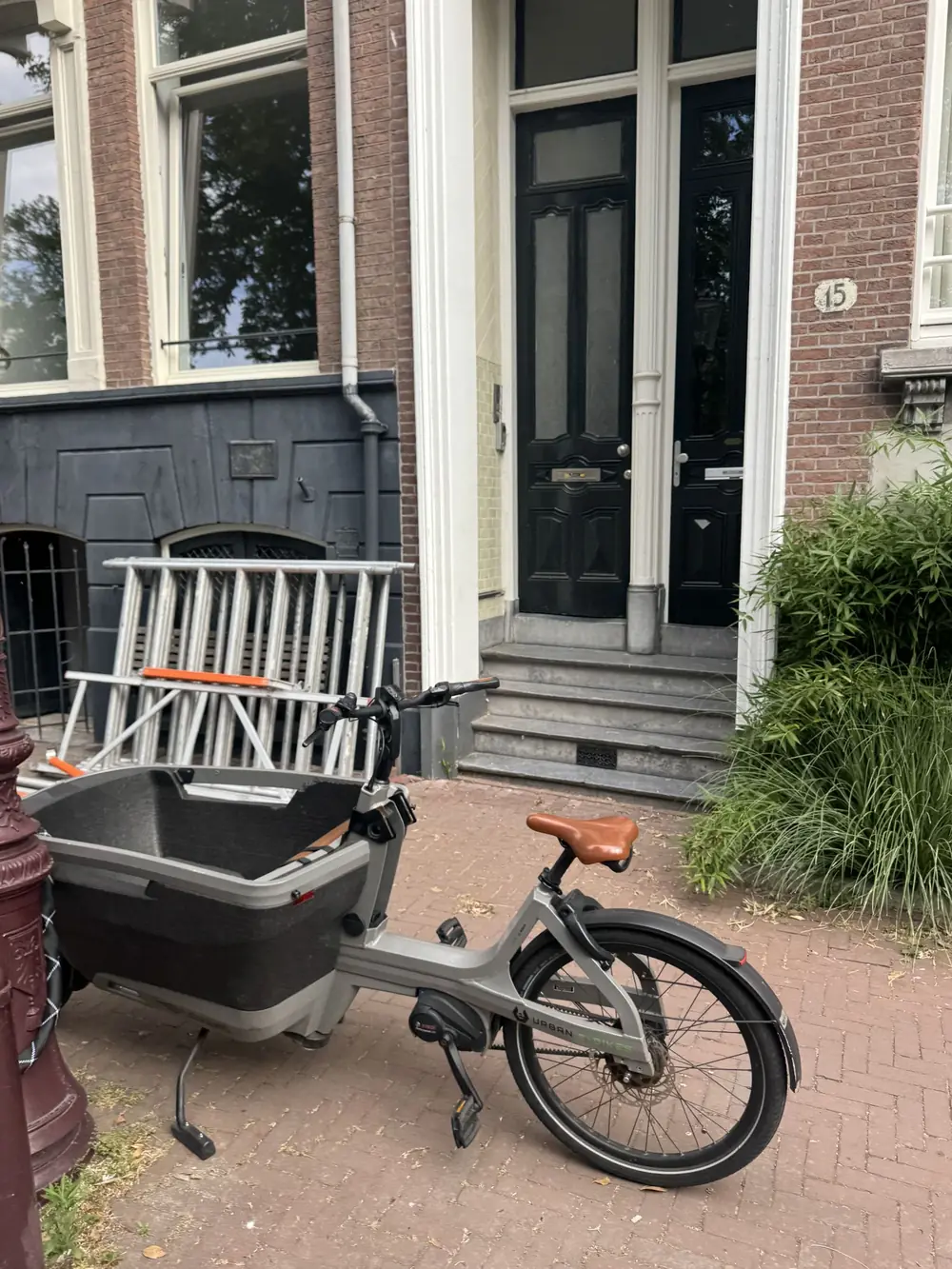
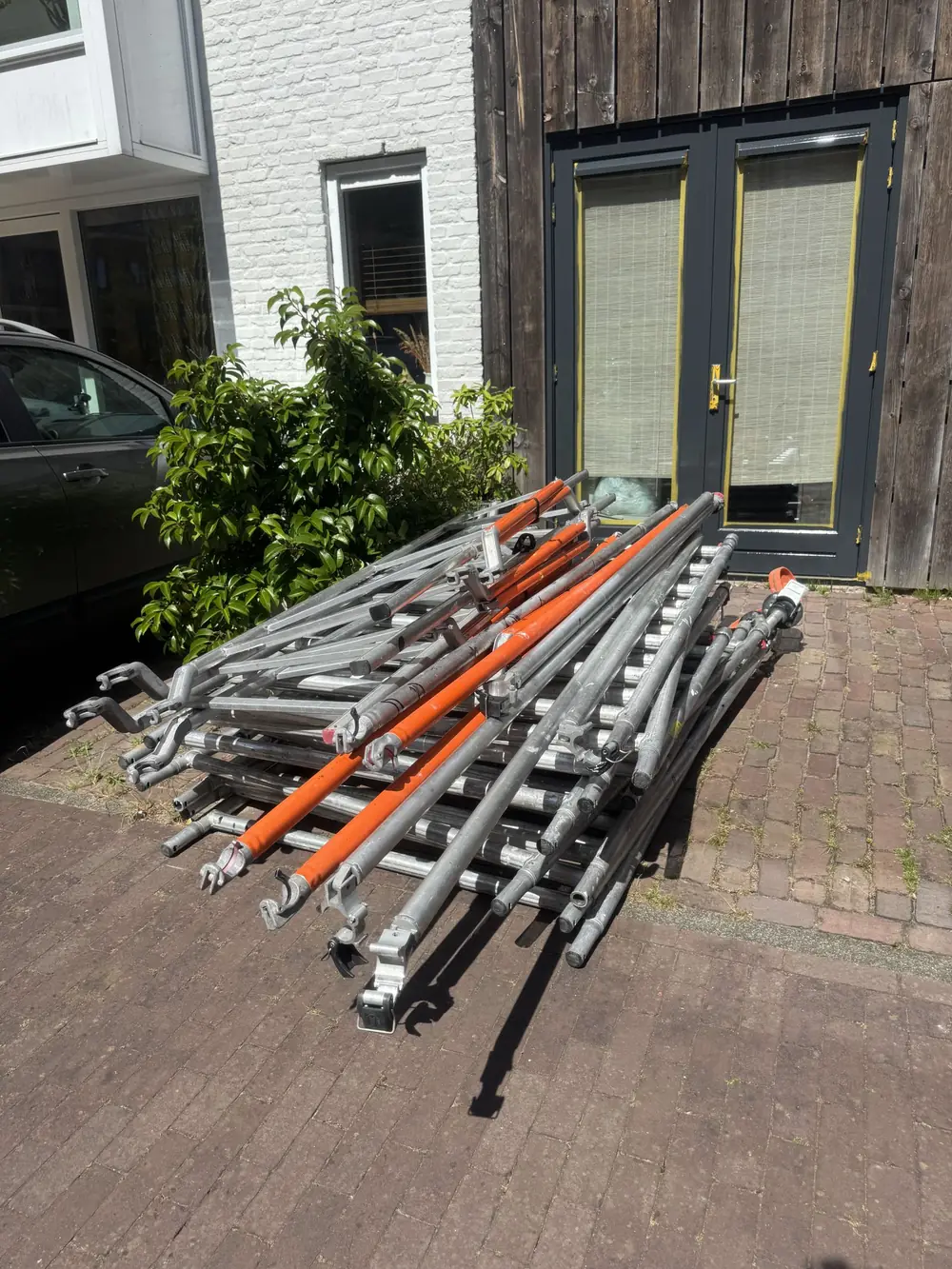
Frames leaning on a house wall by a cargo bike, the narrow 75 cm RS51 kit with few parts to shift

Doing a single small bay on an extension or a garden wall, a one-person model can be enough. Even so, applying facade render is rarely a solo affair: someone mixing and passing up at ground level saves you the trip down at every bay, and that trip is precisely what your material will not allow. Leave a room scaffold where it stands, since it is meant for indoor work and not for an outside wall with a tub of mortar beneath it. Outdoors at this height, the mobile scaffold stays the model you hire.
Working height to hire so no join shows in the render

Working height is your platform height plus the two metres you cover above it with outstretched arms, and you book on that total. For applying facade render on a two-storey house that comes out at 6 to 8 metres, which gets you to the top edge of the rendered area: usually the junction with the soffit or with a roof edge. Which build belongs to it you can look up at a reach of eight metres before you reserve.

On this job there is a further reason behind that height. A bay wants finishing in one pass, and that only works if you reach the top edge from the same floor as the bottom edge. Have to add a lift halfway across a bay, or reposition the platform, and the edge of what you have already laid on tightens up meanwhile, and you will still see that transition once it has dried. So choose your height on the topmost centimetre you still have to render.

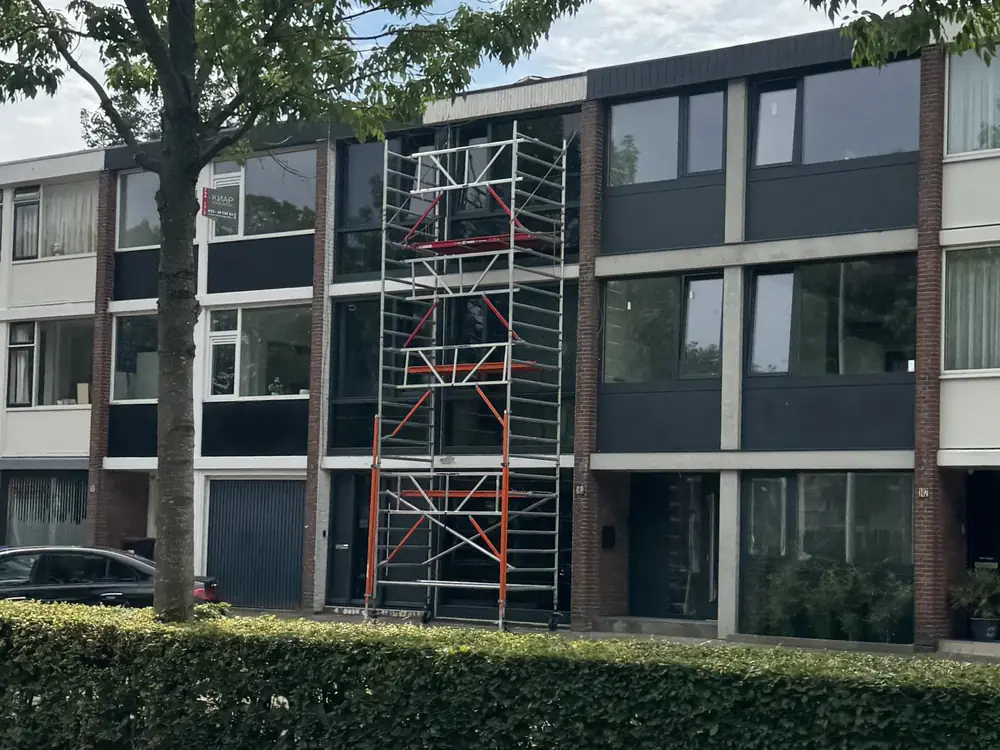
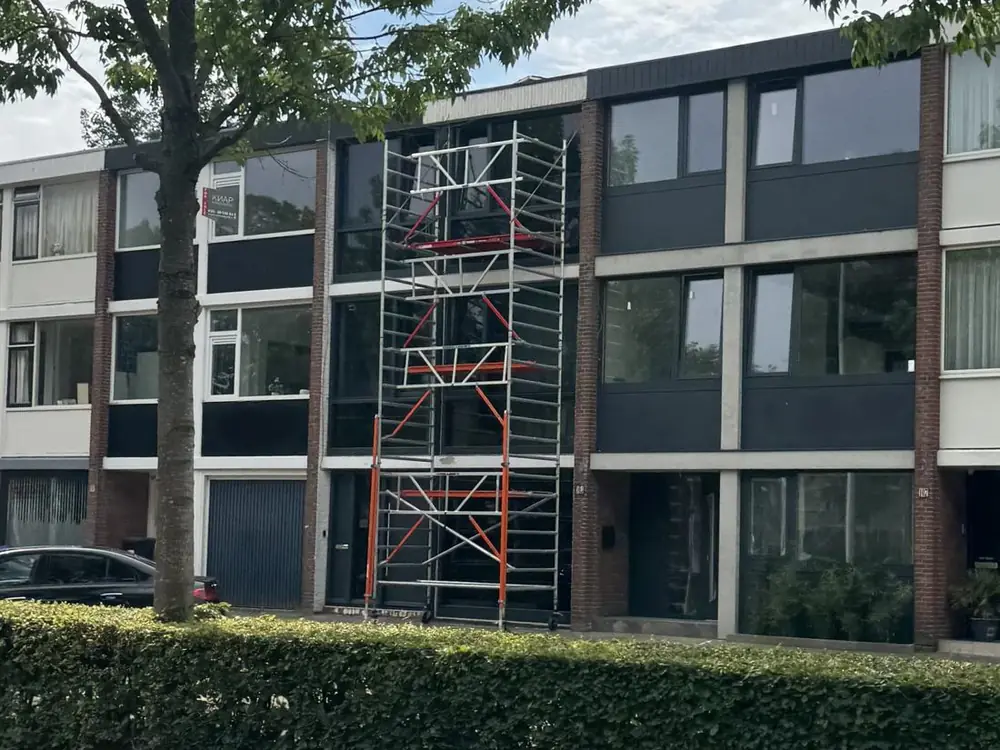
Tower running up a front elevation to just below the roof edge, where the top edge of a render bay sits

Measure from whatever surface the castors will be standing on, and not from the back door threshold. If the stand goes in a garden that sits a step lower, you hire from that lower level and need more build than you judge from indoors. Torn between two ranges, take the higher one: half a metre spare hurts less on render than a bay you have to do in two goes. See also the height at a first floor.

Where the tower stands while you apply facade render

The spot beneath the stand is your workshop on this job. That is where your mixing tub goes, a bag of material, a bucket of clean water and usually a drill with a paddle on an extension lead. Those things have to be close to the feet, but not so close that they are in the way when you push the tower to the next bay. Keep the four corners free for the stabilisers as well, since they angle outwards and take more room than you expect.

Note what has to come out from under you before the work starts. Fresh material spatters, and whatever misses the tub lands on paving, on gravel or in the planting and does not come off easily there. Sheet the strip along the wall and move planters out. Make sure the ground is level and firm too, certainly if you are walking about with full buckets. For a terrace on a fall, this article on levelling on a slope gets you going.

Stabiliser legs folded out under a mobile scaffold, the room at the base you keep clear next to your mixing spot

Look at the sun and the wind on the elevation you are starting from, as well. A bay in full afternoon sun or in a stiff breeze dries faster than you can spread, and then you lose to your own material before you reach the bottom. So begin on the side that is in shade at that moment and work ahead of the sun, so every bay keeps the working life it was meant to have. That is one more reason to take your hire period a little wider than the number of bays suggests.

How many hire days for applying facade render on one elevation

On render work you count in bays and in coats, not in square metres per hour. Per stand you finish one bay, and the elevation of an average terraced house breaks down into six to eight of them. Lay on a base coat and then a finishing coat and you pass every bay twice, once for each. Add the building and the dismantling on top and one elevation therefore comes to three or four days of hire.

The waiting time between two coats governs the rest of your planning. How long before you can carry on is printed on the bag and depends on temperature and humidity; that time cannot be made up by working harder. On top of that come the days you should not start at all: frost overnight, an elevation standing in blazing sun, or rain landing on fresh work within a couple of hours. Count those days into the hire period as well.

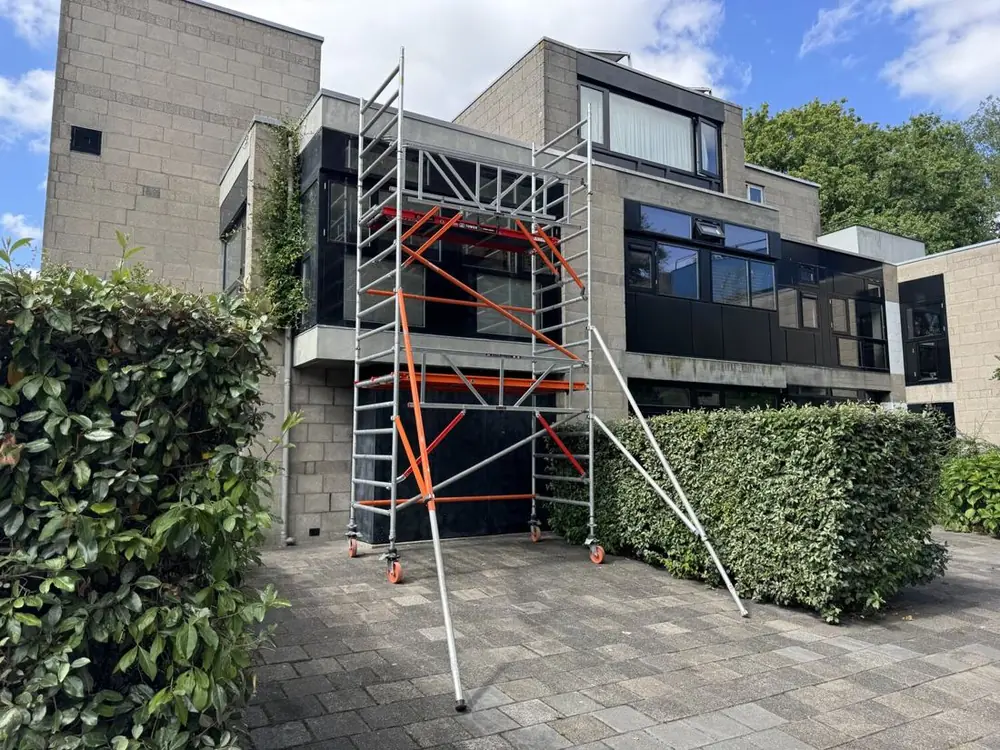
Built mobile scaffold against a clean modern wall, the stand taken up again for every bay and every coat

Booking wide has deliberately been kept cheap in the rental price. Only the opening twenty-four hours are charged at the whole rate, and each hire day following carries a ninety-five per cent reduction, so a day of slack to wait out drying costs you next to nothing. Book too short and half an elevation stands in base coat on the morning the van arrives for the parts, which is exactly the scene to avoid. A realistic estimate you can make with the explanation of hire days.

Which mobile scaffold suits applying facade render?

Kamersteiger RS44
  • Working height up to 4 metres
  • Compact and narrow
  • Great for indoor and small jobs
View and calculate →
Most chosen
Smalle rolsteiger RS51
  • Working height up to 14.2 metres
  • Narrow (75 cm)
  • Ideal for narrow passages
View and calculate →
Brede rolsteiger RS52
  • Working height up to 14.2 metres
  • Wide platform (135 cm)
  • Extra stability and workspace
View and calculate →
1-persoons steiger MiTower
  • Working height up to 6.2 metres
  • Very compact
  • Quick and easy to assemble
View and calculate →

One bay of render per stand from the platform

The 245 centimetre floor is your measuring stick on this work. The width of the bay you finish in one pass is the width you can reach without stretching, and that comes to roughly two and a half metres. Divide the elevation up beforehand with that figure in mind and let the divisions fall on something already there: a corner, a downpipe, the side of a window frame or a projecting band in the brickwork. That is where the join shows least.

Work every bay from the top down and keep the edge wet while you are at it. Do not go down halfway for a fresh tub, because in those few minutes the edge tightens and you see the transition in the finished result. So take one bucket too many up rather than one too few, and have your helper below set the next tub ready before you ask for it. That keeps the run from top to bottom unbroken and your working edge live.

Mobile scaffold set tight against a wall, the stand that brings roughly two and a half metres of elevation within reach

Moving belongs between two bays, never inside one. Set the hawk down, come to the ground, roll the tower to its new place, brake the castors and check the stabilisers before you go up with fresh mortar. Reckon ten to fifteen minutes per move and count that time into your day: at eight bays that runs to well over an hour with nothing going on the wall. If decorative render follows in the same hire period, keep the same bay layout.

Hiring a mobile scaffold with delivery for the render work

We supply the mobile scaffold as a full set of loose, counted parts. Point out a spot in advance where those parts may lie, and bear your mixing place in mind: the strip directly under the wall is what you will want for the tub, the water and the lead. A stretch of drive or a corner of the garden is handier. Anything ordered by 15:00 on a working day is outside your door the working day after.

You fill in the arrival day and the collection day yourself as you hire, and on render work that is worth thinking through. Have the scaffold brought the day before your first rendering day, then you build in peace and start early next morning, while the wall is still cool and the material does not pull away at once. Assembly falls to you, helped by the printed instructions and the film that goes with them; two people take half a day. Collection from Zeeburgerpad is possible too, free and by appointment.

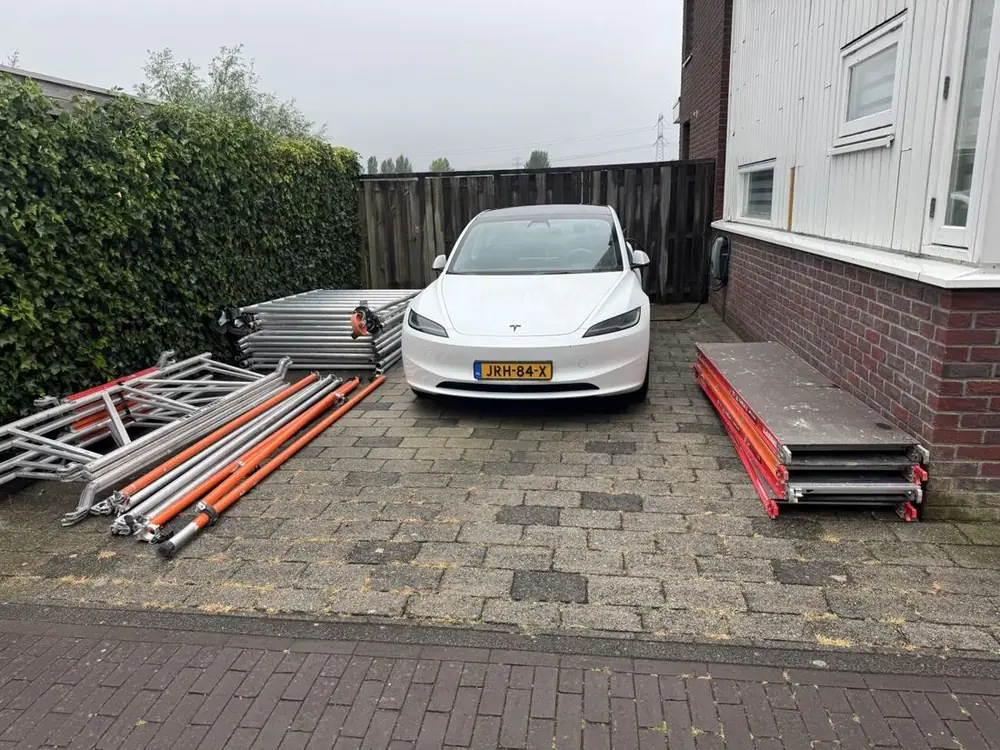
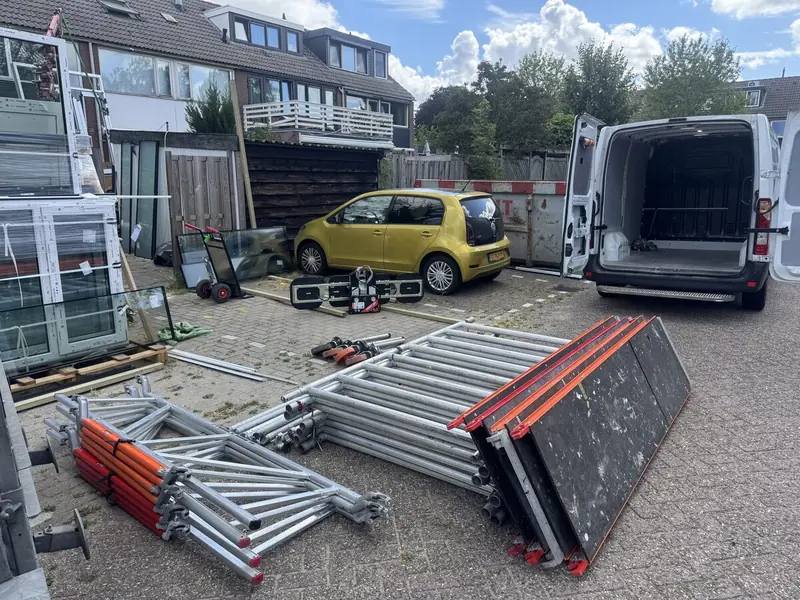
Scaffold parts delivered on site beside a house, ready to be built up yourself for the work on the wall

With the final coat on, you strip the stand down and lay all the parts out together in one place; after that we carry them off. Hose the tubes and the platforms clean before you stack them, because dried mortar will not come off later and it does not belong on material going back out on hire. What we charge for bringing and fetching is stated in advance at the costs per province, so nothing catches you out.

Working safely on a hired tower with wet facade render

A hired mobile scaffold is built for two hundred kilos on each square metre, the third load class named in EN 1004. That sounds ample until you start adding up on render work: wet material is heavy, and with two full buckets, a tub, yourself and a second person you are easily at half of what is permitted. So put no more on the floor than you are going to use in the bay you have in hand, and bring empty buckets straight back down with you.

The greatest chance of a slip on this job lies in the floor itself. Whatever misses the tub makes the surface greasy, and you usually notice only when you step sideways with a full bucket. So lay cardboard or sheeting down and sweep between times. Beyond that, lock the castors before you climb on, and move the stand only when nothing and nobody is left aboard. More rules are set out at the agreements for working at height.

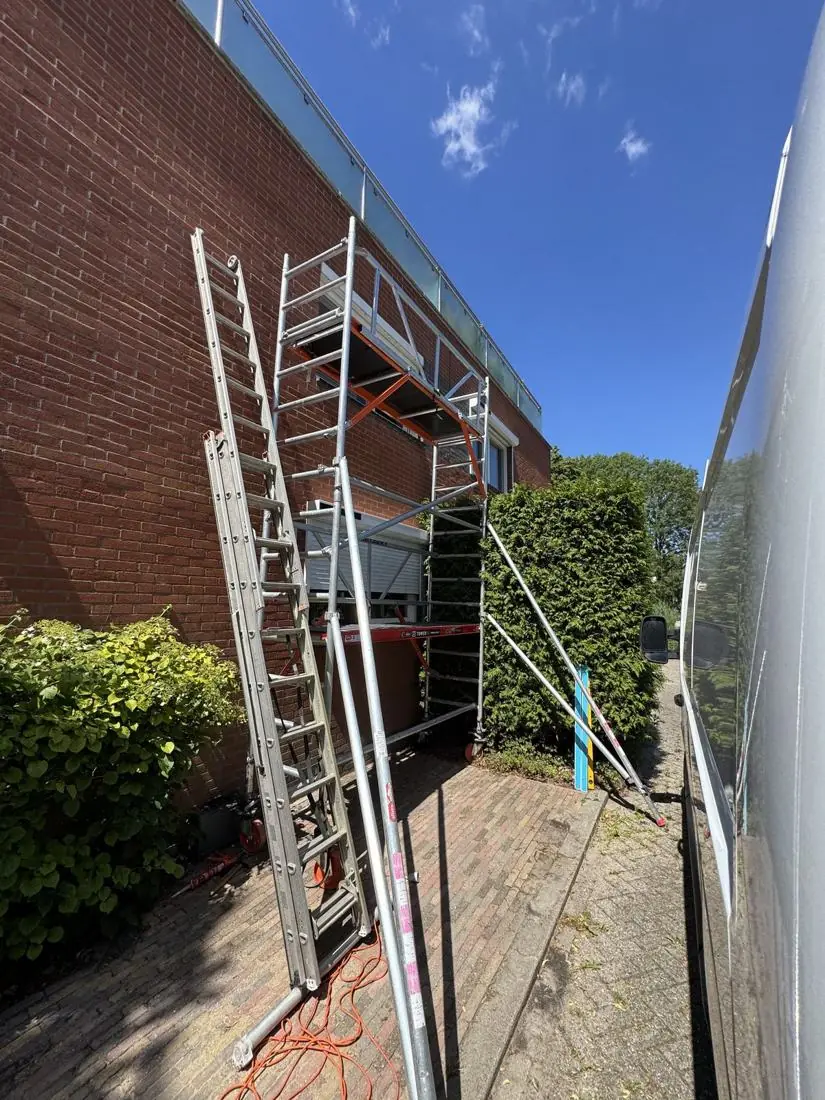
Built mobile scaffold against a side elevation, an extension ladder leaning separately, each deck square metre good for two hundred kilos

Stop in a strong wind, even if you wanted to do one more bay. Wind makes the stand restless and dries your material out too fast into the bargain, so in that weather you lose on both sides at once. Keep the space under the floor clear as well: a falling bucket of mortar is heavy and covers a wider area than you think. Warn the household and the neighbours not to walk beneath the stand while you are up there with wet facade render, since they hear nothing coming.

In 5 steps

How hiring a mobile scaffold works

1
Choose working height

Pick the height that suits your job.

2
Book online

Sorted in 60 seconds, price shown instantly.

3
We deliver

At the agreed spot the next working day.

4
Assemble safely

Assembled by you, with a manual.

5
We collect

One call and we collect the scaffold.

Good to know

Practical tips for applying facade render

1

Chalk the elevation into bays before you hire the mobile scaffold. You then know at once how many stands you need and where the joins will fall, and that settles your number of hire days.

2

Mix no more material than one bay will take. Half a tub stiffening on the platform while you move to the next stand is material you end up throwing away all the same.

3

Hang a second bucket of clean water on the guardrail. You keep your tools and the edge of the bay wet without having to climb down off the tower halfway through.

4

Station your helper below at the mixing tub and agree that a full one is always waiting. Passing it up costs less time than shifting a scaffold or mixing a fresh batch does.

5

Start on the elevation that lies in shade at that moment. That way the sun works ahead of you rather than against you, and you actually keep the working life the material gives you.

6

Wash the platforms and the tubes down at the end of every day. Dried spatter makes the scaffold slippery, and you want to hand the set back clean on the day we come to fetch it.

Frequently asked questions

Frequently asked questions about applying facade render

Which mobile scaffold do I hire for applying facade render?+

For a house of two storeys the narrow RS51 of 75 centimetres is the logical choice. You mix at ground level, so up top you only need space for yourself and the hawk you are working from, and that narrow stand moves between two bays quickly. If two of you are on the floor together, the wide version of 135 centimetres is pleasanter. Either way, measure the passage to the wall before you hire a scaffold.

How does hiring a scaffold for render work actually go?+

Online you put together the model and the working height, pin a date for the parts to arrive and a date for collection, and pay a fixed rate that already has VAT in it. We set the counted set of the hired scaffold down at your address. Then you build, render the elevation bay by bay and take the stand apart again, after which we come for the lot. You arrange only your material and your helper.

For render on one elevation, how many days do I hire the scaffold?+

Reckon on three to four hire days for a normal elevation done in two coats. You do one bay per stand, come back to each bay twice and have to wait between coats until the material is ready. Building and dismantling take another half day between them. Doing only an extension or a single bay, two days of hire is enough. If in doubt, take a day more, since such a day weighs lightly in the price.

What is the rental price for a scaffold for render, and how does the scale run?+

The figure depends on which mobile scaffold you take and on how high you have it built; delivery and collection are reckoned per province, VAT included. Under the current rates everything is set out together, so you know the cost of hiring before you reserve. For render the scale is kind: after day one each further day hardly registers, and on this job you want slack for drying time and weather.

Which working height do I hire to reach the top edge of the render?+

For two storeys you order a build that reaches 6 to 8 metres. The point is that you get at the topmost centimetre of your bay from the same floor as the bottom edge, since otherwise you get an interruption halfway and a visible join. That requirement decides which scaffold you hire on this job. Take your measurement to that top edge from the level where the castors will sit. Which build to hire is shown on the page with working heights.

Can I have the scaffold hired in a day before my first rendering day?+

That is exactly the right order. You pick the delivery day yourself when reserving, so have the tower come the day before your first day of rendering: you build in peace and your mixing spot is still clear. Would you rather fetch the set, you may do so by arrangement and without extra charge, as long as your transport holds every part. Collection after the job we arrange on the date you gave us.

Is erecting the scaffold part of what I hire for render work?+

No, the assembly belongs to your part of the work. We hire out the mobile scaffold, put the complete set down at your place and take it away afterwards, but putting it together, shifting it between bays and dismantling it are your tasks. The manual is in the delivery and the instruction film demonstrates the sequence step by step. Two people need half a day, so schedule it before your first bay rather than the same morning.

What if the render work runs on and I have to hire the tower for longer?+

Pass it on as soon as you see days being added; we shift the collection date as long as the scaffold set is not promised to a following customer. With facade render it often runs on because a coat stays wet longer than hoped or because the weather turns. So book a day wider from the start, since bringing it back early is no bother. An elevation with only one coat on it is not something you want standing for days.

How much space do I need if I hire a mobile scaffold for this?+

Under the stand you want room for the mixing tub, a bag of material, water and a lead, and around that the four stabiliser legs have to angle outwards. So reckon on a strip wider than the scaffold itself, with level ground you walk over carrying full buckets. Sheet that strip against spatter before you begin. If there is a border or a terrace under the wall, clear it before the delivery arrives.

What do I do if the weather turns on my hire days?+

Fresh facade render and rain do not go together, and in full sun or a hard wind the bay dries faster than you can spread it. On days like that you do the preparation and leave the wall alone. The tower can stay where it is, braked, with the legs folded out. Because each extra hire day costs only a fraction, planning a waiting day is far cheaper than redoing a failed bay from scratch later.

How is the deposit handled when I hire this mobile scaffold?+

The sum you pay at reservation comes back to you as soon as the full set is with us again; usually that is settled within a working day of the return and you need think no more about it. On render work watch the state you hand the scaffold back in: clean the parts before the mortar dries on them, and count them as you dismantle. How that settlement runs is in the piece on the security sum.

Can I avoid a join by moving the hired tower during a bay?+

No, that works the other way round. Rolling a scaffold costs you minutes in which the edge of your fresh work tightens, and that is precisely where the transition marks itself out. So split the elevation beforehand into bays you manage per stand, and move only between two bays, with the tub down below. If you hire a scaffold for applying facade render, take an extra day or a narrower bay rather than a layout that makes you stop halfway.

Hire a mobile scaffold for applying facade render today?

Calculate your rental price now or ask for free advice.

Rolsteiger van SteigerTaxi geleverd op locatie
Book it online

Your scaffold sorted in 2 minutes.

Choose your scaffold and working height, see the price instantly and book online.