
See your price
Application

Applying decorative render? Choose the right scaffold.

Applying decorative render is hand work with a float, and the thickness is fixed for you: the coat is exactly as deep as the grain in the material. You lay it on, rule it back until the grain stands as the highest point, then set the texture, all of it wet in wet. Stop halfway through a panel and you will go on seeing that stop for years. On a wall of two storeys you hire a mobile scaffold just 75 cm wide that shifts quickly, built somewhere between 6 and 8 metres.

  • Order before 3 pm, delivered tomorrow
  • Professional Altrex scaffolds
  • Up to 14.2 metres working height
  • Easy to assemble yourself
4,2 tot 14,2 mWorking heights available
12Provinces served
7Days a week
200 kg/m²Load class 3
In short
  • For applying decorative render we recommend the Narrow mobile scaffold.
  • For applying decorative render on a two storey wall you hire the RS51: 75 cm narrow, at 6 to 8 metres.
  • Grain size fixes your coat thickness, so the material per square metre is known and you can count tubs per stand.
  • Plan where the join falls: on a corner, behind a downpipe or on a window line, never in open wall.
  • First 24 hours from €150 incl. VAT and delivery; every day after that 95% off.
Key facts for this job
FeatureValue
Recommended scaffoldNarrow mobile scaffold (Altrex RS TOWER 51)
Working height for this job6 to 8 metres
Available working heights4.2 to 14.2 metres
StandardEN 1004, load class 3 (200 kg per m²)
DeliveryOrdered before 3 pm, delivered next working day
Each extra day95% off, from €7.50 a day
Why a mobile scaffold for applying decorative render?

Safe, stable and professional work at height

Decorative render is the finishing coat, not the one underneath. The wall is already flat; what you put on it is a thin grained skin that only looks right if a whole panel goes on in one continuous pass. That turns the tower into a clock: the faster you travel from left to right, the less chance your previous run has begun to pull. A light frame you can shunt a deck length in twenty seconds therefore beats a wide one that needs two people to shift. And because you stand there scooping from a full tub, you want a rental build that does not sway while you press.

  • Coat thickness equal to the grain size itself
  • One whole panel in a single continuous pass
  • Join placed on a corner or behind a downpipe
  • Applying decorative render with a full tub aboard
Read more about working safely →

Hiring a narrow tower for applying decorative render by hand

Applying decorative render is done with a stainless float, so you stand close in with your face half a metre from the wall. Extra deck width only pushes you back out of that working posture. The RS51 at 75 cm is therefore the sensible thing to hire: narrow enough to pass a gate or run down a garden path, wide enough for you and a tub at your feet. Of the builds this model offers, from 4.2 up to 14.2 metres, a house of two storeys uses only the lower part.

The 245 cm deck is your unit of measure on this job. It is the run you can lay on and rule back in one position without moving your feet, and therefore the width in which your wall gets divided into strips. Work out beforehand how many tubs a strip of that size swallows, because climbing down for more halfway through a panel is exactly what ruins it. Two full tubs on the deck and a third standing ready below it tends to work best.
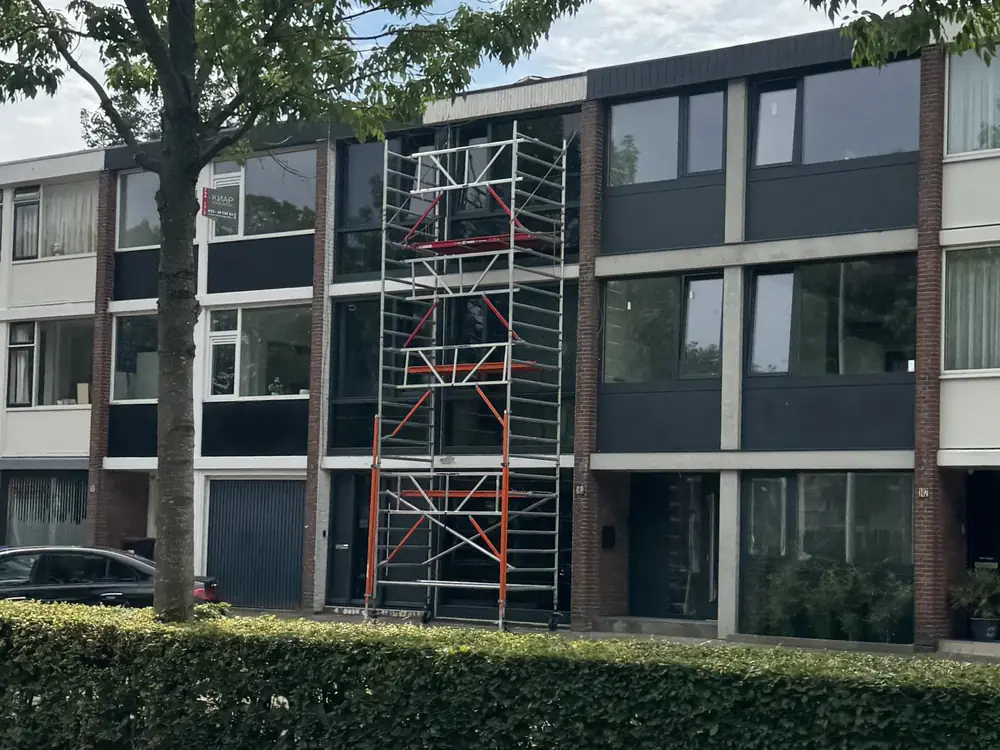
Narrow mobile scaffold standing at a modern house front, the slim stand hired for applying decorative render strip by strip

Do not confuse this with the coat beneath it or with indoor work. Laying a thick levelling coat over masonry is heavier going with far more material per metre, and that is described at the page on rendering an outside wall. Smooth plaster indoors wants a different set-up again, usually a room tower, as at the page on plastering interior walls. Decorative render sits between the two of them: outside, thin, decorative and entirely by hand, which changes what the tower has to carry and how often you shift it along the wall.
The working height to hire when render reaches the eaves

It is the panel you are coating that sets the height here, not the roof above it. Where the render carries on up under the eaves or against a fascia board, that is your upper limit; where it stops at a band or a string course, measure there instead. On a dwelling of two storeys you land almost every time on 6 to 8 metres. Begin the measurement at the level the castors will finally rest on, because a sloping drive can swallow half a metre of that.

The number on the booking adds two things together: the working height is the deck plus roughly the two metres you gain with your arms. On this job you would rather not be working at the very top of that reach, since above shoulder height the float will not lie flat and the coat goes uneven. Reckon on a deck that brings you up to about chest height at that top edge. How many builds that involves is listed at this working height of eight metres.

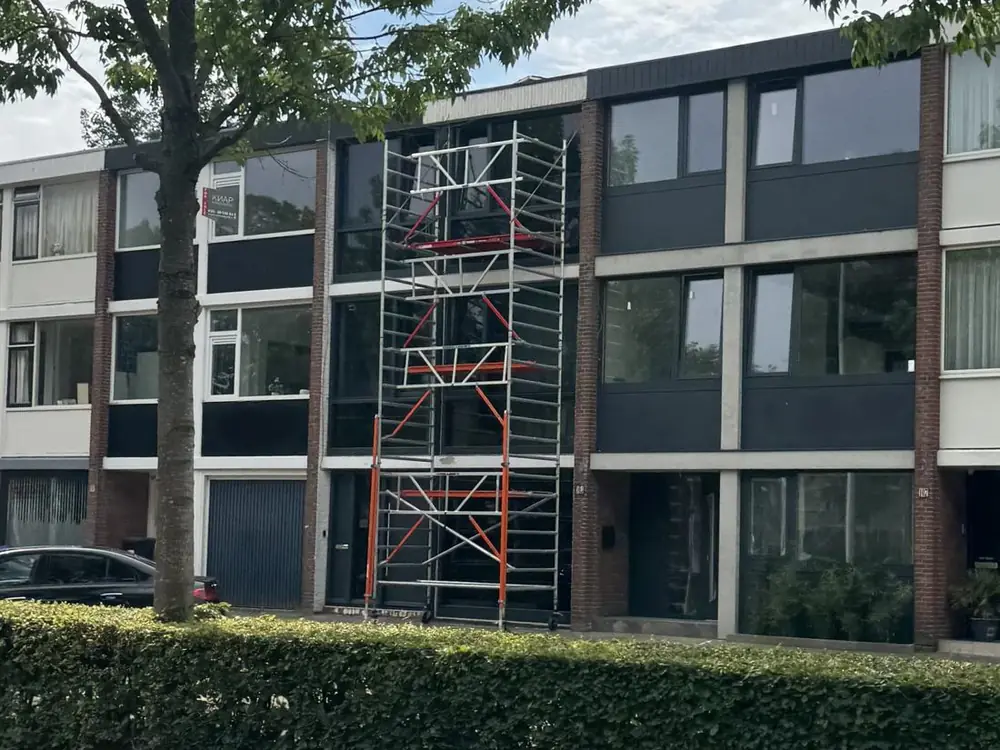
Mobile scaffold along a front elevation with its top deck close under the eaves, the reach a render panel needs

Hiring short costs you more than discomfort here. Doing the top strip with straight arms means pressing harder on one side than the other, and later, in raking light, that reads as a wave in the texture. A build that is too low also forces an extra position above, and every extra position is another join. Where you hesitate between two builds, take the one above; it costs a few more components and no extra day.

Where the hired scaffold and the mixing station stand

At the foot of the tower two things compete for the same ground: the stabilisers and your mixing point. In that tub you stir with a drill, a can of water stands beside it and a stack of dry bagged material waits under a sheet. Allow a flat, hard strip about three metres deep alongside the wall. Put the mixing point beside the tower rather than in between the legs, or every move you make begins with lifting a full tub out of the way.

The ground under the castors carries more here than on painting work. A tower with two people, buckets and material on it weighs a good deal more, and on soft grass or freshly laid gravel it will lean within the hour. Put down road plates or thick scaffold boards wherever the surface is not properly made up. Where the garden falls away, take up the difference with proper base plates rather than a stack of bricks; that case is set out in the guide to a tower on uneven ground.

Extended stabilisers under a mobile scaffold, the clear ground that also has to hold your mixing tub during the hire

Cover what lies beneath you before anything else. Decorative render throws specks, and dried specks on a terrace, a window cill or a parked car do not simply wipe off. Run sheeting a metre or two out from the wall and mask the frames before the tower is standing, because afterwards you can no longer get at them properly. Think of the neighbours' route past as well if part of the base sits on the pavement. A roll of dust sheet is cheap set against a lost afternoon.

How many hire days applying decorative render needs

A front wall of two storeys takes two to three days, preparation included. You begin by checking whether the background draws evenly, because a patch that pulls water makes your render set faster there than everywhere else. Then comes the day of real work on the panel itself: laying on, ruling back and setting the texture, in strips joined into one another. Finishing the corners, the abutments and clearing away the sheeting fills the last day of the hire.

On this job the weather runs your diary rather than the other way round. Strong sun on the panel pulls the material before you are ready to texture it, rain washes a fresh coat out and in frost you cannot start at all. Reserve a day or two extra in the booking and decide on the morning itself whether you go. That is cheap insurance, since you pay a full day once and each following day of the booking comes in 95 per cent lower.

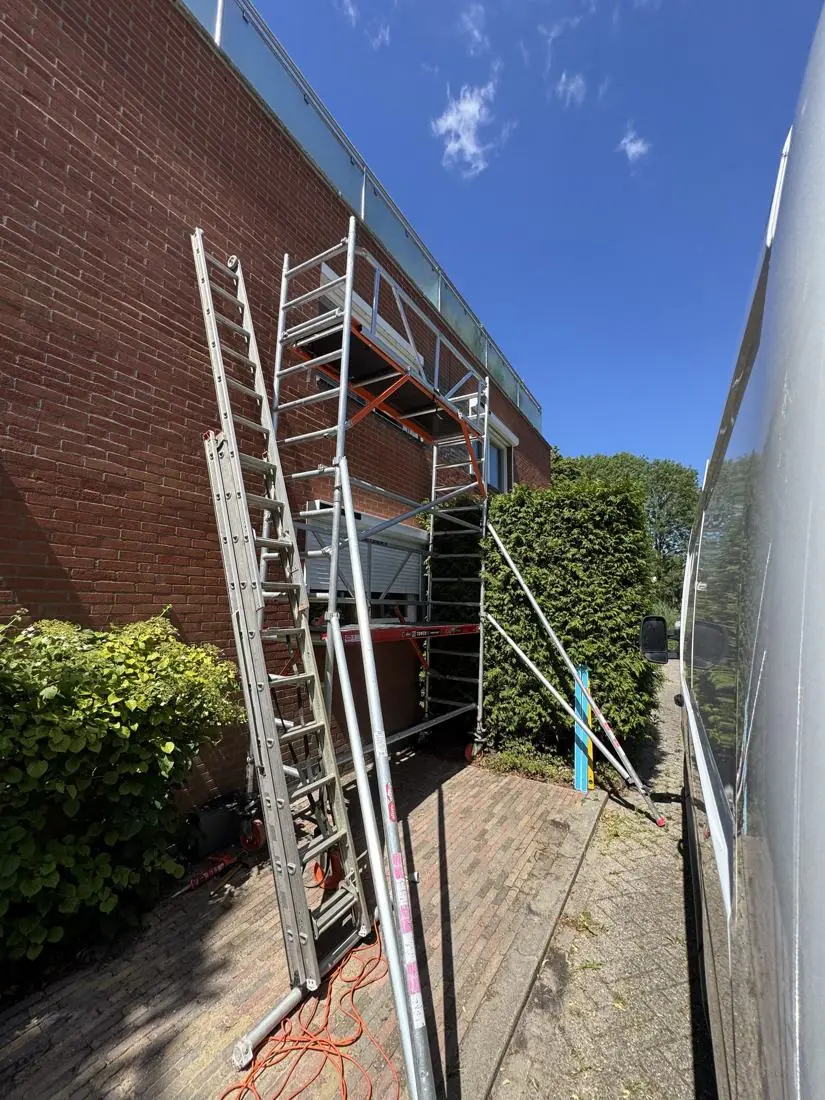
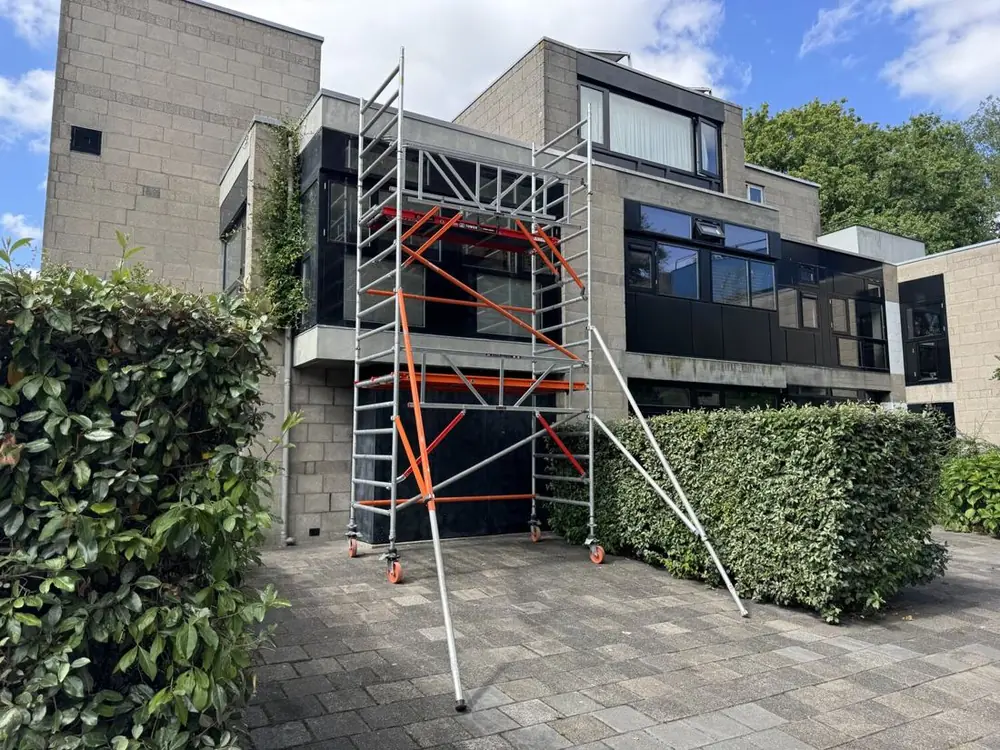
Mobile scaffold along a side elevation, the stand that stays up through your hire days while the coat firms up

Count in the waiting between laying on and texturing as well. The material has to firm up just enough to take the float, and that pause cannot be shortened by anyone working harder. In practice applying decorative render means each panel needs a block of a few hours in which you do nothing else at all. Anyone hoping to do a whole wall on a Saturday almost always runs out of time; two hire days back to back give far more room than one long one.

Which mobile scaffold suits applying decorative render?

Kamersteiger RS44
  • Working height up to 4 metres
  • Compact and narrow
  • Great for indoor and small jobs
View and calculate →
Most chosen
Smalle rolsteiger RS51
  • Working height up to 14.2 metres
  • Narrow (75 cm)
  • Ideal for narrow passages
View and calculate →
Brede rolsteiger RS52
  • Working height up to 14.2 metres
  • Wide platform (135 cm)
  • Extra stability and workspace
View and calculate →
1-persoons steiger MiTower
  • Working height up to 6.2 metres
  • Very compact
  • Quick and easy to assemble
View and calculate →

Ruling back to the grain from a 245 cm deck

The grain in the material is your gauge. Choose a two millimetre grain and your coat is two millimetres thick; laying it on heavier does not improve it and does make it prone to cracking. So put the material on generously and then take it back again until the float rasps across the tops of the grains. Ruling back to the grain is the moment the thickness is settled, and it is also the moment you find out whether you mixed too much or too little for the strip.

The join is where two runs meet, and it always shows. Place it therefore on a natural break in the wall: an external corner, a vertical band, the edge of a frame or the line behind a downpipe. Inside such a panel work downwards and travel sideways without a pause. With the 245 cm deck you cover roughly two and a half metres per position, so a panel five metres wide means two positions joined with no interval between them at all.

Narrow mobile scaffold standing along a house wall, the 245 cm position from which one strip is laid on and ruled back

That shift in between is where this job stands or falls. Brakes off, roll one deck length along, brakes on, check the stabilisers and climb again: that is a couple of minutes, and in those minutes your last run is pulling. With two of you on the deck, one lays on while the other rules back, and you move only once the whole panel is closed. Carry up only what you need, because every descent for a forgotten float counts twice on this work.

Hiring delivery the day before your render goes on

Have the tower brought out a day before you render, so that you can put it up unhurried and get the sheeting on. The components arrive as a complete, counted set, and that pile is not wanted on the strip of ground where your mixing tub will stand. The drive or a corner of the garden is better. Where the booking is placed by 15:00, on a working day, the parts go out for the working day that follows; both dates in the hire are yours to choose.

Building it is your task and you tackle it yourself, with the manual supplied and the instruction film alongside. Do it the day before rather than on the morning you want to mix, or your best rendering hour disappears into tubes and braces instead. Reckon too on having to strike the tower completely between two wall panels if you want to turn a corner with it. The step by step guide to putting one up takes you through the order.

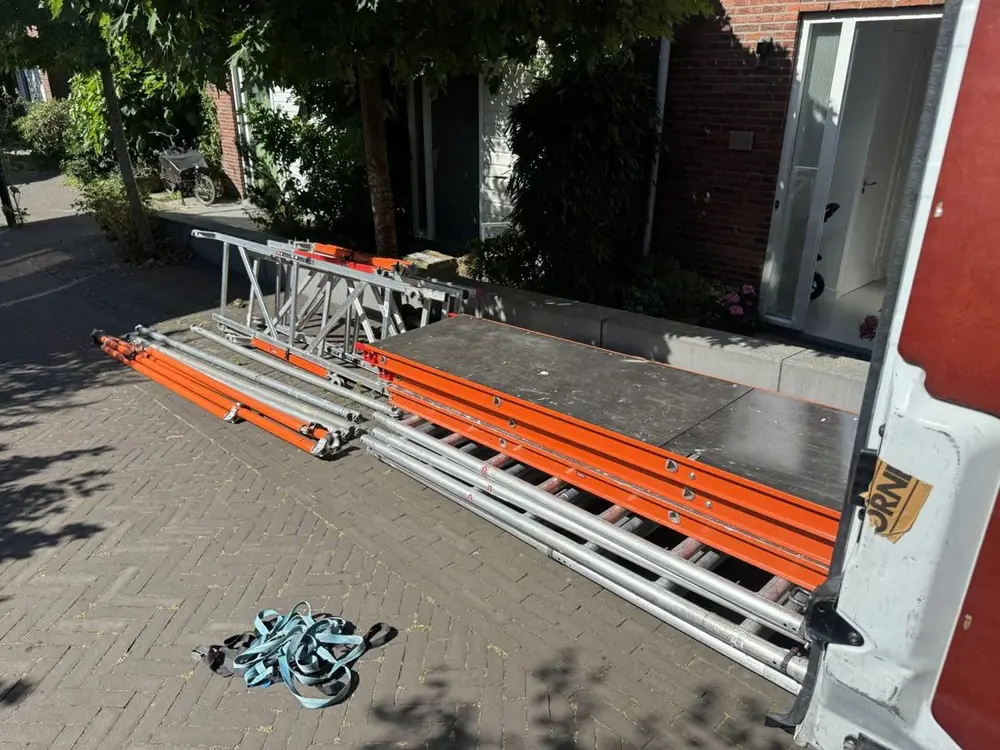
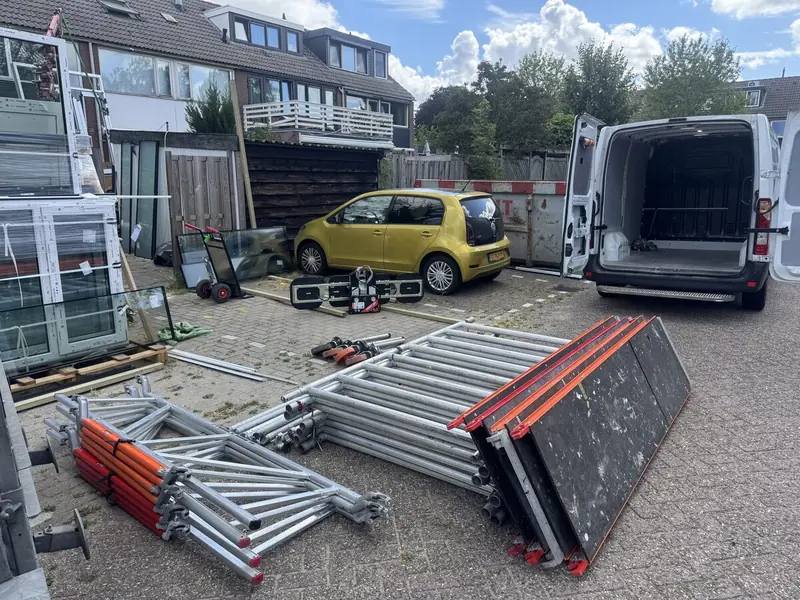
Scaffold parts ready for assembly in the street, the counted set delivered a day before your rendering starts

After your last hire day the van comes back for the set; you dismantle the tower and stack everything complete. Wait until the render feels dry to the touch, because chipping hardened mortar off tubes is more tedious than the rendering itself. Fetching the set is allowed as well: by appointment the parts wait for you at Zeeburgerpad 89 in Amsterdam and nothing is charged for that, though the tubes will not go in every car. What holds for your province appears at the fixed carriage rates.

Applying decorative render safely on a hired mobile scaffold

This job takes you nearer the load limit than most work on a tower does. A tub of twenty five kilos, two full buckets, hand tools and two people all add up, while class 3 in EN 1004 works on 200 kg for each square metre of deck. Spread that weight along the whole length of the platform rather than letting it all collect around your feet, and send anything empty straight back down instead of leaving it to stand up there.

The usual agreements hold otherwise. Brake the castors the moment anybody goes up, never move the tower with material or people aboard, and stop in a strong wind. That wind limit is lower on render work than you would think, because a drying breeze pulls the panel so fast that you can achieve nothing anyway. Check all four stabilisers after each shift of the tower and wind them out hard again; on this job that is the step most often forgotten, precisely because you are in a hurry.

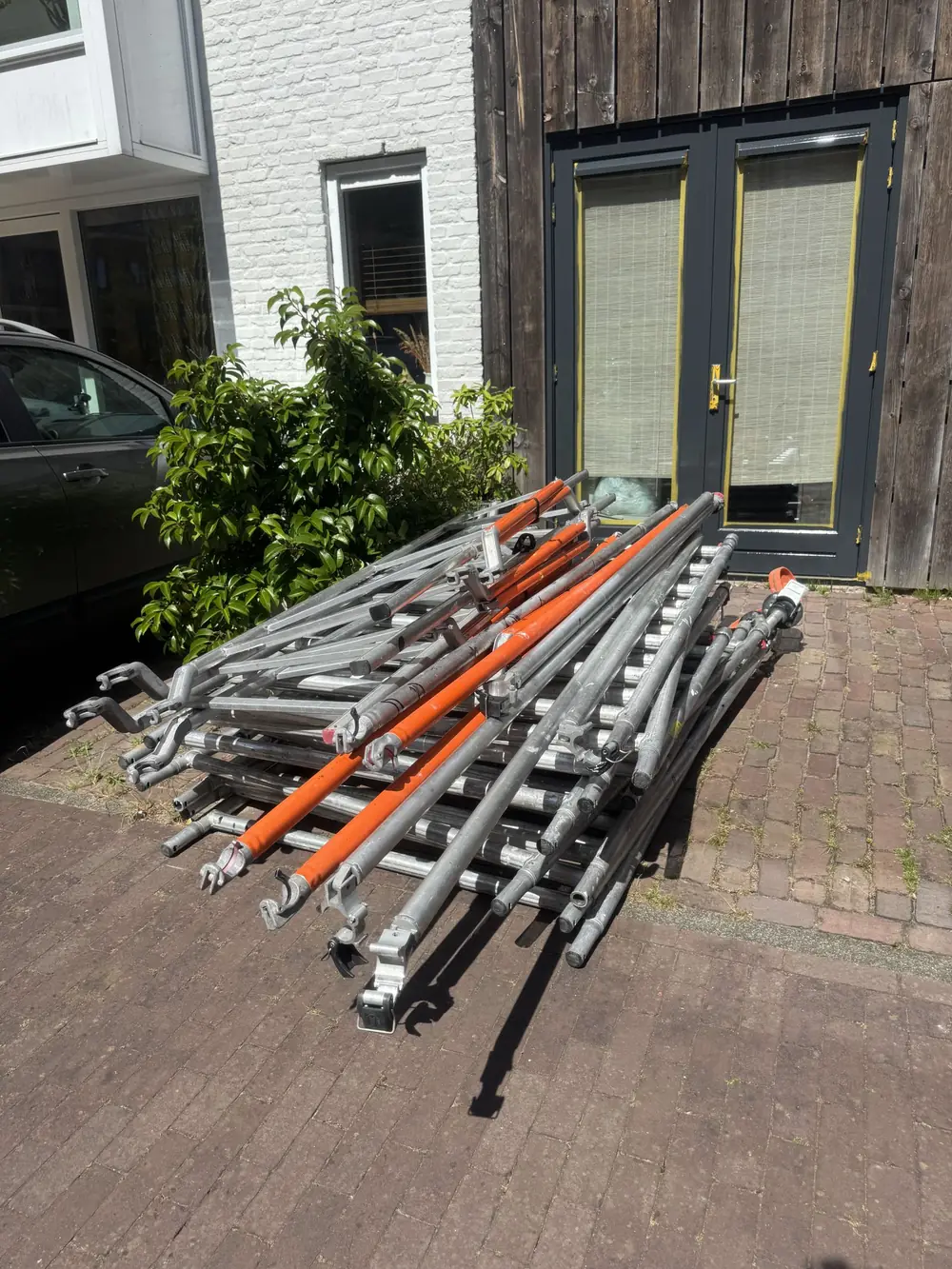
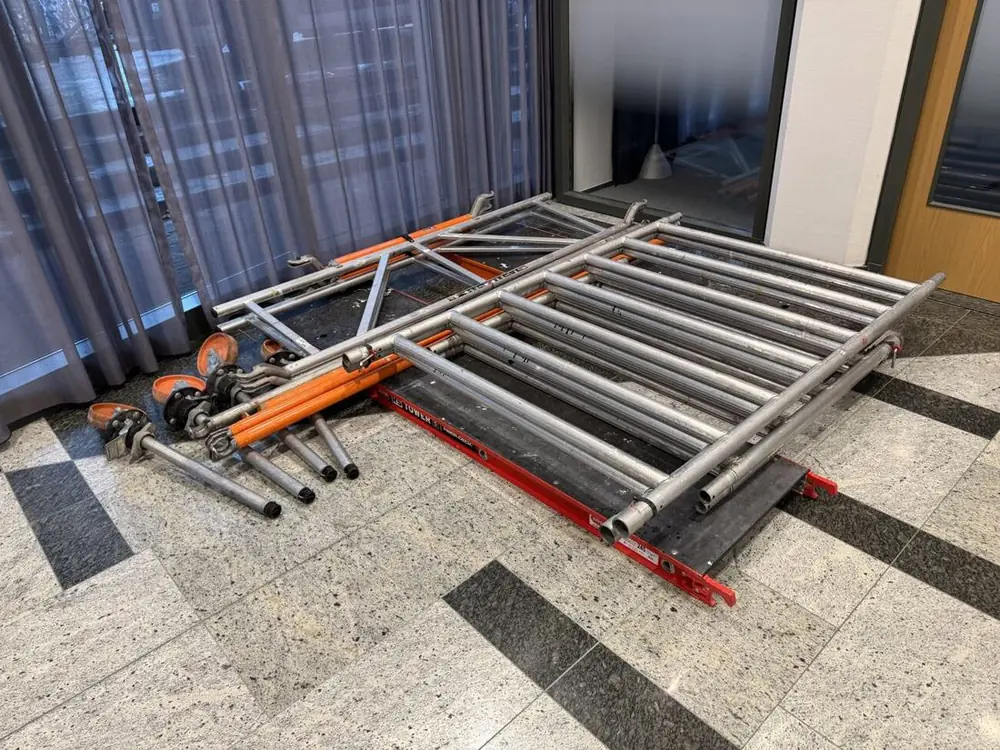
Inspected scaffold components gathered complete, the set from which you build a stand for work on a wall

The hazard peculiar to render is the floor under your feet. Spilt mortar turns into a hard, slick crust within a quarter of an hour, and there you are turning on it with a float in your hand. Sweep the deck clear before it sets and keep a bucket of water up top to rinse your tools in. Watch who passes below, too: a dropped float or a half full bucket is no small matter down there. The rest is at the explanation of weight on a tower.

In 5 steps

How hiring a mobile scaffold works

1
Choose working height

Pick the height that suits your job.

2
Book online

Sorted in 60 seconds, price shown instantly.

3
We deliver

At the agreed spot the next working day.

4
Assemble safely

Assembled by you, with a manual.

5
We collect

One call and we collect the scaffold.

Good to know

Practical tips for applying decorative render

1

Never mix up more material than a single run will take. A tub left standing begins to pull, and it sets a different texture in the panel from the batch you have only just stirred up.

2

Work each panel from the top downwards and leave the bottom fifty centimetres until the very end. Material that drops then lands on a part of the wall you still have to do anyway.

3

Keep one float purely for the texturing and use it for nothing else at all. As soon as a hardened grain sits on its edge it drags a line across the panel you can never remove.

4

Stand a bucket of water on the deck of the tower so you can rinse the float between runs. Caked material on your tools is the commonest cause of uneven texture along the topmost strips of the wall.

5

Mark on the wall with tape where each of your panels starts and finishes before you begin. Then you are not standing with a loaded float trying to decide where this particular run ought to stop.

6

Put the collection date one day beyond your final rendering day. That leaves you a morning to strip the sheeting, deal with the specks and stack the components clean and dry for the return.

Frequently asked questions

Frequently asked questions about applying decorative render

For applying decorative render, which mobile scaffold do you hire?+

For a two storey wall the RS51 is what you hire, a frame of just 75 cm. Hand work keeps you tight in against the panel anyway, so extra deck width gains you nothing at all, while the slim frame gets you through a gate and along a garden path. Where two of you work the same panel and a lot of material has to go up, the broader RS52 at 135 cm earns its place. Measure your narrowest point of access before you book anything.

How does hiring a tower for wall rendering actually go?+

You put the model and the build together online, add an arrival date and a return date, and the rental price with VAT appears while you do it. The set turns up in loose parts, you erect it yourself, render your wall and leave it dismantled again on the final day. Hiring the scaffold asks nothing more of you than that; planning around the weather is by far the harder half of the job.

Over how many hire days does one rendered wall usually run?+

For a single wall of two storeys reckon on two to three hire days, plus one spare day held back for the weather. Laying on and ruling back a panel goes quickly enough, but the preparation, the wait before you can texture and the finishing of the corners fill the rest. Where there are several walls to do, add a day for each of them. One more day of hire beats booking the same tower a second time, so leave some air in your end date.

What is the hire of a tower for decorative render based on?+

That depends on the model, on the build you choose and on the province the carriage runs to. The figures appear including VAT at the tariff list per model and build, so you know before you confirm. On this job a generous period pays for itself: the opening day carries the weight and the ones behind it hardly register at all, whereas a second booking of the same scaffold hands you another full opening day.

Which working height do you rent when render runs to the eaves?+

Take the tape from the level the castors occupy through to the top edge of the rendered area, which is the point at which the decorative coat stops. Two storeys puts you in practice somewhere at 6 to 8 metres. Make sure the deck you rent brings you to roughly chest height at that top edge, because with straight arms the coat will not come out even. Which build suits which reach is set out at the overview of working heights.

Can the hire delivery be matched to your rendering day?+

Yes. Both dates sit in your hands when you book, and for this work you want the set a day early instead of on the rendering morning. That way the tower goes up in peace, the sheeting goes on, and you start the next morning against a clean wall. Fetching it yourself by appointment is possible, though the tubes will not fit every car, and with bags of mortar to shift most people prefer a tower that is brought.

Is putting the scaffold up part of what you hire, or your own job?+

It is your side of it. We bring the complete set and come back for it afterwards, but erecting, moving and dismantling are done by your own people. On a full wall that is a couple of hours with two of you. Build those hours into the plan as well, because they come off your rendering day. System scaffolds, facade scaffolds and powered access are not with us, so for applying decorative render at this height a mobile tower is the tool.

What if the weather turns and you have to hire the tower longer?+

On render work an overrun is normal rather than unusual. Give us word in good time and your collection day simply moves, provided nobody else is waiting on this particular scaffold. Smarter still is to reserve an extra day up front: handing back early is always fine, and then you are not watching the forecast with half a panel finished. Half a wall left open for a week gives a difference in tone that no amount of later work will remove.

How much clear space is needed when you hire for render work?+

Besides the width of the build and the splay of the stabilisers, decorative render also wants room for your mixing tub, your water and your bags. In practice keep a strip about three metres deep along the wall, flat and firm. Clear the garden furniture, the planters and the bikes before the scaffold arrives, since shuffling round them with a full tub does not work. Your bags of dry material need somewhere sheltered as well.

Can you keep the hire running while the render cures?+

Yes, and that is the intention. The build stays exactly where it is while the panel firms up and cures, brakes on and stabilisers wound out. That way you carry on next morning from precisely the same position without setting out again. Do take loose floats and buckets back down before you finish for the day, especially if any wind is forecast. For the hire it simply means counting the curing days inside your period.

What happens to the deposit if mortar gets on the hired scaffold?+

Your deposit comes back one working day after the return, once everything has been counted and checked over. On render work it is hardened mortar on tubes and decks that causes the trouble, so rinse specks away before they set. A couple of minutes a day during the hire saves you a whole chipping session on the final morning. Tally the parts as you dismantle; there is more on that at the notes on returning the components.

How does decorative render differ from ordinary rendering, and does the hire change?+

Ordinary render is the flat coat that covers the background and goes on thick; applying decorative render means the thin finishing skin above it, as deep as its grain. Smooth plaster is the indoor version of it, for which a room tower is usually hired instead. For the scaffold the difference is pace and weight: less material aloft, but far more urgency in moving, because the join is watching. That urgency is what decides which build you end up reserving.

Hire a mobile scaffold for applying decorative render today?

Calculate your rental price now or ask for free advice.

Rolsteiger van SteigerTaxi geleverd op locatie
Book it online

Your scaffold sorted in 2 minutes.

Choose your scaffold and working height, see the price instantly and book online.