
See your price
Application

Plastering walls? Choose the right scaffold.

Plaster will not let you work in sections. Once the mix is on the wall the clock runs: you have a limited window to rule off, flatten and trowel up, so you want to cover a whole wall face in one pass. Climbing off a hop-up and back up does not fit inside that window. For plastering walls you hire the RS44 room scaffold from Altrex, a build of 3 to 4 metres working height on a base that fits an interior door. Below: the build to choose and the hire days to book.

  • Order before 3 pm, delivered tomorrow
  • Professional Altrex scaffolds
  • Up to 14.2 metres working height
  • Easy to assemble yourself
4,2 tot 14,2 mWorking heights available
12Provinces served
7Days a week
200 kg/m²Load class 3
In short
  • For plastering walls we recommend the Room scaffold.
  • You hire an RS44 room scaffold from Altrex for plastering walls indoors: it reaches 3 to 4 metres and suits interiors.
  • Measure the narrowest interior door on the route to the room first, because from roughly 70 cm the parts still pass through.
  • Book two hire days: one for laying on and flattening, the second for trowelling up and taking the room scaffold apart.
  • First 24 hours from €50 incl. VAT and delivery; every day after that 95% off.
Key facts for this job
FeatureValue
Recommended scaffoldRoom scaffold (Altrex RS44)
Working height for this job3 to 4 metres
Available working heights4.2 to 14.2 metres
StandardEN 1004, load class 3 (200 kg per m²)
DeliveryOrdered before 3 pm, delivered next working day
Each extra day95% off, from €2.50 a day
Why a mobile scaffold for plastering walls?

Safe, stable and professional work at height

Indoors, height looks like the problem, but with plaster the problem is time. A wall face you tackle in two halves never comes out flat, because where the first half has already started to set you draw a join that no amount of sanding will remove. So you have to stay up there, shuffle sideways and keep the bucket within reach until the whole face is closed. A hop-up forces you into exactly the opposite. Hiring a scaffold for plastering walls is therefore about uninterrupted working time, about a solid floor under your weight, and about a base that will actually come into your room.

  • Plastering walls in one pass without a visible join
  • A base that comes through your interior doorway
  • Three to four metres of working height indoors
  • Wet material with a short usable window
Read more about working safely →

Which room scaffold to hire for plastering walls indoors

Inside a house the door frame, not the ceiling, is the measurement that decides everything. The Altrex RS44 room scaffold is built around that: you carry it in as separate parts, and from roughly 70 cm of door width it gets through in most homes. That matters a great deal with plaster, because you rarely stop at a single wall and you want to push the build on down the hall after the first room. The sizes kept for interior work are listed under hiring a room scaffold.

On the deck itself the question is not room for tools but room beside your feet. There is a bucket up there, a two metre straightedge lying about, and you swing a trowel with your arm length added on top. That straightedge decides more than anything else: it has to pass flat alongside you without catching a guard rail or the ceiling. On a room scaffold from the rental fleet you make that movement standing, without shifting your weight.
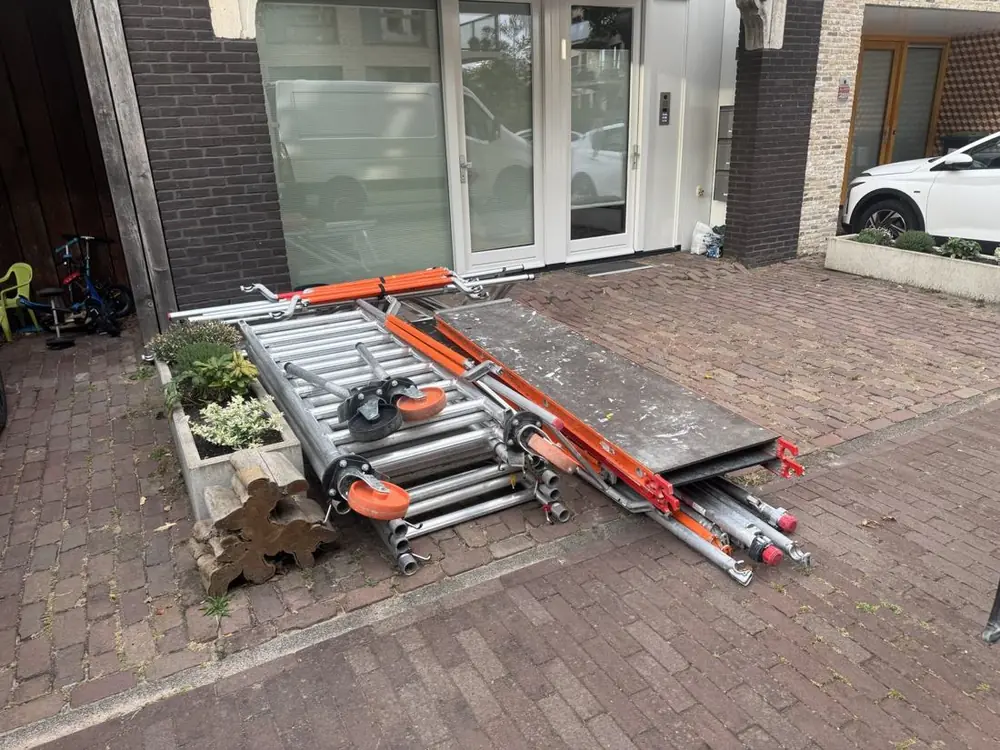
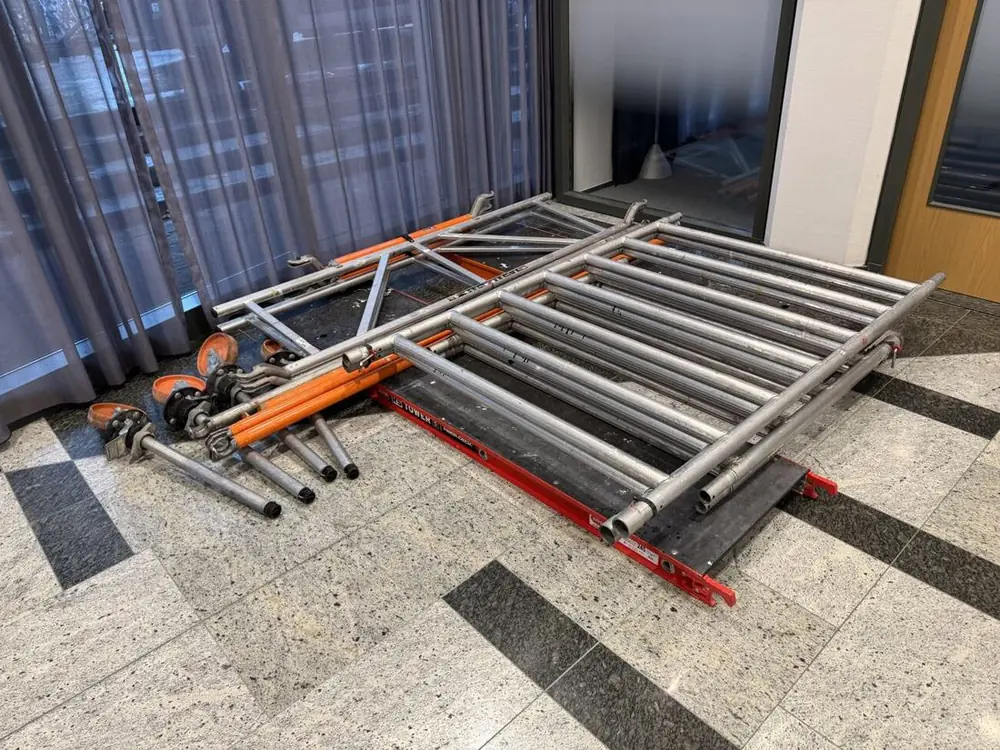
Scaffold components waiting beside a front door, the load that still has to travel through the hall into the room

An outdoor model is a nuisance for this job. Such a build reaches higher than you ever need inside, its parts were never drawn for a stairwell or a narrow hallway, and the base fouls your furniture. If the front elevation follows once the plaster is dry, that is the moment to hire a mobile scaffold instead, and those models sit in the range of mobile scaffolds for outdoor work. For everything that happens behind the front door, plastering walls included, the room scaffold remains the model that fits.
What working height to hire for a three metre wall

With plaster the highest point is the join between wall and ceiling, and that line has to be closed with the trowel. So measure from the room floor up to that line, not up to your own eye level. In a house with a raised ceiling, an old upper storey or an open stairwell you land on 2.80 to 3.20 metres without noticing. The build you hire for that sits between 3 and 4 metres of working height, and it puts you comfortably under any normal interior wall.

Do not confuse working height with the height you actually stand at. To the height your deck is pinned you add roughly 2 metres of reach, because your arms and the trowel cover the rest. With the deck at a little over one and a half metres you are working the wall up to about 3.5 metres. Book on that total, and the page about a build reaching four metres of working height shows what it delivers in practice.

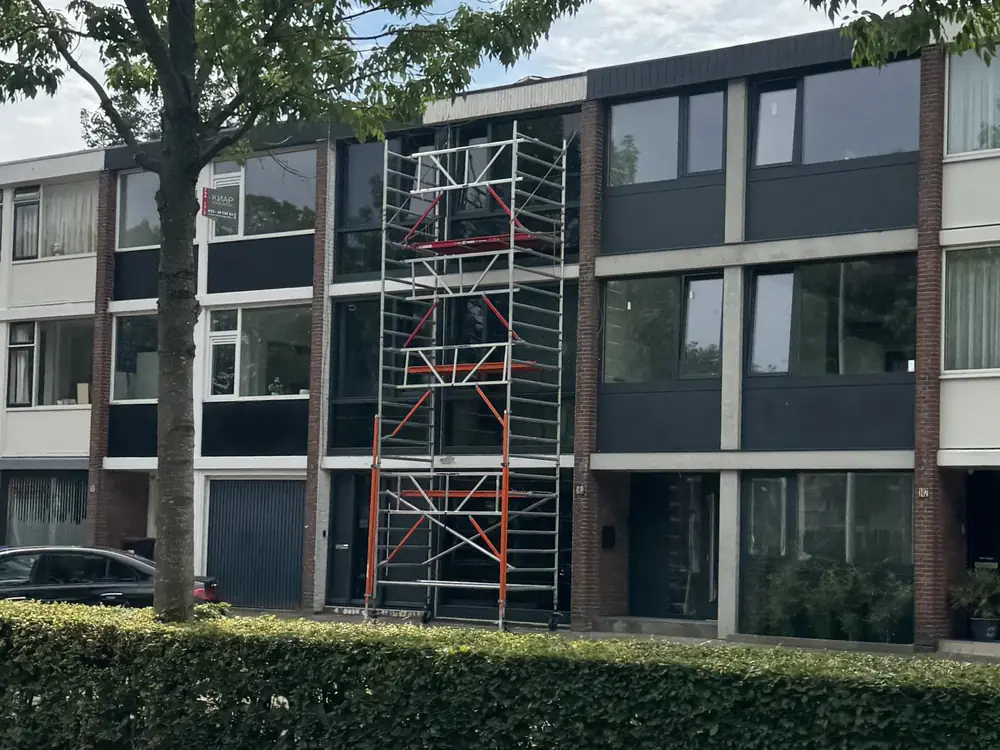
Mobile scaffold with a deck and double guard rails, set at the height where you reach an interior ceiling line

Hiring too low shows up exactly where it stays visible. You end up laying the top twenty centimetres against the ceiling with your arms stretched, you lose pressure on the trowel and the face runs proud. Worse, you start correcting from the top tread of a hop-up while the mix is already pulling. Take a build with a little room to spare instead, because dropping the deck one hole down is a five minute job and running short is not.

Where the hired room scaffold stands while you plaster

A room that is about to be plastered is seldom empty. A cupboard stands against the wall and has to shift, a radiator sits under the window, and a skirting board runs along the floor that you will not be able to reach later. So only roll the room scaffold in once the wall is completely clear, and keep a metre spare at either end so you can walk past it and put the bucket down somewhere. That clearance is needed at the feet for the stabilisers as well.

The floor is the second point. On laminate, parquet or a poured floor, put hardboard or a thick sheet under the castors, because the weight of the build plus you plus a full bucket rests on four small contact patches. On a screed or tiles the hired room scaffold rolls straight over, though you sweep the grit away first. One small stone under a castor makes the whole thing rock, and you feel that with a loaded trowel in your hand at the worst possible moment.

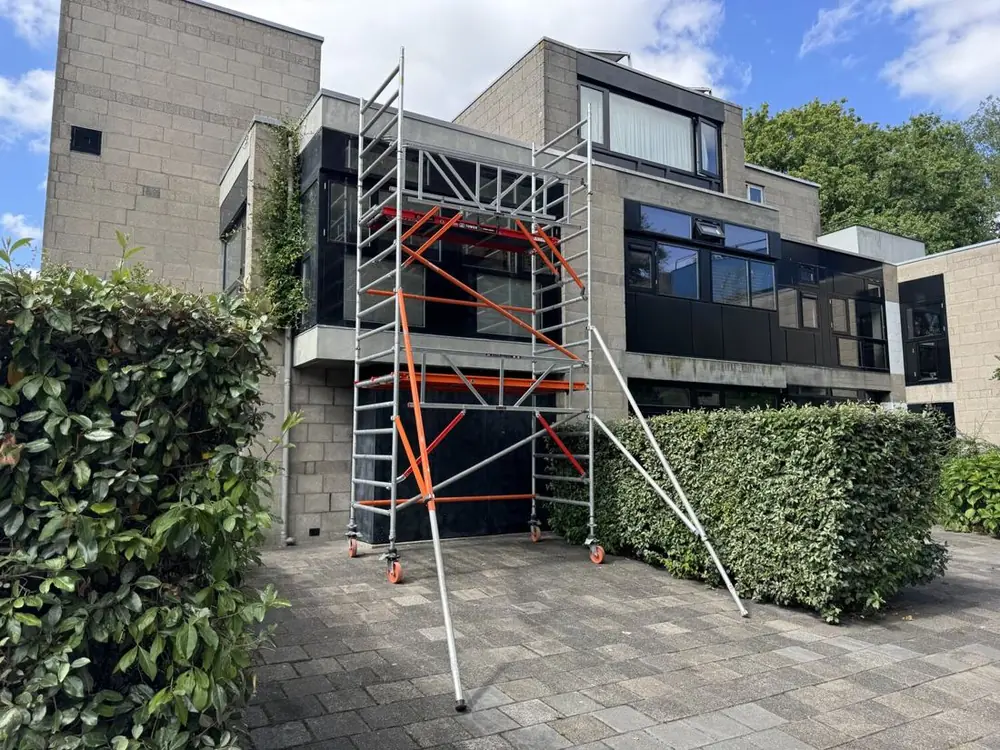
Stabilisers swung out at the base of a mobile scaffold, the angled legs that need clear floor around the build

Finally look at what hangs over your head and to the side. A pendant fitting, a smoke detector, a curtain track or a sloping wall under the roof all decide how close the build may come to the wall. Take pendant fittings down before you assemble. In a hall or on a landing you sometimes get only half a platform length, so you reposition more often. There is more on indoor use in the piece on using a mobile scaffold inside a house.

How many hire days a room scaffold needs for plastering

Count in wall faces, not in rooms. A wall four metres by three goes on in a morning with two people, but flattening follows and a couple of hours later the trowelling up, and you plan that for the same day. A living room with three walls and a ceiling fills two full working days that way. Moving from room to room adds half an hour of assembly and dismantling per room on top of the time you spend on the deck itself.

Then the curing. Fresh plaster has to dry for days before paint or paper may go on, and during that period the build is of no use to you. So you hire it for the days you are laying on, and have it collected afterwards, rather than leaving it idle in the room. If you want to paint once it is dry, book a second hire period later. The rental price attached to each period is listed on the tariff page for every model.

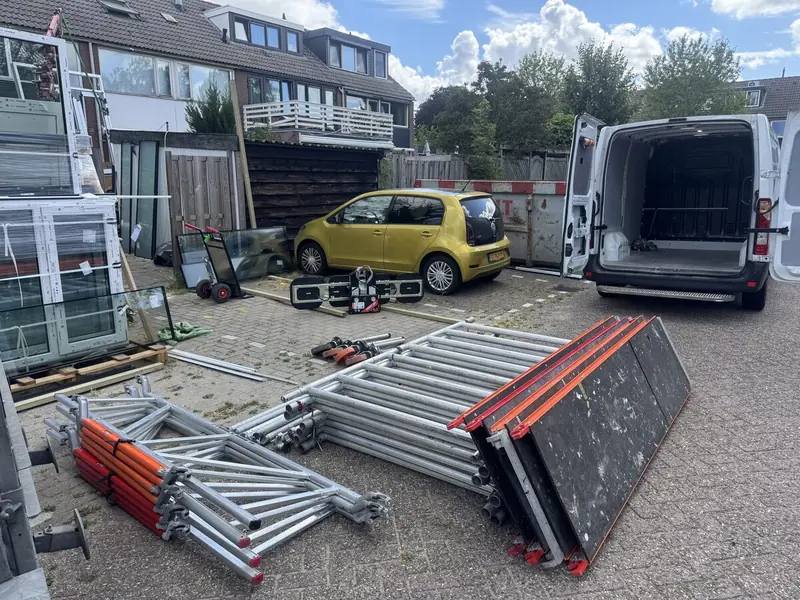
Scaffold material strapped on a pallet ready for transport, the hire set leaving for your chosen delivery day

Booking generously works out well here. Only the opening twenty four hours goes onto your reservation at the whole figure; everything joined onto it carries ninety five per cent off per day. With plaster that is welcome, because nobody knows in advance how many hours an old, wavy wall will take to bring flat. Put the collection date one day later than you hope to need, and you will not be dismantling in the dark on the last evening. Plastering walls rewards that bit of slack.

Which mobile scaffold suits plastering walls?

Most chosen
Kamersteiger RS44
  • Working height up to 4 metres
  • Compact and narrow
  • Great for indoor and small jobs
View and calculate →
Smalle rolsteiger RS51
  • Working height up to 14.2 metres
  • Narrow (75 cm)
  • Ideal for narrow passages
View and calculate →
Brede rolsteiger RS52
  • Working height up to 14.2 metres
  • Wide platform (135 cm)
  • Extra stability and workspace
View and calculate →
1-persoons steiger MiTower
  • Working height up to 6.2 metres
  • Very compact
  • Quick and easy to assemble
View and calculate →

Plastering a whole wall face from a 245 cm platform

A platform length of 245 cm is also the width you finish per standing position. On a four metre wall that means two positions, and you put the changeover somewhere it will not show later: at a door frame, in an internal corner, or under a dropped ceiling. On a blind six metre wall you set out the bays before you start, because the junction between two strips has to be made wet on wet and not half stiffened.

Decide before you begin what goes up with you. A bucket of mix, a trowel, a straightedge, a sponge and a pail of water is plenty; everything else you add is in the way the moment you shuffle sideways. Mixing happens below, so stand the tub and the paddle drill right beside the build rather than out in the hall. With two of you, one stays down to pass things up, and that saves dozens of trips.

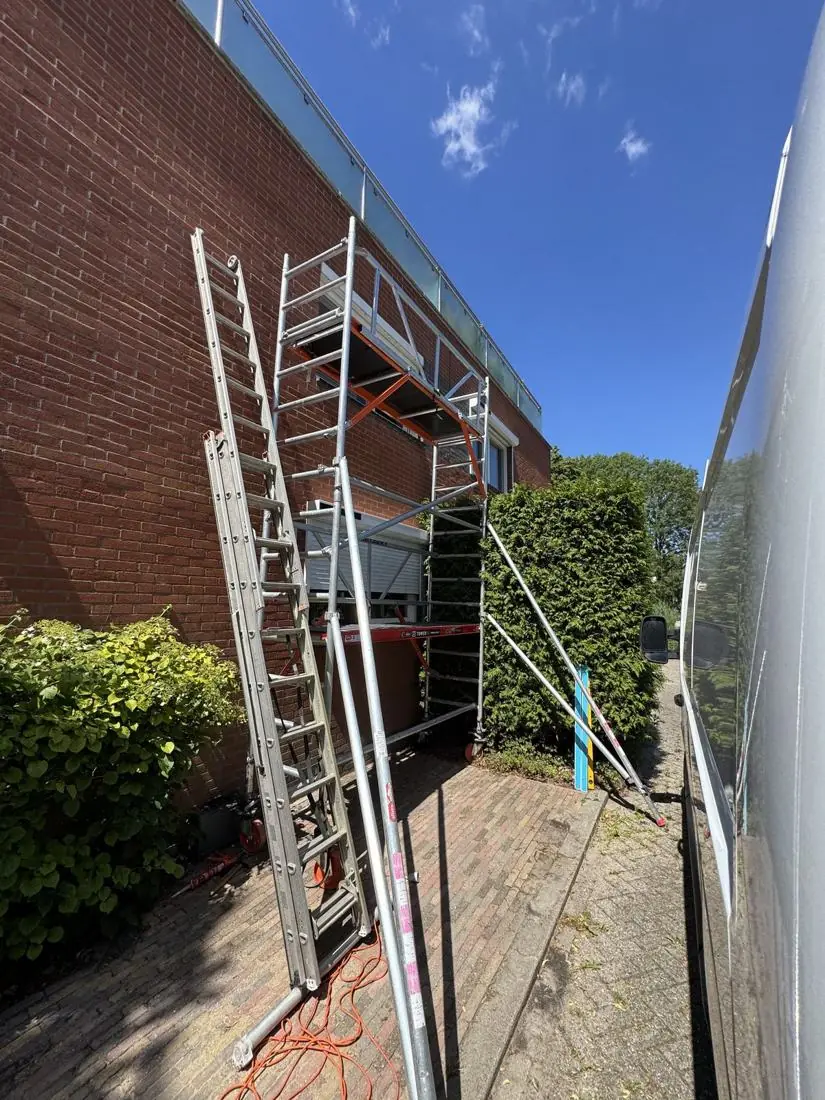
Assembled scaffold with its integral climbing frame up to the deck, the route you use all day during plaster work

What catches people out is the second pass. Flattening and trowelling up want the same positions as laying on, in the same order and at the same intervals. So you need the room scaffold not only while you are spreading, but all day. Anyone who starts dismantling straight after laying on is standing an hour later with a sponge in hand looking up at the top edge. Leave the build standing until the face is genuinely finished. Plastering walls ends when the trowel comes off, not when the spreading stops.

Hiring a room scaffold with delivery on your plastering day

The room scaffold arrives as a complete set of parts, every item counted before it leaves. There is a 15:00 cut-off on working days; stay inside it and your parts travel out for the working day that follows. While booking you set the drop-off and return dates yourself. Agree in advance where the parts may be put, because a load that lands in the middle of the hall sits exactly on the walking route of your plaster job. A garage, an empty bedroom or the utility room works better.

Assembly is the part that stays with you, because we do not erect scaffolds and nothing ever arrives assembled. A manual comes with the set, and the assembly video shows the order the parts go together in; at this height you are done in half an hour. Do that on the day before the first bucket is mixed rather than the same morning: you want to start with the wall clear, the floor covered and the build sitting level. Fresh mix will not wait while you are still clipping braces.

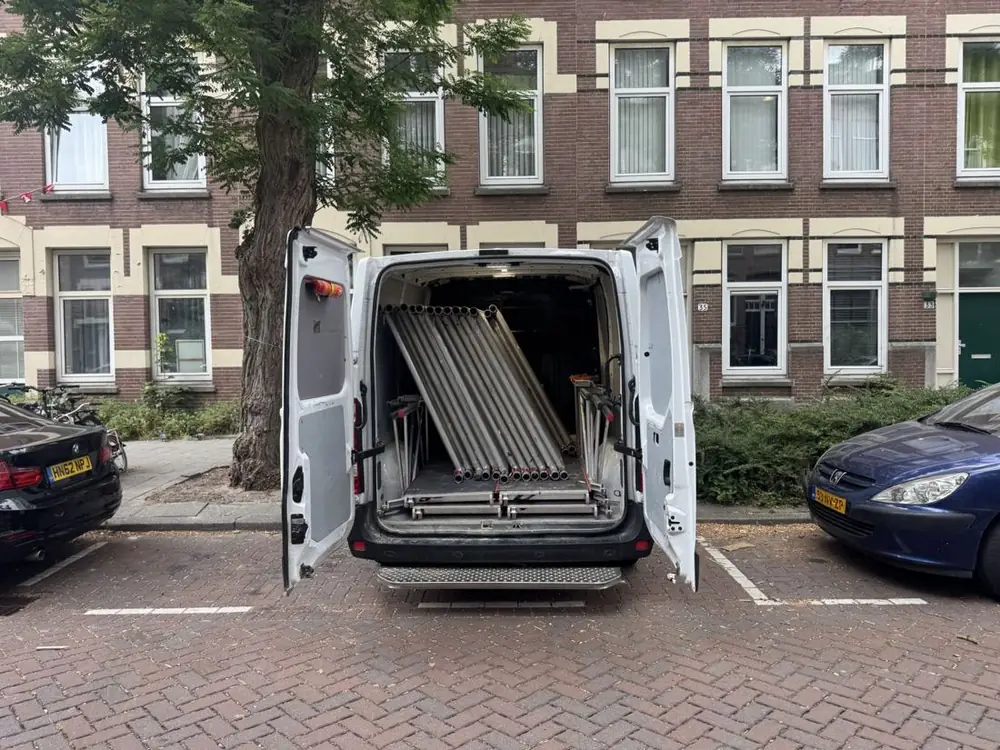
Delivery van loaded with scaffold parts parked at a house, the moment your hire set for the plaster job arrives

Afterwards you take the room scaffold apart again, bundle the parts and stack everything at the agreed spot. On the day you chose, our van comes back for the material, so nothing has to be driven anywhere. If the plastering overruns because a wall needed more preparation than expected, pass on a new collection day through the contact page of the rental service. That is easier than forcing the last of it into one evening.

Working safely on a hired room scaffold while plastering walls

The deck is a class 3 platform under EN 1004, so each square metre of it will take 200 kg, and with plaster you approach that sooner than you would think. A full bucket weighs close to thirty kilos, and if somebody else steps up to pass the straightedge, that counts heavily too. Keep the load spread out over the deck length instead of gathering it all into one corner, however convenient that feels while you are spreading.

The second risk is under your shoes. Mix that drops past the trowel makes the deck slick and sticky within an hour, and you only notice at the moment you step sideways. Wipe it down with a wet sponge as you go and keep the top surface free of blobs. Set the castor brakes before you take the first tread, and only move the room scaffold when nobody is on it and the bucket is off: empty it first, then push.

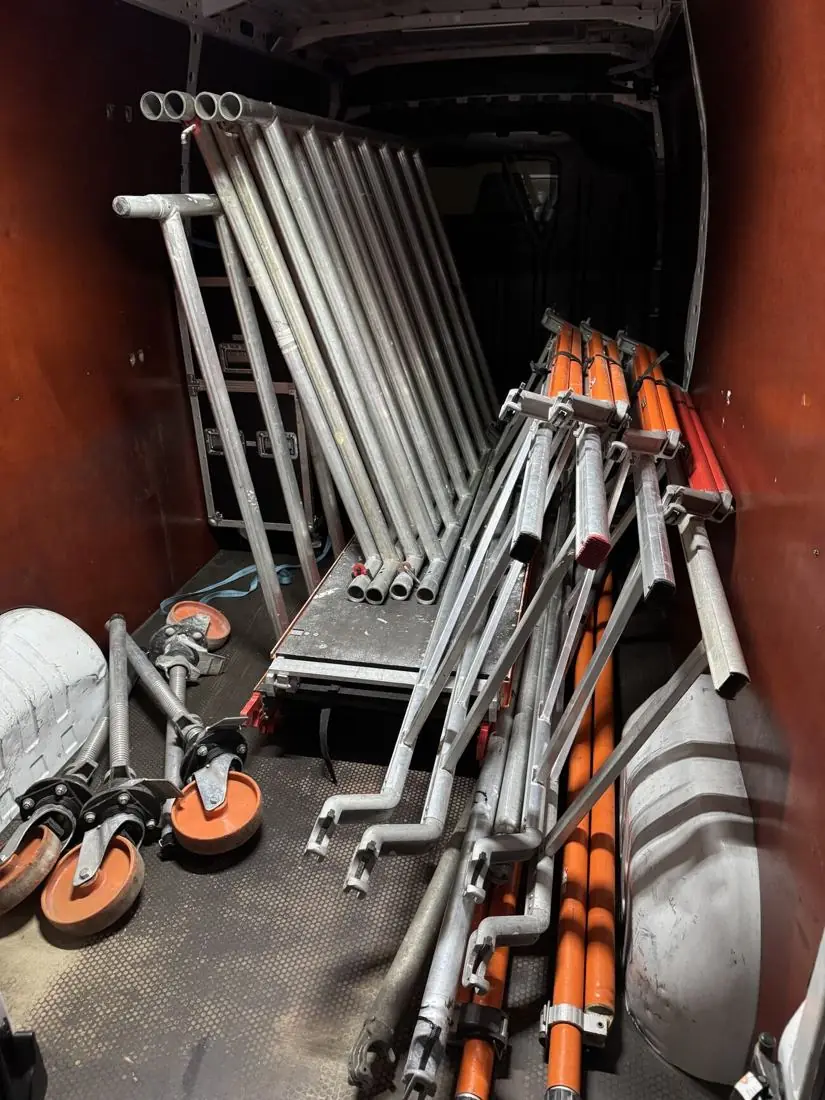
Inspected scaffold components laid out side by side, the material you work at height with indoors without improvising

Finally, think about who is walking below. Indoors that means housemates, children or a dog coming into the room while you are working with a trowel above your head. Keep the door of the work room shut and say that plastering is going on. Do not leave tools loose on the edge either, because a trowel that falls lands point first. The rules that actually apply here are gathered together in the piece on working safely at height.

In 5 steps

How hiring a mobile scaffold works

1
Choose working height

Pick the height that suits your job.

2
Book online

Sorted in 60 seconds, price shown instantly.

3
We deliver

At the agreed spot the next working day.

4
Assemble safely

Assembled by you, with a manual.

5
We collect

One call and we collect the scaffold.

Good to know

Practical tips for plastering walls

1

Stand the mixing tub and the paddle drill right beside the room scaffold, not out in the hall. Every metre you walk with a full bucket is a metre you can spill on and step through later.

2

Tape the floor edge and the skirting along the full length of the wall before the build goes up. With the scaffold in front of it, a knife and a roll of tape will never reach that bottom strip again.

3

Lay an old towel on the deck edge where you rest the straightedge while plastering walls. Aluminium slides off steel the instant you let go, and a straightedge that drops three metres onto a hard floor is bent for good.

4

Assemble the room scaffold in the room you start in and move it between rooms in parts. Rolling through an interior door rarely ends well, while an unclipped brace goes back on in seconds.

5

Have someone pass the two metre straightedge up once you are standing on the deck. Climb the frame with a length under your arm and you have one hand left, and that is where indoor work goes wrong.

6

Have the hire set delivered the day before your first plastering day. Then the room scaffold is already standing and the floor is already covered by the time you mix the first bucket.

Frequently asked questions

Frequently asked questions about plastering walls

Which room scaffold should you hire for plastering walls indoors?+

Indoors you plaster from the Altrex RS44 room scaffold. It is a model drawn specifically for use inside a house: it goes through an interior door in parts and gives you a build up to four metres of working height. That reaches the ceiling join on virtually any internal wall without stretching, whereas an outdoor model in a living room is simply in the way. If you are weighing up two options, the comparison of a mobile scaffold against a room scaffold lines the difference up neatly.

How does booking and hiring a scaffold for a plastering job work?+

You start online with the model and the build you need, then fix two dates and see straight away what the hire comes to, VAT included. After that the set of parts travels to the address you gave, you put it together in the room, and our van pulls up after your last plastering day to take everything back. No driving and no trailer on your side. The whole sequence is summarised among the frequently asked questions about the rental service.

How many hire days do you need to plaster a room?+

For a single wall four metres wide one hire day covers it, flattening and trowelling up included. Do a whole living room, or several rooms one after the other, and two to three days is realistic. Drying of the plaster coat does not count, because the scaffold does not need to stand for that. Take the collection date a little wider rather than tighter, so you are not dismantling by torchlight because the van is due back first thing.

What do you pay to hire, and what changes on day two?+

Every scaffold in the fleet has a fixed price including VAT, shown on the site before you book. The opening period of twenty four hours is settled in full; each day joined onto it counts at a heavily reduced figure. Keeping the build on therefore works out better than planning two separate reservations back to back, certainly on a plaster job that runs over. Carriage each way sits in one fixed amount per province, listed on the page with the cost of delivery.

What working height should you hire for a three metre wall?+

With a three metre ceiling you hire a scaffold with a build of 3 to 4 metres of working height. You then stand at around a metre and a half and carry on comfortably with the trowel right into the top corner of the room. If you are plastering in a house with a void or an old upper floor, measure again, because the wall there runs half a metre further than you expect. Book on the measured total; the ranges sit side by side on the working height page.

Do you deliver the room scaffold, or can you collect it from the rental depot?+

Two routes run alongside each other here. Have the scaffold material brought and it arrives on your own date and leaves with the van again after the last plastering day; a fixed rate per province goes with that and you see it beforehand. If you would rather fetch it with your own transport, the set can travel free of charge by appointment from Zeeburgerpad 89 in Amsterdam. Allow for a roomy van for a build up to four metres, and for two runs in total.

Do you have to build the hired room scaffold yourself?+

Assembly belongs to your side of the work. We bring the full set of parts, counted item by item, and remove it once your plaster job is done, but we do not erect anything and we never deliver a scaffold assembled. The assembly order comes with the delivery and there is a short video online in which every step passes by. At this working height building alone is perfectly manageable; with somebody helping, the room scaffold stands level in the room inside twenty minutes.

Can you extend the hire if a wall needs more preparation?+

Yes, and with plaster that happens regularly. A wall that has to be dubbed out first, or that needs a scratch coat, costs an extra day soon enough. You simply pass on a new collection date and the hire period runs on at the reduced daily figure. That is handier than returning the room scaffold and having it come again later, because then you pay twice for carriage and you stand a few days without a build while the preparation carries on regardless.

How much floor space does the hired scaffold need in the room?+

Keep a strip of roughly a metre and a half along the wall completely clear and make sure you can walk round the hired scaffold at both ends. The stabilisers stick out at an angle and must not press against a sofa or a cupboard. Push furniture into the middle of the room and cover it. For the bucket and the pail of water you also want a flat patch of floor that is not on your walking line, because you will be going round it all day.

Does the weather affect your hire days when plastering indoors?+

Not for the spreading itself, since you are standing dry. Weather counts at two other moments: at delivery and during drying. A van of scaffold material sometimes runs late in ice or a gale, so do not let the drop-off coincide with the morning you want to begin. And in cold, damp weather the plaster coat hardens more slowly, which mainly means the hired build can go before the wall may be painted. In practice the weather shifts your painting date, not the days you booked for plastering walls.

What happens to the deposit when a scaffold hired for plastering goes back?+

You pay a deposit on top of the hire when you book. Once the scaffold is back, checked over and found complete, you see it returned within 1 working day. A few splashes of mix belong to normal use, so there is no need to lie awake over that; it is about damage and about parts that are missing. Do wipe the deck and the braces down before you bundle, and do not let plaster dry on the tubes for days. A wet sponge makes that a ten minute job.

Can you keep the same room scaffold on hire for the ceiling?+

Yes, and that is a good reason to take the hire period a little wider straight away. You plaster a ceiling from the same deck, except you set the build square to your bays and reposition it more often than on a wall. Bear in mind that overhead work is heavy on your shoulders, so do not plan it directly after a full day of wall work. At the very least you save yourself a second delivery and a second assembly.

Hire a mobile scaffold for plastering walls today?

Calculate your rental price now or ask for free advice.

Rolsteiger van SteigerTaxi geleverd op locatie
Book it online

Your scaffold sorted in 2 minutes.

Choose your scaffold and working height, see the price instantly and book online.