
See your price
Application

Replacing decorative trim? Choose the right scaffold.

Replacing decorative trim begins with demolition, and that is the awkward half. The old moulding is held by rusted nails driven into fixing blocks or into the fascia, and anyone who pulls too hard brings a lump of render or a mortar joint down with it. The profile then has to be copied, which takes a week or two at the mill. A moulding under the eaves of a two storey house puts you at 6 to 8 metres, so you hire a mobile scaffold in the narrow RS51 pattern, 75 cm across the frame.

  • Order before 3 pm, delivered tomorrow
  • Professional Altrex scaffolds
  • Up to 14.2 metres working height
  • Easy to assemble yourself
4,2 tot 14,2 mWorking heights available
12Provinces served
7Days a week
200 kg/m²Load class 3
In short
  • For replacing decorative trim we recommend the Narrow mobile scaffold.
  • Replacing decorative trim under the eaves calls for the narrow RS51 at 75 cm, built to 6 to 8 metres of reach.
  • Cut the old moulding into short lengths and lever against a wooden block, or you will open up the wall behind it.
  • You hire a tower twice over for this job, because weeks pass between taking the measurements and the new lengths arriving.
  • First 24 hours from €150 incl. VAT and delivery; every day after that 95% off.
Key facts for this job
FeatureValue
Recommended scaffoldNarrow mobile scaffold (Altrex RS TOWER 51)
Working height for this job6 to 8 metres
Available working heights4.2 to 14.2 metres
StandardEN 1004, load class 3 (200 kg per m²)
DeliveryOrdered before 3 pm, delivered next working day
Each extra day95% off, from €7.50 a day
Why a mobile scaffold for replacing decorative trim?

Safe, stable and professional work at height

Replacing decorative trim is not a job you finish in one run. First the old moulding comes off, and for that you stand with both hands on a crowbar and a shoulder against the wall, which only works on a deck that does not give and where you can move about freely. Then everything stops while the joinery works copies your profile. Only when the new lengths arrive do you go back up, this time handling three or four metre pieces that have to be offered up and mitred. Hiring a tower here is therefore mainly a question of when you need it, and how often.

  • Rusted nails in the fixing blocks behind it
  • Render and pointing must stay on the wall
  • Copy the profile before the old one disappears
  • Replacing decorative trim means two separate tower bookings
Read more about working safely →

Which mobile scaffold to hire for replacing decorative trim

For replacing decorative trim under the eaves you take the Altrex RS51, a frame just 75 cm across the base. That narrow measurement is a gain rather than a loss here, because decorative trim often runs on over a bay window, past a downpipe or right along to the boundary line, and a wide tower will not follow it cleanly. The scaffold usually stands on the pavement or the drive as well, where a walkway has to be left. What else is available appears in the range of mobile towers you can hire.

On the 245 cm deck you work with timber longer than the floor you are standing on. A four metre length therefore does not go up in one piece; you cut it to size below and carry it up in sections, or have somebody pass it over the guard rail to you. Expect to be up and down a great deal, because the offering up happens aloft while the sawing happens down on the ground. That makes a solid, roomy ladder inside the tower count for more than extra deck width.
Narrow mobile scaffold built along a house wall, the 75 cm stand you hire for replacing decorative trim

An RS52 at 135 cm only becomes interesting once two of you are working the same run and toolboxes, sealant guns and even a mitre saw have to stand up there alongside you. Above a front door or a bay you gain nothing from it, since what you want is to be close in against the wall. How the two of them compare is set out in the comparison of tower sizes across the hire fleet.
Hiring the working height that puts the trim at chest level

Measure to the top of the moulding and add the slack you need to get a crowbar in behind it. On a house of two storeys that line generally sits between four and six metres, which lands you in a 6 to 8 metre band. Where the trim runs round a dormer or carries on over a bay window the height varies from one stretch of wall to the next, so take your reading at the highest point on the run and book the tower for that.

The number on the order is your deck height with the two metres or so your arms add counted on top of it, so the floor you stand on always ends up lower than the figure you booked. For this work you want that floor sitting just below the moulding, so you can lever at chest height instead of above your head. Force applied with straight arms neither works properly nor spares the wall behind. What a given band means in parts is described on the page about eight metres of reach.

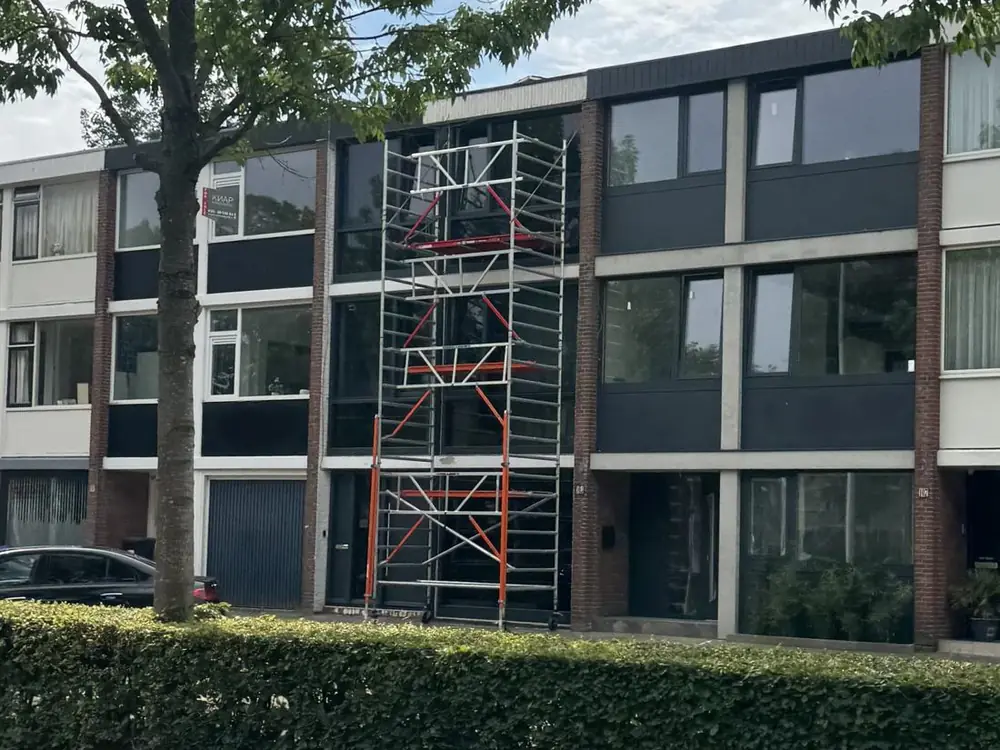
Mobile scaffold against a front elevation with the top deck just under the eaves, the build you reserve for moulding work

Do not forget that the new length has to go back up as well. Fitting means holding the profile in place with one hand and driving screws with the other, and for that you want a little clearance above your head for the drill. Book the tower too low and you are left balancing three metres of timber on tiptoe. On a wall of two storeys the upper build in this band is nearly always the right call.

Where the hired tower stands while you strip old trim

Decorative trim is usually on the front of the house, which means the pavement, the drive or a narrow front garden. Look first at where the castors are able to stand: slabs are fine, a gravel path sinks under load and a planted border is hopeless. If the tower sits partly on the public footway, leave anyone on foot a clear way past and ask at the council what the rules are in your street. Arrange that a week before the set is delivered, and not on the morning the van arrives outside.

All sorts of things come down from under a moulding once it is loose: rotten timber, bent nails, lumps of old sealant and sometimes a slab of ancient paint. Fence off the zone beneath your working position with cones or a sheet, particularly where cars park or children walk past. The stabilisers occupy that ground too, so allow a strip a metre wider than the tower on either side. Move any parked cars out of the way before you start, because a dropped crowbar is not a theoretical problem.

Splayed stabiliser legs under a mobile scaffold, showing the pavement width you have to reserve before the hire begins

Give some thought to your sawing position at ground level as well. The new lengths get cut to size and the corners mitred down there, on trestles beside the tower rather than up on the deck. So keep clear not only the footprint of the frame itself but room for a two metre bench beside it, with a socket within reach. Put that station too far away and every trial fitting costs you another walk across the garden.

Two hire periods with the timber yard in between

Replacing decorative trim falls into two blocks with a gap between them. Stripping out and measuring costs one to two days: the moulding off, the fixing blocks inspected, the timber behind it checked and a clean section chosen to serve as a pattern. That section then goes off to the joinery works, and one to two weeks pass before the new lengths are ready for you. Fitting, sealing and painting takes another two to three days after that, and a corner house with trim round the return runs longer still.

Those intervening weeks are why you book twice rather than once at length. That is no problem, but it is worth knowing in advance: each booking opens with a day at the standard rate before 95 per cent comes off the days that follow it. Two separate periods of two days therefore carry two opening days between them. Build a spare day into the demolition block for that reason, and do exactly the same when you book the fitting block.

Frames leaning against a house wall on the pavement, the same hire set booked twice with weeks of joinery between.

There is an alternative many people overlook. Where the moulding happens to start low enough, above a bay window or over a single storey extension, you can take one short sound length off first to serve as a pattern, without putting the whole elevation in scaffold. Then you only hire the tower once the new profile has arrived, and a single continuous period will do. Weigh that against the state of your old trim, since a rotten piece of moulding makes a useless pattern.

Which mobile scaffold suits replacing decorative trim?

Kamersteiger RS44
  • Working height up to 4 metres
  • Compact and narrow
  • Great for indoor and small jobs
View and calculate →
Most chosen
Smalle rolsteiger RS51
  • Working height up to 14.2 metres
  • Narrow (75 cm)
  • Ideal for narrow passages
View and calculate →
Brede rolsteiger RS52
  • Working height up to 14.2 metres
  • Wide platform (135 cm)
  • Extra stability and workspace
View and calculate →
1-persoons steiger MiTower
  • Working height up to 6.2 metres
  • Very compact
  • Quick and easy to assemble
View and calculate →

Taking the trim down and fitting it from the deck

Never lever straight against the masonry itself. Put a block of wood under the crowbar so the load goes into timber rather than into a mortar joint or the edge of the render. Saw the moulding into lengths of about a metre first, and then each piece holds only a few nails and nothing drags anything else along with it. Nails that will not shift get punched through from behind or simply cut off, because pulling them out tears both the timber and the ground behind it.

Before anything comes down, capture the profile. Run a contour gauge over the cut end, or trace the section out onto a piece of stiff card, and photograph how the moulding meets the wall above and below. Then take the cleanest length down with you to serve as a pattern, because a drawing on its own gives a mill very little to work from. Do all of that on your first hire day, while the tower is still standing; going up again for a forgotten dimension costs a whole second period.

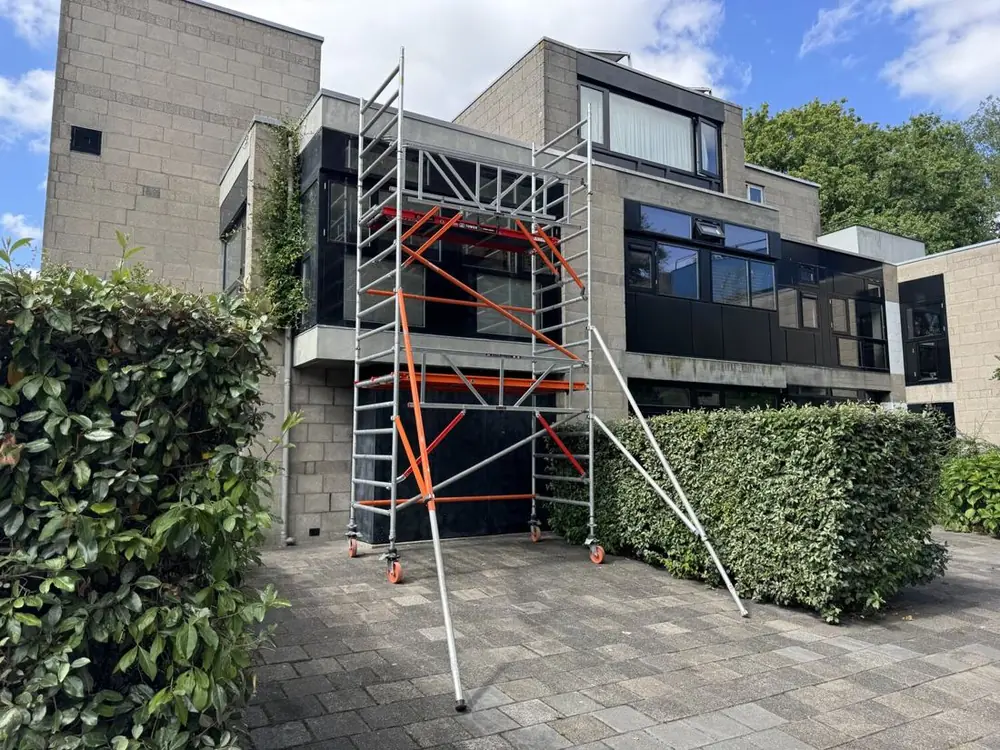
Assembled tower standing at the flank of a house, the position you hire from while stripping a run piece by piece

Fitting makes the corners the difficulty. On an old house an external angle is seldom a true right angle, so cut your mitre a degree or two generous and pare it back until it closes. Take that reading in place from the deck of the tower rather than off a drawing. Seal the top edge and the end joints afterwards but leave the joint along the bottom open, because any moisture that does find its way behind has to have somewhere to run out again.

Hiring delivery twice: demolition week and fitting week

Because you hire twice, you plan two deliveries. Put the first of them on the day before demolition starts, so the tower can go up unhurried and you begin on the moulding with a fresh morning ahead. Anything ordered up to 15:00 on a working day can arrive the working day afterwards, so long lead planning is unnecessary. Pin the second delivery down only once the joiner confirms your profile is ready, because a promised date at a mill slips by a week without much difficulty.

You receive a complete, counted set of parts, and putting it together is your own work, done with the manual and the Altrex video within reach. Lay the components out on the drive or along the wall, and never on the stretch of pavement the neighbours have to use. Building it again for the second period goes noticeably faster, since the order of the parts is already familiar. The stage by stage assembly guide covers what to watch at each level of the tower.

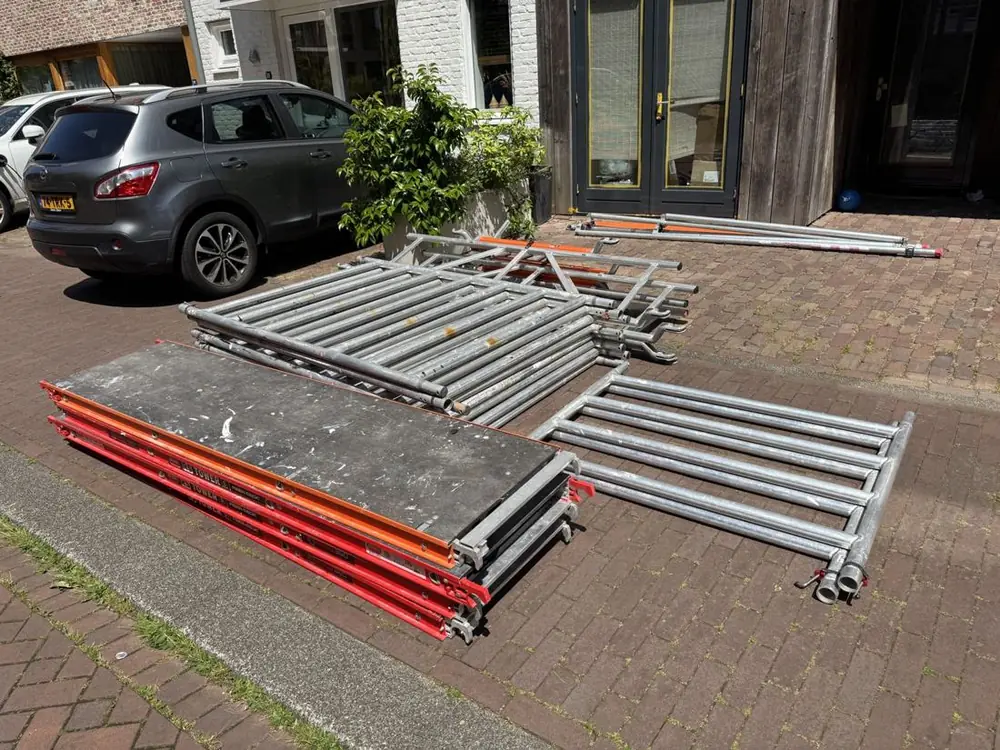
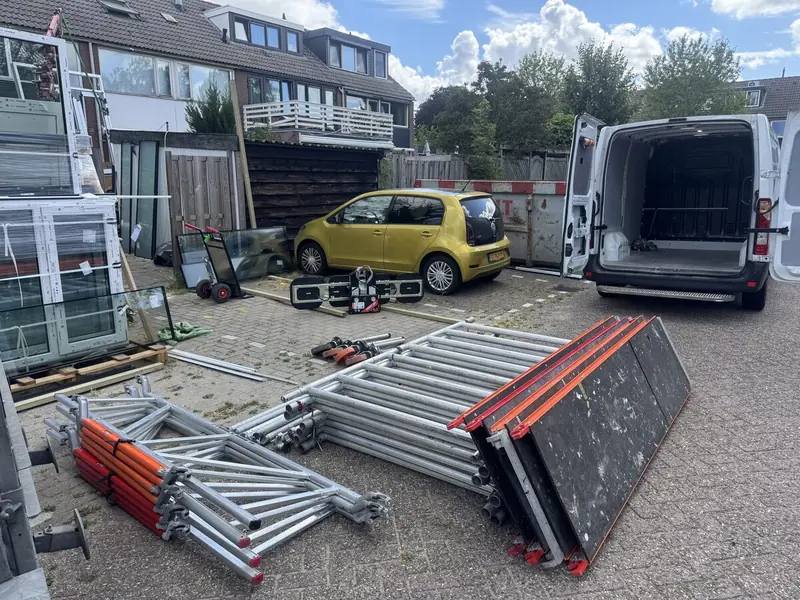
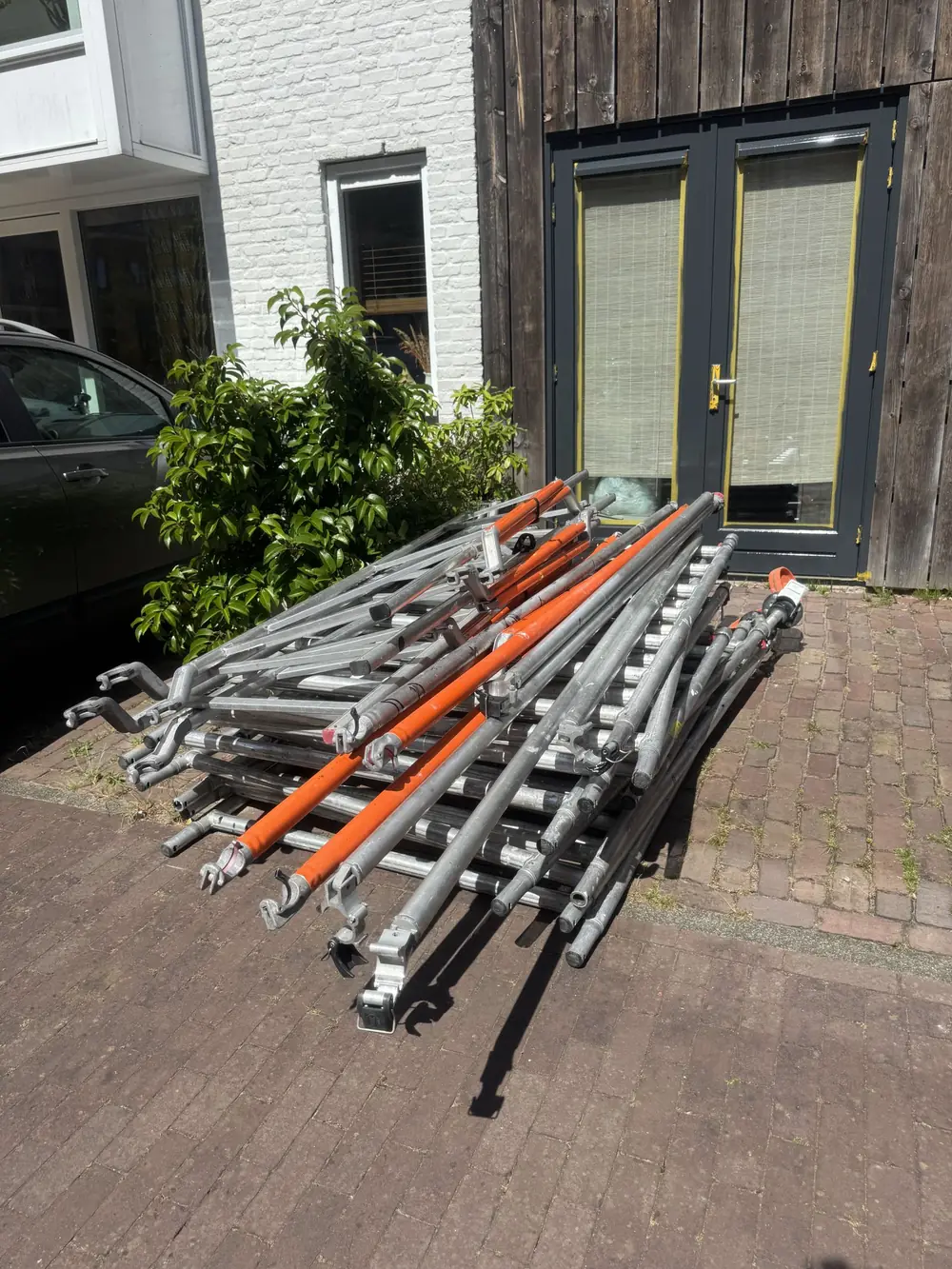
Scaffold parts laid out in the street in front of a house, the counted set delivered for each hire period

After each period the set is collected again, and you leave it dismantled and complete on the day agreed. Tally the components while the tower comes apart, so you know for certain that nothing has finished up in the pile of scrap timber. If you live nearby, collecting the set at Zeeburgerpad 89 in Amsterdam by appointment costs you nothing extra at all. The fixed figures for each province appear at the charges for bringing and fetching the set.

Replacing decorative trim safely from a rented mobile scaffold

Replacing decorative trim means pushing sideways, and sideways is exactly what a tower minds. The deck itself copes without difficulty, since EN 1004 rates load class 3 at 200 kg for every square metre and you with a crowbar and a length of moulding stay well under that. Stability is the real question here, so run the stabilisers right out and never shove away from the wall while you are standing on the topmost level of the platform.

The ordinary rules hold in full. Brake the castors before you climb up, keep the deck clear while the tower is being moved along, and come down when the wind gets up. Moulding work adds one thing: a freed length of three metres is heavy and catches the wind at the same time. Hand it down to somebody below or lower it on a rope, and never pitch it over the rail unseen. More on that sits at the rules that apply at height.

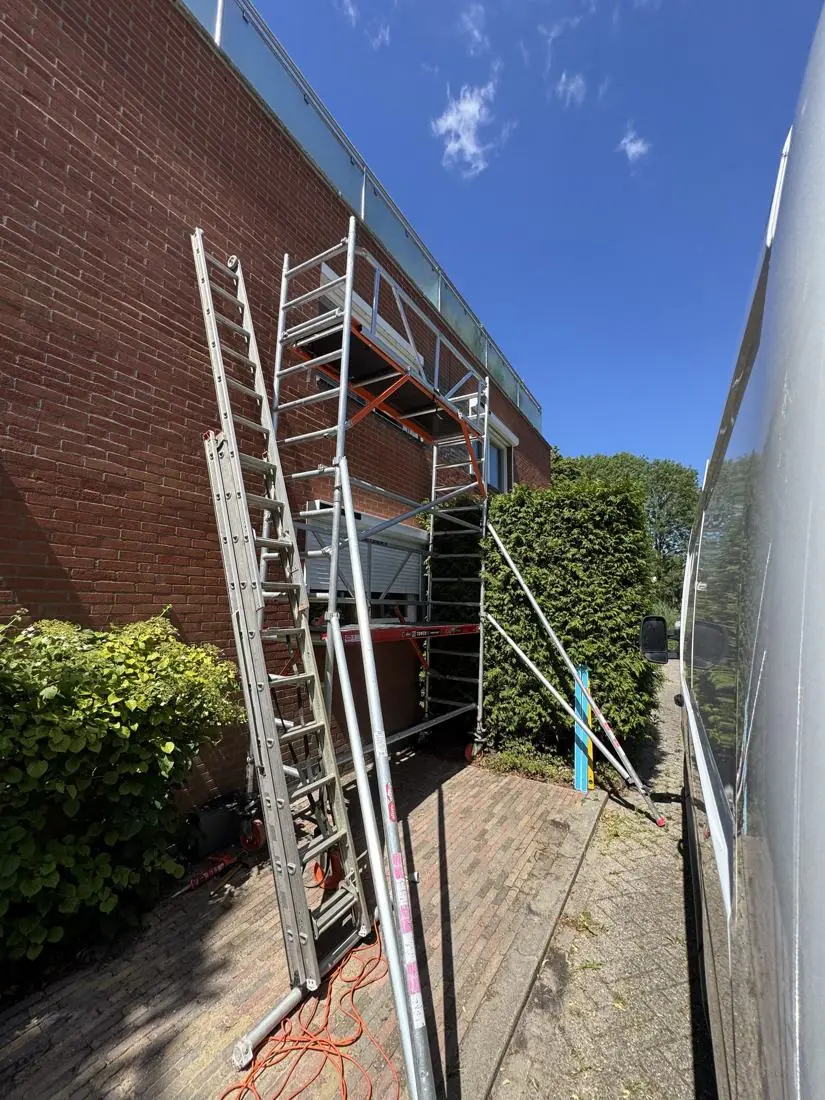
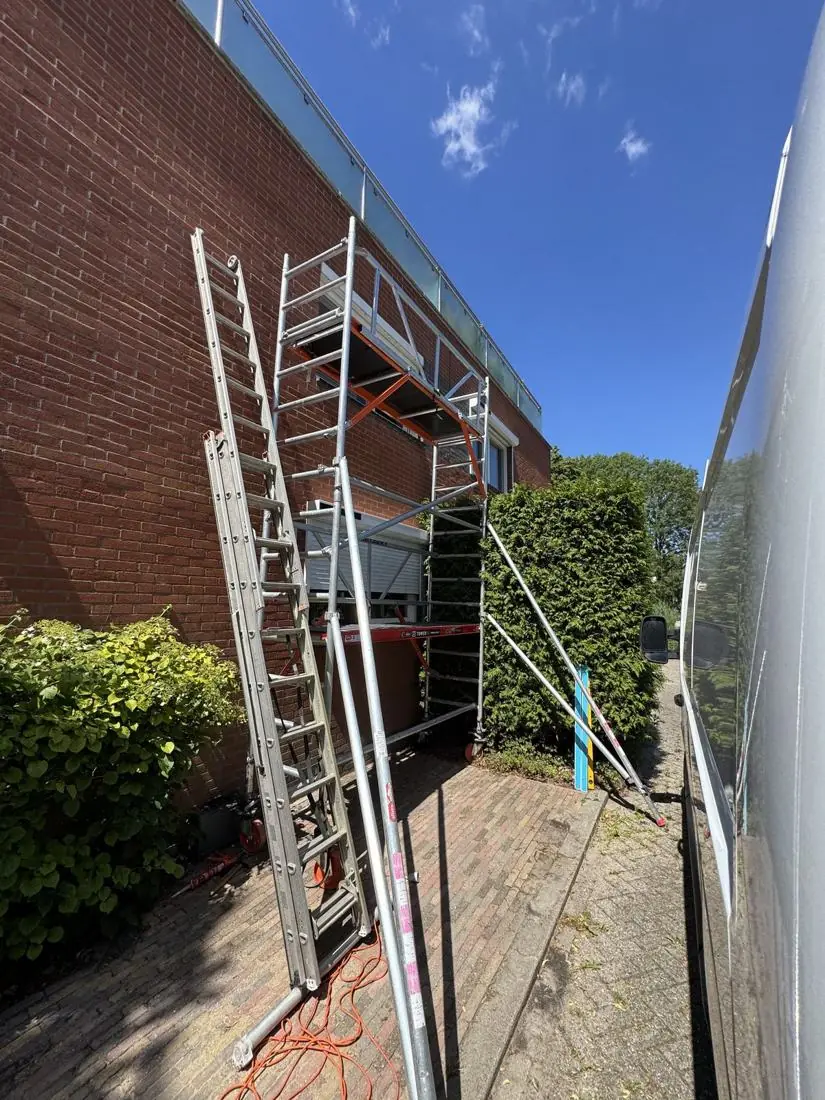
Assembled tower beside a brick wall with its stabilisers run right out, and an extension ladder resting against the same wall.

Finally, look at what appears once the trim is off. Perished fixing blocks, a sunken wall plate or a nest behind the fascia all change the job halfway through, and sometimes a stretch of wall stands suddenly open. Do not carry on working until dark in that case; sheet the opening over instead, because an open junction that takes a night of rain costs more than an extra day of hire. Planning for extra work is covered in the checklist to run before you book.

In 5 steps

How hiring a mobile scaffold works

1
Choose working height

Pick the height that suits your job.

2
Book online

Sorted in 60 seconds, price shown instantly.

3
We deliver

At the agreed spot the next working day.

4
Assemble safely

Assembled by you, with a manual.

5
We collect

One call and we collect the scaffold.

Good to know

Practical tips for replacing decorative trim

1

Photograph the moulding close up and from the side before you loosen it. A mill gets far more from a picture with a rule beside it than from a description, and you still know how it met the wall.

2

Number the pieces you take off with a marker pen and chalk their positions on the wall. Where a run turns a corner that saves you half a day of puzzling when the new lengths go back up.

3

Prime the new timber all round before it goes aloft, the ends and the back face included. Once it is fixed you can no longer reach those surfaces, and that is precisely where rot starts over again.

4

Check the fixing blocks the moment the old moulding is off the wall. Where any of them are soft or loose, renew them straight away, because new trim on old blocks will be moving again within a couple of years.

5

Leave the joint along the bottom edge open and seal only the top edge and the ends. Moisture that gets behind can then drain away instead of standing in the timber and rotting it from within.

6

Order a few extra metres of profile at the time you place the order. A mitre cut wrong or a split when nailing up happens easily enough, and another fortnight of waiting costs you a third hire period on top.

Frequently asked questions

Frequently asked questions about replacing decorative trim

For replacing decorative trim, which mobile scaffold should you hire?+

On a two storey house the RS51 is the obvious choice, the narrow one at 75 cm. It fits past a bay window, between two houses and onto a tight pavement, and up on the deck you need nothing beyond hand tools and a length of timber anyway. Where two of you are working the same run and a good deal of material has to stand up there, the wider RS52 in the hire fleet is the better call.

How does hiring work when the job falls into two halves?+

Replacing decorative trim splits neatly in two, so you simply book twice, each period with its own delivery date and collection date. On the first booking you strip the old moulding off and record the profile; on the second one you fit the new lengths. Reserve the first period as soon as a gap appears in your diary, and leave the second one until the lead time on the timber is known. Hiring the tower itself changes nothing at all; only the planning of the job does.

For how long do you need the tower on hire for this job?+

Allow one to two hire days for stripping out and measuring, and another two to three for the fitting and finishing. Between them sit the weeks in which your profile is being made, and during those no tower needs to stand at the house. Where the moulding turns a corner or crosses a bay window, add another day to each block. Book both periods a day longer than you hope to need them, because seized nails always take more time than anyone expects.

What does hiring two separate periods cost for this job?+

Each reservation is priced on its own, so you pay for two opening days at the standard rate and for two separate rounds of carriage. What every model and build comes to appears with VAT on the page with all the tariffs, and the rental price is visible before you confirm. For your planning that means stretching each period slightly rather than finding you need a third tower booking later on.

Which working height do you hire for trim under the eaves?+

Run the tape from the paving up to the top edge of the moulding, then add half a metre for the room you need behind it. A two storey house typically lands in the 6 to 8 metre band, and that is the build you hire. Where the trim sits above an extension, start the tape at the level the castors occupy rather than at the flat roof. Builds per height are listed on the page about seven metres of reach.

Can you time the hire delivery to the arrival of the new profile?+

Yes. Each reservation carries its own delivery day and collection day, so the tower can turn up the day after the timber lands. Hold off fixing that date until the joinery works confirms one of its own, because lead times shift by a week without warning. Collecting the set yourself is possible too, although the tubes will not go into every car. Most people have both periods delivered and save themselves four journeys.

Do you put the tower up yourself, or is that part of the hire?+

Assembly is yours to do. The set arrives complete and counted, you assemble it from the manual and take it down again afterwards. With two hire periods you do that twice, although the second time goes considerably quicker. Allow a couple of hours with two people on it the first time round. Powered access, facade scaffolds and system scaffolds are not things we supply, so for trim at six to eight metres this tower is the answer.

What if the profile is late and you have to hire for longer?+

That happens to almost everyone on this job. As long as no other customer is booked on that tower, your collection date shifts happily enough when you tell us in good time. Where the timber really runs away from you it is usually smarter to cancel the second period and rebook it once you have a firm date, rather than paying for a tower that stands idle. A phone call or an email is usually enough to sort it out.

How much room do you clear before hiring a scaffold for trim work?+

Take the width of the tower, allow for the stabilisers splaying out on either flank, and then add room for your saw bench and the waste timber. On a pavement that often means keeping a parking space free as well, and leaving a route for people walking past. Measure the spot before you reserve anything, because decorative trim frequently sits directly above a bay, a canopy or a low extension that fouls the base of the tower.

May you hire for longer if it rains during the moulding work?+

The tower stays up, but the work does not. An opened junction between wall and roof should never be left standing in the rain, and fresh sealant or paint takes badly to wet timber. Sheet it over the moment the weather turns and carry on indoors, preparing the new lengths there. Since you fix the last day of the hire yourself, you push everything back a day and resume as soon as it dries.

How does the deposit work when you hire twice in a row?+

Every booking has a deposit of its own, refunded a working day after the counted set comes back. On moulding work the things to watch are splinters, nails and paint residue left between the components, so sweep the deck of the tower clear at the end of each period. That way you are not left waiting twice over while something is sorted out. More on this sits at the notes on dismantling and returning a tower.

Can you copy the profile without hiring a tower for the whole elevation?+

You can, provided there is a sound section somewhere you are able to free without damage, above a bay window for instance or on a side wall where the moulding sits lower. Take that piece off during your first hire period, or from ground level where it happens to be low enough to reach. Where the whole run sits high up and everything has perished, a tower and two separate bookings before replacing decorative trim are unavoidable.

Hire a mobile scaffold for replacing decorative trim today?

Calculate your rental price now or ask for free advice.

Rolsteiger van SteigerTaxi geleverd op locatie
Book it online

Your scaffold sorted in 2 minutes.

Choose your scaffold and working height, see the price instantly and book online.