
See your price
Application

Plastering a stairwell? Choose the right scaffold.

Plastering a stairwell is settled by two decisions you take before the first bag is opened: where you mix, and where you split the wall into two passes. Mixing belongs upstairs on the landing, because carrying a loaded tub up a flight of treads is the moment this job goes wrong. The shaft dries from the top downwards as well, so the order you work in shapes your whole timetable. You work from an Altrex RS44 room scaffold that spans three to four metres indoors, and below you can read how to hire one.

  • Order before 3 pm, delivered tomorrow
  • Professional Altrex scaffolds
  • Up to 14.2 metres working height
  • Easy to assemble yourself
4,2 tot 14,2 mWorking heights available
12Provinces served
7Days a week
200 kg/m²Load class 3
In short
  • For plastering a stairwell we recommend the Room scaffold.
  • For plastering a stairwell you hire the Altrex RS44 room scaffold, an indoor model that reaches roughly four metres inside a house.
  • Set your mixing station up on the landing, so that a full tub of render never has to travel over the stair treads.
  • Split the shaft wall along a line that is already there, and no fresh edge has to start halfway across smooth plaster.
  • First 24 hours from €50 incl. VAT and delivery; every day after that 95% off.
Key facts for this job
FeatureValue
Recommended scaffoldRoom scaffold (Altrex RS44)
Working height for this job3 to 4 metres
Available working heights4.2 to 14.2 metres
StandardEN 1004, load class 3 (200 kg per m²)
DeliveryOrdered before 3 pm, delivered next working day
Each extra day95% off, from €2.50 a day
Why a mobile scaffold for plastering a stairwell?

Safe, stable and professional work at height

A stairwell shaft is the most awkward surface you will ever plaster indoors. It is tall, it is narrow, and no single set-up covers all of it, so you cannot lay the whole face in one go. On top of that the hall below stays cooler than the landing above, which leaves the upper part firm while the bottom is still wet. Hiring a scaffold for plastering a stairwell is therefore more than buying height. You are hiring a fixed working floor with room for a tub beside your boots, plus enough hire days for two passes to harden with nobody waiting on the collection round. That second half is what people underestimate when they book.

  • Mix on the landing rather than down in the hall
  • Split the shaft wall on a line that already exists
  • The top of the shaft dries before the bottom does
  • A filled tub stands on the deck beside your boots
Read more about working safely →

Which room scaffold to hire for plastering a stairwell

For this job the model you pull out of the hire fleet is the Altrex RS44 room scaffold. It is an indoor build reaching four metres, and every loose component slides through an opening from about seventy centimetres wide. That last figure is no footnote when you are plastering a stairwell. The whole set travels through the front door, past the meter cupboard and up the flight, and a component that snags in the hallway cannot be sawn shorter. Walk that route with a tape before you reserve anything.

What weighs heaviest here is the surface your tub stands on. A tub filled with render is a serious weight, and you want it beside your boots rather than climbing down for a fresh scoop every few minutes. A closed deck with a guardrail around it gives you that spot; a pair of steps bridging two treads does not. You also need to swing a two metre straightedge without catching it on anything, and that alone rules out most of what people already own for indoor work.
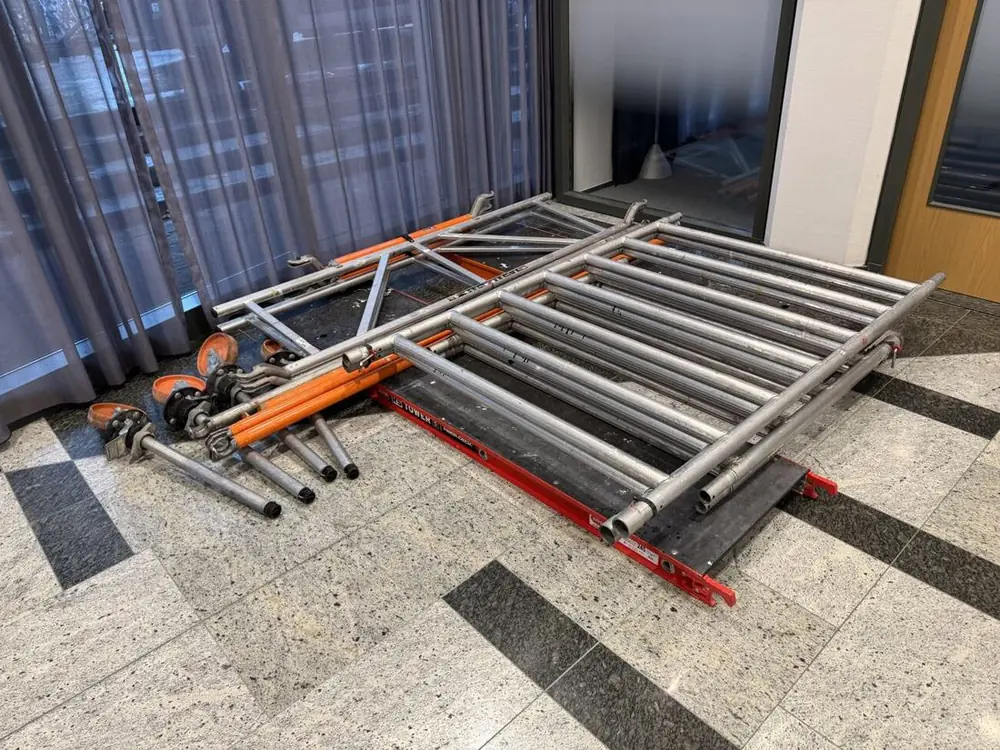
Scaffold frames, braces, castors and a platform deck laid out indoors on a tiled floor beside a glazed wall

Against an outside wall you would hire a mobile scaffold and think no further, but indoors the door frame decides what fits. For a stairwell you therefore always land on the room model, usually with adjustable legs so the feet can sit on different treads. Getting through the doorway is the first condition of any indoor job; height and platform come after that. Sizes and builds are set out on the page about the room scaffolds in our hire fleet, where you can also see what extra width does and does not buy you.
Which working height to hire for a stairwell shaft

Your highest point is the top edge of the shaft, where the render runs up against the landing ceiling or the trim below it. Measure to that edge from the level your set-up will actually rest on, which on this job is the landing with a few treads beneath it, not the hall floor a storey below. Anyone who measures from the bottom of the house orders a build one stage too tall, and a build one stage too tall no longer slots into the shaft at all.

We express every build as working height, which is the platform height plus roughly two metres of reach from where you stand. For a shaft in an ordinary house that puts you between three and four metres, which is exactly the span this indoor model covers. Within that range, pick the stage that leaves the top edge of your surface at eye level or a fraction above it, because that is where a trowel travels most calmly. For comparison, look at the build that reaches four metres.

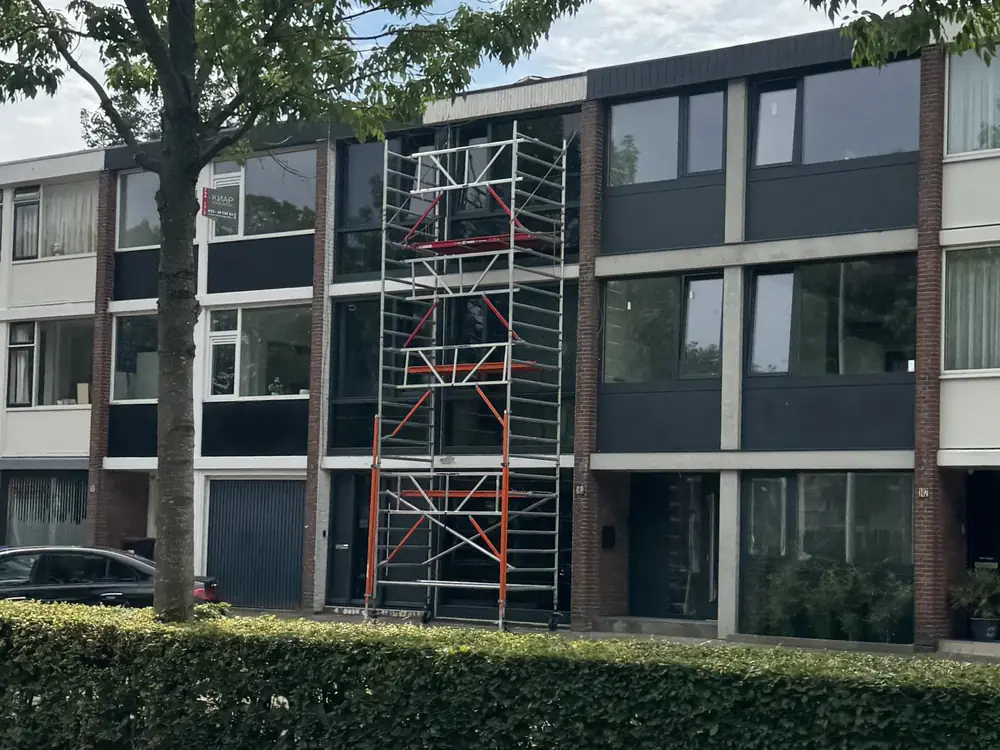
A narrow mobile scaffold built up three storeys against a flat house front, the sort of height a tall shaft needs

Stand a stage too low and you lay the top band with your arms above your shoulders, and that shows up later in the flatness of the wall. Render gives you no second chance the way paint does: once the mortar has pulled in, the whole pass has to belong together. Hiring one stage higher saves you no time at all on the day, but it saves you a surface that ripples, and you notice the difference again when you move on to the walls on the first floor.

Where to stand the scaffold you hire above the stairs

The single biggest choice on this job is where you mix. Do it up on the landing and not down in the hall, because lifting a full tub up a flight is exactly the movement that puts people on their backs or on their knees. Stand a bucket of clean water next to it, lay a board under your mixing gear, and arrange things so that you can reach your material from the deck without descending. That is what keeps a pass on the wall running from corner to corner without a break in it.

That does mean the landing has to be emptied. Cupboards, laundry baskets and the bedroom doors that open onto it all have to go or be wedged shut, because you need that space for the mixing station, for the bags of dry mortar and for the footprint of the scaffold itself. Lay sheeting with turned up edges over the whole landing and over the top few treads. Mortar that dries on a timber tread will not come off again without taking some of the wood with it.

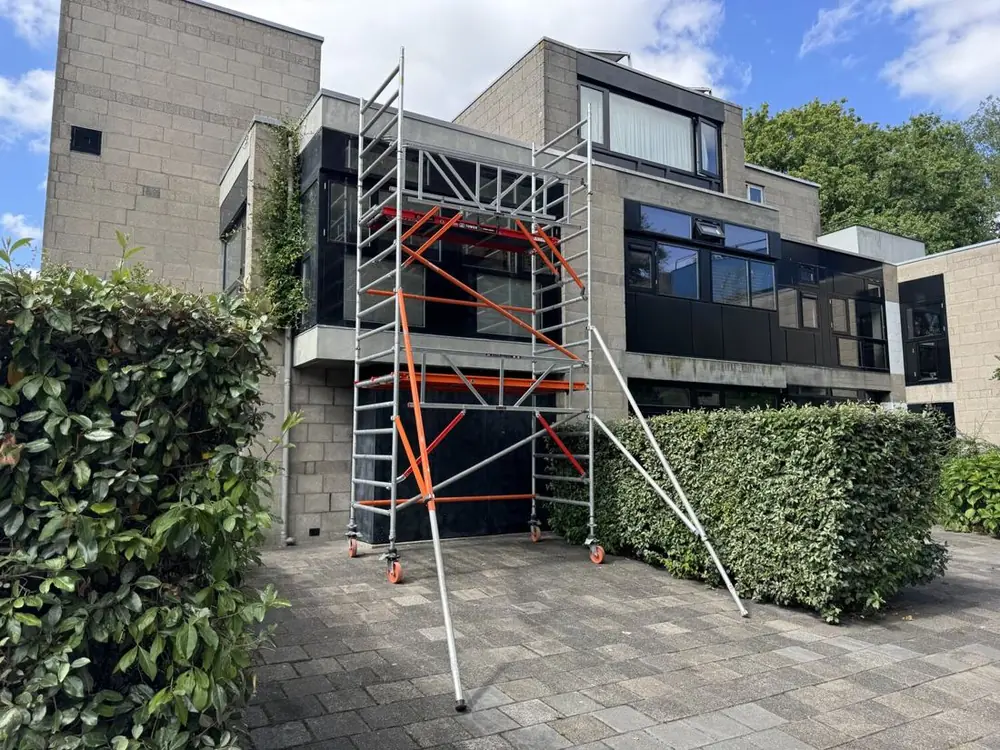
A mobile tower on block paving with four stabilisers splayed out from its base, its feet set on an even surface

Do not forget the flight itself. The treads under your set-up are your only way down and you want them clean and dry even when you are in a hurry. If you are hiring adjustable legs because the four feet land at different levels, check how solid those treads are first. A tower standing on stepped timber simply asks for more care in the levelling than the same tower would on a flat bedroom floor. What that involves is explained in this piece on working over a stairwell void.

How many hire days plastering a stairwell really takes

Render in a shaft is planned in passes rather than in hours. You lay the upper section in one continuous movement, close it up, and leave it; the lower section follows the next day from a lower stage. Two passes, in other words, with a night in between. Add the build day, plus the day on which you close everything up and take the tower down, and three to four hire days is the honest figure for a house stairwell, with the scaffold standing all the way through it.

Drying behaves differently here from drying in a room. Warm air collects at the top of the shaft, so the upper section feels firm while everything down by the hall floor is still clammy. Count on the lower part needing longer and plan your last day around that. Ventilation helps, but too much draught across a fresh face brings hairline cracks instead, so do not throw every window in the house open at once, however impatient you may be about starting the second pass on the lower half.

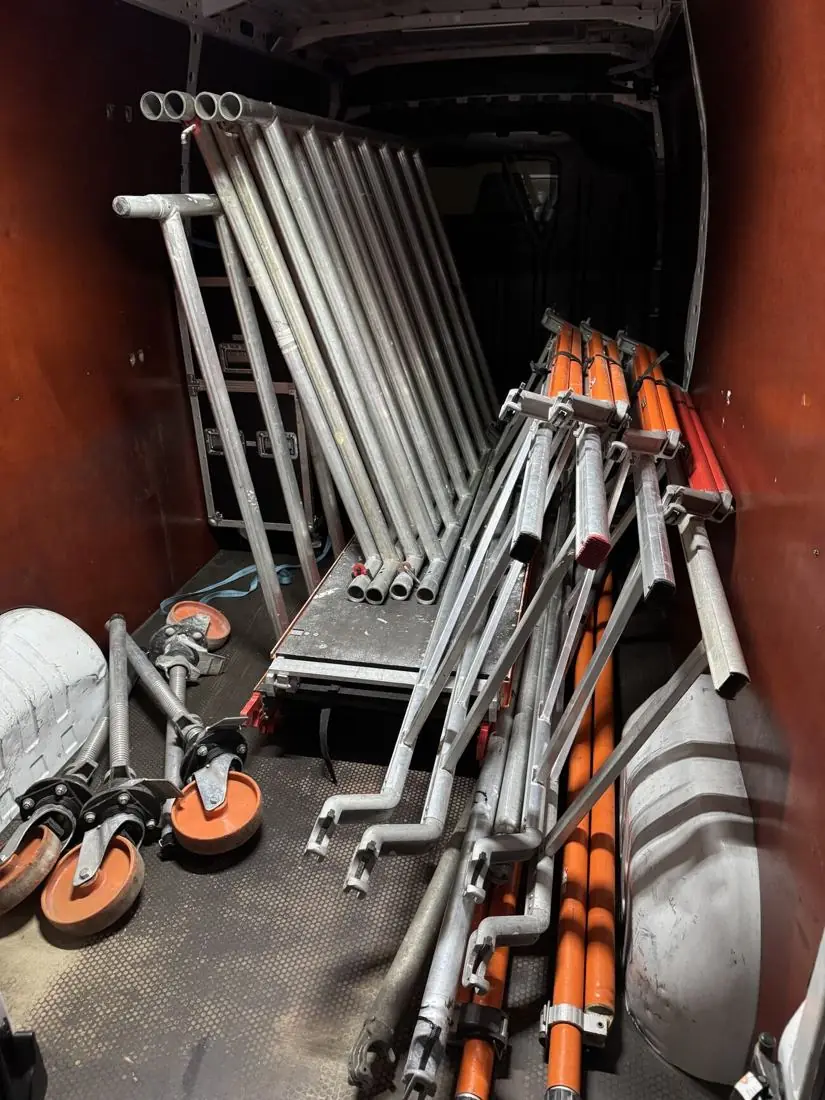
Scaffold frames stood on end inside a van with castors, guardrails and orange braces stacked on the floor beside them

An extra day costs very little once a scaffold is on hire with us. The full rate applies to your opening period of twenty four hours only, and a discount of 95 per cent then runs on every following day, so waiting for mortar to harden is not an expensive decision at all. What does get expensive is booking too short a period: the shaft is still damp halfway down while the collection van is already on its way. There is more on this in our note on sensible hire periods.

Which mobile scaffold suits plastering a stairwell?

Most chosen
Kamersteiger RS44
  • Working height up to 4 metres
  • Compact and narrow
  • Great for indoor and small jobs
View and calculate →
Smalle rolsteiger RS51
  • Working height up to 14.2 metres
  • Narrow (75 cm)
  • Ideal for narrow passages
View and calculate →
Brede rolsteiger RS52
  • Working height up to 14.2 metres
  • Wide platform (135 cm)
  • Extra stability and workspace
View and calculate →
1-persoons steiger MiTower
  • Working height up to 6.2 metres
  • Very compact
  • Quick and easy to assemble
View and calculate →

Plastering a stairwell from a platform of 245 cm

Your working floor is 245 cm long, and that number decides where you split the surface in two. Across the width you will usually take the whole wall face from one position; up the height you will not, so you go looking for a horizontal line where the two passes can meet. Do not pick that line at random in the middle of the wall. Choose somewhere that already exists: just under the handrail, level with a door head, or precisely in the internal corner of the shaft.

Upstairs, finish the entire upper section first, corner to corner, in one unbroken pass. Feather the bottom edge of it a little thinner and the second pass will meet it cleanly the following day without leaving a ridge. Keep your straightedge lying flat on the deck rather than propped against the guardrail, because aluminium against steel slides away the moment you look elsewhere. And keep the tub in the middle of the floor, never on the edge beside the open void, where a knock sends it straight down into the hall.

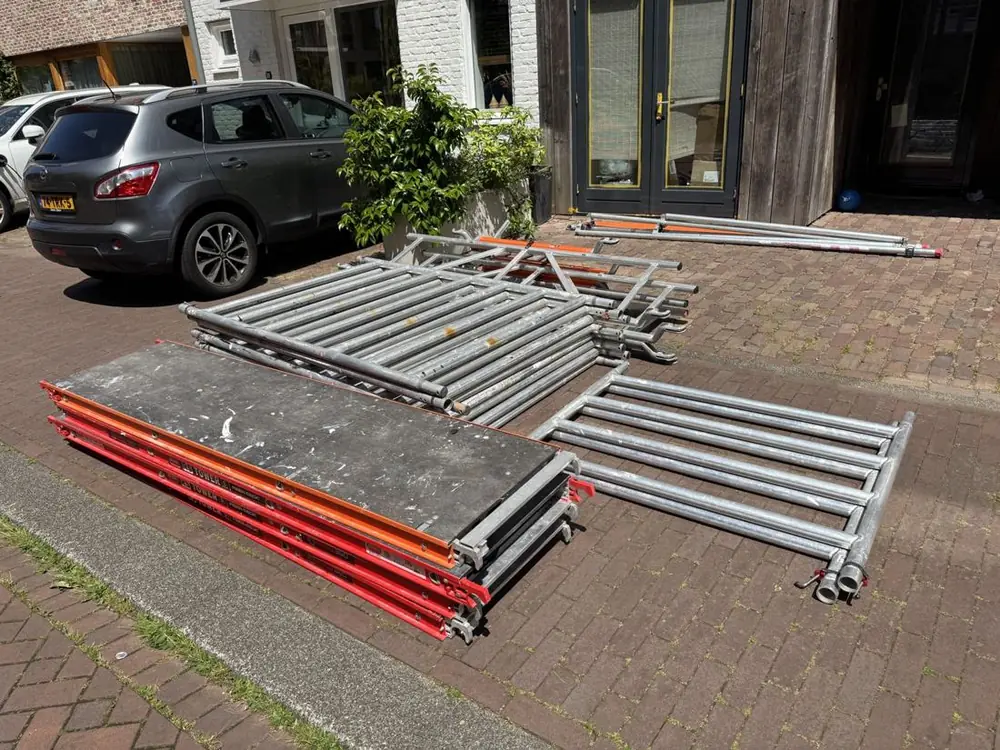
Platform decks with red end rails stacked on paving beside sorted frames and bundles of guardrails outside a house

For the lower section you drop a stage and shift the set-up down along the string. Before you start, check that the meeting line is still clean; an edge that has begun to fluff up gets sanded back first. Make sure everything you need travels up with you in one trip, because stopping halfway through to fetch a tool is how a pass ends up with a cold joint. If the adjoining rooms follow, plan the wall surfaces in the bedrooms as a separate stretch.

Hiring a scaffold with delivery for your plastering days

What arrives is a counted set of loose components, not a standing tower. Decide in advance where that pile is going to land, because when you are plastering a stairwell the hall will soon be holding your bags of mortar and your tools, and the flight has to stay clear as the route upstairs. An empty room on the ground floor works best, particularly if it is raining. Reservations completed on a working day before 15:00 arrive as loose parts on the next working day.

You name the delivery date and the collection date yourself. Take a delivery day a couple of days ahead of your first pass, because you need time to build, to sheet the stairs and to set up the mixing station. Putting the tower together belongs to your side of the job rather than ours; the printed manual sits in with the parts and an instruction video walks through the order in which they go together. The stage by stage guide to putting a tower up covers what to watch for on the landing.

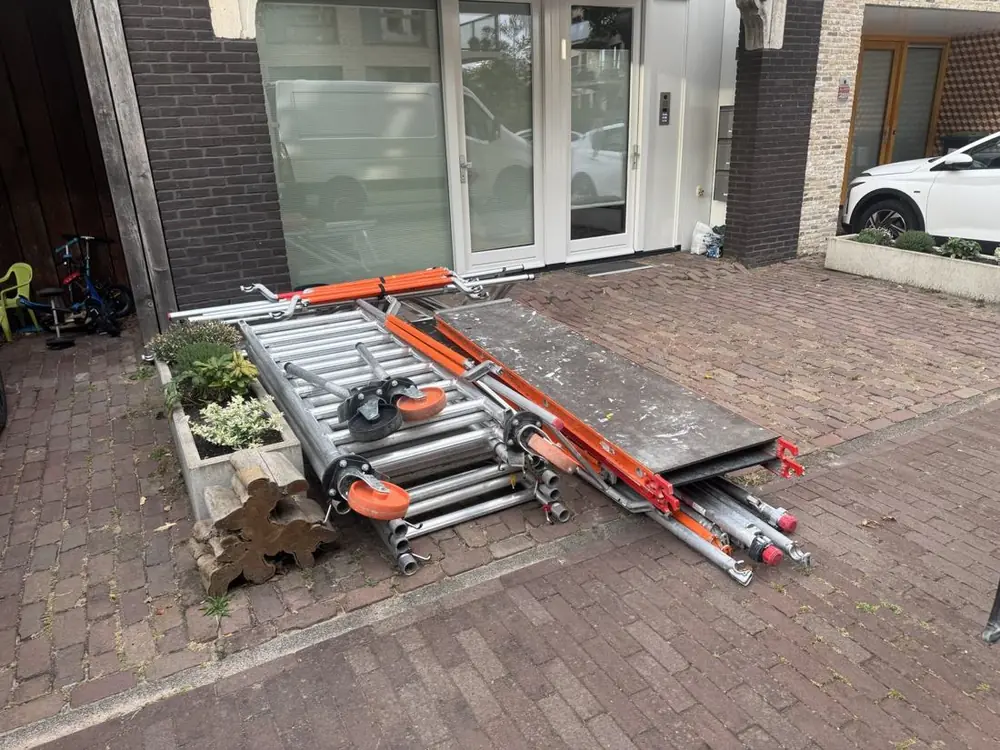
Loose scaffold parts and a platform deck set down on brick paving in front of a glazed front door

Once the render is on, you take the tower apart and stack the complete set on the ground floor, and we pick it up from there on the date you gave us. If you would rather drive over yourself, collection by appointment is free of charge at Zeeburgerpad 89, 1019 AD Amsterdam, so long as your vehicle will swallow the longest components. Fixed rates per province are listed under the charges for bringing and fetching, so nothing about the total shifts once the work is behind you.

Safe plastering above a stairwell void on a hired tower

Every square metre of your working floor may carry 200 kg, the figure listed as load class 3 in EN 1004. On a plastering job that number is not a formality: a filled tub, a bag of mortar, you and your tools add up faster than you would guess, especially with somebody standing beside you to hand things across. Spread what you carry over the full length of the floor instead of stacking everything into one corner above the open void, where the load sits worst.

If there are castors underneath, they go on the brake before anybody climbs, and you only move the tower with an empty deck. When plastering a stairwell that is a rule you keep to even when it means carrying a tub down to the landing first. The ground under this set-up is a flight of stairs, after all, and a flight of stairs is nowhere level. Level up again after every move you make and check that each deck section has dropped back into its catch before you load it.

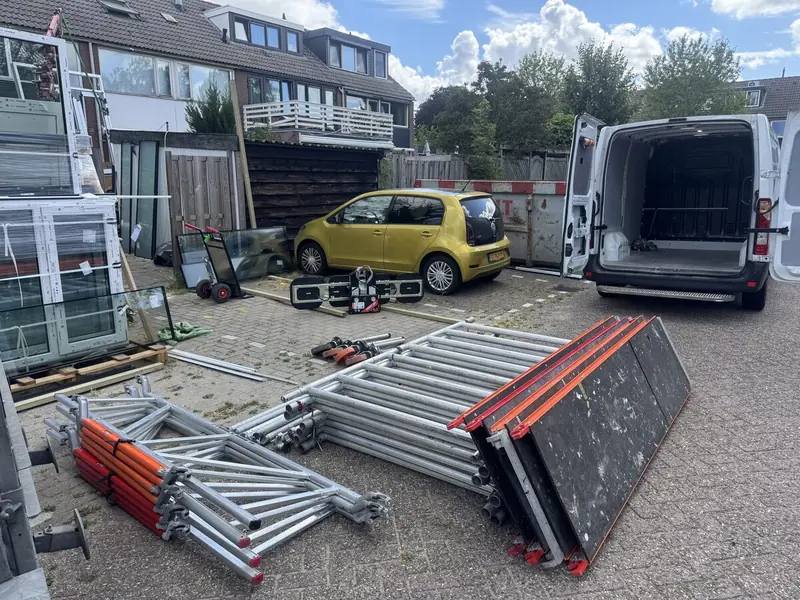
Scaffold frames, braces and decks spread across a paved drive beside a parked car, every piece to be carried by hand

The real hazard stays the drop through the void. A tool that slides off your floor lands on the hall floor a storey below, so trowels and the straightedge lie flat rather than leaning on the guardrail. Fresh mortar also turns a deck section greasy, so wipe splashes away before they pull rather than at the end of the day. Agree with the household that nobody walks under the tower while you are up there, not even for a moment. The rest is set out in the guidance on indoor work at height.

In 5 steps

How hiring a mobile scaffold works

1
Choose working height

Pick the height that suits your job.

2
Book online

Sorted in 60 seconds, price shown instantly.

3
We deliver

At the agreed spot the next working day.

4
Assemble safely

Assembled by you, with a manual.

5
We collect

One call and we collect the scaffold.

Good to know

Practical tips for plastering a stairwell

1

Stand your mixing tub on a low crate up on the landing instead of flat on the floor. You bend far less with a loaded trowel, and over a whole pass your back will notice the difference.

2

Mark the split between your two passes with a pencil line and a long batten before you start. Improvising halfway across a wall leaves a ridge that you will never fully sand out afterwards.

3

Have clean water and a sponge standing beside you on the platform. Mortar on a guardrail or on a tread has to be dealt with immediately, because once it has dried it sits there like concrete on the tube.

4

Never fill the tub right to the rim; walk to the mixing station one extra time instead. A half full tub lifts more easily across the deck and stays inside the weight you can safely carry.

5

Measure the opening at the turn of the stairs before the set is delivered. In many houses that bend is tighter than the door frame downstairs, and the build stops there before it has started.

6

Put a fan low down in the hall rather than up on the landing. A shaft dries from the top downwards anyway, so the help is needed at the bottom and not where it is already going hard.

Frequently asked questions

Frequently asked questions about plastering a stairwell

Which room scaffold should you hire for plastering a stairwell?+

The Altrex RS44 is the obvious choice: an indoor model reaching three to four metres with a closed working floor wide enough for a tub beside your boots. Its parts come through an ordinary interior door, so you can get them along the hallway and up onto the landing. Consider hiring adjustable legs alongside it if the four feet are going to land on different treads, because standing level is no luxury at all under wet render that has already begun to pull in.

How does hiring a scaffold for a plastered shaft actually work?+

You settle the model and the build height online, state which day the parts should turn up and which day they travel back, and settle a fixed rate with VAT already inside it. The scaffold then reaches you as loose parts, you carry everything upstairs and assemble it on the landing. When your hire period ends, the dismantled set waits on the ground floor for the van. The only thing left for you to plan is the morning your first pass on the wall begins.

How many hire days does plastering a stairwell shaft need?+

Three to four days is realistic for a house stairwell. You need a day for building and preparing, a day for the upper pass, a day for the lower pass, and time to close up and take the tower down again. Because the bottom of the shaft stays wet for longer than the top does, an extra hire day is rarely a wasted one. You choose the collection date yourself when you book, so putting a margin in the period is always open to you.

What does hiring a room scaffold for indoor plastering cost?+

The rental price is made up of the model and build you choose, plus a fixed rate covering the run out and the run back. Everything is quoted with VAT included on our page of fixed rates, so nothing appears afterwards that you did not see. For render work the point that matters is that your opening day carries the weight, while each day after it adds only a fraction of that. Long curing times therefore have very little influence on what the hire itself comes to.

Which working height should you hire if the shaft rises above the flight?+

Measure from the level your set-up will rest on, so from the landing and the treads beneath it, and measure to the top edge of your render. In a normal house you land somewhere between three and four metres, which is precisely the reach of the room scaffold you are hiring. Measure from the hall instead and you end up with a build that no longer fits inside the shaft. The overview of working heights sets the figures side by side.

Is the scaffold brought to the house, or do you fetch it yourself?+

That choice is yours at the moment you reserve. We bring the room scaffold on the day you name and fetch the parts once your hire period is over, with both journeys settled inside the one booking. Most people plastering a stairwell take delivery, because the delivery day is already needed for carrying parts upstairs, sheeting the treads and setting up on the landing. Driving over to fetch the set yourself only makes sense if your vehicle takes long tubes.

Does the room scaffold arrive assembled when you hire it?+

No, the scaffold reaches you as loose components and you build it yourself. We make sure the complete set arrives and later leaves again; assembling it, levelling it on the treads and taking it apart are all yours to do, with the manual and the instruction video to lean on. In a stairwell every one of those steps takes longer than in a bedroom, because you carry the parts up first and then have to get them level on ground that runs away under you.

Can you extend the hire if the render in the shaft cures slowly?+

Yes, tell us that the scaffold has to stay longer and we push the collection round back, as long as nobody else has that particular set reserved for those dates. With a shaft this happens more often than with a single room, because the lower part stands cooler by the hall floor and stays wet. Anyone who takes an extra day at the moment of booking has nothing to arrange afterwards and keeps the plan intact.

How much space has to be clear to hire a scaffold here?+

You need the whole landing: for the footprint of the tower, for the mixing station with your tub and water, and for the bags of dry mortar beside it. Clear away cupboards and laundry baskets and fix the doors that open onto it. Keep the treads underneath free as a walking route as well. Measure the clear height in the void as well, so that the scaffold you hire for plastering a stairwell drops into place without anyone forcing a frame past a beam.

Do you keep the scaffold on hire while the render dries?+

Yes, and that is exactly why those drying days belong in your reservation. The tower stays where it is in the meantime, so the following morning you can begin the second pass without levelling anything again. All you take off the deck at the end of a working day is your tub and your tools. Dismantling the set and then hiring again a week later costs far more of your time than those quiet standing days ever will.

What does spilt mortar do to your deposit when you hire?+

Once every component has been counted and looked over after the return, your deposit is credited back inside one working day. Render that you wipe off the hired tubes straight away with a wet sponge causes no trouble at all; mortar left to pull for a day sits on like stone and shows up on the collection date. Carry a bucket of clean water up with you and go over the deck sections at the end of every plastering day, before you climb down for the evening.

Can the adjoining walls be done within the same hire period?+

They can, and it is often the sensible move. While the upper pass in the shaft is hardening, the same hired set-up will reach the walls on the landing or the strip above a door head. That way you use a day that would otherwise run empty, and no second hire is needed later on. Do keep to the same mortar for surfaces that flow into one another, because two different setting times will show up on the finished wall in the end.

Hire a mobile scaffold for plastering a stairwell today?

Calculate your rental price now or ask for free advice.

Rolsteiger van SteigerTaxi geleverd op locatie
Book it online

Your scaffold sorted in 2 minutes.

Choose your scaffold and working height, see the price instantly and book online.