
See your price
Application

Cleaning screens? Choose the right scaffold.

Cleaning screens is done with the fabric let all the way down, and that single fact reshapes the whole job. You work downwards over a panel two to three metres deep, you use suds and no pressure whatever, and rolling up stays forbidden until everything is bone dry. The RS51 covers it: a narrow 75 cm chassis, assembled to six or eight metres of reach. Further down you will find where that lands on the ground, how much of your hire period goes on drying, and how the zip and the channels get their turn.

  • Order before 3 pm, delivered tomorrow
  • Professional Altrex scaffolds
  • Up to 14.2 metres working height
  • Easy to assemble yourself
4,2 tot 14,2 mWorking heights available
12Provinces served
7Days a week
200 kg/m²Load class 3
In short
  • For cleaning screens we recommend the Narrow mobile scaffold.
  • For fabric across two storeys you hire the RS51: narrow enough for a footway, built out to a six or eight metre reach.
  • Cleaning screens means the fabric comes right down and goes back up dry, so your hire period runs on throughout.
  • Work with lukewarm suds and a soft brush; a pressure washer blows the fabric out of its channels and wrecks the coating.
  • First 24 hours from €150 incl. VAT and delivery; every day after that 95% off.
Key facts for this job
FeatureValue
Recommended scaffoldNarrow mobile scaffold (Altrex RS TOWER 51)
Working height for this job6 to 8 metres
Available working heights4.2 to 14.2 metres
StandardEN 1004, load class 3 (200 kg per m²)
DeliveryOrdered before 3 pm, delivered next working day
Each extra day95% off, from €7.50 a day
Why a mobile scaffold for cleaning screens?

Safe, stable and professional work at height

Washing a screen sounds simple until you remember the fabric has to stay hanging out. While it is down you cannot roll it away to take shelter, and it may only go back into the box once it is genuinely dry, or you end up with tide marks and eventually mould. So you need a platform that stays put for hours on end, that you can work from with a bucket of suds and a soft brush in your hand, and that reaches the zip and the channels over their whole run. Cleaning screens is therefore quite as much a question of drying time as it is of reach, and that catches most people out completely.

  • Fabric right down, and only rolled up dry
  • Lukewarm suds and a soft brush, never pressure
  • Zip and channels cleaned along their whole run
  • A reach of six to eight metres per elevation
Read more about working safely →

Which mobile scaffold to hire for cleaning screens outside

For cleaning screens one or two storeys up, the RS51 is the sensible answer: the Altrex RS TOWER 51 on a 75 cm chassis, a type that reaches 14.2 metres but which you put together far lower for this. Narrow pays you back here, because you shift the tower along one window at a time and a footway often leaves nothing more than a strip between the wall and the parked cars. The rest of the fleet appears on the page about mobile scaffolds available to hire.

Let down, the fabric hangs a little proud of the wall, held in the channels beside the reveal. Your set-up therefore belongs just in front of that, never up against it. On a narrow deck you watch that gap almost automatically, whereas a wide platform quietly invites you to step backwards without looking first. Put your bucket down on the wall side of the deck so that you do not knock it over while edging sideways along a wet panel. A bucket going over at four metres costs more than the suds.
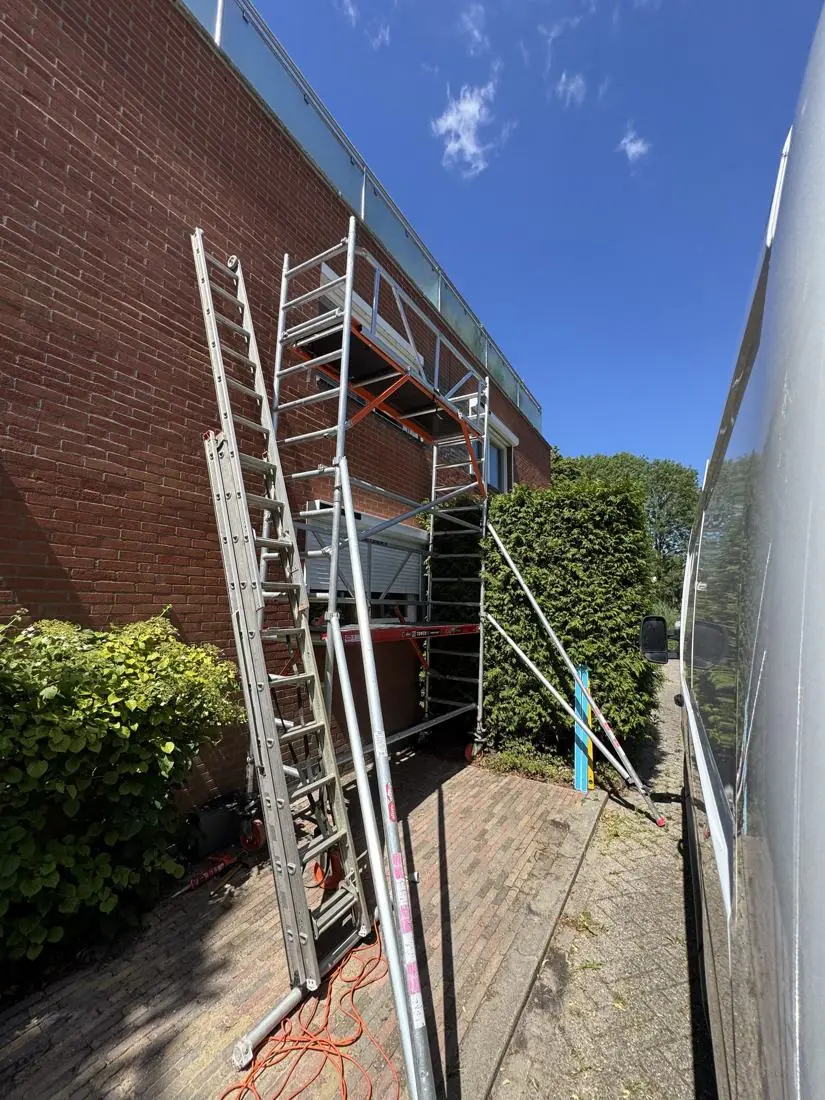
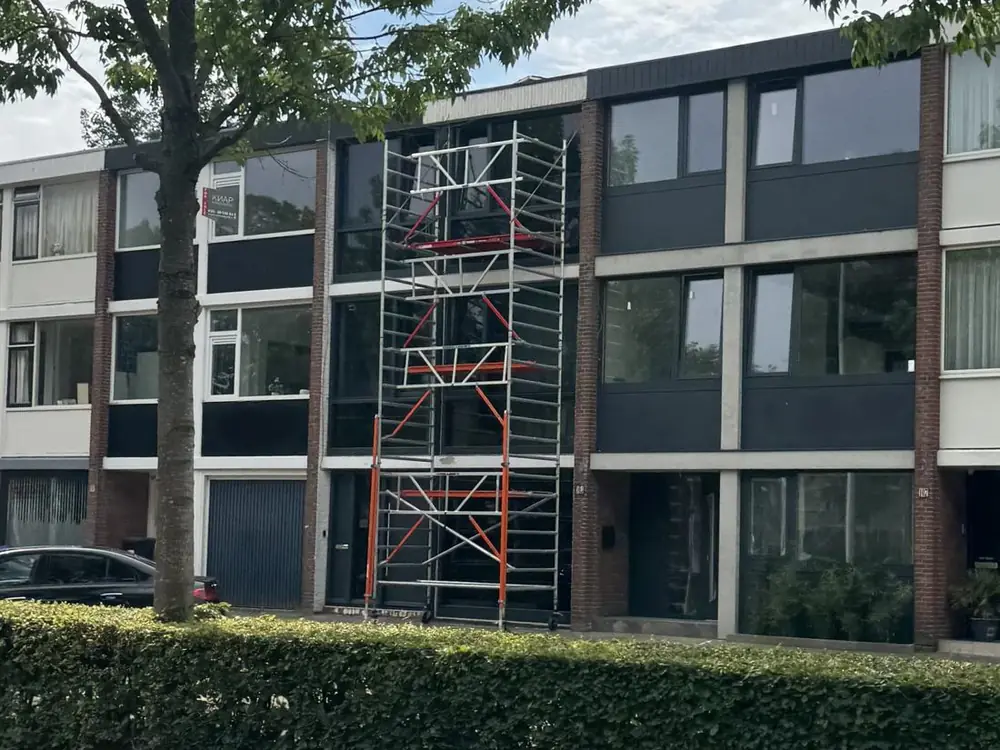
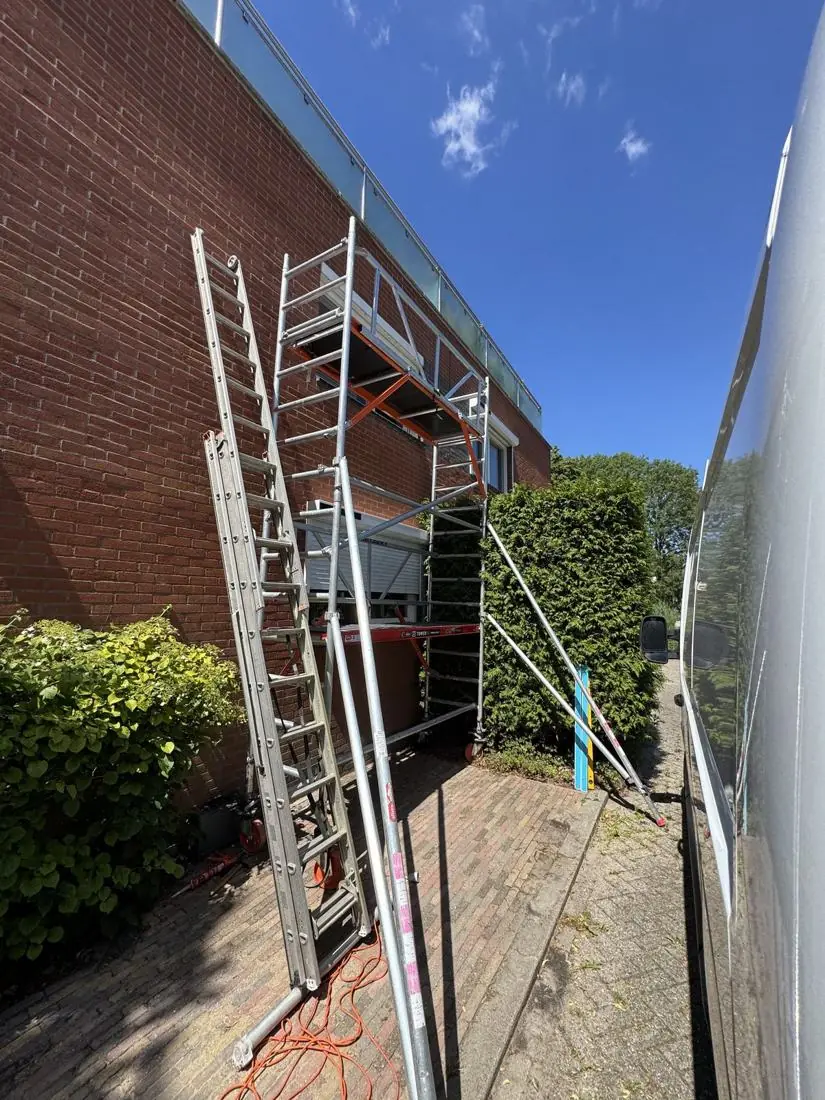
Mobile scaffold erected along the side of a house, positioned just clear of the wall rather than against it

Taking a whole elevation of four or five panels with two people is the case for the broad RS52 at 135 cm. Two buckets, two brushes and two people fit onto that deck without any negotiation over elbow room. Against that it swallows more footway and it shifts less willingly from window to window, and shifting is exactly what this job asks for again and again. For a single opening, it can still pay to hire a mobile scaffold with the slim chassis and simply move it more often.
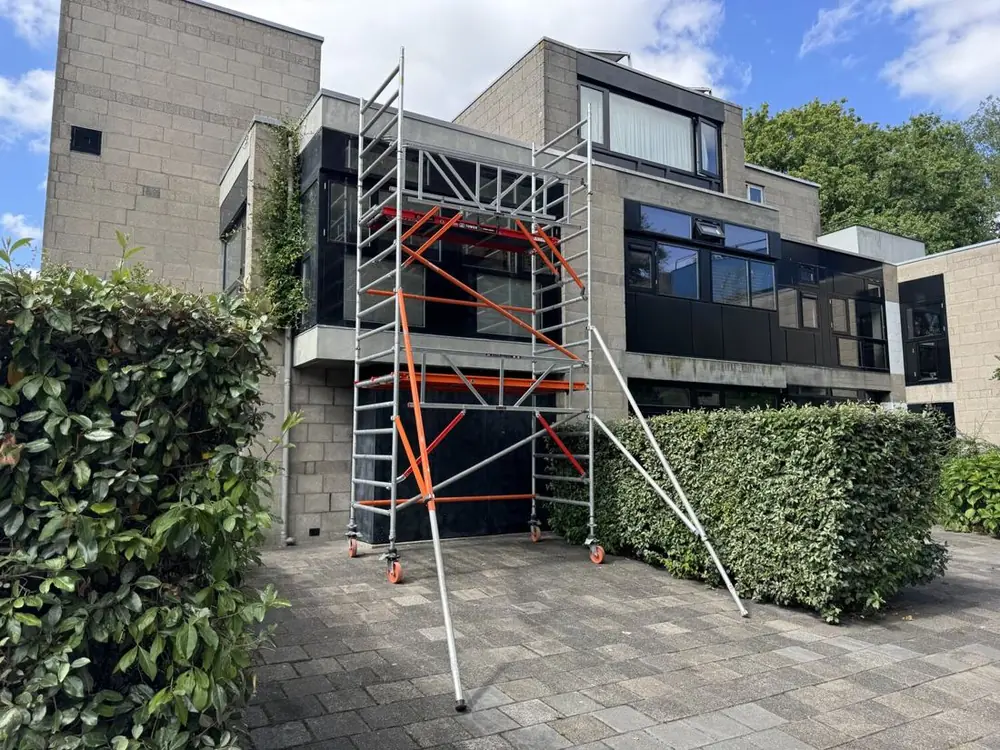
Hiring reach up to the headbox above unrolled fabric

When cleaning screens, measure to the top of the headbox, because the box itself is part of the wash. Dust settles on it, cobwebs gather inside it, and the top edge of the fabric vanishes underneath, so you want a brush in there and a clear line of sight along the whole run. Take the reading from the paving your castors will actually sit on, and not from a raised terrace that happens to lie alongside the wall. In practice that difference alone is worth half a metre of build.

From there the deck height follows, and the working height you book is that deck with something like two metres of reach standing above it. For panels on a two storey elevation that comes out at six to eight metres, with the platform itself stopping somewhere between four and six metres. You state the reach at the booking stage, along with how many openings you intend to get through in the period. What a build of that order delivers is shown at seven metres of reach, deck height included.

A stack of frames and tubes on the paving, each extra frame lifting the build another two metres up the wall.

Take the higher stage rather than the lower one whenever you hire. With your head stuck under the box you end up washing by touch, and you miss precisely the sort of dirt that hides up there. You also want to wet the fabric from the top and work down; start halfway and streaks run through the part you had already finished. For a panel at second floor level that means the roomier build, never the tight one.

Standing the tower clear of a screen hanging fully unrolled

For cleaning screens the set-up goes in front of the hanging fabric, centred on the opening, with roughly a hand's width between guardrail and panel. Catch it with a castor or a brace and you push the fabric out of its channels, which will cost you far longer than the wash itself. So look beforehand at where the channels run and how far the panel stands off the brickwork, and keep that clearance over the entire height of the opening rather than only at deck level.

Water ends up underneath you, and that changes the ground. Suds run down the wall, across the paving and into the border, so any surface that was already slippery becomes considerably more so. Set the legs down on dry slabs or lay boards beneath them, and empty your bucket somewhere other than the route you will walk along carrying a full one. On grass or on bare soil a set-up can lean noticeably within an hour of wetting the wall down, long before you have finished.

Extended legs of a mobile scaffold resting on hard paving, the footing you want under a tower on a slippery surface

Look too at whatever is standing beneath the opening before the tower goes there. With this sort of fabric it is usually a terrace set, a barbecue, an awning at ground level, or a ventilation grille low in the wall. Cover those over or move them well away first, because suds and loosened grime will otherwise land on every one of them. Keeping a tower steady on a slope or on loose ground is covered in the notes on ground that will not lie level.

Drying time decides how many days you hire the scaffold

Cleaning screens runs at roughly an hour a panel: wetting down, soaping, letting it work, brushing, rinsing off, and then the box and the channels. Drying takes a great deal longer. Fabric rolled up too soon goes damp into the box and comes out marked, or spotted with mould, so you wait until it feels dry everywhere you touch. On a sunny day with a breeze that is two to three hours; under cloud or in damp air it stretches out considerably.

Your hire period therefore follows the drying rather than your working hours. In practice: wash through the morning, go back and check during the afternoon, and only then roll anything up. Four panels are manageable inside two days, but only where the weather plays along from start to finish. Put one grey, damp afternoon in the middle and the fabric stays hanging out while rolling up slides to the next morning, with your hired tower standing exactly where it was.

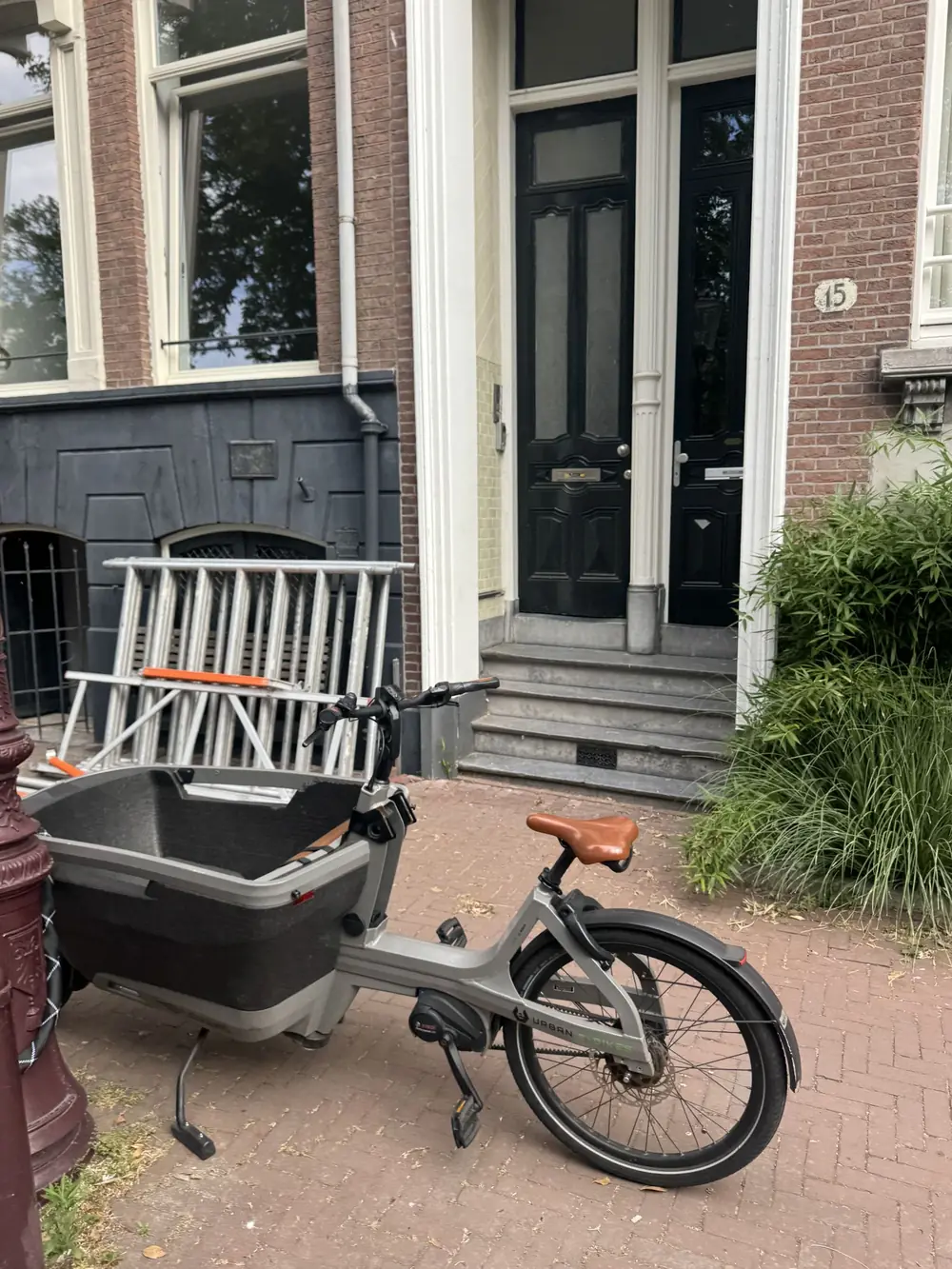
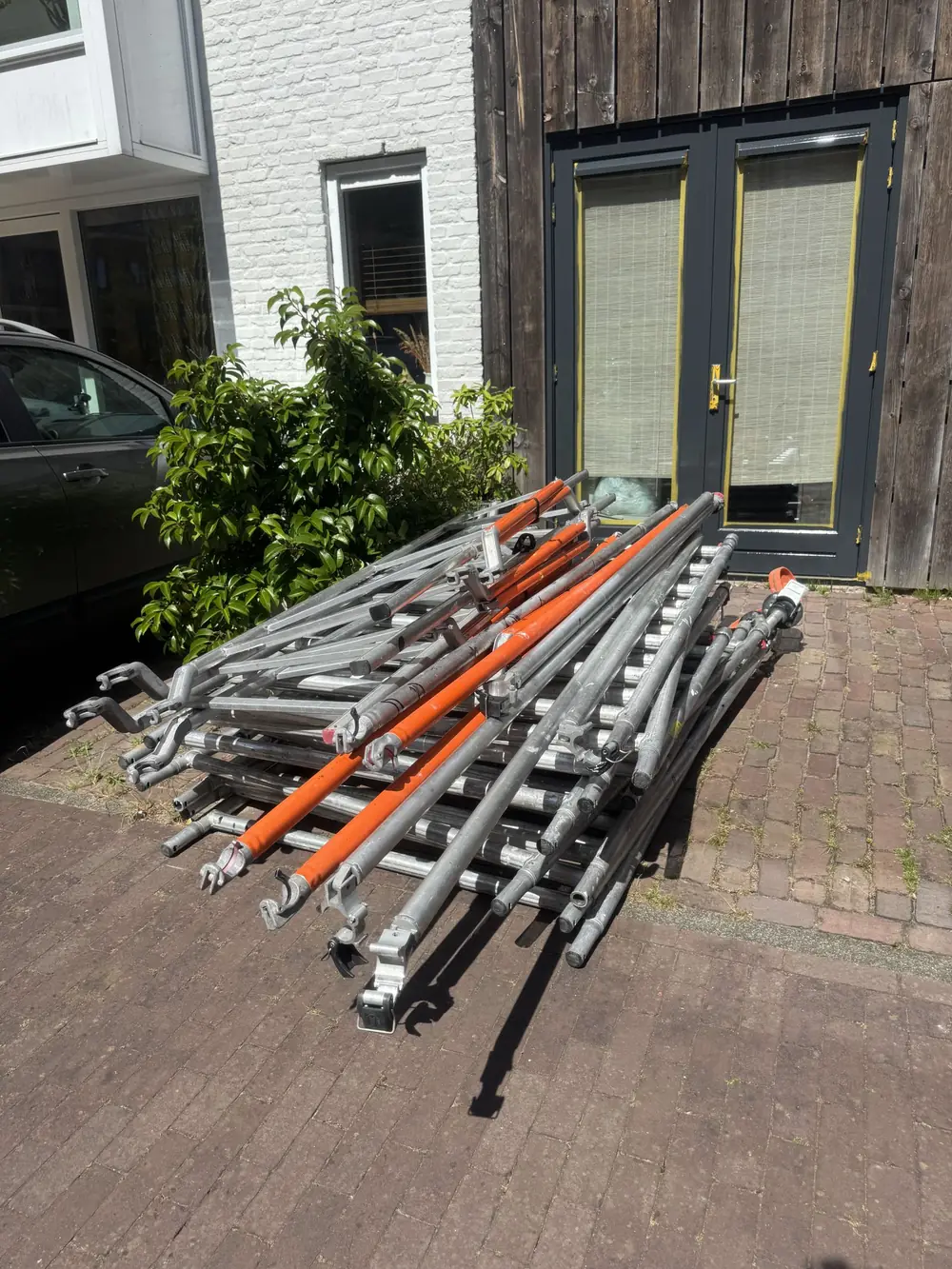
Frames waiting on a pavement by a front door, the hire set that stays with you until the fabric dries.

So reserve on the generous side rather than to the day. That opening 24 hours carries the whole amount, and anything you stick to the back of it comes in with 95 per cent taken off, which makes one spare drying day cost next to nothing on the rental price. What the tower does per model and per build is on the page listing every rate, with transport shown separately and VAT included. Booking too tight means rolling up damp fabric and doing the lot again next season.

Which mobile scaffold suits cleaning screens?

Kamersteiger RS44
  • Working height up to 4 metres
  • Compact and narrow
  • Great for indoor and small jobs
View and calculate →
Most chosen
Smalle rolsteiger RS51
  • Working height up to 14.2 metres
  • Narrow (75 cm)
  • Ideal for narrow passages
View and calculate →
Brede rolsteiger RS52
  • Working height up to 14.2 metres
  • Wide platform (135 cm)
  • Extra stability and workspace
View and calculate →
1-persoons steiger MiTower
  • Working height up to 6.2 metres
  • Very compact
  • Quick and easy to assemble
View and calculate →

Cleaning screens with suds from the scaffold platform, top down

At 245 cm the deck matches the width of an average panel fairly closely. Usually that works out at one panel per pitch of the tower, working left to right and always from the top downwards. Begin up at the box and drop down from there, so that dirty water always runs over a stretch you have not yet washed. Rinse each section off before the suds dry on it, because dried soap leaves edges along the fabric that are a real nuisance to lift out afterwards.

Suds without pressure is the rule when cleaning screens. Lukewarm water, a mild detergent and a soft brush or sponge take most of it off; a pressure washer drives water behind the coating, damages the seams and blows the fabric clean out of its channels. Rinse afterwards with a hose on low pressure, once again working downwards. Carry the water up in a bucket, or run the hose up alongside an upright of the tower so that it reaches the deck.

Working platform of a tower held close to the front of a house, the floor a panel is washed down from

The zip and the channels want separate attention. Sand, moss and leaf litter collect inside the channel, and that is exactly what makes a zip skip later on. Run a narrow brush down the groove over its whole length, rinse it through and then wipe the channel dry. Then go along the underside of the box, checking for leaves and cobwebs as you pass. Only when the whole panel feels dry to the hand does the fabric go back into the box, and not one minute earlier.

Scaffold delivery and collection across the dry days you hire

The mobile scaffold travels to you in loose parts, counted and bundled, and you are the one who stands it up. Reserve somewhere for that pile in advance, since the strip directly beneath the opening is wanted for your buckets, your brushes and your hose. A drive, or a patch of grass a little further along the road, suits the pile far better than the footway right under the wall. Book on a weekday while the clock is short of 15:00, and the van reaches you on the working day that follows.

Delivery date and collection date are both yours to mark out, and on this job the forecast ought to have the deciding vote on each of them. What you want for cleaning screens is a dry and breezy run of days, because your drying time depends on nothing else. Standing the thing up is part of your own day, working from the booklet and the film that comes with it; at this height a pair of you is busy for roughly an hour. Follow the order in the steps for putting one up.

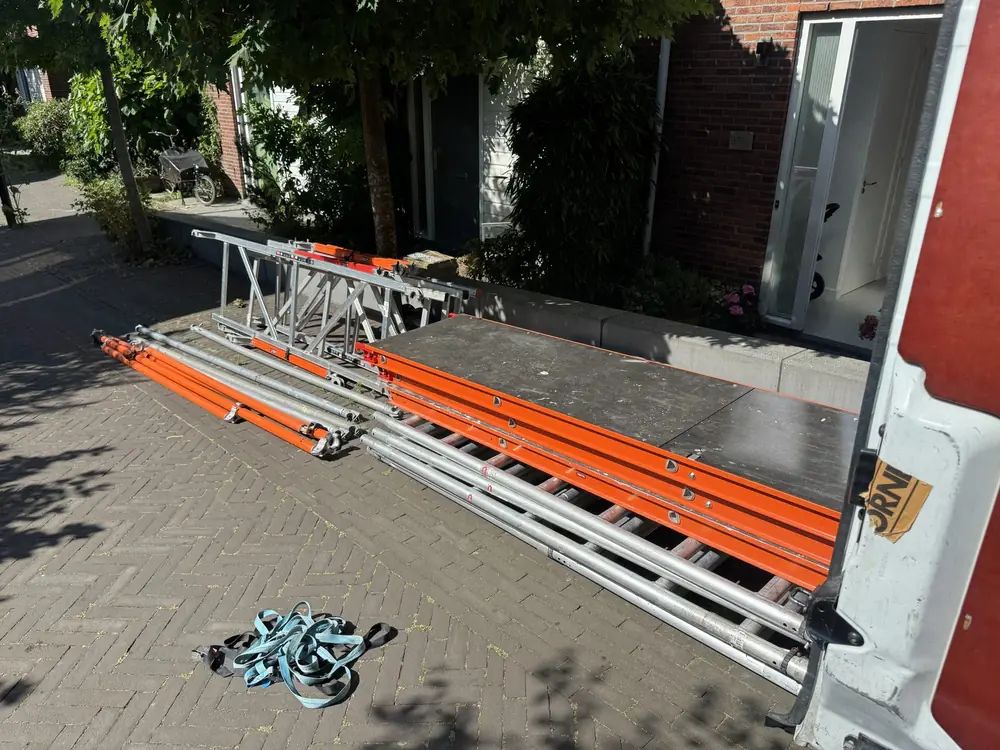
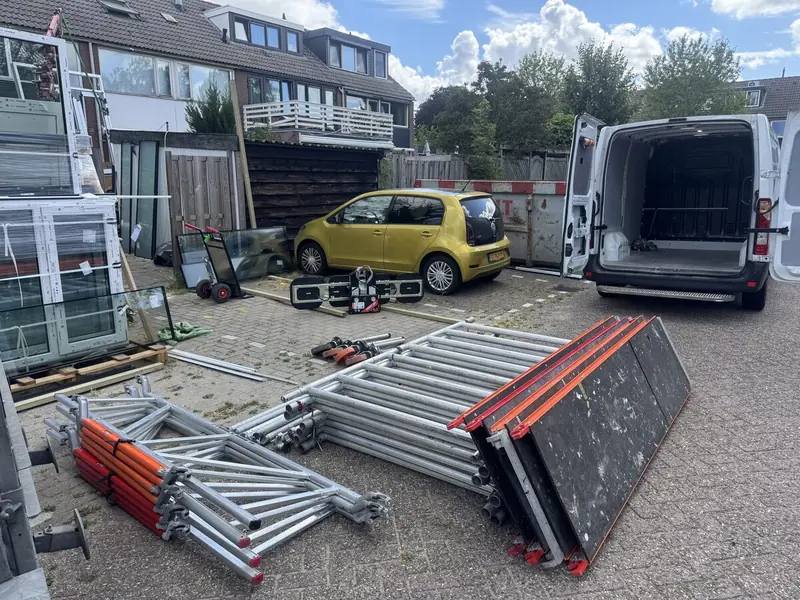
Scaffold sections stacked inside a delivery van, the tallied bundle that leaves the yard for a booked address

Once the last panel is dry and rolled safely away, unbolt everything and set the parts out bundled together; on the collection day you chose, we take them off your hands. Rinse the uprights down if suds have run over them, so that no white streaks are left behind to raise questions at the check. Collecting yourself is equally possible: by arrangement and free of charge in Amsterdam, at Zeeburgerpad 89. The charges for bringing and fetching are listed per province.

Working safely on a wet scaffold deck when cleaning screens

Every tower on our hire list is manufactured under EN 1004 in load class 3, a grading that allows 200 kg of carrying capacity for each square metre of decking. On washing work you fill that up faster than you would think: a ten litre bucket weighs ten kilos, you often have two of them with you, and then there is your own weight, your brushes and the hose as well. More about how that grading works appears at the standard all of these towers meet.

The ordinary rules still stand. Brakes locked before you climb. Nothing and nobody riding the deck while it rolls. And straight down the moment it starts blowing hard. Wind matters more here than it usually does, because a wet panel hanging out acts as a sail and loads both the channels and the box heavily. If the wind gets up, roll the fabric away as soon as it feels dry enough, and never leave it out flapping through a whole night.

Guardrail and inner ladder on an assembled tower, the climb you repeat each time a bucket has to go up

The hazard when cleaning screens is simple enough: everything gets wet. A deck carrying suds is treacherous underfoot, so wipe between panels, wear boots with a decent tread, and place your bucket where you will not step over it as you turn. Keep the area below clear, because a falling bucket brings its contents down with it. Do not work on your own above four metres on a wet day like that. There is more at the rules for work at height.

In 5 steps

How hiring a mobile scaffold works

1
Choose working height

Pick the height that suits your job.

2
Book online

Sorted in 60 seconds, price shown instantly.

3
We deliver

At the agreed spot the next working day.

4
Assemble safely

Assembled by you, with a manual.

5
We collect

One call and we collect the scaffold.

Good to know

Practical tips for cleaning screens

1

Wash on a day with a little wind rather than the hottest day of the year. In full sun the suds dry on the fabric and leave edges that only come out by washing the panel again.

2

When cleaning screens, brush the channels out before you soap the fabric. Sand and moss you would otherwise wash loose later end up in the groove anyway and make the zip skip when you roll up.

3

Feel for dryness in three places on every panel: at the bottom hem, halfway up and just under the box. The bottom hem stays damp longest and it is what decides when rolling up is allowed.

4

Hook your bucket onto the inside of the guardrail instead of standing it loose on the deck. That keeps the floor drier and leaves both hands free for the brush all the way down.

5

Run the hose up alongside an upright and set it to low pressure at ground level. You then never climb down mid-rinse simply to fill a bucket that has run empty on you.

6

Ask for collection a day after the final panel rather than the same evening. That leaves you a morning to confirm everything went up dry and to take the hired tower apart without any rush.

Frequently asked questions

Frequently asked questions about cleaning screens

Which mobile scaffold should you hire for cleaning screens?+

The RS51 on its 75 cm chassis suits this best. You shift it along one opening at a time, it stands happily on a narrow footway, and it goes in front of the hanging fabric without ever touching it. Built between six and eight metres of reach you comfortably meet the box of a panel two storeys up. Doing a whole elevation with two of you makes a wider tower the more comfortable thing to hire, though it moves less willingly.

From reserving to collection, how does the hire work here?+

You choose your model and your build online, mark one day for delivery and another for collection, then pay up front at a price with VAT already in it. The parts arrive at the house, you assemble them, wash your panels and take the tower down after the last dry roll-up. We then carry the complete set away again. The only real thinking goes into which days you pick for the hire, because every one of them needs to be a dry one.

How many days do you hire to wash and dry four panels?+

Two days is realistic for four, reckoning on about an hour of washing each and two to three hours of drying afterwards. Cleaning screens is never the bottleneck on a job like this; the drying always is. So take a hire period of three days instead, and one grey afternoon will not upset the plan. Add in the hour during which the tower goes up and gets levelled, because that comes straight off your first morning on site.

What do you pay in hire, and what does one extra drying day add?+

It follows from the model, the build height and the province you live in. Every rate is shown including VAT under the charges per build, so you know before committing to a tower. On this job the rental price falls kindly: you pay chiefly for day one and hardly at all for what follows. Planning one spare drying day into the hire therefore costs little, and it keeps you from winding damp fabric back into the box.

What reach do I need to hire if the box is included?+

Measure to the top of the box rather than to the top of the glass, because the box gets washed too and holds most of the dust. Take the reading from the paving your castors stand on. For fabric on a two storey elevation you then hire a tower of six to eight metres, which puts the deck between four and six. Sitting exactly between two stages of build, hire the higher one and keep the box in plain view.

Is the hired tower delivered to the house, or do I fetch it?+

Delivery is on offer, and the van puts the parts down on your footway or on the drive. From that point you carry them across to the wall yourself, which a narrow model lets one person manage. With your own transport you may collect the set by arrangement instead, with no transport added to the hire. At an address that is awkward to reach, tell us in advance where a van is able to stand and unload.

Do I put the tower together myself after hiring it?+

Yes, assembly is part of your side of the job. The loose parts arrive with a manual and with footage you can follow the sequence from, and at this height two people have the tower standing inside an hour. We do not come out to build, and nothing is delivered ready assembled. Cherry pickers and facade scaffolds are missing from the hire range too, so this rolling tower is simply what the work runs on.

Can I hire for longer when the fabric is still not dry?+

Yes, and on this job that is the commonest reason for extending. Fabric rolled up too early gives you tide marks, so an extra day of hire beats a blotchy panel for the whole season. Pass on your new collection date and the tower simply stays standing, as long as it has not already been pledged to somebody else. Handing the parts back sooner is fine as well, so reserve generously at the outset and then see how the week goes.

How much clear ground under the window does the hire want?+

Under the opening you want the footprint of the tower free, plus whatever the legs take as they extend, and then a strip for your buckets and your hose. Move the garden chairs, the planters and the barbecue well before you hire anything, since suds and loosened dirt will otherwise rain down onto the lot. Remember as well the hand's width of clearance you need between the guardrail of the hired tower and the fabric hanging down.

Is renting worth it when showers are forecast?+

Not for the washing. Rain rinses your suds straight off the panel and keeps the fabric wet, which only pushes rolling up further back into the week. The tower may stand out in it meanwhile, so continuing the hire nearly always beats sending the set back and ordering again later. Use a day like that to brush the channels out from the deck and to go over the box itself, since neither of those minds a grey sky.

How soon is the deposit returned when the hire finishes?+

A deposit is settled with your reservation. Once the collected tower has been counted as complete, the money is back in your account within a working day. On this job it tends to be dried soap residue and stray parts left lying somewhere in the grass that hold things up. A clean and complete set passes the check quickest of all, so count along out loud while you take the tower apart.

Can I do the windows behind from the same hired position?+

You can, and it is the cleverest order to work in. While the fabric hangs down you cannot get at the glass at all, so wash your panels first, let them dry, roll them away and only then take the windows from that same pitch. That way your hire days do double duty and the tower never stands idle. Expect rather more water running down the face of the wall than you had bargained for at the start.

Hire a mobile scaffold for cleaning screens today?

Calculate your rental price now or ask for free advice.

Rolsteiger van SteigerTaxi geleverd op locatie
Book it online

Your scaffold sorted in 2 minutes.

Choose your scaffold and working height, see the price instantly and book online.