
See your price
Application

Installing bird protection? Choose the right scaffold.

Installing bird protection is work measured in metres. You walk an entire roof edge with lengths of comb filler, mesh or small grilles, and every position moves you a little further along. So what you want above all is a tower that repositions easily and offers enough deck to lay long pieces on. For a terraced house with protection under the tiles or beside solar panels you hire the wide RS52, reaching 8 to 12 metres. Below: what that width gives you, the hire days it takes and where the build can pass.

  • Order before 3 pm, delivered tomorrow
  • Professional Altrex scaffolds
  • Up to 14.2 metres working height
  • Easy to assemble yourself
4,2 tot 14,2 mWorking heights available
12Provinces served
7Days a week
200 kg/m²Load class 3
In short
  • For installing bird protection we recommend the Wide mobile scaffold.
  • Protection along a complete roof edge calls for the wide RS52 out of the fleet, built to a reach that carries to twelve metres.
  • Installing bird protection covers roughly two metres of edge per position, so this is mainly a job of shifting and bracing out.
  • Never seal the roof up completely: the protection keeps birds out, but the air still has to move past it.
  • First 24 hours from €175 incl. VAT and delivery; every day after that 95% off.
Key facts for this job
FeatureValue
Recommended scaffoldWide mobile scaffold (Altrex RS TOWER 52)
Working height for this job8 to 12 metres
Available working heights4.2 to 14.2 metres
StandardEN 1004, load class 3 (200 kg per m²)
DeliveryOrdered before 3 pm, delivered next working day
Each extra day95% off, from €8.75 a day
Why a mobile scaffold for installing bird protection?

Safe, stable and professional work at height

Fitting protection looks like small work, yet it happens on the trickiest line of a house: the edge where the roof meets the wall. Installing bird protection means reaching it with both hands, seeing under the tiles, and holding a strip of more than a metre dead straight. That is exactly why people hire a mobile scaffold for it rather than working off a ladder, where you shift position every half metre and never have two hands free at once. There is a further point on the rental side, because an edge of any length means you need the same build standing for several days together, and the days are what you book.

  • Ventilation under the tiles has to stay open
  • Combs go beneath the lowest course of tiles
  • Rustproof fixings, or the strip works loose
  • Installing bird protection follows the whole roof edge
Read more about working safely →

Hiring a wide mobile scaffold for installing bird protection

Installing bird protection means handling long pieces. A comb filler runs a metre to a metre and a half, a roll of mesh will not steer with one hand, and you have a cordless drill, a box of screws and a pair of snips with you as well. That is the argument for hiring the RS52 at 135 cm wide: on that deck a strip can lie lengthways without sticking out past the guard rail. The choice between slim and broad is explained under the mobile scaffolds you can hire from us.

Going wide brings a second advantage here. Fitting a comb goes fastest with two people, one holding the strip true against the tile batten while the other drives the fixings. That only works if the pair of you can pass without anyone stepping backwards into a rail. Solar panels weigh on the choice as well, because there you work with clips and mesh strips hooked on one by one along the panel edge, and every piece of that has to be put down somewhere in between.
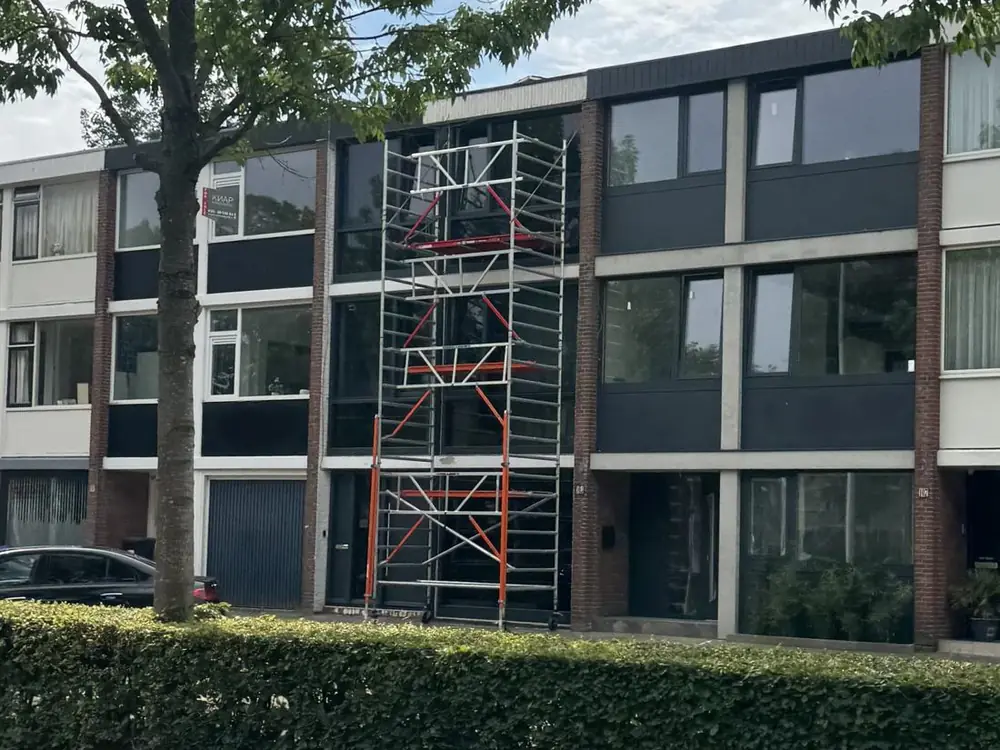
Assembled mobile scaffold rising up the front of a three storey block, level with the top row of windows

For a single short run above an extension the slim 75 cm version will serve, particularly where the route round the back goes through a narrow gate. Reckon then on repositioning more often and on carrying materials up in smaller loads. Working a complete roof edge on a terraced house, the wide tower from the fleet wins at every position, even though it costs you a few extra components to carry. Both are compared under the narrow and wide tower side by side.
Working height to hire up to the lowest tiles and above

The height you need hangs on where the protection goes. Comb filler sits beneath the lowest course of tiles, so you have to come just above the gutter. Where the protection belongs at solar panels, you are working at the edge of the panel field, and that often lies a good deal further up the roof slope. On a terraced house of two or three storeys you therefore hire a reach of 8 to 12 metres, depending on how far the panels run towards the ridge.

Turn that height into a platform height before you book. From the deck you are standing on, your arms still bridge roughly 2 metres, so subtract that from your highest fixing point. If a clip sits at nine metres, you want to be standing at seven. Measure from the garden, the footway or the drive the castors land on, because a terrace higher than the path gives a false starting point and leaves you one setting short. If in doubt, look at a ten metre working height.

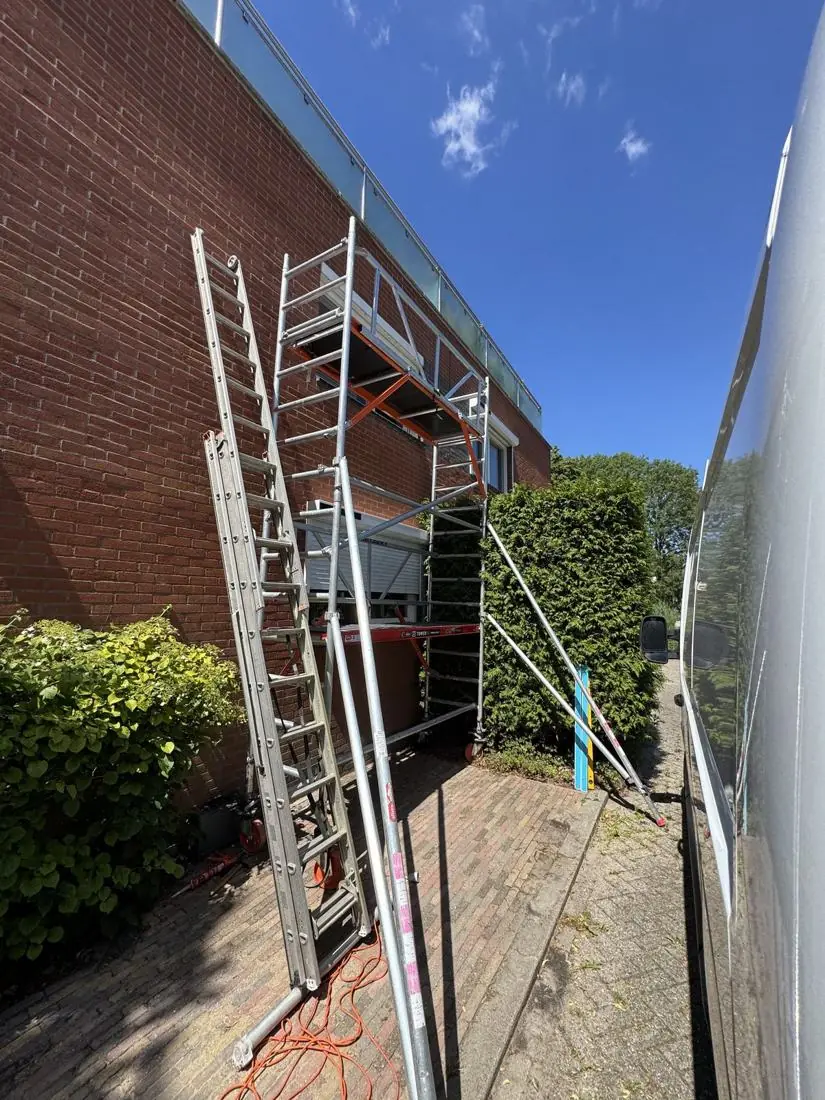
Erected tower in a side passage next to brickwork, with an extension ladder standing upright against the same wall

Anyone who builds too low feels it in the wrists. To get a comb square under the tiles you have to line it up at eye level; standing lower means screwing above your head, the strip drifts out of true and the pins press unevenly against the tile. With panels it is more direct still: fail to reach the top edge of the panel and that side stays open, and the pigeons simply creep in underneath it again the following week.

Where the tower you hire stands when installing bird protection

Installing bird protection nearly always runs the full width of a roof slope, so you take the tower along the whole elevation with you. So do not look at a single standing spot but at a strip: is it level over the full length, does the same surface run all the way, and can you travel along it without a detour? An extension halfway down, a conservatory or a shed built against the wall will sometimes force you to tackle part of the run from the other side of the house.

The four stabilisers have to be braced out afresh at every position, so along that whole strip you need a couple of metres of clear width. Garden paving and a drive are fine; a border, bark chippings and grass that softens after rain are not. Look at what is under the grass as well: a chamber, a gravel soakaway or a freshly laid cable duct will not carry the weight of an extended leg. Levelling out a step is covered in the notes on an uneven standing surface.

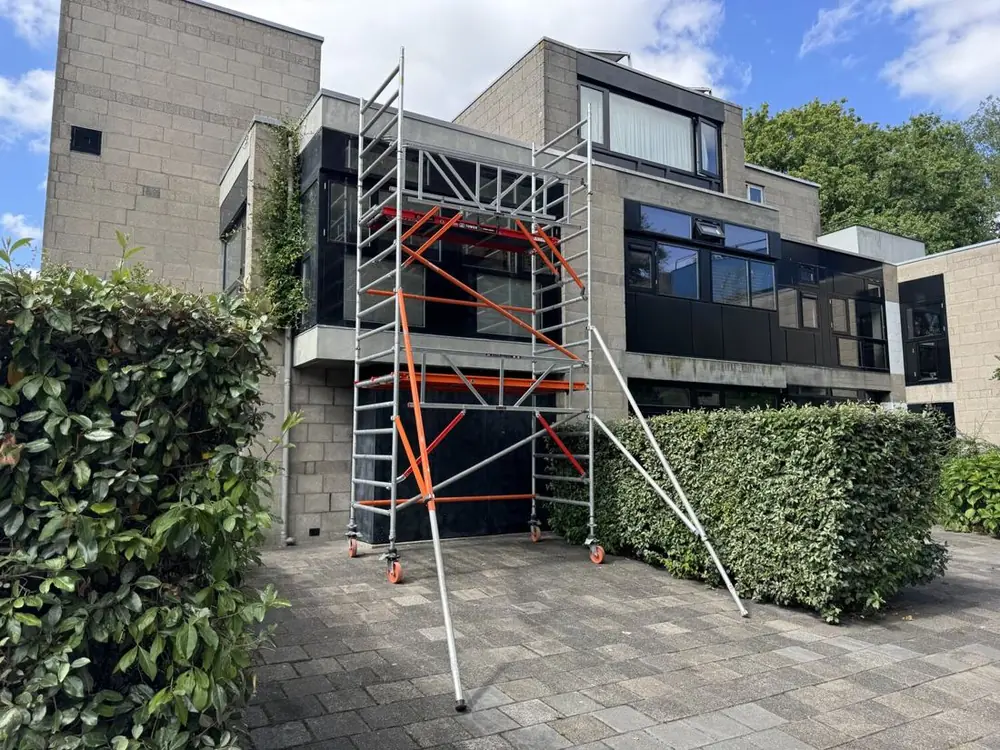
Mobile scaffold with all four stabilisers braced down to block paving in front of a grey stone fronted house

If the solar panels sit on the rear slope, the whole job moves to the back garden. Measure the gate and the path first in that case, because the components have to go through in one go. Working at the street side, keep a walking route free beside the build and ask your council whether the pavement in your road may be used. Fence off the strip below while you are up there, since a snipped off piece of mesh is razor sharp and light enough to blow anywhere.

How many hire days for bird protection along a roof edge

Reckon this job in metres of roof edge rather than in hours. Each position covers around two metres, so a ten metre elevation already means shifting, bracing and climbing five times over. For the front of a terraced house that adds up to one or two days; take in front and back, or add a strip along the solar panels, and you are on three to five hire days. Most of that time goes not on driving screws but on moving and resetting the build.

There are interruptions you have no control over as well. If an occupied nest still sits behind the spot you mean to close, the protection cannot simply go over the top of it: that cavity stays open until the nest is empty. That order of work is set out on the page about the removal of old nests from a roof edge. The weather sets your pace too, because nobody wants to be snipping and screwing along an edge in wet gloves, and a comb will not sit square on a greasy tile.

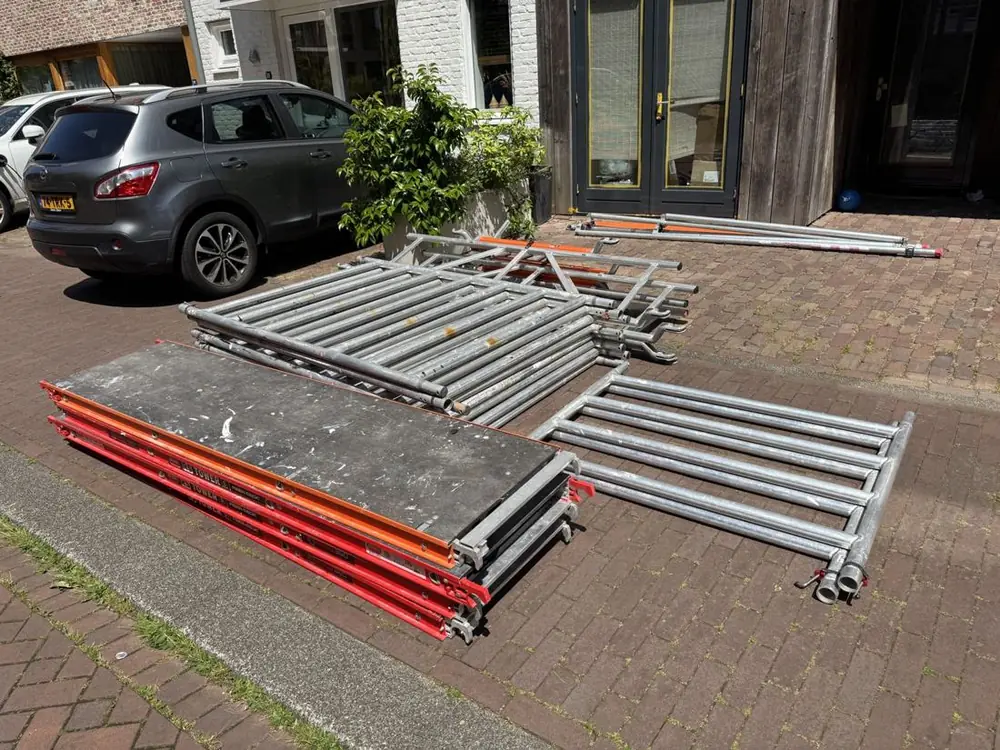
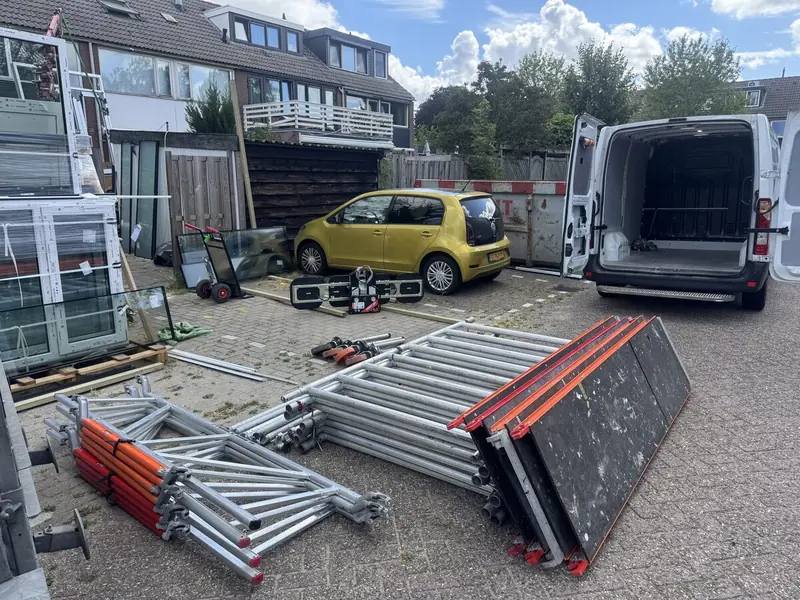
Frames, tubes and red edged deck boards laid across block paving outside a house, a grey car parked alongside

All of which argues for booking on the generous side. The bill does not run in step with the days: the opening period alone is charged at the full figure, while each day that follows has 95 per cent lifted off it. Two days of slack therefore cost you far less than a second delivery, which is what you are facing the moment the job overruns. What a longer period does to your total is set out on the overview of hire rates.

Which mobile scaffold suits installing bird protection?

Kamersteiger RS44
  • Working height up to 4 metres
  • Compact and narrow
  • Great for indoor and small jobs
View and calculate →
Smalle rolsteiger RS51
  • Working height up to 14.2 metres
  • Narrow (75 cm)
  • Ideal for narrow passages
View and calculate →
Most chosen
Brede rolsteiger RS52
  • Working height up to 14.2 metres
  • Wide platform (135 cm)
  • Extra stability and workspace
View and calculate →
1-persoons steiger MiTower
  • Working height up to 6.2 metres
  • Very compact
  • Quick and easy to assemble
View and calculate →

Fitting comb filler without closing off the roof ventilation

Working off boards 245 cm long, one position takes you along a little over two metres of edge, so an average frontage runs to five standing spots or so. Take up only the combs that fit inside that stretch each time. The principle behind installing bird protection stays the same throughout: you keep birds out without sealing the roof, because a tiled roof has to breathe underneath, and closing the space at the gutter completely leaves moisture sitting in the sarking boards.

Set the comb under the first course of tiles with the pins against the underside of the tile, and fix it with rustproof screws. A galvanised screw in a damp roof edge rusts loose within a few seasons and then your whole strip is left flapping on one fixing. So choose stainless screws, or clips that grip around the tile batten, and work through from one end so that the combs overlap each other without leaving a gap between two lengths.

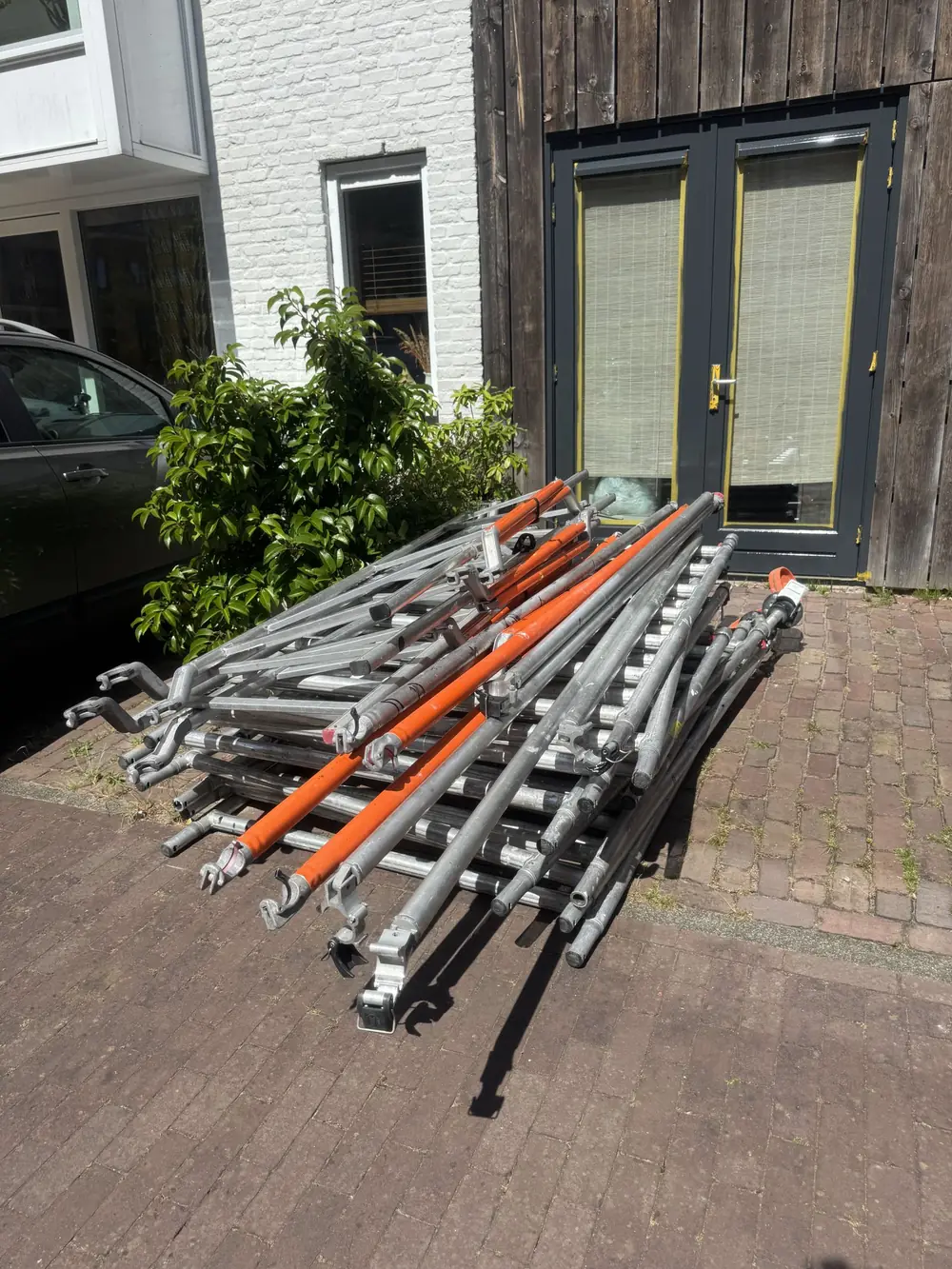
Bundled scaffold frames and orange braces lying on a paved drive beside a white brick wall and a timber door

Open perpends in the wall want small grilles rather than sealant, and those sit lower down, roughly at the level of your second platform rather than at the roof edge. That is worth knowing before you book, because it means two deck heights at one standing position instead of one. Panels are the opposite case: the mesh runs along all four edges of the panel field, so you keep repositioning until the last side is closed, and one side left open undoes the rest.

Hiring a scaffold with delivery for a long roof edge

What is handed over on delivery are loose parts, every one of them counted, and putting them together is your task rather than the driver's. Have the reservation confirmed before 15:00 on a weekday and those parts are waiting for you on the next working day, with both the delivery date and the collection date chosen by you. On a job that runs along a long roof edge it is sensible to have the delivery a day before you start, so you begin with a complete build.

Nominate an unloading corner that is out of the way. The components take up roughly the footprint of a car, and you do not want them lying in the middle of the strip along which the tower has to travel. Where the work is in the back garden, ask whether the load can go down close to the gate, because every metre of carrying counts double with a set this size. We come back for the complete set afterwards; you make sure everything is dismantled and gathered on the spot you gave us.

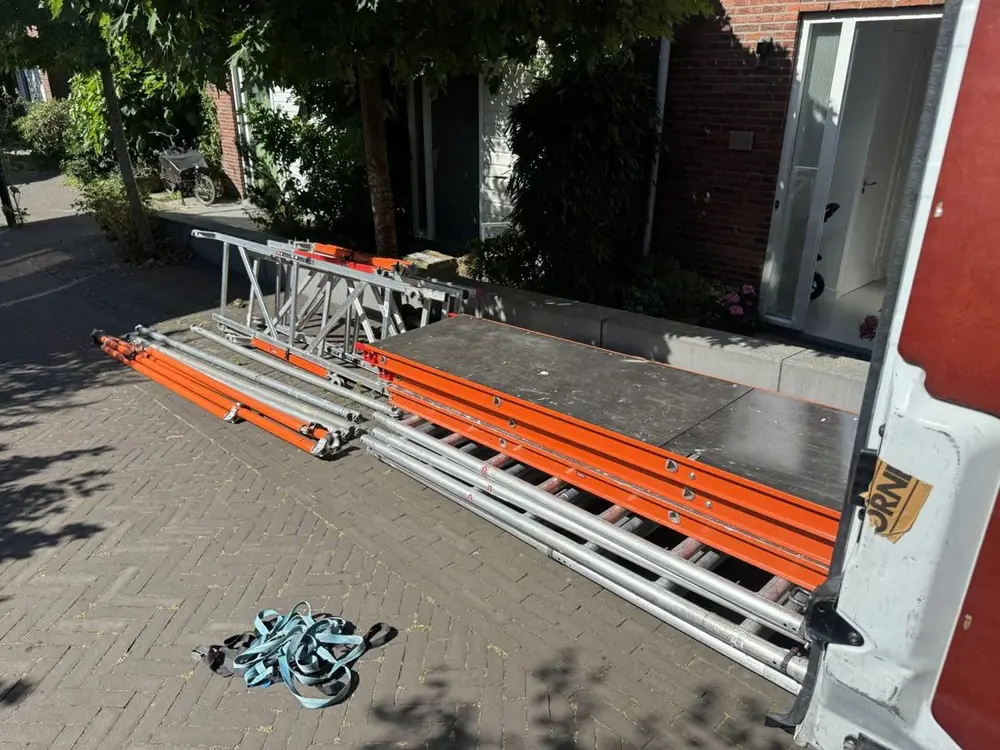
Long orange braces and aluminium frames laid on herringbone brick paving at the open rear of a delivery van

Let the wind have a say in your dates. Installing bird protection means handling long, light pieces at height, and a comb filler catches wind like a sail. A day of hard gusts produces crooked strips and a great deal of fuss, so it is better to move things back. You name the collection day for the hired tower yourself, so pushing everything back by twenty four hours is nearly always workable, as long as we hear about it before the collection round is planned.

Installing bird protection safely at eight to twelve metres

Heavy this work is not: a comb and a cordless drill together weigh less than a bucket. Load class 3 within EN 1004 rates the deck you stand on at 200 kg for every square metre, so the loading is never what limits you here. The attention belongs somewhere else. You reach sideways past the guard rail again and again to line a strip up or to place a screw just beyond your span, and it is precisely that movement that costs people their balance.

The castors go on the brake before anyone climbs, and they stay locked until the last person is down. A build with tools or a person still on it does not get moved, however short the two metres to the next strip. When the wind is strong you stop the work altogether: at ten metres along an open roof edge a gust takes hold of you easily, and with half a comb in your hands there is nothing left to hold on with.

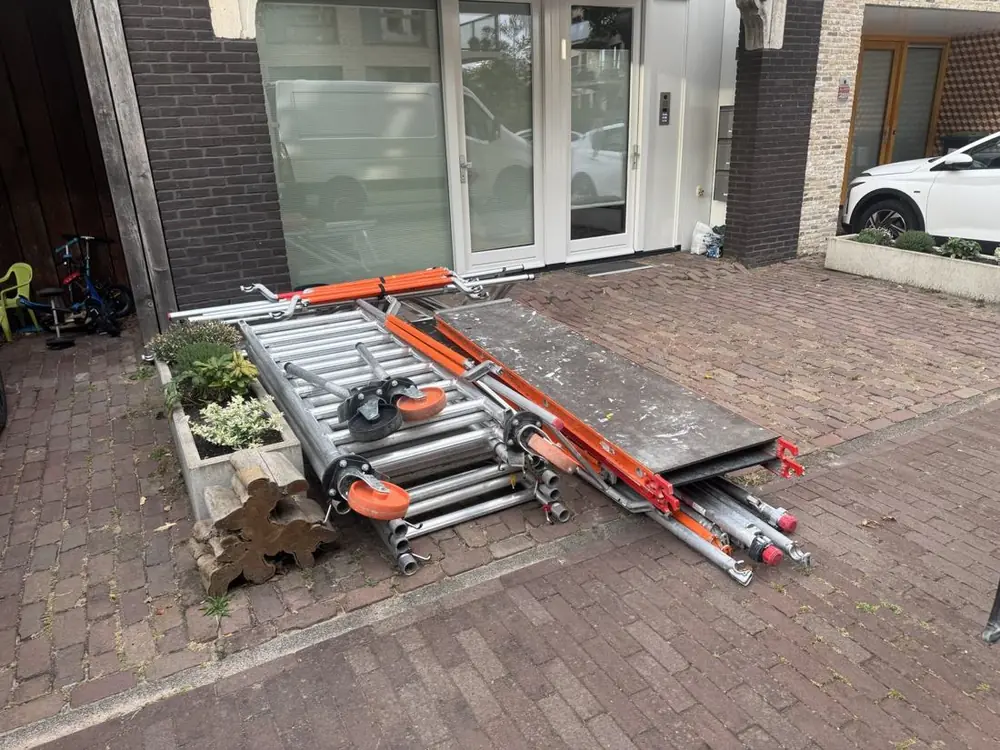
Scaffold frames, a wide deck board and stabilisers with red clamps set down on paving by a glazed front entrance

The hazards that go with this particular job are small and sharp. Snipped mesh and loose pins cut straight through a glove, and screws laid down on the deck roll towards the edge. Use a belt pouch or a magnetic dish, and leave nothing at all lying loose on the boards. If you are working over a terrace or a path, fence it off, because a piece of mesh falling ten metres is not something you want anybody standing under.

In 5 steps

How hiring a mobile scaffold works

1
Choose working height

Pick the height that suits your job.

2
Book online

Sorted in 60 seconds, price shown instantly.

3
We deliver

At the agreed spot the next working day.

4
Assemble safely

Assembled by you, with a manual.

5
We collect

One call and we collect the scaffold.

Good to know

Practical tips for installing bird protection

1

Cut your combs to length on the ground and not up on the deck. Measure at height, cut below, because a pair of snips and half a strip of filler have no business together on a platform.

2

Begin installing bird protection from the side the wind usually comes from, and let each strip slide over the previous one instead of butting against it. That way no gap is ever left standing open between two combs.

3

Carry one more strip per position than you think you need. Climbing down again for twenty centimetres of filler costs you more time than the whole of that position put together.

4

Check before you close anything that there is no occupied nest behind the opening. A creature you shut in makes itself heard within a day, and the protection you just fitted has to come off again.

5

Keep your screws in a magnetic dish on your belt rather than a box on the deck. A box knocked over at ten metres costs you half a day searching among the paving below.

6

After your last position, walk the elevation once more from a distance and look into the light. Openings you miss from close up stand out at once from the far side of the street.

Frequently asked questions

Frequently asked questions about installing bird protection

Which mobile scaffold should I hire for installing bird protection?+

The wide RS52 is the logical tower here. You are handling strips over a metre long, often with a second pair of hands, and those pieces have to rest somewhere while you drive screws. On a broad deck that works without anything projecting past the rail. Only for a short run above an extension, or where your side gate is too narrow to admit anything else, is it better to hire the slim version and carry the material up in smaller loads.

How does hiring a tower for bird protection run from start to finish?+

You record online which model and which height you need, and add a delivery day and a collection day straight away. On the agreed day the components arrive, you build the tower and work the roof edge metre by metre. On the last day of your hire period you dismantle it and set the set out complete on the agreed spot. Everything you fix beforehand appears as a fixed amount in your confirmation, VAT included.

How many hire days does installing bird protection along one edge need?+

For the front of a terraced house one to two days is enough. Take on front and back, or add a run beside the solar panels, and three to five hire days is nearer the mark. Remember that one position covers only about two metres of edge, so the time goes mostly into shifting. Count the building morning in and keep a day spare for the spots you skipped, since a corner by a dormer eats more time than three straight metres.

What is the rental price built from, and why is day two cheap?+

Two choices steer it: the scaffold you take, and how high it goes up. Alongside that sits one transport amount, fixed per province, which covers bringing the set to you and fetching it away afterwards. Because only that opening period counts in full and the days behind it are heavily reduced, an extra day is barely noticeable. Book tight and fail to finish and you pay transport twice, which weighs a great deal more.

What working height do I hire for protection beside solar panels?+

Look at where your highest fixing point sits, which is the top edge of the panel field and not the gutter. Your deck therefore ends up a good way below the clips themselves, which is where you want to be working from. With panels running halfway up the roof slope you are looking at a reach towards twelve metres. If you are only working under the tiles by the gutter, a lower setting of the tower will do and the reach you hire sits nearer eight metres.

Do you bring the hired tower, or do I have to collect it myself?+

Having it brought is the easiest route and it happens on the date you pick; the amounts per province appear with the cost of bringing and fetching a set. If you would rather avoid that and you have a suitable van, the hired parts can be picked up at no charge by appointment at Zeeburgerpad 89, 1019 AD Amsterdam. Bear in mind that a build for this height runs to a fair number of deck boards and frames, so measure your load space before setting off.

Is erection part of the hire, or do I build the scaffold myself?+

Building stays your job. An instruction manual comes with it and a short film online shows the order in which the components go together; at this height two people need something like ninety minutes for it. Our range consists of mobile scaffolds, room scaffolds and the MiTower, each delivered as loose parts. We supply nothing ready to use, and we carry neither facade scaffolds nor cherry pickers. For this work that is no drawback, since you reposition it yourself anyway.

Can I extend the hire if the roof edge turns out to need more work?+

Yes, that can be arranged. You simply pass on a new collection day and the tower stays exactly where it stands. With protection work it comes up often: you find a hole behind the gutter bracket, or the corner by the dormer needs something made to measure. Sort it out as soon as you can see it coming, because once the collection round has been planned you will find yourself dismantling with an open strip still left under the tiles.

How much clear ground along the wall does this hire ask for?+

Not one spot but a strip, since you move the tower along the entire roof edge. Reckon on a couple of metres of free width over that whole length, with room on all four sides for the extended legs. The stumbling blocks are an extension halfway along, a raised terrace, a shed against the wall and a dense hedge. What you cannot get past you do from the other side, or you build the hired tower there a second time.

What do I do if the wind gets up during my hire period?+

Then you postpone. A comb filler catches a surprising amount of wind, and at ten metres you feel a gust sooner than at ground level by the wall. The tower may stay standing provided you do not move it and the stabilisers are out. Push your collection day back a day and pick the work up once things are calmer; extending the hire over a hold up like that costs less than a crooked strip you have to replace a season later.

How quickly is the deposit returned after this hire period?+

Your deposit is credited again inside 1 working day of the components arriving back with us. Make sure that when you dismantle you leave no screws, offcuts of mesh or fragments of filler between the deck boards, because those do not belong to a hired tower. Lay all the components together on the spot you gave at the reservation and count them off against the packing list, and there is nothing for anyone to argue about at the check.

Does bird protection block the ventilation of my roof, and can I hire higher?+

Not if you do it properly. A comb closes the opening at the lowest course of tiles with pins, so air still passes by. Open perpends in the wall are closed with small grilles and never with sealant, because those joints ventilate the cavity. If you want to be certain of reaching every edge to do that neatly, hire the tower one setting higher rather than one setting too low.

Hire a mobile scaffold for installing bird protection today?

Calculate your rental price now or ask for free advice.

Rolsteiger van SteigerTaxi geleverd op locatie
Book it online

Your scaffold sorted in 2 minutes.

Choose your scaffold and working height, see the price instantly and book online.