
Knowledge base · reading time 10 minutes
RS51 or RS52: which mobile scaffold suits you?
Two mobile scaffolds with the same working height and the same platform length, but sixty centimetres of difference in width. That single difference decides where the scaffold can stand, what you take up with you and how often you move it.
- The difference between the RS51 (75 cm) and RS52 (135 cm) mobile scaffold: width, working space, stability and access. How to pick the right model.
- Slightly, but the difference is small.
- No, the RS44 room scaffold is the model for that.
- Usually yes, depending on availability at that moment.
The difference comes down to one measurement: 75 versus 135 centimetres
The RS51 and the RS52 are both Altrex mobile scaffolds built to EN 1004, and they reach exactly the same working heights: 4.2 to 14.2 metres. The only real difference is the width of the frame, and therefore of the platform. The RS51 measures 75 cm across, the RS52 measures 135 cm. That is sixty centimetres of difference, and those sixty centimetres decide whether the scaffold fits through your gate, how much tooling you can keep beside you and how settled the whole thing feels on the pavement.
In practice people choose that difference by instinct, and often in the wrong direction. Someone with a cramped back garden orders the wide one because wide sounds safer. Someone with plenty of room orders the narrow one because it looks cheaper, and then spends two days sharing a 75 cm board with a bucket, a sealant gun and a stack of trim. Measuring before you order settles both cases, and it takes five minutes with a tape measure.
Turn the width difference into something you can picture. The platform on both models is 245 cm long. On the RS51 that gives you roughly 1.8 square metres to work on; on the RS52 roughly 3.3 square metres. The wide model nearly doubles your working surface at the same point on the facade. Every further difference, from stability to transport, traces back to that one figure.
What stays exactly the same on both models
Platform length is identical: 245 cm on the RS51 and on the RS52. You therefore cover the same stretch of facade per set-up, and you have to reposition just as often when you work along a long wall. Vertical reach is identical too. Both use the same rule of thumb: working height is platform height plus two metres, because an adult reaches about two metres above the deck they stand on. The guide on scaffold height per storey works through that in more detail.
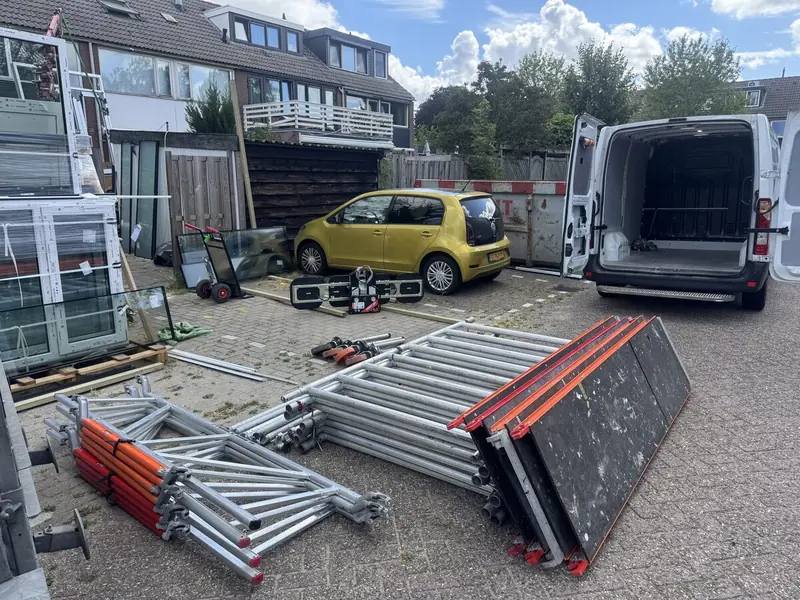
Both models fall under EN 1004 and under load class 3, which comes down to 200 kilos per square metre of platform. They use the same clamp system, so neither needs tools to assemble. Steigertaxi does not deliver assembled and does not build the scaffold for you: you put it together yourself using the manual and the instruction video supplied with the hire. That applies to the narrow model just as much as to the wide one.
The hire terms match as well. The first hire day is charged at the full daily rate and every following day counts as five percent of that rate. Order before 15:00 and the scaffold is delivered the next working day, anywhere in the Netherlands. Delivery and collection together are covered by a fixed amount per province, listed on the page with delivery costs.
Measure your access route before you measure the facade
The measurement that usually decides the choice is not the facade but the route to it. A mobile scaffold is either wheeled to its position fully assembled, or carried across in parts and built on the spot. Either way it has to pass the narrowest point on the way. For terraced houses that is often the rear gate, between houses it is the alley, in flats it is the entrance hall or the lift. A 135 cm RS52 simply will not pass an opening of one metre.
Walk the route once with a tape measure and note the tightest point. Look beyond the opening itself at everything that protrudes: a door handle, a downpipe, a meter cupboard, a bike rack. Those few centimetres are the difference between wheeling through and taking the scaffold apart. If the route really is tight, the guide on whether a mobile scaffold fits through a door covers the awkward cases.
- The width of the gate or rear entrance, measured between the posts rather than in the brickwork
- The clear width of the path, including planters, bins and bicycles that will stay where they are
- Anything protruding at eye level: downpipes, meter cupboards, shutters, outdoor taps
- Turning room at the corner of the path, because you have 245 cm of length to swing around
- The width of the standing position itself, including room for the stabilisers
- For indoor work: the door width and the clear height under the ceiling
Working space on the platform: what fits beside your feet
A 75 cm platform is perfectly comfortable to stand on, but little is left over. Subtract the space you occupy yourself and you keep a strip of about thirty centimetres for your things. A paint kettle, a roll of tape and a sanding block go up with you. A full tool case, a stack of roof tiles or a length of guttering does not. You climb down more often, and each trip costs more time than the wider scaffold would have.
At 135 cm the picture changes. You put a tool case down beside you and still walk past it. Long material such as fascia boards, glazing beads or a section of rainwater pipe can lie flat on the deck without sticking out over the guardrail. On jobs like painting window frames or replacing a gutter you notice that within the first hour.
Load class 3 means 200 kilos per square metre, and those square metres differ considerably between the two models: roughly 1.8 square metres of platform on the RS51 against roughly 3.3 on the RS52. More important than the total is how you spread it. Keep heavy material in the middle of the deck rather than on one corner. The guide on scaffold loading and weight sets out what is and is not sensible.
Stability and the room the stabilisers take up
A wider base sits calmer. You notice it most when you are high up and pushing sideways, for instance when raking out pointing or pressing home cladding. The RS52 offers more counterweight, so the structure gives less. That is not a licence to work without stabilisers: from the heights at which they are required, you fit them on both models.
What people underestimate is that stabilisers make the footprint of either model considerably larger than the frame width. They splay outwards and take up room on both sides. An RS51 that rolls neatly through an 80 cm gate still occupies a good deal more width once it is standing. On a narrow path along a side wall that, rather than the scaffold itself, is the real constraint. The guide on stabilising and anchoring explains how far they reach.
Ground conditions weigh equally on both models. On block paving, grass or a slightly sloping drive you spread the load with base plates and level the scaffold with the spindles. A wide scaffold on poor ground is not safer than a narrow one on good ground. Width only helps once all four feet carry evenly.
RS51 and RS52 side by side
The table below sets out the fixed figures for both models, including the deposits that apply for delivery and for collecting the scaffold yourself. Anything not in this table, from the assembly method to the hire terms, is the same on both.
| Feature | RS51 (narrow) | RS52 (wide) |
|---|---|---|
| Width | 75 cm | 135 cm |
| Platform length | 245 cm | 245 cm |
| Working surface on the platform | around 1.8 m2 | around 3.3 m2 |
| Working height | 4.2 to 14.2 m | 4.2 to 14.2 m |
| Load class | class 3, 200 kg per m2 | class 3, 200 kg per m2 |
| Strongest point | passes tight openings | space and calm on the deck |
| Deposit on delivery | 500 euro | 500 euro |
| Deposit when collecting yourself | 1000 euro | 1000 euro |
Moving during the job: manoeuvrability versus fewer repositions
On work where you shift along a few metres at a time, such as painting a long facade or clearing a gutter across its full run, the narrow scaffold is the friendlier one. It swings around a corner more easily, it passes a shed and it catches less overhanging greenery. Always move it with nobody on the deck and no loose material on the platform, and put the castor brakes back on afterwards.
The wide scaffold takes more effort per move, but you have to move it less often because more material goes up with you. On work that stays in one place for days, such as fitting a dormer or replacing fascia boards, that outweighs manoeuvrability. Estimate how often you expect to reposition; above roughly ten times a day the RS51 nearly always wins.
How far up you need to go changes the balance
Up to around six metres of working height, so up to the gutter of an ordinary terraced house, both models feel settled and the choice is mainly about space. Higher up, towards the third storey and beyond, the wider base of the RS52 counts for more in comfort. You feel less movement under your feet and you are quicker to work with both hands.
The reverse also applies: the higher the scaffold, the more components it takes and the more it asks of the standing position. A tall, wide scaffold needs a decent stretch of level ground plus room for the stabilisers all around. Check what is realistic per height through the overview of working heights, or go straight to the page for the height you need.
If you are not yet sure which model and which height suit the job, work through the selection guide. It starts from the job and the facade rather than from the product, which more often lands you on the right combination of height and width.
Jobs where the RS51 is the better choice
The narrow scaffold is the default as soon as space is tight or you have to reposition frequently. It asks less of the standing position and it reaches places the wide model cannot. For most maintenance work on a terraced house a 75 cm deck is ample.
- Work in an alley, rear entrance or gap between two houses with less than a metre of clearance
- Window cleaning and glass work, where little material goes up with you
- A long facade where you shift along ten times a day or more
- Balconies, roof terraces and courtyards with a limited floor area
- Jobs where one person works up top and a second passes things from below
- Situations where the scaffold has to be parked between sessions, for instance beside a car on the drive
Jobs where the RS52 is the better choice
The wide scaffold pays off as soon as material, length or a second pair of hands goes up with you. You do need the room for it, both on the route there and at the spot where it will stand.
- Two people working on the same deck at once, for example when fitting a window frame
- Work with long material: fascia boards, gutter sections, cladding, battens
- Rendering, pointing and facade painting over large areas, with buckets and trays beside you
- Multi-day jobs in one position, where clearing up at the end of the day should stay minimal
- Work above the third storey, where the wider base feels steadier
- Jobs where you want tools within arm's reach continuously rather than in a bucket on a hook
What the width difference means for delivery and self-collection
For delivery the choice changes nothing logistically: both models arrive as loose components and you assemble them yourself. The deposit is the same as well, 500 euro on delivery for the RS51 and the RS52 alike. Delivery and collection together are covered by a fixed amount per province, so the number of hire days does not change that figure.
Collecting the scaffold yourself is a different matter. The RS52 frames are 135 cm wide and that is the measurement that decides whether they fit in your load space; on the RS51 it is 75 cm. Both models include parts of 245 cm that have to go in whole. The deposit when you collect is 1000 euro for either model and is returned within one working day after the scaffold comes back. What you need in terms of van or trailer is covered in the guide on transporting a scaffold.
Setting the choice in the configurator
In the configurator you first pick the working height you need and then the model. Because the RS51 and RS52 cover the same heights, both options appear at every height with their own rate. You are comparing like with like: same height, same platform length, only a different width. What that does to the hire price of each model is visible straight away.
If you are torn between two heights or the two widths, send a photo of the facade and the access route through WhatsApp. A picture of the gate and the path usually shows at a glance whether the wide model will pass. If that still leaves questions, the page with frequently asked questions or a message via contact will settle them.
Frequently asked questions
Is the RS52 heavier to assemble than the RS51?
Slightly, but the difference is small. The components are wider and therefore more awkward to hold on your own, while the number of actions per level stays the same. Both models use the same tool-free clamp system and the same manual. With two people the difference in build time is barely noticeable.
Does the RS51 fit through a standard internal door?
No, the RS44 room scaffold is the model for that. It passes an ordinary internal door from around 70 cm, while the RS51 with its 75 cm frame and 245 cm platform is hard to manoeuvre inside a house. For indoor work the room scaffold is almost always the practical choice.
Can I switch from RS51 to RS52 during the hire period?
Usually yes, depending on availability at that moment. Get in touch as soon as you notice you need more working space and we will check whether an RS52 in the same height is free. Bear in mind that a swap means an extra journey, so it is not arranged the same day.
Can two people stand on an RS51 together?
Technically it stays within the load class, but in practice it works badly. At 75 cm you are constantly in each other's way and have to squeeze past one another at height. If two people routinely work on the deck, choose the RS52 or set two narrow scaffolds side by side.
Does the RS52 take longer to build per level?
No, the number of components per level is the same on both models. What really drives build time is the height you want to reach, not the width. A twelve-metre scaffold takes the same number of levels on an RS51 as on an RS52.
Which of the two is better on a sloping drive?
Either works, provided you use the spindles to level it. The wider base of the RS52 gives a little more margin, but the ground decides: firm, continuous paving and base plates under the feet. If the scaffold is not level, extra width will not help you.
Does the RS52 cost more to hire than the RS51 at the same height?
Yes, the wide version is priced above the narrow one at equal working height. The exact amount depends on the height you choose and the number of hire days, with the first day at the full rate and every following day at five percent of it. Current rates are shown in the configurator and on the prices page.