
Knowledge base · reading time 10 minutes
Transporting a scaffold: what do you need?
Collection is free and by appointment, but the set does have to fit in your vehicle. The platforms are 245 cm long, and that is the measurement your whole transport plan turns on.
- Collecting a mobile scaffold yourself? The dimensions, the weight and the van or trailer you need, plus when delivery is the easier option.
- Allow 245 cm of clear, flat load length.
- You can, but it is rarely convenient.
- No, we do not rent out trailers.
The measurement that decides everything: 245 centimetres
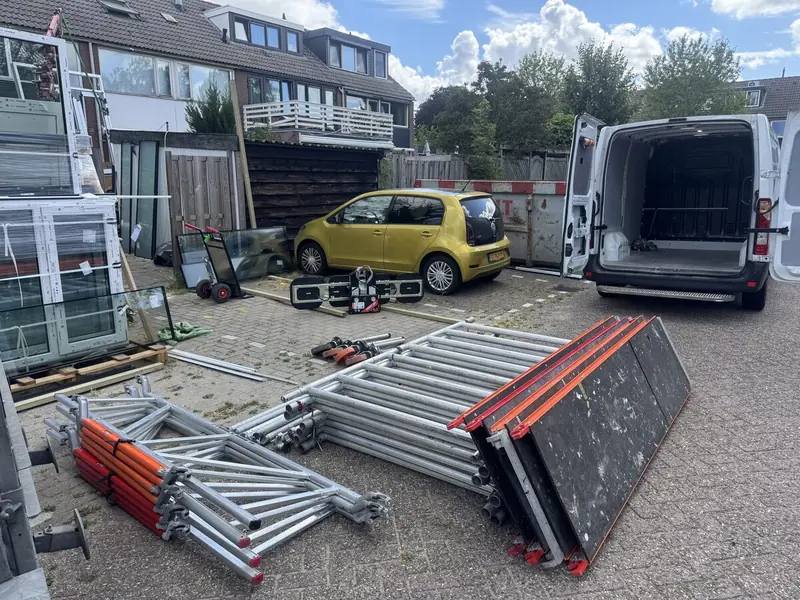
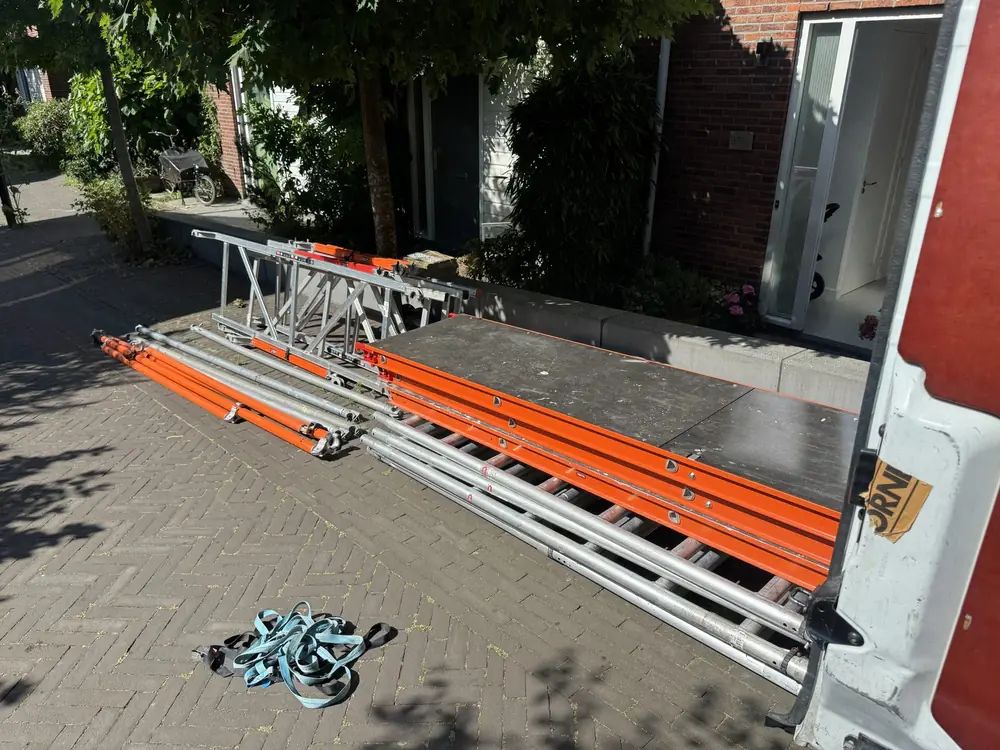
Transporting a mobile scaffold comes down to one figure: 245 cm. That is the platform length of both the RS51 and the RS52, and those platforms do not telescope, fold or come apart. Everything else you load is shorter, so once you have 245 cm of clear load length the rest will follow. Without that length it stops there, however cleverly you stack.
The second measurement is the width of the frames: 75 cm on the RS51 and 135 cm on the RS52. Frames travel best standing upright against the side of the load space, because laid flat they take up the whole floor straight away. In a van, therefore, the distance between the wheel arches matters more than the width of the door opening. The overview of scaffold dimensions lists the individual parts.
The third measurement is the one most people forget: the height of your load space. Frames standing upright need headroom, and in a low van they end up lying flat after all. Measure all three dimensions before you set off, not just the length. Five minutes with a tape measure in your own van saves you standing in Amsterdam working out what to do with half a set on the pavement.
Why a passenger car almost never works
With the rear seats folded, an average hatchback or estate does not reach 245 cm of flat load length. What people then do is slide the passenger seat forward and push the platforms through the car at an angle. That sometimes works, but you end up with parts pressing against the windscreen, a tailgate that will not shut and a load that slides forward under braking. That is exactly the situation in which damage happens, either to the scaffold or to your car.
There is a further reason not to try: you cannot secure the load properly. A passenger car has no lashing eyes where you need them, so the parts lean against the trim and the seats. At the first set of traffic lights everything slides back, and unloading scrapes the sill. Anyone who moves scaffolds regularly picks a van or trailer every time, even for a four-metre set.
A roof rack or roof box does not solve it either. Scaffold parts are long and smooth, and on top of a car they sit high and out of sight. We advise against it. If a car is all you have, check whether a room scaffold covers your job, because it is considerably more compact than a mobile scaffold. The guide on hiring a scaffold without a trailer works through the alternatives.
What has to travel with you: the parts of a set
A complete set is not one large package but a stack of loose parts that you assemble yourself. Steigertaxi never delivers assembled and never builds the scaffold for you; you receive the manual and an instruction video. For loading, that means a lot of separate pieces in different lengths, plus a few items you want to keep apart because they mark easily.
The higher the scaffold, the more of each component comes with it. At 4.2 metres of working height it is a modest stack; at 14.2 metres it is a serious volume. Run through the list once when you collect, because a missing diagonal only shows up when you are halfway through the build. The hire checklist covers what to check before you drive off.
- Frames with rungs, 75 cm wide on the RS51 and 135 cm on the RS52
- Platforms of 245 cm, at least one of them with a hatch to climb through
- Diagonal braces and horizontal ledgers, the longest parts after the platforms
- Guardrails and toe boards for the edge protection around the deck
- Four castors with brakes and spindles to level the scaffold
- Stabilisers with their clamps, which travel loose and are easily left behind
Van, trailer or box truck: what fits where
The table below sets out what to expect per vehicle. Treat the load length column as something you measure yourself in your own vehicle, because manufacturer figures usually describe the floor at the doors rather than the clear space between the wheel arches.
| Vehicle | Clear load length | RS51 (75 cm) | RS52 (135 cm) | What to watch |
|---|---|---|---|---|
| Passenger car, rear seats folded | usually shorter than 245 cm | not suitable | not suitable | Parts reach into the passenger footwell |
| Estate car or large MPV | measure it, 245 cm is the limit | only if the tailgate really closes | not suitable | A 135 cm frame will not pass the wheel arches |
| Panel van, short wheelbase | tight, measure behind the seats | suitable | measure the width between the arches | The floor must be flat over 245 cm |
| Panel van, long wheelbase | ample | suitable | suitable | Use the lashing eyes so nothing shifts |
| Open trailer with sides | bed from around 250 by 130 cm | suitable | suitable if the bed is wide enough | Cover and lash extra, the load is exposed |
| Roof rack or roof box | not applicable | advised against | advised against | Length and weight high above the car |
Loading: order, protection and lashing
Load in the order in which you will unload, so whatever you need first goes in last. Start with the platforms flat on the floor, because they are the longest and stiffest parts and make a good base. Stand the frames along the side afterwards with the rungs facing the wall, so they cannot hook into each other. Small items such as clamps and castors go in last, into a corner where they cannot roll around.
Aluminium is light, but it is also soft. Parts that slide against each other pick up scratches and dents, and a dented tube no longer clamps properly. Put a blanket or a sheet of cardboard between the stacks and leave nothing loose. Driving with a load that rattles and shifts is the quickest way to cause damage that shows on return, and that counts when your deposit is settled.
Keep the small items together. Clamps, castors and the pins for the stabilisers are exactly the parts that disappear into the trim and turn up missing on return. A bucket or crate at the front of the load space keeps them in one place. You use that same crate on site later, so you are not on your knees in the grass halfway through the build looking for one clamp.
- At least two ratchet straps, even in a closed load space
- A blanket, tarpaulin or piece of cardboard between the stacks against scratches
- Work gloves, because platform and frame edges are sharp
- A second person to feed in and aim the long parts
- For a trailer: a tarpaulin with tensioners against wind and rain
- A brush or cloth, so the load floor stays clean and nothing slips
Weight and payload: check your vehicle registration
Individual scaffold parts are aluminium and easy enough to lift, but a complete set together is a serious load. The payload of your van or trailer is on the vehicle registration document, and that is the figure to work to. Remember that you, your passenger and your tools count towards it as well. With a trailer, what your driving licence allows you to tow also applies, and that is something you check beforehand rather than in the car park.
Spread the weight across the floor and keep the centre of gravity between the axles rather than right at the back. A tail-heavy trailer starts to sway at speed, which is particularly unpleasant with long items on board. In a panel van, put the heaviest parts as close as possible to the bulkhead. When unloading, lift with two people as soon as a part is over a metre long, because the length is more awkward than the weight.
Plan for the return trip as well. When you hand the scaffold back, the same load goes into your vehicle again, now with dust, grit and usually some damp on it. Put an old tarpaulin on the load floor before you set off and you save yourself the vacuuming afterwards. It also helps at the damage check, because dirt hides scratches that you would rather establish together at the moment they happen.
How the working height drives your transport
The range covers working heights from 4.2 to 14.2 metres, and the difference in transport volume between those extremes is considerable. Every extra level means another set of frames, another pair of braces and usually another platform. A set for the gutter of a terraced house goes into a short van; a set for fourteen metres fills a long-wheelbase van comfortably.
From roughly eight to ten metres of working height, collecting everything in one van is often no longer a realistic plan. You either drive twice or hire a larger vehicle, and at that point delivery is usually the calmer choice. Before you decide, check what height you actually need through the page per storey, because one level lower immediately means fewer components.
If you are choosing between the narrow and the wide model, transport counts too. The RS52 frames are 135 cm wide, which is exactly the measurement that will not pass the wheel arches in many vans. The comparison between the two is set out in the guide on RS51 or RS52.
Room scaffold and MiTower: the manageable exceptions
Not every scaffold demands a van. The RS44 room scaffold is built to pass a standard internal door from around 70 cm, so its parts are much shorter and narrower than those of a mobile scaffold. For indoor work such as painting a ceiling or papering a stairwell it is often the better choice anyway, and the transport side becomes far simpler. The options are listed under room scaffold hire.
The MiTower is a one-person scaffold up to six metres of working height and is likewise more compact than an RS51 or RS52. It is still too large for an ordinary passenger car, but it is manageable in a small van or on a trailer. Here too you assemble the scaffold yourself using the supplied manual.
Collecting at Zeeburgerpad in Amsterdam: how it works
Collection is free and by appointment, at Zeeburgerpad 89 in Amsterdam. You book a slot so the set is ready and you do not have to wait; turning up unannounced is harder to accommodate. Take the time to go through the set together before you drive off, so you can see straight away that everything is there and what condition the material leaves in.
The deposit is higher for collection than for delivery. For the RS51 and the RS52 it is 1000 euro, for the MiTower 750 euro and for the room scaffold 150 euro. On delivery those amounts are 500 euro for the RS51, RS52 and MiTower and 150 euro for the room scaffold. The deposit is back in your account within one working day after the scaffold is returned. The page on scaffold hire deposits explains how that runs.
Returning it follows the same steps in reverse: dismantle, sort the parts by type and load them clean and dry. Loose material that has rolled around the load space rarely arrives without scratches. The steps from dismantling to handing back are covered under dismantling and returning.
On the road: overhang, corners and braking
Drive more gently than usual with a long load. Aluminium parts slide easily, so an emergency stop moves the whole stack forward if you have not lashed it down. Take corners and speed bumps slowly, certainly with a trailer, and allow for the longer braking distance. A load you can hear moving is a load that is not secured; pull over and retension the straps.
If something does end up overhanging at the rear, it has to be clearly marked and stay visible. Better still is to avoid that situation by choosing a vehicle in which everything fits inboard. On an open trailer, cover the load against both rain and small items such as clamps and toe boards blowing away.
- Retension the straps after the first few kilometres, webbing settles
- Practise reversing with a trailer on an empty yard beforehand
- Allow for height at car parks and under overhanging branches
- Keep small items in a bucket or crate so they cannot roll loose
- Cover everything in the rain; wet aluminium is slippery to unload
When delivery works out more practical than driving yourself
Collecting the scaffold yourself means two return journeys, so four times the distance to Amsterdam, plus loading and unloading at both ends. Against that stand a higher deposit and the risk of causing damage in your own van. Delivery and collection together are covered by a fixed amount per province, whatever the number of hire days. What that means per province is set out under delivery costs and on the page about the cost of having a scaffold delivered.
There is a planning advantage too. Order before 15:00 and the scaffold is delivered the next working day, anywhere in the Netherlands. You do not have to arrange a van on a day when there may not be one available. Where the first hire day is charged in full and every following day at five percent of that rate, an extra day waiting for a vehicle is rarely worth it.
If you are unsure whether your van or trailer will cope, send a photo of the load space through WhatsApp along with the height you need. A photo with a tape measure in it usually shows immediately whether it will fit. If that leaves questions, you can also put your situation to us via contact.
Frequently asked questions
What is the minimum load length I need?
Allow 245 cm of clear, flat load length. That is the platform length of both the RS51 and the RS52, and those parts cannot be made shorter. Measure it between the closed rear doors and the back of the seats, not at the door sill.
Can I collect the scaffold in two trips?
You can, but it is rarely convenient. You drive four times the distance and you only have a complete set after the second trip, so you cannot start assembling in between. At greater working heights delivery is usually the calmer solution.
Can I hire a trailer from you?
No, we do not rent out trailers. Many customers arrange one locally at a hire point or borrow one. Make sure the bed measures at least 250 by 130 cm and check your driving licence and registration document for what you are allowed to tow.
Do you assemble the scaffold if I collect it myself?
No, Steigertaxi never assembles the scaffold for you, not even on delivery. You always build it yourself using the supplied manual and the instruction video. The clamp system works without tools, so you do not need spanners or a drill.
Why is the deposit higher when I collect the scaffold myself?
Because the material travels out of our sight. For the RS51 and RS52 the deposit on collection is 1000 euro against 500 euro on delivery; for the MiTower it is 750 against 500 euro, and for the room scaffold 150 euro in both cases. The amount is back in your account within one working day after return.
Do I need an appointment to collect?
Yes, collection is always by appointment at Zeeburgerpad 89 in Amsterdam. That way your set is ready when you arrive and you do not wait while someone gathers it. Collection itself is free, so there are no transport charges.
How many people do I need for loading and unloading?
Two is comfortable, one is workable at low heights. The parts are manageable individually, but 245 cm of length is hard to aim on your own inside a load space. For sets of eight metres and above a second person is no longer a luxury.