
See your price
Application

Removing birds' nests? Choose the right scaffold.

Removing birds' nests keeps you standing in one spot for a long while, peering deep into a dark cavity and handling dusty material. That asks for a steady position with room around you, and under a roof edge it asks for serious height too. On a three storey house you therefore hire the wide RS52, put up somewhere inside the 8 to 12 metre band. What follows sets out why that width earns its place, the number of hire days to allow, and the rules that decide when you may begin.

  • Order before 3 pm, delivered tomorrow
  • Professional Altrex scaffolds
  • Up to 14.2 metres working height
  • Easy to assemble yourself
4,2 tot 14,2 mWorking heights available
12Provinces served
7Days a week
200 kg/m²Load class 3
In short
  • For removing birds' nests we recommend the Wide mobile scaffold.
  • For removing birds' nests under a roof edge you hire the wide RS52, with a reach falling between 8 and 12 metres.
  • Two people work up there more often than not, so you want a deck you can pass on without any shuffling sideways.
  • Find out first whether you are allowed near the nest site, and only then pick a delivery date for the tower.
  • First 24 hours from €175 incl. VAT and delivery; every day after that 95% off.
Key facts for this job
FeatureValue
Recommended scaffoldWide mobile scaffold (Altrex RS TOWER 52)
Working height for this job8 to 12 metres
Available working heights4.2 to 14.2 metres
StandardEN 1004, load class 3 (200 kg per m²)
DeliveryOrdered before 3 pm, delivered next working day
Each extra day95% off, from €8.75 a day
Why a mobile scaffold for removing birds' nests?

Safe, stable and professional work at height

A nest is seldom in a handy place. It sits behind a gutter bracket, under the lowest course of tiles or in an open perpend just below the overhang, and you have to be able to look into it as well as reach it. Which is why, for removing birds' nests, you hire a mobile scaffold rather than leaning a ladder against the wall: two hands go on a lamp, a mirror and a bag, and you sometimes stay in the same position for half an hour. On top of that the rules have a say. An occupied nest stays where it is, so you may not be allowed to start for months, and the hire period has to follow that.

  • Two people aloft, so a wide deck
  • Looking into a cavity needs mirror and lamp
  • Removing birds' nests waits on an empty cavity
  • The nest height decides between eight and twelve metres
Read more about working safely →

Hiring a wide mobile scaffold for removing birds' nests

For clearing nests out from under a roof edge you take the RS52, the broad version at 135 cm. That is not because the job needs a mountain of tools, but because you stand in one place for a long stretch and a good deal has to sit around you there: a sealable bag, a bucket, a lamp, a mirror on a handle and your protective kit. On a slim deck all of that is in the way the moment you turn round. Both widths appear together under the mobile scaffolds you can book online.

You are also rarely up there alone on this job. One person draws the nesting material out of the cavity while the other holds the bag open and passes tools across. With more than a metre between the guard rails, the two of you get past each other without anyone shoving a full sack. The weight is modest, the volume is not: an old starling nest behind a gutter bracket comes out in dozens of handfuls and you do not want those loose across the boards.
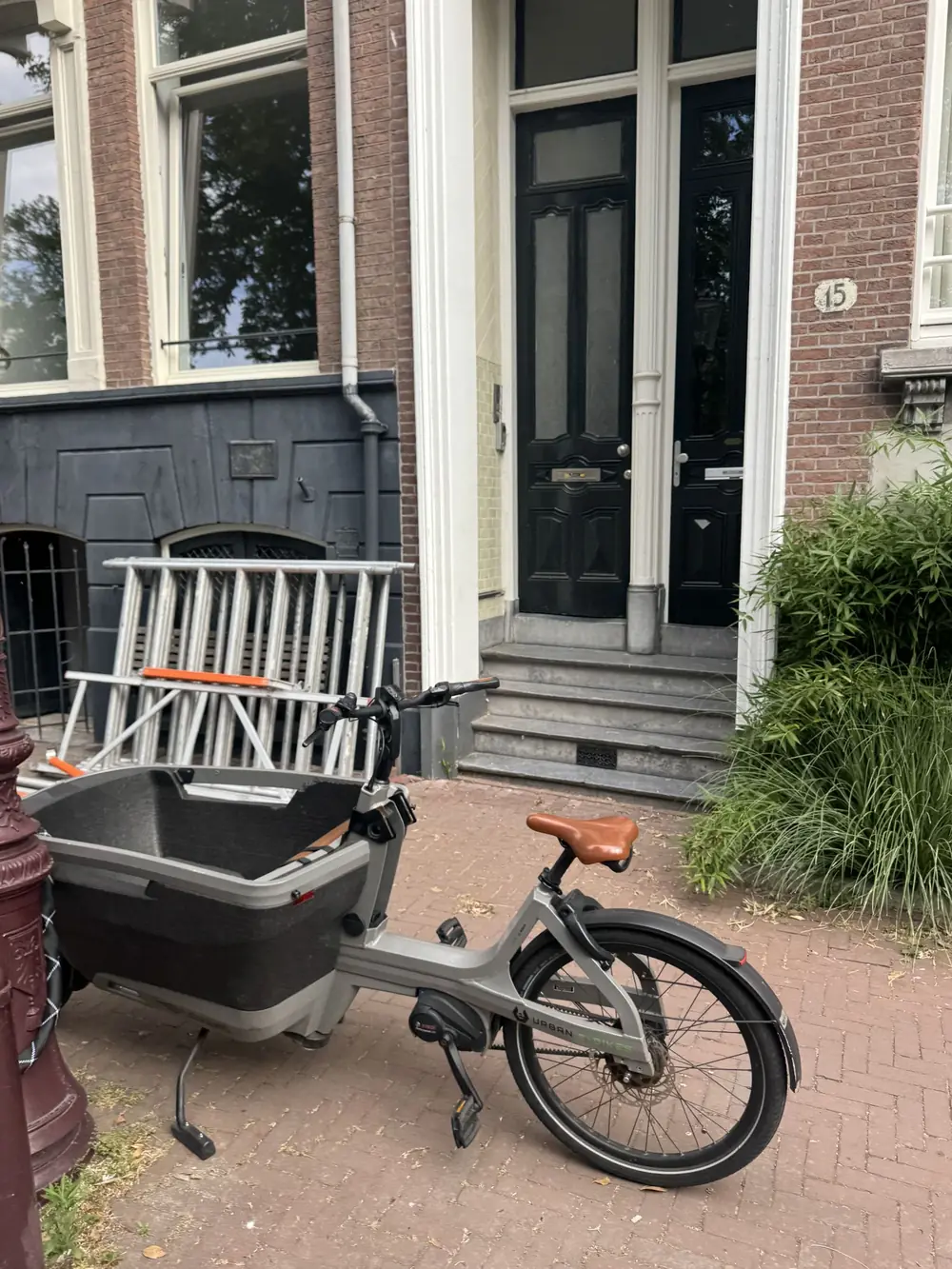
Stacked scaffold guard rail frames leaning against a house front beside a parked cargo bike on the pavement

Where it is a single cavity in the wall and you are working alone, the narrow version will do, and it passes a side gate to the back of the house far more easily. As soon as several metres of roof edge have to be walked, or two of you are removing birds' nests together, the wide model from the fleet is the better answer. Weights, sizes and what to watch for are gathered in the reference on tower sizes and weights.
The working height to hire for nests under the roof edge

Removing birds' nests takes you to the highest point a bird can get to: under the bottom row of tiles, behind a gutter bracket, in an open perpend just below the roof edge or in the cavity at an overhang. On a three storey house, or one with a deep roof, you are quickly looking at somewhere between eight and twelve metres. Measure to the cavity you have to see into, not to the ridge, because you have no business up there for this work.

Then count back downwards. Take roughly 2 metres off the point you need to reach, because that is what your arms still bridge from the boards; what remains is the platform height you hire. If the cavity sits at ten metres, you stand at eight. Start measuring on the ground where the castors will go, so in the garden or on the footway, and not on your back door threshold, which nearly always sits a step higher.

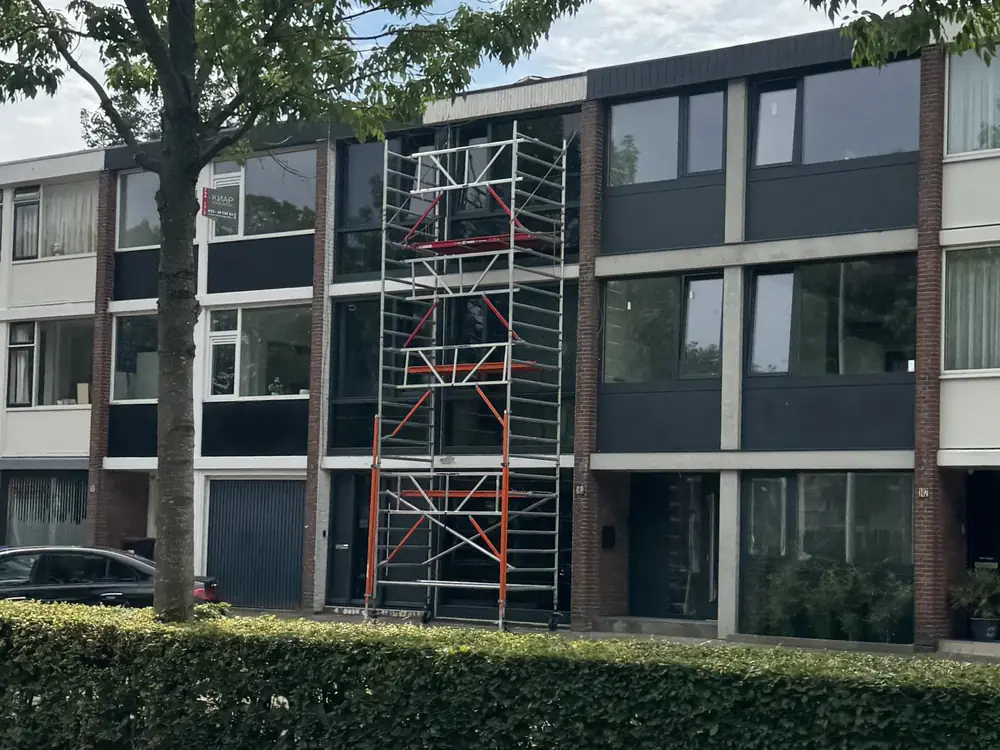
Tall mobile scaffold erected against a three storey building and reaching above the top row of windows

Hiring short is more of a nuisance here than it would be for painting, because you have to be able to look inside. Stand half a metre below the right height and all you see is the bottom edge of the nest, groping about in the dark with a pair of tongs. Remains stay behind, the smell lingers, and by next spring there is simply another nest in the same hole. What three storeys means in metres is worked out under work at second floor level.

Hiring a tower and siting it under an occupied roof edge

Nest sites tend to be exactly where the ground is least helpful: over an extension, behind a conservatory, between the shed and the boundary, or hard against the street. Work out first where the foot of the build can stand, and only after that where you begin. A wide tower asks for more space underneath than its own width, because the stabilisers sit at an angle out of the base and all four want to bear on the same firm ground, even where the garden falls away.

The surface has to be level and to stay level. A terrace of sunken slabs, a border of bark chippings or a strip of grass beside the shed gives way once two of you are aloft with bags on the boards as well. A step between a raised terrace and the garden path is the second stumbling block, and mind what stands hard against the wall: a water butt, an outward opening shed door, a low hedge or a bolted down cycle rack.

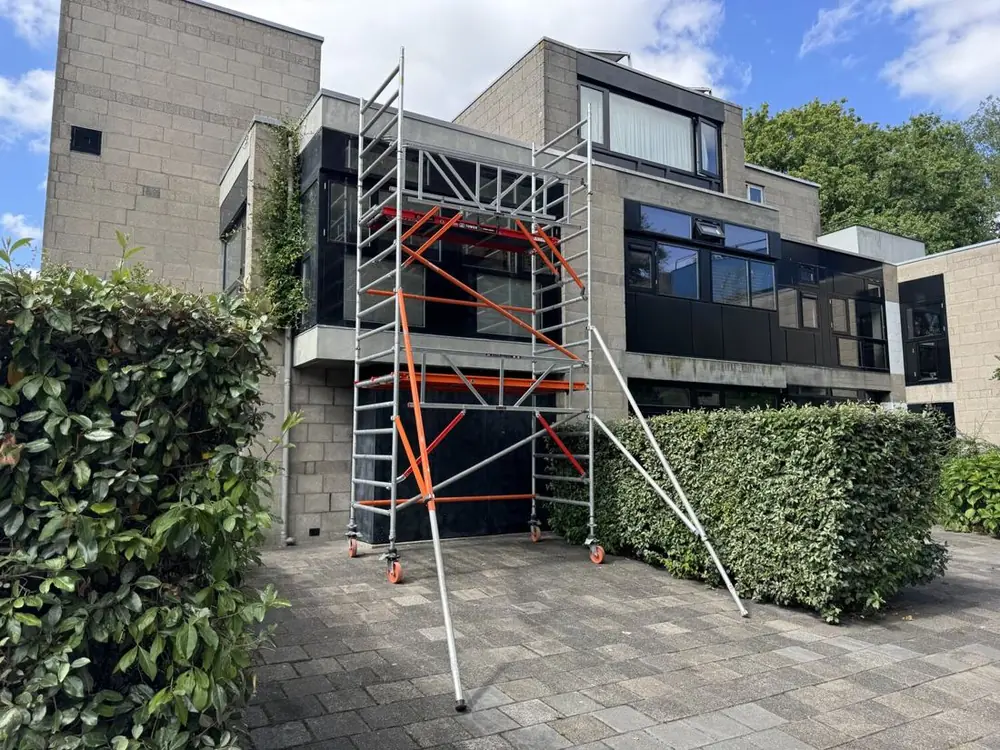
Long stabiliser tubes reaching from a built tower down onto paving in front of a modern grey block house

Think about what comes down from under you too. Clearing a nest sends material downwards, sometimes with a roof tile or a length of comb filler along with it, so fence off the strip beneath the build and tell the neighbours when you will be at it. Where the hired tower stands partly on the footway, leave enough width for a pram to pass. Holding a build steady is covered in the guidance on stabilisers and anchor points.

Hire days to allow when removing birds' nests

Before you fix a date, find out whether you are permitted to work at this nest site at all. Wild birds are protected in the Netherlands, a nest in use is left alone, and with certain species the nest site counts as protected the whole year round even when nothing is in it at that moment. This is not legal advice: ask your municipality, or have an ecologist come and judge on the spot what is and is not possible in your case.

Once that is clear, the work itself is manageable. Emptying and cleaning one cavity takes a couple of hours. Where a run of nests sits under the tiles, you walk the whole roof edge and spend two to three hire days on shifting, inspecting and clearing up. Add the morning it takes to build the tower, then put another day behind that to check what you skipped from the earliest positions, because something always is missed there.

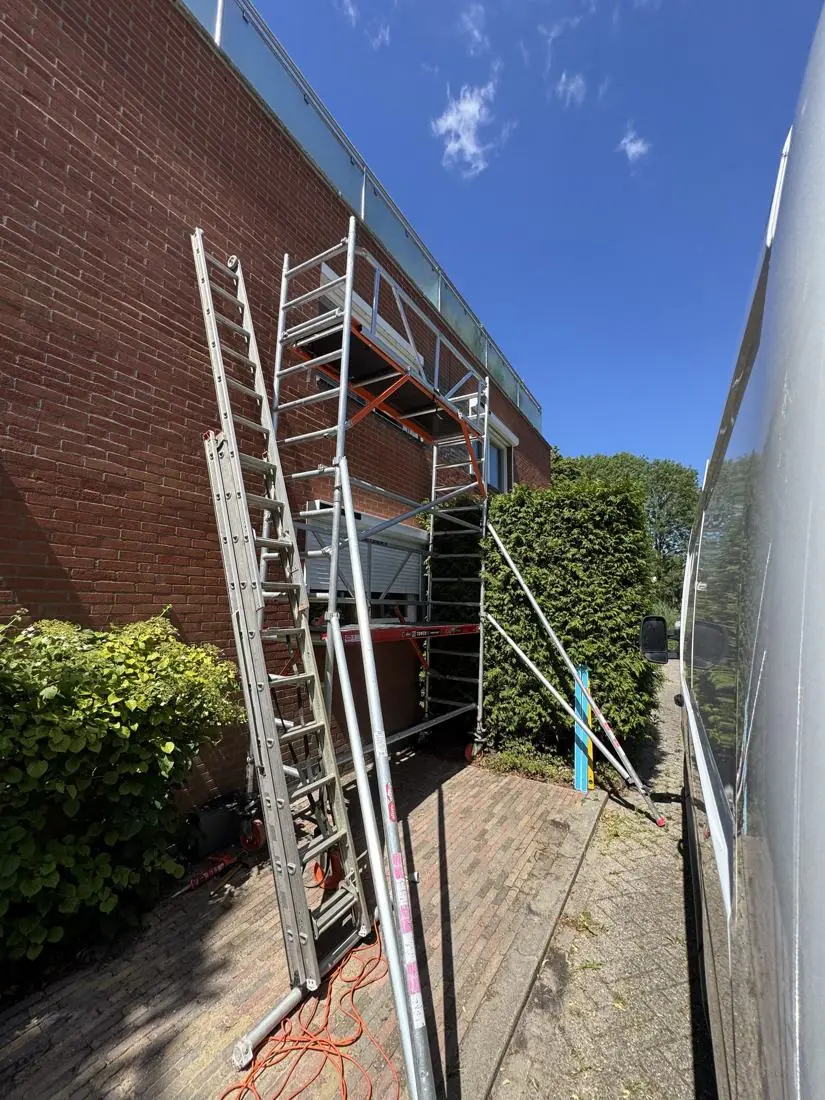
Mobile scaffold standing in a narrow alley against a brick wall, a ladder resting against the brickwork beside it

That programme contains waits that are not yours to control. An answer from the council or from an ecologist rarely arrives the same afternoon, and the breeding season decides which months are open to you at all. So stay on the generous side with the number of days you hire: an extra day weighs lightly, because the full figure is charged over your first twenty four hours and everything after that is billed with 95 per cent taken off. The checklist for booking a tower helps you prepare.

Which mobile scaffold suits removing birds' nests?

Kamersteiger RS44
  • Working height up to 4 metres
  • Compact and narrow
  • Great for indoor and small jobs
View and calculate →
Smalle rolsteiger RS51
  • Working height up to 14.2 metres
  • Narrow (75 cm)
  • Ideal for narrow passages
View and calculate →
Most chosen
Brede rolsteiger RS52
  • Working height up to 14.2 metres
  • Wide platform (135 cm)
  • Extra stability and workspace
View and calculate →
1-persoons steiger MiTower
  • Working height up to 6.2 metres
  • Very compact
  • Quick and easy to assemble
View and calculate →

Clearing a cavity from the platform with mirror, bag and gloves

One position covers roughly two metres of roof edge, and that is precisely what makes removing birds' nests a job of repositioning: the cavities sit scattered and each one wants examining from close up. Carry everything up in a single trip, because going down and back costs more time than the clearing does. On the list are a mirror on a handle, a decent lamp, long tongs, sealable bags, a hand brush and a roll of tape for closing a full bag while you are still aloft.

Hold that mirror in the opening and shine a light in before you put anything into it. You want to know how deep the hole runs, whether a second nest lies behind the first and whether there is still life in there. Do not flush the cavity out with a hose. Water drives the material deeper into the cavity wall, wets the timber underneath and spreads the very thing you came to remove across a much larger part of the structure.

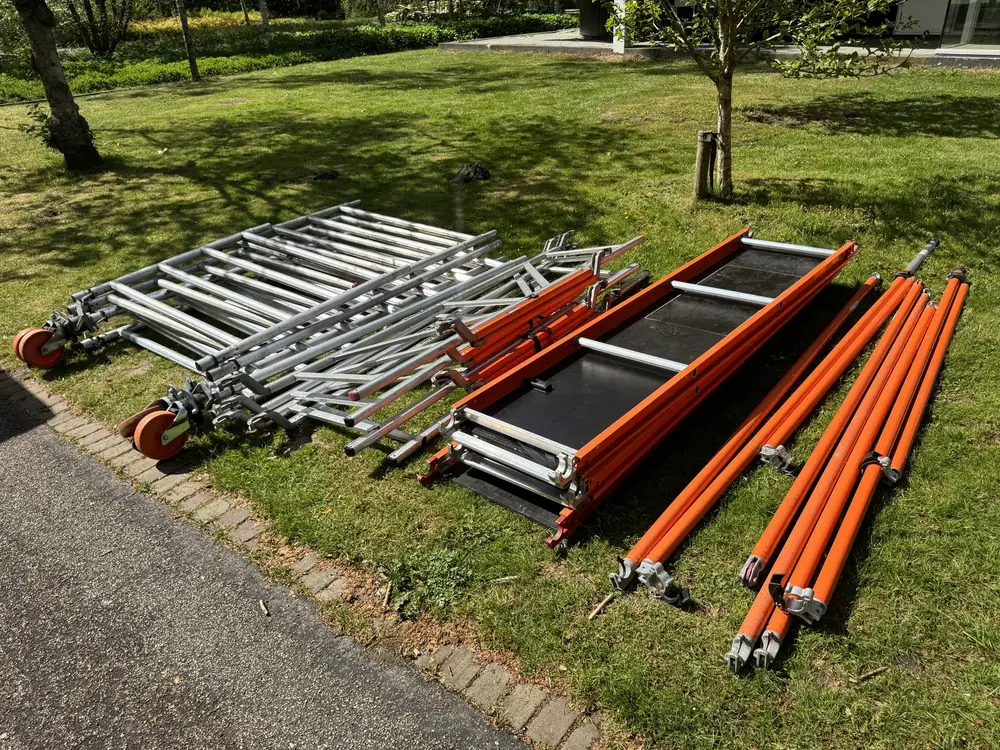
Frames on red castors, orange braces and dark deck boards spread out over a garden lawn under a tree

What comes out is more than moss and twigs. An old nest holds mites looking for a fresh host the moment you lift it, and the dried droppings turn to dust as soon as you stir them. So work in gloves and a dust mask, and knot each bag shut up on the boards. Do not beat your clothing out while you are still on the deck, and lower full bags on a line rather than standing them loose.

Hiring a scaffold with delivery outside the breeding season

No assembled tower arrives at your gate. What comes is a counted parcel of loose parts that you turn into a build on site. Orders can be placed until 15:00 on a working day, and whatever is confirmed in time is ready the next working day after that. Beyond that, the arrival date and the day the parts leave you again are both your own decision. When removing birds' nests that freedom is useful, because your starting day hangs on an answer you may not have in hand yet.

Point out beforehand where the components may lie. They end up on the pavement, the drive or the path and take up roughly the room of a large car. Do not have them put down on the very square metres where the hired tower itself has to stand, or you will carry everything twice. If your nest site is round the back, arrange for the unloading as close to the side gate as possible, which saves tens of metres of carrying.

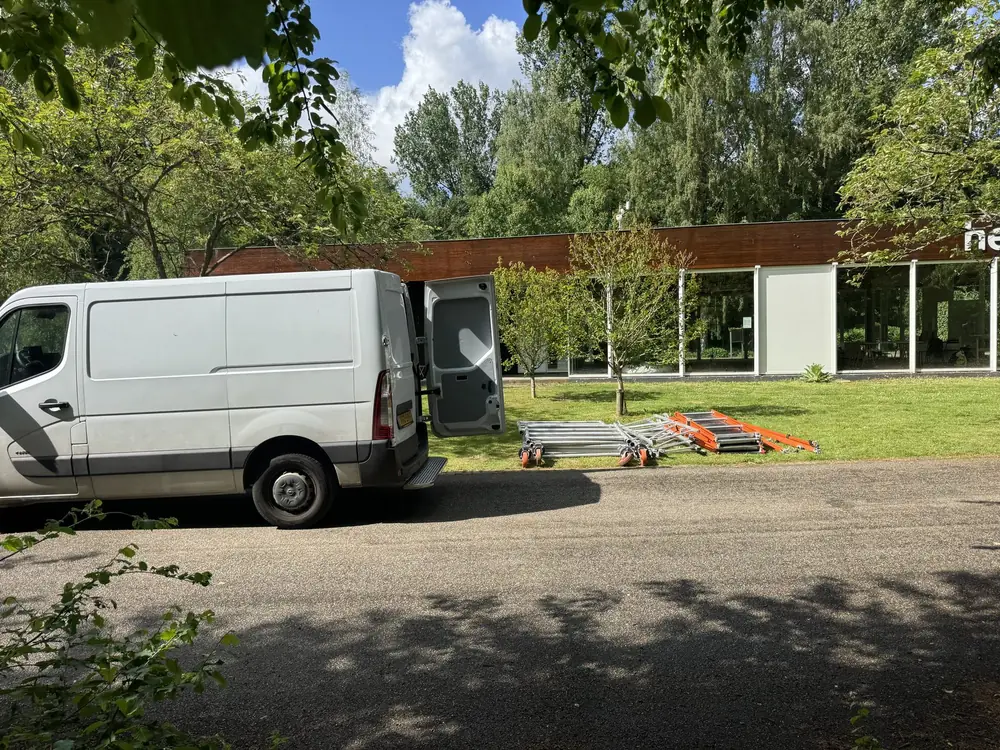
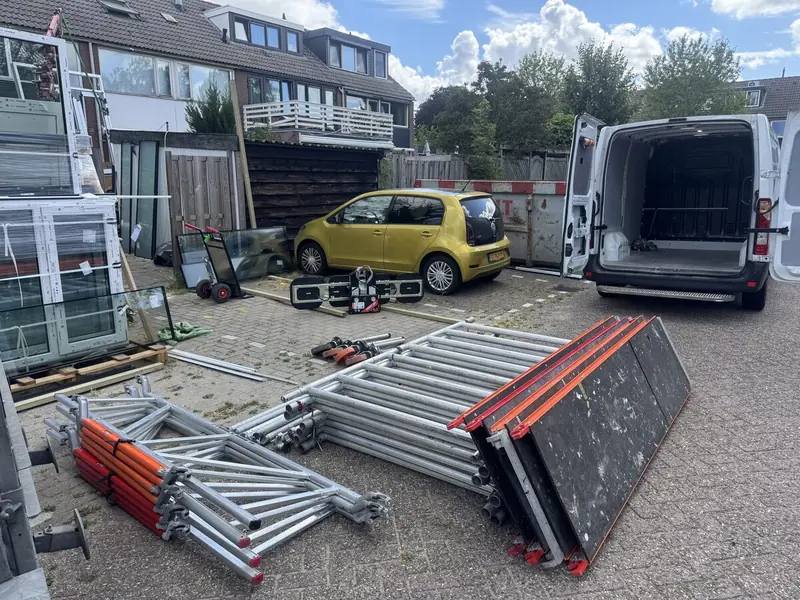
Delivery van standing on tarmac with its rear door swung open, and scaffold parts lying on grass nearby

Afterwards we drive out again and take the whole set back; you leave it dismantled and complete in the same spot. Let the weather set your end date, because on a wet, blowy day you are not climbing to ten metres with a sack of dusty nesting material. Moving a day is wiser than pressing on, and it is arranged simply by giving us your new collection date before the van is already on the road.

Working safely at ten metres beside a nest cavity

The boards you stand on take 200 kg for every square metre, which is the loading that class 3 within EN 1004 provides. On this job you come nowhere near it: you go up with empty bags and come down with full ones. The danger lies elsewhere. Your head and arms end up deep inside a cavity, and while you are pulling at something in there your centre of gravity drifts over the guard rail without your registering it.

Lock the castors before you start to climb and leave them locked until you are back down. Moving a build with anyone aboard is never allowed, not even to reach the next nest a metre along; up top you feel that shift as a jolt and at ten metres you have no free hand to grab with. If the wind picks up the work stops, because at this height there is always more of it than at ground level by the wall.

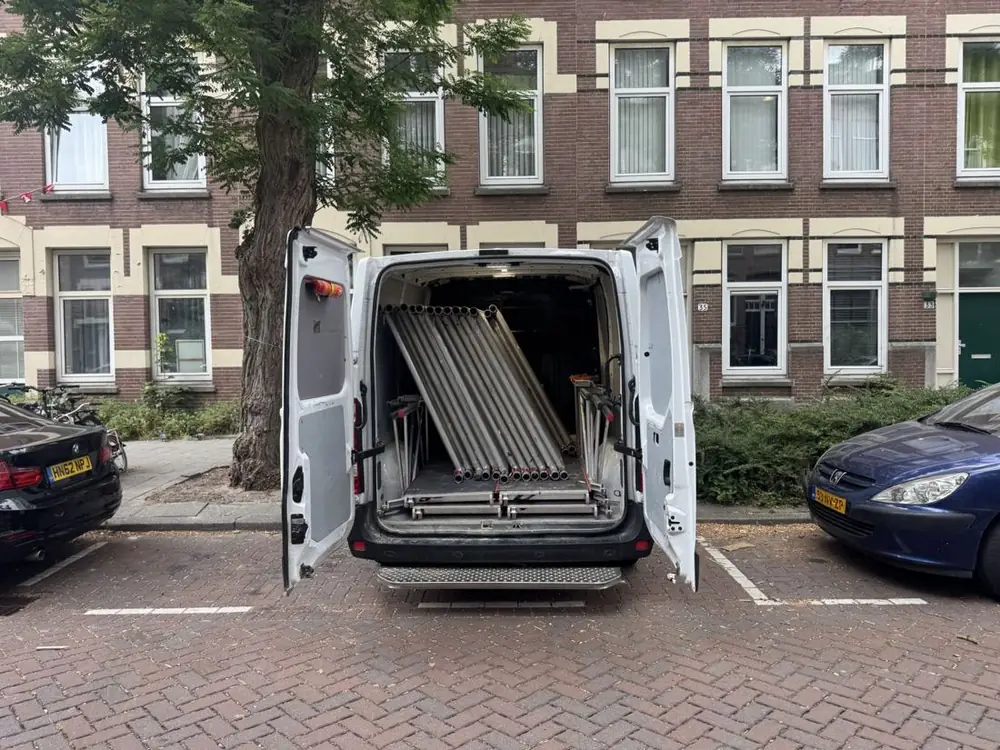
Aluminium frames stacked on end inside the load space of a van parked between cars on a residential street

The hazards that belong to this job are dust, falling lumps and slippery footing. Droppings on a pitched tile or on your deck board turn greasy as soon as they get wet, so sweep as you go and place your feet deliberately. Fence the strip below off, because a handful of nesting material with a lump of mortar in it lands hard. Never work over a path that people use without someone keeping an eye on it from below, and never over the street without a barrier.

In 5 steps

How hiring a mobile scaffold works

1
Choose working height

Pick the height that suits your job.

2
Book online

Sorted in 60 seconds, price shown instantly.

3
We deliver

At the agreed spot the next working day.

4
Assemble safely

Assembled by you, with a manual.

5
We collect

One call and we collect the scaffold.

Good to know

Practical tips for removing birds' nests

1

Photograph every cavity with a lamp shining in before you empty it. Down on the ground your phone shows far better than your eye pressed to the wall whether material is still sitting at the back.

2

Take two kinds of bag up with you: a strong one for nesting material and a small one for dust and grit. All of it together in one sack tears open the moment you lift it over the rail.

3

When removing birds' nests, work down from the ridge and along the roof edge from left to right, taping a marker beside each cavity as you finish it. From a fresh position you will otherwise recognise nothing.

4

Pull your work gloves off before you climb into the ladder frame and keep a second pair waiting below. What clings to a glove is not something you want spread down every rung.

5

Get the answer from your council or ecologist in writing before you book a tower for removing birds' nests. Your delivery date hangs on it, and without it you may hire something you cannot use.

6

Use a bucket with a lid on it up top rather than an open tub. Dusty nesting material blows in all directions at ten metres, even when it seems still down at the wall.

Frequently asked questions

Frequently asked questions about removing birds' nests

Which mobile scaffold should I hire for removing birds' nests?+

In most cases the wide RS52. The job holds you in one spot for long stretches, with bags, a lamp and tools lying around you, and you are regularly up there with a second person, so a broad deck beats a narrow one. If it is a single cavity and you are working on your own, you can hire the slim version, which also passes a side gate more easily. Look hard at the route from the street to the wall before you settle on a model.

From booking to collection, how does hiring for removing birds' nests work?+

You fix a model and a height online, choose the day the components may arrive and the day the tower may go away again. One fixed amount is settled, VAT included. After that you build it yourself, clear the nests out and leave everything dismantled and stacked on your last day. What is unusual here is that the starting date is not yours alone: you may only work once it is established that the nest site is free.

How many hire days does removing birds' nests take altogether?+

For a single cavity in the wall you are done in a day, building and dismantling included. Where a run of nests follows the tiles along, allow two to three hire days: you shift the tower a couple of metres each time and every new position calls for fresh looking, brushing and clearing up. Put half a day behind that to check what the earliest positions missed, because from the ground you cannot see which cavity is still full.

What does the hire come to, and what is an extra day worth?+

Your rental price turns on two things: the scaffold model you pick and the height it goes up to; the delivery and collection ride on top as one amount fixed per province, VAT included and visible beforehand on the page listing hire rates. The structure suits anyone who wants slack in the plan, since the first period carries the whole amount and each hire day behind it is heavily discounted. Holding a spare day in reserve therefore costs you almost nothing on a job like this one.

What working height do I hire when the nest is under the lowest tiles?+

Find out first at what height the cavity sits. On a mid terrace of three storeys that is often around nine or ten metres, so the tower you hire lands between eight and twelve. Your deck ends up standing well below the cavity itself, which is precisely where you want it if you have to look inside. If you hesitate between two settings, take the higher of the two, because looking down into a nest cavity is not something anyone can manage.

Do I have the hired set delivered or fetch it myself?+

Having the tower brought is the simplest route and it happens on the day you chose; the cost is fixed per province and set out with the delivery charges. If you would rather not pay for transport and you have a van at your disposal, you may fetch the components yourself at no cost, once a time is agreed, from our address at Zeeburgerpad 89, 1019 AD Amsterdam. For a build reaching towards twelve metres that is a considerable load of frames and boards, so reckon on making two trips.

Is erection included in the hire, or is the building mine?+

Building is your side of the arrangement, since erection is not part of the hire. A manual comes with the set and an instruction film shows the order from the bottom upwards; with two people at this height you are standing on the boards after roughly an hour and a half. The fleet holds mobile scaffolds, the room scaffold and the MiTower, and each goes out as a loose set only. Nothing leaves assembled, and neither facade scaffolds nor cherry pickers are stocked at all.

The job is overrunning. Can I keep the tower on hire for longer?+

Yes, and on a job like this it happens often enough: a second nest turns up behind the first, or the ecologist wants another look before you carry on further. Send through a fresh collection date at the first sign of that happening. The tower then stays where it stands and your hire period simply runs on at the low daily figure. Waiting until the collection day itself is awkward, because you then find yourself dismantling under time pressure with cavities still standing open under the tiles.

How much clear ground does the hired build need in a back garden?+

Take the width of the model you are hiring, add the extended legs on all four sides, and keep a strip beyond that where bags and buckets can stand without tripping you. In a back garden that soon means several metres square with no step in the middle of it. If the route there runs through a side gate, measure the gate before hiring a wide model, or the set ends up on the wrong side of the house.

Can I keep the hire running if it rains or blows hard during the work?+

In rain and wind you put this work off. Dusty nesting material and a wet, greasy roof edge go badly together, and at ten metres you notice a gust far sooner than at ground level. Leaving the tower up is fine provided you neither move it nor climb it, with the stabilisers out. If it costs you a day, shift your collection date. Extending the hire is always cheaper than pressing on in poor weather and having to redo a cavity you rushed.

When do I get the deposit back once the hire is over?+

You pay a deposit at the reservation and it is credited again within one working day of the return. What matters on this job is putting the scaffold components back clean: nest remains, droppings and feathers do not belong between the deck boards. Brush the set down before you lay it ready, count the parts against the packing list and put the waste in your own sack. There is then nothing left to discuss about the refund.

May I take a nest away while birds are still flying in and out?+

No, a nest that is in use stays exactly where it is. If you see birds arriving, hear young or find fresh material, this is not the moment and hiring a scaffold serves no purpose yet. Quite apart from that, certain nest sites stay protected all year round. Let your municipality or an ecologist judge what is allowed here, and pick a hire period on the strength of that answer rather than on the calendar you had in mind.

Hire a mobile scaffold for removing birds' nests today?

Calculate your rental price now or ask for free advice.

Rolsteiger van SteigerTaxi geleverd op locatie
Book it online

Your scaffold sorted in 2 minutes.

Choose your scaffold and working height, see the price instantly and book online.