
See your price
Application

Painting the roof edge? Choose the right scaffold.

Painting the roof edge is the job everyone walking past looks at: that thin line between tiles and brickwork stands out from the pavement the moment it goes dull or starts flaking. The edge timber, the barge board and the strip that runs up against the roof trim all belong to it. To get that line crisp you want to stand still with tin and brush in reach. So you hire a mobile scaffold in the wide RS52 form, built to between 8 and 12 metres of reach.

  • Order before 3 pm, delivered tomorrow
  • Professional Altrex scaffolds
  • Up to 14.2 metres working height
  • Easy to assemble yourself
4,2 tot 14,2 mWorking heights available
12Provinces served
7Days a week
200 kg/m²Load class 3
In short
  • For painting the roof edge we recommend the Wide mobile scaffold.
  • Paintwork on the roof edge calls for an RS52 of 135 cm wide, set up to reach between 8 and 12 metres.
  • Put the deck slightly above the paint line, because you also have to see the top butting against the roof trim.
  • Reckon on three to five hire days: the line runs round the house and several coats go over it.
  • First 24 hours from €175 incl. VAT and delivery; every day after that 95% off.
Key facts for this job
FeatureValue
Recommended scaffoldWide mobile scaffold (Altrex RS TOWER 52)
Working height for this job8 to 12 metres
Available working heights4.2 to 14.2 metres
StandardEN 1004, load class 3 (200 kg per m²)
DeliveryOrdered before 3 pm, delivered next working day
Each extra day95% off, from €8.75 a day
Why a mobile scaffold for painting the roof edge?

Safe, stable and professional work at height

The roof edge is not the same thing as the fascia board on its own. Fascia boards are the upright planks under the gutter; the roof edge is the whole visible closing of the roof plane, barge board, end grain and the narrow strip along the trim included. You are therefore painting up against materials you would rather not touch: zinc, aluminium or the bottom row of tiles. That calls for masking, for aiming calmly and for a stance in which you can look upward without wobbling. From a ladder that fails, because you need both hands and a steady footing. Hiring a mobile scaffold gives you exactly that, plus somewhere to put your tin down.

  • Edge timber, barge board and the strip beside the trim
  • Masking against zinc, aluminium and the tile row
  • Reach of 8 to 12 metres to the trim
  • One crisp line with no visible joins
Read more about working safely →

Which tower to hire for painting the roof edge

On roof edge paintwork you pick the RS52, the version with 135 centimetres between the uprights. Up top you carry rather more than a brush: a tin of primer or topcoat, a small pot for the finishing, abrasive paper, masking tape in two widths, a cloth and a screwdriver for tapping back proud nail heads. On a narrow deck you put all of that in your own walking line. Which versions else stand ready is shown under the mobile scaffold range, with the builds each type allows.

There is a second reason why wide works pleasantly here. Paint must not tip over and must not stand in your way, and you want half a metre in front of your feet so you can step back and judge what you have just laid on. At 135 centimetres that works; at 75 your heels meet the guard rail as soon as you move backwards. The slim version stays interesting only when the parts have to go through a tight gate to reach the back garden.
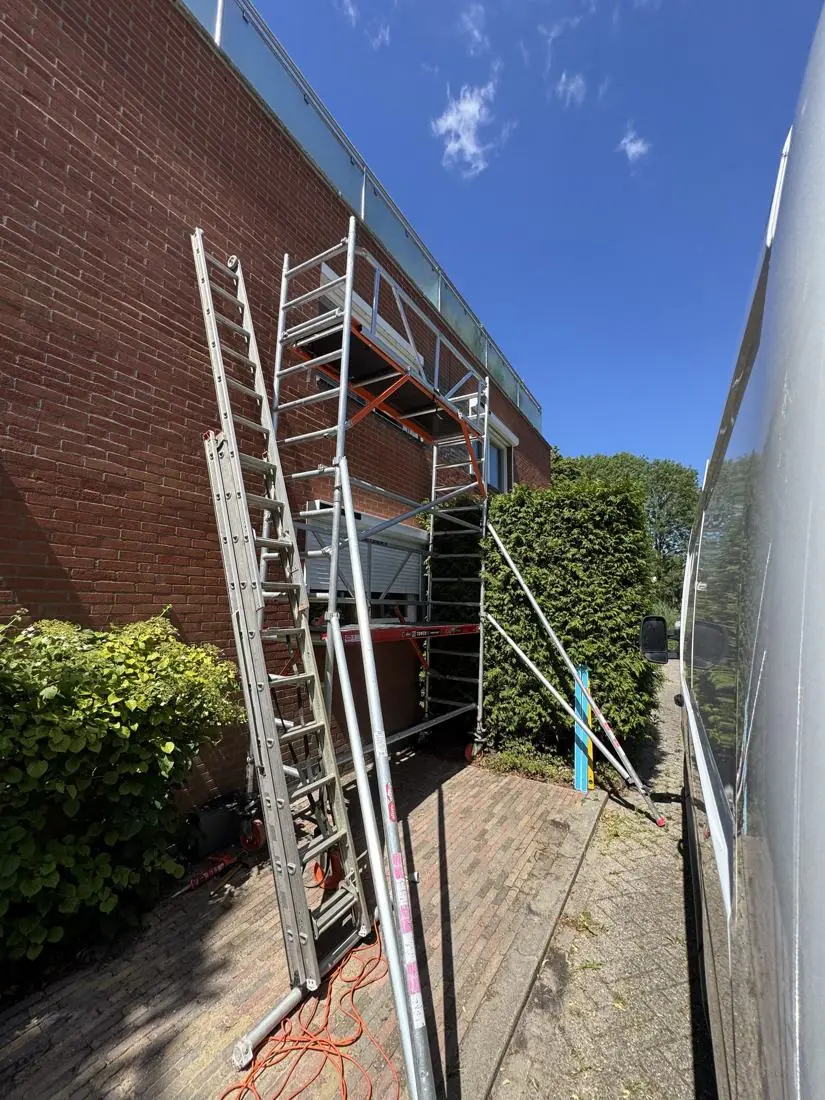
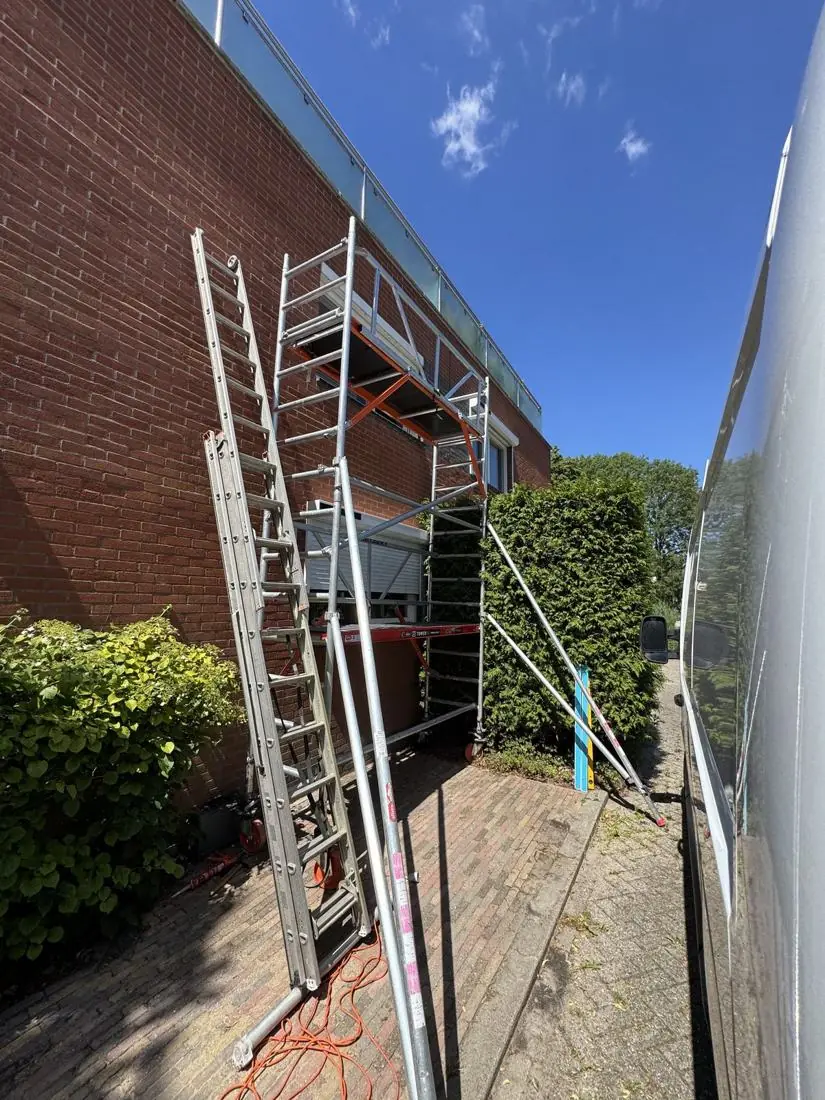
Wide 135 cm mobile scaffold erected along a side elevation, the model you hire for roof edge paintwork

Do not confuse the model with the build you choose alongside it. The model settles how wide your deck is and how much you can put down; the build settles how high you come out. With the same RS52 you can take a low stance for a garage and a high one for the roof edge of a house. So fill both fields in separately when you reserve, because a wrongly ticked build means being half a metre short on the first morning. Full sizing per type sits in the survey of dimensions and measurements.
What working height to hire for roof edge and trim together

The highest point of this job lies above the timber itself. The paint line ends at the top against the trim or against the lowest row of tiles, and you have to be able to see that seam to work neatly up to it. So measure to the upper rim of the trim, not to the underside of the edge timber. On two storeys that puts you on a build with a reach of 8 to 12 metres. Begin at the paving where the castors land, since a falling drive shifts your whole sum.

That working height is not the same as the height you stand at. On top of the deck height comes about two metres of reach, and that total is what you state when you reserve. For paintwork along the roof edge you would rather pick, within that range, a stance where your eyes come just above the paint line. Then you look down on the seam instead of straight at it, and you see at once whether the tape lies tight and whether paint has crept underneath.

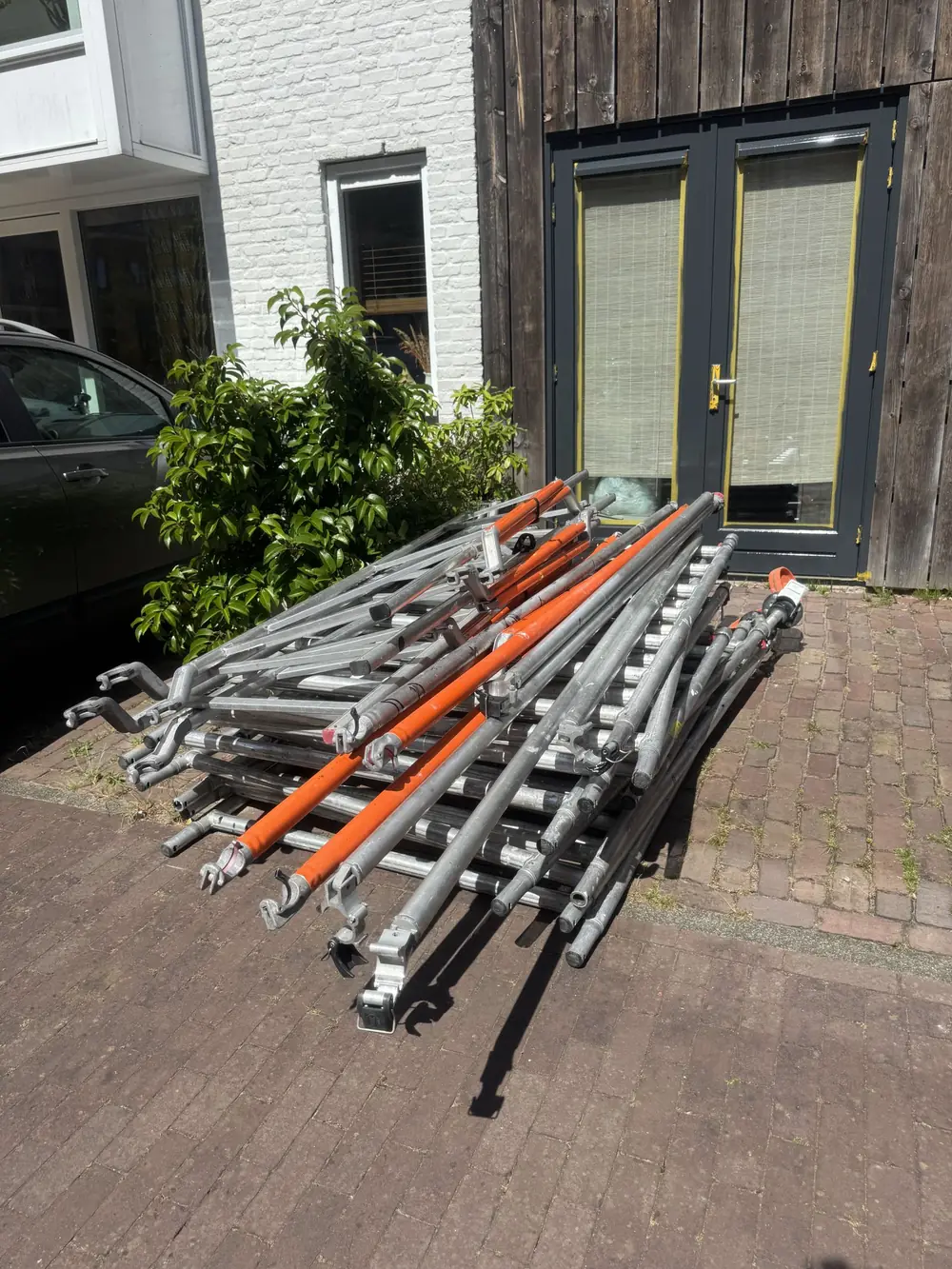
Scaffold parts on a drive in front of a house, delivered flat at ground level whatever build height you booked

Choose too low and you paint the topmost centimetres by feel. That is precisely where the junction with the zinc or the tile sits, and precisely where every blemish shows from street level. On top of that, paint from an upward pointing brush runs down the handle into your sleeve. Reserving a stance higher costs you little; repainting because the top rim came out uneven costs you half a day. The page on working at 9 metres shows what goes with it.

Placing the hired tower with sight of the paint line

Where you put the setup on this work decides not only whether you can reach, but also what happens underneath. Paint dripping off a brush falls straight down, and at many houses that is exactly where the neighbour's car, a bike shelter or the hydrangeas stand. Move what can be moved, cover what has to stay and warn the neighbour before the parts arrive. That is a one minute conversation which saves you an awkward afternoon.

Beyond that the usual demands on a standing place apply. The castors want a level, load bearing surface, and the four stabilisers must be able to come out fully on every side. Along a roof edge you often run into a sloping garden store, a low shed or a terrace canopy that falls just inside that spread. Walk your route beforehand and note per side what has to go. If the paving is sinking, look at ground that is not level.

Base of a mobile scaffold with the stabilisers wound fully out, the standing place you need along a roof edge

When you mark out your standing places, allow for the overhang. If the roof projects a long way past the brickwork, the build stays further from the wall and you reach the edge with a longer arm. Go for a little extra height then rather than a little extra distance. Does your house front straight onto the street? Ask the council whether the setup may stand on the pavement, and keep a walking route clear for people passing.

How many hire days a full roof edge repaint takes

The paint itself goes quickly; the preparation and the masking do not. A roof edge is old timber with gaps, nail heads and patches of loose paint, so you sand, fill and dust off before anything wet goes on. After that you mask the trim and the bottom tile row, metre by metre, and along a roof edge that goes slower than along a flat wall. On a mid terrace the preparation alone soon fills a whole day, after which each coat asks half a day to a day.

Add the waiting to that. Between two coats the previous one has to be dry and sometimes lightly rubbed down, and that drying happens at the pace of the weather rather than yours. A cold morning with dew on the timber is lost time, and so is an afternoon with the sun full on the elevation and the paint closing up too fast. Count on three to five hire days for an ordinary house, and put the awkward elevation early in that run.

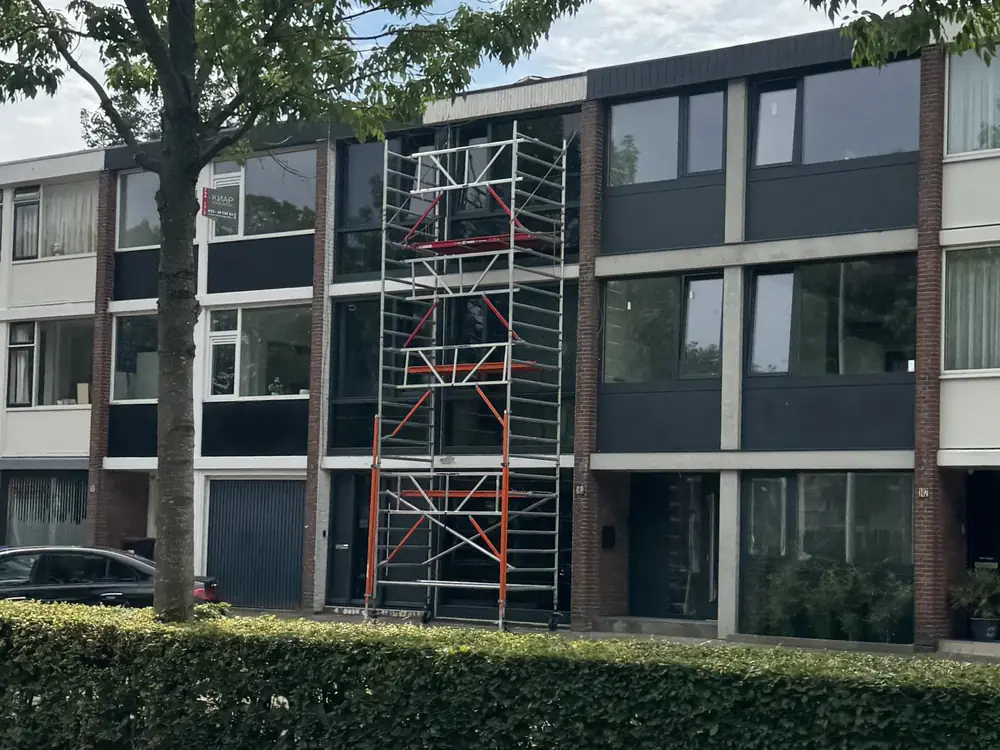
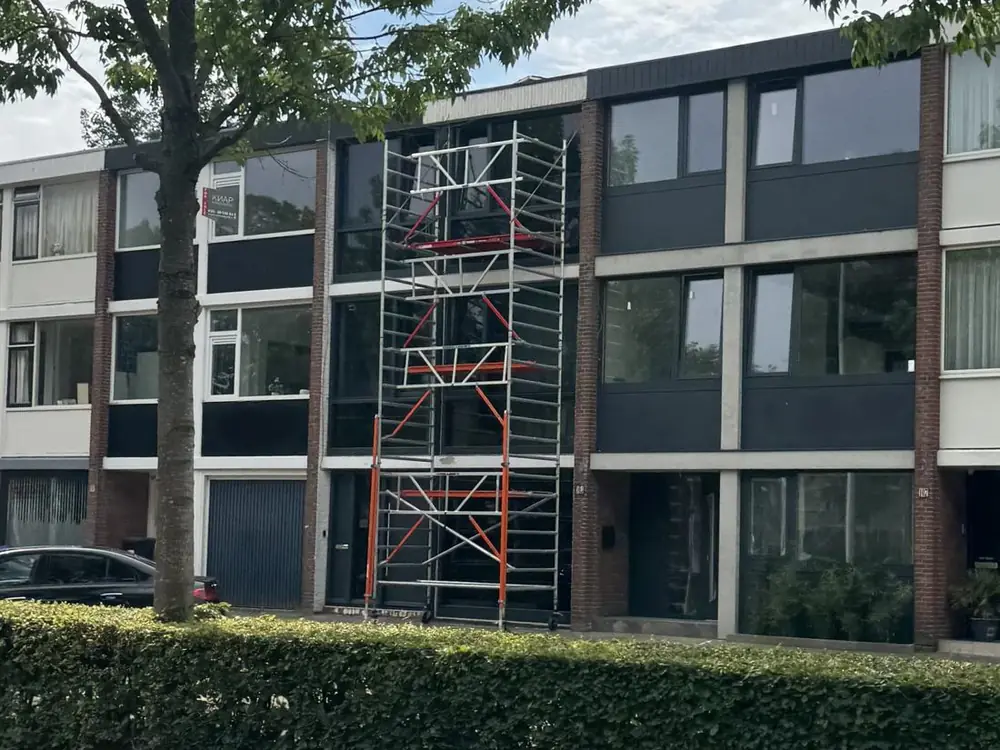
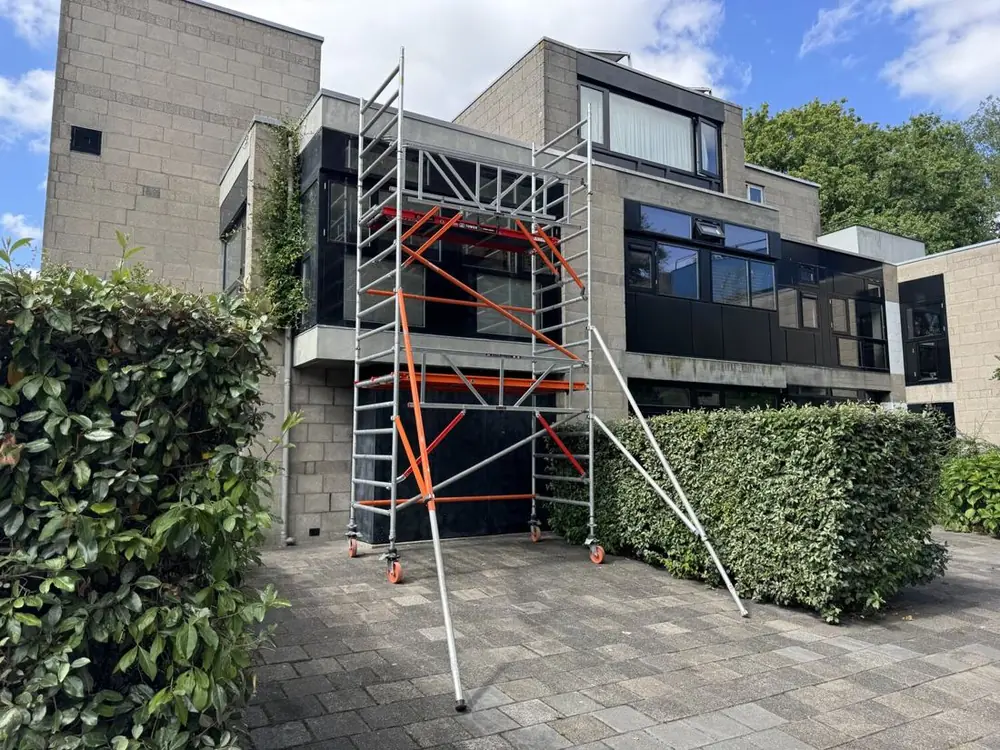
Erected mobile scaffold against a modern house, the setup that simply stays put between two coats of paint

Booking roomily costs strikingly little here. The opening 24 hours are settled at the full amount, and from the second hire day onward 95 per cent of that rate disappears. Slotting in a spare day for a shower is therefore almost free, while booking too tightly means stopping with half a coat on. How to judge such a period is explained under the number of days you need; every rental price sits on the page with prices.

Which mobile scaffold suits painting the roof edge?

Kamersteiger RS44
  • Working height up to 4 metres
  • Compact and narrow
  • Great for indoor and small jobs
View and calculate →
Smalle rolsteiger RS51
  • Working height up to 14.2 metres
  • Narrow (75 cm)
  • Ideal for narrow passages
View and calculate →
Most chosen
Brede rolsteiger RS52
  • Working height up to 14.2 metres
  • Wide platform (135 cm)
  • Extra stability and workspace
View and calculate →
1-persoons steiger MiTower
  • Working height up to 6.2 metres
  • Very compact
  • Quick and easy to assemble
View and calculate →

Painting the roof edge from a 245 centimetre deck

Per setup you finish 245 centimetres of roof edge, and on paintwork that is a more telling figure than on other jobs. You do not want to stop in the middle of a stretch: where you leave a wet edge and paint into it later, a visible join appears. So work the whole length of a standing place from top to bottom and put your overlap at a sensible point, such as a joint in the timber, a downpipe or a corner of the house. The only visible boundary then falls where something already sits.

Take up per stance what fits into those 245 centimetres and no more. Half a tin handles better than a full one, because it weighs less and does not slop over the rim when your hip brushes the guard rail. Stand the tin on a board or in a tray with raised sides, never loose on the deck. Tape, cloth and abrasive paper live in your trouser pockets, so the floor stays clear and you do not trip over your own kit.

Mobile scaffold built in front of a front elevation, the setup that paints the roof edge in 245 centimetre lengths

What people underrate is the number of standing places. Thirty metres of roof edge already means twelve setups per coat, so with three coats you are on the same spots thirty six times. Every move costs time, every move the build has to come level again, and every move you walk the stabilisers. That is exactly why your hire period runs longer than the hours with a brush in hand. If you take in the fascia boards as well, do them per standing place rather than in a separate round.

Hire a mobile scaffold with delivery for outdoor paintwork

All the parts reach you loose and counted, and you point out where they may lie. Choose a patch of ground you will not be using while painting, because right under the roof edge you want room for your paint kit and your dust sheet. Get your order in before 15:00 on a working day and delivery follows on the next working day. Which date that becomes, and when everything leaves again, you state yourself when reserving.

The building we leave to you. A manual is included and an instruction video shows the order of assembly; with a second person on hand you are busy half a day before the first setup stands. So do not plan that build on the morning you meant to start sanding. For outdoor paintwork it is also wise to tie your delivery day to a dry spell, so you can go straight into the preparation instead of waiting.

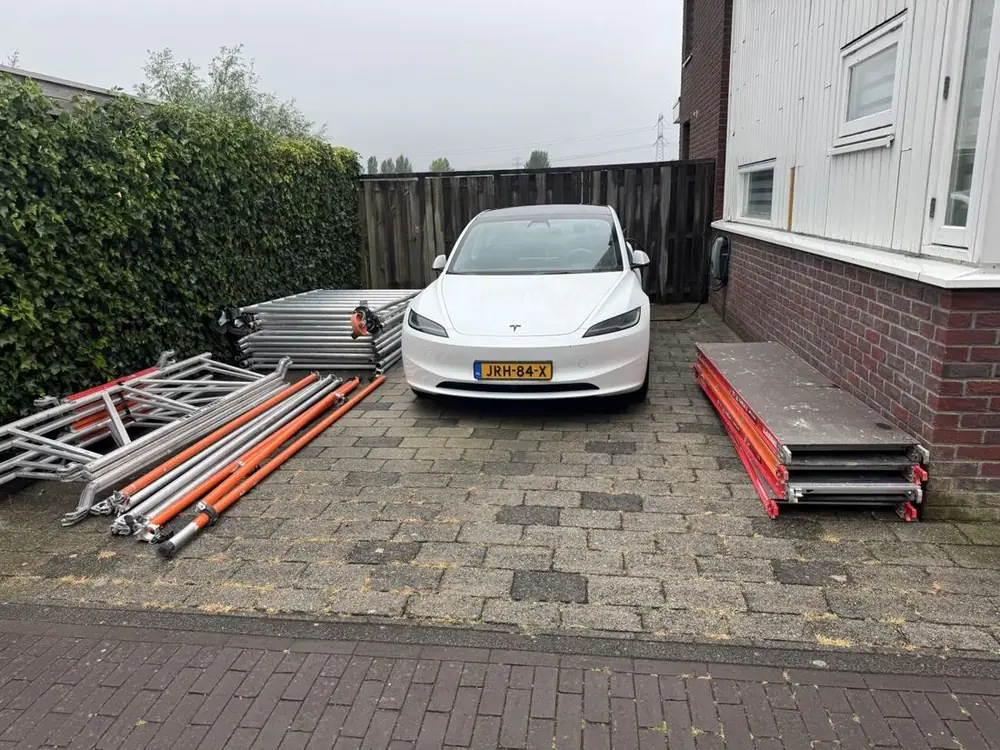
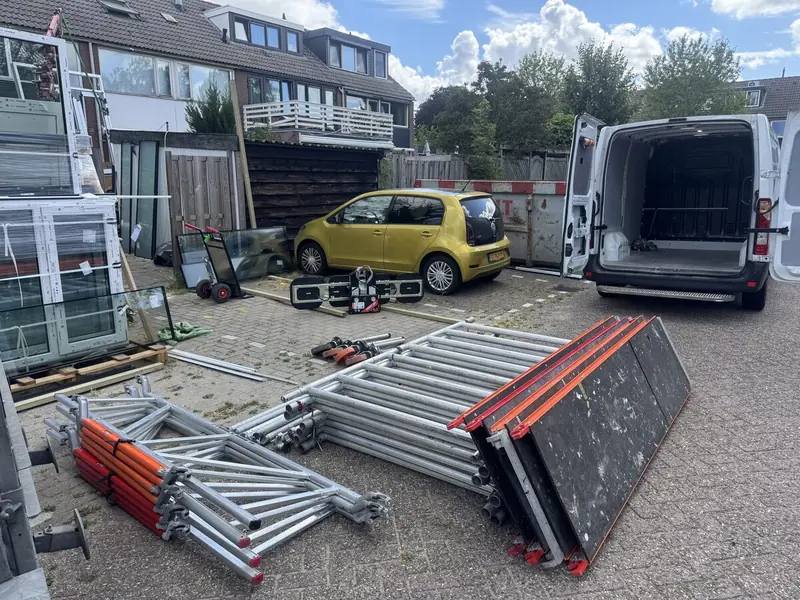
Loose scaffold parts dropped at a house on the delivery date, the counted set you put up yourself for painting

Once the last coat is on, you take the build apart and we load the parts again. See that everything lies complete and reachable and that nothing wet can come against it; a guard rail resting on a freshly painted end grain leaves a streak you will spot later. What bringing and returning costs in your region you find under the delivery rates per province, so you can set that beside your hire days while you are still planning the period.

Safe painting on the hired scaffold along your roof edge

Every deck in the hire fleet belongs to load class 3 and therefore holds 200 kg per square metre, as EN 1004 lays it down. On paintwork you rarely come near that, because a tin and a handful of tools weigh little. Stand up there with two of you, though, with a box of filler beside you and a bucket of sand someone hauled up as ballast, and it adds up faster than expected. Worked examples sit under load and weight on a tower.

Nothing changes about the fixed rules: castors locked first and only then up, no moving at all while a person or material is on board, and work down as soon as it really starts to blow. On this paintwork that wind limit sits lower than you would think, since paint drifts and dries in streaks. After every move walk the stabilisers and check the build is still level before you carry your tin up; a pavement with a fall goes wrong faster than a garden path.

Erected tower fenced on all sides with an internal climbing ladder, the access used on this roof edge job

The real dangers on this job are small and everyday. Spilt paint makes a deck lethally slippery, and a toppled tin takes half an afternoon of cleaning and sometimes the neighbours' pavement with it. Working with your head tipped back leaves you unsteady after an hour, so build in short breaks. Keep the zone under the build clear and put something eye catching in it. The full list of rules sits under working at height.

In 5 steps

How hiring a mobile scaffold works

1
Choose working height

Pick the height that suits your job.

2
Book online

Sorted in 60 seconds, price shown instantly.

3
We deliver

At the agreed spot the next working day.

4
Assemble safely

Assembled by you, with a manual.

5
We collect

One call and we collect the scaffold.

Good to know

Practical tips for painting the roof edge

1

Study the roof edge first from across the street with binoculars. You then see where the timber is genuinely open and how much preparation to plan before you let the tower come and your hire days start.

2

Mask the trim and the bottom tile row per standing place, not in one long round beforehand. Tape that has sat in the sun for days lets go or tears, and you end up there with a fresh roll anyway.

3

Keep your tin at eye level in a hook on the guard rail instead of on the deck. You then stop bending, and when the hired tower is moved there is nothing standing on the floor to tip over.

4

On each side of the house finish the shaded part first. Paint that goes onto warm timber in full sun closes too quickly and leaves brush marks you will spot again from the pavement.

5

Write down on a list which standing place has had which coat. With twelve setups and three coats you lose that count after the second day and miss a stretch that only shows once everything is dry.

6

Put your collection day at least one day after the last coat. You do not want to touch fresh paint on the edge timber while dismantling, and you need the morning to strip all the tape and sheeting.

Frequently asked questions

Frequently asked questions about painting the roof edge

Which mobile scaffold do I hire for painting a roof edge?+

The RS52 with its 135 centimetre deck is the sensible pick here. Up top you need room for a tin, sanding kit and two rolls of tape, and you want to take a step backwards to judge the line. That works on a wide deck and not on a narrow one. The 75 centimetre version is only needed when the route to the back runs past a cramped gate. Measure that opening first, because a tower that will not go round the back is no use to you.

How does hiring a scaffold for roof edge paintwork actually work?+

Online you state which model you want, which build goes with it and on what days the parts arrive and leave again. We deliver counted, you assemble the tower and work the line round your house. On your closing day you break everything down and leave the set within reach. The rates are known in advance and include VAT, so nothing is added afterwards and you can budget the whole job in one go.

How many days should I hire to paint an entire roof edge?+

On a mid terrace count on three to five hire days. Preparation and masking fill roughly one day, after which every coat costs half a day to a day plus drying time. More coats or a larger house simply means more days with the tower standing. Because drying depends on the weather, book a day extra rather than end up with an unfinished coat and a second reservation later. The tower itself is quite happy standing idle.

What does hiring cost here, and why is the second day cheap?+

The amount rests on the model and the build you select, plus what bringing and collecting costs in your province. Everything is shown including VAT before you confirm. On roof edge paintwork the arrangement falls out kindly: the first day and night count in full and every day after them hardly at all. Anyone working with paint, and so depending on dry weather, is better off with one generous scaffold booking than two short ones.

What working height do I hire to reach up to the roof trim?+

Set your tape down where the castors will stand and read up to the upper rim of the trim; the timber underneath is not your highest point. Two storeys yield a reach of 8 to 12 metres. Within that margin choose the stance where you look down onto the paint line from the deck, so you can see the seam and judge the tape. Which build of the tower belongs to that sits on the working height page.

Can I have the tower brought, or must I hire and fetch it myself?+

Either route works. Having it brought suits paintwork, because you need your car for paint and tape and you would rather not shift the parts twice. We drive out on the day you name and once more afterwards, for a fixed rate per province. Anyone who prefers to go themselves may take the scaffold along by appointment at Zeeburgerpad in Amsterdam without charge, provided a van or trailer is waiting that the longest tube fits into.

When hiring, do I have to build the tower myself for this paint job?+

Yes, assembly is on your side of the arrangement. The scaffold comes as a loose set with a manual, and a video is ready that shows the order. With two people the first setup costs half a day; moving along the roof edge goes quickly afterwards because you wheel the build along as a whole. We have no facade scaffolds in the range, no system scaffolds and no cherry pickers, so a line at ten metres is mobile tower work.

Can the hire run on when the final coat is not yet finished?+

Just tell us, and the collection day shifts, so long as nobody has that tower booked right behind you. On paintwork that happens regularly, since a shower at the wrong moment costs you a whole coat. To get ahead of it, build a margin into your period at the time of booking; handing back early is always allowed. You then never have to stop on an elevation that has only half its paint on.

How much room does each standing place along the roof edge need?+

Take the outside dimension of the tower plus the spread of the stabilisers all round, and add that the overhang keeps you a little further from the wall. In practice you want several clear metres per side, with space beside it for your sheeting and your paint kit. Shift garden furniture, bicycles and water butts before the parts are delivered, or you lose that time mid hire and stand waiting beside a half built scaffold.

Does the hire carry on when rain interrupts the painting?+

Your tower stays put on its standing place; only the paint goes back in the van. Nothing bonds to wet timber, and a coat you put on anyway comes off again later. Use a wet day to sand under a sheet, fill gaps or mask the next elevation in advance. Because you pick the end date yourself, that delay costs you an extra day at most and certainly no second delivery run with all the parts.

What should I watch when hiring so the deposit comes back in full?+

A deposit stands against the hired set and is settled when you reserve. If the count is right once the tower is back, we transfer that amount to you within one working day. With paintwork it usually goes wrong through spatter and drips: dried paint on the decks or on the guard rails does not belong there. Lay an old sheet on your floor and wipe spills at once. Further detail sits under the sum after return.

Is painting a roof edge the same as fascia boards when you hire?+

For the hire it makes little difference: model and build come out the same. For your planning it does. Fascia boards are the upright planks under the gutter, while the roof edge also takes in the barge board, the end grain and the strip along the trim. That is more running metres and far more masking, so reckon on a longer hire than when you tackle the fascia boards alone. Two days of difference is no exception.

Hire a mobile scaffold for painting the roof edge today?

Calculate your rental price now or ask for free advice.

Rolsteiger van SteigerTaxi geleverd op locatie
Book it online

Your scaffold sorted in 2 minutes.

Choose your scaffold and working height, see the price instantly and book online.