
See your price
Application

Installing a satellite dish? Choose the right scaffold.

Installing a satellite dish is mostly fixing work on a wall: a bracket that has to land on whole bricks, a mast that must finish dead plumb, and coaxial cable that has to get indoors. All of that keeps you in one spot for a long stretch with both hands occupied. When the dish belongs high on a front elevation, or just beneath the gutter, the 135 cm RS52 is the model you want, built anywhere from 8 up to 12 metres. What follows covers everything the hire period has to carry.

  • Order before 3 pm, delivered tomorrow
  • Professional Altrex scaffolds
  • Up to 14.2 metres working height
  • Easy to assemble yourself
4,2 tot 14,2 mWorking heights available
12Provinces served
7Days a week
200 kg/m²Load class 3
In short
  • For installing a satellite dish we recommend the Wide mobile scaffold.
  • A dish going high on a wall wants the broad RS52, hired in a build that stretches towards twelve metres of reach.
  • Installing a satellite dish goes better on wide boards, where the reflector lies flat while the bracket is fixed.
  • Count the cables before delivery arrives, because installing a satellite dish twice over for a second cable entry costs you another hire day.
  • First 24 hours from €175 incl. VAT and delivery; every day after that 95% off.
Key facts for this job
FeatureValue
Recommended scaffoldWide mobile scaffold (Altrex RS TOWER 52)
Working height for this job8 to 12 metres
Available working heights4.2 to 14.2 metres
StandardEN 1004, load class 3 (200 kg per m²)
DeliveryOrdered before 3 pm, delivered next working day
Each extra day95% off, from €8.75 a day
Why a mobile scaffold for installing a satellite dish?

Safe, stable and professional work at height

Aiming a dish takes minutes; getting the carrier onto the wall takes hours. You drill anchor holes, hang the bracket level, slide the mast in and true it up before the reflector is allowed anywhere near it. Every one of those steps needs two hands, tools within reach and a stance that does not involve stretching. A ladder cannot supply any of that: you stand skewed to your own drill hole, the spirit level never settles, and the reflector can never be lifted onto the mast under control. That gap between a quick hook up and half a day of standing still is why people hire a mobile scaffold for the job, and a 245 cm platform takes bracket, mast, cable drum and drill together.

  • Anchor holes belong in whole bricks, never in joints
  • Truing the mast plumb takes real standing time
  • Counting cables first avoids drilling a second entry
  • Broad hired boards for reflector, bracket and drill
Read more about working safely →

Which mobile scaffold to hire for the wall bracket

The model for this work is the Altrex RS TOWER 52 in the 135 cm width. A broad platform is no indulgence here, because the reflector goes up whole and has to lie flat somewhere while you offer it to the mast. On a narrow deck that panel leans against the guard rail or against your shins the whole time, and you only want to carry it up once. The full choice sits on the page about mobile towers available to hire.

The 245 cm platform length counts almost as heavily. Onto it go the wall bracket, the mast, a drill with a long masonry bit, a box of anchors and a drum of coaxial cable, and every one of those has to stay put while you turn around. Put two people up there, one on the drill and one steadying the bracket, and the boards fill faster than anyone expects. Let that weigh on the model you pick, because installing a satellite dish is bulky work.
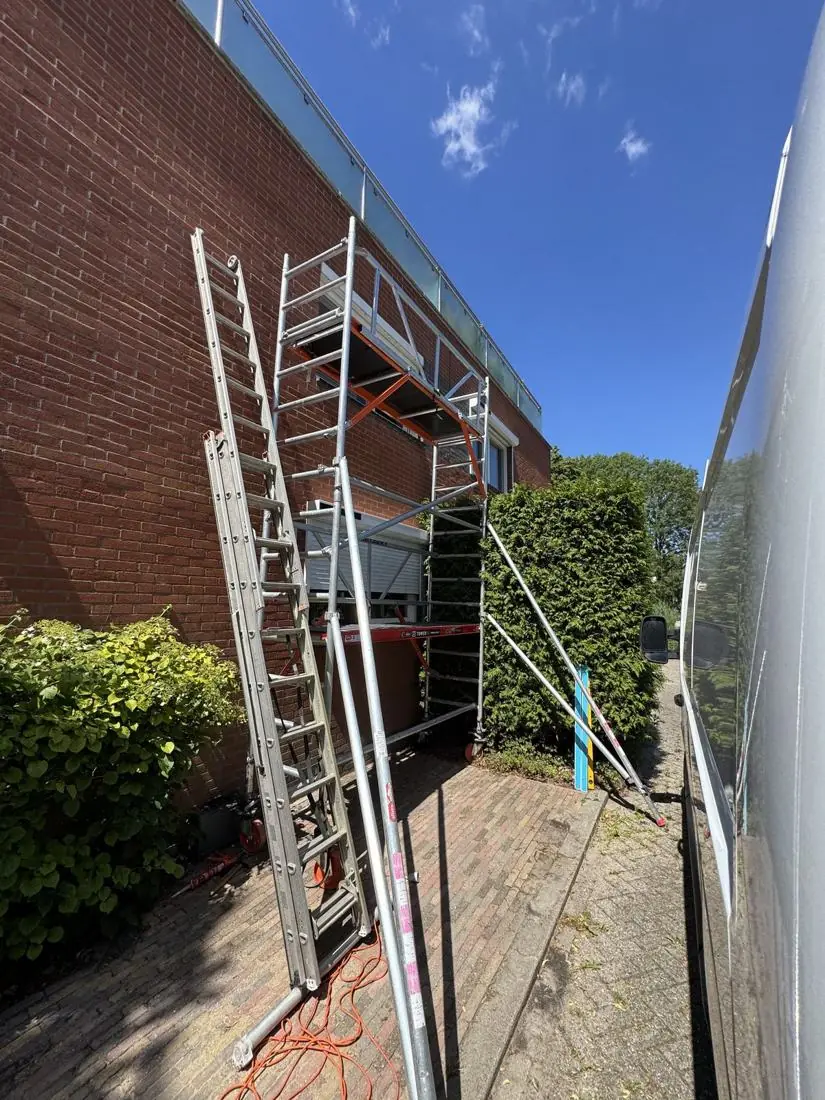
Mobile scaffold with a broad platform and guard rails beside a modern house, the sort of deck hired for bulky fixing work

The 75 cm width only enters the conversation when the route to the wall forces it, a side gate under a metre being the usual culprit. You give up elbow room and carry the load in two trips, mast and bracket first and the reflector later on. Measure the narrowest pinch point on your route before booking, because a broad tower that will not pass the gate ends up standing in the wrong place for the whole of the hire period, and no amount of goodwill fixes that afterwards.
Working height to hire when installing a satellite dish high

The top of this job is the top of the wall bracket, not the ridge of the roof. On a three storey house it usually sits a little under the gutter, which lands you in the 8 to 12 metre band. Working height is the height of the boards under your feet with roughly two metres of arm reach added on, so your platform ends up between six and ten metres. Which build corresponds is set out under ten metres of reach explained, alongside the platform heights that go with it.

Begin measuring at the ground where the castors will sit, not at the doorstep. If the garden path drops half a metre towards the boundary, that difference simply adds to the reach you need. Look up as well, at any overhang, bay or balcony projecting above the mounting point. Where one of those exists you set the tower further out from the wall and need rather more build to still arrive at the bracket with your hands free and your body upright.

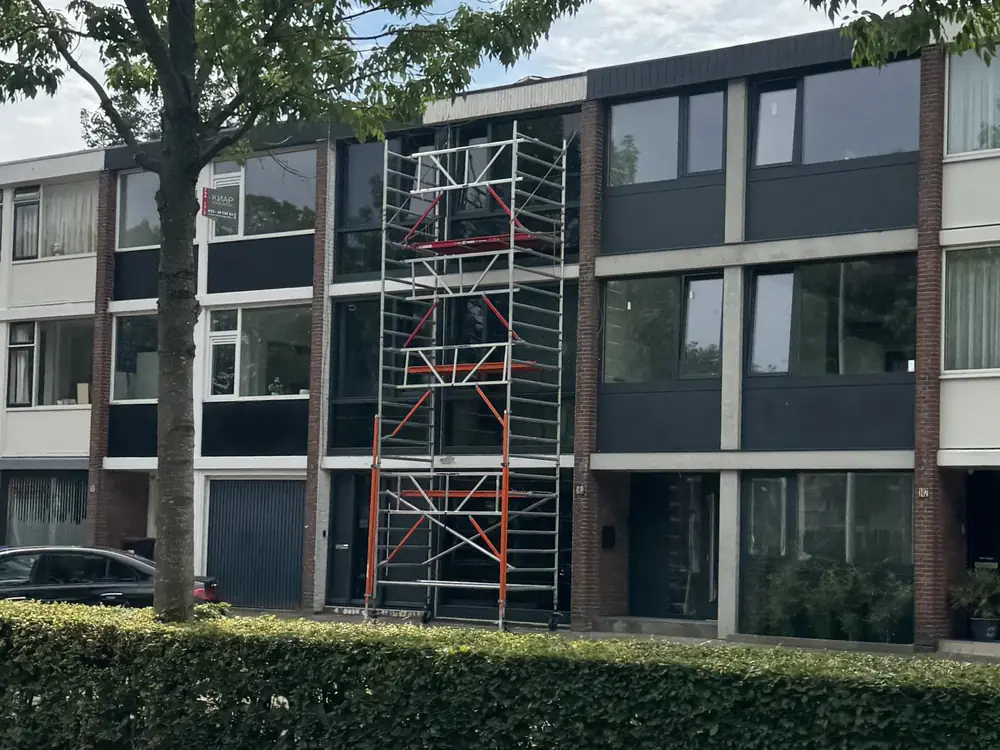
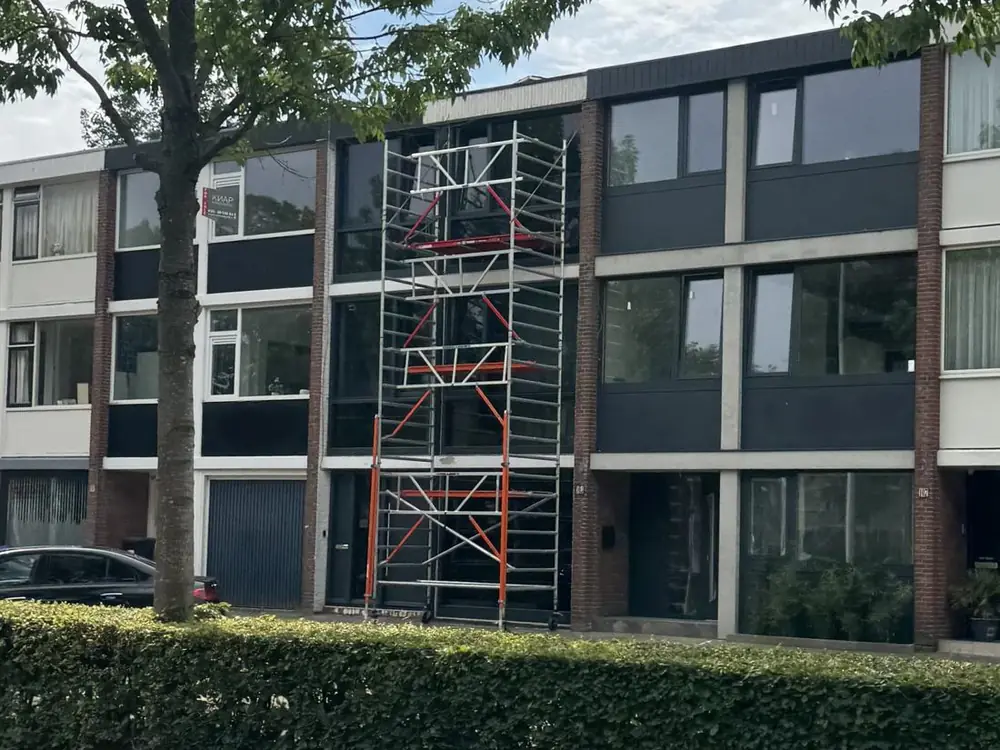
Tower erected against a front elevation and reaching the gutter, the build height booked for fixings high on a wall

Hiring short punishes you immediately. Lose that final half metre and you are drilling into brickwork with your arms above your head, the bit wanders off line, and the anchor never grips as it should. That very hole then has to hold a panel which behaves like a sail. Take the taller build and drill at shoulder level instead. A build one lift taller costs far less than a second hire period. If an aerial near the ridge is also planned, book the greater reach at once and save yourself a second hire period.

Hiring a tower: the standing position under the mounting point

The tower belongs squarely beneath the mounting point, which for a dish is nearly always the front elevation or a side wall close to the meter cupboard. Under the base you want a level strip noticeably wider than the frame itself, because the stabilisers reach out at an angle. Slabs, a drive or well trodden gravel all carry the load. A planting bed that softens after rain under the castors is not a surface on which anybody should be truing a mast.

Along a front elevation the obstacles queue up: a cycle rack, a knee high hedge, wheelie bins, an inspection cover exactly where a stabiliser wants to land, and a window sill no upright should touch. Move all of it before the delivery arrives and you will not be shuffling anything mid job. Where part of the frame stands on the footway, leave room beside it for people to pass. For a falling path, the guidance on uneven ground applies.

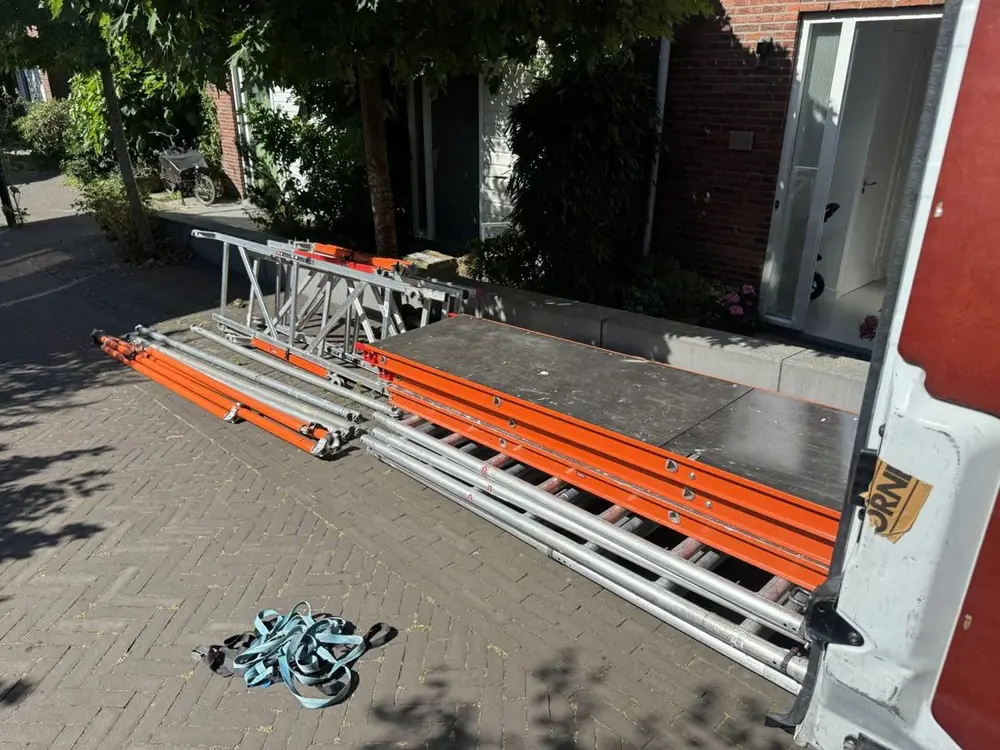
Scaffold components laid out in the street with the first lift going up, a hire set being raised beside a house

Let the cable run help choose the spot. Coax travels from the dish along the wall to the point where it goes inside, and from a single position you want both the bracket and that entry within reach. If that hole sits two metres to one side, stand the tower so both fall inside an arm's length of each other. Pace the route out at ground level first, or installing a satellite dish turns into two separate builds on the same wall.

How many hire days installing a satellite dish really takes

The fixing work itself runs from half a day to a full one. Setting out the bracket, drilling, placing anchors, fitting the mast, hanging the reflector and dressing the cable is steady rather than slow work, provided the brickwork behaves itself. Even so, almost nobody hires for just the one day. Raising the tower has to happen before any of that, and drilling, mounting and connecting indoors on that same date only works when nothing at all surprises you.

So reckon on two hire days: one to build and to set out the mounting point, one to drill, fix, connect and check. There is little waiting time built in, unless you are using resin anchors or have a hole to make good before continuing. Weather governs this more than materials do. Nobody hangs a reflector in a strong wind, and when it blows the whole sequence slides a day, so pick the calmest date in the forecast.

Mobile scaffold with double guard rails and a built in climbing route, the structure left standing through a whole hire

The tariff works in your favour there. Only the opening twenty four hours attract the whole rate; every further day after that carries a reduction of ninety five per cent, so a spare date hardly shows in the rental price at all. Plan too tightly and you are standing beside a mounted bracket with no dish on it, waiting for the van. Booking that extra day up front beats extending afterwards on work of this kind, and it takes away the temptation to rush a fixing which then has to hold for years on end.

Which mobile scaffold suits installing a satellite dish?

Kamersteiger RS44
  • Working height up to 4 metres
  • Compact and narrow
  • Great for indoor and small jobs
View and calculate →
Smalle rolsteiger RS51
  • Working height up to 14.2 metres
  • Narrow (75 cm)
  • Ideal for narrow passages
View and calculate →
Most chosen
Brede rolsteiger RS52
  • Working height up to 14.2 metres
  • Wide platform (135 cm)
  • Extra stability and workspace
View and calculate →
1-persoons steiger MiTower
  • Working height up to 6.2 metres
  • Very compact
  • Quick and easy to assemble
View and calculate →

Setting the bracket and mast plumb from the scaffold deck

Drill your anchor holes into whole bricks and never into the joints. Mortar is softer, it crumbles around the hole and it will never hold a plug the way the brick itself does. So offer the bracket up to the wall, mark through it, then slide your marks a few centimetres until every hole lands in the middle of a brick. From a platform that does not move you can take that measurement calmly; on a ladder the marks stay where they first fell.

Carry up everything you need in one trip. The mast has to finish plumb, because a mast out of true throws the whole reflector off and no setting afterwards will rescue it. Level on the tube, two bolts slack, adjust, tighten again: none of that is work you want to abandon halfway down for a spanner. Lay out the level, the open ended spanners, the anchors and the reflector on the boards before you climb, and installing a satellite dish stays one continuous job.

Mobile scaffold standing tight against a house wall, the steady position hired when both hands are needed at the brickwork

Settle the cable count before you go up. A single receiver means one coax, two tuners mean two, and a multiswitch serving several floors pushes that towards four. That number sets the diameter of the entry you drill, and one hole done properly beats a second one alongside it later. With 245 cm of boards the drum can also be unrolled tidily instead of being hung over the guard rail, and anything left leaning against that rail is one gust away from the pavement below.

Delivery, self collection and what you hire for dish work

What arrives is a complete set of parts, counted before it leaves us. Decide beforehand where that pile may land: keep the strip beneath the wall empty, because the tower goes up there. The drive or a corner of the garden serves better than a narrow side alley, which is exactly where you will later be walking with a reflector under your arm. A reservation confirmed before three o'clock on a working day puts everything on site the next working day.

You choose the arrival date and you choose the day we take it away again, and on this job let the wind have a vote. Have the parts brought on a quiet day, build that afternoon and fix the following morning. Erecting is your side of the bargain; we neither build towers nor deliver them standing. Two people with the manual and the film to hand need about half a day, which belongs in the plan separately from the fixing work itself.

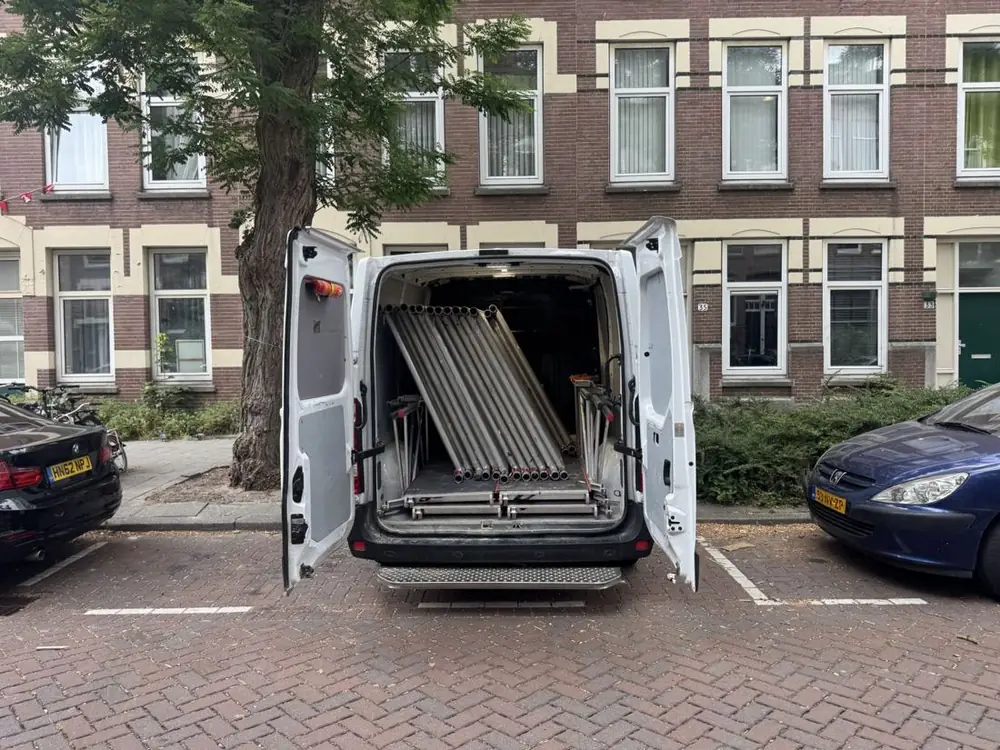
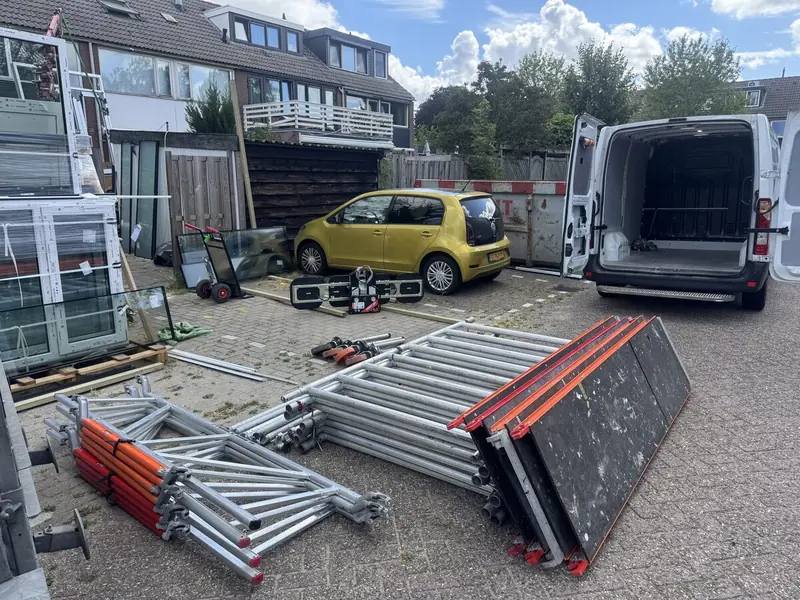
Delivery van at a house with a scaffold set being unloaded, the counted parts handed over at the start of a hire

Living near Amsterdam gives you a second option: the parts may be collected in person, free of charge and by appointment, from Zeeburgerpad 89, as long as your vehicle takes the lot in one load. Once the dish is up, tested and signed off indoors, dismantle the tower and return the parts to the spot where they were dropped, and our driver calls round to load them. The sequence for each lift is in this walk through of the build order.

Load class and wind on the scaffold you hire

Every tower in the fleet answers to EN 1004, and load class 3 permits two hundred kilograms of load on each square metre of platform. For this job you stay well under that, even with a reflector, a mast and a cordless drill aboard. Pay attention once two of you are up there together with a cable drum and a tool box as well. What the class means day to day is set out in this explanation of the standard.

The ordinary rules apply in full. All four brakes go on before anybody climbs, the tower is only moved with an empty platform and nobody aboard, and work stops when it starts blowing hard. That wind limit is no formality when a dish is involved: the reflector is a sail, and the moment you hold it one handed to slide it over the mast the wind pulls straight at it. Get it bolted before you let go of it.

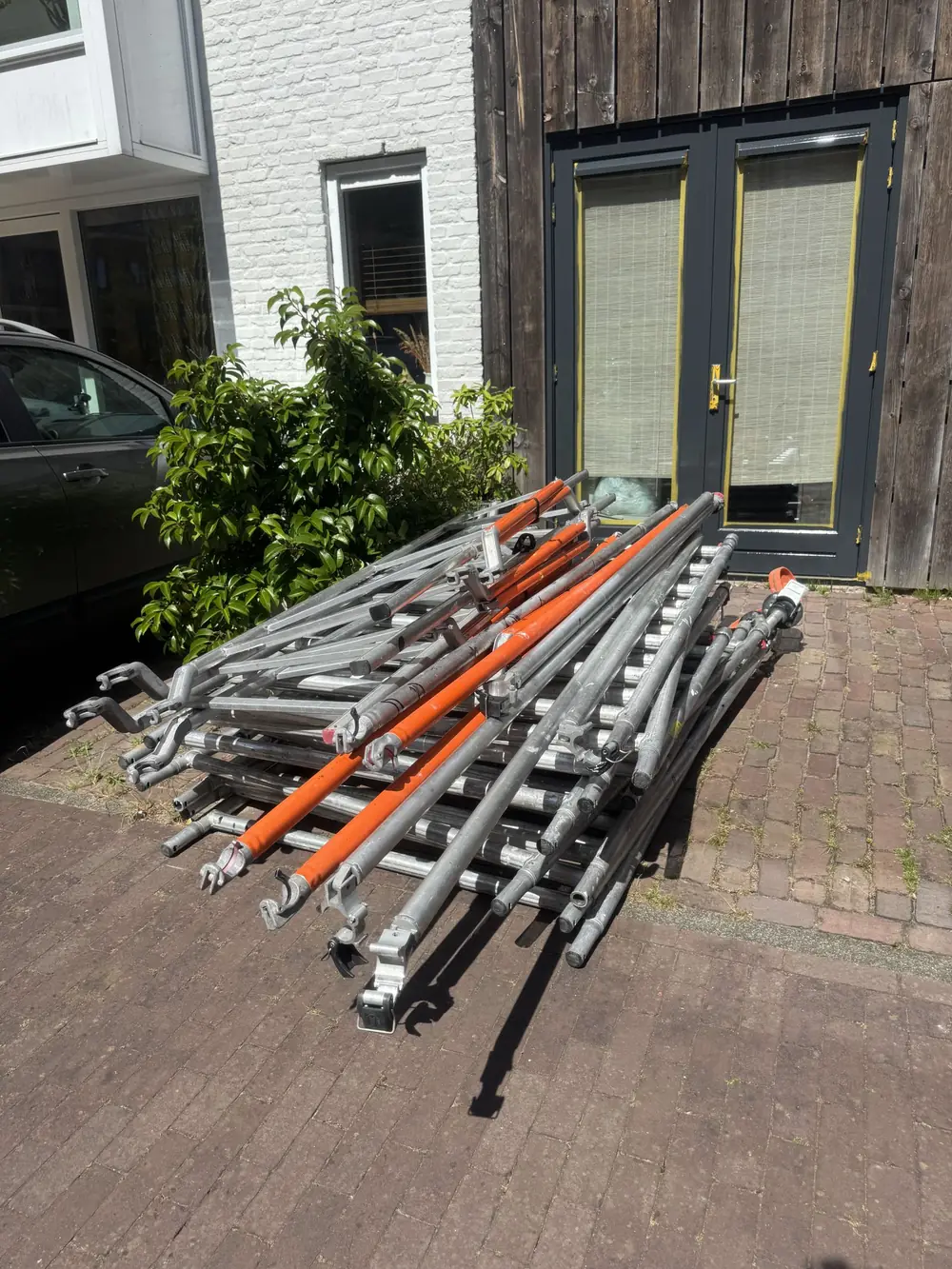
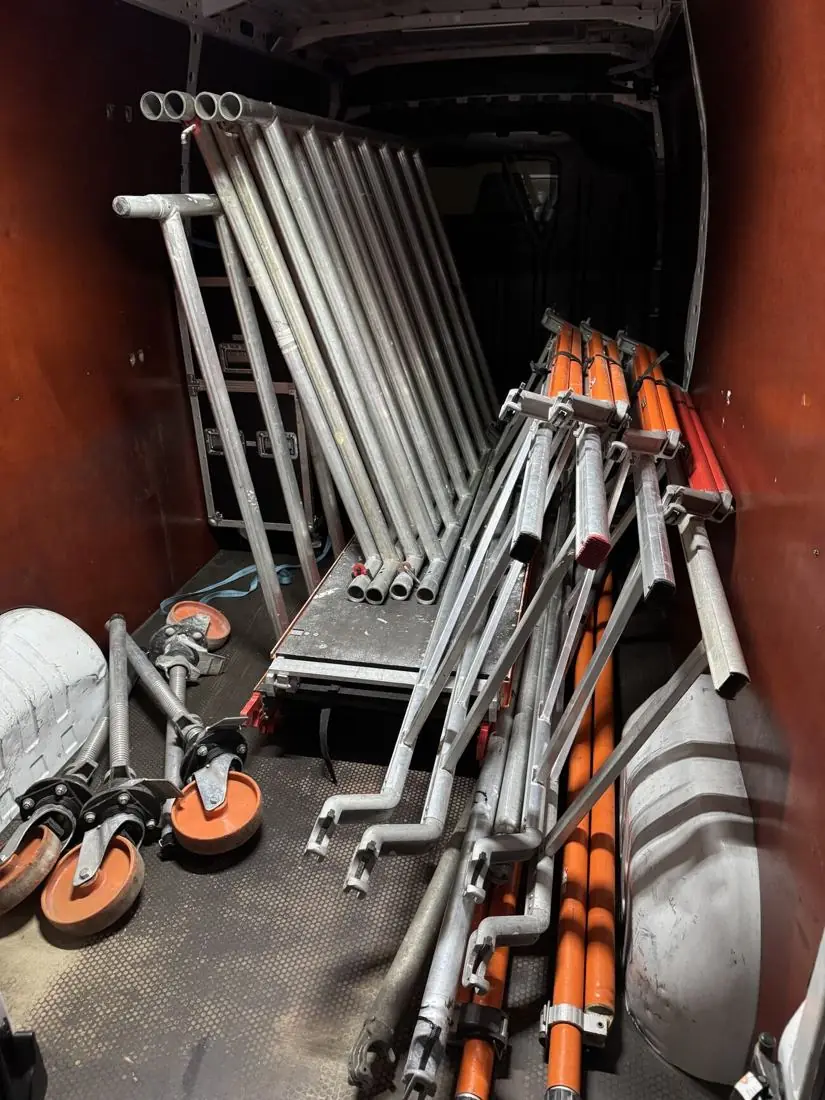
Scaffold parts bundled and ready for transport, the complete hire set counted before it goes out to a customer

The risks that actually matter here travel downwards. Brick dust and grit fall vertically, so keep the strip below the boards empty and park no car or bicycle there. A tool balanced on the edge will follow sooner or later, so everything lives in the middle of the deck. A dropped reflector takes the cable with it. Beside a street that is no idle worry while installing a satellite dish, so agree who is watching the ground before the first fixing is touched.

In 5 steps

How hiring a mobile scaffold works

1
Choose working height

Pick the height that suits your job.

2
Book online

Sorted in 60 seconds, price shown instantly.

3
We deliver

At the agreed spot the next working day.

4
Assemble safely

Assembled by you, with a manual.

5
We collect

One call and we collect the scaffold.

Good to know

Practical tips for installing a satellite dish

1

Mark the bracket holes with the bracket held in your hand, then shift it until every single mark sits in the middle of a brick. One hole drilled into a joint costs you the whole fixing later on.

2

Lay the reflector on the boards with the hollow side towards the wall. Turned the other way a gust takes it like a sail and slides it off the platform before you have proper hold of it.

3

Count your cables at ground level rather than up top. Receiver, second tuner and any multiswitch together decide how fat the entry has to be, and therefore which bit goes up with you.

4

Hoist the reflector up the outside of the upright on a light line. Climbing with that thing tucked under one arm removes exactly the hand you need on every single rung of the ladder.

5

Drop the mast into the bracket loose first and check with a level that it stands plumb on two faces. Only then tighten, because a leaning mast can never be corrected once the dish is on.

6

Set your collection day one day later than the day on which you fix. That leaves time to test indoors and to climb back up once more if needed, with the hired tower still standing where you left it.

Frequently asked questions

Frequently asked questions about installing a satellite dish

Which tower do I hire to fix a dish to the wall?+

The 135 cm width is the obvious answer. You need boards to lay the reflector flat, to slide it over the mast and to keep the drill and anchors within reach at the same time. If the wall lies behind a narrow gate, the 75 cm tower is the only one that will pass, and the load then goes up in two separate trips. Measure that gate before reserving anything, since installing a satellite dish from the wrong width is a slow business.

How does hiring a mobile scaffold for this job work?+

It starts with a reservation in which you set the model, the build height, the date everything arrives and the date it goes again, at fixed amounts including VAT. On the agreed morning the parts are set down at your address, then you raise the tower, fit the dish and connect it. At the end of the hire the dismantled set stands ready and we drive it away. Only the indoor testing needs a second person scheduled, and that is easily arranged on the day.

For how many days is a scaffold hired when a dish goes up?+

Two days suits most houses. The opening day goes on building and setting out the mounting point, the second on drilling, fixing and connecting. Installing a satellite dish is rarely the slow part. Manage the build in a single morning and the whole thing can occasionally be squeezed into one day, though that turns tight the moment the brickwork disappoints or the wind gets up. Hire a day wider and no half finished job is left behind on the wall for the neighbours to look at.

What does hiring a tower for this fixing work cost?+

The figure depends on the model and on the height you end up building to, with a charge for bringing and fetching set per province. Amounts appear with VAT included on the page showing our hire rates. For this job the shape of it helps: the opening day weighs heavily and each one after it hardly counts at all. One roomy booking therefore beats two separate short ones taken back to back, which is worth knowing before you pick dates.

What working height should I hire if the dish sits under the gutter?+

For three storeys take a tower reaching towards twelve metres, so your hands arrive at the bracket without stretching. Measure to the top of that bracket rather than the roof edge, and start at the ground where the castors will stand. The page listing working heights shows which build belongs to which tower. Caught between two of them, take the larger one, because drilling above your own head while installing a satellite dish is miserable work that produces a poor hole.

Do you put the tower up as part of the hire?+

Building is not included. We set down the complete set and later take it back, but assembling the scaffold, moving it and taking it apart are all yours. With another person it swallows the best part of a morning, and the supplied instructions plus the film give the order. Keep that time separate in the diary, because on build day you seldom get as far as the drill. Cherry pickers are absent from our range, and so are facade and system scaffolds.

What if the work overruns and I need to hire for longer?+

Let us know in good time and the pick up slides, so long as nobody else is waiting for that particular set. On this job the overrun is usually the cable, an entry that proves awkward, a longer route indoors or a signal that will not land. Anyone wanting to sidestep all that hires an extra day at the outset and can always bring the pick up forward instead, which costs nothing beyond a short message.

How much clear space does the hired tower want under the mounting point?+

Work from the width of the tower, increased on both sides by however far the stabilisers throw out, and add a separate patch where the parts may lie. Along a front elevation that comes down to a flat run of several metres free of obstructions. Bins, a cycle rack or a low hedge under the mounting point want moving before the hire begins. Shifting a built scaffold along a pavement costs far more time than tidying the ground up beforehand does.

Can the rental run on when wind makes hanging the dish impossible?+

The tower may stay standing; only the hanging is postponed. A reflector is a large face that catches wind, and the second you hold it one handed over the mast that force runs straight down your arm. Use such a day to set the bracket and pull the coax through, then hang the panel the next morning. Since the collection date sits in your hands, the delay usually costs a single day of hire and nothing else.

How does the deposit work when hiring a tower for this?+

The deposit taken at booking returns to you inside one working day, counted from the moment the set has been checked over. On this job watch the brick dust and grit especially. Sweep the boards down before you begin dismantling the scaffold, because dried grit is hard to shift later. Hand back every brace and coupling, and stack the pile so the count goes quickly. Details sit in this piece on getting a deposit back.

May a bracket be fixed into the brickwork when I hire the scaffold?+

Usually yes, though check first. From a hired tower you have both hands free, so the bracket can be set out properly and fixed dead level. Drill into whole bricks: joints are softer and will not hold the pull of a dish over the years. If the property is a flat or a rented house, ask whether fixing to the wall is allowed, since many associations have rules. Otherwise a balcony mount avoids drilling altogether, and the same hired tower still helps you route the cable neatly.

Hire a mobile scaffold for installing a satellite dish today?

Calculate your rental price now or ask for free advice.

Rolsteiger van SteigerTaxi geleverd op locatie
Book it online

Your scaffold sorted in 2 minutes.

Choose your scaffold and working height, see the price instantly and book online.