
See your price
Application

Applying facade insulation? Choose the right scaffold.

Applying facade insulation runs in a fixed order: set the board, bond it, plug it, and only then the reinforcing layer and the finish coat. Every round travels the same metres of elevation again, so you want a deck where a board fits beside you and where you can keep going steadily. On a house of two storeys the RS51 of 75 cm comes into the picture, in a build that reaches 6 to 8 metres. What that hire means for your standing place, your positions and your planning is worked out below.

  • Order before 3 pm, delivered tomorrow
  • Professional Altrex scaffolds
  • Up to 14.2 metres working height
  • Easy to assemble yourself
4,2 tot 14,2 mWorking heights available
12Provinces served
7Days a week
200 kg/m²Load class 3
In short
  • For applying facade insulation we recommend the Narrow mobile scaffold.
  • For applying facade insulation on two storeys you hire the RS51, a narrow tower of 75 cm built to 6 to 8 metres.
  • Keep the mobile scaffold clear of the wall, because leaning on anything pushes a freshly bonded board out of the plane.
  • Reckon on four to six rental days, since bonding, plugging, reinforcing and finishing are that many separate rounds.
  • First 24 hours from €150 incl. VAT and delivery; every day after that 95% off.
Key facts for this job
FeatureValue
Recommended scaffoldNarrow mobile scaffold (Altrex RS TOWER 51)
Working height for this job6 to 8 metres
Available working heights4.2 to 14.2 metres
StandardEN 1004, load class 3 (200 kg per m²)
DeliveryOrdered before 3 pm, delivered next working day
Each extra day95% off, from €7.50 a day
Why a mobile scaffold for applying facade insulation?

Safe, stable and professional work at height

With facade insulation the scaffold mainly determines how true your rows come out. You set boards that carry one another while the adhesive has yet to grab, and that only works when you stand square in front of them and can press with both hands at once. A ladder drops out on that score: you cannot shuffle sideways, from close to you cannot see whether a row still runs level, and there is nowhere for a bucket of mortar. On top of that you pass the same elevation four or five times, each time with different tools in your hands. Hiring a scaffold for facade insulation is therefore as much about days and positions as it is about metres of height.

  • Setting boards with both hands at height
  • Four to five rounds along the same elevation
  • Working height up to the top row of boards
  • A clear strip for mortar tub and board stack
Read more about working safely →

Which mobile scaffold to hire for applying facade insulation

On a house of two storeys the choice falls on the narrow RS51 from Altrex, which manages on 75 cm. That width is not a concession but a condition: as soon as the boards sit against the brickwork, less room is left between the insulation package and the boundary than you reckoned beforehand, and with a narrow tower you can still turn the corner to the next side. Everything you can reserve stands together on the page where the mobile scaffolds are lined up.

Up top you hardly miss those extra centimetres, provided your stock stays on the ground. An insulation board goes up singly or in pairs, mixed mortar travels in a bucket, and your cutting tools hang from your belt. What you do feel is the length of the deck: 245 cm, and that figure says exactly how many boards fit beside one another before you have to move. Your gain here is in the long direction, not in the width of the tower.
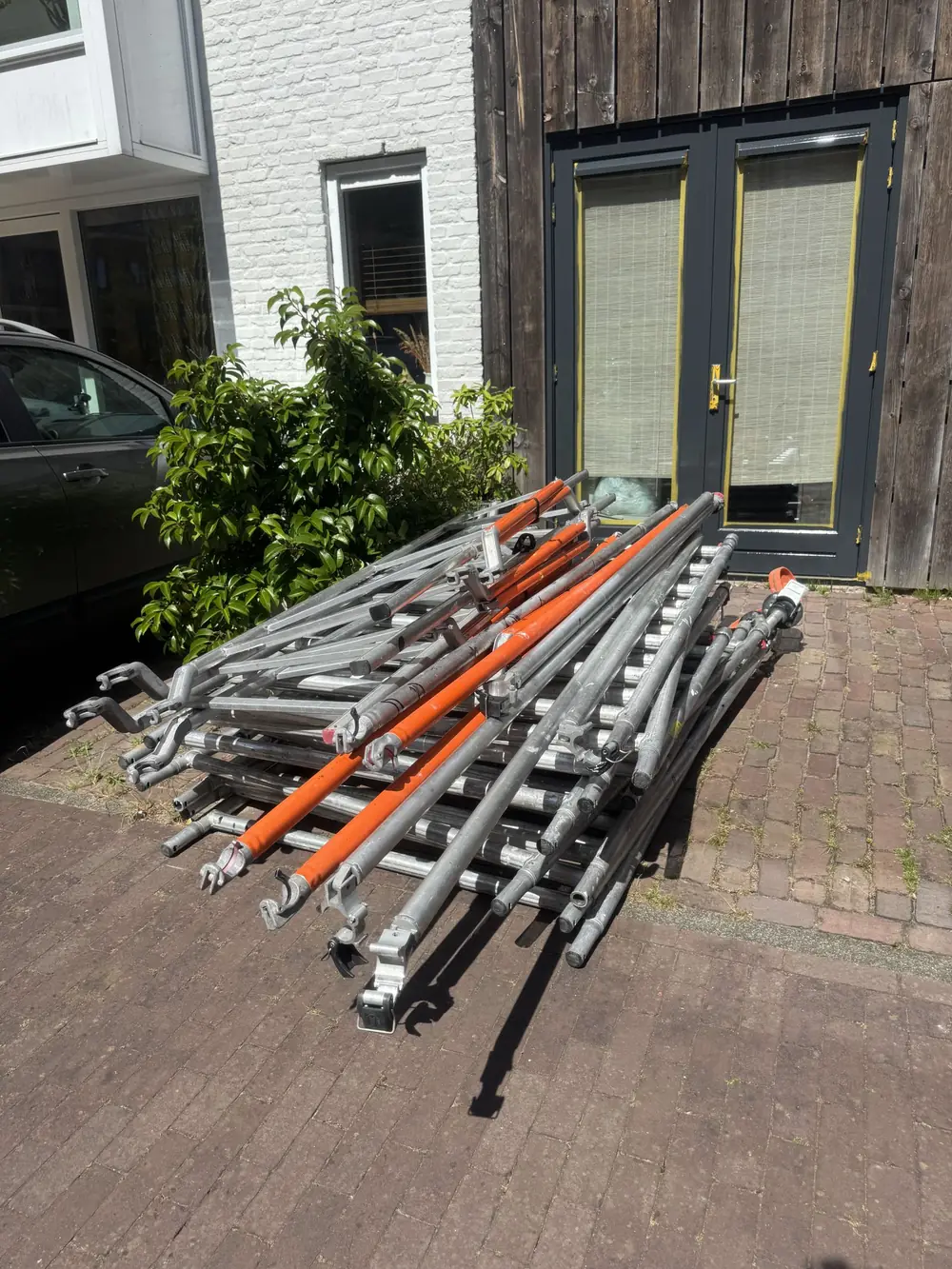
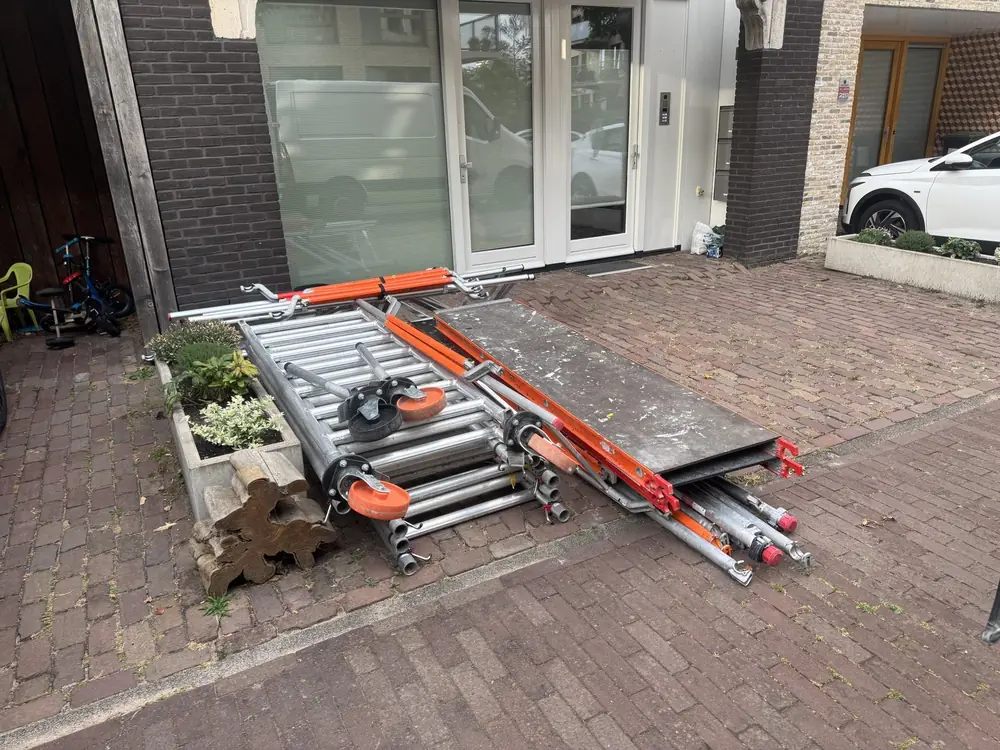
Delivered frames and braces on brick paving, parts of the narrow Altrex RS51 that manages on 75 cm of width

Only when two of you stand up there at once does the RS52 become interesting, the wide version of 135 cm, because then you want to lay the reinforcing layer in continuous bands. Against a free standing elevation with no narrow passage that is a fair trade. If your route to the back runs past a gate or a garden path, that wide tower will not even reach the wall. Weigh that against the time lost driving round, and compare the sizes calmly in the overview of scaffold dimensions.
Hiring a working height that reaches the top insulation board

The highest point of this job rarely lies where you expect it. You insulate up to where the last board ends, and that is usually a closing profile under the overhang or just below the gutter. So measure to that top edge and not to the tiles above it, or you reserve metres you will never use. Two storeys bring you to a working height of 6 to 8 metres, and that is the reach you state as soon as you hire the tower.

Working height and platform height are two different things. Your deck comes to lie at 4 to 6 metres and about two metres of reach is added to that, because the top row of boards gets pressed home with your arms above your head. The model itself carries on much further, up to 14.2 metres, but for this elevation you deliberately pick a lower build with fewer braces. The stand that goes with it is drawn out on the page about eight metres of working height.

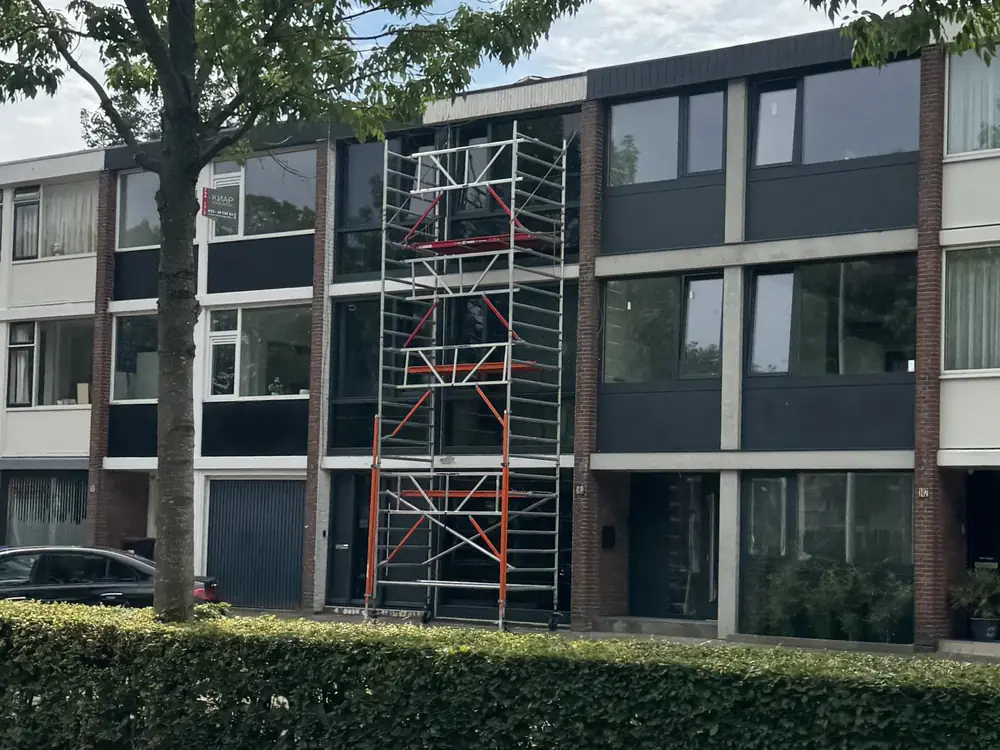
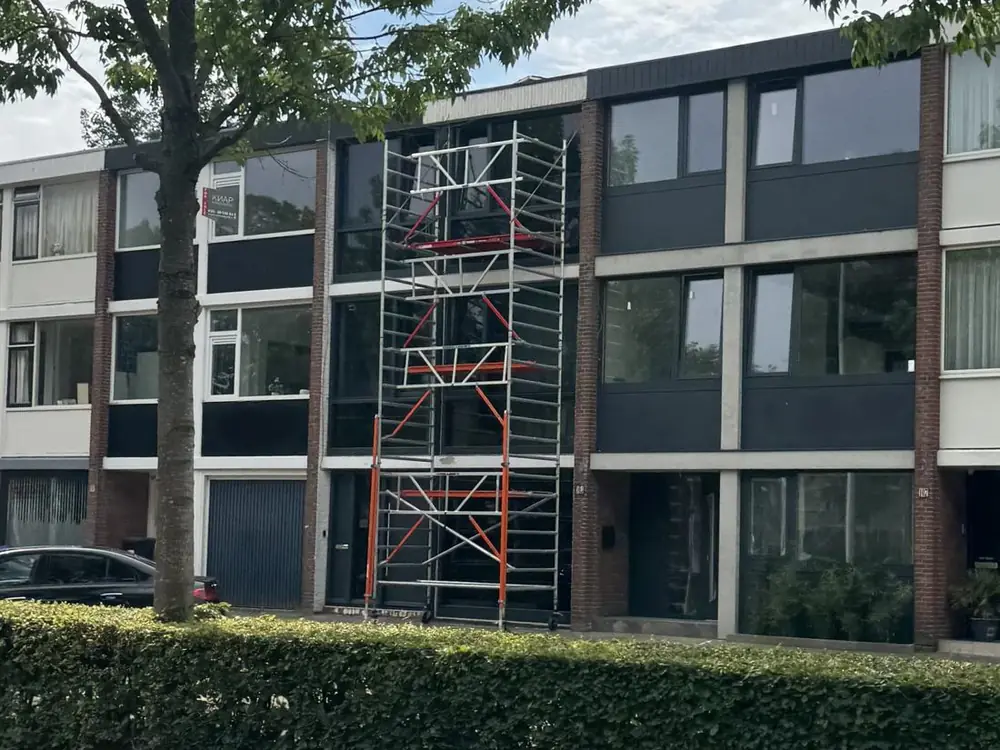
Built up mobile scaffold against a front elevation to just under the overhang, the reach insulation over two storeys asks

Choosing too tight punishes itself straight away here. Miss half a metre and you press the top board against the wall with arms outstretched, it sinks away in the wet adhesive and the whole row runs out of true. What once hangs wrong never comes out neatly again. So take the roomier build and rather keep half a metre in hand. What the different heights cost is on the prices page, and that difference nowhere near outweighs a row of boards you have to set a second time.

Where the hired mobile scaffold stands during insulation work

The foot of the tower gets plenty of company on this job. Beside the four stabilisers pointing outwards there is a tub of adhesive mortar, a stack of boards on edge and a lead running to the mixer. So make sure of a flat piece of ground that comes out considerably wider all round than the scaffold itself, and keep your line to the stack open so you can turn with a board under your arm without scraping past anything.

Judge the ground before delivery. Slabs, block paving and a driveway carry well; a border or a lawn that sinks after a shower does not, and here in particular the tower stays on the same spot for days on end. Look too at the step between terrace and garden and at drain covers along the wall. A slab tipping under a stabiliser only shows itself once you are standing with a board above your head. For uneven ground, the explanation of working on an uneven surface offers a workable answer.

Stabilisers set out at the base of a mobile scaffold, sharing ground during insulation work with tub and board stack

While you are applying, let the mobile scaffold rest against the elevation nowhere at all. Leaning pushes a freshly bonded board out of the plane, and you see that wave again later in the finish coat. Set it so that a hand's width stays between it and the wall, and only move it once the row below is set and checked. At an extension, a low addition or a shed against the wall your standing place gets pinched, so measure those corners out beforehand.

How many days to hire a tower for applying facade insulation

Applying facade insulation is not a one day job. You go along the same elevation in rounds: first the base profile with the bottom row, then the boards upwards in bond, then the plugs, next the reinforcing layer with its mesh and finally the finish. Every round asks for the same positions again, each time with different tools. For a front and a rear elevation on two storeys you are therefore soon at four to six rental days, reckoned on two people working steadily.

Within that period sit waits you cannot make up. The adhesive has to grab before you drill and plug, and the reinforcing mortar has to cure through before the finish coat may go on. Those times hang on your material and on the temperature, not on the diary you would rather keep to. If it freezes, or the rain drives against the wall, everything shifts a day. So count from the day the tower stands to the day you can take it apart dry.

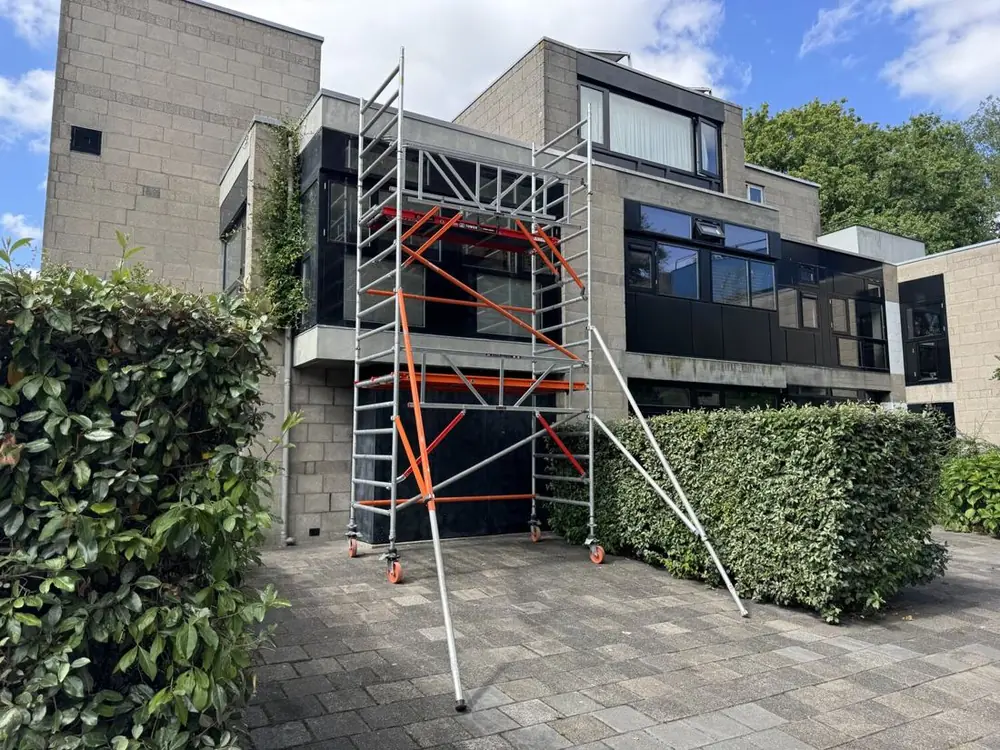
Mobile scaffold built up next to a house, the tower that stays in the same place for the whole insulation hire

The way the rate is built up rewards planning with room. The full rate covers only your opening 24 hours, and each rental day that follows has 95 per cent taken off it. A couple of spare days behind your planning therefore cost you almost nothing, while having to stop halfway through the reinforcing layer means doing that whole round again later, with a second build on top. To sharpen the estimate, the article on estimating rental days takes you further.

Which mobile scaffold suits applying facade insulation?

Kamersteiger RS44
  • Working height up to 4 metres
  • Compact and narrow
  • Great for indoor and small jobs
View and calculate →
Most chosen
Smalle rolsteiger RS51
  • Working height up to 14.2 metres
  • Narrow (75 cm)
  • Ideal for narrow passages
View and calculate →
Brede rolsteiger RS52
  • Working height up to 14.2 metres
  • Wide platform (135 cm)
  • Extra stability and workspace
View and calculate →
1-persoons steiger MiTower
  • Working height up to 6.2 metres
  • Very compact
  • Quick and easy to assemble
View and calculate →

Applying facade insulation from a platform of 245 cm

This page is about the execution: setting boards, bonding, plugging and getting the finish coat on. The preparation around it, so measuring up, judging the substrate and bringing in and storing the material, is on the page about installing facade insulation. That difference counts for your scaffold too: during the execution the tower stands still for long stretches and you work it off row by row, while the preparation is mostly walking, measuring and carrying and you shift the tower constantly.

Per position you have 245 cm of elevation in front of you, roughly four boards side by side. You finish that strip over the full height of your stand before you move, and you start at the bottom on the base profile, because every row rests on the one below while the adhesive has yet to grab. Only roll on once the boards in your plane are set and plugged, or the movement of the wheels will push exactly that one corner out of true.

Mobile scaffold built along a side elevation, with a platform wide enough to set about four insulation boards side by side

What you take up in one go decides how often you climb that ladder. Take the boards for one row, a bucket of adhesive, your float, a knife and the plugs with the drill, and leave the rest below until the moment comes. Most people misjudge the finish coat: it asks for one continuous movement across the whole face, so there you want fewer positions and longer sessions on each of them than when setting the boards themselves.

Hiring a tower for insulation work and getting it delivered

What gets dropped off at your address is a full set of loose parts, counted item by item. Decide in advance where that stack ends up, because the band along the wall is already taken by boards and mortar on insulation work. Rather lay them on the driveway than on the path you have to squeeze along with a board under your arm. Book on a working day and still before 15:00, and the set travels your way the following working day.

Delivery day and collection day are yours to mark, and on this job you tune them to the moment your insulation material is dropped off. Have the scaffold come a day before the boards: then you build in peace while the wall is still clear and you are not working over stacks. Building is done under your own steam, manual and instruction video within reach, and with two people that takes half a day. The order of work is in the step by step guide to building a tower.

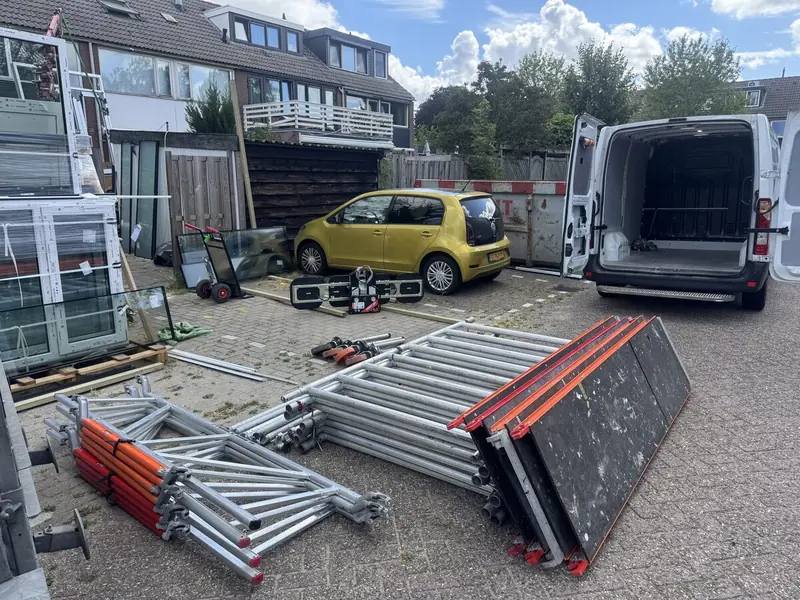
Scaffold parts counted out on the pavement beside a house, the set you put up before the insulation boards arrive

Collection is on us again. You dismantle the tower and lay the parts out complete where the van can get alongside. Wait with that until the finish coat is hard enough, because tubes brushing past fresh render leave traces you will not polish out. Simply count along while you take it apart, and then you know for certain that the set lies complete when the van pulls up. Which amount applies for fetching and bringing in your own province is in the overview of delivery charges per province.

Applying insulation safely from the hired tower at height

Our mobile scaffolds are built to EN 1004 and fall in load class 3. Translated to your working deck: two hundred kilos per square metre, and not a kilo more. On insulation work you come nearer to that than on painting, because boards weigh little but a full bucket of mixed mortar weighs plenty and with two of you it adds up quickly. So spread the weight over the deck and keep the greater part of your stock standing below. What that scaffold standard involves is explained briefly.

The ordinary rules hold undiminished as well. Brake the wheels before you climb on, never travel with a person or material aboard, and stop work as soon as it starts to blow hard. You reach that limit sooner here than on other work at a wall, because an insulation board of any size catches the wind like a sail and gets pulled straight out of your hands. After every move, look at all four stabilisers once more and make sure each of them presses firmly on the ground.

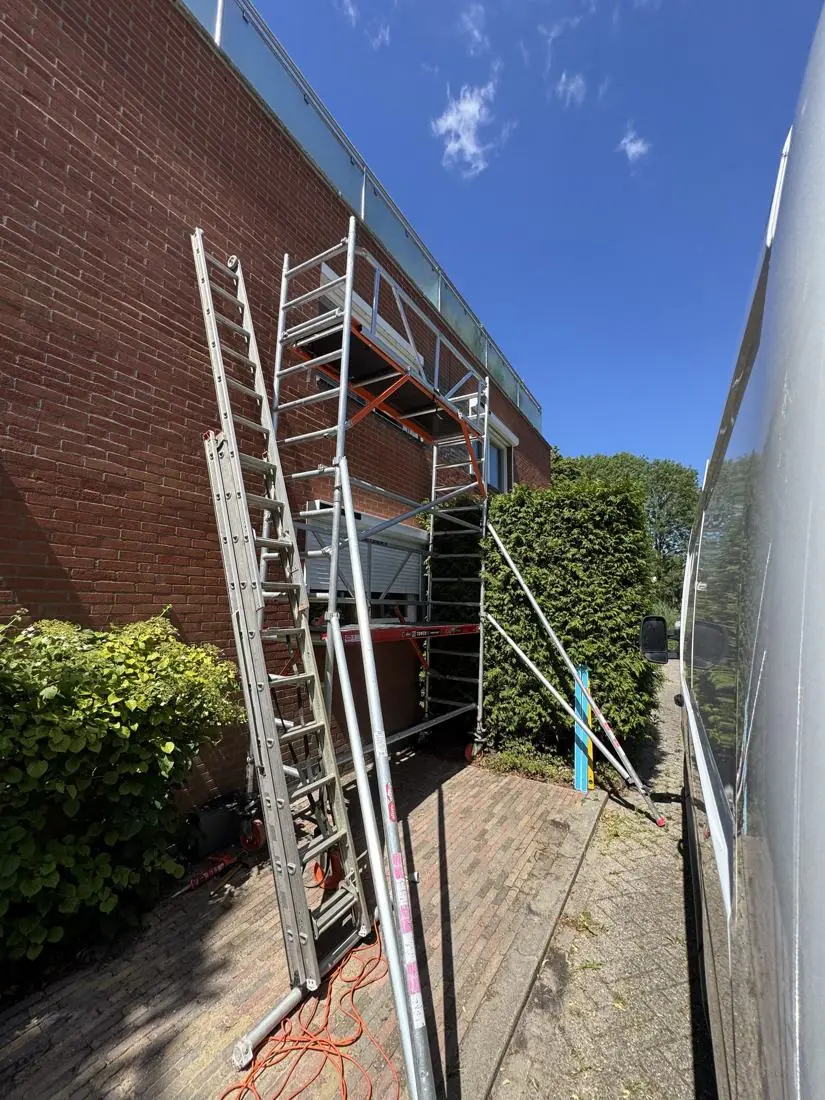
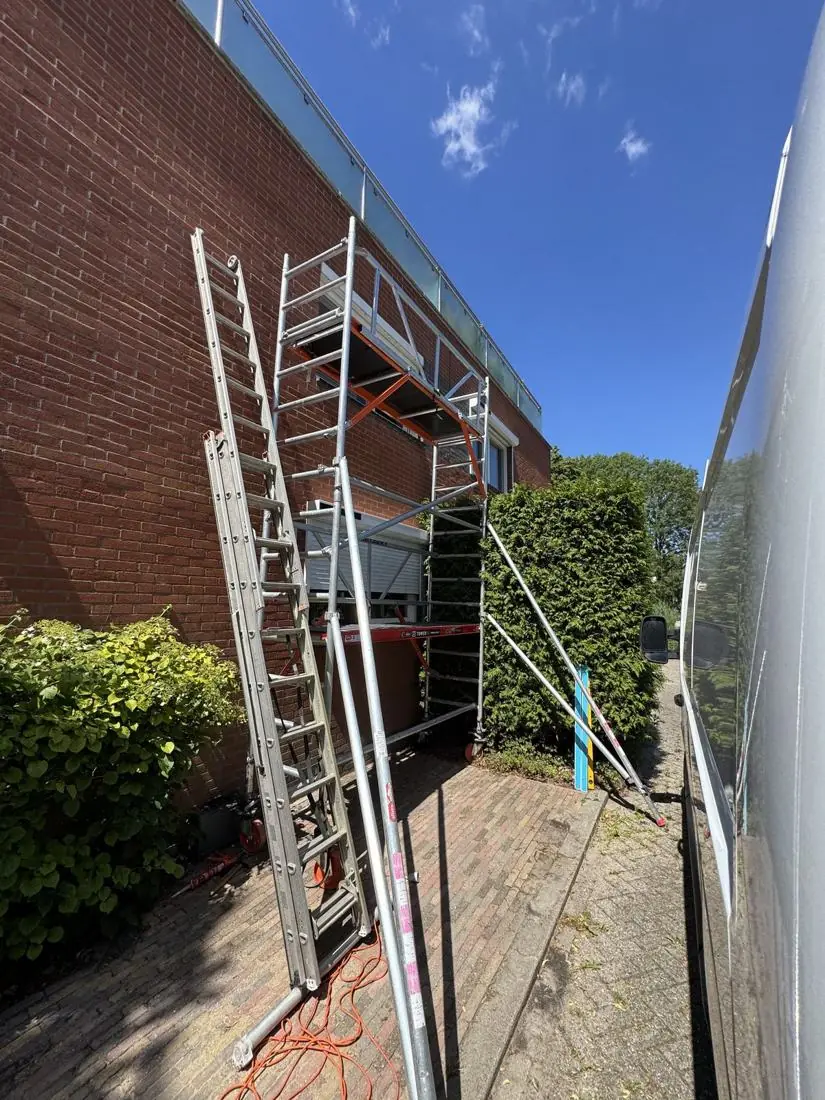
Mobile scaffold erected in a narrow gap by a brick wall, a separate ladder beside it, deck rated to load class 3

The hazard that really belongs to this job is everything that can go down. Offcuts, a float, a drill on a short lanyard: keep the strip under the deck empty and do not work above a footway without a barrier. Mortar left lying on the platform turns treacherous the moment it gets wet, so scrape your deck clean at the end of every day. Stand your tools on the deck against the guard rail rather than on the edge. The full rules are at working safely at height.

In 5 steps

How hiring a mobile scaffold works

1
Choose working height

Pick the height that suits your job.

2
Book online

Sorted in 60 seconds, price shown instantly.

3
We deliver

At the agreed spot the next working day.

4
Assemble safely

Assembled by you, with a manual.

5
We collect

One call and we collect the scaffold.

Good to know

Practical tips for applying facade insulation

1

Measure the thickness of your insulation package before the tower goes up and count the finish coat in. Those few centimetres decide whether the mobile scaffold will still pass the corner of the house.

2

Mix no more mortar than you can use within one position. A half full tub standing and stiffening costs you more time than one extra trip down to mix a fresh batch.

3

Only plug once the complete row of boards for your stand is set. Drill in between and the board next to it shakes loose from the wet adhesive and the bond runs out of line.

4

Lay clean cardboard on the deck before you start with mortar. Caked material turns treacherously slippery in the first shower and gives you needless bother on the day you hand back.

5

Chalk off where the wheels come for each position. During the reinforcing round and the finish you roll the tower back to exactly that mark and your bands line up again.

6

Put your collection date at least a day behind the last finish coat. Then a morning is left to dismantle and count without steering tubes past render that is still soft.

Frequently asked questions

Frequently asked questions about applying facade insulation

Which mobile scaffold should I hire for applying facade insulation?+

On two storeys the RS51 is the logical pick: 75 cm wide, so it still passes a gate or a garden path, even after the insulation package has thickened the wall. If two of you stand up there at once and you want the finish coat in continuous bands, the wider RS52 of 135 cm is worth hiring instead. In both cases, walk your route first and measure the narrowest point along it.

How does hiring a mobile scaffold for insulation work from start to finish?+

Reserving is done online: you hire a mobile scaffold by model and height, mark your own delivery and collection dates and pay a fixed amount in advance with the VAT already in it. We drop the set off counted; building it and working the rounds along the wall are yours. On your last day you hand it back dismantled and complete and we take it away. Only the timing with your board delivery is delicate, because both loads want the same square metres of driveway.

How many days do I need to rent a tower to apply facade insulation?+

For two elevations on two storeys you come out at four to six days of scaffold hire. Setting and bonding go briskly, but plugging, reinforcing and finishing are three further rounds over the same metres, with drying time in between. Keep to one end wall or a single storey and it may be shorter. Either way, plan a spare day for cold or rain, because those days fall out more often on insulation work than expected.

What does the rental price come to from the second day onwards?+

Two things settle it: which model you take and to what height you build it. On top of that comes bringing and collecting, a fixed amount that differs per province. You see all the tariffs with VAT included on the page of rates. For insulation that structure works out nicely: your first day weighs heavily, every day after it hardly at all. One continuous period of scaffold hire is therefore cheaper than two separate blocks close together.

What working height do I hire if the insulation runs under the overhang?+

Then the top of your last board is the measuring point, not the roof edge above it. Two storeys yield a reach of 6 to 8 metres, with the deck somewhere between four and six metres. Measure from the level your wheels will rest on, because a sloping driveway easily accounts for half a metre. Which build suits which tower you will find in the overview of working heights while you are still choosing.

Is the tower delivered, or can I collect it myself when I hire?+

That is yours to settle. Choose delivery and the mobile scaffold stands ready on your own date, and we come for it after your last working day, at the rate that applies for your province. Would you rather drive yourself, then you load by arrangement at no extra charge at our Amsterdam premises on Zeeburgerpad, as long as your van or trailer pulls that load. On insulation jobs most people still opt for delivery, because the driveway is already full of boards.

Does the hired mobile scaffold arrive built up, or do I do that myself?+

The latter. We deliver the tower complete and take it back afterwards, but building, moving and dismantling stay with you, with only the manual and the instruction video as help. Two people are occupied with that for half a day, so count that time in and do not start bonding the same morning. Facade scaffolds, system scaffolds and cherry pickers lie outside what we hire out, so for this wall the mobile tower is the answer.

What if the finish coat overruns and I need to rent extra days?+

Report it in good time and we push your collection day back, unless that particular tower is already fixed for someone else in the diary. Insulation work overruns more often than average, because reinforcing and finishing both hang on temperature and drying time. Anyone wanting to cover that risk books an extra day straight away: you set your own end date and handing back early is always allowed. You only settle for the days you truly needed.

How much room along the wall must I keep free when I hire a tower?+

Add the width of the scaffold to the spread of the stabilisers on both sides, and set aside a strip beyond that for your board stack and your mortar tub. In practice you want a few metres of flat, clear ground along the whole elevation. Take away water butts, planters and bikes before the mobile scaffold arrives; shifting them midway costs you an hour, and that is exactly the time your mixed mortar was still workable.

Can the hire carry on if it turns too cold to bond boards?+

The tower may quietly stay standing; only your work shifts. Adhesive and mortar ask a minimum temperature, and in the early morning you sometimes fail to reach it for days together. Use such a day to measure, to cut, to set profiles true or to sheet your stack, and pick the thread up as soon as it clears. Because you determine the end date, that delay costs you at most one extra day and the stand can remain.

Do I get the deposit back if there is mortar on the scaffold parts?+

Once the returned set has been counted through, your deposit is on its way back inside a single working day. Dried material on tubes and platforms weighs as heavily as a missing brace, so wipe spilt mortar off before it hardens. A sheet of cardboard on the platform of the tower and a bucket of water within reach save you half an hour of scrubbing on collection day. Further details are in the explanation about the deposit.

Can I take the finish coat in the same hire without booking again?+

That is exactly the intention. Because every extra day weighs so lightly, you best book the tower as one continuous period, from the first base profile through to the last finish coat. Hiring twice means building twice, measuring out twice, dismantling twice and two separate runs of the van to your address. If you want a render coat on the wall after that, count those days straight into the same reservation.

Hire a mobile scaffold for applying facade insulation today?

Calculate your rental price now or ask for free advice.

Rolsteiger van SteigerTaxi geleverd op locatie
Book it online

Your scaffold sorted in 2 minutes.

Choose your scaffold and working height, see the price instantly and book online.