
See your price
Application

Installing facade insulation? Choose the right scaffold.

Installing facade insulation starts well before the first board goes against the wall. You measure the elevation up, you judge whether the brickwork is dry and sound enough to carry the system, and you see to it that the boards stand dry on the plot. For that preparation on a house of two storeys you book an RS51 of 75 cm, built to 6 to 8 metres. Below you read where that tower stands, how many days you hire it and why it has to sit further off the brickwork than you are used to.

  • Order before 3 pm, delivered tomorrow
  • Professional Altrex scaffolds
  • Up to 14.2 metres working height
  • Easy to assemble yourself
4,2 tot 14,2 mWorking heights available
12Provinces served
7Days a week
200 kg/m²Load class 3
In short
  • For installing facade insulation we recommend the Narrow mobile scaffold.
  • For the preparation on two storeys you book a narrow RS51 of 75 cm, built up to 8 metres of reach.
  • Add the thickness of the whole system, because those centimetres end up between your hired tower and the bare wall.
  • This page covers the preparation; setting and bonding the boards is described on the page about applying facade insulation.
  • First 24 hours from €150 incl. VAT and delivery; every day after that 95% off.
Key facts for this job
FeatureValue
Recommended scaffoldNarrow mobile scaffold (Altrex RS TOWER 51)
Working height for this job6 to 8 metres
Available working heights4.2 to 14.2 metres
StandardEN 1004, load class 3 (200 kg per m²)
DeliveryOrdered before 3 pm, delivered next working day
Each extra day95% off, from €7.50 a day
Why a mobile scaffold for installing facade insulation?

Safe, stable and professional work at height

Before a single board goes up, you have to have seen the whole elevation from close to. Where is there cement haze, where is old paint flaking, where is the brickwork still damp, and does the dimension you copied off the drawing actually hold. You do not judge that from the pavement, and certainly not hanging off a ladder, because you need a tape, a moisture meter and a free hand and you have to shuffle sideways. On top of that, this phase settles your order: how many boards, what length of profile, where do you put it all. Hiring a scaffold for facade insulation is needed in the preparation already, not only on the day the adhesive gets mixed.

  • Measuring up and judging the substrate close to
  • A tower built to 6 to 8 metres of reach
  • Boards brought in dry and stored on the plot
  • Room between tower and wall for the system thickness
Read more about working safely →

Which mobile scaffold to hire for installing insulation on two storeys

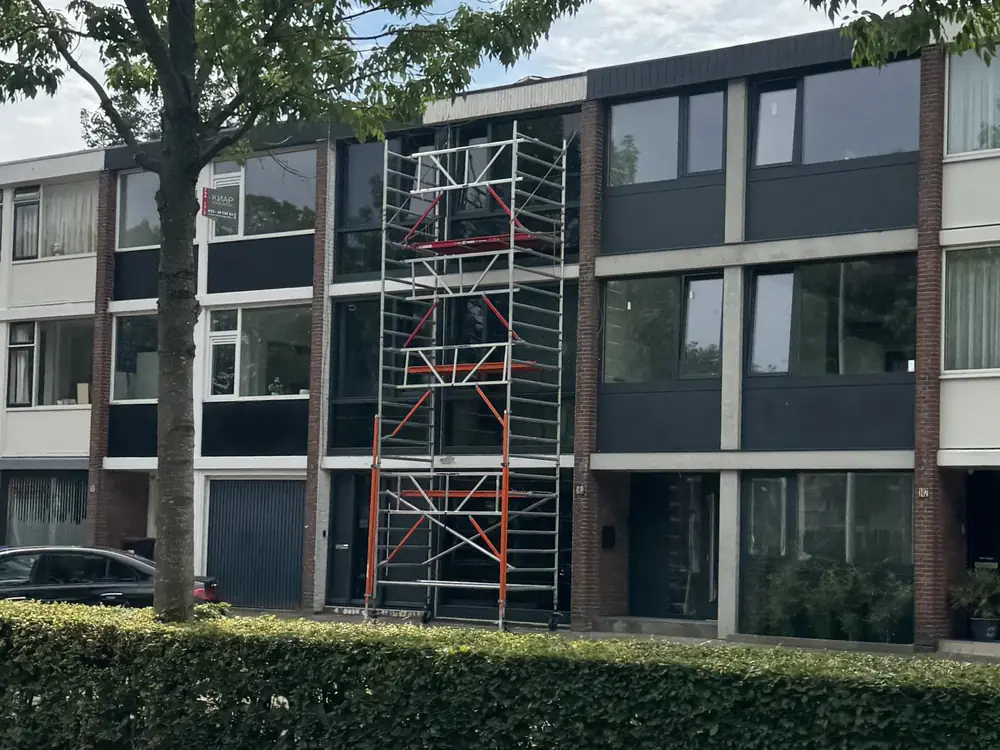
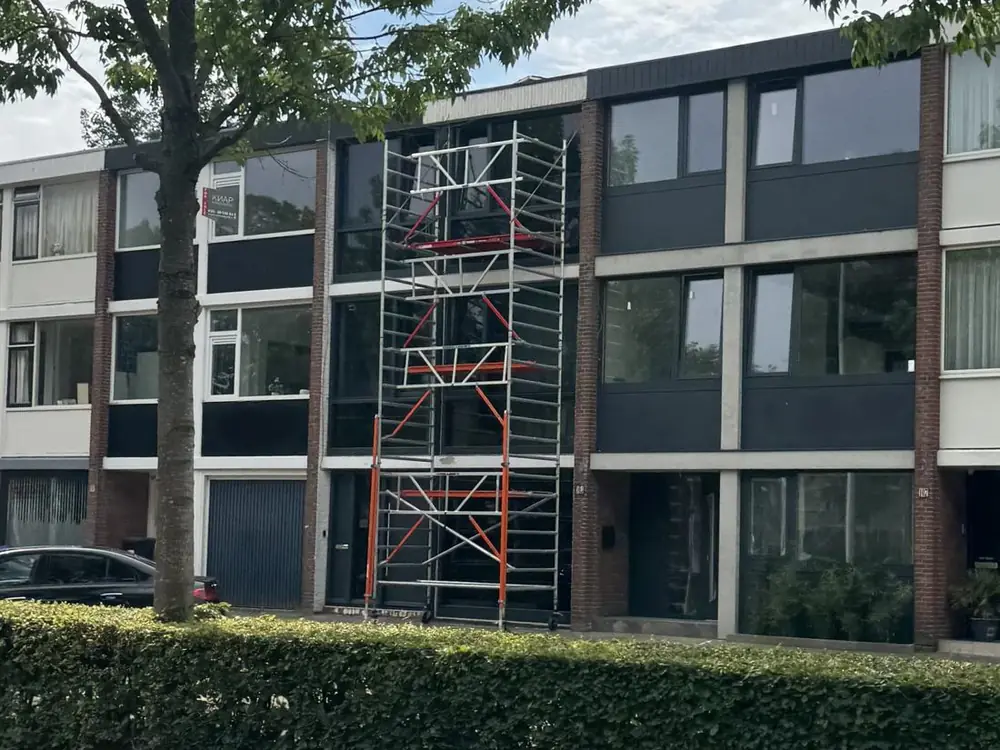
For the preparation on a house of two storeys the choice points at the Altrex RS51, a tower that manages on 75 cm across the width. In this phase you hang about nowhere for long but walk the whole elevation, so you reposition far more often than during the execution. A narrow tower you wheel round a corner, past a downpipe and through a gate on your own, without emptying the garden path. All the available models stand beside one another on the hire page with mobile scaffolds.

What goes up in this phase weighs nothing: a tape, a moisture meter, some line chalk, a brush to open up test patches and a pad to write your dimensions on. You need no wide deck for that. The length of 245 cm counts for more here, because it says how many running metres of elevation you measure and mark out per position. Fewer positions means a shorter measuring round and therefore a shorter period of hire.
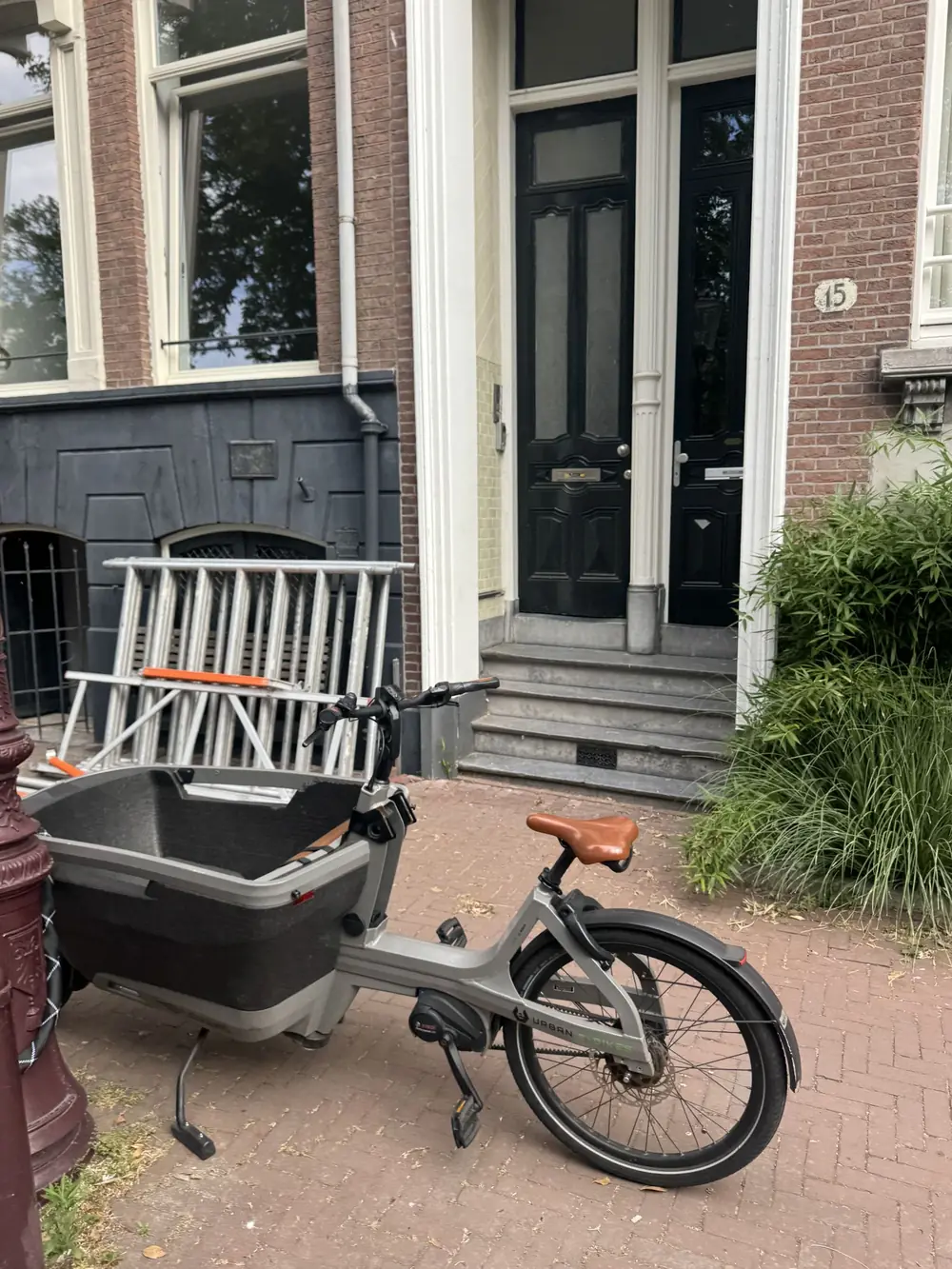
Guard rail frames by a house entrance with a cargo bike beside them, kit for a tower just 75 cm across

The wide RS52 of 135 cm only becomes interesting when preparation and execution fall inside the same rental period and the two of you want to stand up there together. If your route to the rear elevation runs along a narrow path, that width simply will not go through. Setting, bonding and plugging the boards themselves get their own explanation on the page about applying facade insulation; this page is about everything that comes before it.
Hiring a working height for measuring up before you order

Your highest point lies at the top edge of the future insulated face, where the closing profile will come under the overhang or just below the gutter. Measure towards that point and not to the ridge above it, because every metre you reserve too much means frames you have to lift up yourself. Two storeys bring you out at a reach of 6 to 8 metres, which is the figure you fix your build with. If you are in doubt, take the roomier build.

Keep the difference between your deck and your reach clearly apart. The deck will hang between four and six metres; what you pick up above it is roughly 2 metres of reach, because even while measuring you stretch an arm along the top edge. Note this too: as a model the RS51 runs to 14.2 metres, but that is what the structure takes, not what turns up on your plot. For this elevation you order a low build on purpose, drawn out at seven metres of working height.

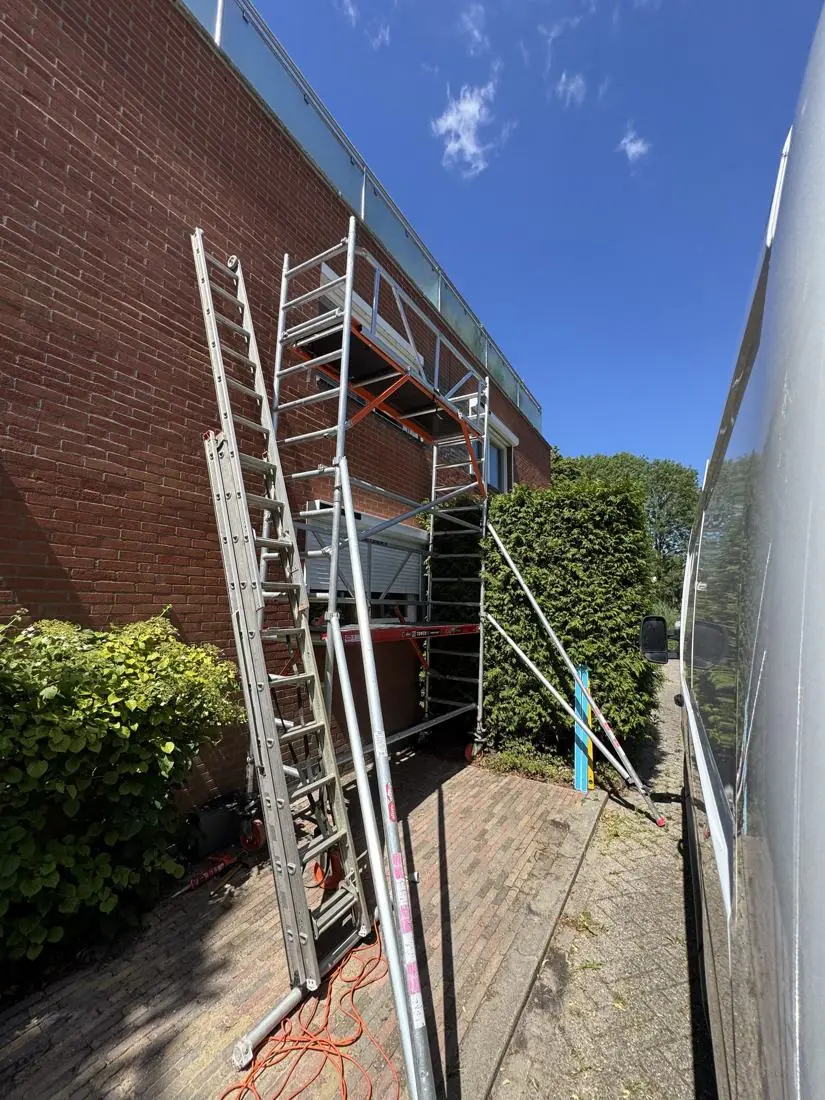
Mobile scaffold built along a side elevation to under the overhang, the reach hired for measuring up facade insulation

Choose too tight and you miss exactly the band where most of the questions sit. The junction with the overhang, the projection of existing sills and the spot where the roof edge has to be extended together settle your materials list. If you cannot get to it you guess those dimensions from the grass, and that shows up later in a second order costing a day. Start your measurement at wheel level as well, because a driveway that falls away shifts your zero point by half a metre.

Hiring a tower and standing it back from the wall

Here is where this differs from almost every other job at an elevation. Normally you push the tower as tight against the brickwork as it will go, but with insulation work that wall grows towards you while you stand next to it. Add up the board thickness, the adhesive bed, the reinforcement and the finish, and keep that dimension plus a workable hand's width open between your uprights and the wall. Set it at that distance straight away and no position has to be lined up again later.

Vetting the ground belongs to the work at this stage just as much. Walk the strip along the wall and watch for slabs that rock, the edge where a border begins and hollows where water stands after rain. All four stabilisers splay outwards and each of them wants to land on firm ground, including on the spot where pallets will shortly lie. If the ground does not run level, the article on anchoring and stabilising offers a workable answer.

Stabilisers folded out on paving under a hired tower, the firm ground you check along the wall in advance

Finally, walk round the obstacles you only notice once they are in the way. Think of an outside tap, a gas meter box, a shed door that opens outwards or a grating no foot may rest on. Note per side of the house where the tower can and cannot come, because that settles the order in which you tackle the elevations. You would rather decide that order now than on the morning the lorry with boards pulls up.

How many rental days this preparation takes on a mobile scaffold

Measuring and judging two elevations takes about a day with two of you; bringing in the material and putting it away asks another half. Even so, almost nobody reserves a separate period for it. You simply leave the tower standing and carry on into the execution, because building twice and two runs of the van cost more than the days that would sit between. So work from one continuous booking that starts on your measuring day and ends only after the finish coat.

The preparation has its waiting moments too, only of another kind. An elevation that has just been rained on must dry out before you can judge the bond, and the board delivery arrives on the date the supplier names rather than the date that suits you. If it freezes, setting out the base profile shifts anyway. So count your rental days from the moment the tower is standing up to and including the morning you take it apart.

Built up mobile scaffold left standing beside a house, as during one unbroken period of preparation and execution

The way the rental price is built up makes generous planning cheap. Only the opening period of 24 hours is charged at the whole amount; on every day you stick behind it, 95 per cent of that rate falls away. A couple of spare days behind your measuring week cost you next to nothing. Reserve too tightly and you watch the van come for the tower with an incomplete list of dimensions, and the building starts afresh weeks later. The article on estimating rental days helps you sharpen it.

Which mobile scaffold suits installing facade insulation?

Kamersteiger RS44
  • Working height up to 4 metres
  • Compact and narrow
  • Great for indoor and small jobs
View and calculate →
Most chosen
Smalle rolsteiger RS51
  • Working height up to 14.2 metres
  • Narrow (75 cm)
  • Ideal for narrow passages
View and calculate →
Brede rolsteiger RS52
  • Working height up to 14.2 metres
  • Wide platform (135 cm)
  • Extra stability and workspace
View and calculate →
1-persoons steiger MiTower
  • Working height up to 6.2 metres
  • Very compact
  • Quick and easy to assemble
View and calculate →

Installing facade insulation: preparing 245 cm per position

Per position you look at 245 cm of elevation, and in the preparation you finish that strip completely before you move on. Tap the brickwork for hollow spots, measure the projection of frames and sills, check whether anchors from old cladding are still in there and write down per strip what has to come out. Whatever you skip now you meet again with a board under your arm and adhesive already pulling, and then that position is lost to you.

Your order runs from the bottom upwards, even though you are not bonding yet. Begin at the line of the base profile, because whether all the rows above it come out level hangs on that, and only climb a position higher once that line is right the whole way round the house. Work the other way about and you are correcting at the bottom what you already fixed at the top. So walk the complete bottom edge round first, including the end wall where nobody goes.

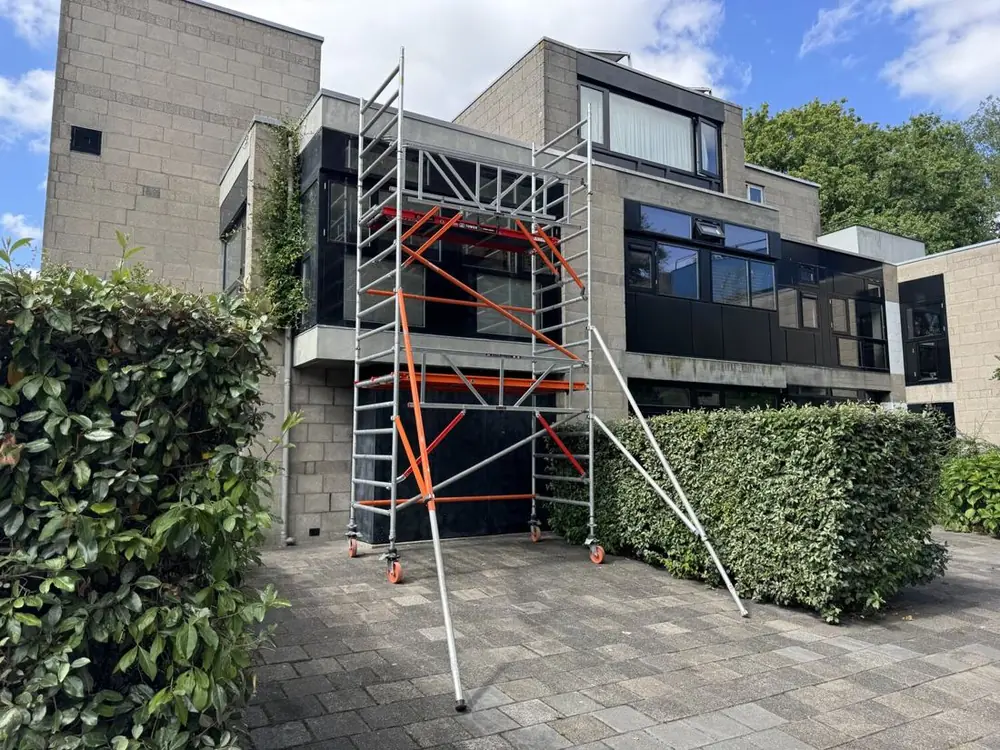
Mobile scaffold with its platform at height against a front elevation, the stand you judge the substrate from strip by strip

What you carry up in one go decides how often you go up and down the ladder inside the tower. Take your measuring kit, tape, a marker and a note pad together and leave the rest below. The number of positions is routinely underestimated here: eight metres of elevation is already three to four of them, and on a corner house the side wall comes on top. Count them beforehand, because they set both the length of your measuring day and your number of days on hire.

Hiring a mobile scaffold delivered before the insulation boards arrive

A complete set of loose parts turns up on your plot, counted item by item on the docket. Point out beforehand where that stack is going, and keep clear the place you had in mind for the pallets, because the scaffold set and the boards compete for one corner of the driveway. Anything that comes in on a working day before 15:00 goes out again the next working day. The date for bringing and the date for fetching you fill in yourself when you reserve, so you can lay them around your board delivery.

Let the tower arrive at least a day before the boards. Then you build in peace while the plot is still empty, you can measure up that same afternoon, and you see exactly where the pallets will be able to stand dry. Putting it together remains your job: the set arrives with a manual and a video runs through the sequence, and two people are busy for half a day. The succession of parts is set out in the step by step guide for building up.

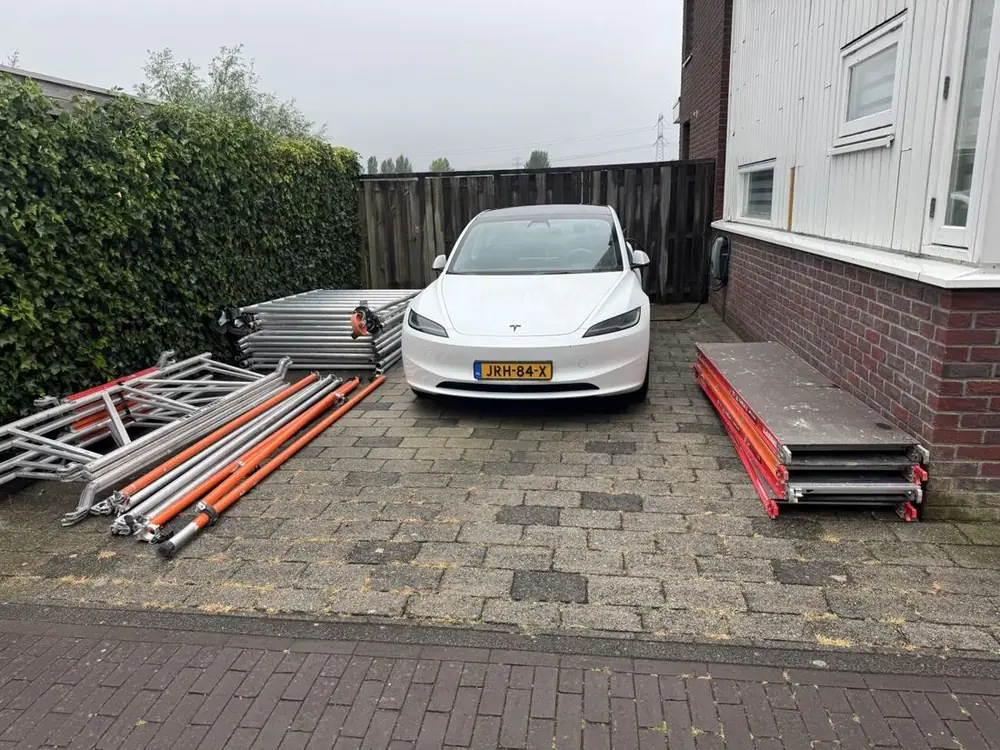
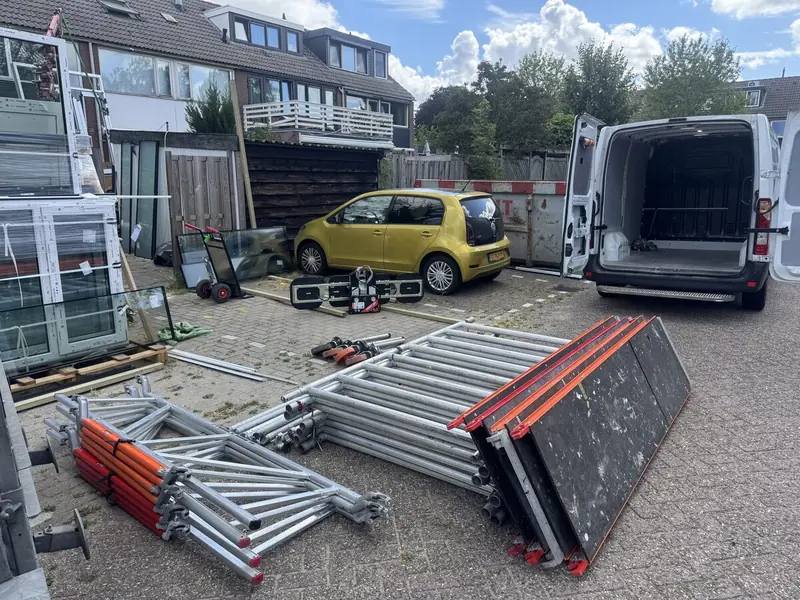
Scaffold parts delivered on location at a house, the set you build up before the insulation material is dropped off

Storing the material dry is half the job here. Insulation boards that have got wet will not bond, so stand them on pallets, sheet them past the bottom edge and put them out of the wind behind the tower rather than beside it. Dismantling is yours, taking away is ours: lay the parts down complete where the van can reach. The amount that applies for the run in your own province is stated at the delivery charges per province, so you can take it into your budget at once.

Working safely at height while installing facade insulation

The deck you stand on may carry two hundred kilos per square metre, load class 3 within EN 1004. During this preparation the temptation is strong to lay a few bundles of boards up there in advance so you do not have to keep passing them up. Leave that alone: a bundle like that does not weigh much but claims the whole deck, and together with two people and tools you approach the limit sooner than expected. More on that is in the explanation of loading and weight.

Because you move about so much at this stage, the fixed rules come up more often here than on other work at an elevation. Brake the wheels the moment you climb on, never wheel the tower with a person or loose items aboard, and fold all four stabilisers firmly out again after every move. If the wind gets up, put the work down: a sheet over the board stack and a loose roll of film on the deck are neither of them things you can master one handed.

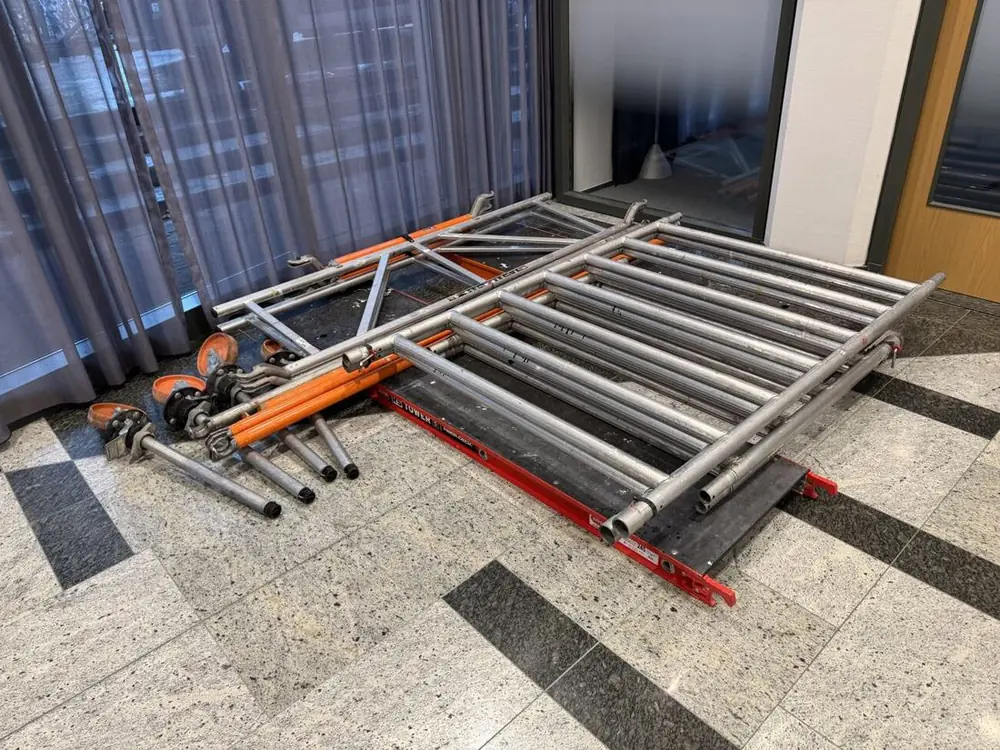
Complete inspected set of scaffold parts standing ready, the basis for working safely at height on the elevation

The hazard that really suits this phase lies on the ground. Pallets, sheeting, offcuts and an extension lead all end up around the foot, and that is precisely where you step off with a tape in your hand. Keep the strip under the platform empty, run leads along the wall instead of across your walking line, and hang your measuring kit on a loop rather than laying it on the edge. The complete rules are at working safely at height.

In 5 steps

How hiring a mobile scaffold works

1
Choose working height

Pick the height that suits your job.

2
Book online

Sorted in 60 seconds, price shown instantly.

3
We deliver

At the agreed spot the next working day.

4
Assemble safely

Assembled by you, with a manual.

5
We collect

One call and we collect the scaffold.

Good to know

Practical tips for installing facade insulation

1

Walk the elevation at eye level first and stick a piece of tape on every loose joint and every soft spot. From the platform you pick those markings up again and do not have to search twice.

2

Only order your insulation boards once the tower has been built. Then you see with your own eyes where the pallets can stand without blocking your walking line to the foot of it.

3

Stand the boards on pallets and sheet them down to below the bottom edge. A pack that has stood a night in the rain will not bond and leaves your hired tower waiting for nothing.

4

Mark off the level line for the base profile on the day you build. That one line settles whether every row above it is true, and you have the tower standing there anyway.

5

Photograph every side of the house from the platform before a board hangs. On those images you count the window junctions afterwards without having to go up for them again.

6

Note per position how many boards you can fit and add that up to a whole elevation. That way you order no half pack short and need no extra day because of a follow up delivery.

Frequently asked questions

Frequently asked questions about installing facade insulation

Which mobile scaffold should I hire for installing facade insulation?+

On a house with two storeys the RS51, only 75 cm across, is the obvious choice. In the preparatory phase you walk the complete elevation with measuring kit, so you move the tower often and you want one that gets round a corner and past a downpipe. If the two of you do the preparation together, the wider RS52 of 135 cm is worth considering. Either way, measure your narrowest passage to the back first.

How does hiring a mobile scaffold for this preparation work end to end?+

You reserve online on model and reach. You mark a delivery date and a collection date yourself and pay a fixed amount up front, VAT included. We drive the parts out to you; building up and measuring the elevation are yours after that. Then you leave the tower standing for the execution and set it out dismantled and complete on your final day. Only tuning it with your board delivery really needs attention, because those two loads want the same room.

How many days do I hire the tower for measuring up and delivery?+

Measuring and assessing two elevations fills roughly a working day, and bringing the material in and stowing it dry adds half a day to that. In practice you do not book those days separately but stick them in front of your execution period, so the mobile scaffold stays standing and you only build once. If you are only measuring because a contractor does the rest, two days of hire is ample for the whole house.

Is it worth hiring for preparation and execution in one go?+

Yes, and that comes from the way the tariff is put together. Your first day weighs heavily and every day after it barely at all, so one continuous period works out lower than two separate blocks close behind each other. On top of that it saves you a second build, a second lining up and an extra run of the van. What it costs to hire a mobile scaffold per model and per reach stands with VAT on the page of rates.

What working height do I hire if the elevation still has to be measured?+

Take the top edge of the future insulated face as your aiming point, so the place where the closing profile will sit. On two storeys a reach of 6 to 8 metres goes with that, with the deck of your tower coming out between four and six metres. Begin your measurement down at the wheels, because a sunken terrace or a rising path changes that figure at once. Which build belongs to which model is in the overview of working heights.

Is the tower brought to me, or do I collect it myself when I hire?+

You decide that one yourself. Choose delivery and the mobile scaffold is on the plot on your date, and we come to take it away after your final day, for a fixed amount that depends on your province. Prefer your own transport and you load by arrangement at no charge at our place in Amsterdam, on Zeeburgerpad, provided your trailer pulls that load. With insulation work most people have it brought, simply because the plot fills up with building materials and pallets.

Do you put it up, or is that part of hiring a mobile scaffold?+

Building falls under your part of the job. We deliver the tower and fetch it again afterwards, while putting it up, moving it and taking it apart happen under your own steam, with the supplied instructions and an instruction video to hand. Two people are at it for half a day, so count those hours in and only plan your measuring round for the afternoon. Nothing in our range covers system scaffolds, facade scaffolding or a cherry picker.

What if measuring up runs over and I want to rent the tower longer?+

Say so in good time and your collection day shifts, as long as that tower is not already reserved for a following customer. In this preparation things run over regularly, because only from above do you see how much rotten timber or loose pointing there really is. Anyone wanting to cover that risk puts an extra day on the end straight away: the end date is yours, and handing back early is allowed. You settle for the days you truly used.

How much space do I keep free for the tower and the board stack?+

Work from the width of the mobile scaffold, add the room for the four splayed supports and then set aside a dry, flat spot for the pallets with boards and profiles. In practice you want a strip a few metres wide entirely clear along every side of the house. Move bikes, planters and the water butt away before the load arrives, because shifting them midway costs an hour you would rather spend measuring. Count a walkway to your cutting spot in as well.

Can I keep the tower on hire when it is too wet to assess?+

The tower may stay standing; only your assessment shifts. A soaked wall gives a distorted picture of the bond and of the moisture content, so you wait for a dry day for that. Use such a day to count, to order, to have profiles cut to size or to set up your storage spot. Because the end date lies in your hands, that delay costs you one extra day at most and you need dismantle nothing.

When is the deposit back after I have returned the mobile scaffold?+

You settle a deposit when you reserve, and we transfer that amount back to you within one working day of the return run, as soon as the set has been counted. In this preparation, mind two things: hand in every part you received, and leave no adhesive residue or cement haze on the tubes. Simply count along while you take the tower apart, and nothing stays behind under a pallet or a piece of sheeting.

What is the difference between installing and applying facade insulation?+

This page holds the preparation: measuring up, judging the substrate, bringing material in and storing it dry, settling the standing place and fixing the order from bottom to top. Setting the boards, the bonding, the plugging and the finish coat are described on the page that deals with applying the insulation boards. For your hire that distinction counts: in the preparation you move the tower constantly, while during the execution it stands in one place for days until a whole band is done.

Hire a mobile scaffold for installing facade insulation today?

Calculate your rental price now or ask for free advice.

Rolsteiger van SteigerTaxi geleverd op locatie
Book it online

Your scaffold sorted in 2 minutes.

Choose your scaffold and working height, see the price instantly and book online.